−10%
Easy
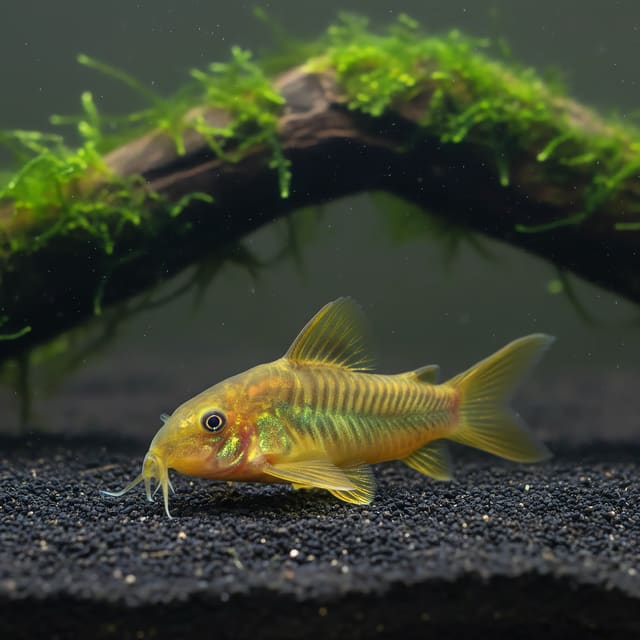
Bronze Corydoras, Bronze Cory Catfish (Corydoras aeneus)
22–26°C · pH 6–7.5 · 60L
£3.59£3.99
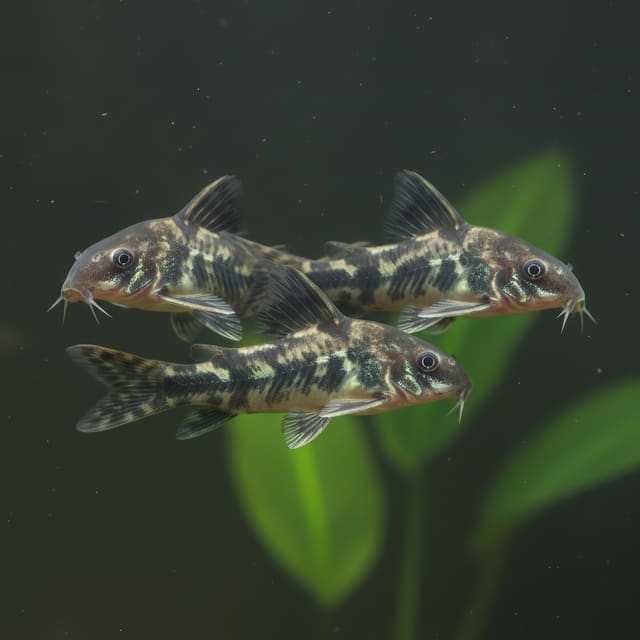
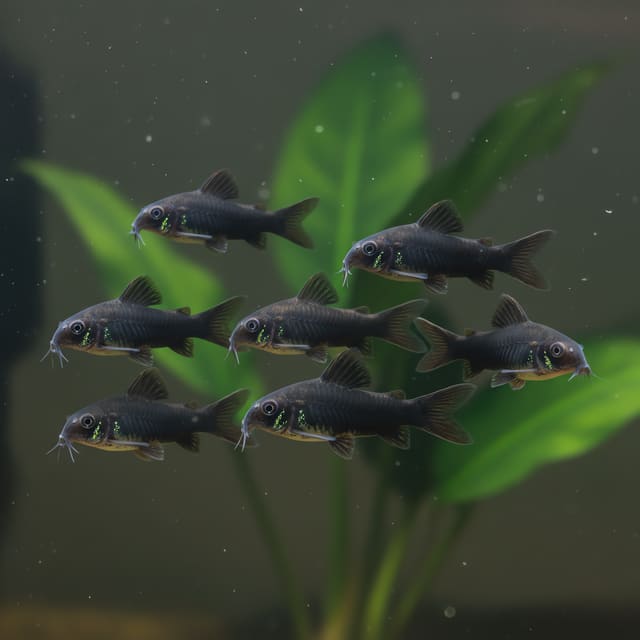
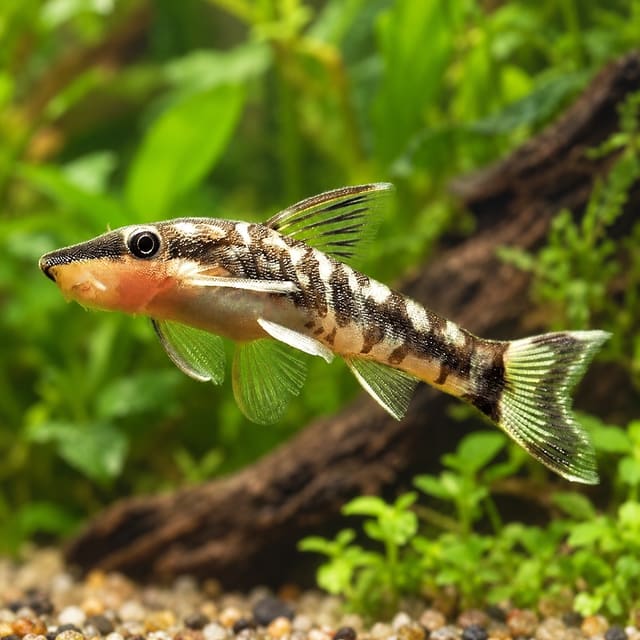
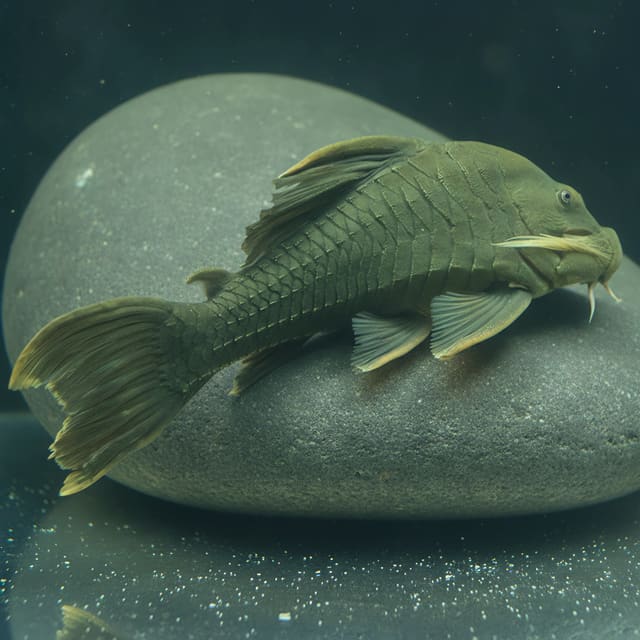
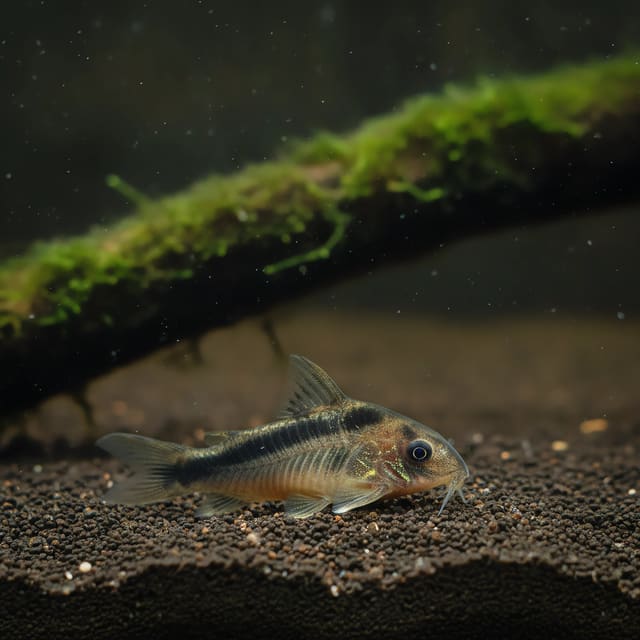
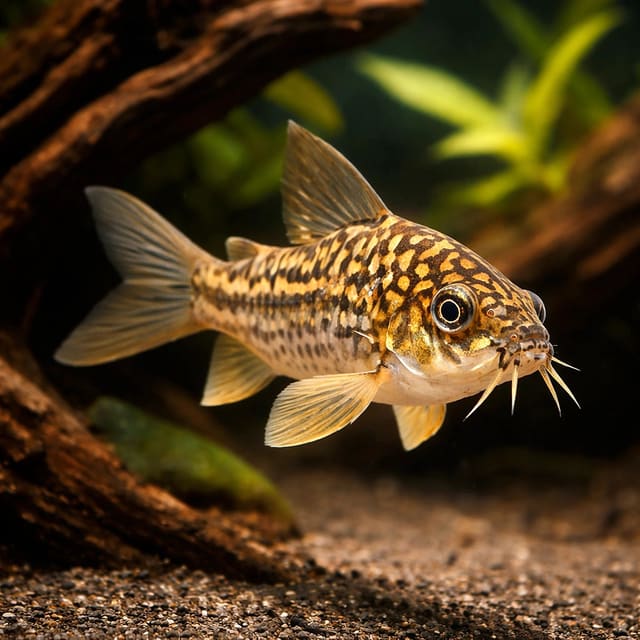
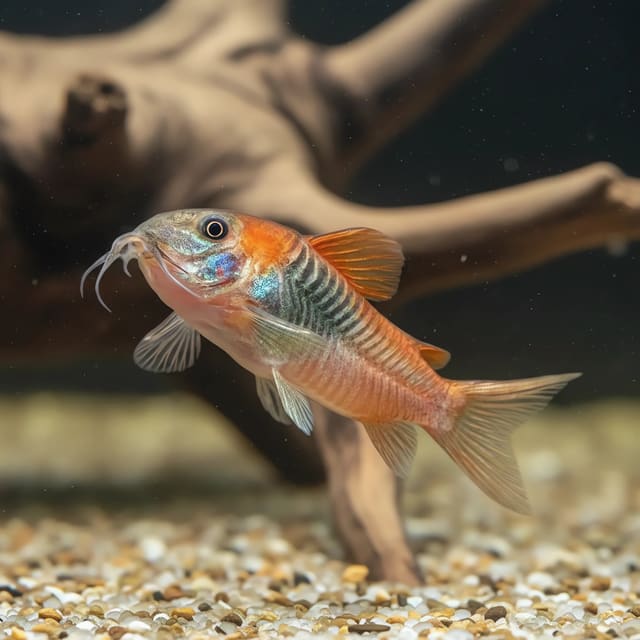
Neon albino bronze corydoras (Osteogaster aenea), an albino line of the bronze cory: a pale pink or orange armoured catfish with red eyes that reaches 7.5 cm SL. Peaceful and sociable; keep five or more on soft sand at 21 to 27°C, pH 6 to 8. Sold per fish; sex cannot be chosen.
Adult size is the maximum length this species reaches at full maturity (scientific sources). The livestock you receive will be younger and smaller. Product-photo provenance and any image-specific limitations are stated on the listing.
Osteogaster aenea
Neon albino bronze corydoras (Osteogaster aenea), an albino line of the bronze cory: a pale pink or orange armoured catfish with red eyes that reaches 7.5 cm SL. Peaceful and sociable; keep five or more on soft sand at 21 to 27°C, pH 6 to 8. Sold per fish; sex cannot be chosen.
Adult size is the maximum length this species reaches at full maturity (scientific sources). The livestock you receive will be younger and smaller. Product-photo provenance and any image-specific limitations are stated on the listing.
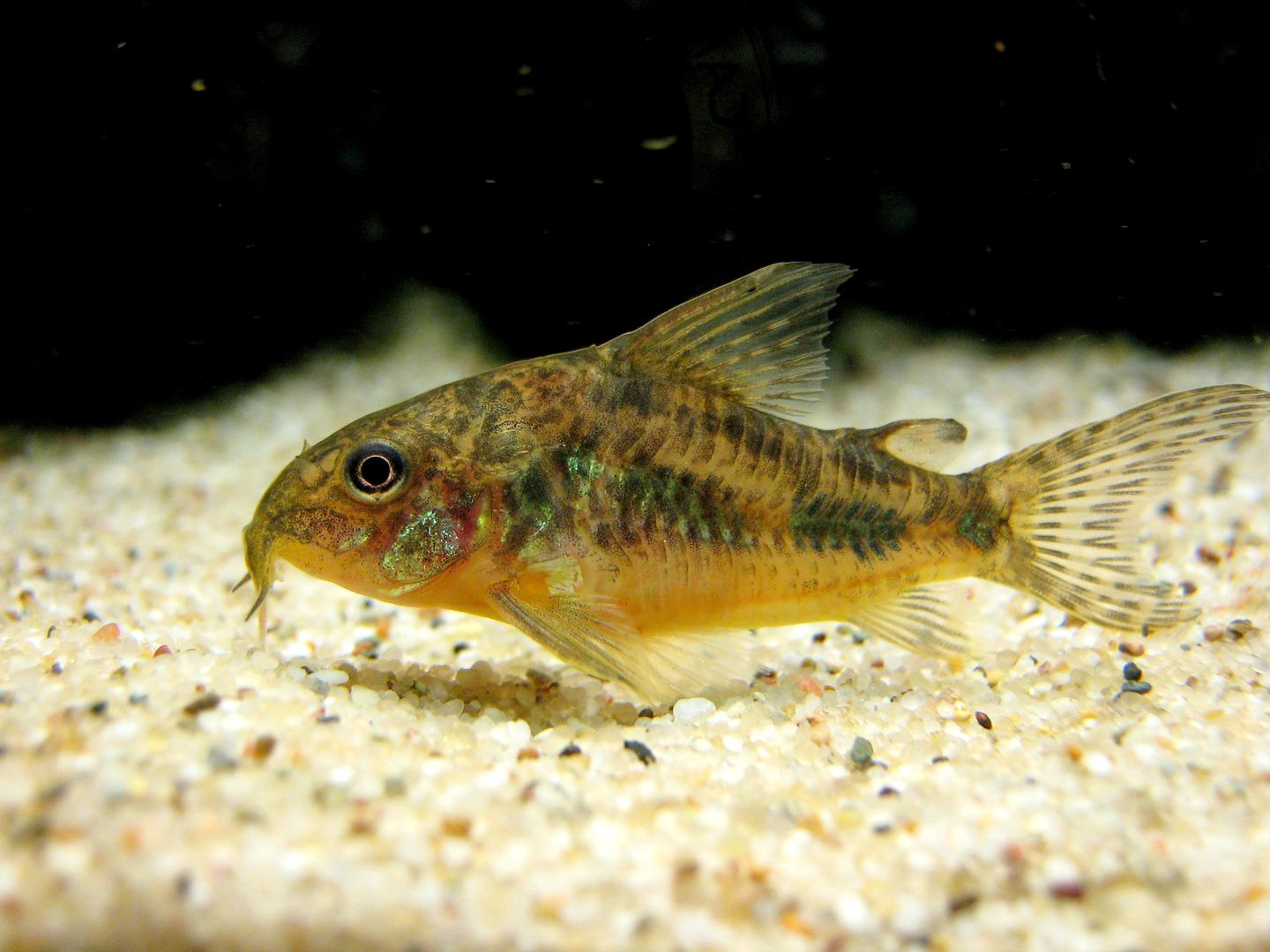
Identify the exact cory catfish before choosing care. Our starting policy for many common medium species is six compatible conspecifics, a mature 60 x 30 cm aquarium of about 60 litres, smooth fine sand and measured species-appropriate water.
Maintain these water conditions for optimal health and vibrant colors
This listing is for the neon albino bronze corydoras, an albino line of the bronze cory. The bronze cory is one of the best-established catfish in the aquarium hobby; FishBase records its importance to the aquarium trade as "highly commercial". Its accepted scientific name is now Osteogaster aenea (Gill, 1858). The genus changed in 2024, and the third section of this guide explains why the name on older labels and in older books is different.
You are buying live fish by the individual: the quantity you choose is the number of corys you receive. The listing does not offer males or females, so we cannot promise a particular sex or ratio in a group. Bronze corys are shoaling fish, and both Seriously Fish and OATA, the UK ornamental aquatic trade association, advise keeping them in groups. OATA puts the minimum at five, so most customers will want to order at least that many unless they are adding to an existing group.
"Neon" is the trade name this albino line is sold under. We have not found a published description that sets a neon albino apart from any other albino bronze cory, so we are not going to claim colour features on its behalf. What is documented for the albino form in general is a pale pink or orange body and red eyes (Wikipedia). That is what to expect, and it is the honest description.
The albino is not a separate species. Seriously Fish lists it as a selectively bred aquarium strain of Osteogaster aenea, so everything published about the species' size, water needs, diet and breeding applies to it. The places where albinos may differ, such as the reports about eyesight, are covered later, along with how much weight those reports deserve.
A group of pale corys working over a sand bed is one of the most watchable sights in a community tank. They spend their time at the bottom, sifting and searching, and they make the occasional quick dash to the surface for a gulp of air, which is normal for this species and explained below. The pale body shows up well against darker sand, which is part of the albino's appeal.
They are a sensible choice for a peaceful community aquarium with a soft substrate, as long as the tank has the floor space for a proper group. This guide covers the size they reach, water, tank set-up, feeding, behaviour, health, breeding and how to settle them in, drawing on FishBase, Seriously Fish, Wikipedia and OATA's catfish care sheet. Where those sources disagree, we show you both figures rather than quietly picking one.
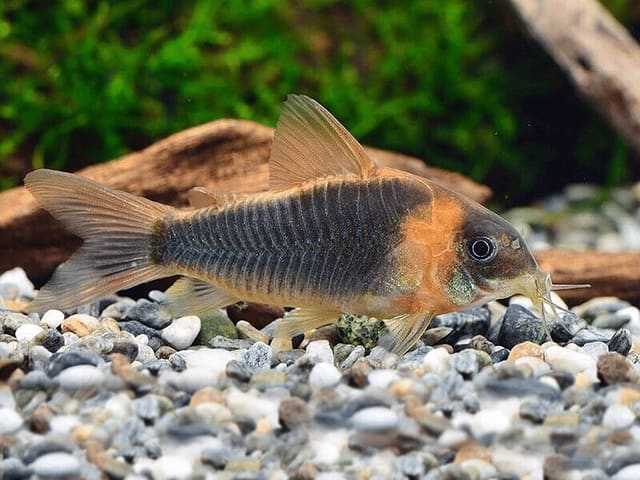
To understand an albino, it helps to know the normal fish. Wikipedia describes the wild-type bronze cory as having a yellow or pink body, a white belly, a blue-grey area over the head and back, and usually a brownish-orange patch on the head just in front of the dorsal fin. The albino lacks the dark pigment, and Wikipedia gives its appearance as a pale pink or orange body with red eyes.
The body shape is unchanged. This is a member of the Callichthyidae, the armoured catfish family. Each pectoral fin carries a stiffened spine, and Seriously Fish warns that these spines can pierce human skin, which matters when you net or handle them. OATA's catfish care sheet also mentions spines just behind the gills and describes catfish barbels, the whisker-like feelers around the mouth, as sensitive. That is the reason substrate choice matters so much for this fish.
An albino bronze cory reaches the same size as any other bronze cory, because it is the same species. No source we have read gives a different figure for albinos. FishBase records a maximum of 7.5 cm standard length (SL) for males or unsexed fish, and Seriously Fish also gives 75 mm SL. Standard length is measured from the snout to the end of the body, without the tail fin, so a fully grown fish looks a little longer than that number.
Wikipedia gives a typical adult size of 6.5 cm for males and a slightly larger 7 cm for females. Treat those as normal adult sizes and the FishBase figure as the maximum. For planning, assume an adult of about 7.5 cm SL plus its tail, and choose your tank and tank mates for that size rather than for the size that arrives.
Seriously Fish describes the difference simply: females tend to grow larger, and sexually mature females are noticeably rounder and broader-bodied than males, especially when they are carrying eggs. The Wikipedia sizes agree, with females half a centimetre or so longer.
In practice, sexing works best with adults side by side. Compare the width of the body behind the pectoral fins; mature females look fuller and broader, males slimmer. Young fish are much harder to tell apart, and you should not expect to sex small corys reliably. Because this listing does not sell by sex, a group of five or more gives the best chance of having both, which matters if you hope to breed them later.
FishBase gives the natural range as South America from Colombia and Trinidad to the La Plata River basin, east of the Andes. Seriously Fish lists Argentina, Bolivia, Brazil, Colombia, French Guiana, Guyana, Paraguay, Peru, Suriname, Trinidad and Tobago and Venezuela, and notes that the type locality, where the fish was first described from, is Trinidad.
That is an enormous range for one small catfish, and Seriously Fish makes the point directly: the distribution looks more like that of a complex of similar-looking but distinct species than of a single one. Several names now treated as synonyms, including schultzei, venezuelanus, microps and macrosteus, were once applied to bronze-type corys. Expect the science to keep moving as these populations are studied further.
Wikipedia describes the wild habitat as quiet, shallow waters with soft bottoms. FishBase classes the species as demersal, meaning it lives on or near the bottom, and non-migratory. FishBase also notes that adults stay in schools of 20 to 30 individuals, and that spawning in the wild happens when the water's physical and chemical quality changes with the onset of the rainy season. Both facts shape how we suggest you keep and breed them.
The species was first described in 1858 as Hoplosoma aeneum, and for most of the hobby's history it has been known as Corydoras aeneus. Seriously Fish records that it was moved into the genus Osteogaster in 2024, and FishBase now lists Osteogaster aenea as the accepted name. The fish has not changed; only its label has. You will still see the old name on many tanks, books and forum threads, and it refers to exactly the same species.
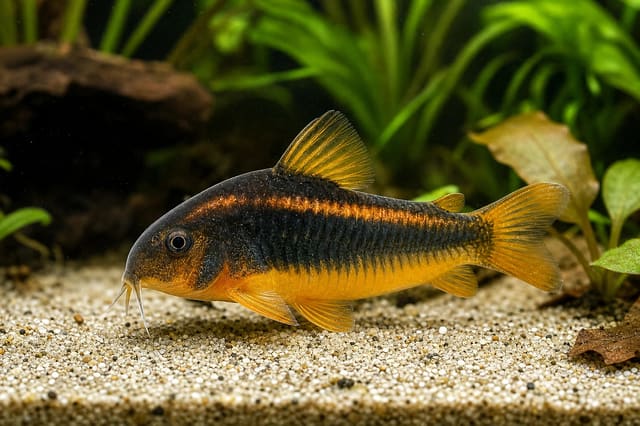
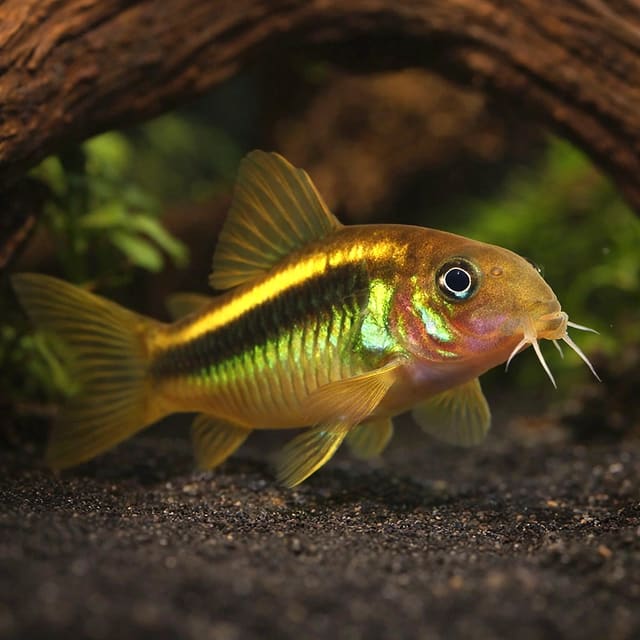
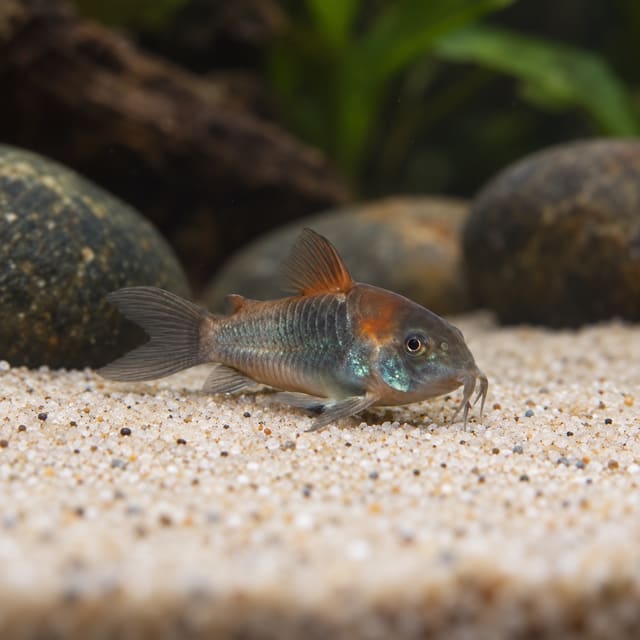
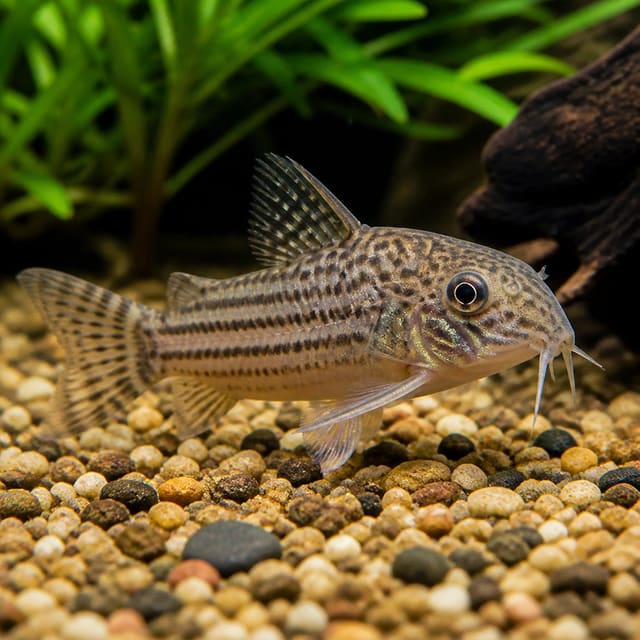
Seriously Fish describes several forms in the aquarium trade:
We also list the standard-coloured bronze corydoras, the longfin bronze corydoras and a second albino bronze cory line, if you want to compare forms of the same species.
One practical point follows from all of this. The albino is a bred strain, so the wild habitat described above is ancestral background rather than the water your fish grew up in. It is still the best guide to what the species is adapted to, but aquarium care ranges matter more for day-to-day keeping, and those come next.
The three sources we use do not quite agree on temperature or hardness, so here they are side by side.
| Source | Temperature | pH | Hardness |
|---|---|---|---|
| Seriously Fish (species profile) | 21 to 27°C | 6.0 to 8.0 | 2 to 15 dGH |
| OATA (general catfish care sheet) | 22 to 27°C | 6.0 to 8.0 | 4 to 18°dH |
| FishBase | 25 to 28°C | 6.0 to 8.0 | 5 to 19 dH |
The pH range is the same in all three. For temperature and hardness, our listing uses the Seriously Fish figures, because that is the species-specific aquarium profile: 21 to 27°C and 2 to 15 dGH. OATA's general range for catfish sits almost entirely inside it. FishBase's temperature range is noticeably warmer at the bottom end.
If you have seen 22 to 26°C quoted for bronze corys, that sits inside both the Seriously Fish and the OATA ranges, though below FishBase's lower figure. If you want a temperature that satisfies all three sources at once, 25 to 27°C does. In practice, a steady temperature anywhere within the aquarium ranges matters more than the exact figure, and a reliable heater with a separate thermometer is the way to achieve it.
OATA's targets for catfish are zero ammonia, zero nitrite, and nitrate no more than 20 mg per litre above your tap water. A bottom-dwelling fish lives in close contact with the substrate, where uneaten food and waste settle, so these numbers matter even more for corys than for fish that live higher up. A new tank must be fully matured, with ammonia and nitrite reliably at zero, before any corys go in.
OATA recommends a partial water change of 25% every week, and testing at least once a week for ammonia, nitrite, nitrate, pH and hardness. Siphon the sand surface during the change, concentrating on the corners and the areas under decor where debris gathers. Treat new water with a tap-water conditioner and bring it close to the tank's temperature before adding it.
Tap water varies widely around the UK, so test yours before you buy rather than assuming. If your tap water already falls within these ranges, there is no need to adjust it with chemicals; stability is worth more than a theoretical ideal. If your water sits well outside the ranges above, get in touch before ordering and we will give you a straight answer.
Temperature has a second role with this species. Seriously Fish's breeding method uses large changes with cooler water to trigger spawning, and FishBase links wild spawning to the change in water quality that comes with the rains. If you are not planning to breed them, keep your water changes moderate and the temperature steady. If you are, see the breeding section.
Seriously Fish gives a minimum base of 80 × 30 cm, about 72 litres, for a group of bronze corys. OATA's catfish care sheet asks for at least 80 litres for the smaller catfish species. We work from the larger of the two: an 80-litre tank with an 80 cm footprint as the starting point for a group of five or six.
For a bottom-dwelling shoal, floor area counts for more than height. A long, low tank gives the group space to forage as a unit, while a tall tank with the same volume gives them little extra room where they actually live. If you plan to keep a larger group, which suits a fish FishBase records in wild schools of 20 to 30, scale the footprint up rather than the height.
This is the most important choice. Seriously Fish recommends fine sand as the ideal substrate, with rounded gravel acceptable only if it is kept scrupulously clean. OATA likewise advises aquarium sand or fine gravel to protect the barbels, which it describes as sensitive. Corys spend much of their day pushing through the bottom, so avoid sharp or angular gravel.
A layer of sand a few centimetres deep is enough. Keep it clean with a siphon held just above the surface during water changes, so that you lift debris without stirring up the whole bed.
Seriously Fish advises décor that gives the fish security, and OATA suggests shelter in the form of wood, pots or caves for smaller and shyer catfish. Combine both: a few pieces of wood or a cave near the back, some planting, and a wide open area of sand at the front where the group can forage and where you can see them.
Plants that grow on wood or rock, such as Java fern and Anubias, leave the sand free for foraging. Rooted plants are fine if you leave plenty of open space between them.
For a tank of the size Seriously Fish recommends, it suggests a filter turnover of 290 to 360 litres per hour and a heater of 50 to 75 watts for its stated temperature range. Aim for steady, clean water rather than strong currents across the bottom; corys need to be able to forage without being pushed around.
Bronze corys breathe air as well as using their gills. Seriously Fish calls them facultative air breathers with a modified, highly vascularised intestine, and you will see them rise to the surface now and then to take a gulp of air. Make sure they can do so easily: avoid a closed mat of floating plants across the whole surface, and leave clear patches of open water at the top so they can reach the air.
In the wild, according to FishBase and Wikipedia, adult bronze corys feed on worms, crustaceans living on the bottom, insects and plant matter. Seriously Fish sums up the aquarium approach in a phrase: they are foraging omnivores. They accept most sinking dried foods, along with small live and frozen foods such as bloodworm and Tubifex.
Seriously Fish is clear that corys should not be expected to survive on leftovers from other fish, and should not be treated as tank cleaners. In a busy community tank, the mid-water fish can eat everything before it reaches the bottom, leaving the corys only scraps. Feed them deliberately, with food made to sink.
OATA's advice for catfish is to feed appropriate sinking foods once a day; it notes that catfish usually clear their food within a few minutes. A good sinking pellet or wafer makes a sensible staple, with frozen bloodworm or other small frozen foods as a regular extra. Thaw frozen food in a little tank water first, and pour away the thawing liquid rather than adding it to the aquarium.
The amount should be what the group can clear in a few minutes. Anything still lying on the sand after that becomes waste in exactly the place the corys live. If you regularly find old food on the bottom, cut back.
Drop the food in several places rather than one spot, so that the whole group can feed rather than the boldest two or three. If your tank has fast surface feeders, feed them first at one end, then add the corys' sinking food at the other end once the mid-water fish are busy. Watch the group for the first few weeks: a well-fed cory has a gently rounded belly, and a thin fish in an otherwise healthy group usually points to competition at feeding time.
The reports that some albinos see poorly, discussed in the health section, are not established fact. But if your albinos seem slower to find food than other fish, spreading sinking food across the sand where they forage is the simple answer, and it does no harm to any cory.
Resist the urge to overfeed before you go away. A clean tank with stable water is far better for corys than one loaded with extra food, which will only foul the substrate.
Seriously Fish describes the bronze cory as peaceful and gregarious, to be kept in a group of at least four to six. OATA's catfish care sheet says groups of at least five for shoaling species such as corydoras. In the wild, FishBase records adults staying in schools of 20 to 30 individuals. We recommend five or six as the minimum and more where the tank's floor space allows, which brings the group a little closer to the wild schools FishBase describes.
Different colour forms of the same species can live together, since they are all Osteogaster aenea. If you plan to breed one particular form, though, keep that form on its own.
New keepers often worry the first time they see a cory shoot up to the surface and back down again. This is normal. Wikipedia describes how the fish rapidly comes to the surface, draws air in through its mouth, and absorbs that air through the wall of its intestine. FishBase records the species as a facultative air-breather taking air between 1 and 45 times an hour.
The difference to learn is between occasional trips and distress. A cory that rises, gulps and returns to foraging is behaving normally. Fish that stay at the surface, or a whole group making repeated trips with rapid gill movement, are telling you something is wrong with the water. Test for ammonia and nitrite straight away and check the filter and temperature.
OATA describes corydoras as excellent additions to community aquariums, while warning that some other catfish can be extremely predatory. A good companion for bronze corys is peaceful, does not harass bottom-dwellers, and is not large enough to swallow a 7 cm fish.
When planning, remember that the corys and their companions share one floor. Count the bottom-dwellers in a tank, not just the total number of fish, and make sure the sand area is large enough for all of them.
Get to know how your own group behaves in its first weeks, because that is your baseline. A single fish that stays apart from the rest day after day, or stops coming out at feeding time, is worth watching closely and can be the first sign of a problem with that fish or with the water.
OATA lists the signs to watch for in catfish: changes in colour, abnormal swimming, reduced feeding, damage to fins, and white spots or growths. With corys, add the barbels. OATA describes them as sensitive, and a clean, soft substrate keeps them in good order. Look at the group at feeding time each day, count them, and check that every fish comes out to eat.
If something looks wrong, test the water before reaching for a treatment. For a fish that lives on the substrate, conditions at the bottom of the tank are the first place to look, so check ammonia, nitrite and nitrate, siphon the sand, and look at what is being left uneaten.
Seriously Fish warns that the stiffened pectoral-fin spines can pierce human skin and that a sting can be very painful. It adds that secretions from glands at the base of each spine may be mildly toxic or venomous. OATA's care sheet also mentions spines behind the gills. Never hold a cory in your bare hand. Guide it gently into a net or, better, into a container under water, so the spines have nothing to catch on and you are not handling the fish.
When you move corys between tanks, keep them in water at all times and do not squeeze the net closed around them.
This is one of the most common questions about albinos, so here is what the sources actually say. Wikipedia reports that some breeders find albino fry "a little slower to develop", and that others claim albinos are practically blind and that the males are somewhat sterile. Those are breeders' claims reported in passing, not the results of a study we have read, and Seriously Fish, which lists the albino as a widely kept strain, raises no specific health concerns.
So the honest answer is that it has not been established. Albinos are widely kept and bred. If your albinos do seem slower to find food, the practical steps are the ones already covered: spread sinking food across the sand, avoid fast, competitive tank mates, and watch body condition.
Wikipedia gives an average lifespan of 10 years for the species. We know of no published lifespan figure specific to albinos, so treat 10 years as the species figure. Long life depends on stable water, a clean sand bed and proper feeding rather than luck.
A separate quarantine tank, used for a few weeks before new fish join an established group, lets you watch them closely and protects the fish you already keep. If medication is needed, dose by the real volume of water rather than the size on the box, follow the instructions closely, and ask us if you are unsure what you are seeing.
The albino breeds in the same way as any other bronze cory. Seriously Fish sets out a practical method for the aquarium, and Wikipedia describes the unusual way the fish actually fertilise their eggs.
Seriously Fish suggests a ratio of two males to each female if possible. When the females are visibly full of eggs, carry out a large water change of 50 to 70% using cooler water, and increase oxygenation and water flow in the tank. Repeat this daily until the fish spawn. It mirrors what FishBase describes in the wild, where spawning is linked to the change in water quality that comes with the rainy season.
Because you cannot choose the sex of the fish you order, the easiest path is to keep a group of six or more and, once they mature, set up a spawning group of two males to each female. Sex them as adults using the body-shape differences described earlier.
Wikipedia describes the spawning act. The male presents his abdomen to the female, and she attaches her mouth to his genital opening, forming what keepers call the T-position. The female takes in the sperm, which passes quickly through her intestine and is released with her eggs into a pouch formed by her pelvic fins. She then places the eggs.
Wikipedia adds that females spawn 10 to 20 egg clutches with several males, but each clutch is fertilised by a single male. In captivity, after several spawning acts over two to three hours, one female can produce up to 200 eggs.
According to Seriously Fish, the eggs are normally placed on the aquarium glass, but it is worth offering alternatives such as fine-leaved plants or spawning mops. Eggs on the glass can usually be rolled gently upwards with a finger and moved to a separate container. Most breeders add methylene blue, or an alder cone or two, to stop the eggs developing fungus.
Seriously Fish gives an incubation period of three to four days. Wikipedia gives three to seven days, after which the eggs turn dark brown and hatch. The two sources differ, so expect hatching anywhere within that window.
Seriously Fish recommends small live foods such as microworm and Artemia nauplii for the fry, and notes that they seem less prone to ailments when kept over a thin layer of sand. Keep the rearing tank very clean and make small, frequent water changes.
Wikipedia reports breeders' observations that albino fry can be a little slower to develop, and some claims that albino males are somewhat sterile. These are anecdotes rather than established findings, but they are worth knowing if an albino group is slow to produce fertile eggs. Patience, good water and a larger group of adults give you the best chance.
Before ordering, please read our delivery and live-arrival information, and get the aquarium ready in advance: the filter running and mature, the water tested, and the temperature set and stable. Someone needs to be at the delivery address on the day to take in the parcel, since it contains live fish.
The corys travel in oxygen-filled bags packed in insulated packaging, with heat packs added when conditions call for them, and are carried by a tracked courier licensed to transport live animals. You will receive the confirmed delivery date and tracking details by email.
Begin a continuous video before you open the parcel, while it is still sealed, and keep filming in one take until the fish are visible in their sealed bag. If any fish is dead, dying or clearly compromised on arrival, email hello@tropicalfishco.co.uk on the day of delivery, including your order number and the video. Photographs on their own do not meet the policy. Under the guarantee terms, we will either replace the affected fish with your next order or refund them.
Keep the lights low for the rest of the day. Let them settle and find their own way out onto the sand in their own time. Offer a small amount of sinking food the next day and remove anything left after a few minutes.
Through the first week, watch breathing, appetite and behaviour, count the group at each feed, and keep an eye on surface trips: an occasional gulp of air is normal, but repeated trips by the whole group mean you should test the water. Keep up your weekly tests, avoid adding further fish for a while so the filter can adjust, and contact us early if anything concerns you.
Everything in this guide comes from the sources below. They are worth reading if you want more depth on any part of keeping bronze corys.
No reviews for this item yet. Bought one? Honest reviews only, good or bad.
What customers say about ordering from us
Easy website plenty of info on fish your buying great to pick a time slot
TRACEY DURRANT · 7 Oct 2026
Got some lovely fish thank you
Kevin Mackie · 7 Oct 2026
Reviews of our shop, collected by Judge.me, an independent third-party review collector. Newest first.