Moderate
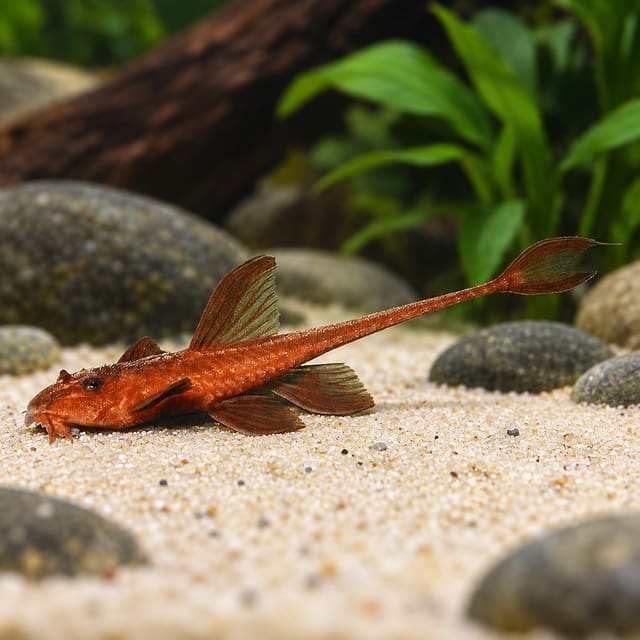
Red Whiptail Catfish (Loricaria sp.)
22–27°C · pH 6–8
£25.99
Photo coming soon
The size, price and care details on this page are for this listing.
The Rio Atabapo whiptail is a flat, sand-dwelling armoured catfish from the Orinoco basin, sold under the trade name Loricaria sp. 'Rio Atabapo'. You receive one unsexed young fish at 5-6 cm or 6-7 cm. Adults reach about 18 cm standard length, so plan a long tank with soft sand, warm, well-oxygenated water, strong filtration and calm tank mates.
Adult size is the maximum length this species reaches at full maturity (scientific sources). The livestock you receive will be younger and smaller — pick a size above for the actual shipping size. Product-photo provenance and any image-specific limitations are stated on the listing.
Loricaria sp.
The Rio Atabapo whiptail is a flat, sand-dwelling armoured catfish from the Orinoco basin, sold under the trade name Loricaria sp. 'Rio Atabapo'. You receive one unsexed young fish at 5-6 cm or 6-7 cm. Adults reach about 18 cm standard length, so plan a long tank with soft sand, warm, well-oxygenated water, strong filtration and calm tank mates.
Adult size is the maximum length this species reaches at full maturity (scientific sources). The livestock you receive will be younger and smaller — pick a size above for the actual shipping size. Product-photo provenance and any image-specific limitations are stated on the listing.
Maintain these water conditions for optimal health and vibrant colors
This page is for the Rio Atabapo whiptail catfish, a long, flat, armoured catfish from the genus Loricaria. It is traded as Loricaria sp. "Rio Atabapo", a name taken from the Atabapo River in the Orinoco basin, and that is the name our stock records carry. There are two size options, 5–6 cm and 6–7 cm, and each one you add to your basket is a single fish at the size you pick.
Those sizes describe the fish on the day it leaves us, not the size it stops at. Planet Catfish and ScotCat both put the adult at about 18 cm, and the scientific description of the species those databases now attach to this fish (more on that in the next section) measured its largest specimen at 190.9 mm standard length. Standard length runs from the snout to the base of the tail, so a grown whiptail with its tail fin and trailing filament looks longer again. Put simply, the youngster in your bag can end up close to three times its arrival length, and the aquarium has to be planned around the adult rather than the juvenile.
The listing does not sell a particular sex. The differences between male and female whiptails belong to mature fish: thickened pectoral spines in males and, in some species, enlarged lips. They cannot be read with any confidence on a fish of 5–7 cm, so what you receive is an unsexed juvenile.
Who is it for? It suits a keeper who likes unusual catfish and is happy to build the tank around one: a broad floor of soft sand with open patches, wood and a few smooth stones, warm water with plenty of oxygen and strong filtration, and companions calm enough that a slow bottom feeder still gets its share. It is not an algae-cleaning crew member, and it is not a fish to add to a crowded community tank as an afterthought. Kept on its own terms it is a quietly remarkable animal, a flat-bodied catfish made for open sand which, in the right hands, breeds by a method few aquarium fish share: the male carries the clutch on his lips until the eggs hatch.
Loricaria has a special place among catfish. Wikipedia notes that it was the first genus of the family Loricariidae to be described, so the whole family of suckermouth armoured catfish takes its name from it. The genus now holds around twenty recognised species, and some have only been named in the last few years, including Loricaria nimairaco in 2023 and Loricaria thomasi in 2024. Many whiptails were being exported for aquariums long before anyone could say which species they were, so the trade gave them working names: the genus, then "sp.", then the place they were collected. "Rio Atabapo" is one of those labels.
In 2023 Londoño-Burbano, Urbano-Bonilla, Thomas and Britto described Loricaria nimairaco in the journal Neotropical Ichthyology. The specialist catfish databases have since filed the Rio Atabapo whiptail under that name. Planet Catfish's entry for Loricaria sp. "Rio Atabapo" now leads to its L. nimairaco page, and ScotCat's factsheet for the species lists "Rio Atabapo Loricaria" and Loricaria sp. "Colombia" among its trade names, with crying whiptail as a common name.
We have read the description itself, and this is why we still sell the fish as Loricaria sp. Every specimen the authors examined came from Colombian rivers that drain to the Amazon: the Orteguaza, which is the main tributary of the Caquetá system, the Putumayo, and the Amazon itself at Leticia, the type locality. The Atabapo belongs to the Orinoco basin, a separate river system, and the paper mentions neither the Atabapo nor the Orinoco. The link between the Atabapo fish and the new species has been made by the hobby databases, not by the scientists who named it. It may well prove correct, but until it appears in the scientific literature we will not print a species name we cannot stand behind. The honest label is Loricaria sp. "Rio Atabapo".
FishBase, our usual first check, has no public page for Loricaria nimairaco yet. The care figures on this page therefore come from Planet Catfish, ScotCat and the 2023 description, plus Seriously Fish's account of the marbled whiptail, Loricaria simillima, a related fish that reaches the same 180 mm standard length, wherever a fuller husbandry picture helps. We say which source each figure comes from. It is also worth knowing that Loricaria is a difficult genus even for specialists: Seriously Fish points out that several different fish may be traded under the single name L. simillima. Read the numbers here as sound guidance for this group of whiptails rather than a laboratory specification.
The basic body plan is shared across the whiptail subfamily, the Loricariinae. Wikipedia describes a depressed (flattened from top to bottom) body covered by bony plates, a long, depressed tail stalk that is rectangular in cross-section, and no adipose fin, the small fleshy fin that many other catfish carry behind the dorsal. The mouth sits underneath the head, and in Loricaria, Wikipedia notes, the lips carry elongate, slender filaments.
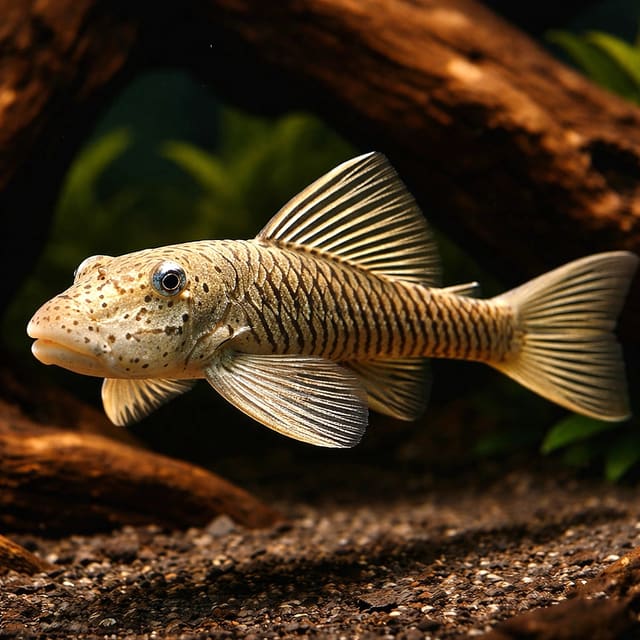
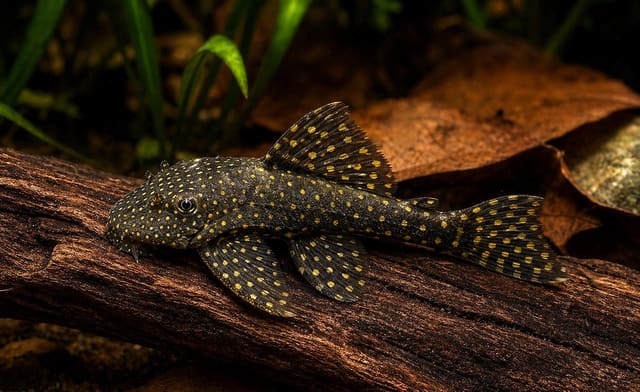
On top of that plan, the Rio Atabapo whiptail has a distinctive head pattern, and the sources agree on it closely:
The tail filament is worth a comment. Because Planet Catfish describes it on well-conditioned fish, treat it as a sign of good health and feeding rather than an identity mark every individual will show. The head stripes and dark fins are the features to check when your fish arrives.
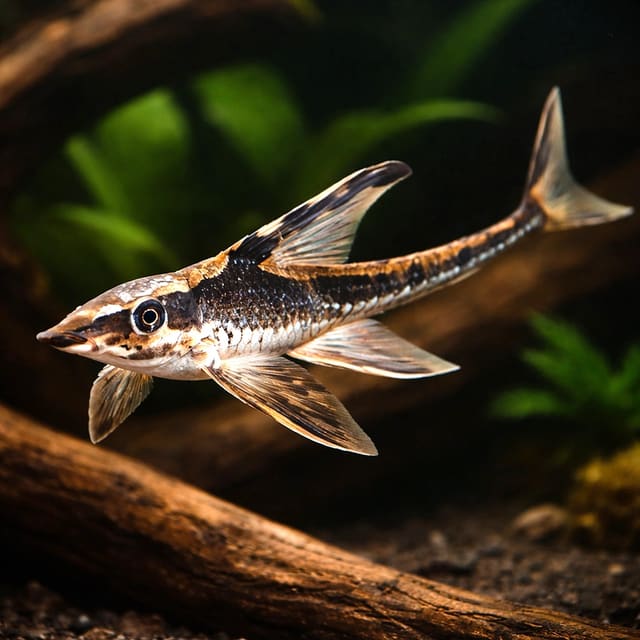
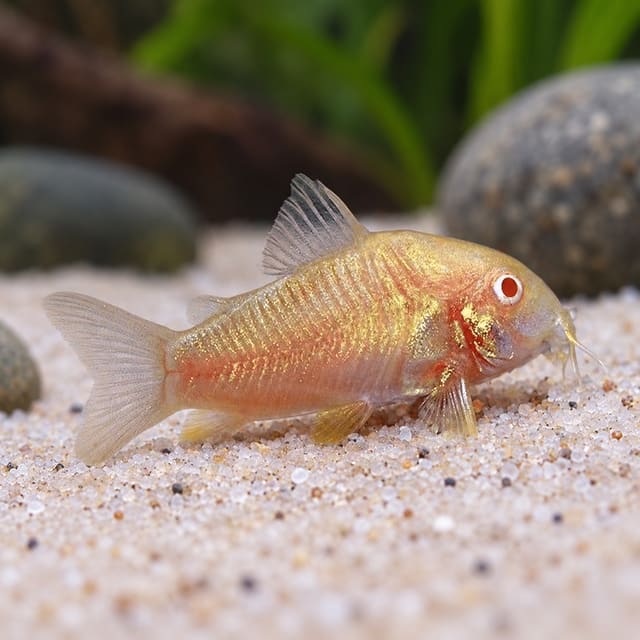
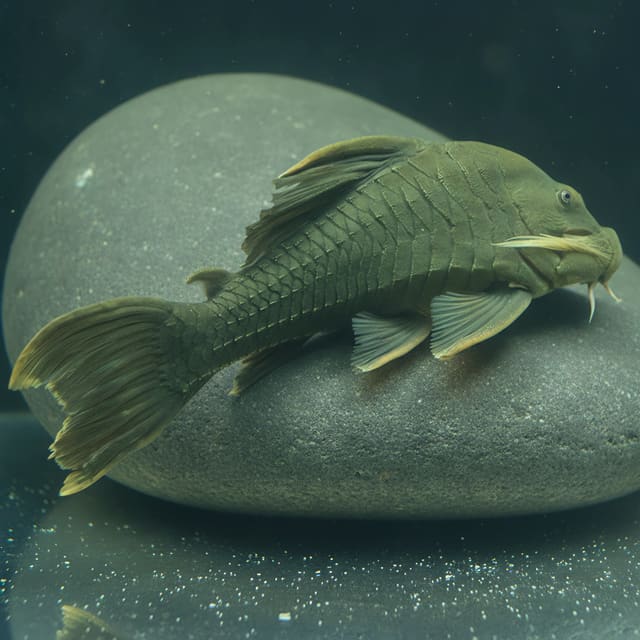
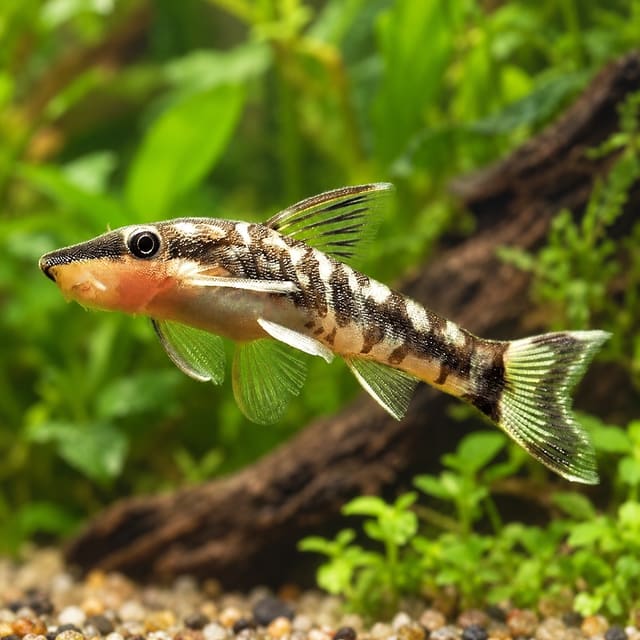
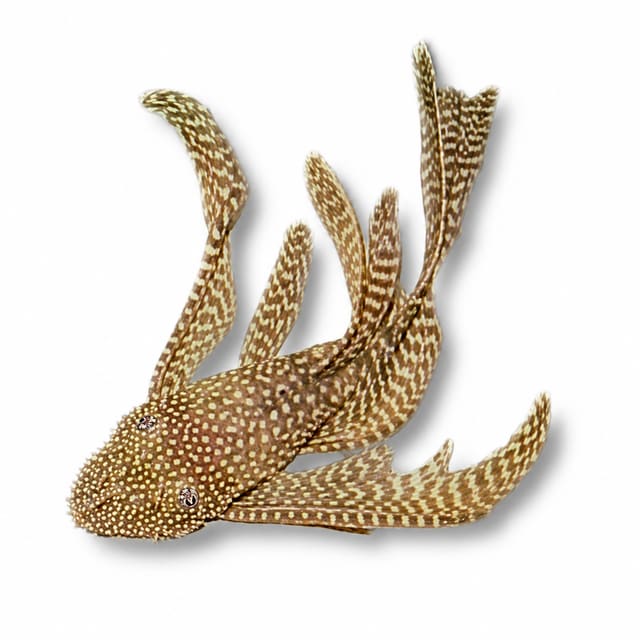
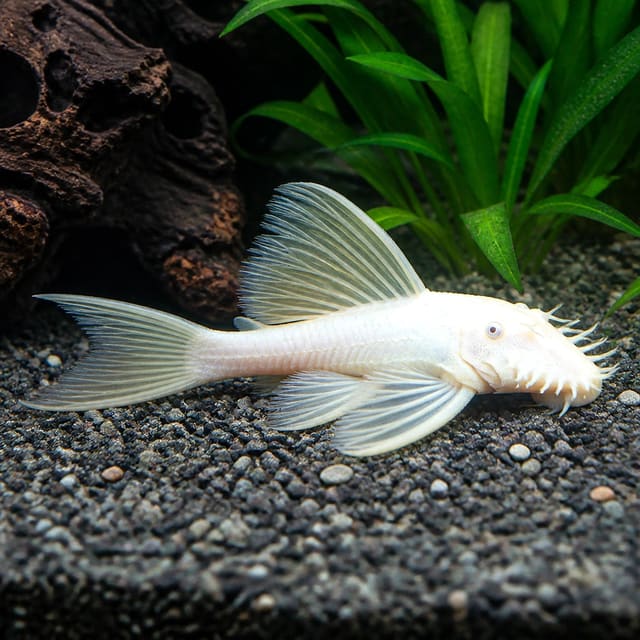
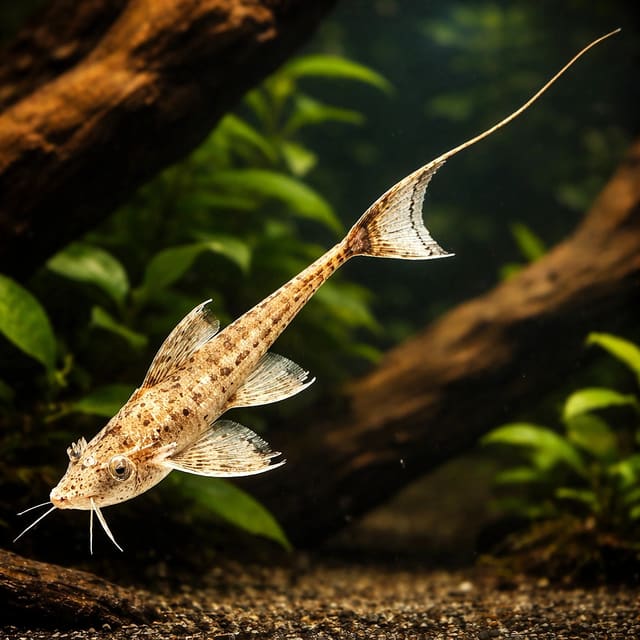
If you are comparing whiptails, it helps to know that the name covers several genera with different sizes and needs. Alongside this fish we list the Red Whiptail Catfish (Loricaria sp.), the Chocolate Whiptail Catfish (Rineloricaria lanceolata) and the Royal Whiptail Catfish (Sturisomatichthys panamensis). Each has its own page with its own size and care notes, and none of them should be assumed to need the same set-up as the Rio Atabapo fish.
The Atabapo is a river of Venezuela and Colombia, about 280 km long, and for much of its length it forms the border between the two countries. Spanish-language Wikipedia traces it from the forests of southern Venezuela, in the Maroa municipality of Amazonas state, to the Orinoco near San Fernando de Atabapo, and describes its water as blackish in colour. English Wikipedia gives its basin as about 13,000 km² and its average flow as around 883 cubic metres per second, which makes it a substantial river in its own right.
Planet Catfish's notes on where this whiptail was collected describe a river between 5 and 30 metres wide, with rocks and a few sandy zones, and a water temperature of 26 °C at the time. That is a helpful picture: moving water, hard structure and patches of open sand.
The 2023 description adds habitat notes from the Amazon-side specimens of L. nimairaco. One was taken in strong current over a mainly muddy bottom with organic matter; another came from a lower-gradient stream with slow current over cobble mixed with sand. ScotCat gives the range as Colombia, in the Putumayo region around Puerto Asís and the Putumayo River, together with the Rio Atabapo. Looking at the genus as a whole, Wikipedia records Loricaria almost everywhere east of the Andes in tropical and subtropical South America, in places ranging from main river channels with sandy or rocky beds to flooded areas over mud.
Three things follow for the aquarium. First, the floor matters most: these are fish of sand, fine sediment and scattered stones, and the tank should give them a soft bottom to lie on. Second, the wild water is warm and on the move, which fits ScotCat's call for high oxygen levels and strong filtration. Third, although the Atabapo itself is a dark-water river, the published care ranges for this fish reach neutral and slightly above, and a recorded aquarium spawning took place at pH 7.5. There is no need to chase extreme blackwater conditions; steady, clean water within the ranges below matters far more.
Start with the footprint. A flat-bodied whiptail lives on the bottom, so the length and width of the tank do far more for it than the height. None of our sources gives a tank size for the Rio Atabapo fish itself, but Seriously Fish gives one for the marbled whiptail, which reaches the same 180 mm standard length: a pair can be housed in a tank of around 75 × 30 × 30 cm, with larger tanks needed for a group. Treat that as the floor for one or two adults, not a target. If you would like to keep several, which Seriously Fish says suits the marbled whiptail well, add length and front-to-back depth before anything else. Do not forget that you are buying a 5–7 cm fish that is heading for 18 cm plus its tail.
All three care sources ask for sand. Planet Catfish specifies a fine sand bottom with open expanses, ScotCat says a soft substrate such as sand is beneficial, and Seriously Fish recommends a soft, sandy substrate for the marbled whiptail. We would not keep this fish on coarse or sharp gravel. Use a fine, rounded aquarium sand, rinse it well before it goes in, and leave a generous open area, ideally towards the front and middle of the tank where you can see the fish resting.
Planet Catfish suggests driftwood and a few rocks; ScotCat recommends plants and bogwood for shelter; Seriously Fish lists driftwood, smooth rocks, lengths of PVC pipe and live plants to provide cover and shaded spots. A practical layout puts the wood and the larger stones towards the back and sides, with planting behind them for shade, and leaves the centre as open sand. A length of smooth pipe or a sheltered gap under a root gives the fish a retreat without taking floor space away from the open sand.
Choose rocks with smooth faces and rounded edges. Anything that can shift should sit directly on the glass bottom, not on top of the sand, so that nothing can topple if the sand is disturbed during cleaning.
ScotCat asks for high oxygen levels, frequent water changes and strong filtration, and the wild habitat notes describe rivers with current. Size the filter generously for the tank, and point the return so it moves water across the whole tank rather than only along the surface. Warm water holds less dissolved oxygen than cool water, so good surface movement, or an air stone, is worth having, especially in summer. The aim is a tank with gentle to moderate movement over the sand, with quieter corners behind the decor where the fish can rest.
Plants are optional for the fish but useful for shade, and they help with water quality. Rooted plants planted at the back, epiphytes tied to the wood, and floating plants to soften the light all fit this style of tank. Leave the open sand clear, though: the fish needs that space more than it needs a full planting scheme.
The two catfish databases that cover this fish give slightly different ranges, so here they are side by side, with the related marbled whiptail for comparison.
| Source | Temperature | pH | Hardness |
|---|---|---|---|
| Planet Catfish (Rio Atabapo whiptail) | 23–28 °C | 6.4–7.6 | Breeding report: 6 °KH |
| ScotCat (L. nimairaco) | 22–25 °C | 6.0–7.0 | Not given |
| Seriously Fish (L. simillima, a related fish) | 24–27 °C | 5.6–7.8 | 1–20 °dGH |
| Planet Catfish wild collecting note | 26 °C at capture | Not given | Not given |
Our suggestion is to run the tank at a steady 24–26 °C. That sits inside the Planet Catfish range, close to the 26 °C recorded where the fish were collected and the 25.5 °C used in a successful aquarium spawning, and only just above ScotCat's more cautious upper figure. For pH, anywhere between about 6.4 and 7.0 satisfies both catfish databases, and the Planet Catfish range runs to 7.6. UK tap water varies a great deal from one area to the next, so test yours before you order and always treat it with a dechlorinator. What matters is knowing your numbers and keeping them steady.
Neither catfish database gives a hardness range for everyday keeping. The only hard figure for this fish is the 6 °KH recorded in the Planet Catfish breeding report, and Seriously Fish gives the marbled whiptail a wide 1–20 °dGH. Soft to moderately hard water is the sensible reading. If your tap water is very hard, ask us before you order rather than trying to make big changes after the fish arrives.
Warm-water, oxygen-hungry fish feel a British heatwave more than most. If the tank creeps above the top of the range, switch the lights off, keep the room shaded, and increase surface movement or add an air stone, because warmer water holds less oxygen just when the fish need more. Do not chase the temperature down with large, cold water changes. In a power cut, insulate the tank with blankets or polystyrene to hold the heat, keep the lid on, and stop feeding until the filter is running again. A battery air pump is sensible insurance for a tank like this.
ScotCat's care note asks for frequent water changes, and Seriously Fish recommends weekly partial changes of 40–50% for the marbled whiptail, partly to keep it in spawning condition. For a tank of this kind we would change a good share of the water every week, with dechlorinated water matched to the tank temperature. Run a gravel cleaner lightly over the open sand to lift waste from the surface without digging deep, and rinse filter media in old tank water rather than under the tap so the filter bacteria survive.
A new tank must be fully cycled before any fish goes in. Test for ammonia and nitrite, which should both read zero, and keep an eye on nitrate between changes. Stability is the goal. Seriously Fish describes young marbled whiptails as highly sensitive to changes in water chemistry, and a steady routine is kinder to adults too than occasional large corrections.
Getting food to a whiptail is the part of its care that most often goes wrong, and the reason is behaviour rather than diet. Seriously Fish describes the marbled whiptail as a very quiet fish, to the point that it will be out-competed for food by more vigorous tank mates. A shy, slow catfish on the bottom of a busy tank can go hungry while everything above it is fat and well fed.
ScotCat lists the Rio Atabapo whiptail as an aufwuchs feeder: a fish that grazes the film of algae, micro-organisms and fine debris that builds up on surfaces. Seriously Fish describes the marbled whiptail as an omnivore that in nature feeds mainly on aquatic invertebrates, and suggests bloodworm, daphnia, chopped earthworm, dried sinking foods, cucumber and courgette in the aquarium. Planet Catfish's breeding report notes that the young of the Rio Atabapo fish take tablets and brine shrimp once their yolk sacs are used up.
Put together, that points to a mixed diet built on sinking foods:
The tank's own biofilm on wood, stones and glass is a bonus, but it is not a diet. Do not buy this fish to clean up algae: it needs feeding like any other fish.
Drop sinking food close to where the whiptail rests, not into the current at the far end of the tank, and watch long enough to see it actually eat. If faster fish are reaching the food first, feed the rest of the tank at the surface first and give the bottom food a minute later. A healthy whiptail should have a gently rounded belly when it rests on the sand; a hollow, pinched underside on a fish that has been with you a while is a sign it is not getting enough.
Little and often suits a growing juvenile. Feed amounts that are cleared in a few minutes and lift any leftovers with a siphon or net, because uneaten food rotting in the sand quickly undoes the water quality the fish depends on.
Peaceful is the word for this fish. Seriously Fish's account of the marbled whiptail, the fullest husbandry account we have found for a fish of this group, describes it as quiet and amicable with its own kind, and says it usually does well kept in a group. It recommends small characins, peaceful cichlids, and catfish such as Corydoras or other loricariids as companions. We would apply the same rules to the Rio Atabapo whiptail, while remembering that the marbled whiptail is a related fish rather than the same one.
A single Rio Atabapo whiptail can be kept perfectly well. If you have the floor space, Seriously Fish's experience with the marbled whiptail suggests a small group is a good option too, and a group is the obvious route for anyone hoping to breed them. Because the sexes cannot be told apart at our dispatch sizes, keeping several juveniles gives you the best chance of ending up with both. Give each fish enough open sand that they are not lying on top of each other, and enough feeding spots that a lower-ranking fish still eats.
When you plan a mixed tank, check every species against the conditions above rather than relying on a general "community fish" label. Two fish that are both peaceful can still need quite different temperatures.
Across the whiptail subfamily, Wikipedia describes pronounced sexual differences in mature males, expressed as enlarged odontodes (tooth-like bristles) on the fins and snout. For Loricaria in particular it lists enlarged pectoral-fin spines in males and tooth crowns that blunt with age. The 2023 description of L. nimairaco found thickened pectoral spines in mature males, and noted that the lip and barbel changes seen in some other Loricaria were not present in the specimens it examined.
Planet Catfish's notes on the Rio Atabapo fish, by contrast, say the male's lips are bigger so that it can hold an egg clutch, and Seriously Fish says male marbled whiptails develop greatly enlarged mouthparts as they mature. The sources do not fully agree on the lips, which is one more reason to keep this fish as Loricaria sp. until its identity is settled. The safest single sexing cue on an adult is the thicker leading spine of the male's pectoral fins, seen when the fish rests on the sand. None of these differences is reliable on a fish of 5–7 cm.
Wikipedia describes the males of Loricaria as abdomino-lip brooders, and notes that the details vary between species: some carry the eggs on the enlarged lower lip, others attach them to the underside of the body. Planet Catfish's report for the Rio Atabapo whiptail describes the female laying about 60 eggs, which the male then takes and holds with his lips. In that report the young hatched after 16 days, and the breeding tank was running at pH 7.5, 25.5 °C and 6 °KH.
Seriously Fish's account of the marbled whiptail fills in some of the practical detail. The male keeps the eggs for around 10–15 days and ventilates them with movements of his mouthparts. Parental care varies between individuals: some males eat the eggs or release them early, while others hold on steadfastly. After hatching, the fry need another 2–3 days to absorb their yolk sacs.
Planet Catfish describes raising the Rio Atabapo young as not problematic: they take tablets and brine shrimp as soon as the yolk sac is fully absorbed. Seriously Fish suggests brine shrimp nauplii, microworm and crushed foods for young marbled whiptails, and warns that they are highly sensitive to changes in water chemistry and to starvation. In practice that means small, frequent feeds, scrupulous cleaning of leftovers, and small, regular water changes with carefully matched water.
Seriously Fish also links regular partial water changes of 40–50% each week with bringing marbled whiptails into spawning condition. If you hope to breed them, start with a small group of healthy juveniles, grow them on carefully with a varied diet, and expect the process to take time as the fish mature.
Have the aquarium ready before the parcel comes. That means the filter running, the water tested and the temperature matched, with the sand, wood and shelter already in place, so the fish goes straight into a finished home. Someone must be at the delivery address to receive live animals. Please read our delivery and live-arrival information before ordering.
Your whiptail travels in an oxygen-filled bag inside insulated packaging, with heat packs when conditions call for them, and goes by a tracked courier licensed to carry live animals. We email the confirmed delivery date and the tracking details.
Start a continuous unboxing video while the parcel is still sealed, and open it in the same take, showing the fish in its still-sealed bag. If a fish arrives dead, dying or clearly compromised, email hello@tropicalfishco.co.uk on the day of delivery with your order number and that video. Photos alone do not meet the policy. The resolution is a replacement with your next order or a refund for the affected fish, subject to the guarantee terms.
Lower the net close to the sand and let the fish swim off rather than dropping it from the surface. With the lights low, give it time to find its own spot near the wood or in the shade of the plants. Offer a small amount of sinking food once the fish has had a few hours to settle, place it nearby, and check later that it has gone. Over the following days look for steady, unlaboured breathing, a fish that rests flat on the sand rather than gasping at the surface, and a belly that stays rounded rather than hollow.
Keep feeding light and water changes regular for the first couple of weeks while the tank's filter adjusts to the extra fish. If you are adding tank mates later, add them gradually and keep watching that the whiptail still gets its food.
These are the main sources behind the facts on this page. Planet Catfish's Cat-eLog also has an entry for the Rio Atabapo whiptail, filed under Loricaria nimairaco.
No reviews for this item yet. Bought one? Honest reviews only, good or bad.
What customers say about ordering from us
Easy website plenty of info on fish your buying great to pick a time slot
TRACEY DURRANT · 7 Oct 2026
Got some lovely fish thank you
Kevin Mackie · 7 Oct 2026
Reviews of our shop, collected by Judge.me, an independent third-party review collector. Newest first.