Moderate
Bristlenose Pleco (Ancistrus sp.)
22–27°C · pH 6–8
From £3.51Some sizes on sale
Photo coming soon
The size, price and care details on this page are for this listing.
One L213 Bristlenose Pleco (Ancistrus sp.), a still-undescribed bristlenose from the Rio Tapajós in Brazil that grows to about 10 cm. It wants warm, soft to neutral water (26–30 °C, pH 5.5–7.0), caves, wood and a mainly vegetable diet. One fish per order; sex is not specified.
Adult size is the maximum length this species reaches at full maturity (scientific sources). The livestock you receive will be younger and smaller. Product-photo provenance and any image-specific limitations are stated on the listing.
Ancistrus sp. (L213)
One L213 Bristlenose Pleco (Ancistrus sp.), a still-undescribed bristlenose from the Rio Tapajós in Brazil that grows to about 10 cm. It wants warm, soft to neutral water (26–30 °C, pH 5.5–7.0), caves, wood and a mainly vegetable diet. One fish per order; sex is not specified.
Adult size is the maximum length this species reaches at full maturity (scientific sources). The livestock you receive will be younger and smaller. Product-photo provenance and any image-specific limitations are stated on the listing.
For one typical common bristlenose, start with a mature, filtered aquarium of at least 90 litres, useful floor area, wood and cover. OATA reports about 15 cm adult length, 22-27°C, pH 6-8 and 4-12 dGH. Confirm the exact trade identity before applying species-level claims.
Maintain these water conditions for optimal health and vibrant colors
The L213 Bristlenose Pleco is a suckermouth armoured catfish of the genus Ancistrus, family Loricariidae, that has never been formally described by scientists. That is why it is sold as Ancistrus sp. with a code rather than a two-part Latin name. The code is an L-number, and it tells you a great deal about where this fish sits in the hobby.
L-numbers began in 1988 in the German aquarium magazine DATZ, which published photographs of loricariid catfish arriving in shipments and gave each new type a number. As Wikipedia's article on the system explains, an L-number is not a formal scientific name. It is a label that lets fishkeepers and importers talk about a catfish reliably before it has been described, and it is retired once the fish receives an official name. One species can end up with several L-numbers, for example when different populations are photographed, and occasionally one number has been applied to more than one species.
That is exactly what happened here. ScotCat, the catfish reference site, records that L213 first appeared in DATZ in August 1996, and that a fish published in the same magazine in 2004 as L370 turned out to be the same species. You may therefore see this bristlenose labelled L213, L370 or both. Wikipedia's L-number table lists the two numbers separately, both as Ancistrus sp., so the two sources do not quite agree on how they are filed; ScotCat's note is the more specific of the two.
A related system exists too: the German magazine Das Aquarium introduced its own codes with the prefix LDA. For a buyer, the practical point is simple. The code is the fish's identity until science gives it a name, so it is worth keeping a note of it, especially if you plan to breed, swap or sell young fish later.
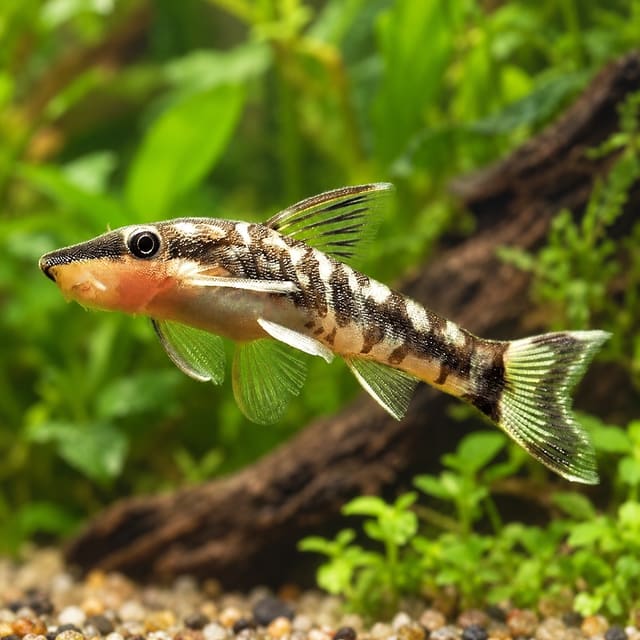
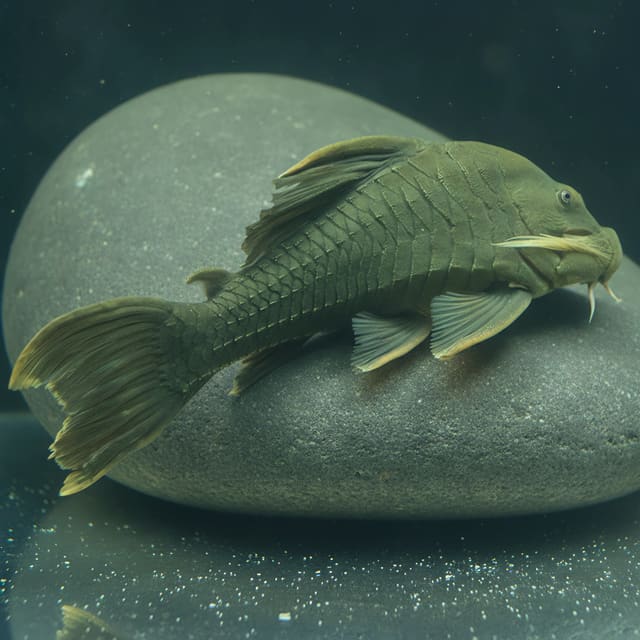
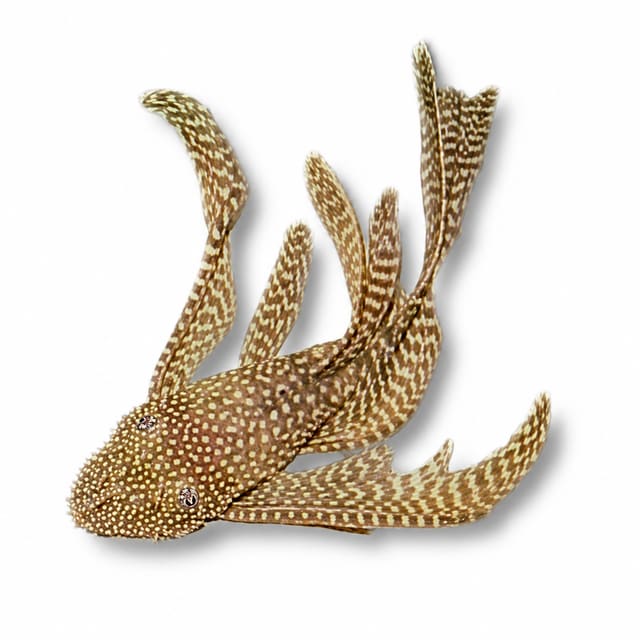
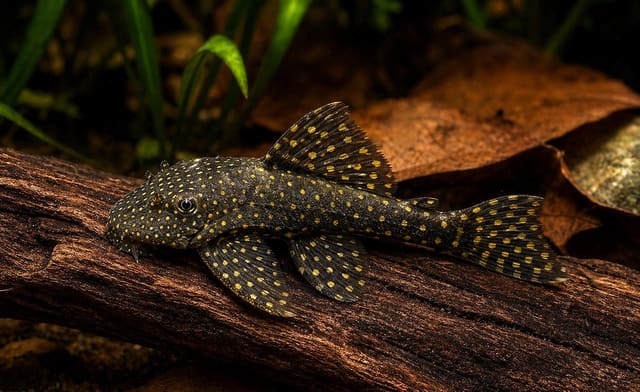
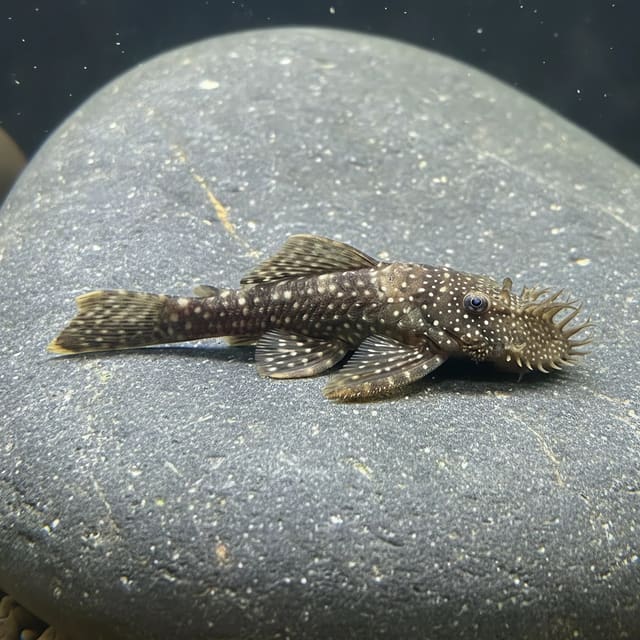
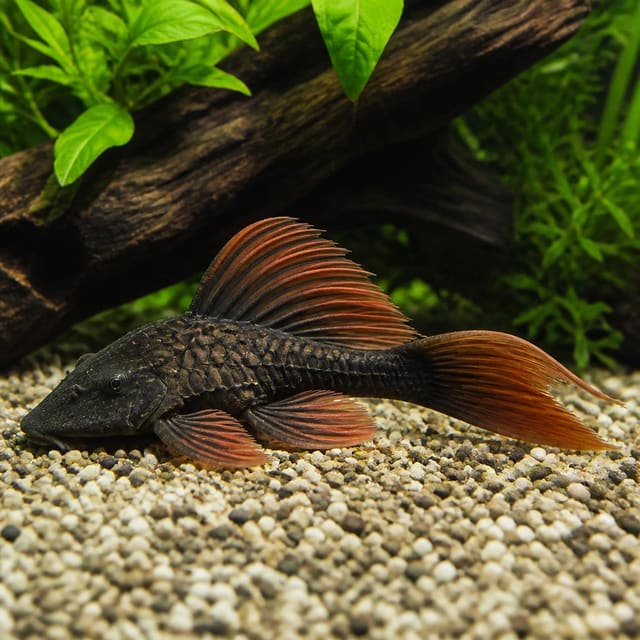
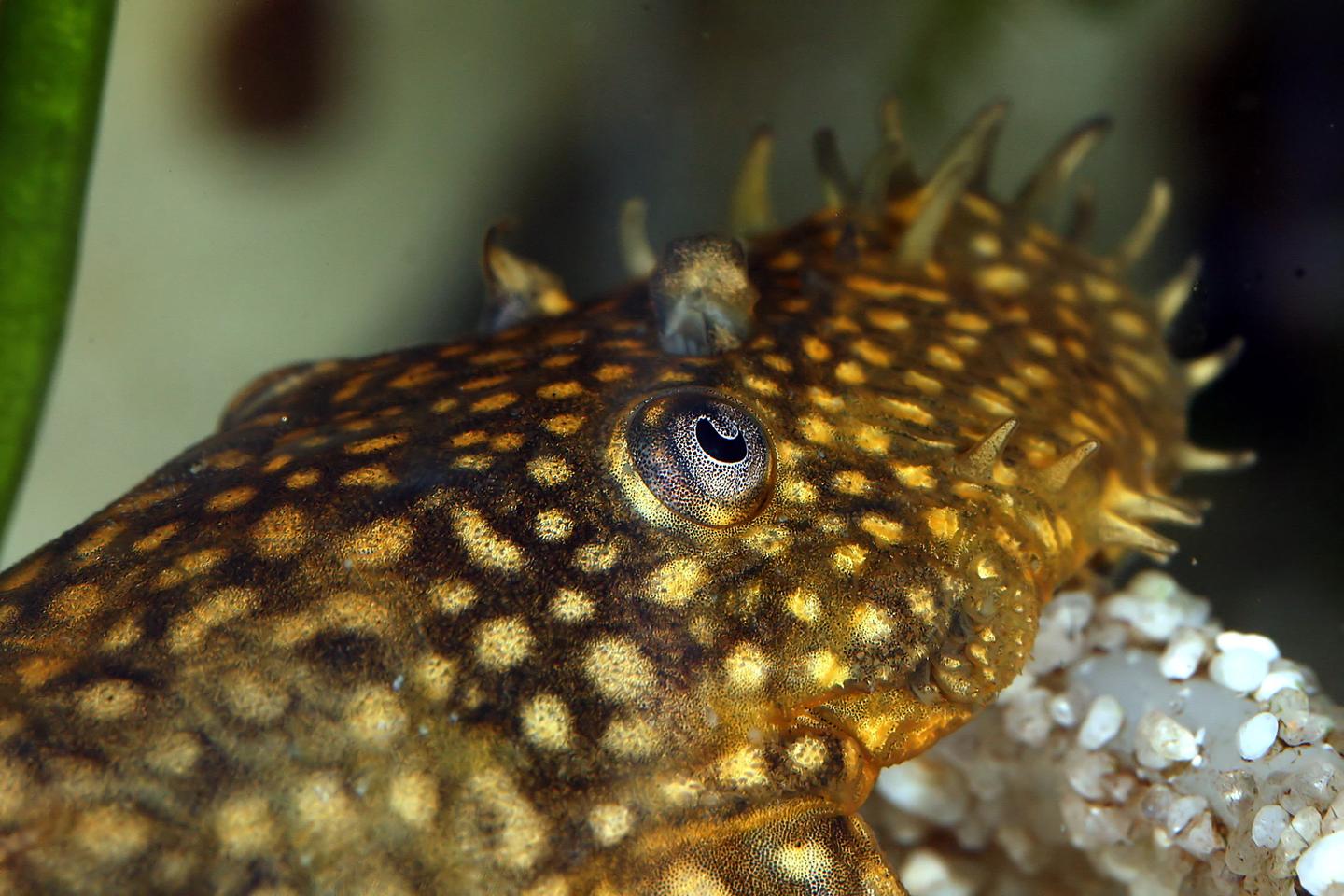
Like every Ancistrus, the L213 has a bony-plated body and a sucker-shaped mouth on the underside of the head. Wikipedia describes the genus as typically mottled brown, grey or black, often with white or yellow spots, and the reference photographs on ScotCat fit that pattern: a very dark, almost black fish peppered with tiny pale dots across the head and body. The male in those photographs carries a thick fringe of branched, fleshy tentacles on the snout, and the female is greyer, with the same fine spotting and much smaller growths on the snout edge.
Those tentacles are the "bristles" in bristlenose. ScotCat notes that mature males tend to have them and that females show the trait on a lesser scale. Wikipedia adds that males also have evertible cheek spines, called odontodes, which females lack or barely show. Young fish of both sexes look much alike, so the bristles are a guide to adults rather than to juveniles.
Each order on this page is for one L213 bristlenose. The listing does not specify a sex, and we do not promise one. It also does not state a dispatch size, so if size matters for your set-up, ask us before you order and we will tell you what we are currently sending.
| Point | Detail |
|---|---|
| Scientific name | Ancistrus sp. (L213), undescribed; also recorded as L370 |
| Family | Loricariidae (suckermouth armoured catfish) |
| Origin | Rio Tapajós at Pimental, Pará, Brazil |
| Size | About 10 cm (ScotCat) |
| Temperature | 26–30 °C |
| pH | 5.5–7.0 |
| Aquarium | 80 litres or more, with caves and wood |
| Diet | Mainly vegetable foods, plus some meaty foods |
| Social | One male per group; peaceful with other fish |
| Breeding | Cave spawner; the male guards eggs and fry |
ScotCat gives the distribution of L213 as South America: Brazil, Pará state, Rio Tapajós, with Pimental as the locality. The Tapajós is a major tributary of the Amazon. Wikipedia describes it as roughly 840 km long, or about 2,080 km if you count the Juruena, its main headwater, and it runs mainly through Pará before joining the Amazon at Santarém. Its upper course has substantial cataracts and rapids.
The Tapajós has historically been one of the largest clearwater rivers in the Amazon basin, once known locally as the "blue river". Wikipedia reports that illegal gold mining has since clouded parts of it to a light brown colour, and it lists proposed hydroelectric dams, including São Luiz do Tapajós, among the threats to the basin's endemic species. About 325 fish species are known from the Tapajós basin, 65 of them endemic, and Wikipedia notes estimates that more than 500 will eventually be recognised. L213 is one of the many catfish from that river still waiting for a scientific name.
For the genus as a whole, Wikipedia describes Ancistrus as native to freshwater in South America and Panama and notes that wild populations prefer flowing water. It also lists the natural diet of the genus as algae, aufwuchs (the film of algae, micro-organisms and debris that coats submerged surfaces) and detritus. Those two points, moving water and a grazing lifestyle on hard surfaces, shape almost everything about how you should set up a tank for this fish.
ScotCat lists the conservation status of L213 as not evaluated by the IUCN, which is normal for a fish that has not yet been described.
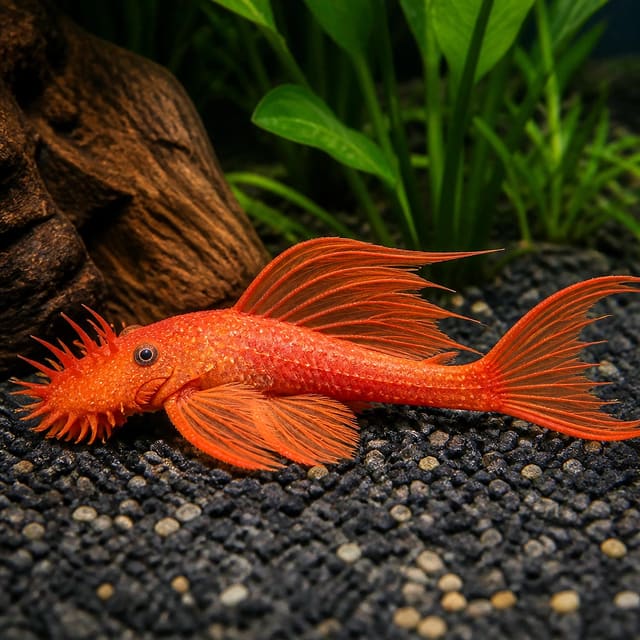
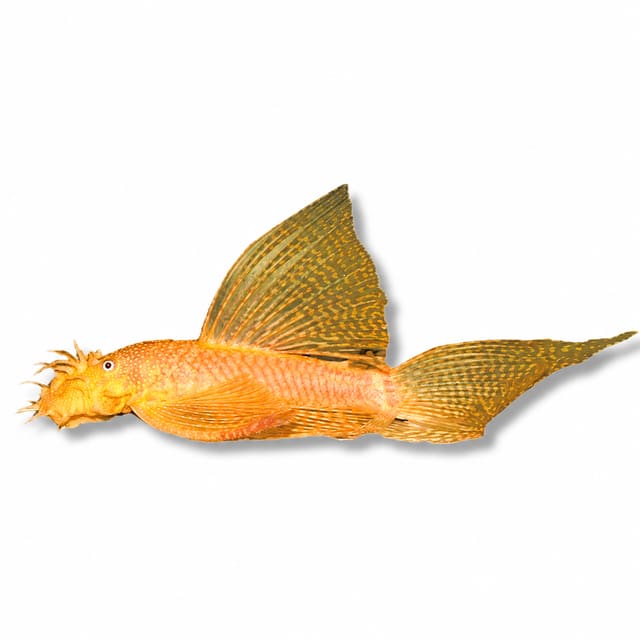
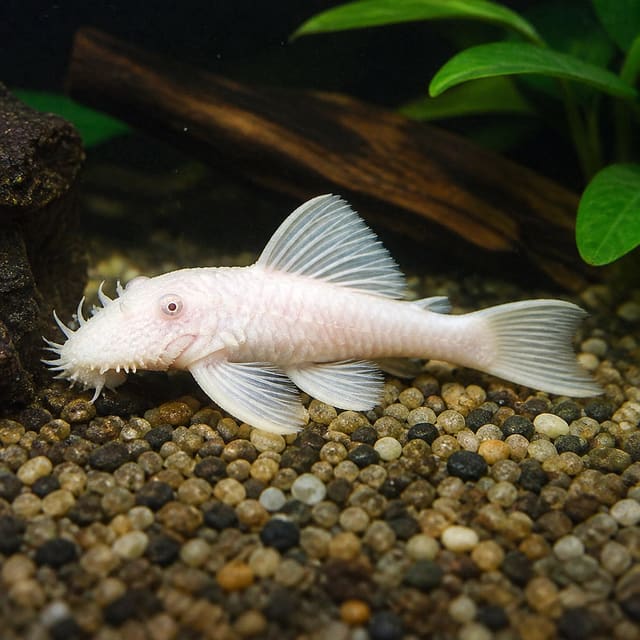
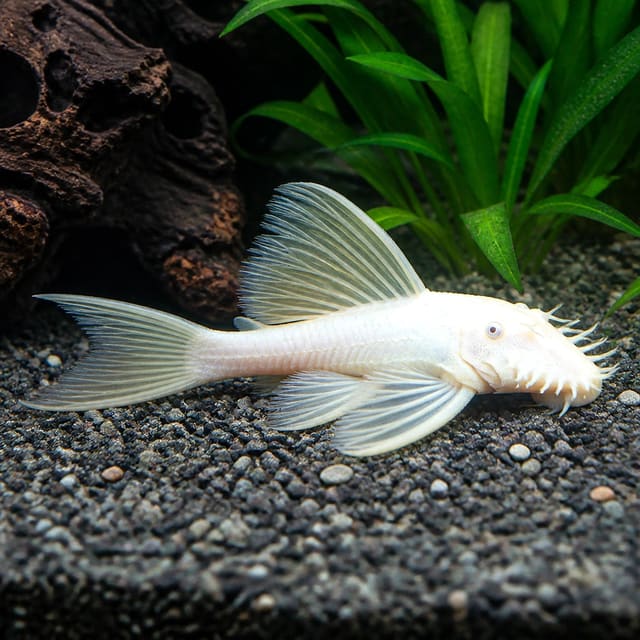
The bristlenose most fishkeepers know is the common bristlenose. Seriously Fish files that fish as Ancistrus sp. '3' and describes it as the ubiquitous bristlenose of the hobby, bred commercially on a large scale, with an unknown precise origin; some believe it may be a hybrid. Our common Bristlenose Pleco (Ancistrus sp.) listing covers that fish and its colour forms.
L213 is a different animal: a distinct bristlenose species with a known river of origin and its own requirements. The table below sets the two side by side using the figures each source gives.
| L213 (ScotCat) | Common bristlenose, Ancistrus sp. '3' (Seriously Fish) | |
|---|---|---|
| Origin | Rio Tapajós at Pimental, Pará, Brazil | Unknown; widely bred, possibly a hybrid |
| Size | 10 cm | 125 mm standard length |
| Temperature | 26–30 °C | 21–26 °C |
| pH | 5.5–7.0 | 5.5–7.5 |
| Hardness | Not stated | 1–15 °dGH |
| Look | Very dark, finely spotted with white (ScotCat photographs) | Many bred colour and fin forms, including long-finned, albino and white (OATA) |
The practical difference is temperature. The range ScotCat gives for L213 starts where the common bristlenose's range ends, so the two are not interchangeable in a cooler community tank. If you keep your aquarium in the low twenties, the common bristlenose is the better fit; if your tank already runs warm and soft, L213 suits it well.
L213 is one of several Ancistrus that carry their own codes or names rather than being colour forms. If you are comparing, we also have the Pearl Sucker Pleco L059 (Ancistrus hoplogenys) and L034 Ancistrus ranunculus, each with its own care notes. Check each listing's figures before mixing them, because their needs differ.
It is a good choice if most of these are true:
OATA's own checklist before buying any fish asks the same kind of questions: do you have the right equipment and position for the aquarium, have you researched every species you plan to keep and checked they are compatible, do you know how to release new fish, are you aware of the daily, weekly and monthly maintenance, and are you prepared to look after the fish for the whole of its life? If the honest answer to the temperature question is no, the common bristlenose is the kinder choice.
Bristlenoses are among the smaller suckermouth catfish, which is a large part of their appeal. OATA, the UK's ornamental fish trade association, recommends an aquarium of at least 80 litres for the smaller pleco species, and its general rule is to buy, within reason, as large an aquarium as possible, because a larger volume keeps temperature and water quality more stable. A filter is always essential. For comparison, Seriously Fish considers a tank with a base of 60 × 30 cm enough for a single common bristlenose or a breeding pair. Our care summary for L213 uses 80 litres as its starting point.
OATA describes bristlenose catfish as quite secretive and says they thrive in aquariums with lots of cover and at least one piece of wood to graze on. In practice that means:
Wild Ancistrus prefer flowing water, according to Wikipedia, and Seriously Fish notes that even the undemanding common bristlenose prefers well-oxygenated water. For L213, which comes from a large Amazonian river and is kept warm, good oxygenation matters even more because warm water holds less dissolved oxygen. Arrange the filter outlet or an air stone so the surface keeps moving, and avoid tanks so densely stocked that the water becomes stale.
With a recommended range of 26–30 °C, this fish needs a reliable heater sized for the tank and a thermometer you can read at a glance. Position the aquarium away from draughts, radiators, direct sunlight, loud noises and vibration so the temperature holds steady and the fish is not startled. OATA's shopping list for these fish also includes a tap water conditioner to remove chlorine and chloramine, freshwater test kits for ammonia, nitrite, nitrate, pH and hardness, and cleaning kit such as a siphon and bucket. A secure lid is sensible for any aquarium, and shaded corners under wood or plants give a secretive catfish somewhere to rest during the day.
The figures for L213 itself come from ScotCat, which gives 26–30 °C and pH 5.5–7.0. OATA's general guidance for bristlenose catfish, written for the common bristlenose and other algae eaters, is wider and cooler: 22–27 °C, pH 6.0–8.0, general hardness of 4–12 °dH and carbonate hardness of 3–10 °dKH. Because those general figures are not specific to this fish, our care summary follows ScotCat for L213 and treats the OATA hardness figures as a sensible general guide.
| Parameter | L213 (ScotCat) | Bristlenose catfish in general (OATA) | Our care summary |
|---|---|---|---|
| Temperature | 26–30 °C | 22–27 °C | 26–30 °C |
| pH | 5.5–7.0 | 6.0–8.0 | 5.5–7.0 |
| General hardness | Not stated | 4–12 °dH | Soft to medium |
| Carbonate hardness | Not stated | 3–10 °dKH | Soft to medium |
| Ammonia and nitrite | Not stated | Zero | Zero |
| Nitrate | Not stated | No more than 20 mg/L above tap water | As OATA |
Where the two ranges overlap, at 26–27 °C and pH 6.0–7.0, you have water that suits both this species and the general bristlenose advice, and that is a comfortable band to aim for. There is no need to chase the top of ScotCat's range. Check the pH and hardness of your tap water before buying, and if it is well outside these figures, set the tank up for soft, slightly acidic to neutral water from the start rather than chasing the numbers with repeated adjustments.
Add new fish gradually. OATA explains that the filter bacteria need time to catch up whenever stocking and feeding increase; overstocking, or stocking too quickly, causes "new tank syndrome", when ammonia and nitrite rise to levels that can make fish ill or kill them.
Algae can be a sign of a water chemistry problem rather than a lack of algae eaters. OATA puts it plainly: algae-eating fish are not a substitute for regular maintenance and appropriate stocking levels.
In the wild, Ancistrus graze algae, aufwuchs and detritus from surfaces, according to Wikipedia. In the aquarium that grazing habit needs backing up with proper food. OATA states that bristlenose catfish and other algae eaters need their diet supplemented with prepared foods such as algae-based wafers or flakes, and ideally fresh vegetables such as cucumber. ScotCat's diet note for L213 lists vegetable foods such as cucumber and courgette, along with tablet foods and meaty foods.
OATA's rule for algae eaters is to feed only what the fish can eat within a few minutes, once a day, while noting that some grazers need extra time with algal foods. In practice a vegetable slice can be left for longer than flake would be, but remove what has not been eaten before it starts to break down. Overfeeding leaves uneaten food to rot and release toxic waste into the water. Because bristlenoses are secretive, it can help to add sinking food shortly before the lights go out, so the catfish is not outcompeted by livelier tank mates.
Bristlenoses are often said to eat wood. Wikipedia's article on the genus is direct about it: despite reports from aquarists, no scientific evidence to date supports members of this genus feeding on wood. OATA still recommends at least one piece of wood for bristlenoses to graze on, and the two points fit together. The wood offers a surface for the biofilm and algae the fish grazes, and shelter, even if the wood itself is not food.
Bristlenoses are generally good community fish. OATA's catfish sheet counts smaller plecos among the excellent additions to a community aquarium, and ScotCat's aquarium notes describe the genus as making good community fish where they do not outgrow the tank, and at around 10 cm the L213 suits most medium aquariums. Seriously Fish describes the common bristlenose as relatively peaceful but territorial with its own kind and with similarly shaped species. That territoriality is the key to keeping more than one.
OATA says bristlenose catfish can be kept alone, in pairs or in small groups, but that it is usually best to have just one male per group. Adult males are territorial towards one another, so if you want more than one L213, plan for one male with one or more females and give every fish its own cave. Since sex is not sold with this listing and young fish are hard to sex, a single fish is the simplest choice for most community tanks. If you buy more than one, be ready to rehome a second male if one turns out to be bullying the other.
Choose tank mates by water first. Anything kept with L213 must be comfortable at 26 °C or above in soft to neutral water, which rules out many cooler-water community fish. Beyond that, the sources point to a few sensible rules:
Bristlenoses are secretive, so don't worry if you see your L213 less often than your other fish in the first weeks; a good cave and a piece of wood will be where it spends much of its time.
Bristlenoses are among the easier catfish to breed. OATA's catfish sheet names bristlenose catfish as the catfish most likely to breed in the home aquarium, its algae-eater sheet adds that males and females can breed in a community tank given a suitable cave or crevice, and Wikipedia notes that the genus breeds easily in captivity. ScotCat describes how it works for L213 and its relatives.
Breeding often happens without any special effort. OATA says you may first notice small fry in the aquarium once they are large enough to swim freely, and Seriously Fish makes the same point about the common bristlenose: in a well-maintained, mature set-up, juveniles may simply begin to appear. In a community tank, ScotCat notes that a few fry will survive if there are enough hiding places. If you want to raise more, a separate rearing tank gives the fry a better chance than a busy community aquarium.
Breeding L213 also helps the hobby. A fish that has never been formally described, from a river under pressure from mining and dam proposals, is worth maintaining in aquariums with its identity intact.
Checking on a catfish that spends much of its time hidden takes a little more effort than watching a shoal in open water. OATA describes a healthy fish as having clear bright eyes, undamaged fins, intact scales, no ulcers or bumps, normal swimming and steady breathing. OATA also lists changes in body weight among its warning signs, and on a suckermouth catfish the belly is the easiest place to judge condition: a hollow underside is worth acting on.
OATA also lists clamped fins, flicking against gravel or décor, and shimmying as signs of disease. If you notice any of these, test the water first and then seek advice. You are welcome to contact us with your test results.
OATA warns that most catfish have spines on the front (pectoral) fins and just behind the gills, so take care whenever you handle one. Net it gently and avoid lifting it out of the water in your hands.
We have not found a published lifespan for L213 itself. OATA's general catfish sheet says that, regardless of size, catfish can live for several years in a well-matured set-up with good water quality, which is the realistic expectation if you look after the water and diet.
OATA's care sheet also reminds owners of the Animal Welfare Act 2006, which gives every pet keeper a legal duty of care, and stresses that aquarium fish must never be released into the wild.
A warm-water catfish settles best into a tank that has been ready and stable for some time. Before you order, make sure the filter is running and matured, ammonia and nitrite read zero, and the heater is holding the temperature you intend to keep. Please read our delivery and live-arrival information before ordering, and make sure someone will be at the delivery address to receive the parcel.
Your L213 travels in an oxygen-filled bag inside insulated packaging, with heat packs when conditions call for them, carried by a tracked courier licensed to carry live animals. The confirmed delivery date and tracking are sent to you by email.
Keep the lights low and expect your bristlenose to vanish into a cave or under wood straight away; for a secretive catfish that is normal. Over the first week, watch its breathing, appetite and behaviour. Offer a sinking wafer or a slice of vegetable in the evening and check the next morning whether it has been grazed. Seeing the fish out at dusk, or finding that a vegetable slice has been grazed, are good signs that it has settled.
The details on this page come from the following sources. They are worth reading if you want to know more about L213 and bristlenose catfish:
No reviews for this item yet. Bought one? Honest reviews only, good or bad.
What customers say about ordering from us
Easy website plenty of info on fish your buying great to pick a time slot
TRACEY DURRANT · 7 Oct 2026
Got some lovely fish thank you
Kevin Mackie · 7 Oct 2026
Reviews of our shop, collected by Judge.me, an independent third-party review collector. Newest first.