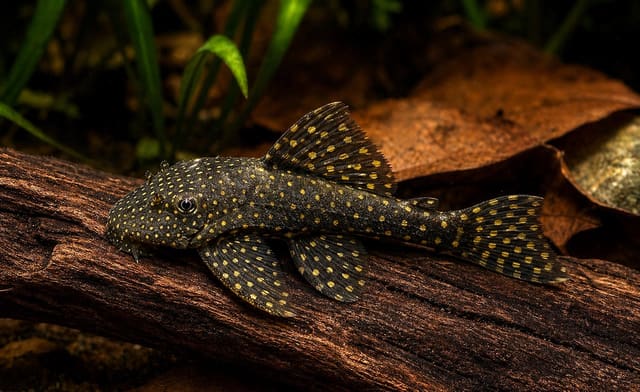
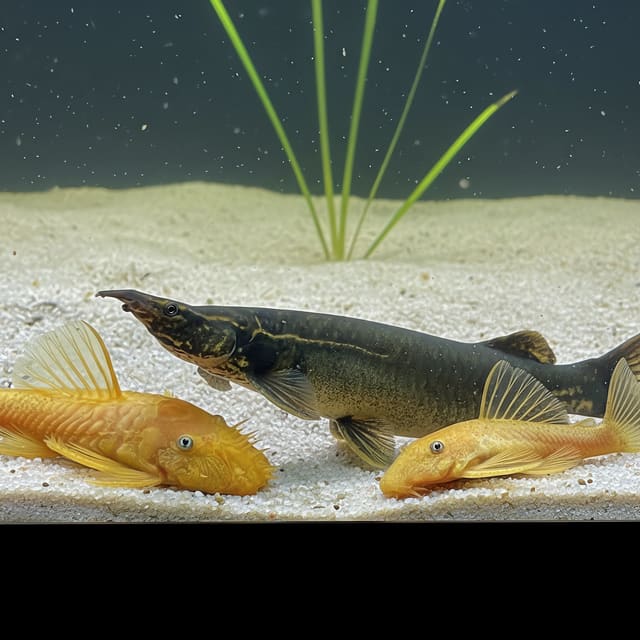
Moderate
Bristlenose Pleco (Ancistrus sp.)
22–27°C · pH 6–8
From £3.51Some sizes on sale

L034 Ancistrus ranunculus is a freshwater loricariid from Brazil’s Xingu and Tocantins river basins that reaches 19.5 cm. It suits experienced keepers able to provide an 80 × 30 cm base, 25–28°C, pH 6.0–7.0, 2–10 dGH, strong movement and high oxygenation. Sold individually in dispatch sizes from 4–6 cm to 8–9 cm.
Adult size is the maximum length this species reaches at full maturity (scientific sources). The livestock you receive will be younger and smaller — pick a size above for the actual shipping size. Product-photo provenance and any image-specific limitations are stated on the listing.
Ancistrus ranunculus
L034 Ancistrus ranunculus is a freshwater loricariid from Brazil’s Xingu and Tocantins river basins that reaches 19.5 cm. It suits experienced keepers able to provide an 80 × 30 cm base, 25–28°C, pH 6.0–7.0, 2–10 dGH, strong movement and high oxygenation. Sold individually in dispatch sizes from 4–6 cm to 8–9 cm.
Adult size is the maximum length this species reaches at full maturity (scientific sources). The livestock you receive will be younger and smaller — pick a size above for the actual shipping size. Product-photo provenance and any image-specific limitations are stated on the listing.
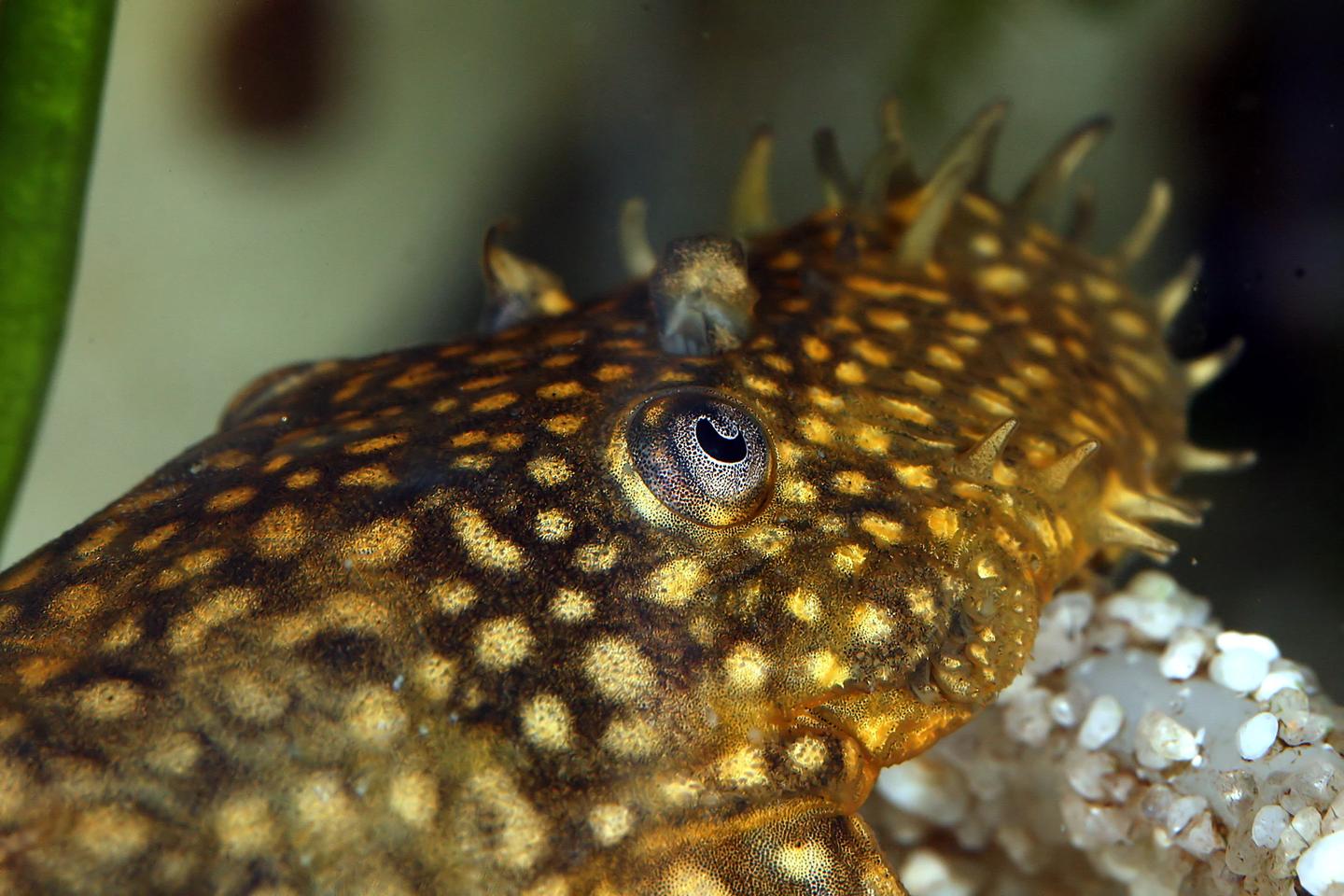
For one typical common bristlenose, start with a mature, filtered aquarium of at least 90 litres, useful floor area, wood and cover. OATA reports about 15 cm adult length, 22-27°C, pH 6-8 and 4-12 dGH. Confirm the exact trade identity before applying species-level claims.
Maintain these water conditions for optimal health and vibrant colors
The L034 pleco (Ancistrus ranunculus) is a freshwater, bottom-living loricariid from the Xingu and Tocantins river basins of Brazil that reaches 19.5 cm. It suits experienced keepers prepared to provide warm, highly oxygenated water, sustained movement, secure rock refuges and deliberate feeding. Its generally peaceful nature does not make it a routine community choice because the aquarium must be planned around these specialised conditions.
FishBase places Ancistrus ranunculus in the Xingu and Tocantins river basins of Brazil. It inhabits clear running water and uses narrow cracks, passages between overlapping rocks and spaces beneath flat rocks. During the dry season it has been recorded at depths of up to 3 metres in water without a strong current. These observations explain why close-fitting rock refuges matter, while aquarium husbandry still calls for substantial movement and oxygenation.
The same reference records a maximum of 19.5 cm total length for a male or unsexed fish and classifies the wild population as Near Threatened. Plan conservatively around that recorded maximum rather than treating a dispatch measurement as the final size.
This is not simply an algae-control purchase. Its species diet is more protein-rich than that of many other Ancistrus, and it still needs deliberate feeding. It also requires a refuge of its own and tank mates able to thrive in the same warm, moving water. Browse the bristlenose pleco collection if you want to compare that commitment with other members of the group.
| Suits | Not suited to |
|---|---|
| Experienced keepers able to maintain warm, highly oxygenated, moving water | A routine community aquarium without matching flow and oxygenation |
| An aquarium with secure rock refuges and an 80 × 30 cm base | A layout that cannot provide one refuge per fish |
| Tank mates that share its water and current requirements | Tank mates that need different water conditions or control its refuge |
Seriously Fish gives an 80 × 30 cm aquarium base, equivalent to about 72 litres, as sufficient for a couple of specimens. Larger quarters are required for a group. Use the footprint as the decisive measurement because this bottom-dwelling fish needs usable floor area for rocks, passages and separate refuges, not just water above it.
Plan around FishBase’s recorded maximum of 19.5 cm total length. Seriously Fish separately records 13 cm standard length. Lay out each shelter and passage for a fish approaching the larger 19.5 cm planning figure.
| Decision | Planning value |
|---|---|
| Adult-size reference | Maximum 19.5 cm total length |
| Base for one or a couple | At least 80 × 30 cm, about 72 litres |
| Routine temperature | 25–28°C |
| pH | 6.0–7.0 |
| General hardness | 2–10 dGH |
| Water movement | Strong movement with high oxygenation |
The aquarium profile gives 25–30°C, while FishBase records 25–28°C for the species’ wild environment. A routine target of 25–28°C remains inside both ranges. Keep pH between 6.0 and 7.0 and hardness between 2 and 10 dGH.
These requirements work as one system. Warm water must remain well oxygenated, the filter must process the fish’s waste, and the arrangement must preserve enough floor space for secure retreats. A nominally large aquarium is still a poor fit if rockwork occupies every passage or the filter cannot create the required movement.
One purchase supplies one animal of the size selected on the live selector. The size choices are labelled 4–6 cm, 5–7 cm and 8–9 cm; use the selector to see which choice can be ordered. The size you select is the size supplied, not the adult size.
A smaller dispatch measurement does not establish age, sex or eventual length. Prepare the same adult aquarium before ordering any of the size choices, with an 80 × 30 cm base, suitable water movement and a refuge laid out for the larger planning size. This avoids making a temporary measurement responsible for a long-term space decision.
Sex is guaranteed only when the selected option explicitly states male or female. This L034 Ancistrus ranunculus listing has no sex-guaranteed option.
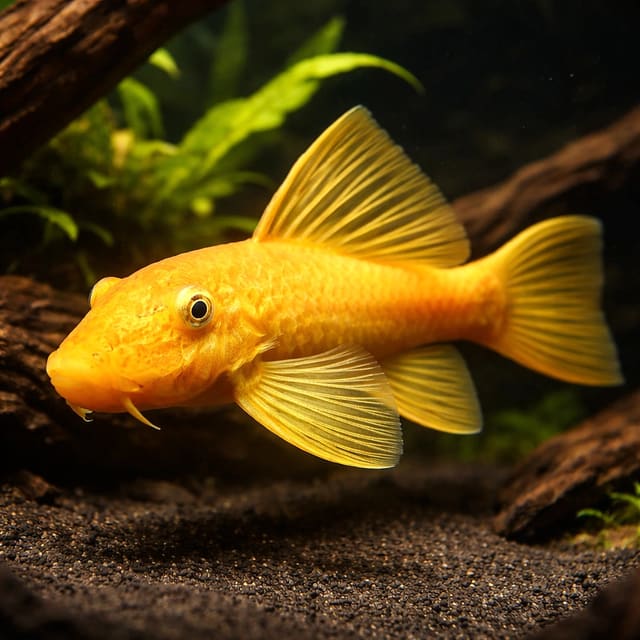
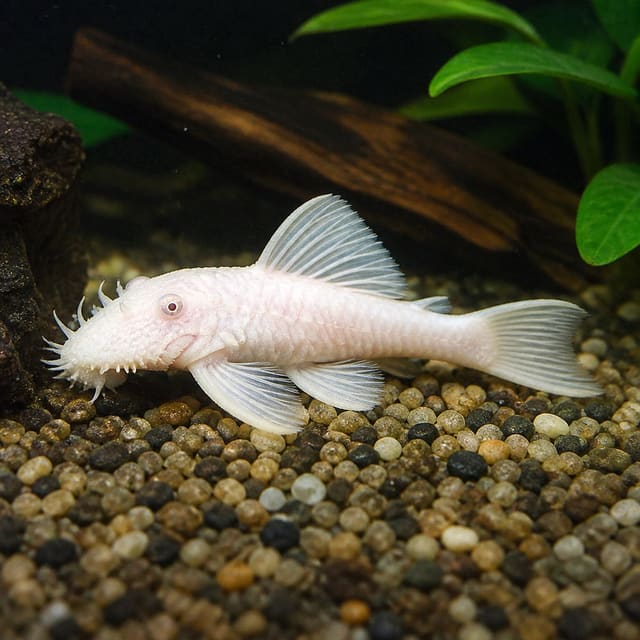
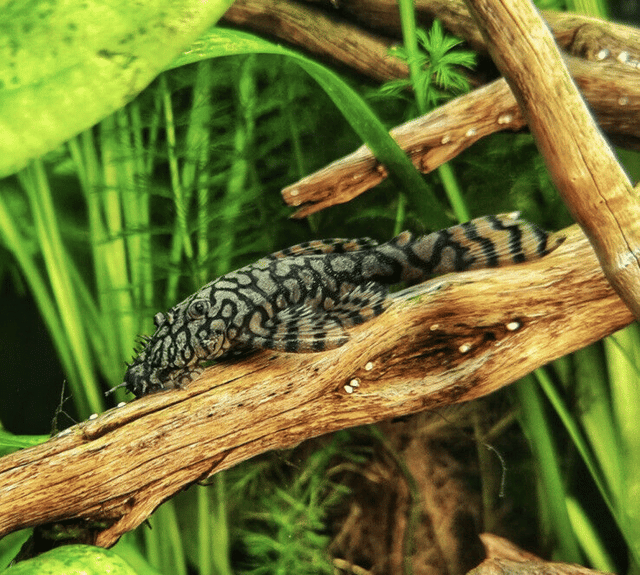
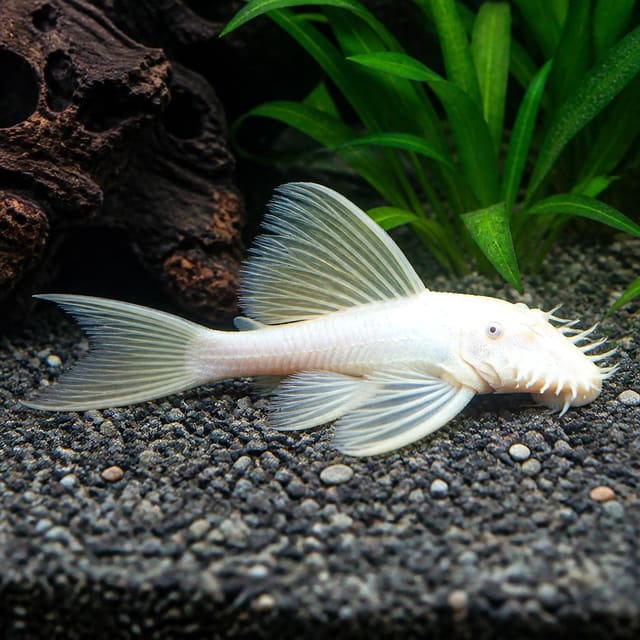
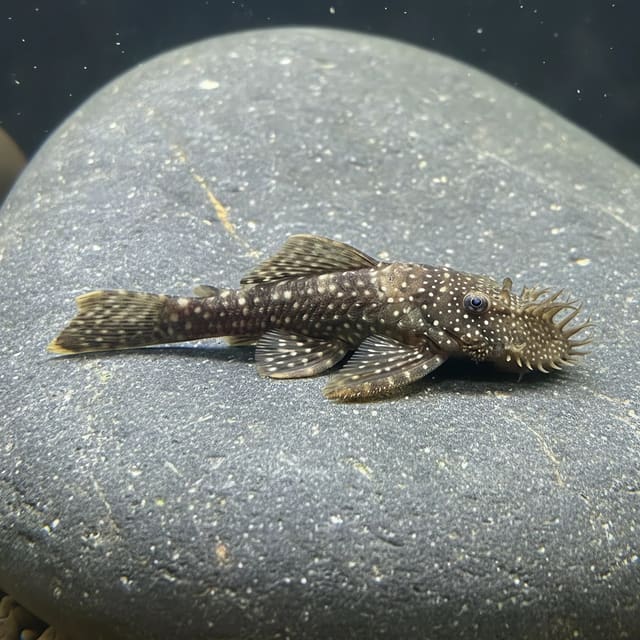
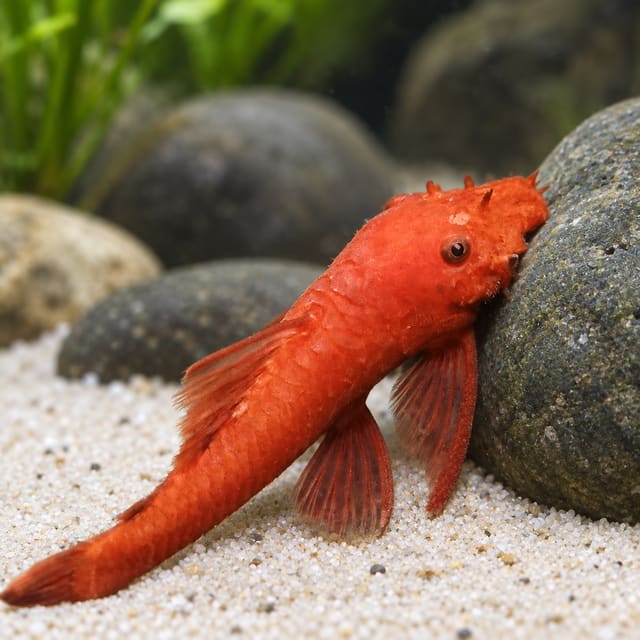
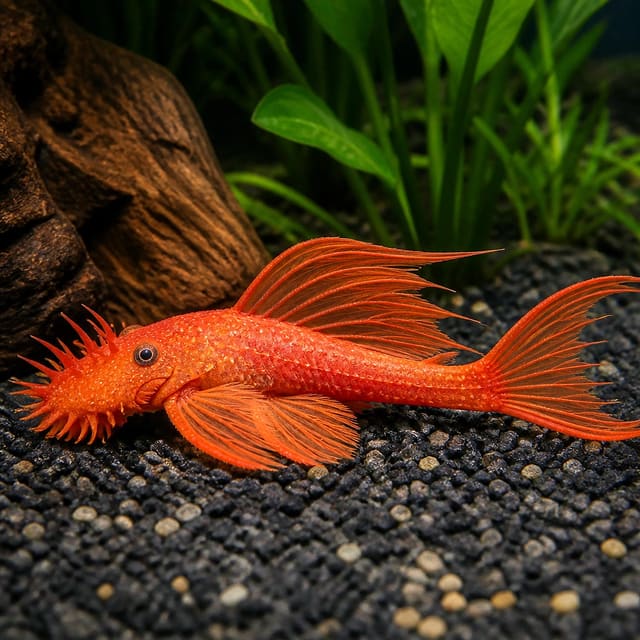
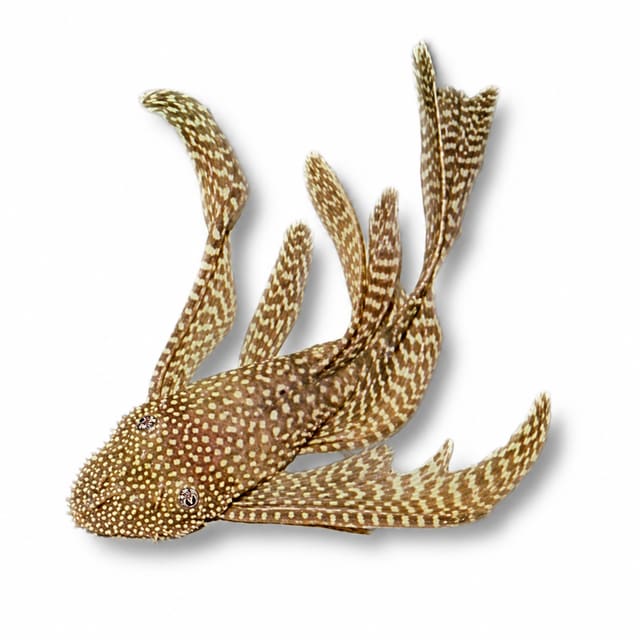
The gallery images are representative, based on reference photographs of this species, so colours can look slightly different from the live animal.
Start with an aquarium base of at least 80 × 30 cm, equivalent to about 72 litres. That footprint is described as sufficient for a couple, while a group needs larger quarters. For a single fish, the same baseline leaves room for the filter, current and adult-sized refuge without forcing every function into one small area.
Use aquarium sand or gravel with rounded stones and rocks. Create narrow passages between securely positioned rocks and shaded spaces beneath flat pieces, reflecting the places this fish uses in the Xingu and Tocantins systems. Every structure must remain stable when the fish moves beneath or alongside it.
Give each specimen a refuge it can occupy without sharing an entrance. The opening should admit the fish comfortably while still feeling enclosed. If two fish repeatedly meet at the same shelter, add or reposition cover rather than expecting them to divide one preferred crack peacefully.
A stream-style arrangement suits the species, but a planted aquarium can also work. High movement may make some live plants difficult to maintain, so prioritise oxygenation and fish access over a dense planting plan. Plants must not block the outlet, close a refuge entrance or remove the open base needed for movement.
Inspect the layout from the fish’s level before filling the aquarium. A cave that looks spacious from above may taper sharply at the rear, while stacked rocks can create an inaccessible trap. Build for a fish approaching 19.5 cm total length and leave enough room for it to turn or reverse out.
Set the routine temperature to 25–28°C. This target remains within both the 25–30°C aquarium range and FishBase’s 25–28°C environmental record. Maintain pH 6.0–7.0 and general hardness 2–10 dGH. Stability within those limits is more useful than repeatedly moving a reading towards an arbitrary midpoint.
Test the aquarium rather than estimating from the local water supply or an earlier result. Our water chemistry guide explains what the principal readings mean, while the water matcher lets you compare measured values with this fish’s target range.
| If the reading is | Make this decision |
|---|---|
| 25–28°C | Keep the heater and flow arrangement stable. |
| Above 28°C | Return the routine temperature to the shared 25–28°C range. |
| pH 6.0–7.0 | Avoid unnecessary adjustment. |
| Outside pH 6.0–7.0 | Resolve the mismatch before introducing the fish. |
| 2–10 dGH | Use it as the working hardness range. |
| Outside 2–10 dGH | Choose livestock suited to the measured water or prepare a stable correction first. |
Temperature, pH and hardness must also suit every proposed tank mate. A fish described as peaceful is not compatible if it needs cooler, harder or more alkaline water. Screen the shared range before temperament or colour.
Place the thermometer where it represents the occupied aquarium rather than directly beside the heater. Test after equipment changes and continue weekly water-quality checks, because a correct temperature does not reveal ammonia, nitrite or nitrate.
This species needs well-oxygenated water with substantial movement and will not do well without a degree of current. For an aquarium of about 72 litres, the species profile recommends turnover of four to five times the volume each hour. That calculation gives 288–360 litres per hour, aligning with its suggested filter rating of about 290–360 lph.
Multiply the aquarium volume by four and five to create the starting turnover band. A 72-litre aquarium gives 288–360 lph; a different volume needs its own calculation. Filter ratings are a selection aid, while rocks, media condition and outlet position influence how movement reaches the occupied part of the aquarium.
The RSPCA explains that a working biological filter supports bacteria that convert toxic ammonia to nitrite and then to the safer nitrate. Keep that filter running and maintained; water movement alone does not replace biological filtration.
OATA’s freshwater algae-eater sheet gives group guidance: test water weekly, hold ammonia and nitrite at 0 mg/L, and keep nitrate from exceeding 20 mg/L. It also stresses that algae-eating fish are not substitutes for maintenance or appropriate stocking.
| Weekly check | Target or action |
|---|---|
| Ammonia | 0 mg/L |
| Nitrite | 0 mg/L |
| Nitrate | No more than 20 mg/L |
| Outlet flow | Clear, sustained movement |
| Filter operation | Continuous biological filtration |
At least once a week, change 25% of the aquarium water. If waste readings rise, check feeding, stocking, trapped food and filter performance together. Correct the cause rather than relying on an algae-eating fish to disguise it. Keep enough surface movement to support oxygenation without allowing unstable rockwork to shift.
Ancistrus ranunculus prefers a more protein-rich diet than most Ancistrus. Use a quality sinking dried food as the regular base and add live or frozen foods such as bloodworm, chopped mussel or prawn. Do not treat algae growth, wood or general aquarium debris as a complete diet.
Start with a modest portion that reaches the fish and remove anything left uneaten before it breaks down. Bottom-feeding fish may need time to locate food, so watch whether the portion is actually reached rather than increasing it automatically. Uneaten food adds toxic waste to the aquarium.
| Food role | Supported choices |
|---|---|
| Regular base | Quality sinking dried food |
| Protein supplement | Live or frozen bloodworm |
| Varied supplement | Chopped mussel or prawn |
Place the food where the fish can reach it without entering another specimen’s refuge. In a multi-fish aquarium, use separated feeding positions and watch each position rather than assuming one missing portion means every fish ate. Territorial bickering around shelter can also restrict access to food.
A rounded belly and eyes that are not sunken are useful condition checks for loricariids. Feeding success should therefore be judged by both food uptake and body condition, not by whether the aquarium glass looks cleaner.
Choose equipment for the aquarium volume, room temperature and rock layout rather than copying a wattage or flow rate without context. For a roughly 72-litre aquarium in a room around 20°C, the species profile estimates about 125–150 W to hold 25–30°C. Because the routine target here is 25–28°C, treat that wattage as a contextual equipment example and confirm stable operation with a thermometer.
One device may contribute to more than one job, but do not assume a visible current proves that biological filtration is mature. Likewise, a filter can process waste while leaving sheltered corners with little movement. Check the whole route from outlet to intake after rocks and refuges are in place.
For 72 litres, four times turnover is 288 lph and five times is 360 lph. Start by looking in the 290–360 lph rating range, then assess how the completed arrangement distributes that movement. If plants bend or fail under the required current, simplify the planting rather than reducing oxygenation below the fish’s needs.
Secure cables and equipment so maintenance does not disturb the rockwork. Keep the heater exposed to circulating water and leave the filter intake accessible for inspection. A hidden intake that cannot be checked encourages debris accumulation, while an outlet blocked by plants or stone cannot distribute movement effectively.
Have the aquarium fully prepared before the fish arrives. The biological filter must be established, the heater must hold 25–28°C, and tests must show 0 mg/L ammonia, 0 mg/L nitrite, pH 6.0–7.0 and hardness 2–10 dGH. Complete the rockwork and confirm that every refuge remains stable before adding livestock.
If this is your first setup, use our guide to preparing and maturing a tropical aquarium before choosing a delivery date. Maturation applies to the biological filter and aquarium system, not to a container of water.
Run the aquarium with the rocks, substrate and refuges in their final positions before arrival. Watch whether movement reaches the spaces beside and beneath the cover rather than travelling only across the surface. Check the outlet after any stone or plant is moved, because a small change can redirect flow away from the occupied base.
Use the same completed arrangement when checking temperature and water quality. A reading taken before the heater, filter and rockwork settle into normal operation may not represent the conditions the fish will occupy. Confirm that the filter intake remains accessible, that debris is not collecting behind a refuge and that every rock stays secure during routine maintenance.
Read the current delivery and Live Arrival Guarantee policy before the delivery window.
Keep the prepared refuge clear during release so the fish can move directly into cover. Do not dismantle the rockwork to make the animal remain visible. Once released, restore the aquarium to its normal calm routine and observe without repeated disturbance.
Judge progress through visible condition, food uptake and measured water quality. A healthy-looking loricariid should have a rounded belly rather than a hollow profile, and its eyes should not appear sunken. These checks are especially important for a species described as difficult to maintain when it arrives in poor condition.
If the fish misses food, first check competition and placement. If its belly becomes hollow, its eyes appear sunken or another health change develops, contact us with the aquarium readings and a clear description of the change.
Continue the measured feeding routine and weekly water testing. Record ammonia, nitrite, nitrate, temperature, pH and hardness so a change can be seen rather than guessed. Recheck filter movement after cleaning or repositioning equipment, because a shifted outlet can alter oxygenation around the refuges.
Expect some territorial bickering when more than one specimen is kept. If repeated disputes centre on one shelter, provide a separate refuge and more usable floor space. Do not solve a shelter conflict by adding food throughout the aquarium; extra food raises the waste load without creating another territory.
Cheek odontodes and pectoral spines can become entangled in a net. Avoid unnecessary capture. When movement is essential, prepare the destination first and minimise the time spent pursuing or restraining the fish.
Ancistrus ranunculus is generally peaceful, but it is not an automatic match for a general community aquarium. Compatibility begins with its specialised environment: 25–28°C, pH 6.0–7.0, hardness 2–10 dGH, high oxygenation and substantial movement.
In a biotope-style arrangement, Seriously Fish identifies Anostomus, Hemiodus, Semaprochilodus and Metynnis species, reophilic Retroculus cichlids and other loricariids requiring similar conditions as possible companions. These are conditional examples, not universal pairings. Adult size, behaviour, group requirements and the exact water range still need checking for the proposed species.
Map where every bottom-dweller will shelter and feed. Two fish described as peaceful may still compete if both depend on the same crack, cave or sinking-food position. Add separate refuges and separated feeding points before adding another bottom-oriented fish.
There is honest uncertainty whenever individual temperament, aquarium layout and an exact mix of fish have not been observed together. For a stocking and compatibility assessment, contact us with the aquarium dimensions, measured water values, filtration, established livestock and intended purchase quantity.
A single specimen avoids competition with another Ancistrus ranunculus for the same preferred crack. More than one can be kept when space and shelter are planned properly: about 72 litres with an 80 × 30 cm base is described as sufficient for a couple, while a group requires larger quarters.
| Planned quantity | Layout decision |
|---|---|
| One fish | Provide an adult-sized refuge and clear feeding access. |
| Two fish | Use at least the 80 × 30 cm baseline and provide two distinct refuges. |
| Group | Choose larger quarters, one refuge per fish and additional separation between territories. |
A “couple” in the aquarium-size guidance means two specimens; it does not make them a sexed or breeding pair. Choose quantity for the space you can provide and expect territorial bickering when multiple fish establish preferred shelters.
Refuges should be genuinely separate rather than two entrances into the same contested hollow. Spread them across the footprint while keeping the rockwork secure. Place sinking food so one fish cannot control every feeding point from a single shelter.
Observe access rather than counting caves alone. A refuge is useful only when its entrance, surrounding floor and approach route remain open to the intended fish. If one specimen stays outside while another moves repeatedly between several shelters, redistribute the cover so each fish has a practical retreat.
Check feeding access at the same time. Separated food positions should allow each specimen to reach sinking food without crossing the entrance controlled by another fish. When one fish consistently misses food, change the positions and shelter arrangement before increasing the amount offered.
As the fish grow, repeat the space check using their larger bodies rather than the dispatch measurements. A route that once allowed two specimens to pass may become a point of conflict, and an entrance can become too narrow. Enlarge the usable layout while keeping all rockwork stable and preserving movement around the bottom.
If disputes remain brief and every fish retains access to shelter and food, continue monitoring. If one fish is repeatedly displaced, redesign the shelter distribution or increase usable space. The solution is more appropriate territory, not reliance on the species’ generally peaceful description.
L034 Ancistrus ranunculus reaches a recorded maximum of 19.5 cm total length. Plan every refuge and passage around that adult figure rather than its dispatch size.
Start with an 80 × 30 cm base, equivalent to about 72 litres. Seriously Fish describes that footprint as sufficient for a couple, while a group requires larger quarters.
You can keep one fish or plan about 72 litres with an 80 × 30 cm base for a couple. Give each fish its own refuge and use larger quarters for a group.
L034 Ancistrus ranunculus is better suited to an experienced keeper because it needs warm, highly oxygenated water, substantial movement, secure refuges and careful feeding.
Feed L034 Ancistrus ranunculus a quality sinking dried food with regular live or frozen bloodworm, chopped mussel or prawn. Remove uneaten food before it breaks down.
Keep it at 25–28°C and pH 6.0–7.0, with general hardness of 2–10 dGH. The temperature is the overlap of FishBase’s 25–28°C environmental record and Seriously Fish’s 25–30°C aquarium range.
This fish is generally peaceful, but multiple specimens may show territorial bickering around refuges. Give each fish its own shelter and monitor whether every specimen can reach food and cover.
Possible companions include Anostomus, Hemiodus, Semaprochilodus or Metynnis species, reophilic Retroculus cichlids and other loricariids requiring similar conditions. Check that the exact species shares 25–28°C, pH 6.0–7.0, 2–10 dGH, strong movement and high oxygenation.
Start filming every delivery with the parcel still sealed, then open it in one continuous take and show the fish still inside the sealed bag. Someone must be present to receive it; float the bag for 20–30 minutes, then release the fish without pouring the bag water into the aquarium.
No reviews for this item yet. Bought one? Honest reviews only, good or bad.
What customers say about ordering from us
I have a small group of long finned mountain minnows. So was delighted to be able to order ten of this variety to increase the genetics in my tank . The ones I recieved are healthy but it’s to early to give a verdict on wether they are of a long finned type since they are small currently.
Gordon Walker · 23 Sept 2026
100% success travel and "installation". Pleased with quality of purchase. The Siamese fighter a bit "shy" so have not yet seen him at his best yet but looking good. Happy customer. GG
George E Garratt · 21 Sept 2026
Reviews of our shop, collected by Judge.me, an independent third-party review collector. Newest first.