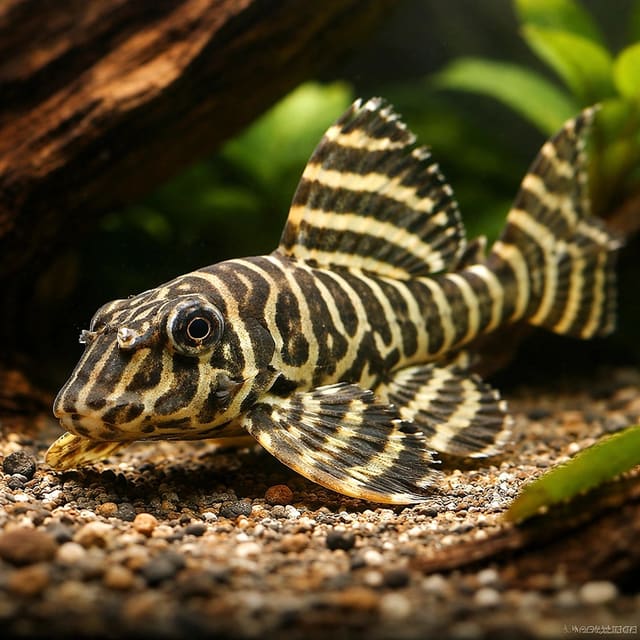
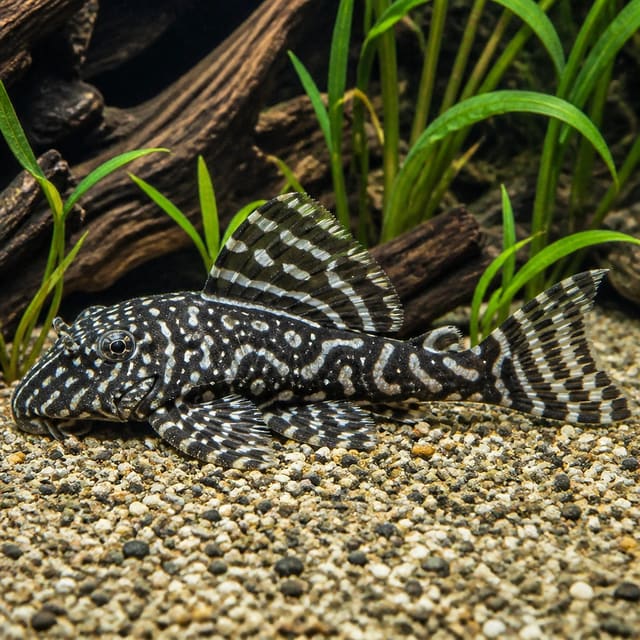
L066 King Tiger Pleco (Hypancistrus sp.)
22–27°C · pH 6–8
£84.99
Photo coming soon
The size, price and care details on this page are for this listing.
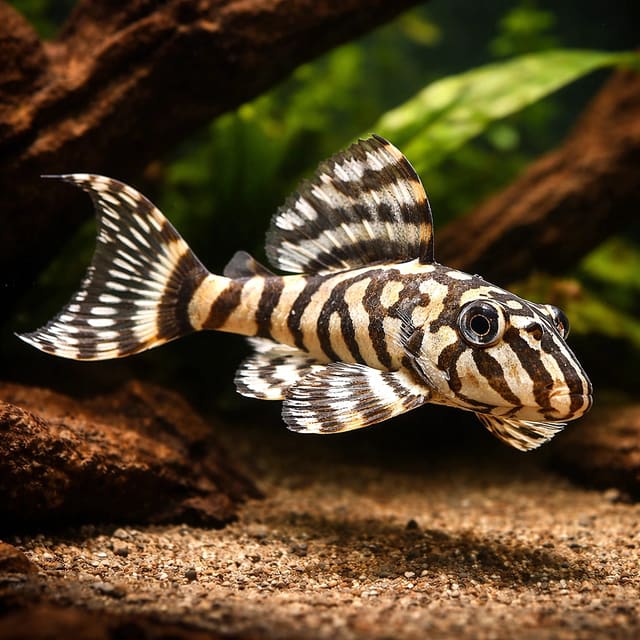
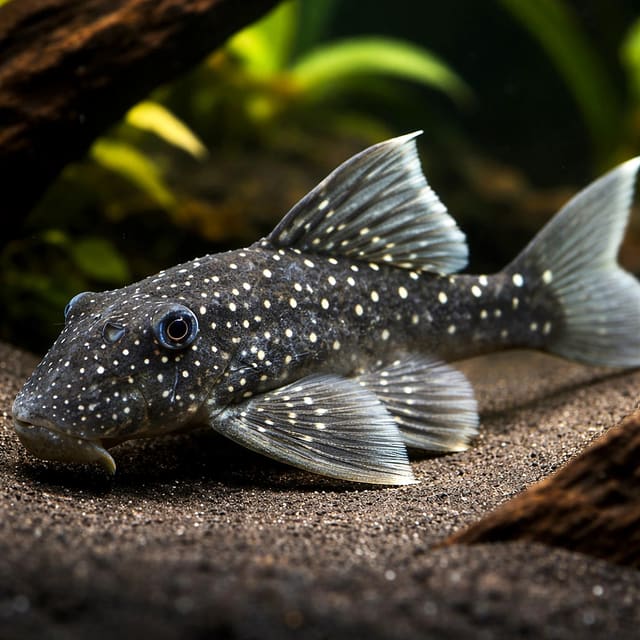
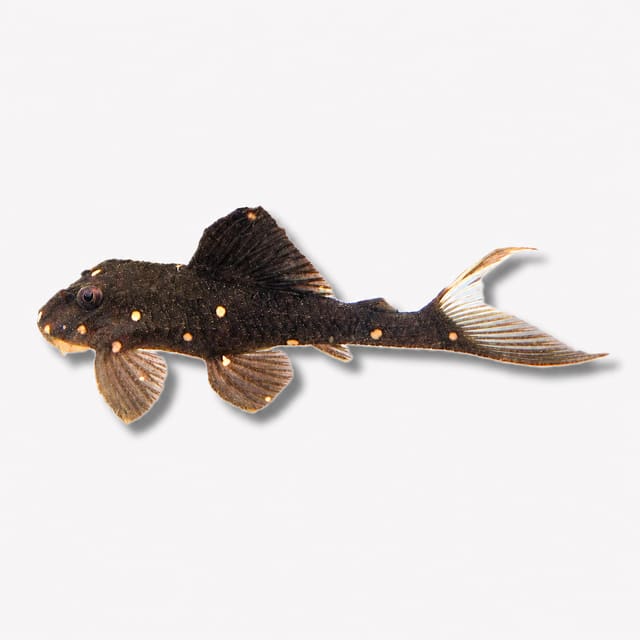
L201, the Orinoco angel pleco: a dark, light-spotted Hypancistrus from the upper Río Orinoco, long sold as H. inspector but treated by catfish specialists as a separate, undescribed species. About 12 cm SL. Needs 27–30 °C, oxygen-rich water, caves and meaty sinking foods. One fish per unit; size and sex not selected.
Hypancistrus sp. (L201)
L201, the Orinoco angel pleco: a dark, light-spotted Hypancistrus from the upper Río Orinoco, long sold as H. inspector but treated by catfish specialists as a separate, undescribed species. About 12 cm SL. Needs 27–30 °C, oxygen-rich water, caves and meaty sinking foods. One fish per unit; size and sex not selected.
Maintain these water conditions for optimal health and vibrant colors
L201 is a small suckermouth catfish from the upper Río Orinoco in South America: a dark, light-spotted member of the genus Hypancistrus, known among catfish specialists as the Orinoco angel pleco. It is a popular fish with pleco keepers. Planet Catfish, the specialist catfish site, shows over four hundred registered keepers and more than thirty breeding reports for it. It is not an algae cleaner and it is not a fish for a beginner's first tank, but in a warm, clean, well-oxygenated aquarium with a few good caves it is a rewarding fish to keep.
Each unit you order is one live L201. The listing has a single option, so no size grade and no sex is chosen; plan your aquarium around the adult size of roughly 12 cm standard length rather than the size of the fish that arrives.
About the name on this listing. Our title pairs the trade code L201 with the scientific name Hypancistrus inspector, which is how this fish has long been labelled. The specialist catfish references do not support that pairing. Planet Catfish and ScotCat both treat L201 as a separate fish that has not yet been formally described, written Hypancistrus sp. (L201), and ScotCat states that L201 had been incorrectly identified as H. inspector. The name H. inspector belongs to a different, described fish: the snowball pleco, L102, according to Planet Catfish, Seriously Fish and Wikipedia. We have left the listing name as it is, recorded the scientific name as Hypancistrus sp. (L201), and written the care on this page for L201, with the figures for true H. inspector alongside wherever the two differ.
| Need | What to provide |
|---|---|
| Adult size | About 12 cm standard length (Planet Catfish); ScotCat gives 10 cm |
| Temperature | 27–30 °C |
| pH | 6.5–7.5 |
| Water | Clean, warm and well oxygenated, with some movement |
| Set-up | Sand, rocks, optional wood, and a cave for every fish |
| Food | Mainly meaty sinking foods; only occasional vegetable food |
| Temperament | Peaceful with other fish; males may quarrel over caves |
| Golden rule | Only one Hypancistrus species per tank, to avoid hybrids |
| Care level | Moderate |
Suckermouth catfish from South America reach the hobby faster than scientists can describe them, so many carry an L-number: a trade code that lets keepers, shops and breeders talk about the same fish whether or not it has a scientific name. Many of these codes were first published in the German aquarium magazine DATZ. Planet Catfish records that L102 was introduced in DATZ in 1992, and ScotCat notes that L201 appeared there in September 1995. A code is not a species name, and it says nothing on its own about whether the fish has been formally described.
In 2002 the ichthyologist J. W. Armbruster formally described Hypancistrus inspector. Its type locality, the place the describing specimens came from, is the Río Casiquiare in Amazonas state, Venezuela, about ten river kilometres above its junction with the Río Negro. The name inspector is Latin for observer, a reference to the species' large eyes. Planet Catfish, Seriously Fish and Wikipedia all link this described species to the code L102 and the common name snowball pleco.
L201 is a different matter. Planet Catfish lists it as Hypancistrus sp. (L201), common name Orinoco angel pleco, and ScotCat does the same, adding that it is similar looking to H. contradens and H. inspector, "which it had been incorrectly identified as". Put simply, the specialist view is that L201 is its own fish, still waiting for a scientific name, and that the label H. inspector was attached to it by mistake. You will also see L201 offered as a "snowball pleco"; the specialist references give that name to L102.
| Feature | L201 (Orinoco angel pleco) | H. inspector (L102, snowball pleco) |
|---|---|---|
| Scientific status | Not formally described: Hypancistrus sp. (L201) | Described by Armbruster in 2002 |
| Edges of the dorsal and tail fins | No black edging | A black ribbon or seam along the edge of both fins |
| Body shape | Lower, squatter body | Higher-bodied |
| Maximum size | 120 mm standard length (Planet Catfish); 10 cm (ScotCat) | 12.6 cm standard length (FishBase); 160 mm (Planet Catfish, Seriously Fish) |
| Where found | Upper Río Orinoco, near Minicia and the Río Ventuari | Upper Rio Negro and the Casiquiare |
| Temperature range given | 26–30 °C (Planet Catfish); 27–30 °C (ScotCat) | 22–30 °C (Seriously Fish, Planet Catfish); 26–29 °C (ScotCat) |
The quickest check is the fins. Planet Catfish says the snowball pleco is most easily identified by the black ribbon along the margin of its tail and dorsal fins, and that this is what separates it from L201. If your fish has plain-edged fins and a low, stocky build, the sources would rule out true H. inspector.
There is a third look-alike, Hypancistrus contradens. According to Planet Catfish it has a higher body than L201, and ScotCat describes L201 as the smaller of the two, with a lower body profile and a shorter head. Planet Catfish also notes that young L201 have smaller spots than H. contradens fry of a similar size. Spot size varies between individual L201 too; Planet Catfish's gallery includes a fish captioned "big spot" L201.
All three are dark fish with pale spots, and all share the small, lightly toothed mouth that Planet Catfish describes as typical of Hypancistrus. The genus name itself is explained there as a contraction of the Greek hypo, less than, and Ancistrus, an allusion to the reduced number of teeth, particularly in the lower jaw.
Planet Catfish gives the distribution of L201 as the upper Río Orinoco near Minicia and the Río Ventuari, a tributary of the upper Orinoco in Venezuela. ScotCat places it in the upper Río Orinoco on the border between Colombia and Venezuela. That is warm, tropical water in the heart of northern South America.
True H. inspector lives close by. Seriously Fish describes its range as the upper Rio Negro basin in Amazonas state, Brazil, and the Casiquiare drainage in Venezuela, the natural channel that links the Rio Negro with the Río Orinoco. FishBase adds the upper Orinoco basin to that list. The two fish therefore come from neighbouring parts of one connected river network, and keepers handling either one are dealing with fish from the same broad region.
The sources we use give the localities for L201 but not a detailed description of the water it lives in, so we will not invent one. For its close relative the picture is clearer. Seriously Fish says H. inspector is normally collected from rocky rapids, over a substrate of variably sized rocks, sand, fine gravel and some water-worn boulders, and FishBase likewise describes rocky areas and rapids. Planet Catfish adds that it is unclear whether H. inspector is a white, clear or black water species.
Two things follow for the aquarium, and both match the advice the specialist sources give for L201 directly. First, this is a fish of rocks and crevices: it wants hard surfaces and caves to shelter in rather than an open sandy floor. Second, its close relative comes from moving, well-oxygenated water, and the warm temperatures given for L201 make good oxygenation all the more important, so a still, warm tank with a weak filter is the wrong home.
ScotCat lists L201 as not evaluated by the IUCN, which is usual for a fish without a scientific name. FishBase records H. inspector as Least Concern, assessed in October 2020. Whatever a fish's status, the responsible course is the same: keep it well and, if you breed it, keep the line pure, which is covered in the tank mates and breeding sections below.
Planet Catfish describes the furniture for L201 in one line: sand, primarily rocks, optionally driftwood, and caves made from slate plates, bamboo or PVC pipe. That is the whole brief, and it is a good one. Everything below builds on it.
Caves are the centre of an L201's life. ScotCat warns that males may quarrel over caves, so provide at least one cave per fish, and a couple of spares, spread out across the floor so that no fish has to pass another's doorway to reach its own. Ceramic pleco caves, slate stacked into crevices, short lengths of bamboo and dark PVC pipe all work.
ScotCat's factsheet for the closely related H. inspector gives practical guidance on cave size for breeding: the cave should be about a third longer in length, width and height than the male, so that there is room for the female to enter, and it should have a single entrance that the male can guard. Even if you are not planning to breed, caves that fit the fish snugly with one opening are the ones a Hypancistrus will claim.
None of the sources we use publishes a minimum tank size for L201 itself. Seriously Fish recommends a base of 120 × 45 cm, around 243 litres, for H. inspector, which reaches 160 mm. L201 is a little smaller, but it lives on the bottom and claims territory around its cave, so floor area matters far more than height. If you plan to keep more than one, or hope to breed them, a tank with a generous footprint gives each male room for a cave of his own with some distance between them.
Seriously Fish says H. inspector needs a moderate-to-high proportion of dissolved oxygen and some water movement, provided by power filters or airstones. Planet Catfish notes that a strong current is not necessary. The two fit together well: you do not need to recreate a rapid, but you do need well-oxygenated water that moves through the whole tank, including the bottom where the caves are. A filter outlet that agitates the surface, backed up by an airstone or a small circulation pump, is a straightforward way to achieve it. This matters all the more because L201 is kept warm, and warm water holds less oxygen than cool water.
L201 is a warm-water fish, kept towards the top of the tropical range. The sources give these figures:
| Parameter | L201 sources | What we recommend |
|---|---|---|
| Temperature | 26–30 °C (Planet Catfish); 27–30 °C (ScotCat) | 27–30 °C |
| pH | 6.5–7.5 (Planet Catfish); 6.0–7.5 (ScotCat) | 6.5–7.5 |
| Hardness | Not given for L201 | Soft to moderate, kept stable |
We recommend the range where both L201 sources agree. For comparison, Seriously Fish gives H. inspector 22–30 °C, pH 5.0–7.5 and 1–15 °dGH, and ScotCat says that species prefers water on the warm side at 26–29 °C, soft and slightly acidic. If you are not sure which of the two you have, a temperature of 27–29 °C and a pH between 6.5 and 7.5 sits inside every range given for both.
Keeping a tank at 27–30 °C all year means your heater is working harder than in a typical community tank, so use one rated comfortably for the volume, check it against a separate thermometer, and consider two smaller heaters rather than one large one in a big tank, so a single failure is not a disaster. A very hot British summer can push a warm tank above 30 °C; if that happens, increase surface movement and aeration, as oxygen will be the first thing to run short.
No hardness figure is published for L201 in the sources we use, and the pH range for it centres on neutral. Tap water in the UK varies widely from place to place, so test yours. If it falls inside the pH range and is not extremely hard, dechlorinated tap water kept stable is likely to serve better than water that is constantly adjusted. If your water is very hard or alkaline, mixing in some reverse-osmosis water is the most controllable way to soften it.
Seriously Fish advises weekly water changes of 30–50% of the tank volume for H. inspector, a fish from the same group and region, and that is a good standard for L201 too. A meaty diet produces waste, warm water speeds up decay, and plecos living on the bottom sit where uneaten food and debris collect. Regular water changes, a filter sized generously for the tank, and siphoning around the caves keep conditions where these fish need them.
Many people assume every pleco cleans algae. Planet Catfish puts it plainly for this genus: unlike the popular image of many other loricariids, Hypancistrus are more carnivores than algae eaters, and their small, lightly toothed mouth shows they are poor algae scrapers. An L201 left to graze on whatever grows in the tank will go hungry.
Planet Catfish recommends a small and frequent supply of mainly meaty foods, such as dry discus food, bloodworm and even brine shrimp, with only an infrequent offering of flake or algae tablets. ScotCat's L201 page agrees that, like all Hypancistrus, it prefers a meaty diet, and lists:
ScotCat adds one useful detail: young L201 seem to show more of a liking for vegetable foods. So if your fish is still small, a little vegetable-based sinking food alongside the meaty menu is sensible, shifting towards meatier foods as it grows.
Planet Catfish notes that these fish can be a bit shy and slow to grab food when it is available, which is why it stresses that care is needed to make sure they get enough. In practice:
A well-fed L201 has a gently rounded belly when you see it on the glass. A belly that looks sunken or hollow over several days means it is not getting enough, and the usual fix is better-targeted feeding rather than more food overall.
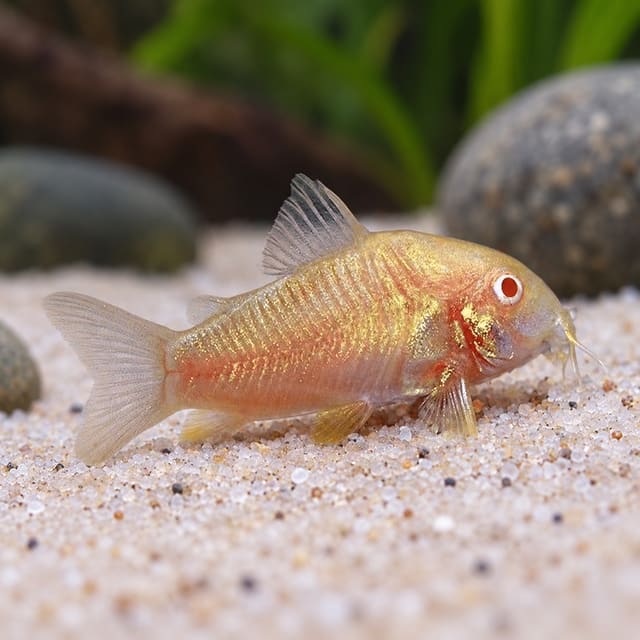
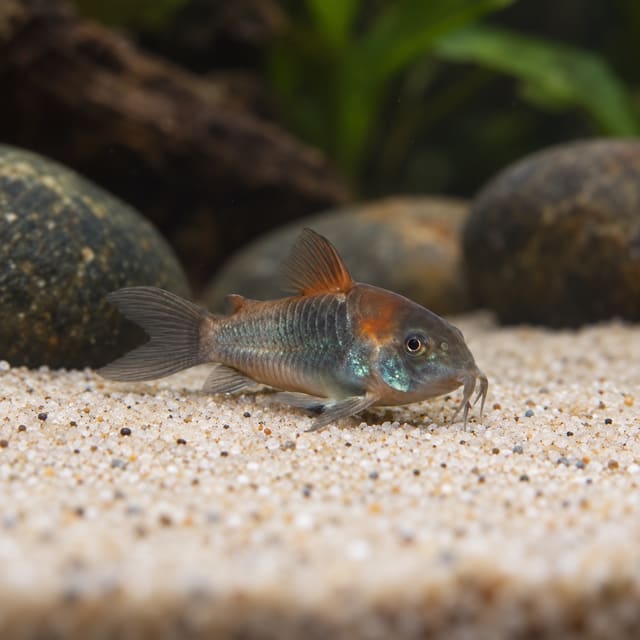
Planet Catfish describes L201 as suitable with most fish, as long as they are not too large or territorial about bottom space. Its suggested companions are small tetras and other similar small fish, and also Corydoras, with the caution that you must make sure the pleco still gets enough to eat, because it can be shy and slow at feeding time.
This is the rule that matters most. ScotCat says only one Hypancistrus species should be kept in a tank, because there have been reports of hybridisation, and Seriously Fish gives the same advice for H. inspector. Hybrids muddy the identity of the fish that are passed on to other keepers, and with so many similar spotted forms, that is a real problem.
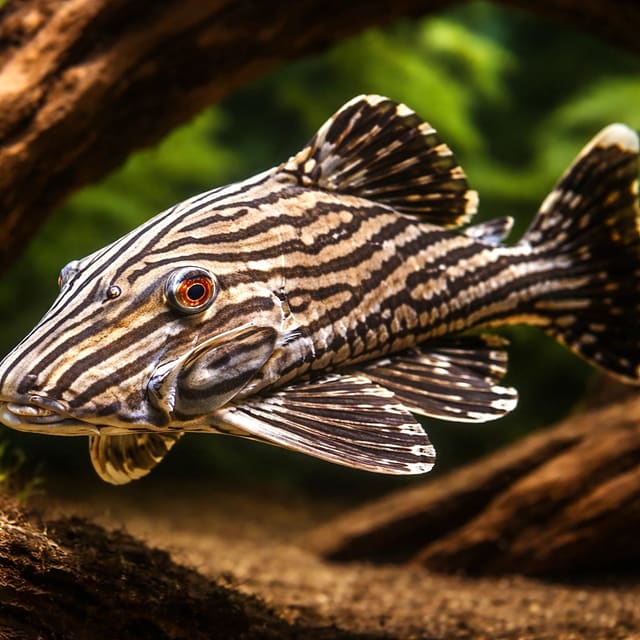
So if you love Hypancistrus, choose one form per aquarium. We list several others, including the L066 king tiger pleco, the L333 maze zebra pleco and the L236 RB line Hypancistrus. Each is a lovely fish in its own right, but each belongs in its own tank, not alongside L201.
ScotCat describes L201 as fairly peaceful with its own kind, although males may quarrel for caves. A small group can work in a tank with enough floor space and enough caves. Planet Catfish's sexing notes describe mature males with a wider head and more pronounced odontodes, the short bristle-like spines on the fins and body, which helps you work out what you have once the fish mature. Where two males share a tank, spread the caves out and watch for persistent chasing.
Our L201 are not sold as a sexed fish, and young fish cannot be sexed reliably. The differences appear as they mature. Planet Catfish describes mature males as having a thicker first pectoral-fin ray, more pronounced odontodes on that ray, odontodes on the cheeks and towards the rear of the body, and typically a wider head. Mature females are wider around the middle of the body and have much less noticeable odontodes on the body and fins. ScotCat's description agrees: males have broader, longer heads, with odontodes on the rear of the body, behind the gill covers and on the pectoral-fin spines, all much less developed in females.
Planet Catfish says L201 breeds in the typical Hypancistrus manner, with the male guarding the eggs in a cave, and it holds more than thirty breeding reports from hobbyists for this fish. ScotCat's factsheet for H. inspector describes the sequence in more detail. The male occupies a cave and entices a gravid female to join him; she lays her eggs on the roof of the cave and the male guards them. That is why cave size and a single entrance matter, as described in the set-up section above.
ScotCat adds an important caution for L201: females can sometimes be badly injured, or even killed, during breeding when trapped in the male's cave. If you are trying to breed them:
Planet Catfish notes that L201 fry have smaller spots than H. contradens fry of a comparable size, a detail breeders can use when comparing young fish. Keep any breeding project to L201 alone, in line with the one-Hypancistrus-per-tank rule, so the young you pass on are what their label says.
Most problems with a warm-water pleco like L201 come back to three things the sources stress: clean water, plenty of oxygen and enough of the right food reaching the fish. Check those first whenever something seems wrong.
Bear in mind that a mature male's odontodes, the bristle-like growths on the pectoral-fin ray, cheeks and rear of the body described by Planet Catfish, are normal. They are a sign of a maturing male, not of disease.
Test the water and check the temperature. Then look at oxygen: is the surface moving, is the filter flowing properly, is the airstone working? Then look at feeding: is food actually reaching the cave? Make corrections gradually, with partial water changes rather than a single large change, and keep a note of your readings so that you can describe the problem accurately if you need to ask for advice.
If you already keep fish, a quarantine tank for any new arrival is good practice and well worth the effort. A few weeks alone in mature, warm water, with a cave and targeted feeding, lets you confirm it is eating before it joins a community.
Have the aquarium ready before the parcel arrives: filter running and mature, water tested, temperature set and steady within the 27–30 °C range, and the caves already in place so the fish has somewhere to go straight away. Someone must be at the delivery address to receive the parcel, as live animals cannot be left unattended. Please read our delivery and live-arrival information before ordering.
Your fish travels in an oxygen-filled bag in insulated packaging, with heat packs when the weather calls for them, carried by a tracked courier licensed to carry live animals. We send the confirmed delivery date and tracking by email.
Start a continuous unboxing video while the parcel is still sealed, open it in the same take, and show the fish in its still-sealed bag. If a fish has arrived dead, dying or clearly compromised, email hello@tropicalfishco.co.uk on the day of delivery with your order number and the video. Photos alone do not meet our live-arrival policy. The resolution is a replacement with your next order or a refund for the affected fish, subject to the guarantee terms.
Give the fish time to find and claim a cave. Offer a small amount of sinking meaty food near the caves in the first few days and remove anything left over. Watch breathing, appetite and behaviour over the first week, and check the belly when you get a glimpse of it. Once your L201 is coming out for food, you can settle into a normal routine.
These are the sources behind this page. Planet Catfish's Cat-eLog entries for Hypancistrus sp. (L201) and H. inspector were also used; they can be found by searching the Planet Catfish site for L201.
No reviews for this item yet. Bought one? Honest reviews only, good or bad.
What customers say about ordering from us
Easy website plenty of info on fish your buying great to pick a time slot
TRACEY DURRANT · 7 Oct 2026
Got some lovely fish thank you
Kevin Mackie · 7 Oct 2026
Reviews of our shop, collected by Judge.me, an independent third-party review collector. Newest first.