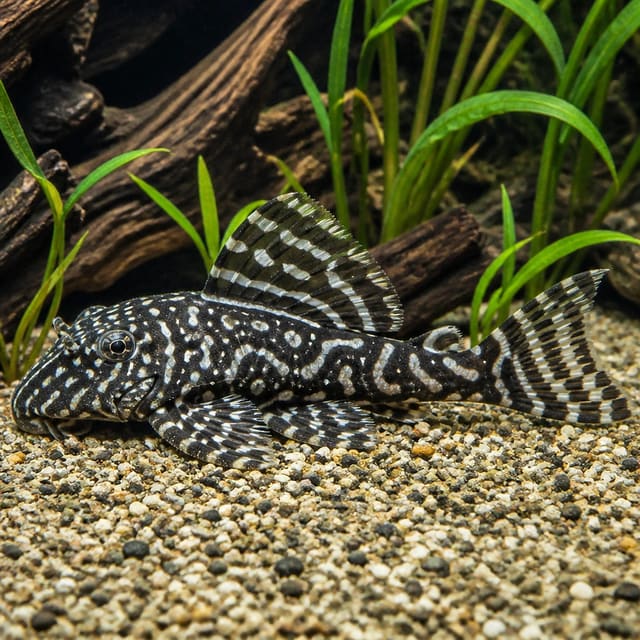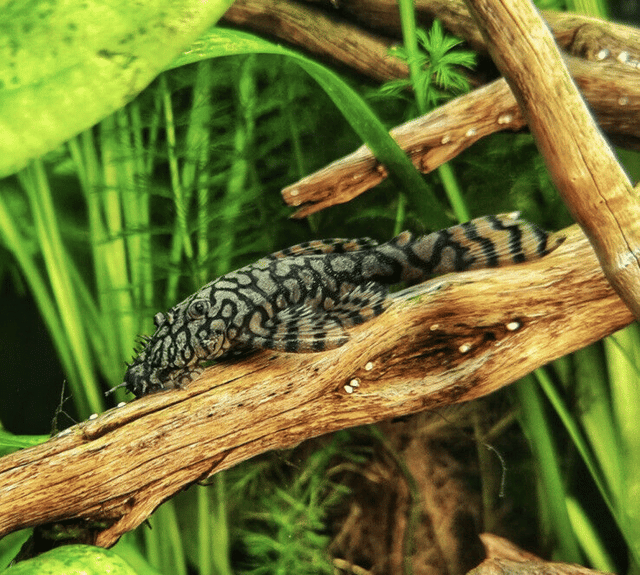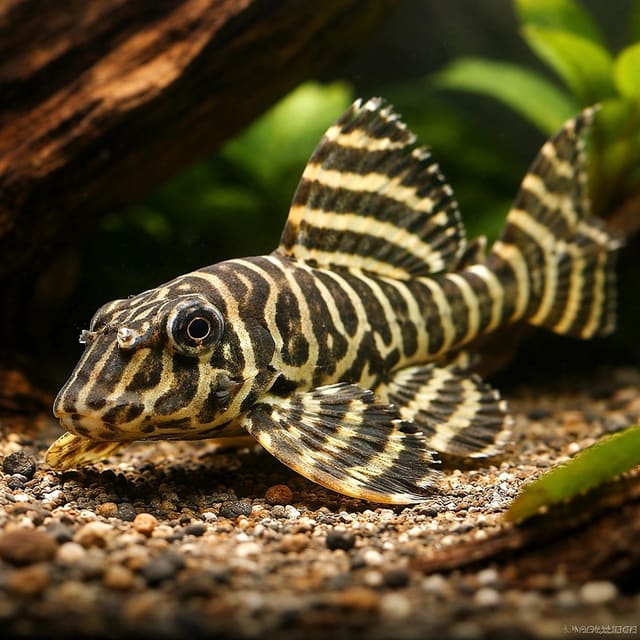
L333 Maze Zebra Pleco (Hypancistrus sp.) – CB Porto de Mos
22–27°C · pH 6–8
£48.99

The L046 zebra pleco (Hypancistrus zebra) is a small, black-and-white striped catfish from the Rio Xingu in Brazil, critically endangered in the wild. Choose one fish at 3-3.5 cm, 5-7 cm or 8-10 cm. It needs warm (26-30 °C), fast-moving, oxygen-rich water, caves to hide in and a meaty diet.
Adult size is the maximum length this species reaches at full maturity (scientific sources). The livestock you receive will be younger and smaller — pick a size above for the actual shipping size. Product-photo provenance and any image-specific limitations are stated on the listing.
Hypancistrus zebra
The L046 zebra pleco (Hypancistrus zebra) is a small, black-and-white striped catfish from the Rio Xingu in Brazil, critically endangered in the wild. Choose one fish at 3-3.5 cm, 5-7 cm or 8-10 cm. It needs warm (26-30 °C), fast-moving, oxygen-rich water, caves to hide in and a meaty diet.
Adult size is the maximum length this species reaches at full maturity (scientific sources). The livestock you receive will be younger and smaller — pick a size above for the actual shipping size. Product-photo provenance and any image-specific limitations are stated on the listing.
‘Pleco’ is a loose aquarium-trade label, not one species or one care sheet. Before buying, confirm the scientific name or defensible L-number, adult size and measurement method, required footprint, temperature and water, diet, social plan and source. No universal pleco tank size, menu or algae result is honest.
Maintain these water conditions for optimal health and vibrant colors
Few aquarium fish are recognised as quickly as the zebra pleco. It is a small armoured catfish with a white body crossed by bold black stripes, and its markings carry on over the head, through the fins and into the tail. The scientific name is Hypancistrus zebra, described by Isbrücker and Nijssen in 1991. Before its formal description, Seriously Fish notes, it was sold under names such as imperial or emperor peckoltia, and its original import designation was L046. Wikipedia also lists L098 for the same species, and Seriously Fish adds L173. That is why you will see several numbers on forums and in older books, all meaning the one fish.
It is not a beginner's pleco, and it is not an algae grazer. It wants warm, fast-moving, oxygen-rich water, a home full of caves and crevices, and a meaty diet given after dark. In return it is a long-term, characterful fish that will be the centrepiece of a well-planned tank. It is also critically endangered in the wild, which is reason enough to plan properly before you buy.
Each option below is one fish. You pick the size; we do not select by sex on this listing.
| Size option | What you receive | Worth knowing |
|---|---|---|
| 3 to 3.5 cm | One young zebra pleco | A juvenile with most of its growing still ahead of it. Small fish need extra care at feeding time so they are not outcompeted. |
| 5 to 7 cm | One well-grown zebra pleco | Close to the maximum sizes recorded by FishBase and Wikipedia, so this is a near-adult or adult fish. |
| 8 to 10 cm | One large adult zebra pleco | Larger than the FishBase and Wikipedia maximums, and in line with the 80 mm standard length that Seriously Fish records for the species. |
Sizes are dispatch sizes: how big the fish is when it leaves us. They are not a prediction of how much more it will grow. If you are planning to breed, remember that the differences between males and females only show in mature fish, and that this listing does not promise either sex.
The small option, at 3 to 3.5 cm, suits a keeper who wants to watch the fish grow and has a calm tank where a small pleco will not be outcompeted. Small fish need the most attention at feeding time: food has to land close to their cave, and the belly check described further down matters more with a juvenile than with anything else.
The middle option, at 5 to 7 cm, gives you a fish that is already close to the published maximum sizes and is generally easier to keep an eye on. It is a good choice if you want the full pattern on show from day one.
The large option, at 8 to 10 cm, is a big adult. It needs the full setup from the moment it arrives: warm water, strong flow, a cave that fits it, and a feeding routine that gets meaty food to it every night. If you are thinking about breeding, larger fish are more likely to be mature, but maturity and sex are not promised on this listing, so plan on a group if breeding is the goal.
| Fact | Detail |
|---|---|
| Scientific name | Hypancistrus zebra Isbrücker & Nijssen, 1991 |
| L-numbers | L046, L098 (Wikipedia); L173 also listed by Seriously Fish |
| Family | Loricariidae, the armoured catfishes |
| Wild range | A small section of the Rio Xingu, Brazil, in the big bend downstream of Altamira |
| Published maximum size | 7.0 cm total length (FishBase); 6.4 cm standard length (Wikipedia); 80 mm standard length (Seriously Fish) |
| Temperature | 26 to 30 °C |
| pH | 6.0 to 7.5 |
| Hardness | 2 to 15 dGH |
| Minimum tank | Base of 60 x 30 cm, around 54 litres |
| Diet | Meaty: bloodworm, brine shrimp, chopped mussel, prawn and sinking foods |
| Activity | Nocturnal |
| Wild status | Critically Endangered (IUCN, assessed 2018); CITES Appendix II |
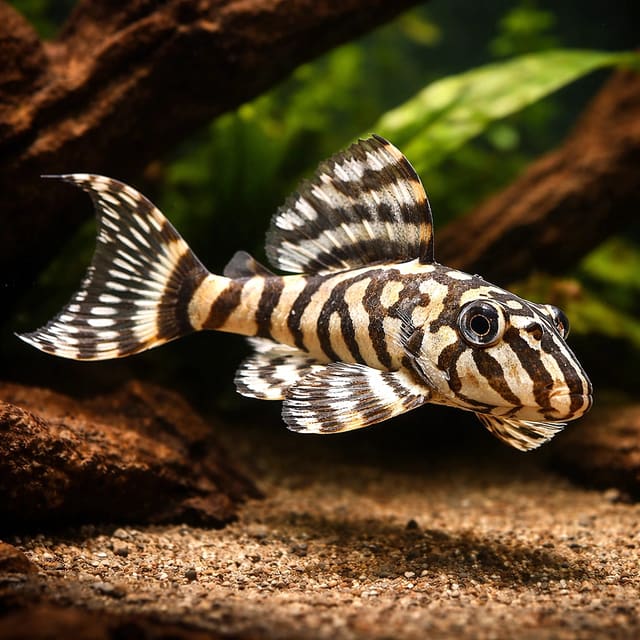
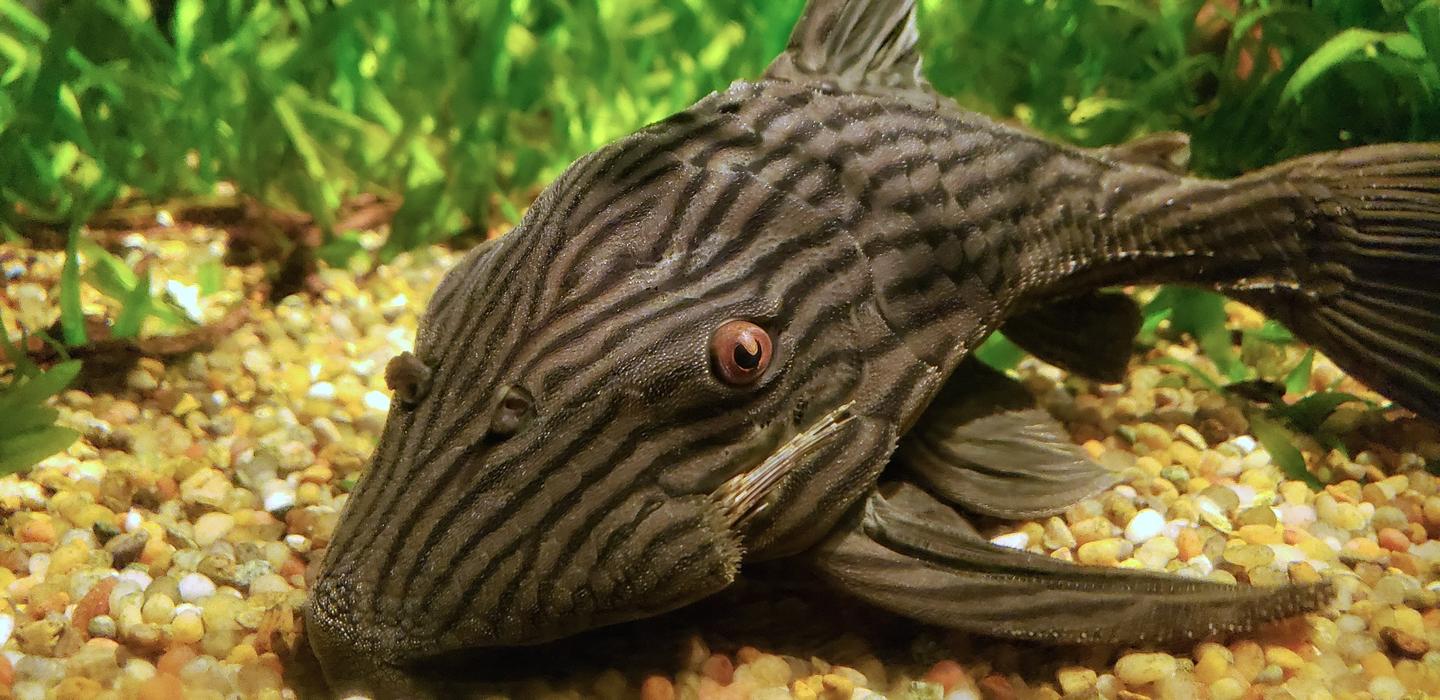
The pattern is the giveaway, but it is worth knowing what a healthy one looks like in detail. In the photographs here the body is bright white with black bands that run diagonally across the flanks and along the back. On the head the stripes curve around the large, dark eye, almost like a target, and a black band reaches down to the snout. The dorsal fin is tall and carries alternating black and white bars, and the forked tail is banded in the same way, with white tips to the upper and lower lobes. The pectoral and pelvic fins are broad and striped, and they spread wide when the fish rests on the bottom.
Wikipedia puts it simply: the species takes its name from black and white stripes that resemble a zebra's colouring. The effect of crisp black on clean white should be obvious in any fish in good condition.
Sources do not agree on the maximum size, so here are all three. FishBase gives 7.0 cm total length, which includes the tail. Wikipedia gives 6.4 cm standard length, which is measured to the base of the tail and leaves the tail fin out. Seriously Fish gives 80 mm standard length. Whichever figure you take, this is a small pleco by any standard, and that is a big part of its appeal: you do not need a huge aquarium to keep one well.
The two sexes look alike when young. Once mature, there are clear differences, described by both Seriously Fish and Wikipedia:
None of this can be judged reliably on a 3 cm juvenile, and this listing does not sell sexed fish. If you want both sexes for a breeding project, the usual approach is to raise a small group and let them mature.
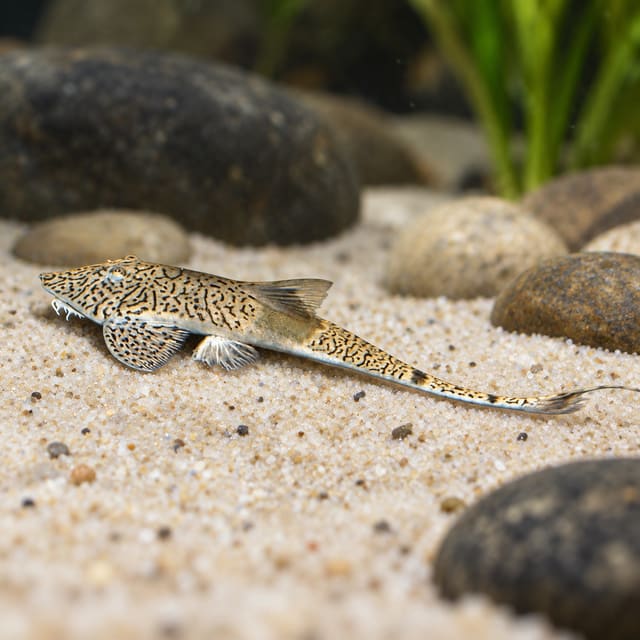
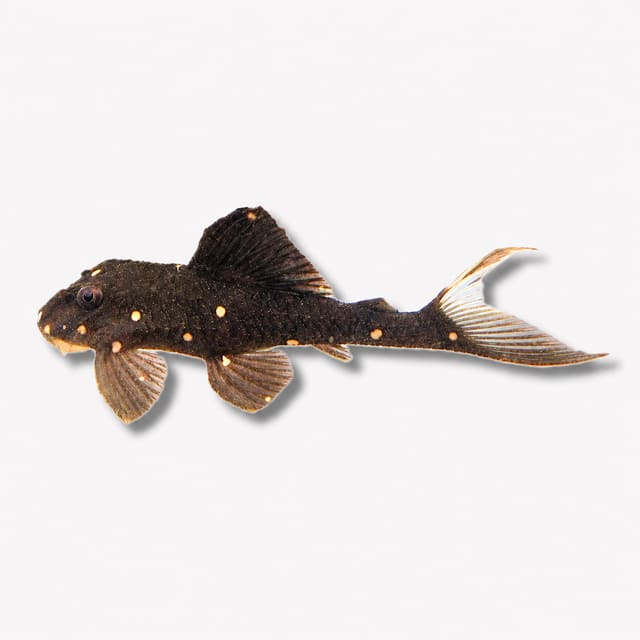
Seriously Fish describes H. zebra as the type species of its genus, the one on which the genus Hypancistrus was founded. Other Hypancistrus plecos are kept in the hobby too, several of them sold under L-numbers. If you are comparing, you might look at our L333 Maze Zebra Pleco, the L066 King Tiger Pleco and the L236 RB Line Hypancistrus Pleco. They are listed here for comparison of looks and size only. They are not the same species, and this page makes no claim about keeping them together.
Wikipedia describes the zebra pleco as endemic to a small section of the Rio Xingu in Brazil, in the big bend area of the river downstream from the town of Altamira, in the state of Pará. FishBase simply records Brazil. Either way, the whole wild population lives in one short stretch of one river.
Seriously Fish describes the habitat as flowing, highly oxygenated water running over sandy ground scattered with rocks and stones, with the fish living in deep water, in crevices among the rubble. Wikipedia adds that it lives among rocks and caves and needs highly oxygenated water with a strong flow and surface agitation. Picture a warm river moving fast over a bed of stone, with fish tucked into cracks and gaps in the rock. That image explains almost everything about keeping one in an aquarium: warmth, movement, oxygen and somewhere to hide.
Wikipedia also describes the species as nocturnal. Most of its activity happens after dark, and that shapes how you light the tank and when you feed it.
The zebra pleco is in serious trouble in the wild. FishBase lists it as Critically Endangered on the IUCN Red List, assessed on 7 November 2018. FishBase also rates its resilience as low, with a minimum population doubling time of 4.5 to 14 years, so any loss takes a long time to recover.
The main threat named by Wikipedia is the Belo Monte Dam on the Xingu, which has caused a severe reduction in the river's flow. For a fish whose whole life is built around fast, oxygen-rich water in one stretch of river, that is about as direct a threat as there can be.
For a keeper, the practical lesson is straightforward. This is a fish to keep well for the long term, and anyone who breeds it adds to the captive-bred supply rather than drawing on the wild population.
Seriously Fish suggests a minimum base of 60 x 30 cm, a tank of 60 x 30 x 30 cm or about 54 litres. That is the minimum. If you plan on several, or on breeding, give them more floor space and more caves, because this species is territorial with its own kind.
Seriously Fish recommends a setup modelled on the wild habitat: a sandy substrate, smooth pebbles, rocks of various sizes and some driftwood branches. It also notes that the fish appreciate refuges such as chunks of wood with tunnels or crevices. In practice that gives you three layers to plan:
Offer more hiding places than you have fish. With a territorial species, a spare cave or two means a lower-ranking fish always has somewhere to go.
Seriously Fish says powerheads are needed to give the water movement and oxygenation this species wants, so plan on adding one rather than relying on the filter alone. Aim for strong, directional flow along the length of the tank and plenty of surface movement. Seriously Fish suggests a filter turnover of four to five times the tank volume per hour, which is 215 to 270 litres per hour for a 54-litre tank, and the powerhead adds flow on top of that.
To make that practical, here is one way to set out a 60 x 30 x 30 cm tank for a zebra pleco, following the habitat description above:
That leaves open sand at the front where you can drop food in the evening, and a back half of rock and wood where the fish can live out of sight by day.
Seriously Fish mentions that hardy plants such as Anubias and Java fern may survive in this kind of setup. Both can be tied to wood or rock rather than planted in the substrate, which suits a tank built around stone and flow. Because the zebra pleco is nocturnal, bright lighting will simply keep it hidden for longer. Moderate light, with shaded areas around the rockwork, gives you a better chance of seeing it in the evening.
Seriously Fish recommends a 125 to 150 W heater for a tank of this size, which reflects how warm this fish needs to be kept. Use a reliable thermostatic heater, add a separate thermometer you can read at a glance, and protect the heater with a guard so a fish resting against it cannot be burnt.
Keep the tank covered. Make sure filter intakes are guarded, especially if you keep juveniles at 3 to 3.5 cm or ever hope to raise fry.
Get the temperature right first. Seriously Fish gives 26 to 30 °C and says plainly that this fish needs warm water and will fail to thrive in cooler conditions. That is warmer than many community tanks are run, so do not add a zebra pleco to a tank kept at 24 °C and hope for the best.
| Parameter | Range | Our notes |
|---|---|---|
| Temperature | 26 to 30 °C | Seriously Fish range. FishBase lists 23 to 26 °C; we follow the aquarium range. |
| pH | 6.0 to 7.5 | Slightly acidic to slightly alkaline is fine; stability matters most. |
| Hardness | 2 to 15 dGH | A wide range; test your tap water to see where it sits. |
| Oxygen | High | Strong flow and surface agitation, as in the wild habitat. |
FishBase records a range of 23 to 26 °C for the species. Seriously Fish gives 26 to 30 °C for the aquarium and warns that the fish fails to thrive in cooler water, and the breeding temperatures given by both Seriously Fish and Wikipedia sit at 27 °C or above. We follow the aquarium range, with the heater set somewhere around the middle of it so there is room for warm summer days without going over the top.
Warm water holds less dissolved oxygen than cool water, and this species comes from fast, highly oxygenated river water. That combination is why flow and surface agitation matter so much. On hot days, when the room pushes the tank temperature up, increase surface movement rather than letting the tank run warm and still.
Before any fish goes in, the filter must be fully cycled. After that, regular partial water changes keep nitrate low and the water fresh. Match the temperature of new water to the tank closely, unless you are deliberately using cooler changes to encourage breeding, as described further down. Siphon debris from the sand and around the rocks, where uneaten meaty food collects.
The good news is that pH and hardness are less demanding than temperature and flow. A pH of 6.0 to 7.5 and hardness of 2 to 15 dGH covers a broad range of water. Test your tap water before you buy, and if it already sits inside these ranges, leave it alone rather than chasing a particular number. Stable water inside a sensible range is better than water that swings while you try to fine-tune it.
The zebra pleco is not an algae eater, and buying one to clean the glass is a mistake. Seriously Fish describes a preference for a meaty diet and says that algae and other vegetable matter are not often taken. Wikipedia describes it as a predatory species that needs a high-protein diet, typically small invertebrates such as insect larvae in the wild.
Between them, the two sources list the foods that work in the aquarium:
Build the diet around meaty frozen foods and good sinking pellets or wafers, and treat vegetables as an occasional extra, not a staple. Frozen foods should be thawed first and offered in small portions.
Because the zebra pleco is nocturnal, the best time to feed is shortly after the main lights go out. Drop food close to the caves or rockwork where the fish lives, so it does not have to cross the whole tank against faster fish. Seriously Fish describes it as shy and easily outcompeted for food by more vigorous feeders, and a zebra pleco that keeps losing out will gradually waste away even though food goes in every night.
Variety is easy to manage if you plan the week rather than reaching for the same tub every night. One approach that follows the sources above:
Adjust the amounts to what disappears overnight. A fish that is clearing everything and still has a flat belly needs more, while food left untouched night after night means you are feeding too much or the wrong thing.
Meaty foods spoil quickly in warm water. Feed what can be eaten overnight, and remove leftovers the next morning. A small amount fed reliably is better than a large amount that rots between the stones.
Seriously Fish gives two simple checks: the fish should have a rounded belly, and its eyes should not be sunken. A hollow belly and sunken eyes are classic signs of a fish that is not getting enough. Check these when your fish arrives and keep checking every few days, using a torch in the evening if your pleco spends daylight hours in its cave.
The zebra pleco is peaceful towards other fish, but that does not make it a community fish. Seriously Fish describes it as not really a good species for the general community tank, because of its specific requirements and its tendency to be outcompeted. It also notes that it is territorial with its own kind and with other bottom-dwelling fish, and Wikipedia calls it moderately territorial.
Because it is territorial with its own kind, this is not a fish that needs a group in the way shoaling species do. If you want more than one, give each fish its own cave and some spare ones, and give the tank enough floor space and rockwork that rivals can stay out of each other's way. Expect some squabbling over the best caves. That is normal territorial behaviour, but a fish that is constantly chased out into the open needs more cover or a separate tank.
Seriously Fish's preference is a setup built around this species, and it suggests tank mates that suit the same warm, flowing water and will not compete hard at the bottom:
Before adding any tank mate, check that it is happy at 26 to 30 °C. Many popular community fish prefer cooler water.
Be ready for a fish you do not see much of in daylight. A zebra pleco may spend much of the day in its cave and become far more active once the lights go down. A dim room light or a low-level night light lets you watch it feed in the evening.
The care points that matter most for this species are warmth, oxygen, clean water and enough food reaching the fish. Most of the checks below come back to those four.
If you see these, check the water first. Test ammonia, nitrite and nitrate, read the thermometer, and look at how much surface movement and flow the tank has. Low oxygen and low temperature are both direct threats to this species and are quick to correct.
Seriously Fish warns that the pectoral odontodes of males can easily get caught in the mesh of aquarium nets. The safest way to move a zebra pleco is to guide it into a small container or a cave and lift that out under the water, rather than chasing it with a net. If a fish does get caught, lower the net back into the water and let it free itself rather than pulling.
A separate quarantine tank for newcomers is good practice, especially before adding a fish to an established group. Make sure the quarantine tank is as warm and well-oxygenated as the main tank, and that the new fish has a cave of its own from the first day.
Zebra plecos breed in captivity, and Wikipedia notes that the species is now commercially bred. It is a slow, patient project rather than a quick win, but the details are well recorded.
Seriously Fish describes a setup with plenty of caves and refuges, with cave entrances only slightly larger than the fish and water flowing through them. It gives breeding conditions of pH 6.5 to 7.5 and 28 to 30 °C in well-oxygenated water. Wikipedia gives breeding at around pH 6.5 to 7.2 and 27 °C. Seriously Fish adds that simulating the rainy season, with water changes of 50 to 70 percent using cooler water every two to three days, may trigger spawning.
You will need mature fish of both sexes. Because this listing does not sell sexed fish, the usual approach is to raise a small group and wait until the sex differences show: the broader head and the odontodes on the pectoral fin rays of mature males.
FishBase records that eggs are deposited in caves and that the male intensively tends the clutch. Seriously Fish says the clutch usually numbers between 7 and 15 eggs, and that the male takes sole responsibility for defending the cave, fanning the eggs vigorously with his fins. Seriously Fish puts the incubation at around a week.
Wikipedia says the fry swim after seven days and absorb the yolk sac over about two weeks. Once the yolk is used up they need small live foods, and Seriously Fish suggests microworm or brine shrimp nauplii. Keep the water warm, clean and well oxygenated, feed little and often, and keep filter intakes covered so the fry cannot be drawn in.
With small clutches and a species this valuable, a few healthy young are a real success. Every captive-bred zebra pleco is one fewer reason for anyone to want a wild fish.
Get the aquarium ready before you place an order: filter running and cycled, water tested, and the temperature already set in the 26 to 30 °C range. Please read our delivery and live-arrival information before ordering. You will receive your confirmed delivery date and tracking by email, and someone must be at the delivery address to take in the parcel, as it contains live animals.
The fish travel in oxygen-filled bags, packed in insulated boxes with heat packs when conditions need them, and are carried by a tracked courier licensed to carry live animals.
Begin a continuous video while the parcel is still sealed, then open it in the same take and show the fish in the bag before the bag is opened. If a fish arrives dead, dying or clearly compromised, email hello@tropicalfishco.co.uk on the day of delivery, quoting your order number and attaching that video. Photographs on their own do not meet the policy. Subject to the guarantee terms, we will replace the affected fish with your next order or refund it.
Keep the lights off for the rest of the day. Place a cave close to where you release the fish so it can find cover straight away. A new zebra pleco may disappear into the rockwork straight away, and that is fine. Offer a small amount of meaty food after dark that first evening and remove anything left the next morning. Over the following days, watch breathing, appetite and behaviour, and check that the belly is rounding out. Keep the temperature, flow and water quality steady while the fish settles.
These are the sources used for the facts on this page.
No reviews for this item yet. Bought one? Honest reviews only, good or bad.
What customers say about ordering from us
I have a small group of long finned mountain minnows. So was delighted to be able to order ten of this variety to increase the genetics in my tank . The ones I recieved are healthy but it’s to early to give a verdict on wether they are of a long finned type since they are small currently.
Gordon Walker · 23 Sept 2026
100% success travel and "installation". Pleased with quality of purchase. The Siamese fighter a bit "shy" so have not yet seen him at his best yet but looking good. Happy customer. GG
George E Garratt · 21 Sept 2026
Reviews of our shop, collected by Judge.me, an independent third-party review collector. Newest first.