Moderate
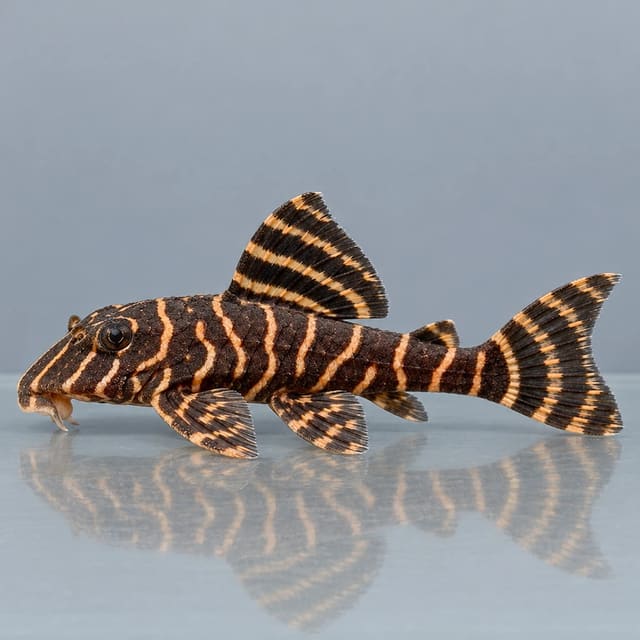
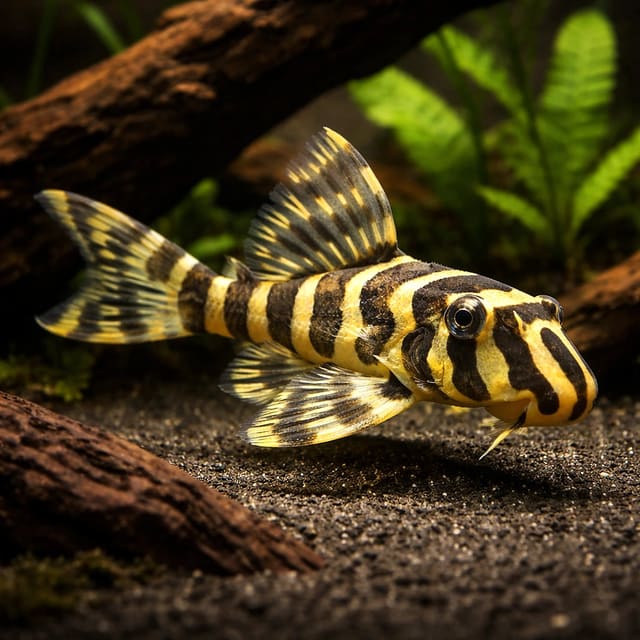
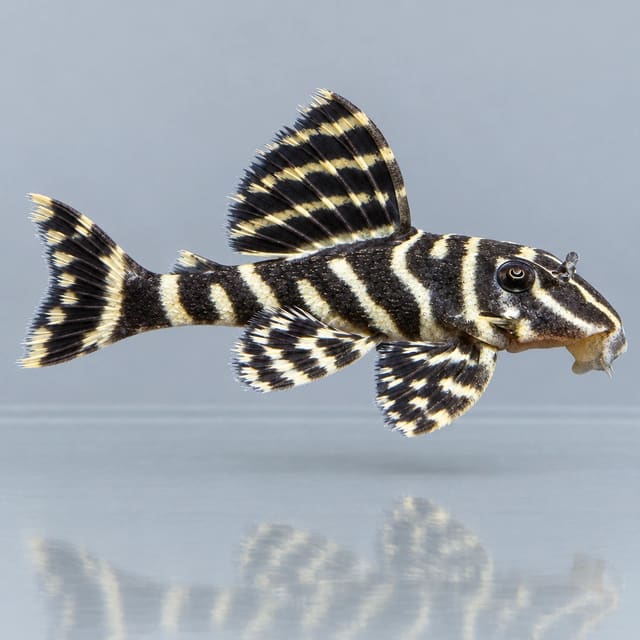
L340 / LDA19 Mega Clown Pleco (Hypancistrus sp.)
£78.69
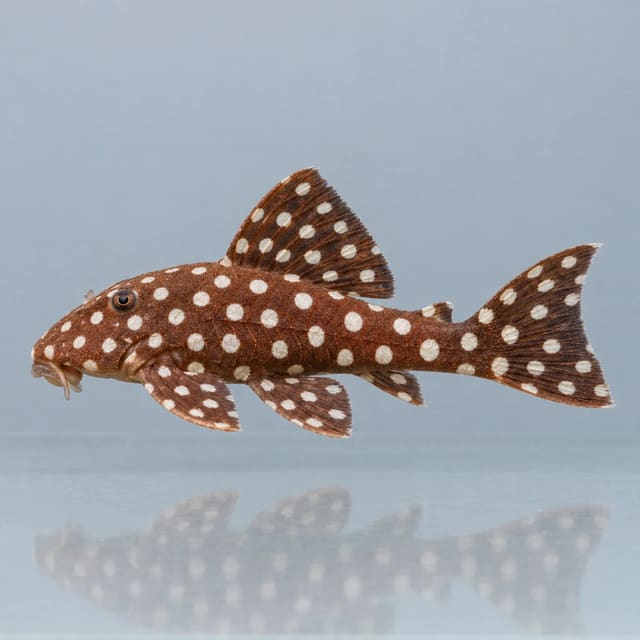
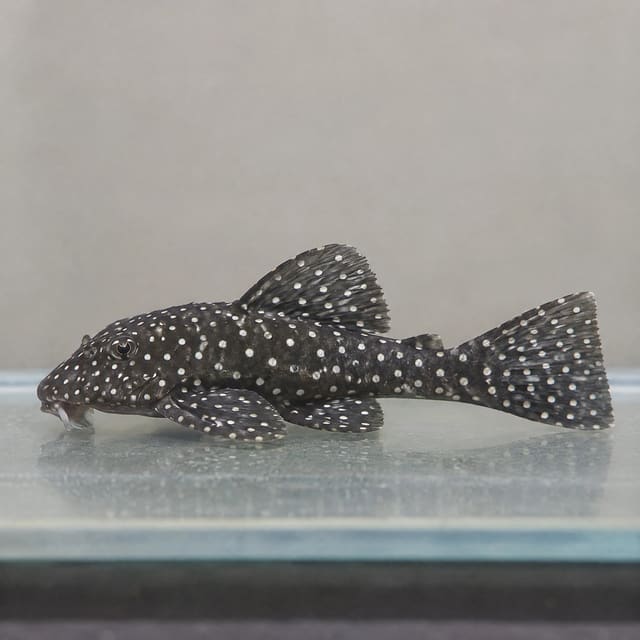
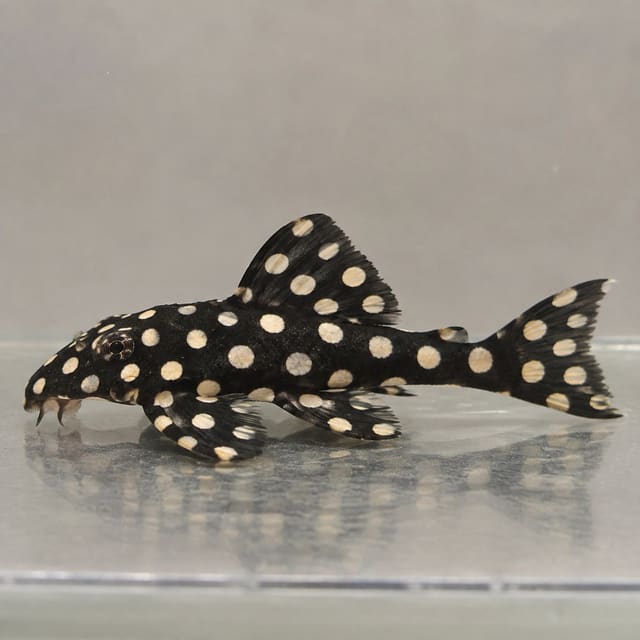
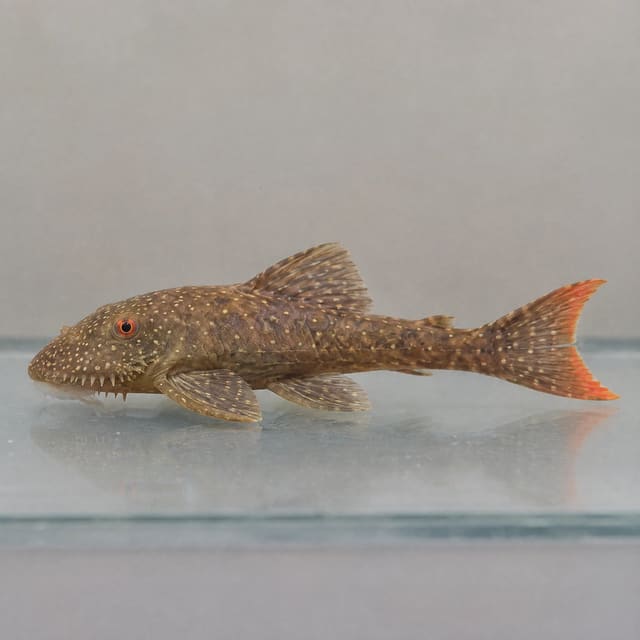
The L262 Stardust Pleco is an undescribed Hypancistrus from the Rio Tapajós in Brazil, a compact suckermouth catfish with a dark body covered in fine white dots. It grows to about 9–10 cm and needs warm, clean, fast-flowing water, rocky caves and small, frequent meaty meals. Sold individually as one live fish.
Hypancistrus sp. (L262)
The L262 Stardust Pleco is an undescribed Hypancistrus from the Rio Tapajós in Brazil, a compact suckermouth catfish with a dark body covered in fine white dots. It grows to about 9–10 cm and needs warm, clean, fast-flowing water, rocky caves and small, frequent meaty meals. Sold individually as one live fish.
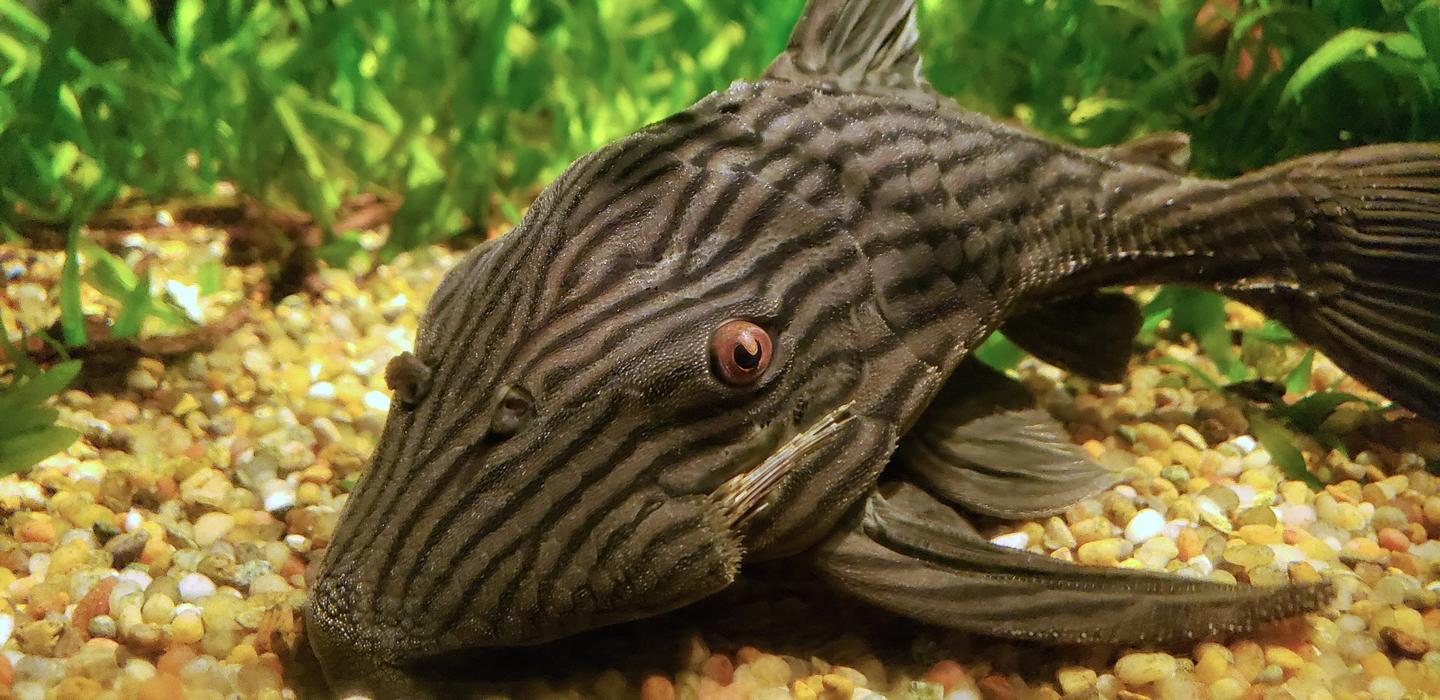
‘Pleco’ is a loose aquarium-trade label, not one species or one care sheet. Before buying, confirm the scientific name or defensible L-number, adult size and measurement method, required footprint, temperature and water, diet, social plan and source. No universal pleco tank size, menu or algae result is honest.
Read the full care guidance when planning conditions for your aquarium.
The L262 Stardust Pleco is an undescribed Hypancistrus from the Rio Tapajós in Brazil: a compact suckermouth catfish with a dark body and fins covered in fine white dots. ScotCat notes that no other known Hypancistrus has spots as numerous, dense and small as L262, and the UK trade name "stardust" reflects that speckling; Planet Catfish lists it as the Fine Dotted Pleco. It first appeared in the German aquarium magazine DATZ in June 1998 and still has no scientific name, so it is sold as Hypancistrus sp. L262.
At about 9–10 cm it is one of the more compact L-number plecos, and one of the most rewarding for keepers who want to watch cave-spawning behaviour: Planet Catfish lists eleven breeding reports. It is a fish of warm, oxygen-rich, flowing water and is largely carnivorous, so it is not an algae eater.
| Name | What it means |
|---|---|
| L262 (also written L-262) | The trade code for this undescribed species |
| Stardust Pleco, Stardust Plec | The UK trade name, from its fine white dots |
| Fine Dotted Pleco | The English name Planet Catfish uses |
| Hypancistrus sp. (L262) | An unnamed species of Hypancistrus, the genus of the zebra pleco |
ScotCat notes that L262 may slightly resemble L136 and L404, but both grow larger. ScotCat also explains that Hypancistrus have fewer, larger teeth than Panaque, Panaqolus and Peckoltia, and Seriously Fish adds that their lower-jaw teeth are about twice as long as the upper ones. See more of the genus in our Hypancistrus plecos category, the wider South American catfish range, or our full catfish and plecos collection.
One purchase supplies one live L262 Stardust Pleco at the standard size offered on this listing. If you hope to breed it, buy several so that a male and a female are likely to be among them, and plan the aquarium and the number of caves for the whole group at adult size.
Sex is not specified. Planet Catfish describes mature males as having a thicker first pectoral-fin ray with more pronounced odontodes, odontodes on the cheeks and rear of the body, and typically a wider head, while mature females are wider around the middle with far less noticeable odontodes. ScotCat adds that males have a broader, longer head. These differences appear only as the fish mature.
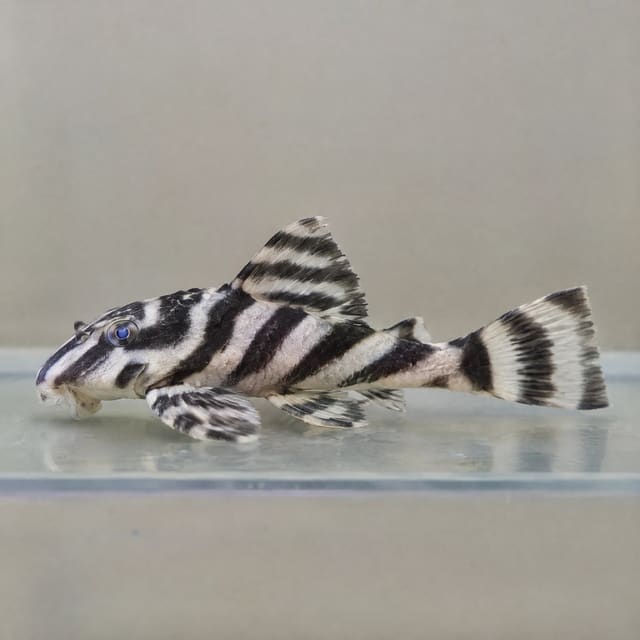
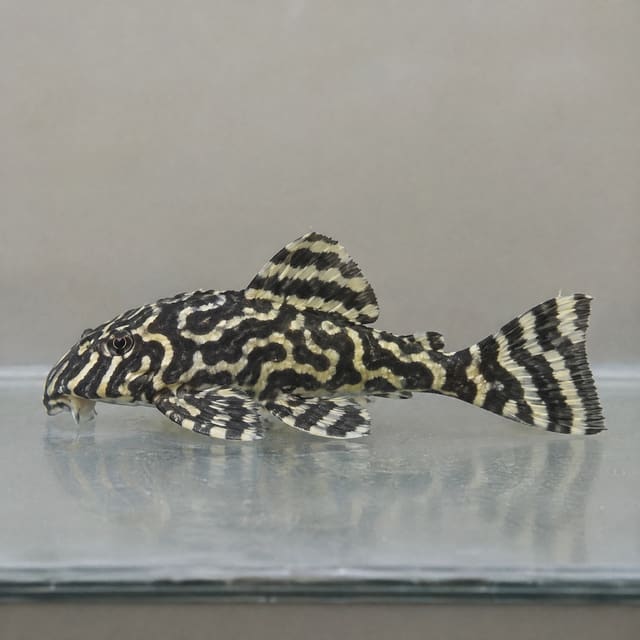
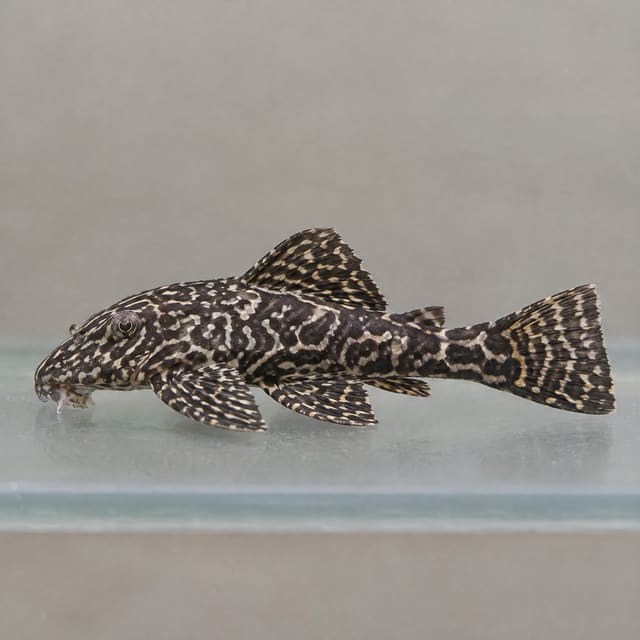
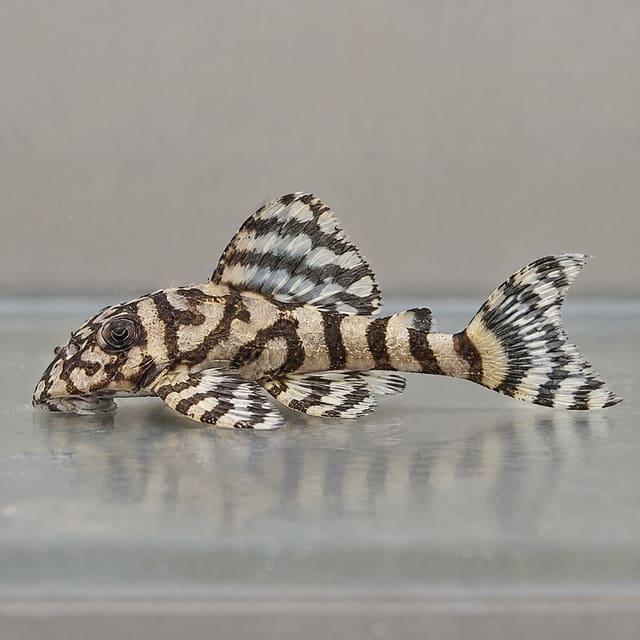
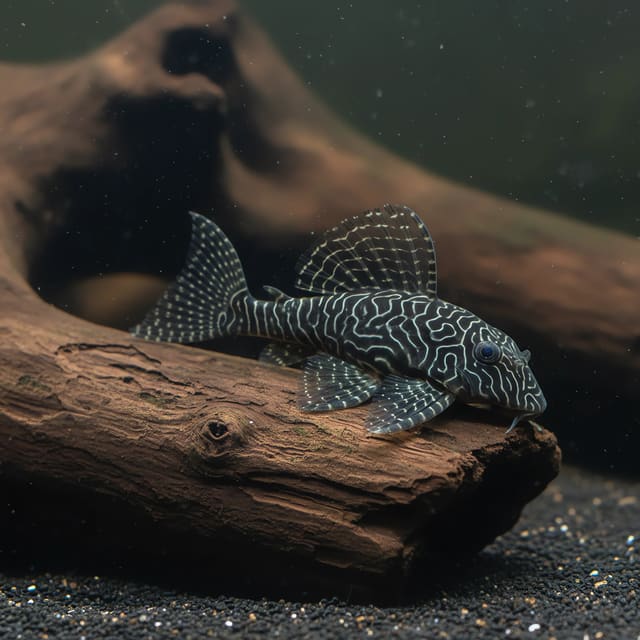
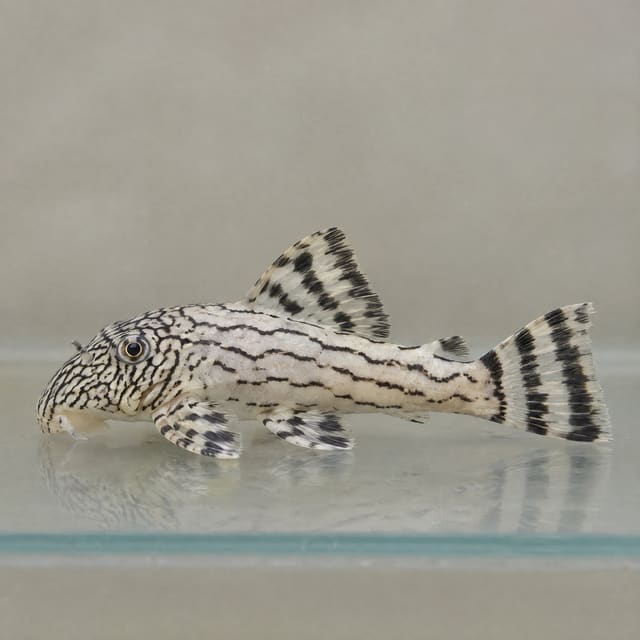
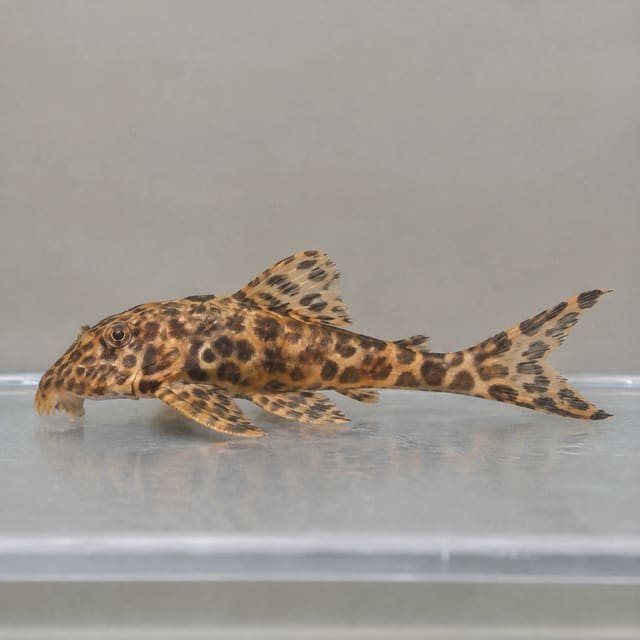
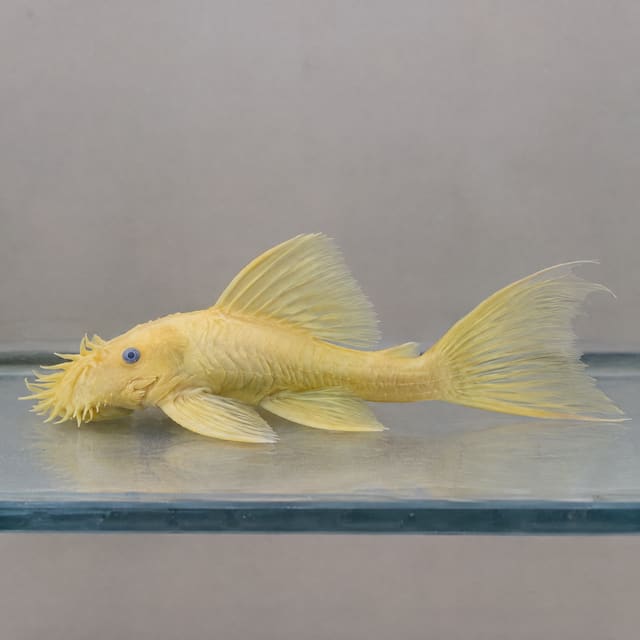
The photographs are representative of the species and do not show the individual you will receive. Dot size and density, and the depth of the dark body colour, vary from fish to fish.
Read our delivery and Live Arrival Guarantee information before ordering, and have the tank mature and stable first.
No aquarium size has been published for L262 itself. Seriously Fish gives a base of 90 × 30 cm, about 81 litres at 30 cm tall, as the smallest to consider for L260, the Queen Arabesque, another Hypancistrus from the lower Tapajós that reaches the same 90 mm standard length. We use that as the minimum for L262.
ScotCat says there is no problem keeping L262 in groups, and Planet Catfish's breeder article describes a colony with more than one breeding male, each holding his own cave. Male Hypancistrus defend their caves, so a group needs more floor space and more caves than fish.
Our tank volume calculator works out the litres you need for filter and heater sums, and our pleco care guide covers the routines that apply to every suckermouth catfish.
Planet Catfish recommends sand, mainly rocks and optional driftwood, with caves made from slate, bamboo or PVC pipe. For L260, Seriously Fish describes an aquarium designed to simulate a flowing stream, with variably sized rocks, sand, fine gravel and some water-worn boulders, plus driftwood, terracotta pipes or plant pots arranged into nooks, shaded spots and broken lines of sight.
| Area | Purpose |
|---|---|
| Sand floor | A soft base that is easy to keep clean around the caves |
| Rock piles | Recreate the rocky river bed and form crevices |
| Small caves | Slate, bamboo, clay or PVC caves, with the entrance only a little wider than the fish |
| Flow zone | Caves placed where the current from a filter or powerhead passes the entrance |
| Shaded corners | Wood or rock overhangs where a shy fish can rest by day |
Place caves where the water moves past the entrance. Build rockwork on the glass before adding sand so it cannot shift. Plants are optional; the stream layout Seriously Fish describes for L260 relies on rock and wood, but a few hardy plants fixed to rock or wood soften the look.
Expect a reclusive fish. Planet Catfish's breeder describes L262 as a recluse whose fry hide from the start, so you will see it most around feeding time and after dark.
The temperature sources do not agree. Planet Catfish gives 23–27°C and ScotCat 26–30°C, so the two overlap at 26–27°C; the breeder in Planet Catfish's L262 breeding article kept a colony at a steady 28°C. ScotCat gives a pH of 5.5–7.0. No hardness is published for L262, but Seriously Fish gives 1–15 dGH for L260.
Clean water matters more than exact numbers. Seriously Fish says L260, like many fish of running water, does not tolerate a build-up of organic waste and needs spotless water, with weekly water changes of 30–50% as routine and a moderate to high level of dissolved oxygen. Warm water holds less oxygen than cool water, so strong surface movement and flow are essential at these temperatures.
| Reading | Target |
|---|---|
| Temperature | 26–27°C suits both sources; keep it steady |
| pH | 5.5–7.0 (ScotCat) |
| General hardness | Not published for L262; 1–15 dGH for L260 |
| Ammonia | Zero mg/l |
| Nitrite | Zero mg/l |
| Nitrate | As low as possible, and never more than 20 mg/l above your tap water |
The ammonia, nitrite and nitrate limits come from OATA's catfish care sheet. In soft-water parts of the UK, conditioned tap water often sits within L262's range; in hard-water areas, particularly southern and eastern England, tap water may sit above pH 7.0 and you may want to blend it with reverse-osmosis water. Your water company publishes the hardness for your postcode. Our water matcher compares your readings with the target, and our water chemistry guide explains how to make changes slowly.
For an 81-litre L260 tank, Seriously Fish suggests a filter rated at about 325–405 litres per hour, four to five turnovers of the volume an hour, and roughly 100–150 W of heating to hold 24–30°C in a room near 20°C. Add a powerhead or airstone if the filter alone does not move the water past the caves.
Meaty foods foul water quickly, so remove leftovers after each meal. A creeping nitrate reading means more water changes or less food, before the fish shows any sign of stress.
Planet Catfish explains that Hypancistrus are more carnivores than algae eaters: their small, lightly toothed mouths make them poor algae scrapers. It recommends small, frequent meals of mainly meaty foods, such as dry discus food, bloodworm and brine shrimp, with only an occasional flake or algae tablet. ScotCat calls L262 an omnivore whose juveniles are keen on vegetable food while adults are less so, and lists frozen brine shrimp, mosquito larvae and mussel as well as tablet foods.
Planet Catfish also warns that L262 can be shy and slow to grab food, so make sure it actually gets some. Feed close to its cave, and offer part of the day's food after the lights go out.
Split the daily amount into small portions rather than one large meal, and watch the belly: a well-fed L262 has a gently rounded belly when it rests on the glass.
Add the fish only to a tank with a mature filter, zero ammonia and nitrite, and the temperature already at its target. Use OATA's floating-bag method: lights off, float the bag for about 10 minutes, then add small amounts of tank water over up to 20 minutes and release the fish with as little bag water as possible. Our guide on how to acclimatise new fish explains the steps.
Have the caves in place before the fish arrives so it can hide straight away. OATA advises double-bagging catfish because their fin spines can puncture bags; the same spines catch in nets, so guide it into a container where you can.
| Checkpoint | What to do |
|---|---|
| Before release | Test ammonia, nitrite, nitrate, temperature and pH |
| First night | Lights off; drop a small meaty meal beside the caves |
| Days 2–3 | Check that food is being taken; remove leftovers |
| Day 4 | Retest ammonia, nitrite and nitrate |
| End of week | Do a 30–50% water change and check its belly |
Expect to see little of it at first. If it has not eaten by the end of the first week, or breathes rapidly, test the water and contact us.
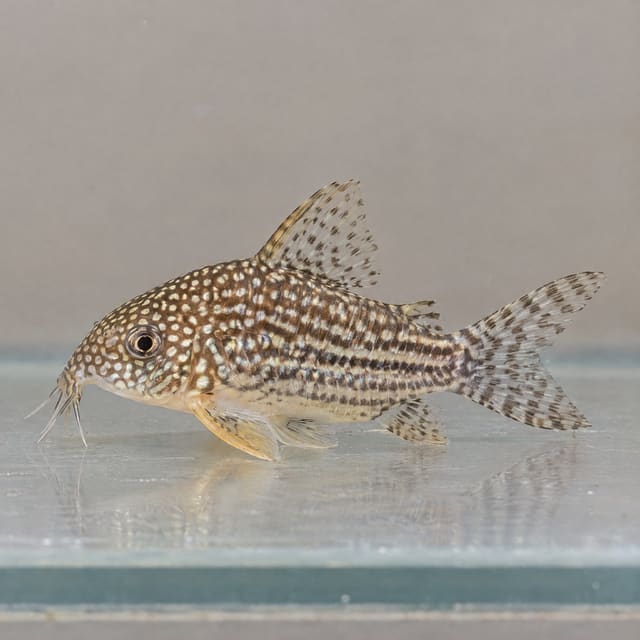
Planet Catfish says L262 is suitable with most fish, as long as they are not too large or territorial about the bottom, and suggests small tetras and similar small fish, and Corydoras. Both ScotCat and Seriously Fish advise keeping only one Hypancistrus species in a tank, because different species have been reported to hybridise, and Seriously Fish adds that these plecos do not compete well with excessively territorial or aggressive tank mates.
From our range, the Cardinal Tetra and the Sterbai Cory are the kind of small tetra and Corydoras Planet Catfish suggests; check each one's temperature range with our tank mates tool, and read our Corydoras care guide if you add a group. If you like spotted and patterned Hypancistrus, the L260 Queen Arabesque Pleco, L201 Snowball Pleco and L046 Zebra Pleco are alternatives: choose one species per tank, not several.
| Suits | Avoid |
|---|---|
| Small tetras and similar small fish that share warm water | Any other Hypancistrus species, because of hybridisation |
| Corydoras | Large fish or fish that guard the bottom |
| A group of its own species with plenty of caves | Boisterous feeders that take all the food |
| Calm fish that cope with steady flow | Fish that need cool water |
Water quality is the main health risk for L262. Seriously Fish's warning about organic waste for L260 applies here too, and OATA lists the general warning signs for catfish: changes in swimming, colour, breathing, appetite, hiding and body condition, plus white spots, fluffy growths and damaged fins.
| If you see | Do this |
|---|---|
| Hollow belly | Feed near the caves after dark and check other fish are not taking the food |
| Fast breathing or hanging near the surface | Test ammonia and nitrite and increase flow and surface movement |
| Nitrate creeping up | Increase water changes and reduce leftover meaty food |
| White spots or fluffy growths | Test the water and seek treatment advice |
| Fish never leaves its cave to feed | Check for a bully, add caves and feed after lights-out |
| Torn fins on males | Cave disputes may be the cause: add caves and visual barriers |
Test first, change one thing at a time and note what you changed. If signs persist once the water is right, contact us with your readings.
Planet Catfish describes L262 as a typical Hypancistrus cave spawner with relatively few eggs per spawn and about 10 days from laying to hatching, and lists eleven breeding reports. Its breeder article gives a closer look: the male kept a female in his cave with him and blocked the entrance; the egg ball held about 20–25 surprisingly large eggs; and at 28°C the fry seemed to hatch 5–6 days after laying, although the breeder could not be certain. The two hatching times differ, so expect anything from about a week upwards.
In that colony the male guarded the eggs with his dorsal fin raised, and the female rested close to his cave. The fry were reclusive from the start and hid under wood, and they survived well even on the very little food available in the tank.
It is an undescribed Hypancistrus from the Rio Tapajós in Brazil, coded L262, with a dark body covered in fine white dots. Planet Catfish calls it the Fine Dotted Pleco, and ScotCat notes that no other known Hypancistrus has spots as numerous, dense and small.
About 9–10 cm: Planet Catfish gives 90 mm standard length and ScotCat 10 cm. It is one of the more compact L-number plecos.
No size is published for L262 itself. Seriously Fish gives a base of 90 × 30 cm (about 81 litres) as the smallest for L260, a Hypancistrus of the same size from the same river, and we use that as the minimum, with more floor and caves for a group.
No, not in any useful amount. Planet Catfish explains that Hypancistrus are more carnivores than algae eaters, with small, lightly toothed mouths. Feed small, frequent, mainly meaty meals.
The sources differ: Planet Catfish gives 23–27°C and ScotCat 26–30°C. The overlap is 26–27°C, and the breeder in Planet Catfish's article kept a spawning colony at a steady 28°C. Keep it warm, steady and well oxygenated.
It is best not to. ScotCat and Seriously Fish advise keeping only one Hypancistrus species per tank, because different species can hybridise. A group of L262 on its own is fine.
Planet Catfish suggests small tetras and similar small fish, and Corydoras. Avoid large, boisterous or bottom-territorial fish, which outcompete this shy feeder.
Yes. It is a typical Hypancistrus cave spawner: the male guards a small clutch inside a cave. Planet Catfish lists eleven breeding reports, and its breeder article describes an egg ball of about 20–25 large eggs at 28°C.
No reviews for this item yet. Bought one? Honest reviews only, good or bad.
What customers say about ordering from us
Easy website plenty of info on fish your buying great to pick a time slot
TRACEY DURRANT · 7 Oct 2026
Got some lovely fish thank you
Kevin Mackie · 7 Oct 2026
Reviews of our shop, collected by Judge.me, an independent third-party review collector. Newest first.
Moved by UK carriers licensed to handle live animals
Hand-packed with oxygen bags, poly box, heat pack
Email photos the same day; an optional unboxing video helps us review problems faster — claim terms apply
Klarna & PayPal Pay in 3 at checkout