−15%
Moderate
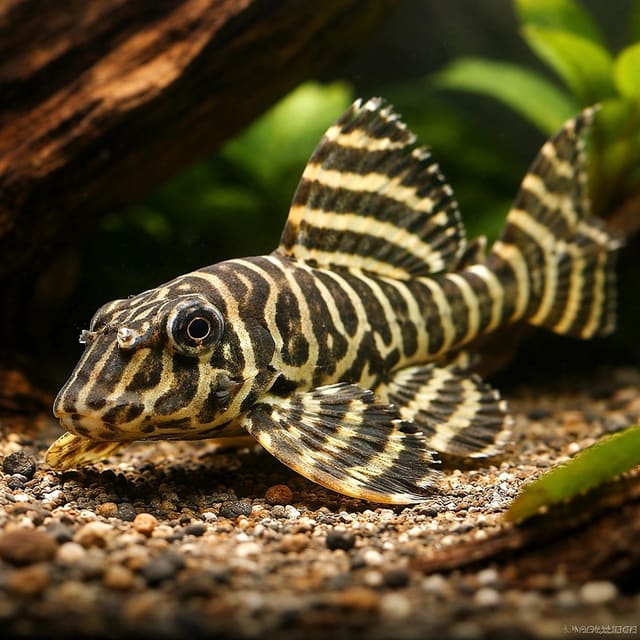
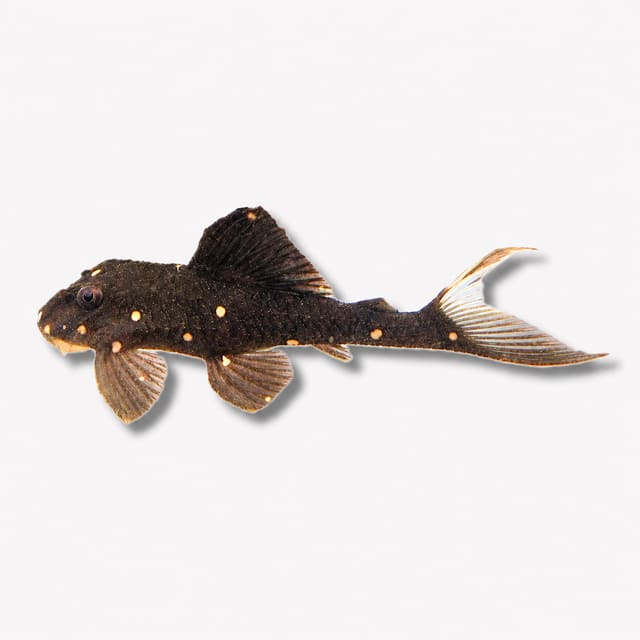
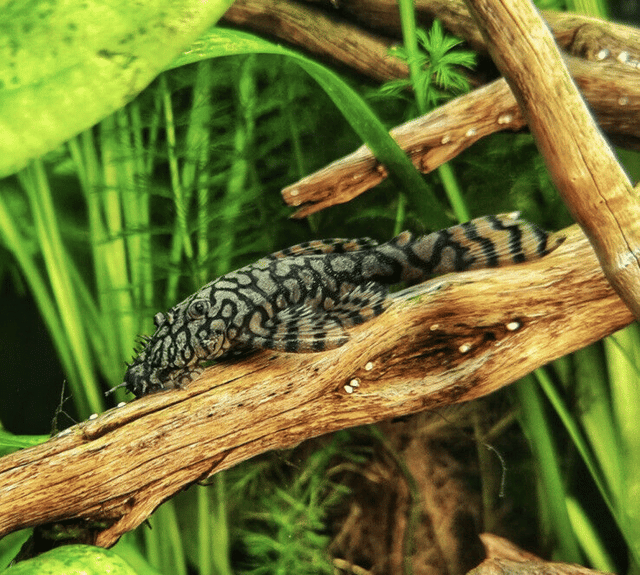
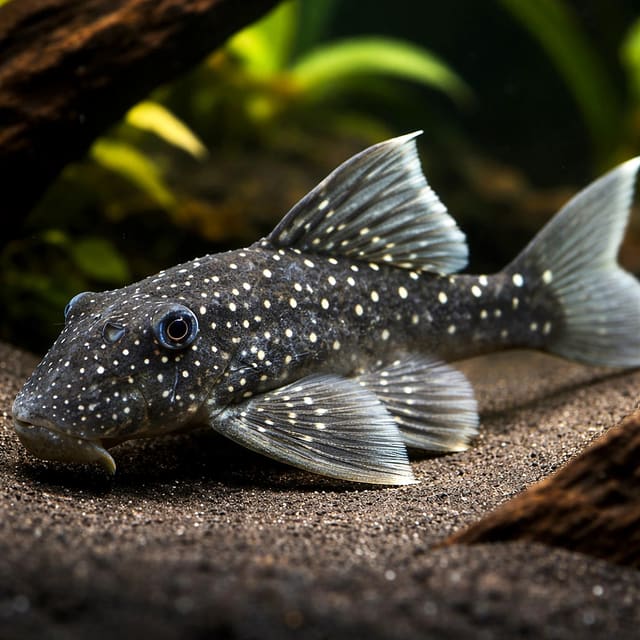
L128 Blue Phantom Pleco (Hemiancistrus sp.)
22–27°C · pH 6–8
£72.24£84.99

The L075 Para Pleco (Peckoltia sabaji), also traded as L124, L301 and LDA02, is a spotted suckermouth catfish from boulder-strewn rivers in northern South America. FishBase records 19.8 cm standard length. Keep it at 26–30°C and pH 6.0–7.5 in 150 litres or more with caves, flow and a mostly vegetable diet. One fish per quantity, 4–7 cm to 20 cm.
Adult size is the maximum length this species reaches at full maturity (scientific sources). The livestock you receive will be younger and smaller — pick a size above for the actual shipping size. Product-photo provenance and any image-specific limitations are stated on the listing.
Peckoltia sabaji
The L075 Para Pleco (Peckoltia sabaji), also traded as L124, L301 and LDA02, is a spotted suckermouth catfish from boulder-strewn rivers in northern South America. FishBase records 19.8 cm standard length. Keep it at 26–30°C and pH 6.0–7.5 in 150 litres or more with caves, flow and a mostly vegetable diet. One fish per quantity, 4–7 cm to 20 cm.
Adult size is the maximum length this species reaches at full maturity (scientific sources). The livestock you receive will be younger and smaller — pick a size above for the actual shipping size. Product-photo provenance and any image-specific limitations are stated on the listing.
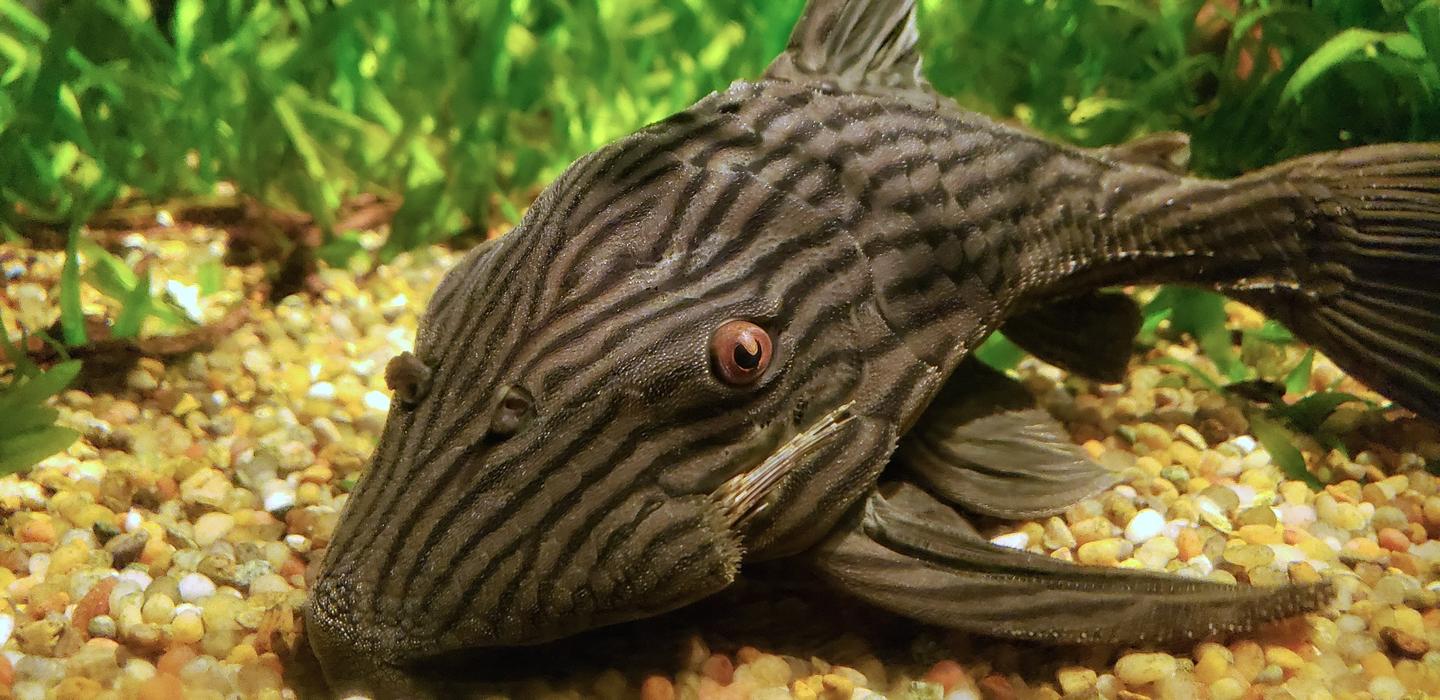
‘Pleco’ is a loose aquarium-trade label, not one species or one care sheet. Before buying, confirm the scientific name or defensible L-number, adult size and measurement method, required footprint, temperature and water, diet, social plan and source. No universal pleco tank size, menu or algae result is honest.
Maintain these water conditions for optimal health and vibrant colors
The L075 Para Pleco is Peckoltia sabaji, a spotted suckermouth catfish from the rivers of northern South America, described by Jonathan W. Armbruster of Auburn University in 2003. The "L075" in the name comes from the L-number system, which Wikipedia describes as a semi-scientific catalogue of loricariid catfish built from photographs of imported fish published by the German magazine DATZ, with the first L-number appearing in 1988. A rival magazine, Das Aquarium, ran a similar series with the prefix LDA. This species ended up with several codes: Wikipedia's L-number table and ScotCat both list L075, L124 and L301 against Peckoltia sabaji, together with LDA02. If you see any of those four codes on a label, it refers to this fish.
The scientific name has moved around, which is why older books and labels disagree. Wikipedia sets out the history: Armbruster described the fish in Peckoltia in 2003, moved it to Hemiancistrus in 2008 after reviewing the genera, and it was returned to Peckoltia in 2015 by Armbruster and colleagues. FishBase accepts Peckoltia sabaji today, and adds a remark that the aquarium world sometimes files it under Ancistomus. Wikipedia's account of the genus goes further and notes that its place in Peckoltia was somewhat arbitrary and that it may even represent a genus of its own. For the buyer the practical point is simple: Hemiancistrus sabaji, Ancistomus sabaji and Peckoltia sabaji are all the same animal.
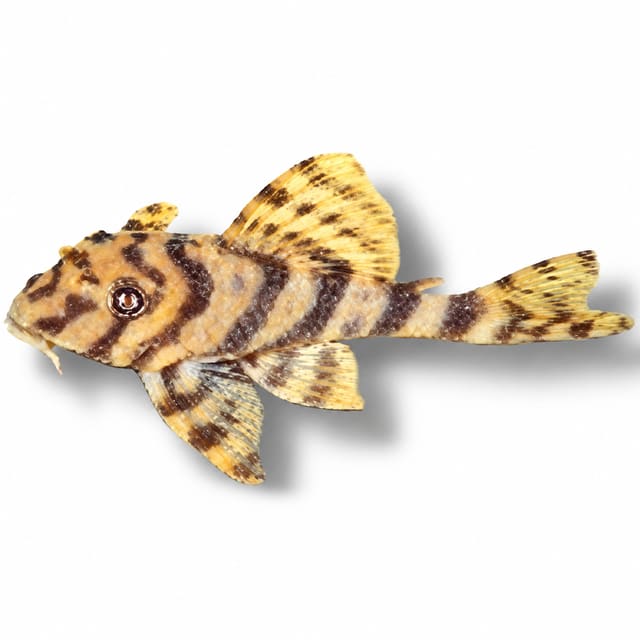
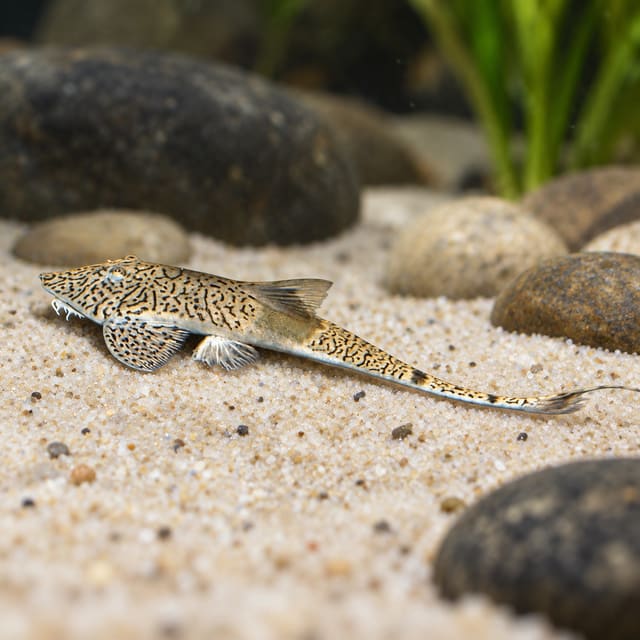
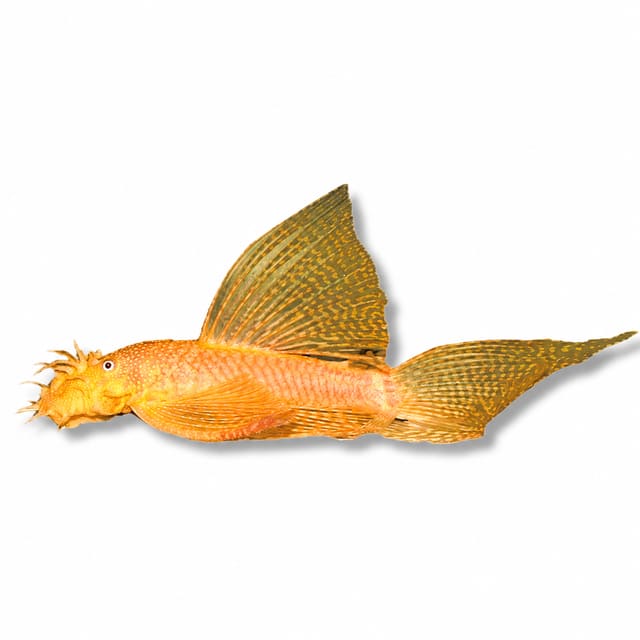
FishBase gives a short diagnosis that is easy to use at the shop glass: small spots on the head, with the spots becoming very large on the caudal peduncle (the narrow part of the body just in front of the tail) and on the tail fin itself, and a very elongated body. It also notes that the gill cover lacks the bristly odontodes some plecos carry there, with only the occasional adult showing one or two. The photos on this listing show exactly that progression: a cream to golden-tan fish whose snout and head are peppered with fine dark dots, while the spots on the flanks, the tall sail-like dorsal fin and the tail are bold and rounded.
It also has the features of its family, the Loricariidae. Wikipedia describes the bony plates that armour the body and the suckermouth on the underside of the head, with small projections on the lips, which the fish uses to feed and to hold fast to surfaces. Look closely at the eye in good light and you may see the family's unusual "omega iris": a loop of the iris expands in bright conditions to cover the centre of the pupil, leaving a crescent-shaped opening.
| Quick fact | L075 Para Pleco |
|---|---|
| Scientific name | Peckoltia sabaji Armbruster, 2003 |
| Other codes and names | L124, L301, LDA02; Para Pleco; formerly Hemiancistrus sabaji |
| Family | Loricariidae, subfamily Hypostominae |
| Wild range | Guyana and Venezuela, with Wikipedia adding Brazil and Colombia |
| Recorded maximum size | 19.8 cm standard length (FishBase); ScotCat gives 25 cm |
| Temperature | 26–30°C |
| pH | 6.0–7.5 |
| Aquarium for one adult | 150 litres or more, with a long footprint |
| Diet | Mostly vegetable foods, with some frozen or live foods |
| Most active | After dark |
| What one quantity buys | One fish, in the size you choose |
This is a bigger fish than many people expect from a "Peckoltia". FishBase records a maximum size of 19.8 cm standard length for a male or unsexed specimen, and Wikipedia repeats that figure. Standard length runs from the tip of the snout to the base of the tail, so the tail fin adds to it. ScotCat quotes 25 cm for the species without saying how it was measured. Either way, plan for a substantial pleco of around 20 cm or more from nose to tail tip when fully grown, not the 12–15 cm figure you will sometimes see quoted for it.
We offer five sizes, and each is the size of the fish we send, not a promise of adult size:
Whichever size you choose, build the aquarium for the adult. A 5 cm youngster looks lost in 150 litres, but it will not stay 5 cm, and moving a large pleco to a bigger tank later means catching an armoured fish out of a rockwork cave. The other thing that has to grow with the fish is the cave. A youngster will happily wedge itself into a tight gap; a 20 cm fish needs a cave it can fully enter, turn in and back out of without scraping its fins. Keep a range of cave sizes in the tank so it can move up as it grows.
FishBase notes that in the wild, small individuals are found hidden in the holes of lateritic rocks in pools, away from the stronger current of the runs where adults are found. That is a useful model for a youngster in the 4–7 cm or 7–10 cm grades. Give it small, tight hiding places as well as the larger caves it will need later: a stack of flat stones with narrow gaps, a short length of pipe or a piece of wood with holes in it. Put some of these in calmer water, so a small fish is not pressed against the full force of the filter outlet. Young fish also need food that actually reaches them. Place a small piece of wafer right beside the hiding place after lights out and check in the morning that it has gone; a growing pleco left to forage on biofilm alone will struggle to put on size.
The size options are only about length. This listing does not offer a choice of male or female, and young plecos of this kind cannot be sexed reliably by eye.
The published ranges differ slightly in detail, which is common for L-number plecos. FishBase gives the distribution as Guyana and Venezuela. ScotCat is more specific: the Rupununi, Essequibo and Takutu river basins in Guyana and the Casiquiare and Orinoco basins in Venezuela, with the type locality (the place the specimens used to describe the species were collected) on the Rupununi River in Guyana. Wikipedia lists Brazil, Colombia, Venezuela and Guyana, across the Amazon, Orinoco and Essequibo basins. Put together, it is a fish of the northern edge of the Amazon basin and of the Orinoco and Essequibo systems beyond it.
Within that range it lives in moving water. FishBase describes it as found in medium to large rivers among boulders, usually in runs and riffles, with small individuals hidden in the holes of lateritic rocks in pools. Wikipedia's account of the genus describes Peckoltia generally as living in shallow, rocky riffles and in quieter water where they hide inside cavities in submerged logs. Picture a broad river running fast and shallow over a bed of boulders, the young fish tucked into pitted rock in the slack pools at the edge and the adults out among the stones where the current keeps the water clean and well oxygenated.
One detail from FishBase is especially useful to a keeper: most specimens were collected at night. That matches the family as a whole, since Wikipedia notes that most loricariids are nocturnal and shy away from bright light, appreciating some cover to hide under during the day. In the aquarium this is a fish you will see most of around dusk and after the lights go out, and much less at midday.
FishBase lists the species as Least Concern on the IUCN Red List, assessed in October 2020, harmless to people and of no interest to food fisheries. ScotCat records that the species name honours Dr Mark Henry Sabaj, collection manager of ichthyology at the Academy of Natural Sciences of Philadelphia.
We recommend at least 150 litres for one adult L075, with the emphasis on floor area rather than height. This is a fish of the bottom: FishBase describes it as demersal, and everything it does, from grazing to resting to defending a cave, happens on or near the base of the tank. A long, wide aquarium gives far more usable space than a tall one of the same volume. ScotCat describes the species as a very good aquarium fish and says several specimens can be kept in a medium-sized aquarium; if you want more than one, give each fish its own cave and go larger than the single-fish figure.
Take the cue from the river. Rounded stones and boulders, a few pieces of bogwood and plenty of caves recreate the rocky runs and log cavities described by FishBase and Wikipedia. Purpose-made pleco caves, slate stacked into overhangs and hollow wood all work, provided the inside surfaces are smooth. Aim for more hiding places than you have bottom-dwelling fish, spread across the footprint rather than clustered in one corner, so that no fish has to pass another's front door to reach its own. Stack rockwork directly on the glass or on a base layer, not on top of sand, so that nothing can be undermined and collapse.
A suckermouth catfish spends its life in contact with the floor, so choose fine sand or smooth, rounded gravel rather than anything sharp. Keep lighting moderate and create shade with wood, overhangs and floating plants; a loricariid that is offered dim corners will use them, which is what Wikipedia's note about the family avoiding bright light would lead you to expect. For plants, tough species tied to wood or rock, such as Java fern and Anubias, cope with a heavy fish moving over them far better than delicate stems planted in the sand.
This species comes from runs and riffles, so it needs clean, well-oxygenated, moving water. Choose a filter with enough capacity for a large fish that eats a lot of vegetable matter and produces plenty of waste, and position the outlet to give good surface movement and a current along the bottom. Leave calmer pockets behind rocks and wood too, so the fish can rest out of the main flow. A spray bar or an additional air pump is a cheap way to lift oxygen levels, especially at the warm temperatures this fish prefers.
For one adult in a tank of around 150 litres with a base of roughly 100 × 40 cm, this is the kind of layout we would suggest:
Run the aquarium for several weeks before adding the fish so the filter is mature, the water tests clean and some biofilm has built up on the rocks and wood.
Water parameters are one of the first things people look up for any pleco, and they matter more than usual with this one because it likes its water warm. ScotCat gives a temperature range of 26–30°C and a pH range of 6.0–7.5 for Peckoltia sabaji, and those are the ranges we now list for it. FishBase records the species as tropical but does not give a temperature range.
| Parameter | Range we list | Practical target |
|---|---|---|
| Temperature | 26–30°C | A steady 27–28°C |
| pH | 6.0–7.5 | Around 6.5–7.0, kept stable |
| General hardness | 2–15 dGH (broad working range) | Soft to moderately hard, kept stable |
| Ammonia and nitrite | Zero | Zero |
| Nitrate | As low as possible | Kept down by regular partial water changes |
Two of those figures need a word of explanation. You may see 24–28°C and pH 5.5–7.5 quoted for this fish; the published ranges we follow are 26–30°C and 6.0–7.5. And hardness is less well documented for this species than temperature or pH. The 2–15 dGH band is a broad working range rather than a measured preference, so treat stability as more important than the exact number within it.
Warm water carries a cost: the warmer it is, the less oxygen it can hold. That is one more reason to keep the surface moving and the filter clean, and to avoid running the tank at the very top of the range unless you have to. A steady 27–28°C sits comfortably inside the published band and leaves headroom on a hot summer day.
Plecos are messy. A fish approaching 20 cm that grazes vegetable food all night produces a lot of waste, and leftover food tucked behind wood rots unseen. Test for ammonia, nitrite and nitrate regularly, especially in the first months, and change part of the water every week rather than letting nitrate build up and correcting it with a large change. New water should be dechlorinated and matched to the tank temperature, so each change shifts conditions only a little.
If your tap water is very hard or very alkaline, check it against the ranges above before you order and ask us if you are unsure. It is far easier to plan around your water than to change it once a large fish is in the tank.
ScotCat describes this species as mostly vegetarian but says it can also be fed frozen and live foods such as mosquito larvae and brine shrimp. That fits the family picture on Wikipedia, which lists algae, invertebrates and detritus as loricariid foods. In practice the diet should be built on vegetable matter, with a smaller share of meaty foods for variety.
Timing matters more with this fish than with most. FishBase notes that most wild specimens were collected at night, and Wikipedia describes loricariids as mostly nocturnal. Feed the main meal shortly after the lights go out, when the pleco is active and the daytime fish have settled. Food dropped into a busy tank at midday is often eaten by faster midwater fish before it reaches the bottom, and a pleco that seems to be "doing fine on leftovers" may in fact be slowly starving.
A sample week of evening meals might look like this:
| Day | After lights out |
|---|---|
| Monday | Sinking algae wafer |
| Tuesday | Blanched courgette, removed the next morning |
| Wednesday | Frozen mosquito larvae, thawed |
| Thursday | Vegetable-based pleco tablet |
| Friday | Blanched cucumber or courgette |
| Saturday | Frozen brine shrimp, thawed |
| Sunday | A small wafer, or nothing if the week has been generous |
To prepare vegetables, slice them into rounds, drop them into boiling water for a minute or two until they soften, cool them and weigh them down with a plant weight or a vegetable clip so they sit on the floor near the caves.
Wood in the tank is for cover and grazing surfaces. Wikipedia notes that some loricariids, notably Panaque, can digest wood, but none of our sources describe Peckoltia sabaji as a wood-eater, so do not count on bogwood as food.
A pleco hides much of the day, so judge its condition rather than its appetite. When it is on the glass, look at the belly: it should be gently rounded, not hollow or pinched. If it looks thin, feed later in the evening, put food right beside its cave, and check in the morning that the food you offered has gone. Remove anything left over, especially vegetables and frozen food, before it starts to break down.
Expect a shy, cave-loving fish. Wikipedia's account of the genus describes Peckoltia as shy fish that spend much of the day hiding, and the family as mostly nocturnal. A settled L075 will claim a cave or a gap under wood as home base, rest there through the day, and come out to graze as the light fades. It is generally peaceful towards other fish, but expect it to treat its chosen cave as its own and to see off another bottom-dweller that tries to move in.
ScotCat says several specimens can be kept in a medium-sized aquarium, and in a well-furnished tank that is true. What makes it work is the layout. Each pleco needs its own cave, with the caves far enough apart that one fish is not constantly at another's door, and enough feeding stations that food reaches everyone. Two large plecos competing for one good cave is the classic recipe for scraped fins and a fish that never comes out.
Temperature is the check people most often forget. Because this pleco wants 26–30°C, every companion has to be comfortable in warm water as well. Look up each species' own care range and look for a genuine overlap of several degrees, not a single shared figure at the edge of both ranges.
If you are browsing other L-number plecos, we also list the L128 Blue Phantom Pleco, the L066 King Tiger Pleco, the L333 Maze Zebra Pleco and the L204 Flash Pleco. Each has its own size, temperature and feeding needs, so check its listing before planning a shared tank. Putting two pleco species together is a question of space, caves and water, not just of temperament.
We have not found a detailed spawning account for Peckoltia sabaji in the references listed at the end of this page, so what follows is what is known at genus and family level, and it is labelled as such.
Wikipedia's account of Peckoltia says most male Peckoltia develop hypertrophied (enlarged) odontodes on the body during the breeding season. Odontodes are the small tooth-like bristles on a loricariid's skin, and the family account adds that they are often sexually dimorphic, being larger in breeding males. So a mature male in breeding condition is likely to look bristlier than a female, but outside that season, and in young fish, the difference may not be visible. That is why the size options on this listing are not sexed.
Across the family, Wikipedia records a wide range of breeding methods, including spawning in cavities, sticking eggs to the underside of rocks and carrying eggs, and notes that in loricariids it is the male that guards the eggs and sometimes the larvae. Wikipedia's genus page mentions that a related species, Peckoltia braueri, was reported bred in captivity for the first time in 2013. If you hope to breed L075, the sensible preparation follows the same lines as good everyday care: a group of mature fish, several caves of a size an adult male can occupy, excellent water quality, warm temperatures within the listed range and a rich, varied diet.
Because a pleco spends so much of its time out of sight, problems are easy to miss, so learn what normal looks like for your fish and check against it. A healthy L075 spends the day in or near its cave, comes out in the evening, holds its fins open, grips surfaces firmly and has a rounded belly and clear eyes.
Most of the problems above come back to the same few causes: water quality, oxygen, food not reaching the bottom, and competition for caves. Fix the environment first; a fish whose conditions are right has the best chance of recovering on its own, and medication is only worth considering once you know what you are treating.
Avoid netting a pleco more than you have to, because the odontodes on its skin and fin rays can catch in net mesh. When you do need a net, use a soft, fine one, lower it into the water and let the fish slide out rather than tipping or tugging it free. Never pull a fish that has locked itself onto glass or into a crevice; wait for it to let go.
One quantity is one L075 Para Pleco. Pick the size from the options (4–7 cm, 7–10 cm, 10–12 cm, 15–19 cm or 20 cm) and set the quantity to the number of fish you want. The size is the size we send, and no choice of sex is offered.
Read our delivery and live-arrival information before you place the order. Have the aquarium ready in advance: filter running, water tested and the heater holding the temperature you intend to keep. Live animals cannot be left on a doorstep, so make sure someone will be at the delivery address on the day. Your confirmed delivery date and tracking come by email.
Each fish is packed in an oxygen-filled bag inside insulated packaging, with heat packs added when conditions call for them, and travels with a tracked courier licensed to carry live animals.
Before you cut the tape, start recording a video and keep it running while you open the box and show the fish inside its still-sealed bag. This one continuous video is what a live-arrival claim depends on; photographs on their own do not meet the policy. If the fish is dead, dying or clearly compromised, email hello@tropicalfishco.co.uk on the day it arrives, with your order number and the video attached. Subject to the guarantee terms, we will replace the affected fish with your next order or refund it.
Leave the lights low for the rest of the day. Given how shy and nocturnal these fish are, do not be surprised if a new arrival disappears into a cave and is hardly seen for the first few days. Over the first week, check its breathing, whether food put out after lights-out is disappearing, and how it behaves when it does come out. A fish that grips the glass or rock firmly, breathes steadily and starts showing up at dusk is settling in well.
These are the references used for the facts on this page.
No reviews for this item yet. Bought one? Honest reviews only, good or bad.
What customers say about ordering from us
I have a small group of long finned mountain minnows. So was delighted to be able to order ten of this variety to increase the genetics in my tank . The ones I recieved are healthy but it’s to early to give a verdict on wether they are of a long finned type since they are small currently.
Gordon Walker · 23 Sept 2026
100% success travel and "installation". Pleased with quality of purchase. The Siamese fighter a bit "shy" so have not yet seen him at his best yet but looking good. Happy customer. GG
George E Garratt · 21 Sept 2026
Reviews of our shop, collected by Judge.me, an independent third-party review collector. Newest first.