Moderate
Amiet's Killie (Fundulopanchax amieti)
23–26°C · pH 6–7 · 30L
£11.99

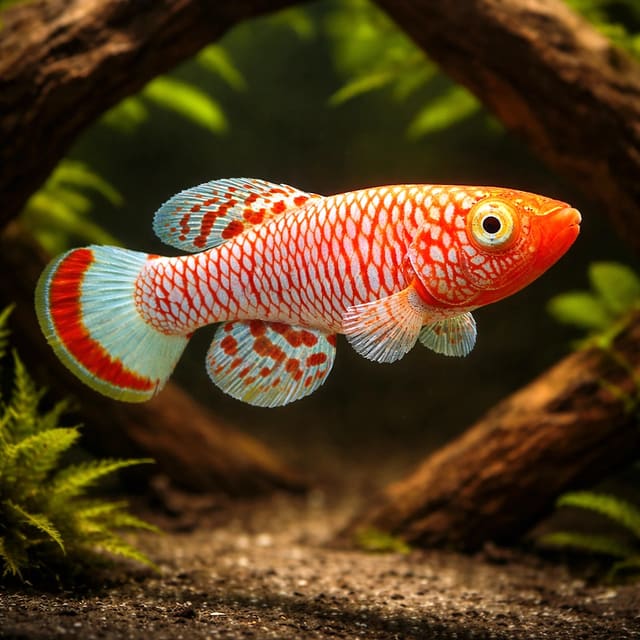
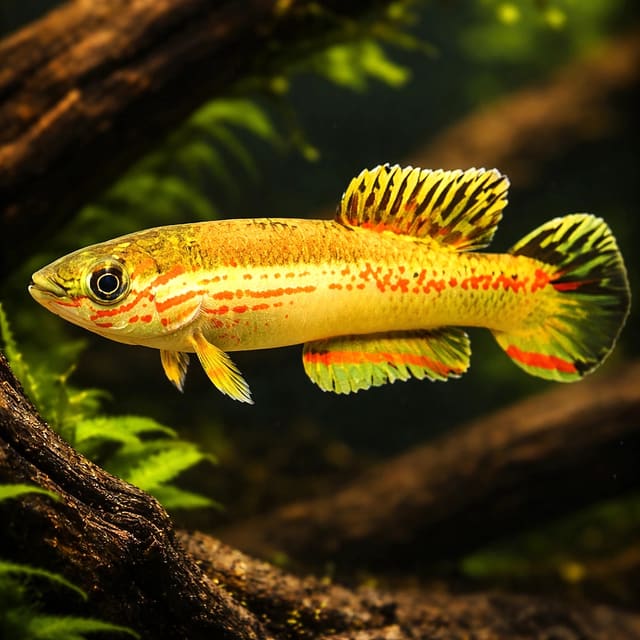
A colourful coastal West African killifish, supplied around 3-4 cm. Best in a covered soft-water species setup with live or frozen foods and calm companions only.
Adult size is the maximum length this species reaches at full maturity (scientific sources). The livestock you receive will be younger and smaller. Product-photo provenance and any image-specific limitations are stated on the listing.
Fundulopanchax filamentosus
Save when buying multiple fish. Each quantity is one fish; sex and pair formation are not guaranteed unless the selected variant explicitly states them.
Confirm your email, then we’ll send an availability message for this exact item if it returns within 180 days.
This request is only for this product—no newsletter or other promotions. A mail-provider retry may very rarely duplicate the same availability message. Unconfirmed addresses are removed after 48 hours. See our privacy policy.
A colourful coastal West African killifish, supplied around 3-4 cm. Best in a covered soft-water species setup with live or frozen foods and calm companions only.
Adult size is the maximum length this species reaches at full maturity (scientific sources). The livestock you receive will be younger and smaller. Product-photo provenance and any image-specific limitations are stated on the listing.
Maintain these water conditions for optimal health and vibrant colors
The Lyretail from Togo, also known as the Plumed Lyretail, is a colourful West African killifish best treated as Fundulopanchax filamentosus. our stock records use the older aquarium name Aphyosemion filamentosum, so that synonym is kept here for clarity, but FishBase lists it as a synonym of the accepted name Fundulopanchax filamentosus.
This listing is for young fish supplied at approximately 3-4 cm. Mature males can reach about 5-5.5 cm total length and develop the blue, red-spotted fins and short tail filaments that give the species its trade name. It is not a generic beginner community fish: it rewards careful keepers who can provide a covered, quiet, planted aquarium, steady soft water and small meaty foods.
Fundulopanchax filamentosus is a coastal West African species recorded from Togo, Benin and Nigeria. FishBase describes it from swamps and swampy sections of shallow brooks in coastal rainforest habitat, where cover, leaf litter, marginal plants and soft water are more important than strong current.
That habitat explains why this fish should not be kept in a bright, fast-flowing, busy aquarium. Use subdued light, floating plants, fine-leaved cover, roots, leaf litter and gentle filtration. A dark substrate helps the colours show and gives nervous fish somewhere visually quiet to settle.
Adult males are the reason this species is so loved by killifish keepers. Specialist descriptions note a pale yellow-green to mauve body, scarlet or maroon barring, blue fins with maroon spotting and a three-lobed tail with short extensions. Older males usually show the best filament development, so young arrivals may colour up gradually as they mature.
Females are much more understated, typically light brown with spotted flanks and clearer rounded fins. This difference is normal and useful when building pairs or trios. Colour is strongest when the fish are settled, not bullied, and fed varied small foods rather than only dry flake.
A pair or trio can be maintained in a compact species aquarium from around 25-40 litres if the water is stable and the tank is mature. For a display group or a mixed peaceful setup, give more space, more plant cover and several broken lines of sight so males can display without constant pressure on females.
Use a sponge filter or a gentle filter outlet, because this is a swamp-and-brook killifish rather than a current-loving species. Keep the aquarium covered with no open gaps; killifish are excellent jumpers, especially during settling, feeding or sudden disturbance.
Good plants include Java moss, moss mops, floating Salvinia or Amazon frogbit, Java fern, Anubias and other shade-tolerant species. Peat fibre, botanicals or catappa leaves can be used if they suit your setup, but clean stable water matters more than trying to force a very dark blackwater look.
FishBase gives a tropical range around 21-23 C, with pH around 6.5-7.2 and soft water. The supplier range for this stock is slightly broader at 21-24 C, pH 6.0-7.4 and 5-15 dGH. For everyday care, aim for steady conditions in the middle of those ranges rather than chasing numbers.
Keep ammonia and nitrite at zero and nitrate low with regular partial water changes. Avoid sudden swings in temperature, pH or hardness. If your tap water is very hard, consider blending with remineralised RO water for long-term breeding and colour, but make changes gradually.
In nature this species feeds on small worms, crustaceans and insects. In the aquarium, offer a varied diet of live or frozen daphnia, cyclops, mosquito larvae, brine shrimp, grindal worm and finely chopped bloodworm, supported by quality micro pellets or soft granules if the fish accept them.
Feed small portions once or twice daily. Remove uneaten food quickly in small tanks. Conditioning adults with live and frozen foods is especially important if you want full colour, regular spawning and strong fry.
The safest and most rewarding setup is a species tank with one male and two females, or a carefully managed small group with plenty of cover. The British Killifish Association notes that males are not usually highly aggressive towards females, but a cramped, bare tank can still create stress.
If you keep them with other fish, choose only very calm, small species that will not outcompete them at feeding time. Avoid fin nippers, boisterous tetras, large cichlids, predatory fish, large shrimp and anything that may view a slim 3-4 cm killifish as food. Very small shrimp fry may also be eaten.
This species is usually treated as a bottom or peat-spawning killifish, though hobbyist breeding reports also mention spawning mops. FishBase notes bottom spawning and an incubation period of around 1.5 months; specialist keeper reports often use peat or similar substrate and may dry-store eggs for longer, around two to three months depending on population and temperature.
A dedicated breeding setup is recommended. Use soft, clean water, a peat layer or mop, and condition adults well. Eggs can be collected and incubated separately; fry need very small first foods such as infusoria, then newly hatched brine shrimp or microworms once large enough.
Do not treat Lyretail from Togo as a hard-water community tetra, and do not rely on a bare tank with harsh lighting. The old supplier-style description also understated adult size and used broad community wording; the important corrections are simple: cover the tank, keep the water stable and soft, provide shade and feed small meaty foods.
Another common mistake is buying one fish for a busy mixed aquarium. A lone killifish may hide, jump or fail to show its natural behaviour. Plan the setup first, then add the fish to a calm mature tank.
Choose this species if you enjoy observing detailed behaviour in a smaller specialist aquarium. The best display is not a crowded mixed tank, but a quiet planted setup where the male can patrol cover, show to females and feed without being rushed by faster fish.
It is also a good choice for keepers interested in killifish breeding, because it introduces peat or bottom-spawning methods without needing a huge aquarium. The trade-off is that you must be comfortable with small foods, careful water changes and patient egg incubation.
Newly arrived killifish can look paler than settled adults, especially after transport. Give them shade, cover and a quiet first evening rather than trying to photograph or feed heavily straight away. Colour and confidence usually improve once the fish have rested and recognised the feeding routine.
Your fish are packed for live delivery and covered by our Live Arrival Guarantee. When they arrive, keep the lights low, float the sealed bag to equalise temperature, then acclimate gradually before release. Do not add transport water to the aquarium.
Offer food lightly on the first day and watch breathing, posture and confidence over the first week. If you are preparing a specialist killifish setup, we can help with tank size, water, feeding and compatibility before you order.
Care notes were checked against FishBase for accepted taxonomy, range, size, habitat, diet and breeding notes; the British Killifish Association for maintenance, colour and breeding detail; Killi.co.uk for recorded strains and keeper breeding reports.
No reviews for this item yet. Bought one? Honest reviews only, good or bad.
What customers say about ordering from us
I have a small group of long finned mountain minnows. So was delighted to be able to order ten of this variety to increase the genetics in my tank . The ones I recieved are healthy but it’s to early to give a verdict on wether they are of a long finned type since they are small currently.
Gordon Walker · 23 Sept 2026
100% success travel and "installation". Pleased with quality of purchase. The Siamese fighter a bit "shy" so have not yet seen him at his best yet but looking good. Happy customer. GG
George E Garratt · 21 Sept 2026
Reviews of our shop, collected by Judge.me, an independent third-party review collector. Newest first.