Moderate
Gardner's Killifish (Fundulopanchax gardneri)
22–25°C · pH 6–7.2
£7.99
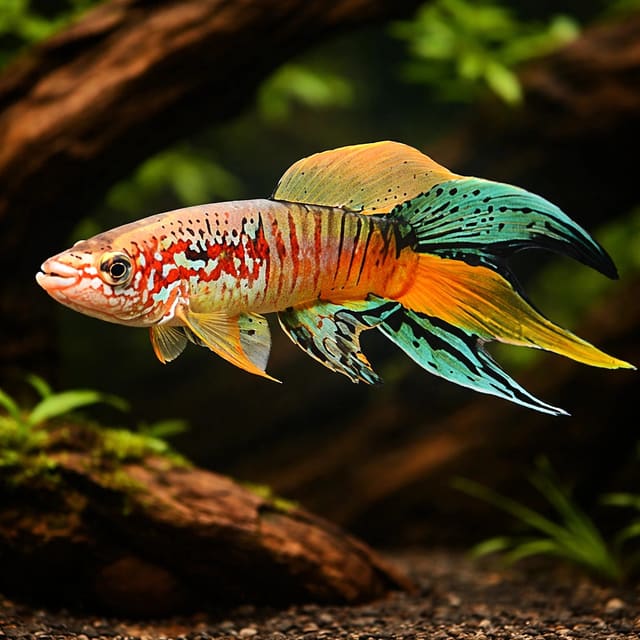
The Hjersseni Lyretail Killifish is the orange-gold aquarium strain of Aphyosemion australe. One unsexed fish per quantity; keep in a covered, planted aquarium with a 60 cm or longer footprint.
Adult size is the maximum length this species reaches at full maturity (scientific sources). The livestock you receive will be younger and smaller — pick a size above for the actual shipping size. Product-photo provenance and any image-specific limitations are stated on the listing.
Aphyosemion australe
Save when buying multiple fish. Each quantity is one fish; sex and pair formation are not guaranteed unless the selected variant explicitly states them.
The Hjersseni Lyretail Killifish is the orange-gold aquarium strain of Aphyosemion australe. One unsexed fish per quantity; keep in a covered, planted aquarium with a 60 cm or longer footprint.
Adult size is the maximum length this species reaches at full maturity (scientific sources). The livestock you receive will be younger and smaller — pick a size above for the actual shipping size. Product-photo provenance and any image-specific limitations are stated on the listing.
Maintain these water conditions for optimal health and vibrant colors
Hjersseni Lyretail Killifish is the orange-gold aquarium strain sold by the supplier as Aphyosemion australe “hjersseni”. The accepted species is Aphyosemion australe; “hjersseni” is a trade strain label, not a separate accepted species or a wild locality. This listing is for one unsexed fish per quantity in the size option selected. Sex, a male-female pair and exact colour are not guaranteed.
This is a small, non-annual West African killifish for a mature, covered aquarium with subdued areas, plants and calm companions. It is a rewarding choice for an aquarist who can keep stable, soft-to-moderately-hard water and offer suitably small foods. The secure lid matters as much as the water values: lyretail killifish are capable jumpers.
| Accepted species | Aphyosemion australe (Rachow, 1921) |
|---|---|
| Trade form | Hjersseni orange-gold aquarium strain |
| What one quantity buys | One unsexed fish in the selected size option |
| Adult length | Up to about 6 cm total length for the species |
| Aquarium planning | A covered aquarium with at least a 60 cm footprint; use more room for multiple males or a community |
| Temperature | 21-24°C is a well-supported maintenance range; the supplier lists 20-25°C |
| pH and hardness | pH 6.0-7.0 and about 5-12 dGH |
| Temperament | Generally peaceful; males may display and chase |
| Diet | Small live and frozen foods, with quality dry food where accepted |
| Essential equipment | A tight lid or cover glass with every cable and filter gap secured |
Aphyosemion australe is the valid species name. It is widely known as the Lyretail Killifish, Lyretail Panchax or Cape Lopez Lyretail. FishBase records chocolate and gold forms in the aquarium trade, while the supplier identifies this particular stock with the strain label “hjersseni”. That label should be kept in quotation marks or treated as a cultivar-style name rather than written as a third part of the scientific name.
The species occurs naturally in western-central Africa, including Gabon, the Republic of the Congo and areas extending south towards Angola. The orange-gold Hjersseni form is an aquarium strain. The species’ wild range therefore describes the biological origin of A. australe; it does not mean the fish in this listing are wild collected or collected from a named locality.
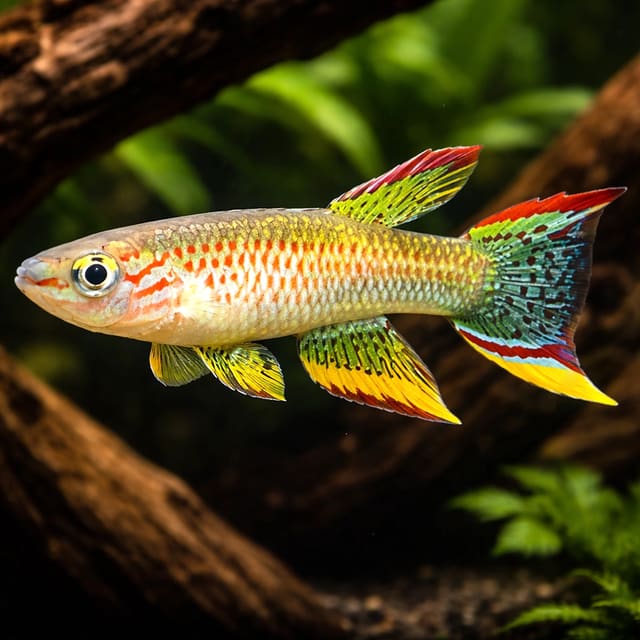
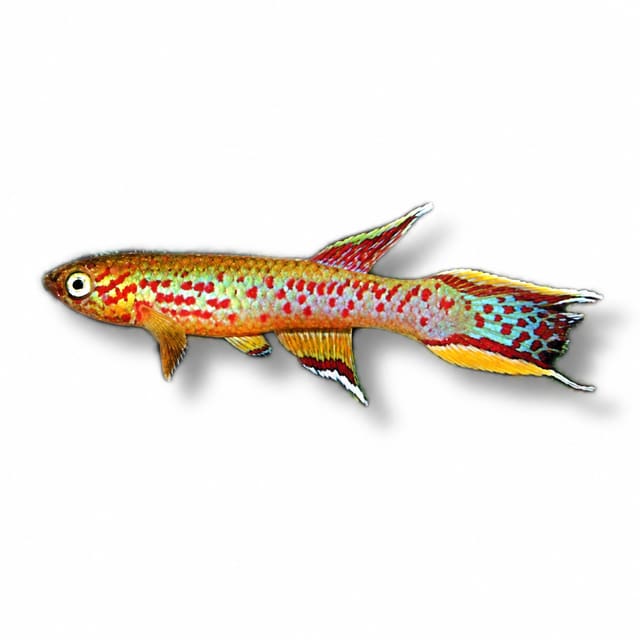
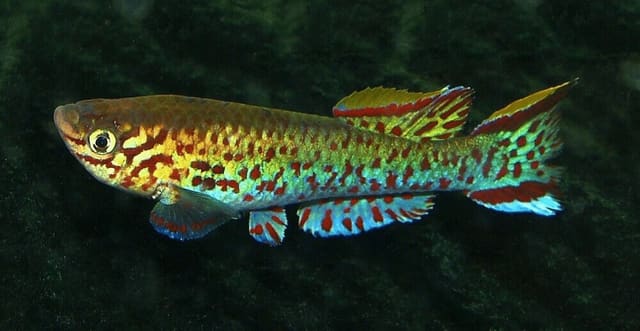
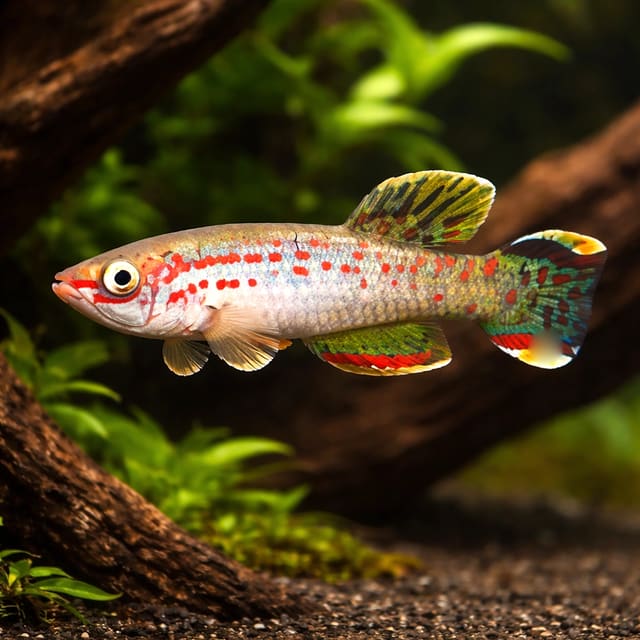
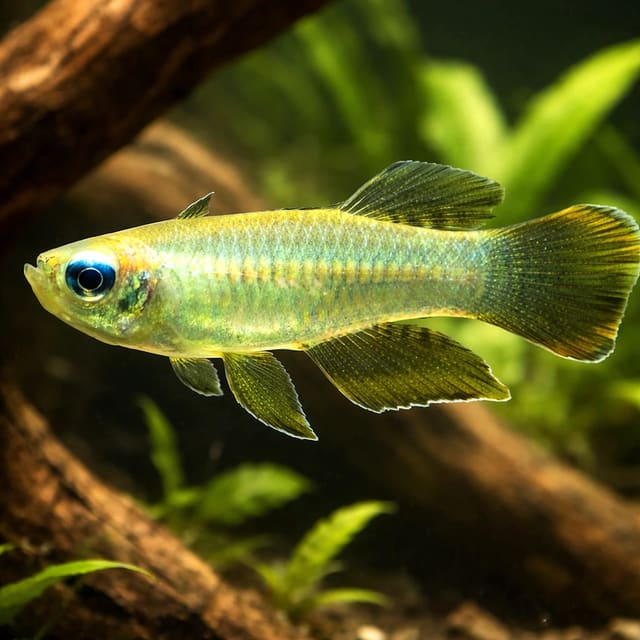
Mature males usually show the strongest orange-gold colour, red markings and longer extensions to the upper and lower edges of the tail. Females are generally plainer with shorter fins. Juveniles and newly moved fish can be less intensely coloured, and appearance varies with sex, age, condition, lighting and background. The gallery is representative rather than a photograph of the exact fish dispatched.
Each quantity adds one fish of the chosen size to the basket. The multi-buy display is a quantity-pricing tool; it does not certify a bonded pair and does not guarantee one male and one female. Select the number your aquarium can support and treat every fish as unsexed unless a size option explicitly says otherwise.
The size selector describes dispatch size, not final adult length. FishBase records a species maximum of about 6 cm total length, while the supplier’s smaller figure reflects its commercial stock information. Plan the mature aquarium for the larger published species figure rather than assuming a dispatch-size fish is fully grown.
Use a mature aquarium with a tight cover, gentle filtration and plenty of structure. FishBase gives a minimum aquarium length of 60 cm for the species. That footprint is a more useful starting point than a small litre figure because it provides swimming room, planted boundaries and space for fish to move away from one another. A larger aquarium is prudent for a group, more than one male or any mixed community.
A practical maintenance target is 21-24°C, pH 6.0-7.0 and roughly 5-12 dGH. These values align with the FishBase species profile and sit within the supplier’s broader 20-25°C, pH 6.0-7.0 and up-to-12 dGH data. Avoid sudden changes. If your aquarium is outside that range, compare the supplier water with your tank and make any adjustment gradually.
Do not keep this fish persistently hot merely because it is sold as tropical. Higher temperature accelerates metabolism and leaves less dissolved oxygen. Stable temperature, clean water and calm conditions are more valuable than trying to hold the aquarium at the top of a permitted range.
Lyretail killifish are generally peaceful, but “peaceful” does not mean they are suitable with every small fish. Males can display and chase, particularly in confined space or without sight breaks. A species-focused planted aquarium is the easiest arrangement. A quiet community can also work when every inhabitant shares the same temperature and water requirements.
| More suitable choices | Usually poor choices |
|---|---|
| Calm, similarly sized soft-water fish | Large, predatory or aggressive fish |
| Small peaceful rasboras or tetras in proper groups | Fin-nippers and very boisterous species |
| Suitable small Corydoras with enough floor space | Fast feeders that prevent the killifish from eating |
| Other carefully chosen calm fish with separate swimming areas | Hard-water livestock needing substantially different chemistry |
Watch feeding response, fin condition and access to cover after any introduction. Separate fish if one is repeatedly chased, hidden, losing weight or excluded from food. Shrimplets and very small fry may be eaten, so this is not a risk-free choice for a breeding shrimp aquarium.
Wild Aphyosemion australe feed on small animal prey including worms, crustaceans and insects. In the aquarium, offer suitably sized live or frozen foods such as daphnia, Artemia, mosquito larvae and small bloodworm, while taking care that every item is appropriate to the fish’s mouth size. Quality flakes or micro-pellets can add variety when the fish accepts them; the British Killifish Association notes that the species can take good flake food.
Feed small portions that are eaten promptly and observe each fish. A varied diet supports condition and colour, but uneaten rich food quickly harms water quality. Newly arrived or shy fish may respond more readily to moving live or frozen food than to dry food at first.
This is a non-annual killifish. A compatible, conditioned pair or trio may deposit eggs among fine-leaved plants or spawning mops instead of burying eggs for a mandatory dry diapause. The British Killifish Association records spawning across different levels of the breeding aquarium and hatching in roughly 12-14 days at about 22°C; development time varies with temperature and conditions.
Breeding is not guaranteed by buying two fish. The listing is unsexed, so two fish may be the same sex, may not be mature and may not be compatible. If breeding is the aim, first learn to identify the sexes, provide several spawning sites and prepare appropriately small live foods for fry before eggs are collected.
This Hjersseni listing is for a named orange-gold strain of Aphyosemion australe. Other products may represent the standard species, a separate gold supplier line, a named locality or a different killifish species. Do not assume that every product containing “lyretail”, “gold” or “panchax” is interchangeable. Compare the scientific name, strain or locality label, dispatch size and current availability.
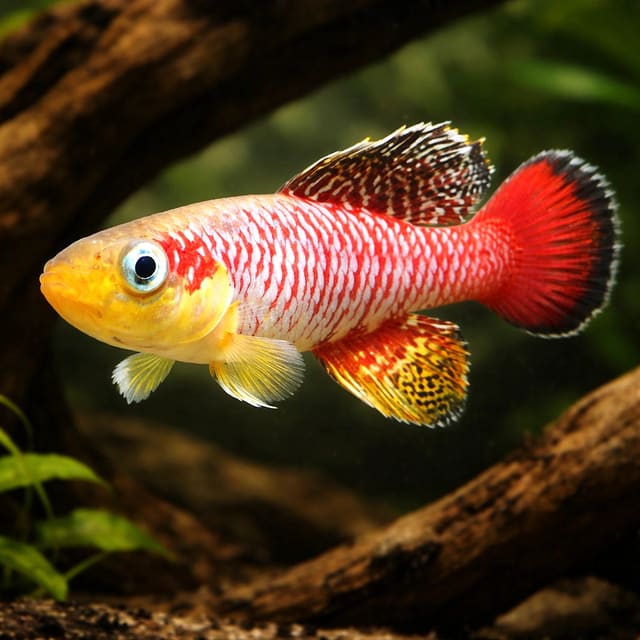
You can browse the live Killifish collection or compare a different species such as Gardner’s Killifish. Keep distinct strains and locality forms labelled accurately if you plan to breed them, and avoid accidental crosses.
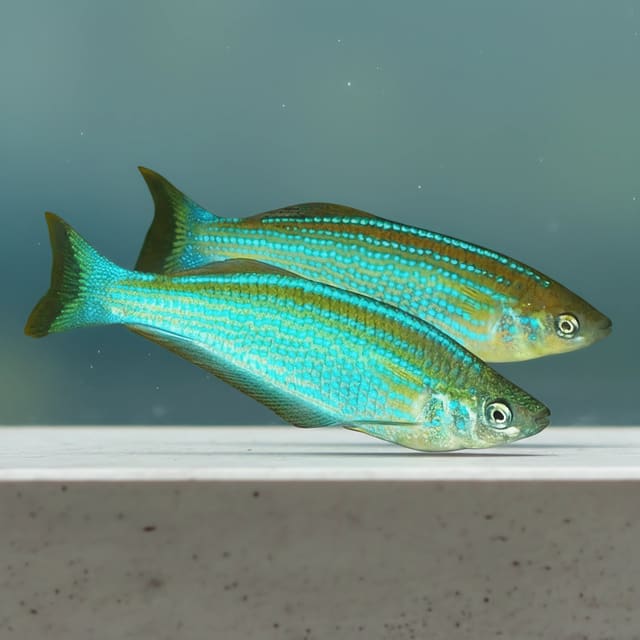
Live livestock orders are packed and carried under the current Delivery and Live Arrival Guarantee policy. Check that page before ordering for the current delivery window, receiving requirements and claim evidence. The gallery images are representative views based on the reference image. They illustrate the orange-gold form but do not show the exact individual that will be sent, and a two-fish image does not mean the product is sold as a sexed pair.
No reviews for this item yet. Bought one? Honest reviews only, good or bad.
What customers say about ordering from us
Easy website plenty of info on fish your buying great to pick a time slot
TRACEY DURRANT · 7 Oct 2026
Got some lovely fish thank you
Kevin Mackie · 7 Oct 2026
Reviews of our shop, collected by Judge.me, an independent third-party review collector. Newest first.