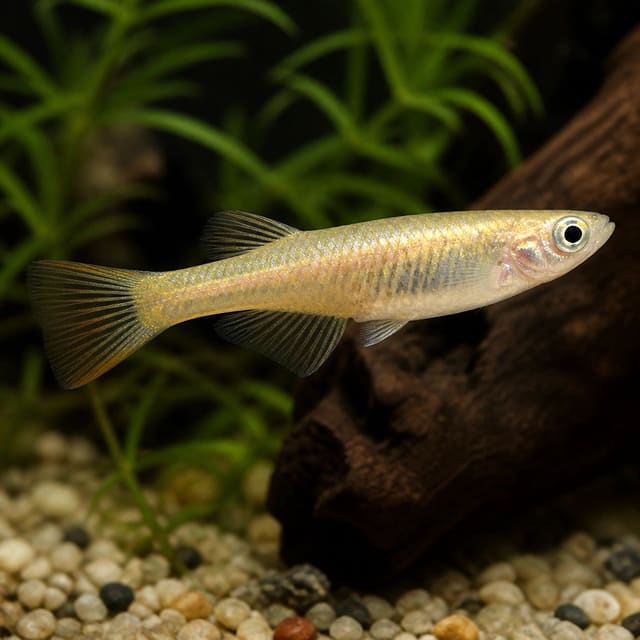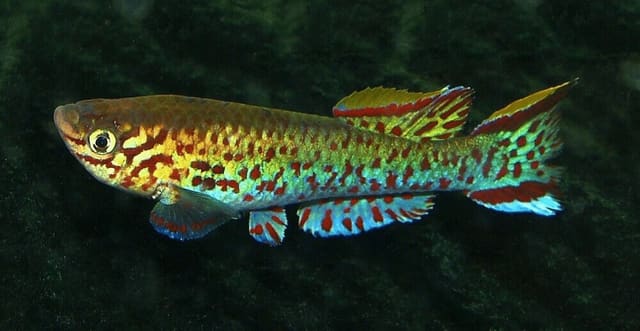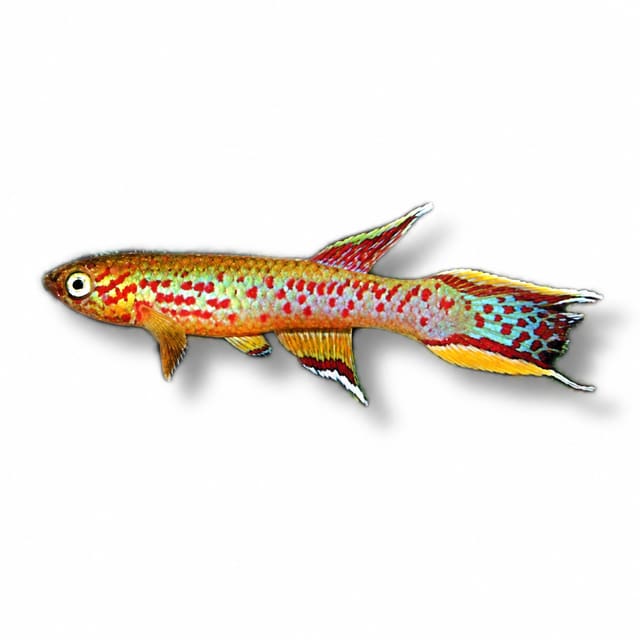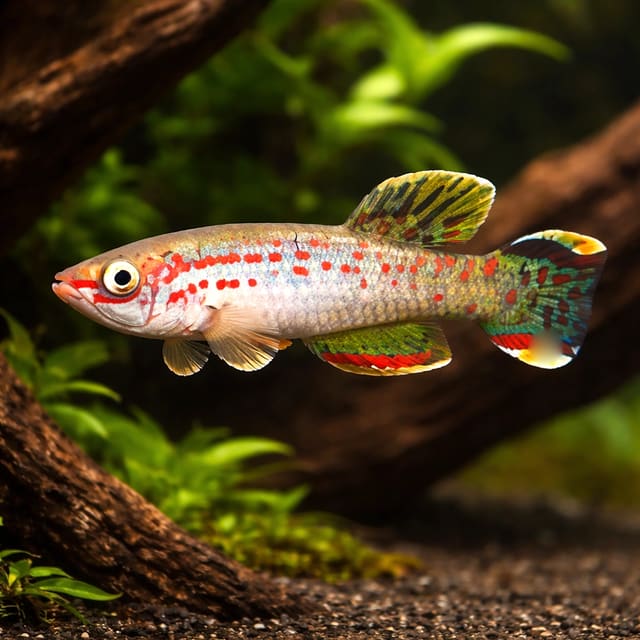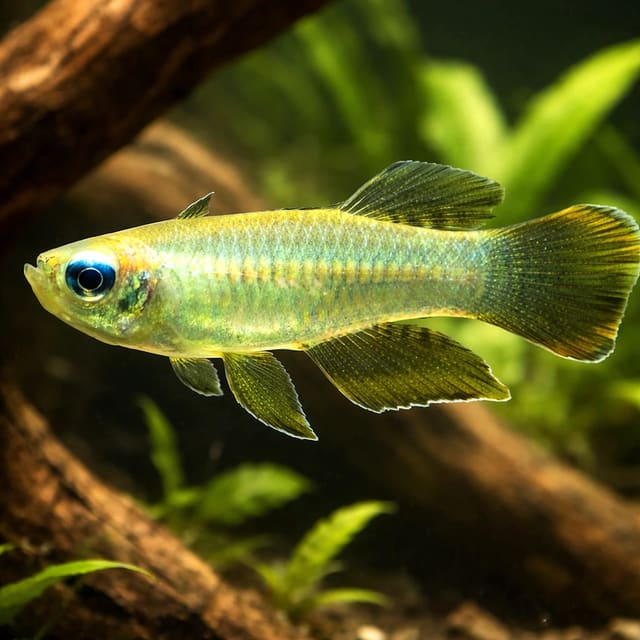
Lampeye (Aplocheilichthys normani)
22–26°C · pH 6.5–7.2
£3.99

Tanganyika Pearl Killifish (Lamprichthys tanganicanus) is a substantial, active Lake Tanganyika schooling fish for a spacious, mature aquarium with hard alkaline water and open swimming room. One purchase supplies one fish in the chosen supply size; the adult measurements require separate long-term planning.
Lamprichthys tanganicanus
Save when buying multiple fish. Each quantity is one fish; sex and pair formation are not guaranteed unless the selected variant explicitly states them.
Tanganyika Pearl Killifish (Lamprichthys tanganicanus) is a substantial, active Lake Tanganyika schooling fish for a spacious, mature aquarium with hard alkaline water and open swimming room. One purchase supplies one fish in the chosen supply size; the adult measurements require separate long-term planning.
Maintain these water conditions for optimal health and vibrant colors
The Tanganyika Pearl Killifish, Lamprichthys tanganicanus, is quite different from the small, softly coloured or short-lived killifish that many aquarists picture first. It is a substantial non-seasonal freshwater fish from Lake Tanganyika, recorded around rocky shorelines and in open offshore water. Wild fish form large schools. Those facts point towards a spacious, mature hard-water aquarium with generous swimming room, dependable filtration and a social plan made before purchase.
One purchase supplies one live fish. The listing has three genuine supply grades: 3.5–4 cm, 4–5 cm and XL. The size you select is the size supplied, not the adult size. A dispatch grade describes the fish sent; it does not reduce the space, filtration or group planning needed as that fish grows.
Sex is guaranteed only when the selected option explicitly states male or female. This Tanganyika Pearl Killifish listing has no sex-guaranteed option. Colour, body shape or a photograph must not be used as a promise that a particular sex will be supplied. The offer is best approached by keepers who value the species and its group behaviour rather than a guaranteed male or female display.
| Suits | Think carefully if |
|---|---|
| You can provide hard alkaline water within the species record and keep it steady | Your source water or established community is soft and acidic |
| You have room for an adult group and broad open-water routes | You are choosing the aquarium around the small dispatch measurement |
| You can mature, test and maintain a capable biological filter | The tank is new, uncycled or already crowded |
| You are prepared to assess every companion against adult scale and schooling activity | You want a universal community fish or a solitary ornament |
The broader killifish collection contains fishes with very different sizes, water needs and social patterns. The category is useful for browsing, but it is not a care template. Build this decision around L. tanganicanus, its Lake Tanganyika environment and its recorded adult measurements.
Lamprichthys tanganicanus is placed in the family Procatopodidae, the African lampeyes. FishBase records it as a freshwater, benthopelagic species endemic to the shore regions of Lake Tanganyika, with an introduced population in Lake Kivu. It inhabits rocky shores and also occurs offshore. The species is non-migratory and is specifically identified as a non-seasonal killifish.
Two published maximum records need their labels preserved. FishBase shows 12 cm maximum total length and also 15 cm standard length for male or unsexed fish; the species summary likewise gives 15 cm standard length. These measurements use different methods and scopes, so they should not be collapsed into one bare centimetre claim. For conservative aquarium planning, recognise the larger 15 cm standard-length record and leave additional room for the complete fish and its movement.
The practical point is not a contest between numbers. A fish bought at 3.5–4 cm or 4–5 cm can become much larger, and the XL grade is still a supply description rather than an adult endpoint. Adult schooling fish need clear turning space, long uninterrupted routes and filtration designed for the eventual group rather than the parcel-day body length. Choose the aquarium from adult swimming space, the group and filtration capacity rather than a bare litre slogan.
Gallery images have been digitally enhanced to improve image quality. Natural colour, pattern, size and maturity can vary between live animals. Direct inspection shows two turquoise-striped fish swimming side by side against a blue-grey background. That observation supports an accurate image description only. It does not establish the image’s provenance, the sex of either fish or the appearance of the individual sent.
Lake Tanganyika context is useful, but it must be applied with care. The supplied OATA sheet is written for African lake cichlids, while this animal is a procatopodid killifish. Cichlid-specific feeding, territory, overstocking and tank-mate instructions are therefore not transferred to this listing. Species values come from the FishBase record; general filtration principles come from broad fish-welfare guidance.
A useful aquarium plan begins with three pieces of evidence: a 15 cm standard-length record, large-school behaviour and use of both rocky shore and offshore habitats. Together they favour a long, spacious swimming footprint. Choose the aquarium by usable length and width, adult group size, filtration capacity and maintenance access; a bare threshold cannot express all of those requirements.
Sketch the adult fish into the layout before buying décor. A group needs to turn without bunching into a narrow channel and to pass one another without every route ending at a rock wall. Leave a broad central or front-to-back swimming lane, then use structure to define calmer edges. Tall or bulky décor should not divide the aquarium into compartments too small for the mature fish.
The exact number kept must match that finished system. Wild schooling behaviour supports group keeping, but it does not supply an aquarium minimum count. A fixed number copied from another killifish or from cichlid care would be guesswork. Decide the group only after accounting for adult scale, available footprint, filter performance and the needs of any other residents. One purchased fish is one animal supplied, not a recommendation to keep the species alone.
Rocky-shore records justify secure stone structure as habitat context, while offshore occurrence supports retaining open water. Use stable rockwork at the margins or rear and preserve broad swimming space. Every stone must sit securely so digging, cleaning or an accidental knock cannot create a collapse. Avoid a maze that looks dramatic to the keeper but leaves the fish with no unbroken route.
A darker background and restrained lighting can make observation easier, but appearance is secondary to access. Keep enough clearance around heater guards, intakes and returns to inspect them. Make sure the fish cannot become trapped behind a rigid panel or in a narrowing gap. The photographed blue-grey background is a visible image scene, not a required aquarium colour or proof of habitat.
Substrate choice should support the intended chemistry and allow waste removal. A material that affects hardness or alkalinity must be understood and tested rather than added because it carries a Lake Tanganyika label. Never assume décor alone will create the required pH and hardness. Measure the actual filled aquarium after it has settled and again as part of normal maintenance.
Leave an open siphon route and enough working space to reach the filter. A mature group produces a real biological load, and trapped waste behind inaccessible stonework undermines water quality. Plan where food will enter, where current will carry it and where debris is likely to settle. The keeper should be able to remove waste without dismantling the main habitat at every water change.
Before livestock arrives, use the first tropical aquarium guide to prepare and mature the system. A filled tank is not necessarily a biologically ready tank. Confirm that the filter is processing waste, temperature is steady and the intended hard alkaline values hold under normal circulation. Repeat the test after major rockwork or filter changes rather than relying on elapsed time alone.
Good planning includes contingency space. The system must remain manageable when the fish grow, when a filter needs temporary servicing or when one area must be left undisturbed. Avoid stocking to the point where one missed maintenance session immediately creates poor conditions. A conservative adult plan is more useful than a minimum that leaves no resilience.
FishBase records Lamprichthys tanganicanus at 23–25°C, pH 8.0–8.5 and hardness from 12°dH, with the upper hardness value left unspecified. These are species-level environmental values. Use them as a clear starting framework, while keeping the hardness figure as a lower bound rather than adding an upper limit absent from the species record. Measure the source water and the aquarium rather than describing water as simply hard.
Aim for a stable point inside the temperature and pH ranges. The endpoints describe a range, not targets to alternate between. Rapid movement can be more stressful than a consistent value within range. If the aquarium requires mineral adjustment, make each change with measured water preparation outside the tank and verify the result before it reaches the fish. Avoid chasing pH with repeated reactive doses.
The water-chemistry guide explains the purpose of common aquarium tests, and the water matcher can help compare measured values with the species range. Use the tools with current readings. A label on a bag of substrate, a regional-water reputation or last month’s result cannot replace today’s test.
The RSPCA explains the core role of filtration: fish release toxic ammonia, beneficial bacteria convert it to toxic nitrite and then to safer nitrate. A properly set up and maintained biological filter is therefore fundamental. Choose a filter sized for the mature stocking plan, provide useful circulation across the aquarium and make sure the return does not remove all calmer water.
Ammonia and nitrite should remain at zero. Although the supplied OATA article states those values in a cichlid context, they are also fundamental mature-aquarium safety goals supported by the general filtration process. Its cichlid-specific nitrate margin and specialised stocking instructions are not adopted as a Tanganyika Pearl Killifish optimum. Test nitrate as a trend and control accumulation through feeding discipline, maintenance and appropriate partial water changes.
Write down temperature, pH, hardness, ammonia, nitrite and nitrate. A log makes gradual drift visible and lets you compare a behavioural change with recent water work. Test more often after adding fish, altering the group, changing food quantity, servicing a filter or making a significant adjustment to mineral content. One reassuring result does not make later monitoring unnecessary.
Set a regular partial-change routine based on measured waste accumulation and stocking. Prepare replacement water with conditioner where tap water contains chlorine or chloramine, match temperature closely and reproduce the established mineral approach. The correct volume is the one that maintains safe stable water without causing abrupt chemistry changes; it is not derived from a cichlid schedule.
Never clean every biological surface at once. Do not run filter media under the tap. If it needs cleaning, rinse it lightly in water removed during a partial change because chlorine or chloramine can harm the beneficial bacterial population; avoid replacing mature media simply because it looks stained. Check impellers, air paths and intakes for obstruction. Reduced flow can change oxygen exchange and waste processing before water looks visibly dirty.
Read results as a set. A suitable pH does not compensate for ammonia, and a suitable temperature does not compensate for a stalled filter. When something changes, look for recent causes: additional fish, excess food, disturbed substrate, reduced flow, altered source water or a large mineral correction. Restore safe conditions steadily and seek expert help when abnormal behaviour persists.
| Measure | Evidence-led use |
|---|---|
| 23–25°C | Species environmental range; select and hold a stable point |
| pH 8.0–8.5 | Species environmental range; keep alkaline water consistent |
| Hardness from 12°dH | Species record provides a lower bound but no upper value |
| Ammonia and nitrite | Keep at zero in a mature filtered aquarium |
| Nitrate | Track the trend and control accumulation through routine husbandry |
The natural-history summary describes large schools. In the aquarium, that makes social planning central rather than decorative. Provide open space where fish can maintain visual contact and move as a group, plus structured edges that let an unsettled fish leave the busiest flow. Avoid a single narrow feeding point that forces every animal into the same corner.
Set the group from adult fish length, the aquarium’s footprint, filter capacity and total community rather than a fixed count. Increase stocking only when the mature system can carry it, and never use wild-school size as an instruction to crowd a home aquarium.
Observe distribution as well as total activity. A functioning group should be able to use the aquarium without one fish remaining continually isolated or pinned into a small refuge. Repeated chasing, persistent surface hanging, clamped posture, damaged fins or one individual failing to approach food deserve investigation. Start with water tests and review the layout, flow, group structure and companion pressure.
Use appropriately sized, nutritionally complete fish foods that remain accessible in the water column, with measured variety rather than oversized portions. Watch the school eat. Food entering the tank is not proof that every fish received it.
Offer a quantity the group can take cleanly, remove obvious excess and adjust by observation. Spread small portions across more than one area if dominant or quicker fish intercept everything. The goal is even access without leaving food to decay behind rockwork. Body condition and feeding response over time are more useful than a rigid scoop size copied from another species.
Do not import the cichlid sheet’s herbivore, carnivore or twice-daily instructions. They describe diverse cichlids, not this procatopodid. Likewise, a generic killifish menu does not by itself prove what this species requires. When selecting a commercial food, use the manufacturer’s suitability and portion guidance as a starting point, then monitor acceptance and waste in this aquarium.
View the fish at the same calm time each day. Count visible individuals, check the group’s position, note breathing effort and look along both sides for fin or scale damage. Watch at least one complete feed often enough to know whether every fish participates. A short written note is valuable because gradual changes are easy to miss when the aquarium is seen daily.
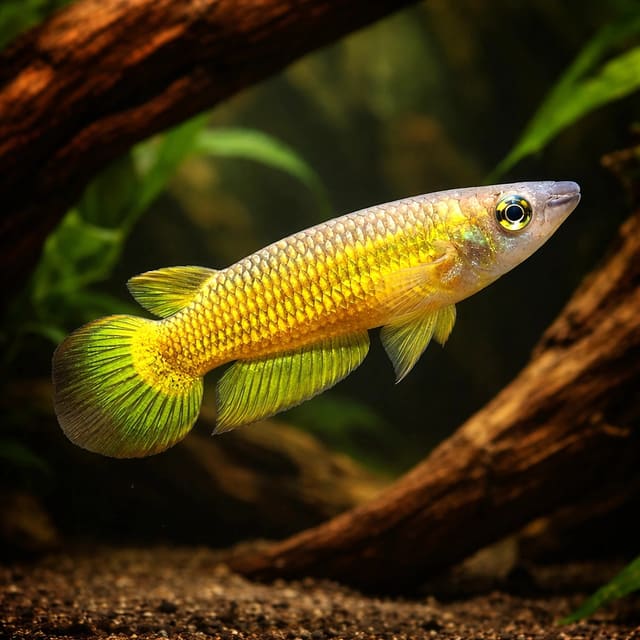
Appearance varies with light, angle, condition and the individual. The turquoise striping visible in the gallery image can vary in colour intensity between live animals. Evaluate health through a combination of alert movement, steady breathing, intact body surfaces, feeding participation and stable water, not through one colour comparison.
When an individual behaves differently, test water before reaching for medication. Review what changed during the preceding days: new stock, more food, filter work, mineral adjustment, temperature movement or altered flow. Quarantine and treatment decisions should be based on the observed problem and qualified advice.
Lamprichthys tanganicanus is an egglayer with external fertilisation. The species summary says eggs are deposited in narrow crevices. That natural-history fact helps explain the association with rocky habitat, but it is not a complete aquarium breeding method. Treat spawning ratio, conditioning, incubation and fry care as specialist topics requiring further guidance rather than filling the details with assumptions.
If breeding is an aim, first stabilise adult husbandry and document the aquarium. Any dedicated project should separate observed results from assumptions and use specialist guidance before changing the group. Do not sell or label young fish by sex without a reliable basis, and do not use the gallery photograph as a sexing guide. The retail offer itself carries no sex guarantee.
The non-seasonal description is also important. It identifies this as a non-seasonal killifish in the biological record; it does not create a promise of year-round aquarium spawning. Reproduction depends on healthy mature fish and suitable conditions, and a natural crevice-spawning strategy cannot be reduced to placing one decorative rock in a community tank.
Review the system at milestones rather than waiting until the fish look cramped. As body size and group biomass rise, recheck open turning space, flow distribution, feeding access and nitrate trend. Rockwork that was generous around 4 cm fish may occupy too much of the usable water when the group approaches adult scale.
A long-term plan includes where a larger aquarium could stand, how mature filter capacity would transfer and what would happen if community compatibility deteriorated. These are not signs that failure is expected. They are normal safeguards for a sizeable schooling species whose supply grades can look deceptively modest.
Build the long-term commitment around a system that remains serviceable as the fish mature rather than around a fixed lifespan figure: stable hard alkaline water, biological filtration, swimming space, measured feeding, observation and room to adapt.
Complete the aquarium before choosing a delivery date. Temperature should be steady within 23–25°C, pH within 8.0–8.5, hardness measured at or above the recorded 12°dH floor, and ammonia and nitrite at zero. Check that the intended group and existing residents have enough adult space. Do not plan to solve basic water chemistry while a newly arrived fish is waiting in a bag.
Someone must be available to receive the live parcel. Prepare a phone for continuous recording, know where the aquarium tests and conditioner are, and read the current policy before the day. Keep room lighting calm and postpone major maintenance. A stable prepared environment makes the arrival process simpler for both fish and keeper.
For any Live Arrival Guarantee claim, make one continuous unboxing video beginning with the parcel still sealed and the outer box visible. Record the box being opened and the fish still inside the sealed bag before the bag is disturbed. Contact the store on the same day with the order number and evidence if there is a concern. This is an evidence condition for the policy, not a species-care behaviour.
Tropical Fish Co states that live fish are hand-bagged in pure oxygen, placed in an insulated poly box and supplied with a heat pack when weather calls for it. A licensed tracked live-animal courier carries the parcel for a confirmed Thursday or Friday delivery. These are current store-policy details; the full delivery and Live Arrival Guarantee page remains the governing source for postcode coverage, dates and conditions.
Once arrival condition has been recorded, follow the current instructions and acclimatise slowly. The policy says to float the bag for 20–30 minutes before release. Keep shipping water out of the display aquarium as far as practical. Avoid adding food immediately simply to test the fish, and keep the surroundings quiet while the group finds swimming routes and shelter.
During the first week, test ammonia and nitrite rather than waiting for visible distress. Confirm that every newcomer can maintain position, join the group and reach food. Compare breathing and movement with the fish’s own earlier pattern. Do not respond to ordinary settling behaviour by changing temperature, pH, layout and diet all at once.
Existing fish should also be observed. A newcomer changes social pressure and biological load even when no aggression is obvious. Watch feeding from more than one angle, inspect for damaged fins and note whether one fish stays isolated. If the aquarium cannot distribute food and space fairly, revise the stocking or layout promptly.
There is no evidence-backed universal tank-mate list for this listing. The safest first plan is a species-focused group in a mature hard alkaline aquarium. That makes the fish’s schooling behaviour, feeding access and water response easier to read. A mixed community should be considered only after the group’s adult space and behaviour can be accommodated.
Every proposed companion must overlap the 23–25°C, pH 8.0–8.5 and at-least-12°dH species record without being forced to the edge of its own needs. It must also tolerate an active school of fish recorded at substantial adult size. Similar water origin alone is not enough: Lake Tanganyika fishes differ sharply in territorial behaviour, feeding, adult size and preferred water zone.
Do not transfer the OATA cichlid sheet’s named communities or stocking tactics to this killifish. It discusses cichlids and even notes wide variation within that group. Overstocking to spread cichlid aggression, mixing by lake, or adding species in a particular aggression order is not species evidence for L. tanganicanus.
Use caution with slow, timid or easily outcompeted fishes, particularly where every animal must feed at the same surface or open-water station. Also consider the reverse risk: a large or territorial companion may disrupt schooling or prevent a Tanganyika Pearl Killifish from using the best part of the aquarium. Observe interactions at feeding and during normal cruising rather than judging compatibility from the first quiet hour.
The natural record of large schools supports keeping this fish socially, but it does not establish aggression level, fin-nipping behaviour or a home-aquarium group number. Avoid assigning a blanket peaceful label. Provide enough visual room for the group to spread, and be prepared to separate fish if repeated chasing, fin damage, persistent exclusion or feeding failure develops.
The two alternatives stored in the related-products field are browsing alternatives, not suggested companions. Their presence does not mean they should share an aquarium with this species. Compatibility always needs a fresh comparison of adult size, water, behaviour and space.
| Compatibility question | Useful screen |
|---|---|
| Do the water needs overlap? | Compare full temperature, pH and hardness requirements |
| Can both species feed? | Watch access and competition through a complete feed |
| Is there adult room? | Plan around mature size and the complete group |
| Does behaviour remain stable? | Check chasing, isolation, damage and breathing over time |
FishBase records 12 cm maximum total length and 15 cm standard length for male or unsexed fish. Because those are different measurement methods and scopes, plan conservatively around the larger 15 cm standard-length record rather than reducing them to one unlabelled number.
Choose a long, spacious aquarium around the 15 cm standard-length record, large-school behaviour, open-water movement and the eventual group. Use adult swimming footprint, filtration and maintenance access to judge suitability rather than a bare litre threshold.
Keep them as a social group rather than planning around a lone display fish, because the species forms large schools in Lake Tanganyika. Select a group the mature footprint and biological filter can support without crowding.
It is better suited to a keeper who can manage hard alkaline water, mature biological filtration, a sizeable schooling fish and careful compatibility decisions. A well-prepared newer keeper can learn those skills, but this is not a small generic starter killifish.
Use appropriately sized, nutritionally complete fish foods that remain accessible to an active school, offer measured variety and watch every fish feed. Remove excess promptly; do not import the supplied cichlid sheet’s species-specific menus or timetable to this procatopodid.
The species record gives 23–25°C, pH 8.0–8.5 and hardness from 12°dH. The hardness upper value is unspecified, so test the aquarium, hold a stable hard alkaline baseline and leave the upper value open.
Large-school behaviour is established, but temperament and fin safety must be judged in the aquarium. Use a species-focused group first, provide generous swimming room and respond to repeated chasing, fin damage, persistent isolation or feeding exclusion.
No named universal companions are established. Consider only fishes whose temperature, pH, hardness, adult size and activity genuinely overlap, and avoid plans in which slow or timid animals cannot feed or use space beside the active school.
Tropical Fish Co hand-packs live fish in oxygenated bags inside an insulated box, adding a heat pack when conditions call for it, and uses a licensed tracked live-animal courier. Film continuously from the sealed parcel through opening to the fish still in its sealed bag; this video is required for any Live Arrival Guarantee claim. Contact the store the same day.
Supply grades and adult measurements have separate meanings. The OATA source concerns African lake cichlids, so its cichlid-specific care, diet and compatibility claims are deliberately excluded from this procatopodid listing.
No reviews for this item yet. Bought one? Honest reviews only, good or bad.
What customers say about ordering from us
I have a small group of long finned mountain minnows. So was delighted to be able to order ten of this variety to increase the genetics in my tank . The ones I recieved are healthy but it’s to early to give a verdict on wether they are of a long finned type since they are small currently.
Gordon Walker · 23 Sept 2026
100% success travel and "installation". Pleased with quality of purchase. The Siamese fighter a bit "shy" so have not yet seen him at his best yet but looking good. Happy customer. GG
George E Garratt · 21 Sept 2026
Reviews of our shop, collected by Judge.me, an independent third-party review collector. Newest first.