Easy
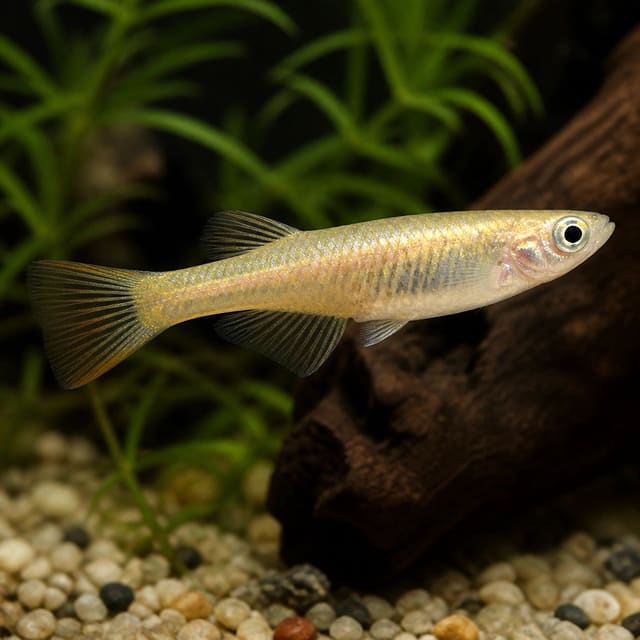
Tomoki Medaka Ricefish, Japanese Rice Fish (Oryzias latipes tomoki)
16–22°C · pH 6.5–8.5 · 41L
£11.99

The Scheel's Killie (Fundulopanchax scheeli) is an African rivuline from south-eastern Nigeria and south-west Cameroon that reaches 6 cm. Keep it at 23–26°C, the FishBase, Seriously Fish and OATA overlap, and pH 6.0–7.5, the Seriously Fish and OATA overlap; OATA suggests at least three killifish. Sold individually at a dispatch size of 3–4 cm.
Adult size is the maximum length this species reaches at full maturity (scientific sources). The livestock you receive will be younger and smaller. Product-photo provenance and any image-specific limitations are stated on the listing.
Fundulopanchax scheeli
Save when buying multiple fish. Each quantity is one fish; sex and pair formation are not guaranteed unless the selected variant explicitly states them.
Confirm your email, then we’ll send an availability message for this exact item if it returns within 180 days.
This request is only for this product—no newsletter or other promotions. A mail-provider retry may very rarely duplicate the same availability message. Unconfirmed addresses are removed after 48 hours. See our privacy policy.
The Scheel's Killie (Fundulopanchax scheeli) is an African rivuline from south-eastern Nigeria and south-west Cameroon that reaches 6 cm. Keep it at 23–26°C, the FishBase, Seriously Fish and OATA overlap, and pH 6.0–7.5, the Seriously Fish and OATA overlap; OATA suggests at least three killifish. Sold individually at a dispatch size of 3–4 cm.
Adult size is the maximum length this species reaches at full maturity (scientific sources). The livestock you receive will be younger and smaller. Product-photo provenance and any image-specific limitations are stated on the listing.
Maintain these water conditions for optimal health and vibrant colors
The Scheel's Killie (Fundulopanchax scheeli) is a small freshwater African rivuline in the family Nothobranchiidae. It occurs in the lower Cross River system of south-eastern Nigeria and is also recorded from the Ndian River in south-west Cameroon. FishBase records a maximum length of 6 cm total length and describes it as easy to maintain in an aquarium. It suits a beginner who can provide a mature, tightly covered, planted aquarium and give a shy fish close attention at feeding time.
This is a peaceful fish rather than a general-community all-rounder. It can be outcompeted by more vigorous species, so success depends on calm companions, suitable water and food reaching the killifish. A dedicated aquarium is also a practical choice. Aphyosemion scheeli is an aquarium synonym for the same fish.
Wild fish inhabit brooks and small streams in coastal rainforest and forested savanna. FishBase records the species as non-migratory, benthopelagic and not seasonal. In the aquarium, the useful decisions are to provide dense cover, avoid an exposed layout and fit a secure lid. The non-seasonal description distinguishes this fish from annual killifish associated with temporary waters, but it does not alter the need for stable water and careful routine maintenance.
Keep it at 23–26°C, pH 6.0–7.5 and 4–12 dGH. The temperature is the overlap of FishBase, the Seriously Fish species profile and OATA's killifish guidance. The pH is the Seriously Fish and OATA overlap, while 4–12 dGH is the overlap of Seriously Fish's 3–15 dGH range and OATA's 4–12 dGH range. OATA's values are group guidance, not a species-specific optimum.
Seriously Fish recommends a base of 45 × 25 cm and approximately 28 litres. For a small group, OATA recommends at least 40 litres for the smallest killifish. Plan the aquarium around the 6 cm adult length and the intended group rather than the dispatch length.
One purchase supplies one Scheel's Killie. The dispatch size is 3–4 cm, while the recorded adult length is 6 cm total length. The dispatch measurement describes the fish sent, not the space it will eventually need, so prepare the full adult setup before it arrives.
OATA suggests keeping at least three killifish, arranged as two females to each male. That ratio is broad guidance for killifish and should be planned before assembling a group. Sex is guaranteed only when the selected option explicitly states male or female. This Scheel's Killie listing has no sex-guaranteed option. Do not assume that purchasing three unsexed fish will produce OATA's suggested ratio.
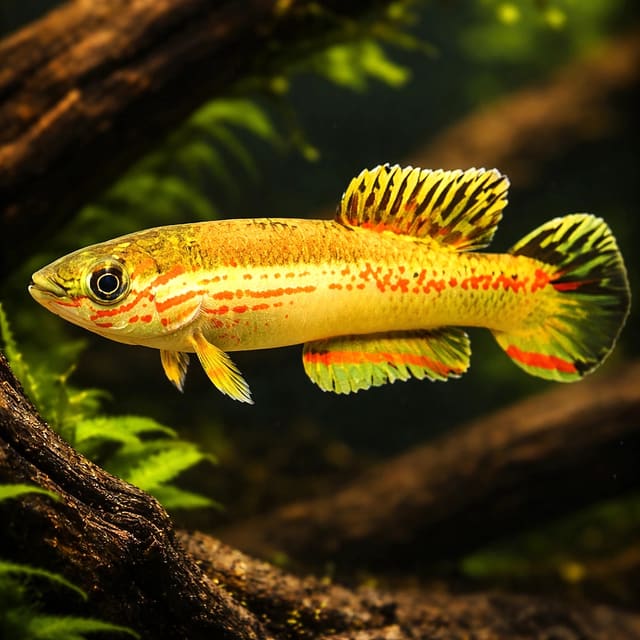
Some gallery images have been digitally enhanced to improve image quality. They show the listed type of animal rather than guaranteeing the exact markings of the individual supplied, so natural colour and pattern can vary.
| Suits | Not suited to |
|---|---|
| A tightly covered aquarium with dense planting and wood | An uncovered aquarium or a lid with open gaps |
| Routine water at 23–26°C, pH 6.0–7.5 and 4–12 dGH | Water outside the stated routine ranges |
| A dedicated setup or carefully selected peaceful community | A general community with vigorous feeders |
| Keepers able to offer small live or frozen foods | A feeding plan that does not account for shy fish |
| At least a 45 × 25 cm base for the species, with more space for a group | Planning space from the 3–4 cm dispatch length |
A keeper choosing between killifish can also browse the killifish collection. Compare adult dimensions, water values, social guidance and feeding behaviour rather than appearance alone.
Use an aquarium with a base of at least 45 × 25 cm and a volume of approximately 28 litres for Scheel's Killie. Seriously Fish associates those dimensions with the species. When keeping a small group, use at least 40 litres in line with OATA's recommendation for a group of the smallest killifish. A larger aquarium gives more room for planting and makes temperature and water quality more stable.
Prepare and mature the aquarium before the fish arrives. If this is your first setup, follow our guide to preparing and maturing a tropical aquarium. Maturation allows the biological filter to establish the bacteria that process fish waste; merely filling a new aquarium with water does not complete that process.
Fit a very tight-fitting cover. Seriously Fish describes this species as an accomplished jumper, while OATA states that an aquarium cover is essential for killifish. Check the lid around filter pipes, cables and feeding openings whenever equipment is moved. The cover remains necessary even when floating plants are present.
Seriously Fish also permits filtering the aquarium through peat where practical. Treat that as an optional setup method rather than a substitute for testing pH and hardness.
A turnover of four to five times the aquarium volume each hour is the species-profile reference. For an aquarium of approximately 28 litres, that corresponds to a filter rated around 110–140 litres per hour. Base the calculation on the aquarium's actual volume: multiply litres by four and five to create the target range. Filtration must remain continuous and well maintained.
Apply the same calculation when using a larger aquarium. A 40-litre group setup calls for a reference turnover of about 160–200 litres per hour. Check the filter's stated flow against the aquarium volume, then make sure planting and wood still leave water able to reach the intake. If the flow falls, inspect for a blockage rather than assuming that the planted layout removes the need for circulation.
Complete a final setup check before adding fish: confirm that the lid closes around every cable, the planting creates several sheltered areas, the filter runs continuously and the aquarium has enough base area for the intended plan. These checks address different needs, so a large aquarium does not compensate for an open lid, and dense planting does not compensate for an unestablished filter.
Keep Scheel's Killie at 23–26°C, pH 6.0–7.5 and 4–12 dGH. The 23–26°C temperature range is shared by FishBase, Seriously Fish and OATA. The pH range is shared by Seriously Fish and OATA, and the 4–12 dGH range is the overlap between Seriously Fish's 3–15 dGH and OATA's 4–12 dGH.
OATA additionally gives 3–10°dKH for killifish. General hardness and carbonate hardness measure different parts of water chemistry, so record them separately when your test kit provides both. Our aquarium water chemistry guide explains the values to measure, while the water matcher can compare your measured aquarium water with these care ranges.
Test the aquarium before adding fish. Temperature, pH and hardness can all look suitable while ammonia or nitrite reveals that the biological filter is not ready. Conversely, zero ammonia and nitrite do not make an unsuitable pH or hardness appropriate. Check all the relevant values as one decision.
A reading of 23°C is inside the routine temperature range; 22°C is outside the Seriously Fish aquarium range even though it appears in FishBase's recorded environment and OATA's wider group range. A general hardness of 12 dGH is inside both cited ranges; 13 dGH is inside Seriously Fish's range but outside OATA's narrower group guidance. These comparisons explain why the routine values are stated as overlaps.
Suppose the aquarium reads 25°C, pH 7.0, 8 dGH, zero ammonia and zero nitrite. Those results fall within the stated routine boundaries, so the next decisions are nitrate, aquarium dimensions, cover, filtration and stocking. If the same aquarium reads pH 7.0 but 14 dGH, do not treat the suitable pH as approval for the whole setup. Bring every relevant measurement into range before adding the fish.
Record the date beside each result and compare like with like. A single suitable test describes that moment; regular tests show whether the aquarium remains stable as feeding, maintenance and stocking change. When a value moves towards a boundary, review the recent water change, replacement water and stocking activity before it moves outside the range.
Run a well-set-up and maintained filter at all times. The RSPCA's aquarium welfare guidance explains that fish release toxic ammonia and that a working biological filter supports bacteria which convert ammonia to nitrite and then to the safer nitrate. OATA likewise states that a filter is essential in every killifish aquarium.
Before adding the fish, test ammonia and nitrite and proceed only when both are zero. Increase the number of fish slowly because the beneficial bacterial population must increase whenever more fish and more feeding add waste. Adding too many fish too quickly can cause new tank syndrome, with ammonia and nitrite rising to levels that can make fish ill or cause death.
| Test result | Decision |
|---|---|
| Ammonia zero and nitrite zero | Continue checking the remaining water values and stocking plan |
| Ammonia or nitrite detected | Do not add further fish; check filtration and water quality |
| Filter flow reduced | Check the filter for blockage |
| Population recently increased | Monitor the weekly tests and feeding closely |
Check the filter for blockages as part of the weekly routine. If the filter media needs cleaning, rinse it lightly in aquarium water removed during the partial water change. Do not run it under the tap because chlorine or chloramine may kill the beneficial bacterial population established in the media.
Filtration and testing answer different questions. Flow shows that water is moving through the filter, while ammonia and nitrite tests show whether waste is being processed adequately. Keep both checks in the routine rather than relying on clear-looking water.
If the outlet flow becomes weaker, inspect the filter for a blockage and check the water tests. Do not wait for the aquarium to look dirty, because ammonia and nitrite are measured hazards rather than visual ones. After any increase in fish numbers or feeding, keep the normal weekly test schedule and pay close attention to the results while the beneficial bacterial population adjusts to the greater waste load.
Use removed aquarium water when filter media needs a light rinse, then return the filter to continuous operation. This keeps filter cleaning tied to the partial water change and avoids exposing the established media to chlorine or chloramine. The aim is to restore flow while retaining as much of the beneficial bacterial population as possible.
Make small live or frozen foods the main part of the feeding plan. Seriously Fish says Scheel's Killie prefers foods such as daphnia and bloodworm, although good-quality flake is accepted in most cases. OATA also names daphnia, brine shrimp and tubifex among the small live or frozen foods suitable for killifish.
Feed once a day and offer only what the fish can eat within a few minutes. Start with a small amount, watch it being taken and stop when the fish no longer feeds promptly. This portion rule matters because uneaten food breaks down and releases toxic waste into the water.
This species is peaceful and shy and can be outcompeted by more vigorous fish. A meal is not successful merely because all the food disappears. Confirm that the killifish itself reaches the food and eats. If companions take every item first, change the community plan rather than repeatedly adding more food, because excess food increases waste.
Use changes in appetite as a health check. OATA lists reduced intake or lack of interest in food among the signs that require attention. Compare the fish with its own normal feeding behaviour and test the aquarium water when that behaviour changes.
First, confirm that the food is small enough for the fish to take. Second, check that the killifish receives food before more vigorous companions consume it. Third, look for uneaten food after the few-minute feeding period. If the fish cannot take the pieces, choose a suitably sized food; if companions dominate, reconsider those companions; if food remains, reduce the next portion.
Keep the once-daily schedule consistent enough to make changes easy to notice. A fish that normally feeds promptly but loses interest is showing a change worth investigating. Test the water, review whether the filter is operating normally and compare the behaviour with the fish's established feeding pattern rather than trying to compensate with a larger portion.
At least once every week, carry out a partial water change of 25%. OATA recommends using a siphon device to remove solid waste from the gravel during this change. Treat the frequency and amount as separate instructions: the maintenance happens at least weekly, and each routine change replaces 25% of the water.
Record the readings so that changes are visible from week to week. A result of zero ammonia one week does not replace the next test; OATA recommends testing regularly, at least once per week. The same applies to nitrite.
Uneaten food contributes waste, so review the portion if debris remains after meals or water quality worsens. The response is not to omit filtration or testing; it is to restore the controlled feeding amount, remove solid waste during the partial water change and confirm that the filter is not blocked.
Dense planting and wood provide the cover this species needs, but they do not remove the maintenance requirement. Siphon accessible areas, inspect around decor and preserve the sheltered layout while keeping accumulated solid waste under control.
During each weekly cycle, write down ammonia, nitrite and nitrate alongside the date, the water-change completion and any filter-flow observation. Four consecutive records create a practical baseline for that aquarium. If ammonia and nitrite remain at zero and nitrate stays within the stated limit, continue the routine rather than reducing the testing frequency below OATA's at-least-weekly instruction.
If a later result differs from the baseline, compare it with recent feeding, added fish, reduced filter flow or missed maintenance. That comparison turns the record into a decision tool. Correct the routine issue, maintain filtration and continue measuring; do not judge water quality from clarity, planting or the absence of visible debris alone.
Be present to receive the parcel because live fish cannot be left unattended. The Tropical Fish Co delivery and Live Arrival Guarantee policy describes fish as hand-bagged in pure oxygen and placed in an insulated box, with a heat pack used when the weather calls for it.
Film every arrival from the sealed parcel onward. For a Live Arrival Guarantee claim, contact us on the same day with the order number and the short continuous unboxing video showing the sealed parcel, its opening and the fish still inside the sealed bag. Keep the fish in the bag until its condition has been shown clearly in the continuous recording.
The aquarium should already be mature, covered and running within 23–26°C, pH 6.0–7.5 and 4–12 dGH. These aquarium checks come from the species profile and OATA guidance rather than the arrival sequence. Test ammonia and nitrite beforehand and proceed only when both are zero.
Do not use the arrival period to finish cycling the aquarium or to improvise a lid. The filter bacteria, secure cover, planting and measured water values are all setup decisions that should be completed in advance.
This preparation keeps the arrival sequence simple: receive, film, open and inspect on the same day, float the bag for 20–30 minutes and release without adding the bag water to the aquarium.
Learn the fish's normal swimming, colour, breathing, feeding and hiding pattern, then act when that pattern changes. OATA advises watching for hanging at the surface, sitting on the bottom, erratic swimming, darker or paler colour, changed aggression, increased hiding, unusually slow or fast gill movement, reduced feeding and changes in body condition.
One sign can have more than one cause, so begin with measurements rather than guessing at a treatment. Test ammonia and nitrite, confirm the temperature and review recent feeding and maintenance. Ammonia and nitrite must remain at zero.
| If you see | First action |
|---|---|
| Reduced appetite | Test water and confirm the fish can reach its food |
| Surface hanging or unusual breathing | Test water quality and inspect filter operation |
| More hiding or changed aggression | Review tank-mate pressure and available cover |
| White spots, growths or damaged tissue | Test water and seek case-specific guidance |
If you are concerned about a health change, test the water quality and contact us for further guidance. Give the measured temperature, pH, hardness, ammonia, nitrite and nitrate values, together with the behaviour or physical change observed. Those measurements make the next decision more useful than a description such as “the water looks clean”.
Observe the fish during feeding and during a separate quiet check. Note where it usually swims, whether it approaches food promptly, how quickly the gill covers move and how much it normally uses the planted shelter. This gives you a personal baseline for detecting increased hiding, altered breathing, reduced feeding or unusual swimming.
When several changes appear together, record all of them rather than selecting only the most obvious sign. Pair those observations with measured water values and the date of the last water change. The combination of behaviour, appearance and test results supports a clearer next decision than any one observation on its own.
Scheel's Killie is very peaceful and shy, but it is not recommended for a general community aquarium. Seriously Fish says it can live in a community when companions are chosen carefully and warns that more vigorous fish can outcompete it. The main test is whether every species shares the water range and allows this killifish to feed without pressure.
Seriously Fish names small characins, rasboras, dwarf cichlids, Corydoras, small Loricariids and peaceful Anabantoids as potential choices. These are candidate kinds, not universal matches. Check the particular species for adult size, temperature, pH, hardness, temperament, food and aquarium dimensions before combining them.
| Candidate kind | Screen before mixing |
|---|---|
| Small characins | Confirm calm feeding behaviour and matching water |
| Rasboras | Confirm the particular species is not a vigorous competitor |
| Dwarf cichlids | Check the named species, aquarium space and water values |
| Corydoras | Match temperature, pH, hardness and base area |
| Small Loricariids | Check adult size, water and available shelter |
| Peaceful Anabantoids | Check temperament, water and feeding behaviour |
Avoid long-finned species. OATA's killifish guidance states that some males may be aggressive towards them. Also treat a vigorous feeding response as a failed community match for this shy species, even if no chasing is visible. Food competition alone can prevent the killifish receiving its daily meal.
For a proposed mixed aquarium, compare every inhabitant against 23–26°C, pH 6.0–7.5 and 4–12 dGH, then check adult dimensions and feeding behaviour. Ask us for a stocking and compatibility assessment when several species need to be considered together.
OATA suggests at least three killifish, using two females to each male to reduce stress on females or other aquarium inhabitants. More can be kept when the same ratio is maintained. This is permission to form a group around that ratio, not an instruction to crowd the fish into the smallest possible aquarium.
Use at least 40 litres for a small group of the smallest killifish. Scheel's Killie reaches 6 cm, placing it within OATA's smaller category rather than the larger category for species over 7 cm. The aquarium still needs enough base area, planting and shelter for the intended number of fish.
For a three-fish group, OATA's ratio works as two females and one male. For six fish, the same ratio works as four females and two males. These examples apply only when sex is known; purchase count alone does not determine group composition. OATA recommends heavy planting and cover, especially where multiple males are kept.
| Plan | Deciding factor |
|---|---|
| Dedicated aquarium | Removes feeding competition from other species and simplifies water matching |
| Carefully selected community | Requires calm companions from the named candidate groups |
| Small group | Needs at least 40 litres and a planned two-females-to-one-male ratio |
| Single fish | Does not follow OATA's suggestion for killifish companionship |
Whichever plan you use, fit the lid before adding fish, maintain the same water boundaries and watch each killifish during feeding. A community that meets the chemical ranges but prevents this species from eating is not a suitable match.
FishBase records a maximum length of 6 cm total length. Plan the aquarium around that adult figure rather than the 3–4 cm dispatch size.
Seriously Fish recommends a 45 × 25 cm base and approximately 28 litres. For a small group, OATA recommends at least 40 litres for the smallest killifish.
OATA's group guidance suggests at least three killifish, arranged as two females to each male. More can be kept when the same ratio and suitable space are maintained.
Yes, for a beginner prepared to provide a mature, planted aquarium with a tight lid and measured water. FishBase describes it as easy to maintain in an aquarium.
Offer small live or frozen daphnia and bloodworm as the main foods. Seriously Fish says good-quality flake is also accepted in most cases; feed once daily within a few minutes.
Keep it at 23–26°C, the FishBase, Seriously Fish and OATA overlap, and pH 6.0–7.5 plus 4–12 dGH, the Seriously Fish and OATA overlap.
It is very peaceful and shy, but OATA says some male killifish may be aggressive towards long-finned species. Avoid long-finned species and watch for feeding competition.
Seriously Fish names small characins, rasboras, dwarf cichlids, Corydoras, small Loricariids and peaceful Anabantoids. Screen each particular species for matching water, adult size, temperament and feeding behaviour.
Start filming the sealed parcel before opening it, continue through showing the fish inside the sealed bag, then float the bag for 20–30 minutes before release. The Tropical Fish Co policy requires receipt in person and the continuous video for a Live Arrival Guarantee claim.
No reviews for this item yet. Bought one? Honest reviews only, good or bad.
What customers say about ordering from us
I have a small group of long finned mountain minnows. So was delighted to be able to order ten of this variety to increase the genetics in my tank . The ones I recieved are healthy but it’s to early to give a verdict on wether they are of a long finned type since they are small currently.
Gordon Walker · 23 Sept 2026
100% success travel and "installation". Pleased with quality of purchase. The Siamese fighter a bit "shy" so have not yet seen him at his best yet but looking good. Happy customer. GG
George E Garratt · 21 Sept 2026
Reviews of our shop, collected by Judge.me, an independent third-party review collector. Newest first.