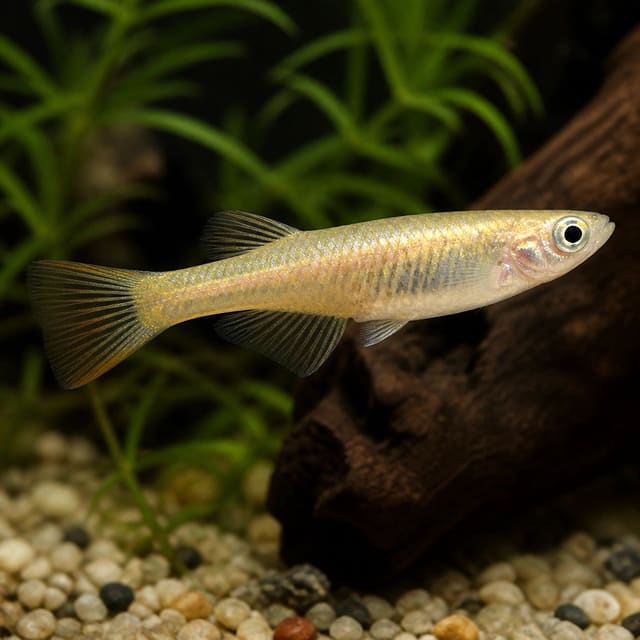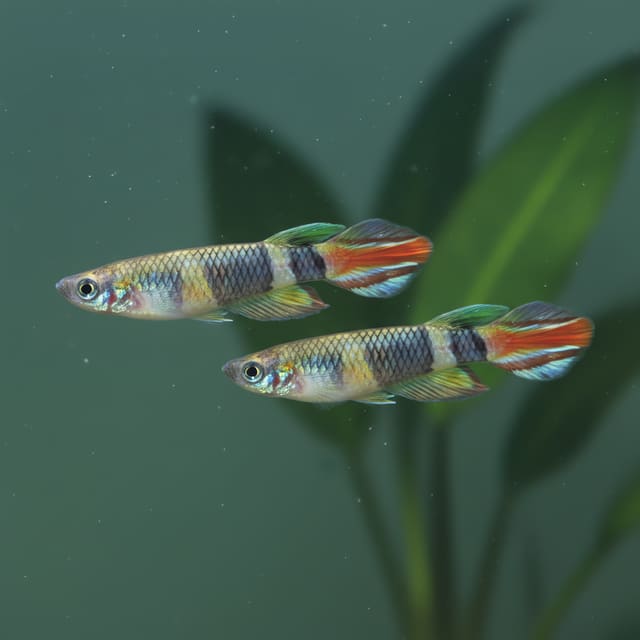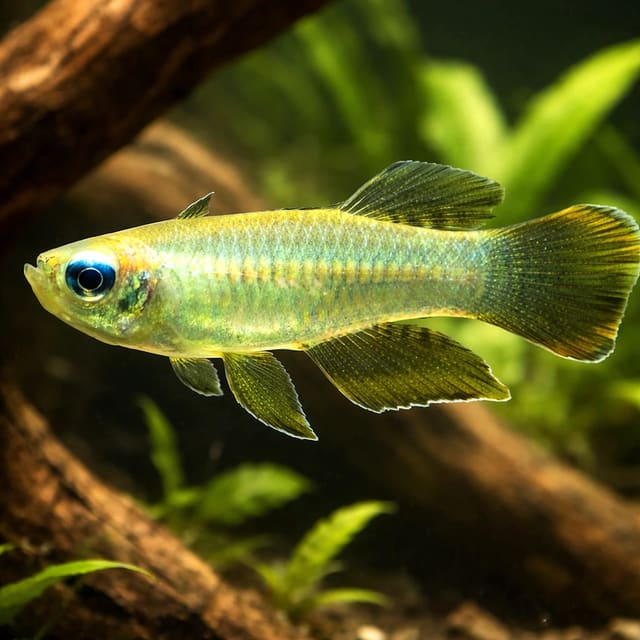
Lampeye (Aplocheilichthys normani)
22–26°C · pH 6.5–7.2
£3.99

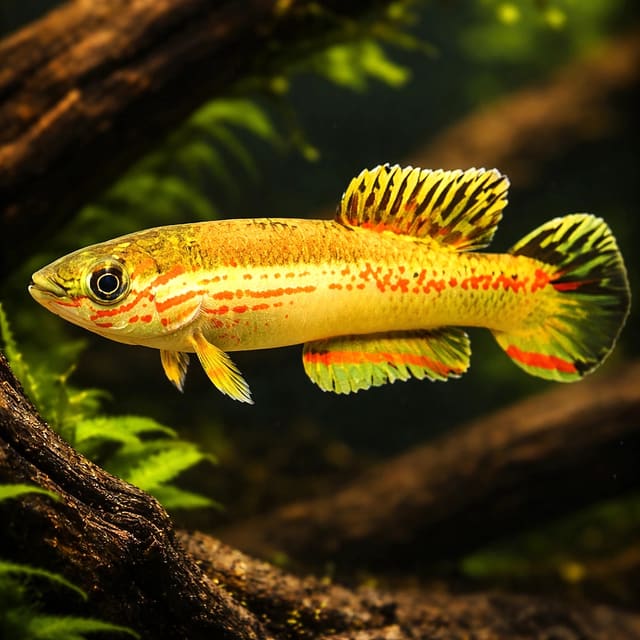
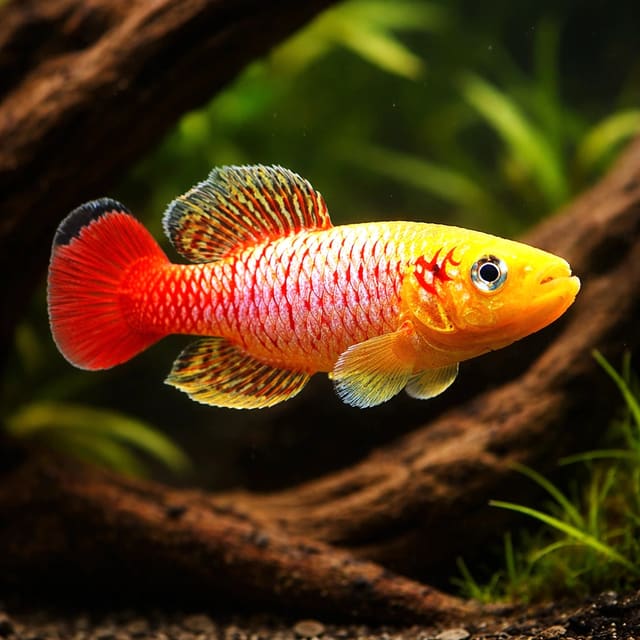
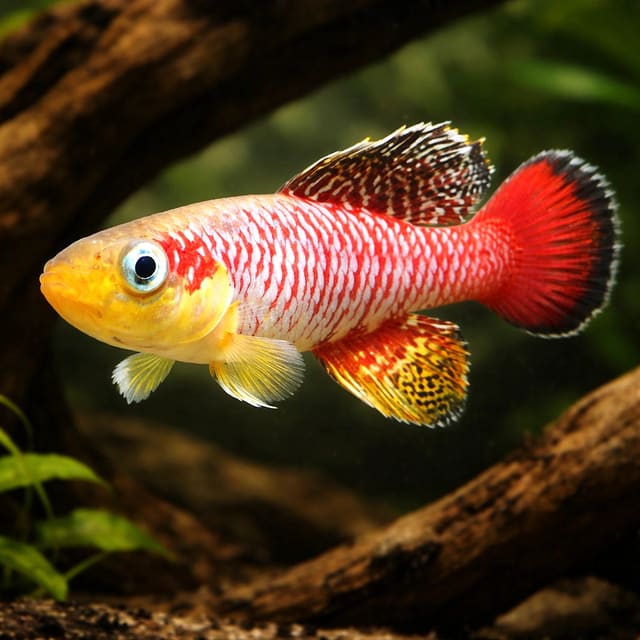
The Gardner's Killifish (Fundulopanchax gardneri) is a freshwater African rivuline endemic to Nigeria and Cameroon that reaches 6.5 cm. It suits intermediate keepers who can maintain the FishBase–OATA overlap of 22–25°C, pH 6.0–7.2 and 5–8°dH and plan around OATA's suggested group of at least three. Sold individually, with dispatch sizes from 2–3 cm to XL.
Adult size is the maximum length this species reaches at full maturity (scientific sources). The livestock you receive will be younger and smaller — pick a size above for the actual shipping size. Product-photo provenance and any image-specific limitations are stated on the listing.
Fundulopanchax gardneri
Save when buying multiple fish. Each quantity is one fish; sex and pair formation are not guaranteed unless the selected variant explicitly states them.
The Gardner's Killifish (Fundulopanchax gardneri) is a freshwater African rivuline endemic to Nigeria and Cameroon that reaches 6.5 cm. It suits intermediate keepers who can maintain the FishBase–OATA overlap of 22–25°C, pH 6.0–7.2 and 5–8°dH and plan around OATA's suggested group of at least three. Sold individually, with dispatch sizes from 2–3 cm to XL.
Adult size is the maximum length this species reaches at full maturity (scientific sources). The livestock you receive will be younger and smaller — pick a size above for the actual shipping size. Product-photo provenance and any image-specific limitations are stated on the listing.
Maintain these water conditions for optimal health and vibrant colors
Gardner's Killifish (Fundulopanchax gardneri) is a small freshwater African rivuline in the family Nothobranchiidae. It is endemic to freshwater habitats in Nigeria and Cameroon and reaches 6.5 cm. This is an intermediate choice for a keeper prepared to manage a covered aquarium, precise water conditions and a deliberately planned group rather than adding a single fish to an unscreened community.
Keep it at 22–25°C, pH 6.0–7.2 and 5–8°dH. These figures are the overlap between the species environment recorded by FishBase and OATA's group-level aquarium guidance for killifish. FishBase also gives a minimum aquarium length of 60 cm. OATA suggests at least 40 litres for a small group of the smallest killifish, so meet both the length and volume guidance when planning the aquarium.
The blue lyretail is another common name for this species. Its native range and modest adult length do not make it suitable for a small, uncovered or newly established aquarium. The lid, biological filter, group plan and water tests are all essential parts of the setup.
| Suits | Not suited to |
|---|---|
| An intermediate keeper who will test the water weekly | An aquarium with detectable ammonia or nitrite |
| A covered aquarium at least 60 cm long | An uncovered aquarium |
| A planned group of at least three | An unplanned single-fish purchase |
| Calm surroundings with plants and shelter | Boisterous or long-finned tank mates |
One purchase supplies one Gardner's Killifish from the selected size label. Use the live size selector to compare the 2–3 cm, 3–4 cm, 3 cm and XL labels. The size you select is the size supplied, not the adult size. Plan every choice around the same recorded adult length of 6.5 cm and the same long-term care requirements.
A larger dispatch grade does not change the minimum 60 cm aquarium length, the water range or the need to plan companionship. It only describes the size of the fish at dispatch. The XL label has no centimetre measurement attached to it, so do not treat it as an adult-size promise.
Sex is guaranteed only when the selected option explicitly states male or female. This Gardner's Killifish listing has no sex-guaranteed option.
OATA suggests keeping at least three killifish, using two females to each male to reduce stress on females or other inhabitants. Because that ratio requires deliberate planning, ask us for a stocking and compatibility assessment before building the aquarium around a particular sex balance.
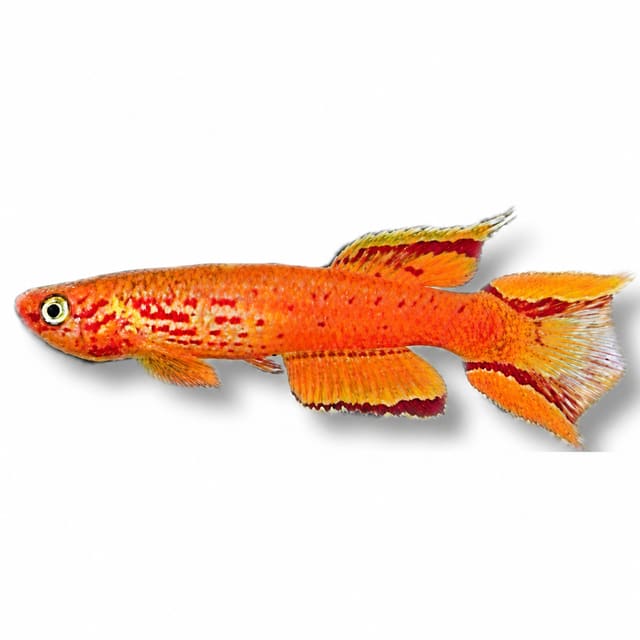
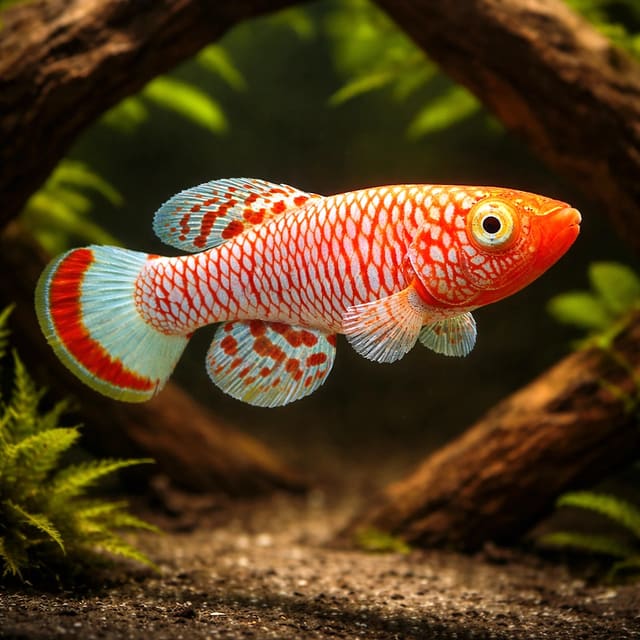
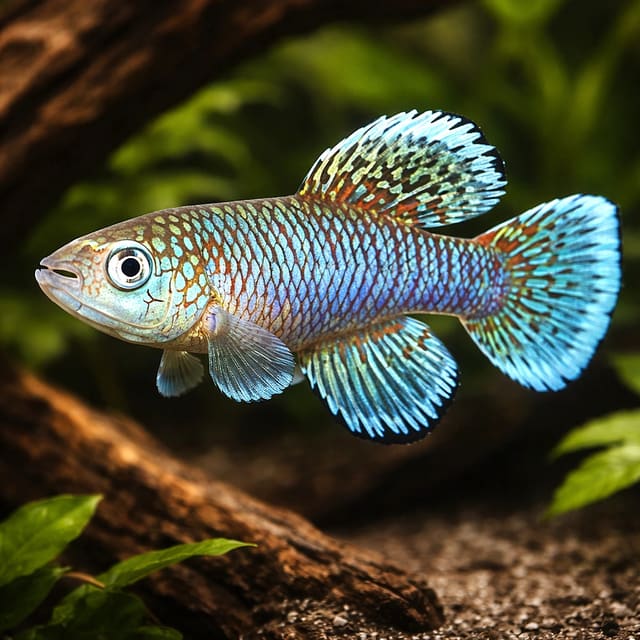
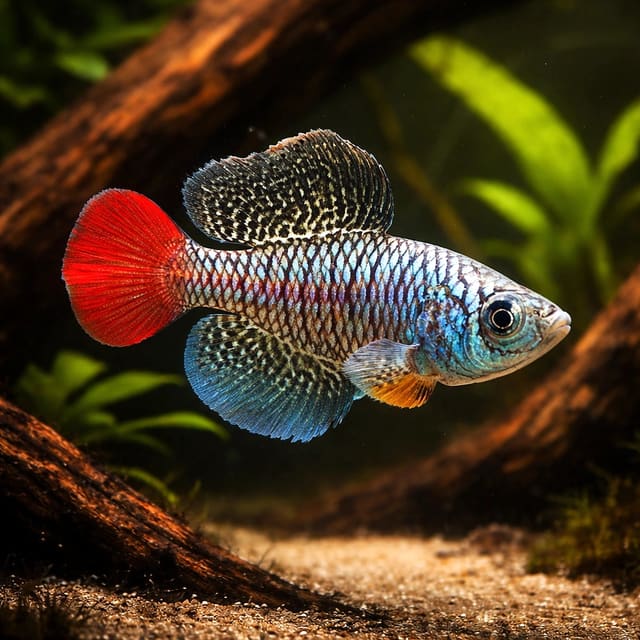
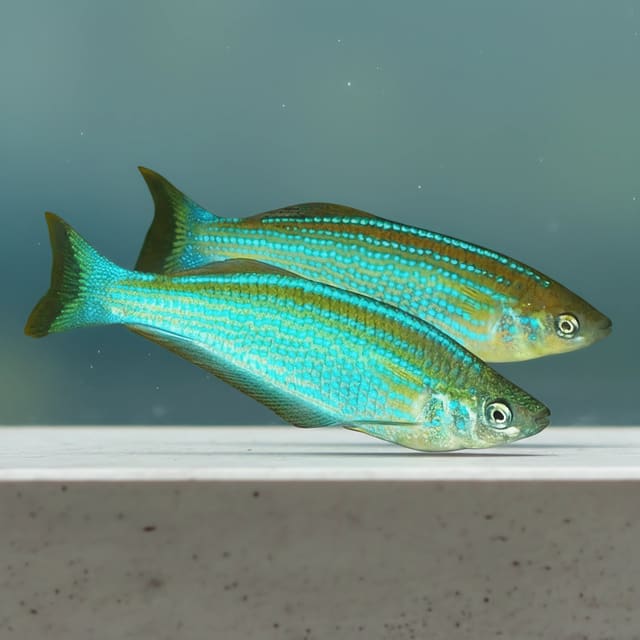
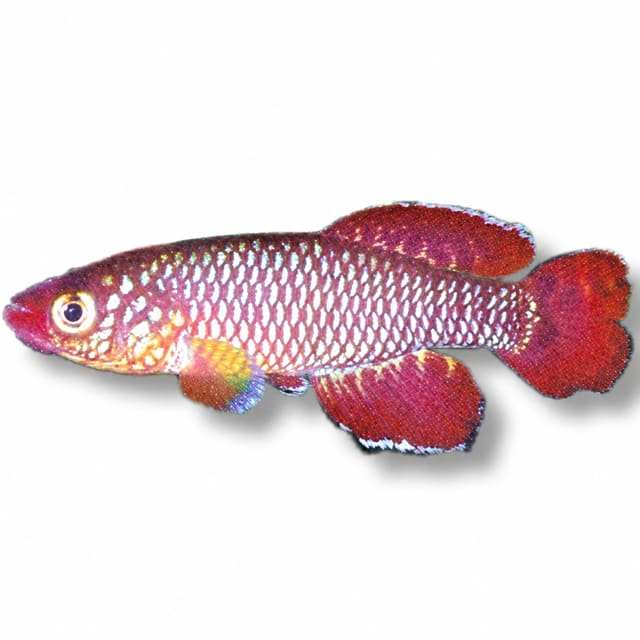
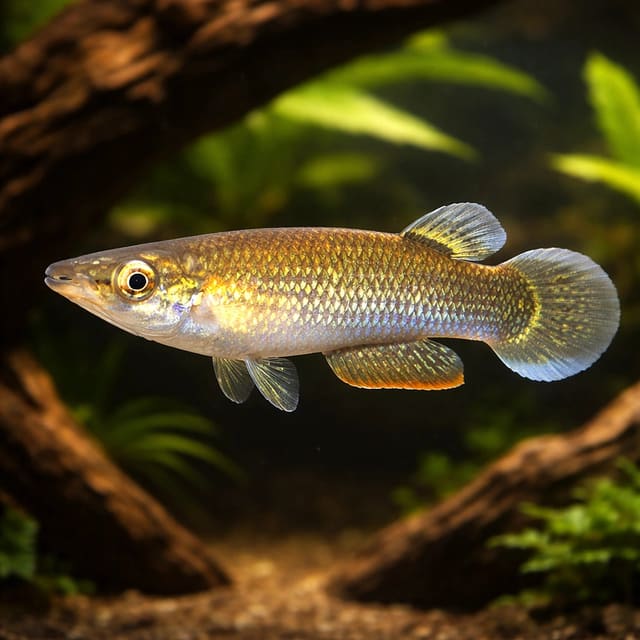
Some gallery images are representative, based on reference photographs of this species, and none shows the exact animal supplied, so colours can look slightly different from the live animal.
Keep this page for this species and use the killifish collection when comparing it with other killifish. Care requirements and compatibility must be checked for the particular species rather than transferred from one member of the group to another.
In nature, this freshwater fish occurs in brooks, swamps, pools and streams through humid forest, highland savanna and rainforest areas. FishBase describes it as benthopelagic and non-migratory. Those habitat notes explain why cover and clean freshwater matter, but aquarium water should follow the 22–25°C, pH 6.0–7.2 and 5–8°dH range set out above.
FishBase describes Gardner's Killifish as non-seasonal. Do not treat it as an annual species whose normal life strategy depends on the adult population disappearing when a temporary pool dries. The species is recorded as a bottom spawner, with an incubation period of about one month; that is a natural-history distinction, not a home-breeding procedure.
Its conservation assessment is Least Concern. That status describes the wild species and does not reduce the keeper's responsibility to provide a covered, filtered aquarium, suitable companions and stable water.
Use an aquarium at least 60 cm long. FishBase gives that minimum for this species, while OATA recommends at least 40 litres for a small group of the smallest killifish. Gardner's Killifish reaches 6.5 cm, placing it below OATA's over-7 cm category for larger species. A suitable plan therefore meets both thresholds: at least 60 cm in length and at least 40 litres for the suggested small group.
Do not substitute one measure for the other. A tall aquarium advertised as 40 litres but shorter than 60 cm misses the species length guidance. A very shallow 60 cm vessel below 40 litres misses OATA's group-volume guidance. Extra water volume can make temperature and water quality more stable, but it does not remove the need for a suitable group structure or screened companions.
Fit an aquarium cover before adding the fish. OATA identifies a cover as essential for killifish because they can jump. Check that the normal positions of cables, filter fittings and feeding openings do not prevent the cover from sitting correctly.
Use aquarium gravel or sand and provide plenty of cover. OATA recommends a heavily planted aquarium, particularly when multiple males are kept together. If live plants are not used, plastic plants and suitable ornaments such as plant pots or model caves can provide shelter. Arrange these features throughout the aquarium rather than concentrating every refuge in one corner.
Install and mature the filter before adding fish. Our first tropical aquarium guide explains how to prepare the system before livestock arrives. Confirm that the aquarium can hold the intended group, maintain the required water values and remain securely covered during normal feeding and maintenance.
Keep Gardner's Killifish at 22–25°C, pH 6.0–7.2 and 5–8°dH. This is the complete overlap between FishBase's species-level environmental range and OATA's broader killifish aquarium range of 22–27°C, pH 6.0–7.5 and 4–12°dH. Staying in the overlap respects the narrower species figures without widening them to the edges of the group guidance.
Set a target inside each range and test the aquarium rather than relying on an assumption about local tap water. For example, a result of 24°C, pH 6.8 and 6°dH lies inside all three ranges. A result of 26°C may sit inside OATA's group range, but it is above FishBase's 25°C species maximum and should not be used as the routine target for this fish.
Maintain ammonia at 0 mg/l and nitrite at 0 mg/l. OATA advises that nitrate should not exceed 20 mg/l above the normal tap-water level. These waste values require a working biological filter, restrained feeding and regular maintenance; temperature, pH and hardness alone do not describe a safe aquarium.
Use our water chemistry guide to understand what each test measures, then enter the measured results into the water matcher to compare them with the target range. Record results consistently so a change is visible before it becomes a health problem.
Run a well-established biological filter continuously. The RSPCA's aquarium welfare guidance explains that fish release toxic ammonia, which filter bacteria convert first to nitrite and then to the safer nitrate. Ammonia and nitrite remain dangerous even when the water looks clear, so appearance cannot replace testing.
OATA warns that the beneficial bacterial population established while a filter matures must increase whenever more fish are added and feeding rises. Add livestock gradually rather than making a large increase in one step. Stocking too quickly can create new tank syndrome because the filter bacteria cannot yet process the increased waste.
| Check | Decision |
|---|---|
| Ammonia above 0 mg/l | Do not add fish |
| Nitrite above 0 mg/l | Do not add fish |
| Filter not fully established | Continue maturing the aquarium |
| Intended group exceeds the aquarium plan | Revise the group or aquarium |
| All care ranges and waste tests met | Proceed gradually |
A filter must match the aquarium and remain free of blockages. Its role is not limited to collecting visible debris: the established bacterial population is part of the life-support system. Never switch the filter off as a routine way to reduce water movement, and do not replace all established media at the same time.
Recheck ammonia and nitrite whenever the fish population or feeding load increases. A result above zero is an instruction to pause further additions and correct water quality. The safest stocking timetable is set by test results and filter capacity, not by how quickly the aquarium looks ready.
Feed once a day, offering only what the fish can eat within a few minutes. OATA's killifish guidance describes the group as omnivorous and recommends a good-quality flake or granule as the prepared food. It also recommends small live or frozen items such as daphnia, brine shrimp or tubifex for variety.
Use food small enough for the fish to take readily. Dispatch size affects the practical food-particle size, but it does not change the once-daily schedule or justify leaving excess food in the aquarium. Watch the meal long enough to see that food is being eaten within the stated few minutes.
Overfeeding allows uneaten food to break down and release toxic waste. That creates extra work for the biological filter and can push ammonia or nitrite away from the required 0 mg/l. A larger portion is therefore not a shortcut to faster growth or better condition.
Use feeding response as a daily observation point. A reduced intake or loss of interest in food is one of the changes OATA tells keepers to watch. Test the water when feeding behaviour changes rather than trying to hide the problem with a different or richer food.
At least once every week, change 25% of the aquarium water. OATA recommends this frequency and amount, with a siphon used to remove solid waste from the substrate. Treat replacement tap water with a suitable conditioner to remove chlorine or chloramine before adding it to the aquarium.
Test the water at least once per week. Record temperature, pH and hardness, then confirm ammonia at 0 mg/l, nitrite at 0 mg/l and nitrate no more than 20 mg/l above the normal tap-water level. Weekly records make a gradual drift easier to see than occasional isolated tests.
Check the filter for blockages during maintenance. If cleaning is needed, rinse the media lightly in aquarium water removed during the partial water change. Do not rinse it under the tap, because chlorine or chloramine may kill part of the beneficial bacterial population established in the media.
Do not turn a weekly 25% change into occasional large corrections without a separate reason. Regular work controls waste before it accumulates and avoids relying on a visible problem as the maintenance trigger.
During the first month after increasing the fish population, give ammonia, nitrite and feeding response particular attention. The filter's bacterial population must adjust to the greater waste load. Pause further additions if either toxic waste test rises above zero.
Before release, OATA's aquarium check still applies: ammonia and nitrite must be 0 mg/l, and the aquarium must already be appropriate for the intended number of fish. Complete those checks before the parcel arrives so they do not interrupt the arrival procedure.
Our delivery and Live Arrival Guarantee policy sets the following sequence. The video begins while the parcel is still sealed; it is not something to recreate after opening.
The continuous video is required for a Live Arrival Guarantee claim and should show the sealed parcel, the opening and the fish still in the sealed bag. Keep the order number with the video. If anything has gone wrong, contact us the same day with the order number and the continuous unboxing video.
The parcel is hand-packed, with the fish bagged in pure oxygen inside an insulated box. A heat pack is used when the weather calls for it, and a licensed live-animal courier carries the parcel. Someone must be present to receive live fish; the parcel cannot be left unattended.
After release, keep the aquarium covered and return to the established daily feeding, observation and testing routine. Do not use arrival day to add further fish or increase feeding beyond what can be eaten within a few minutes.
Observe the fish every day during feeding and whenever you check the aquarium. OATA recommends watching for changes in swimming, colour, temperament, breathing, appearance, body condition and food intake. The useful comparison is the fish's normal behaviour and appearance in its established aquarium.
| If you see | Do this first |
|---|---|
| Hanging at the surface, sitting on the bottom or erratic swimming | Test water quality immediately |
| Gill covers moving faster or slower than normal | Check ammonia, nitrite and temperature |
| Darker or paler colour than normal | Review water results and recent changes |
| More hiding or altered aggression | Review group and tank-mate interactions |
| White spots, fluffy growths, damaged fins or missing scales | Test the water and seek health guidance |
| Reduced feeding or changing body condition | Check water and the controlled feeding routine |
Water testing is the first response because killifish can be stressed by even small amounts of ammonia or nitrite. Both should remain at 0 mg/l. Also compare the current temperature, pH and hardness with the 22–25°C, pH 6.0–7.2 and 5–8°dH target.
Do not begin a disease treatment from appearance alone. Different problems can produce similar signs, while poor water can cause or worsen several of them. Record what changed, when it began, the current test results and whether more than one fish is affected, then contact us for health guidance.
We rate Gardner's Killifish as intermediate because the keeper must combine a secure cover, a deliberate group plan, a narrow water overlap, weekly testing and careful community screening. Consistently completing those tasks matters more than prior ownership of another small tropical fish.
Plan for at least three Gardner's Killifish. OATA says killifish require some companionship and suggests at least three, arranged as two females to each male to reduce stress on females or other aquarium inhabitants. More can be kept when the same ratio is maintained and the aquarium can support the larger group.
Treat that number as a starting point for the group, not as permission to add three fish to any 40-litre container. The aquarium must also be at least 60 cm long, filtered, covered and able to maintain 22–25°C, pH 6.0–7.2 and 5–8°dH. Additional fish increase both the waste load and the need for shelter.
Heavily planted cover is particularly useful when multiple male killifish are kept together. Plants, plant pots or model caves provide shelter, but shelter does not increase filter capacity or guarantee that every combination will work. Continue observing changes in aggression, hiding and feeding after the group is introduced.
Do not infer a fish's sex from the colours shown in the gallery or use an image as the basis for the group ratio. Complete the intended stocking assessment before relying on a particular balance. If the eventual group differs from the plan, reassess shelter, aquarium capacity and interactions rather than assuming the original arrangement still applies.
Treat community placement as conditional. OATA describes killifish as generally small and peaceful, but says they do not appreciate boisterous tank mates. Some species do best in a species-focused aquarium because they can be shy and prone to bullying, while others can live in a community after careful screening.
Avoid boisterous tank mates and other long-finned species. OATA specifically warns that some male killifish may be aggressive towards other long-finned fish. This is a reason to exclude that body type rather than trying the combination and waiting for damaged fins.
| Check | Decision rule |
|---|---|
| Temperament | Reject boisterous fish |
| Fin shape | Avoid other long-finned species |
| Adult and mouth size | Reject a clear swallowing or predation risk |
| Water requirements | Use only animals suited to 22–25°C, pH 6.0–7.2 and 5–8°dH |
OATA flags mouth size as a killifish compatibility question because some members of the group can eat smaller fish; its specific example is the golden panchax. Apply the screening question to Gardner's Killifish without turning that example into a claim that this species will behave identically.
Use the same prey-risk screen for invertebrates. An animal being peaceful does not answer whether a smaller animal can be swallowed. Only proceed when adult size, mouth size, water needs and behaviour all fit the aquarium plan.
A species-focused arrangement is the clearest choice when community candidates cannot pass every check. In a community, provide shelter and monitor swimming, hiding, aggression, fin condition and feeding response. Remove the compatibility assumption if behaviour changes; the label attached to a tank mate matters less than what happens in the aquarium.
Gardner's Killifish reaches 6.5 cm total length according to FishBase. Plan the aquarium around that adult size, regardless of the dispatch size selected.
Use an aquarium at least 60 cm long for Gardner's Killifish; FishBase gives the 60 cm minimum, while OATA's group guidance recommends at least 40 litres for a small group of the smallest killifish. Meet both measures.
OATA suggests at least three Gardner's Killifish, arranged as two females to each male to reduce stress on females or other inhabitants. More can be kept when the same ratio, aquarium capacity and shelter are maintained.
We rate Gardner's Killifish as intermediate because it needs a covered, filtered aquarium, a planned group, weekly testing and water kept within 22–25°C, pH 6.0–7.2 and 5–8°dH.
Feed Gardner's Killifish once daily with only what it can eat within a few minutes. OATA recommends quality flake or granules plus small live or frozen foods such as daphnia, brine shrimp or tubifex.
Keep it at 22–25°C and pH 6.0–7.2, with general hardness of 5–8°dH. These figures are the overlap between FishBase's species environment and OATA's killifish aquarium guidance.
OATA describes killifish as generally peaceful but says some males may be aggressive towards other long-finned species. Avoid long-finned tank mates and watch for changes in aggression, hiding or fin condition.
It may suit a carefully screened community of calm fish, but avoid boisterous and long-finned tank mates. Check every fish or invertebrate for compatible water needs, adult size, mouth size and prey risk before mixing.
Tropical Fish Co's policy says it is hand-bagged in pure oxygen, placed in an insulated box with a heat pack when the weather calls for it, and carried by a licensed live-animal courier. Someone must receive the parcel in person.
No reviews for this item yet. Bought one? Honest reviews only, good or bad.
What customers say about ordering from us
I have a small group of long finned mountain minnows. So was delighted to be able to order ten of this variety to increase the genetics in my tank . The ones I recieved are healthy but it’s to early to give a verdict on wether they are of a long finned type since they are small currently.
Gordon Walker · 23 Sept 2026
100% success travel and "installation". Pleased with quality of purchase. The Siamese fighter a bit "shy" so have not yet seen him at his best yet but looking good. Happy customer. GG
George E Garratt · 21 Sept 2026
Reviews of our shop, collected by Judge.me, an independent third-party review collector. Newest first.