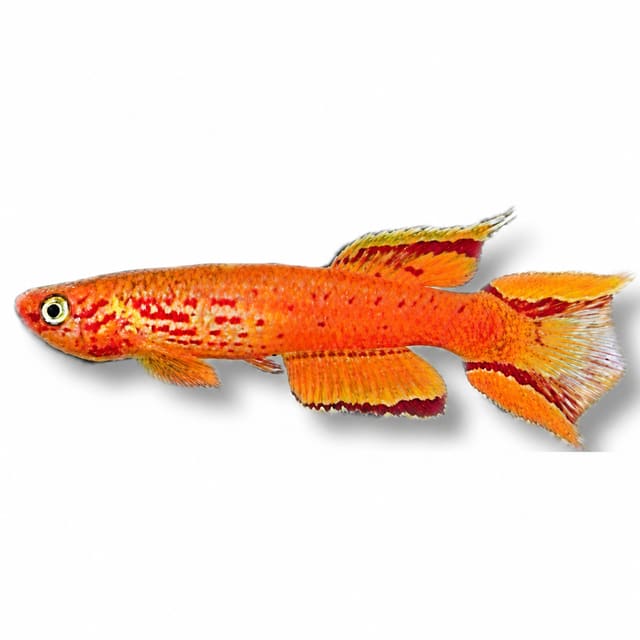
Gold Gardneri Killifish (Fundulopanchax gardneri)
20–26°C · pH 6–7.5
£9.99

Amiet's Killie (Fundulopanchax amieti), supplied at approximately 3–4 cm as one unsexed fish. Adults reach about 6–7 cm; provide a mature, planted, covered soft-water aquarium.
Adult size is the maximum length this species reaches at full maturity (scientific sources). The livestock you receive will be younger and smaller. Product-photo provenance and any image-specific limitations are stated on the listing.
Fundulopanchax amieti
Save when buying multiple fish. Each quantity is one fish; sex and pair formation are not guaranteed unless the selected variant explicitly states them.
Confirm your email, then we’ll send an availability message for this exact item if it returns within 180 days.
This request is only for this product—no newsletter or other promotions. A mail-provider retry may very rarely duplicate the same availability message. Unconfirmed addresses are removed after 48 hours. See our privacy policy.
Amiet's Killie (Fundulopanchax amieti), supplied at approximately 3–4 cm as one unsexed fish. Adults reach about 6–7 cm; provide a mature, planted, covered soft-water aquarium.
Adult size is the maximum length this species reaches at full maturity (scientific sources). The livestock you receive will be younger and smaller. Product-photo provenance and any image-specific limitations are stated on the listing.
Maintain these water conditions for optimal health and vibrant colors
Amiet's Killie is the aquarium fish currently accepted as Fundulopanchax amieti. The supplier lists it under the established synonym Aphyosemion amieti. One quantity buys one unsexed fish, supplied at approximately 3–4 cm. Sex, an established pair, locality strain, adult colour and exact markings are not guaranteed.
This is a colourful Cameroonian killifish for a quiet, mature aquarium. Adults reach about 6–7 cm, so the supplier's 3–4 cm measurement is a dispatch size rather than an adult size. A planted setup, soft water, gentle filtration and a tight, gap-free lid are the important starting points.
| Accepted scientific name | Fundulopanchax amieti |
|---|---|
| Supplier synonym | Aphyosemion amieti |
| What one quantity buys | One unsexed fish; no pair or sex guarantee |
| Dispatch size | Approximately 3–4 cm |
| Adult size | About 6–7 cm |
| Aquarium starting point | 30 litres or more; allow substantially more room for multiple fish |
| Suggested aquarium temperature | 23–26°C, kept stable |
| Suggested pH | 6.0–7.0, with soft water |
| Temperament | Generally peaceful, but males can pressure other fish |
| Diet | Small live, frozen and suitable prepared foods |
Fundulopanchax amieti is also called Amiet's Killie or Amiet's Lyretail. Older aquarium and our stock records commonly use Aphyosemion amieti; both names refer to the same intended species on this listing.
Adult males can develop a blue-green upper body, a yellow to orange lower area and red spotting or broken lines across the body and fins. Females are usually more subdued. Young fish may not yet show their mature colour, and individual appearance varies. The gallery is representative and does not show the exact fish that will be dispatched.
The species is known from the Sanaga system in Cameroon, where specialist records describe rainforest brooks and marshy stream margins. That wild distribution does not establish the breeding facility, collection locality or provenance of the current stock, so no locality strain is claimed here.
Use at least a well-planted 30-litre aquarium as a starting point for one fish. Choose a larger footprint when keeping more than one, and be ready to separate a fish that is persistently chased or excluded. Ordering two fish does not guarantee a male and female or a compatible pair.
Field measurements from the type area recorded very soft water at about 24.8°C and pH 6.5. A field reading is not a universal aquarium prescription, but it supports a stable, soft-water setup. A practical aquarium target is 23–26°C and pH 6.0–7.0. Avoid sudden changes and do not chase a number at the expense of stability.
Offer small foods that can be taken easily. Daphnia, Artemia, cyclops and other appropriately sized live or frozen foods are useful, while good-quality micro-pellets or fine prepared foods may also be accepted. Feed modest portions and check that shy fish receive food when housed with quicker feeders. Remove leftovers before they affect water quality.
Amiet's Killie is generally peaceful and does best without boisterous competition. A species-focused aquarium is the safest option. Calm, similarly sized fish with matching water requirements may be considered in a larger, densely planted aquarium, but watch feeding access and behaviour closely.
Males can display strongly and may pressure females or subordinate fish, particularly where cover and space are limited. Do not assume a random group will settle without intervention. Avoid fast or aggressive tank mates, persistent fin-nippers and fish large enough to treat a killifish as prey. Do not mix it with closely related Fundulopanchax when breeding because hybridisation is possible.
Specialist breeders describe F. amieti as a semi-annual egg layer. Eggs may be deposited in spawning mops or a suitable bottom medium and can be managed with water or damp-medium incubation methods. This is specialist breeding guidance, not a promise that fish ordered together will be a sexed or compatible breeding pair.
Add this fish only to a mature aquarium with stable temperature and chemistry. Check temperature regularly and test pH if your source water or aquarium management can cause it to shift. Use modest, regular water changes matched closely to the aquarium rather than making large, sudden changes. Rinse filter media only as needed and preserve the established biological filter.
Observe feeding and social behaviour, especially during the first weeks. A fish that remains hidden, misses food, breathes unusually quickly or is repeatedly driven away needs prompt investigation. In a multi-fish setup, extra planting is helpful but does not replace adequate space or a separation plan. Make changes gradually, and judge compatibility from what the fish actually do rather than from a general “peaceful” label.
No reviews for this item yet. Bought one? Honest reviews only, good or bad.
What customers say about ordering from us
I have a small group of long finned mountain minnows. So was delighted to be able to order ten of this variety to increase the genetics in my tank . The ones I recieved are healthy but it’s to early to give a verdict on wether they are of a long finned type since they are small currently.
Gordon Walker · 23 Sept 2026
100% success travel and "installation". Pleased with quality of purchase. The Siamese fighter a bit "shy" so have not yet seen him at his best yet but looking good. Happy customer. GG
George E Garratt · 21 Sept 2026
Reviews of our shop, collected by Judge.me, an independent third-party review collector. Newest first.