
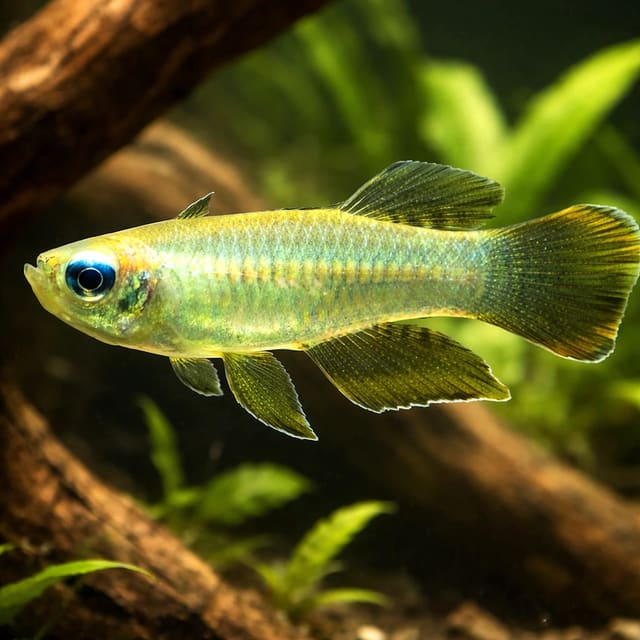
Lampeye (Aplocheilichthys normani)
22–26°C · pH 6.5–7.2
£3.99

The Rachovi's Nothobranch Beira 98 Albino (Nothobranchius rachovii) is an annual freshwater killifish from lower Pungwe and lower Zambezi floodplains that reaches 6 cm. It suits an intermediate keeper: keep it within the FishBase and Seriously Fish overlap of 20–24°C, pH 6.0–7.0 and 4–6 dGH, use a base of at least 45 × 30 cm, and follow OATA's suggestion of at least three killifish when a suitable sex ratio can be established. Sold individually as one live 2.5–3.5 cm fish.
Adult size is the maximum length this species reaches at full maturity (scientific sources). The livestock you receive will be younger and smaller — pick a size variant above for the actual shipping size. Product-photo provenance and any image-specific limitations are stated on the listing.
Nothobranchius rachovii
Save when buying multiple fish. Each quantity is one fish; sex and pair formation are not guaranteed unless the selected variant explicitly states them.
The Rachovi's Nothobranch Beira 98 Albino (Nothobranchius rachovii) is an annual freshwater killifish from lower Pungwe and lower Zambezi floodplains that reaches 6 cm. It suits an intermediate keeper: keep it within the FishBase and Seriously Fish overlap of 20–24°C, pH 6.0–7.0 and 4–6 dGH, use a base of at least 45 × 30 cm, and follow OATA's suggestion of at least three killifish when a suitable sex ratio can be established. Sold individually as one live 2.5–3.5 cm fish.
Adult size is the maximum length this species reaches at full maturity (scientific sources). The livestock you receive will be younger and smaller — pick a size variant above for the actual shipping size. Product-photo provenance and any image-specific limitations are stated on the listing.
Maintain these water conditions for optimal health and vibrant colors
Rachovi's Nothobranch Beira 98 Albino is the named aquarium form of Nothobranchius rachovii, a freshwater annual killifish in the family Nothobranchiidae. FishBase places it in temporary pools, swamps and water-filled depressions across lowland floodplains associated with the lower Pungwe and lower Zambezi rivers in Africa, and records a maximum of 6 cm total length. It suits an intermediate keeper who can maintain stable water, use small live or frozen foods and manage a covered, filtered aquarium.
Its annual life cycle reflects those seasonal habitats. Adults reproduce while water remains, then fertilised eggs persist within the substrate after the habitat dries. Seriously Fish reports that rains return after roughly five to six months in nature, allowing the next generation to hatch and develop rapidly. Keep the aquarium stable and continuously filtered rather than attempting to recreate a drying pool around live adults.
One purchase supplies one live fish at approximately 2.5–3.5 cm. This is the dispatch size rather than the adult length.
Sex is guaranteed only when the selected option explicitly states male or female. This Rachovi's Nothobranch Beira 98 Albino listing has no sex-guaranteed option.
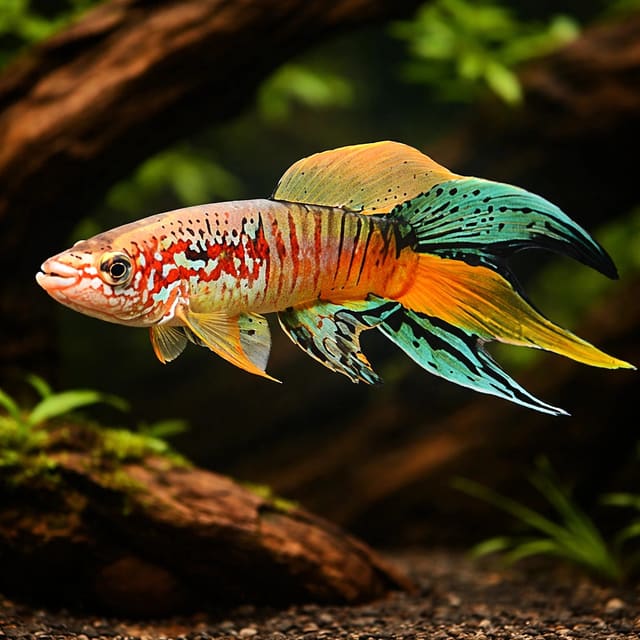
The gallery images are representative, based on reference photographs of this species, so colours can look slightly different from the live animal.
Treat the words Beira 98 Albino as the identifying aquarium-form designation. They do not change the species-level water, space and feeding requirements below, and neither the gallery nor the dispatch size should be used to infer sex, maturity or origin.
The 2.5–3.5 cm dispatch size is only the starting point. FishBase records a maximum of 6 cm total length, while Seriously Fish gives 55 mm standard length. Plan around the 6 cm maximum recorded length and the fish's need for usable horizontal space.
Seriously Fish recommends a base of at least 45 × 30 cm and approximately 41 litres even for a single pair, except during temporary spawning isolation. Use that same minimum footprint when beginning with one animal. A small dispatch fish still needs stable water, an established biological filter and a secure cover, and the larger footprint leaves room for shelter and later stocking decisions.
Keep the aquarium within 20–24°C, pH 6.0–7.0 and 4–6 dGH. These routine values are the overlap between FishBase and Seriously Fish; holding the aquarium steadily within them is more useful than moving between their limits.
| Planning value | How to use it |
|---|---|
| Dispatch size | Approximately 2.5–3.5 cm; use it to prepare suitable food and safe equipment. |
| Recorded adult size | Up to 6 cm total length; use this when judging lasting space. |
| Minimum base | At least 45 × 30 cm, including for a pair. |
| Approximate volume | About 41 litres at the stated base; do not substitute a tall, narrow shape that loses footprint. |
| Routine water | 20–24°C, pH 6.0–7.0 and 4–6 dGH. |
Aquarium volume alone cannot describe a workable layout. Measure the internal base after allowing for thick backgrounds or bulky decorations, and preserve open feeding room alongside planted or ornamental shelter. If more fish are planned, increase footprint and visual separation rather than assuming that the minimum pair aquarium will suit every social combination.
This is an intermediate choice in our care classification. Its modest adult size helps with space planning, but the keeper still needs a covered aquarium, stable soft water, regular testing and dependable access to suitably small foods. Social planning also requires attention because the purchase does not establish a male-to-female ratio.
| Suits | Not suited to |
|---|---|
| Keepers prepared to maintain 20–24°C, pH 6.0–7.0 and 4–6 dGH | Aquariums outside the shared species-level water range |
| A covered, filtered aquarium with a base of at least 45 × 30 cm | Open or unfiltered aquariums |
| Keepers able to offer small live or frozen foods daily | Routines that cannot support daily feeding and weekly maintenance |
| Carefully planned groups with sex ratio, cover and space assessed | Unplanned groups where sex ratio and social pressure cannot be managed |
| Calm, carefully screened community arrangements | Boisterous or long-finned tank mates |
Prepare the aquarium before bringing the fish home. Our first tropical aquarium guide explains how to establish biological filtration before livestock is introduced. A newly filled tank is not equivalent to an aquarium with a functioning bacterial population.
During the first month, judge success through measured water quality, steady breathing, normal swimming, intact fins and reliable feeding. Do not use rapid growth or intense colour as the main test. Males are described as larger and much more colourful than females, but colour and body size are not a substitute for an explicitly sexed purchasing option.
If your routine cannot support once-daily feeding, weekly tests and a 25% water change at least once a week, prepare that routine before bringing the fish home. The compact body size does not reduce the consequences of missed filtration or accumulating waste.
Start with a base of at least 45 × 30 cm and approximately 41 litres. Place the aquarium on a level support, leave access for filter maintenance and arrange cables so the cover can close around them. The lid is part of the permanent setup rather than an optional accessory.
| Zone | Purpose |
|---|---|
| Sheltered area | Plants or suitable ornaments provide cover and interrupt direct sight lines. |
| Open feeding area | Clear space lets you see whether food is taken and whether one fish excludes another. |
| Service area | Keep the filter intake and heater visible enough for routine checks. |
| Surface | Maintain clear gas exchange while keeping every escape gap closed. |
OATA recommends aquarium gravel or sand and ideally heavy planting for killifish, particularly where multiple males may be kept. Plastic plants and suitable ornaments such as model caves or plant pots can provide shelter when live planting is not used. Choose aquarium-safe pieces that remain stable during maintenance and do not prevent you from locating a fish that has stopped feeding.
This species does not require peat for routine maintenance. Seriously Fish notes that peat moss is often used as a spawning medium, but a display aquarium can be arranged without it. Keep breeding equipment separate from the everyday welfare plan unless you have deliberately prepared a managed spawning project.
Close openings around pipes, cables and feeding flaps after every task. A partly displaced cover is still an open route. Arrange feeding access so you can add food without leaving the aquarium uncovered while waiting for thawed food or equipment.
When several animals are planned, add more than one sheltered route and feeding point. Extra decoration only helps when it creates usable separation; a crowded central pile can reduce swimming space without giving a pursued fish a genuine way out.
Keep the aquarium at 20–24°C, pH 6.0–7.0 and 4–6 dGH. This is the overlap between the species-level ranges from Seriously Fish and FishBase. Hold the aquarium steadily within these values rather than pushing it rapidly between the limits.
Measure the aquarium before choosing corrective products. The water chemistry guide explains what pH, hardness, ammonia, nitrite and nitrate measurements mean, while the Water Parameter Matcher helps compare measured water with the stated range. Record readings consistently so a trend can be distinguished from a single unusual result.
| Measurement | Required action |
|---|---|
| Temperature | Hold 20–24°C and avoid abrupt movement through the range. |
| pH | Keep within 6.0–7.0; favour repeatable preparation over chasing one decimal. |
| General hardness | Maintain 4–6 dGH using a consistent water source. |
| Ammonia | Keep at zero mg/L and respond promptly to any detectable result. |
| Nitrite | Keep at zero mg/L and treat any detectable result as a filtration problem. |
| Nitrate | Keep no more than 20 mg/L above the normal tap-water level. |
OATA's broad killifish guidance gives zero ammonia, zero nitrite and nitrate no more than 20 mg/L above the normal tap-water level. These waste limits guide testing and maintenance alongside the aquarium range above.
Provide continuous biological filtration. The RSPCA explains that beneficial filter bacteria convert toxic ammonia to nitrite and then to safer nitrate. Never treat clear-looking water as proof that this process is working; use test results.
For an aquarium of about 41 litres, Seriously Fish suggests turnover of four to five times the volume each hour, corresponding to a filter rating of roughly 165–205 litres per hour. Check the actual flow after media and fittings are installed. The fish must still be able to hold position and reach food without fighting a concentrated current.
A heater of roughly 25 W is suggested for this volume when the room is around 20°C. Heater output is a planning reference, not a promise for every room or aquarium shape, so confirm the achieved temperature with a separate aquarium thermometer.
Seriously Fish describes this fish as a natural micropredator and recommends small live or frozen foods such as Daphnia, Artemia and chopped bloodworm as the basis of the diet. Freeze-dried Daphnia, Artemia and bloodworm can also be used. Match every item to the mouth size of the animal in front of you, especially at the 2.5–3.5 cm dispatch size.
Feed once a day and offer only what can be eaten within a few minutes. This schedule follows OATA's killifish guidance. Uneaten food breaks down and adds waste, so a larger portion is not a shortcut to better condition or faster growth.
| Food | How to offer it |
|---|---|
| Daphnia | Use live, frozen or freeze-dried pieces of a suitable size. |
| Artemia | Offer small portions and observe that the fish captures them. |
| Bloodworm | Chop to an appropriate size when needed; avoid leaving large pieces behind. |
| Quality flake or granule | OATA includes these for killifish generally; confirm that this individual takes and swallows them. |
For one fish, begin with a deliberately small portion, watch until feeding activity stops and remove accessible remains. For several fish, divide the same controlled meal between separate points. This lets you see whether every individual eats instead of assuming that food added to the aquarium was shared evenly.
Keep a brief feeding note during the first week: food type, amount offered, whether it was eaten and which feeding point was used. That simple record separates food refusal from competition and prevents repeated overfeeding when several people care for the aquarium.
Finish the aquarium before arranging the animal's arrival. The filter should already support its biological workload, the heater should hold the intended temperature and the lid should close with all equipment fitted. Test ammonia and nitrite and proceed only when both read zero.
Read the delivery and Live Arrival Guarantee policy before the delivery date.
OATA advises checking the aquarium's size and water quality before introducing killifish. Add livestock gradually because the beneficial bacterial population must grow as the number of fish and the amount of feeding increase. A sudden stocking increase can leave the biological filter unable to process the additional waste.
After introduction, watch balance, breathing and swimming. When the fish is settled enough to respond, offer a small amount of suitable food and remove remains rather than adding a second large meal.
Where several animals enter the aquarium, account for each individual. Check whether all can leave the release area, reach cover and gain feeding access. Brief hiding after transport calls for calm observation; persistent surface hanging, bottom sitting, erratic swimming or unusually fast breathing calls for immediate water and equipment checks.
| Time | Decision |
|---|---|
| First day | Confirm steady breathing, balance, secure cover and functioning equipment. |
| First meals | Identify which foods are accepted and whether every fish gains access. |
| First water test | Act on any detectable ammonia or nitrite rather than waiting for visible decline. |
| End of week | Review appetite, fins, body condition, swimming and social pressure together. |
Carry out a 25% partial water change at least once a week. OATA strongly recommends this schedule for killifish and advises testing at least weekly so ammonia and nitrite do not build up. Use a siphon where practical to remove solid waste from gravel or sand rather than replacing clear-looking water alone.
Match replacement water closely enough to avoid a sudden temperature or chemistry shift. The goal is not to move the aquarium around within the whole permitted range each week. A tank held consistently at one suitable point is easier for the fish and easier for the keeper to monitor.
When filter media needs cleaning, rinse it lightly in aquarium water removed during the partial water change. Do not rinse it under the tap because chlorine or chloramine may damage the beneficial bacteria. Avoid replacing all established media at the same time.
| Observation | Maintenance response |
|---|---|
| Reduced filter flow | Check for blockage and clean only as much media as necessary in removed aquarium water. |
| Detectable ammonia | Reduce the immediate waste load, change conditioned water and check filter operation. |
| Detectable nitrite | Change conditioned water and treat the result as an urgent biological-filtration warning. |
| Rising nitrate trend | Review water-change consistency, feeding quantity and waste removal. |
| Repeated temperature drift | Check heater operation, placement and room conditions before changing its setting repeatedly. |
Keep the routine simple enough to repeat. A dated log of water results, water-change percentage and filter work shows whether a change followed maintenance, heavier feeding or a stocking increase. It also prevents different keepers from cleaning the filter twice or missing a scheduled water change.
During the first month, review the log weekly. Once the aquarium follows a predictable pattern, continue the same schedule rather than reducing care because the fish appears settled.
Learn the individual's normal swimming, feeding and resting pattern. OATA recommends watching for changes in swimming behaviour, colour, temperament, breathing, appearance, body condition and food intake. A change has more meaning when compared with the fish's usual behaviour and with measured water conditions.
| Change observed | First response |
|---|---|
| Hanging at the surface | Check temperature, filter operation, water movement, ammonia and nitrite. |
| Sitting on the bottom | Test water and compare the behaviour with the fish's normal resting pattern. |
| Erratic swimming | Check water, equipment and whether another fish is repeatedly pursuing it. |
| Faster or slower gill movement | Measure temperature, ammonia and nitrite and confirm that filtration is running. |
| Reduced feeding | Check food size, access, water readings and whether the change is progressing. |
| Fin or scale loss | Inspect social behaviour and physical surroundings, then separate persistent aggressors safely. |
White spots, fluffy growths, ulcerations, bumps, damaged fins, altered body condition and sustained loss of appetite all warrant close attention. Several different problems can produce similar outward changes, so record what changed, when it began and whether more than one fish is affected.
If water readings are outside the operating limits, correct the measured problem promptly with conditioned water changes and restored filtration. Do not respond to a visible symptom by feeding more heavily. Extra food increases waste and can make interpretation harder when the fish is already eating less.
Use a prepared, filtered and covered aquarium when social pressure prevents feeding or causes repeated cornering and fin damage. Moving a fish into an unprepared container replaces one problem with unstable water and inadequate filtration. Observe both the separated animal and the remaining aquarium after the move.
Contact us if a health change persists after water, equipment, feeding access and social pressure have been checked. Include the water results, temperature, a description of the change and when it began so the next step can be considered from concrete observations.
Annual biology is not a reason to accept wasting, breathing distress or preventable injury. Judge daily welfare by normal movement, feeding access, body condition and clean water, then act while changes are still small.
OATA advises that killifish benefit from companionship and suggests keeping at least three, arranged as two females to each male, to reduce pressure on females and other inhabitants. That ratio can only be managed after sex has been established; purchasing several animals here does not create a planned ratio.
Seriously Fish gives the minimum 45 × 30 cm base and approximately 41 litres for a single pair. Use more footprint, cover and observation capacity when keeping three or more. OATA recommends heavy planting or alternative shelter, especially where multiple males are kept together.
| Plan | Decision requirement |
|---|---|
| Begin with one | Use the full prepared aquarium and review companionship through a carefully planned later addition. |
| Keep a pair | Meet at least the 45 × 30 cm base and do not assume two animals establish a sex ratio. |
| Build a group | Aim for the advised two-females-to-one-male ratio after sex is established, with more space and cover. |
| Keep multiple males | Provide strong visual separation and monitor for sustained pressure rather than relying on plant density alone. |
Males are reported to grow larger and become much more colourful than females. Use behaviour and a confident identification process when reorganising a group; do not treat one snapshot, the gallery or the dispatch measurement as a guaranteed diagnosis.
A social plan must include a real separation option before conflict develops. The spare aquarium needs established filtration, a secure cover and suitable water; an empty container stored in a cupboard is not yet a workable backup.
A species-focused aquarium is the clearest starting point because it lets feeding, water and social observations centre on this killifish. Community keeping remains a case-by-case decision. OATA notes that some killifish are shy and prone to bullying, while others can live in community aquariums when companions are selected carefully.
| Screen | Pass condition |
|---|---|
| Water | The companion can remain well at 20–24°C, pH 6.0–7.0 and 4–6 dGH. |
| Behaviour | It is not boisterous and will not repeatedly bully or displace the killifish. |
| Finnage | It is not a long-finned species that could attract aggression from a male killifish. |
| Size | Adult body and mouth size do not create an obvious predation concern in either direction. |
| Feeding | Each animal can obtain its required food without one taking the whole meal. |
| Space | The aquarium accommodates the combined adult stock beyond the minimum pair footprint. |
Avoid boisterous tank mates. Also avoid long-finned species because OATA notes that some male killifish may be aggressive towards them. The exact result still depends on the individuals and aquarium.
Collection labels help aquarists keep annual-killifish lines apart and limit hybridisation. Avoid mixing different Nothobranchius forms in a breeding project when eggs or descendants could be confused. Keep each breeding line and its notes separate.
Write down the aquarium base, volume, temperature, pH, hardness, present adult stock and normal foods. Reject any candidate that fails one of those basic screens. If every value overlaps, add slowly and retain a prepared separation option because compatibility cannot be guaranteed by water values alone.
Browse the killifish collection to compare identities and care requirements, but assess each animal independently rather than treating all killifish as interchangeable. Different members of the group vary in size, behaviour and community suitability.
Once a community addition is made, watch feeding access, hiding, chasing, fins and breathing during the first week. A companion that causes sustained exclusion or damage has failed the practical screen even when the numerical water ranges overlap.
Rachovi's Nothobranch Beira 98 Albino reaches up to 6 cm total length according to FishBase; plan around that adult figure rather than its 2.5–3.5 cm dispatch size.
Nothobranchius rachovii needs a covered, filtered aquarium with a base of at least 45 × 30 cm and approximately 41 litres, the minimum Seriously Fish recommends even for a pair.
OATA suggests at least three killifish with two females to each male, but use that ratio only after sex is established; increase space and cover for a group and prepare a filtered separation aquarium.
Nothobranchius rachovii is an intermediate choice suited to a prepared keeper who can maintain a covered, filtered aquarium, stable water, daily small foods and a managed social plan.
Nothobranchius rachovii is a natural micropredator whose diet should be based on small live or frozen Daphnia, Artemia and chopped bloodworm; feed once daily and only what it can eat within a few minutes.
Keep it within the FishBase and Seriously Fish overlap of 20–24°C, pH 6.0–7.0 and 4–6 dGH; keep ammonia and nitrite at zero mg/L.
Some male killifish may be aggressive towards long-finned fish, so avoid long-finned companions and intervene if chasing causes cornering, lost feeding access or damaged fins.
Use a species-focused aquarium unless a calm companion matches 20–24°C, pH 6.0–7.0 and 4–6 dGH and passes the adult-size, feeding and behaviour screens; avoid boisterous tank mates.
The Tropical Fish Co delivery policy requires someone to be present to receive it. Film every delivery continuously from the sealed parcel as it is opened with the fish still in the sealed bag, float the bag for 20–30 minutes, and never pour the bag water into the aquarium.
Max adult size is the length this species reaches at full maturity (from scientific sources). The livestock you receive will be younger and smaller — pick a size variant on the buy box for the actual shipping size. Product-photo provenance and any image-specific limitations are stated on the listing.
Always research specific species before adding them to your tank. Consider:
No reviews for this item yet. Bought one? Honest reviews only, good or bad.
What customers say about ordering from us
I have a small group of long finned mountain minnows. So was delighted to be able to order ten of this variety to increase the genetics in my tank . The ones I recieved are healthy but it’s to early to give a verdict on wether they are of a long finned type since they are small currently.
Gordon Walker · 23 Sept 2026
100% success travel and "installation". Pleased with quality of purchase. The Siamese fighter a bit "shy" so have not yet seen him at his best yet but looking good. Happy customer. GG
George E Garratt · 21 Sept 2026
Reviews of our shop, collected by Judge.me, an independent third-party review collector. Newest first.
22–26°C · pH 6.5–7.2
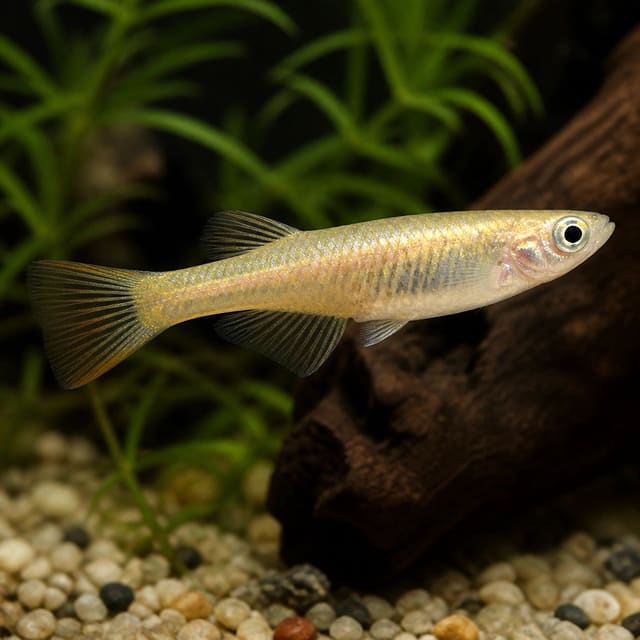
16–22°C · pH 6.5–8.5 · 41L
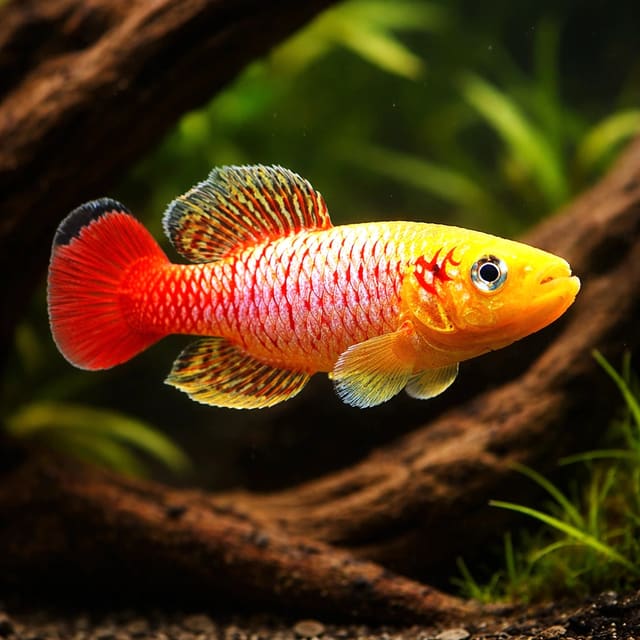
22–25°C · pH 6–7
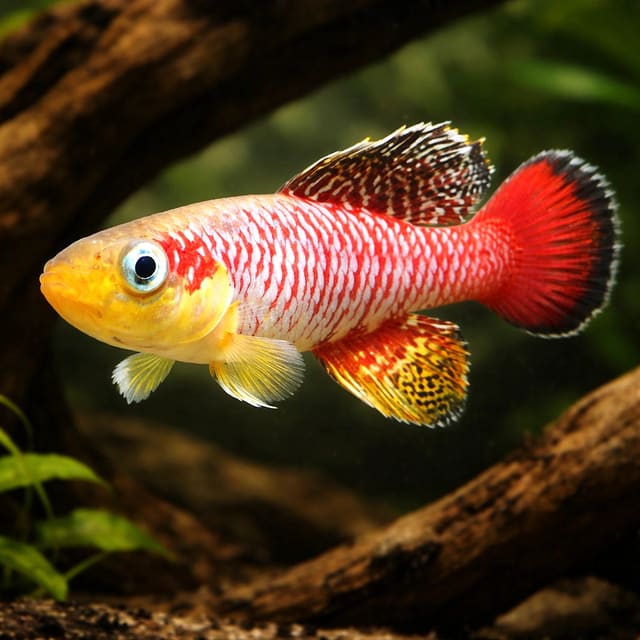
22–25°C · pH 6–7
23–25°C · pH 8–8.5
22–25°C · pH 6.5–7.2

23–26°C · pH 6–7.5 · 28L
22–25°C · pH 6–7.5

24–26°C · pH 6–7.2

20–26°C · pH 6–7.5
21–25°C · pH 6–7.4 · 40L
23–26°C · pH 6–7.5 · 81L

22–24°C · pH 6–7 · 28L

21–24°C · pH 6–7


22–25°C · pH 6–7.2

22–28°C · pH 7–8 · 41L

21–25°C · pH 5–7
24–29°C

24–27°C · pH 6.5–6.5

22–27°C · pH 6–8 · 72L
24–27°C · pH 6.5–8 · 200L

23–27°C · pH 5.5–7 · 60L

22–27°C · pH 6–8