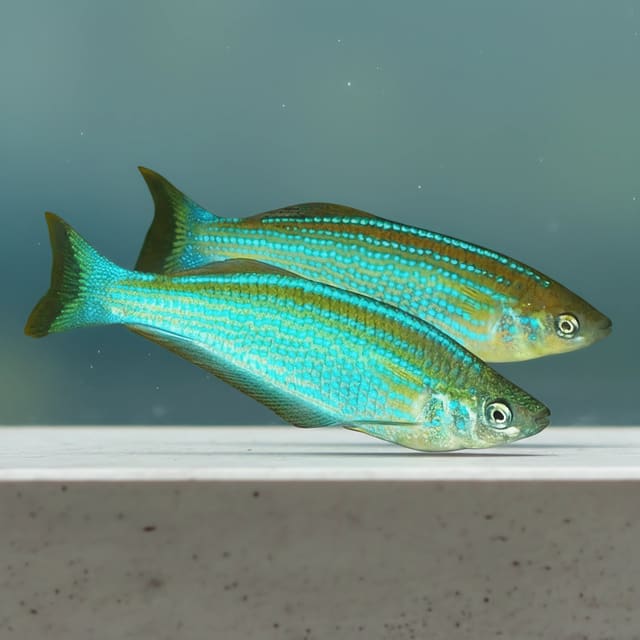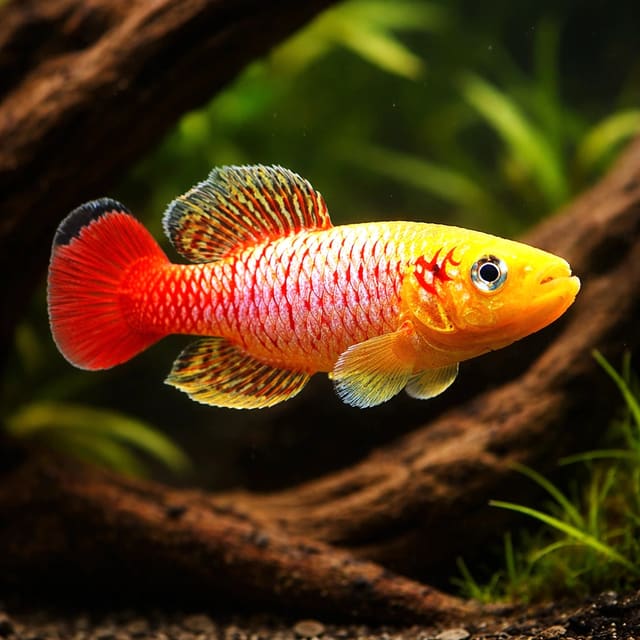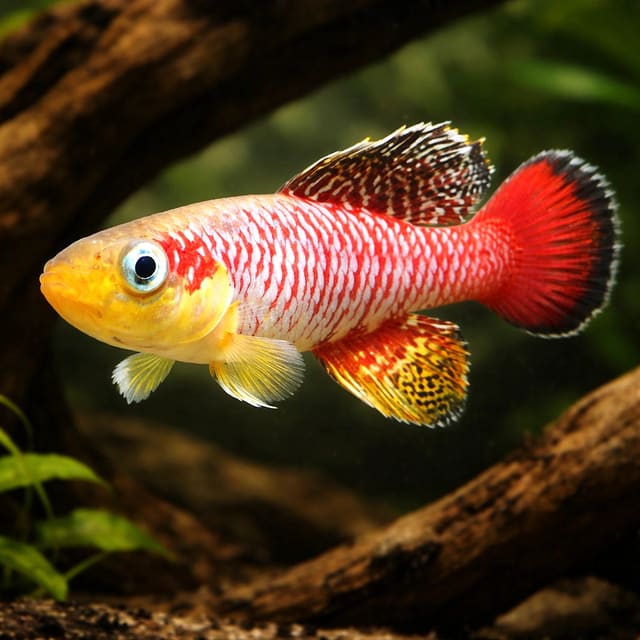
Gunther's Nothobranch (Nothobranchius guentheri)
22–25°C · pH 6–7
£11.99

Somalia Nothobranch (Nothobranchius patrizii), supplied as one live, unsexed fish at approximately 2.5-3.5 cm for a mature, covered specialist aquarium.
Adult size is the maximum length this species reaches at full maturity (scientific sources). The livestock you receive will be younger and smaller. Product-photo provenance and any image-specific limitations are stated on the listing.
Nothobranchius patrizii
Save when buying multiple fish. Each quantity is one fish; sex and pair formation are not guaranteed unless the selected variant explicitly states them.
Confirm your email, then we’ll send an availability message for this exact item if it returns within 180 days.
This request is only for this product—no newsletter or other promotions. A mail-provider retry may very rarely duplicate the same availability message. Unconfirmed addresses are removed after 48 hours. See our privacy policy.
Somalia Nothobranch (Nothobranchius patrizii), supplied as one live, unsexed fish at approximately 2.5-3.5 cm for a mature, covered specialist aquarium.
Adult size is the maximum length this species reaches at full maturity (scientific sources). The livestock you receive will be younger and smaller. Product-photo provenance and any image-specific limitations are stated on the listing.
Maintain these water conditions for optimal health and vibrant colors
The Somalia Nothobranch is a small East African annual fish with a life cycle unlike that of most familiar aquarium species. Its accepted scientific name is Nothobranchius patrizii, and Blue notho or Patrizi's notho are other names encountered in specialist references. It comes from seasonal waters in Kenya and Somalia, where the wet and dry seasons shape feeding, growth and reproduction. That biology makes this a rewarding fish for an aquarist who enjoys species-focused care, small live or frozen foods and close observation rather than a casual addition to a busy community.
This listing supplies one live, unsexed fish per selected quantity, at an approximate dispatch size of 2.5-3.5 cm. It does not supply eggs, and one quantity is not a male-and-female pair. Sex, mature colour, precise length, age and future breeding outcome are not guaranteed. Plan a mature, tightly covered aquarium from about 40 litres and 45 cm frontage for one fish; allow at least 60 litres and 60 cm or more when attempting to keep several unsexed fish, with visual barriers and a cycled separation option ready.
The most important buying detail is simple: selecting one means receiving one live, unsexed Somalia Nothobranch. The approximate 2.5-3.5 cm band is a practical dispatch description, not a measurement promise to the millimetre. A young fish may not yet show mature male colour or reliable external sex differences. Natural growth, individual condition and the point at which the fish enters the supply chain all create reasonable variation.
Quantity pricing does not change that sale unit. Ordering two means two unsexed fish, not a guaranteed compatible pair. Ordering three does not guarantee one male and two females. If the aim is a breeding project, prepare for an uncertain sex ratio, allow enough footprint to reduce pressure, and keep a second mature enclosure or divider available. This avoids asking one small aquarium to solve a social problem after the fish arrive.
| Listing detail | What is included | What is not promised |
|---|---|---|
| One selected quantity | One live fish | A pair, trio, group or eggs |
| Sex | Unsexed | Male, female or a chosen ratio |
| Dispatch size | Approximately 2.5-3.5 cm | An exact length, age or maturity stage |
| Appearance | A living individual of the listed species | Exact mature colour, markings or fin shape shown in an illustration |
| Outcome | A fish requiring prepared specialist care | Compatibility, breeding, lifespan or show-quality guarantees |
The existing URL contains historical egg-related wording, but the current product is a live fish. Eggs and diapause are discussed below only because they explain the annual life cycle and specialist breeding method.
Nothobranchius patrizii belongs to Nothobranchiidae, a family that includes many African annual fishes. The accepted range centres on temporary freshwater habitats in Kenya and Somalia. The fish is small, but small body size should not be confused with beginner simplicity. A short natural life cycle, appetite for small moving foods, sensitivity to social pressure and the need for a secure covered aquarium all reward deliberate planning.
| Feature | Practical listing guidance | Why it matters |
|---|---|---|
| Family | Nothobranchiidae | Places the fish among African annual and related killifishes |
| Natural range | Kenya and Somalia | Corrects the unsupported Tanzanian wording in older copy |
| Adult plan | About 4-5 cm | Useful for footprint, food size and companion assessment |
| Life history | Annual substrate spawner | Explains rapid maturation and embryonic diapause |
| Tank region | Lower to middle water, with use of cover | Guides layout and feeding placement |
| Care emphasis | Stability, small foods, cover and observation | More useful than treating the fish as a generic community species |
Live price and availability are shown by the product selector and should be read there rather than from a fixed sentence in the care guide. For broader browsing, the killifish shop hub groups annual and non-annual options without forcing a broad category phrase into this exact-species page.
The accepted name is Nothobranchius patrizii (Vinciguerra, 1927). Catalog of Fishes places it in Nothobranchiidae and records its type locality near the mouth of the Juba River. FishBase uses Blue notho, while Somali nothobranch and Patrizi's notho also appear in reference databases. Common names vary; the scientific name is the stable identifier that connects husbandry, distribution and conservation information.
The phrase “Msumarini Creek K96-23” appears in specialist hobby records for a recognised population. Current batch records, however, do not certify this fish to that locality line. A collecting code should preserve meaningful provenance, not become decoration added because it ranks in search. This product is therefore identified at species level and must not be treated as a DNA certificate, wild-collection record or guarantee of genetic purity.
| Name or label | How to use it | Evidence boundary |
|---|---|---|
| Nothobranchius patrizii | Primary scientific identity | Accepted taxonomic name |
| Somalia Nothobranch | Primary trade common name on this listing | Useful shopping name, not a locality certificate |
| Blue notho / Patrizi's notho | Alternative discovery names | Common-name usage varies by source |
| A locality code | Use only when current provenance supports it | Not established for this current fish |
| Gallery scene names | Internal media labels only | Do not establish sex, pair status or provenance |
This distinction improves both customer trust and search clarity. A page can be detailed and relevant without repeating a scientific name in every paragraph or borrowing a narrower identity that cannot be proved.
The species is associated with lowland seasonal freshwater habitats in coastal East Africa. Catalog of Fishes records Kenya and Somalia. The British Killifish Association describes temporary pools and swamps around the Uebi and lower Juba systems in Somalia and the lower Tana system in Kenya. FishBase similarly refers to temporary pools, swamps and ditches. These are shallow environments shaped by rainfall, flooding, evaporation, vegetation and fine substrate rather than permanent fast-flowing rivers.
A home aquarium should not copy instability or allow water quality to swing. The useful lesson is structural: provide a calm, mature system with shaded shelter, open feeding spaces, a soft visual background and gentle flow. Seasonal-pool biology explains why these fish mature rapidly and feed with purpose, but it does not justify keeping them in a tiny unfiltered container. Captive welfare depends on dilution, biological filtration and predictable maintenance.
| Habitat feature | Aquarium interpretation | Do not imitate |
|---|---|---|
| Temporary shallow water | Use a long, accessible footprint with cover | Low volume or unstable chemistry |
| Fine bottom material | Choose smooth sand, fine inert substrate or a safe removable spawning container | Sharp gravel or rotting organic layers |
| Vegetation and margins | Add plants and visual barriers | A completely obstructed feeding area |
| Small aquatic prey | Offer varied foods of suitable size | Dependence on one rich food |
| Wet and dry seasons | Understand annual reproduction | Deliberate neglect, drying or temperature swings in the display tank |
The range is also why “Tanzanian fish” should not be used as a selling phrase here. Similar-looking Nothobranchius occur across East Africa, but species distribution is not interchangeable. Accurate geography is part of accurate animal identity.
An annual fish is adapted to habitats where the adult population may disappear as seasonal pools dry. The next generation persists as embryos in the substrate. In Nothobranchius, development can pause through diapause and resume when environmental conditions become suitable. A peer-reviewed review of the genus describes this cycle across seasonal African habitats and explains why these fishes are valuable models for studying development and ageing.
In the aquarium, “annual” does not provide an expiry date. The age of an individual at dispatch is not known precisely, and survival varies with line, sex, temperature, nutrition, water quality, disease history and care. Generic sources may give a broad one-to-two-year context for annual killifish, but it would be misleading to turn that into a guaranteed remaining lifespan after purchase. Buyers should choose this species because its complete natural history is appealing, not because a fixed number has been promised.
| Stage | Natural role | Responsible aquarium interpretation |
|---|---|---|
| Hatch | Rain restores suitable water | Fry require prepared, tiny foods and excellent water quality |
| Rapid juvenile growth | Limited wet season favours quick development | Feed varied small foods without fouling the aquarium |
| Adult courtship and spawning | Eggs are placed in bottom material | Breeding needs a planned substrate method and line records |
| Embryo development | Embryos persist through the dry phase | Incubation varies; inspect development rather than trust one calendar date |
| Adult ageing | Part of the annual strategy | Do not confuse natural ageing with permission to relax welfare |
Annual biology also affects buying decisions. A keeper who wants a long-lived display fish may prefer a non-annual species. Someone interested in development, close feeding observation and carefully documented breeding may find this fish particularly compelling.
The fish is supplied at approximately 2.5-3.5 cm. FishBase records 5 cm as the maximum published total length, while the BKA sheet describes a small adult around 3.5 cm in its account. For practical planning, allow approximately 4-5 cm and judge companions by body depth, mouth size and behaviour rather than length alone. A small predator can still take tiny fry, shrimplets and minute invertebrates.
Mature males are generally the more intensely coloured sex, often showing blue to turquoise body tones and red or orange patterning in the fins and tail. Females are usually less conspicuous. Juveniles and stressed arrivals may look subdued, and an unsexed fish may not develop the exact male-like palette shown by the current gallery. Colour is influenced by sex, maturity, genetics, lighting, background, diet, social context and condition.
Assess health through proportion and behaviour rather than colour saturation alone. Clear eyes, controlled swimming, intact skin and fins, a body that is neither pinched nor swollen, and a willingness to investigate appropriately sized food are more useful observations. Give a new fish time to settle before interpreting temporary hiding or pale colour as its final appearance.
Do not choose a companion because both labels show a similar centimetre figure. Compare body shape, adult mouth size, speed at food, water requirements and the consequences if either fish becomes dominant.
For one fish, start at about 40 litres with at least 45 cm of usable frontage. This is a welfare-led planning minimum, not an invitation to use a narrow ornamental vessel. The extra water volume supports stable temperature and chemistry, while the footprint provides feeding space and a route around decor. A close-fitting lid is essential.
For several unsexed fish, use at least 60 litres and 60 cm frontage, then increase space according to the number, sex ratio and behaviour observed. More floor area allows separate sight lines, multiple feeding points and planted refuge. Because sex is not guaranteed, prepare for the possibility of several males. A spare mature aquarium, secure divider or safe rehoming plan is part of the setup, not an emergency afterthought.
| Plan | Starting footprint | Required safeguards |
|---|---|---|
| One unsexed fish | About 40 L and 45 cm frontage | Covered, mature, gently filtered and easy to observe |
| Several unsexed fish | At least 60 L and 60 cm frontage; increase with number | Visual barriers, several feeding points and separation capacity |
| Breeding project | Purpose-built species system | Verified sexes, spawning medium, line records and fry capacity |
| Community trial | Larger than the species-only minimum | Exact compatibility checks and a reversal plan |
Height is less useful than accessible horizontal area, although enough water depth is needed for stable heating and filtration. Leave open water between plant groups. Keep hardscape stable, smooth and easy to inspect. Every cable, pipe and feeding gap in the cover should be secured; a lid is only as effective as its largest opening.
Published and trade ranges are not identical. FishBase gives 23-30 C for the species. The current care record gives 23-27 C, pH 6.0-7.0 and 2-15 dGH. OATA's general sheet gives a cooler and softer broad range for Nothobranchius. A practical home target is therefore 23-26 C, pH 6.0-7.0 and approximately 2-10 dGH, provided the aquarium is stable and the fish is acclimated from known source water.
| Parameter | Practical target | Action |
|---|---|---|
| Temperature | 23-26 C | Use a guarded reliable heater and separate thermometer |
| pH | 6.0-7.0 | Avoid rapid correction with acids or buffers |
| General hardness | About 2-10 dGH | Measure the actual supply rather than assume soft water |
| Ammonia | 0 mg/L | Stop feeding, test the system and correct the cause if detectable |
| Nitrite | 0 mg/L | Treat any reading as a filtration or stocking warning |
| Nitrate | Keep low and stable | Use measured water changes, sensible feeding and plant growth |
Stability is more valuable than pursuing a perfect-looking number. Sudden changes in temperature, conductivity, pH or dissolved solids can be more stressful than a modest difference within a suitable range. Test the aquarium before purchase, compare source and destination water at arrival, and adjust gradually. The Water Parameter Matcher can help organise that comparison, but it does not replace liquid tests or observation.
Use dechlorinator appropriate to the local supply. Avoid changing a large proportion of water with water of a very different temperature or mineral content. Where tap water is unsuitable, build a repeatable remineralisation method and record it. Consistency matters more than a complicated recipe that cannot be reproduced each week.
Use a fully cycled filter sized for the actual aquarium and stocking plan. A sponge filter, air-driven box filter or gently distributed small external filter can work when it provides reliable biological capacity without turning the tank into a fast channel. Guard the intake with fine foam so a small fish, live food or future fry cannot be pulled against it. Maintain surface movement for gas exchange while retaining calm resting zones.
Do not equate temporary-pool origin with tolerance of poor water. Warm water carries less oxygen, fine foods can disappear into substrate, and rich frozen food can raise waste quickly. Remove uneaten food, inspect the bottom, and clean filter media in removed aquarium water when flow falls. Avoid replacing all biological media at once.
| Routine | Suggested rhythm | What determines the final schedule |
|---|---|---|
| Temperature and behaviour check | Daily | Room conditions, heater reliability and fish response |
| Remove uneaten food | After each feed | Food type and feeding response |
| Ammonia and nitrite | Frequently in a new setup; then as risk requires | Filter maturity, stocking and recent changes |
| Nitrate and pH | Regular trend checks | Source water, plants, feeding and water-change rate |
| Partial water change | Usually weekly as a starting point | Measured waste and matched replacement water |
| Filter service | When flow or debris indicates | Never sterilise all biological media together |
A maintenance log is useful for an annual species because it separates normal maturation from a recent environmental change. Record temperature, key water readings, food acceptance, water changes and any social event. A trend has more diagnostic value than one isolated number.
A simple, inspectable layout is usually better than a dense decorative maze. Smooth sand or fine inert substrate is suitable for a display. Plants attached to wood, rooted plants in contained areas and floating cover can soften sight lines. Leave open patches where every fish can reach food and be counted. Darker backgrounds may make a nervous fish feel less exposed, but colour should never be forced by keeping the aquarium excessively dim.
For a display animal, do not use deep peat merely because the species is a substrate spawner. Organic spawning media require careful preparation and can trap waste. A serious breeding project can use a removable container of appropriate damp-storage medium, allowing the display substrate to remain hygienic. Keep botanicals moderate, source them safely and remove any material that develops an unpleasant smell or causes uncontrolled chemistry change.
Visual barriers become more important when several fish are present. Arrange plants and wood so a chased fish can move out of sight without becoming trapped in a dead end. Make sure there is still enough access for a siphon and close inspection. Covers must fit around the complete layout; trailing plant stems or filter pipes should not create escape gaps.
Somalia Nothobranch are active small fish, and mature males may display, pursue rivals and direct persistent courtship toward females. Behaviour varies by sex, maturity, space, cover and individual. The unsexed sale unit means a future group ratio cannot be chosen from this listing. Several juveniles that coexist at first may change as sexual maturity and colour develop.
| Observation | Possible meaning | Response |
|---|---|---|
| Brief display with both fish feeding | Normal social assessment may be occurring | Keep watching body condition and access to space |
| One fish repeatedly pinned in a corner | Pressure exceeds the available refuge | Separate promptly; adding clutter alone may not solve it |
| One fish misses several feeds | Competition, illness or unsuitable food | Offer separate feeding points and assess individually |
| Torn fins or skin damage | Aggression or unsafe decor | Separate, test water and identify the physical cause |
| Increasing male colour | Maturation or social display | Do not assume the other fish is therefore female |
There is no universal “one male to two females” shortcut when the fish are supplied unsexed. Even a conventional ratio does not guarantee peaceful behaviour. More space, multiple breaks in sight, distributed food and the ability to separate are practical controls. Do not add more fish simply to spread aggression unless the larger system was designed and cycled for them.
A species-focused aquarium is the most predictable place to begin. It makes food intake, faeces, breathing, colour change and social pressure easier to see. This matters with a fish whose small size can make subtle deterioration easy to miss in a crowded display.
In nature, small aquatic invertebrates are central prey. In captivity, offer a varied rotation of appropriately sized live or frozen foods such as Artemia, daphnia and cyclops. Modest chopped or small bloodworm can be useful but should not become the only food. Prepared micro-predator granules or fine foods may broaden the diet when accepted; acceptance must be observed rather than assumed.
Feed small portions that are consumed promptly. A single heavy meal can disappear into the substrate and degrade water quality, while fast growth does not justify constant excess. Young or settling fish may benefit from more frequent small opportunities, but adjust by body condition and filtration rather than a rigid timetable. Distribute food across the usable footprint if several fish are present.
| Food | Role | Caution |
|---|---|---|
| Artemia | Useful moving prey in an appropriate size | Rinse hatch water and vary the diet |
| Daphnia | Good behavioural enrichment and food variety | Use a clean dependable source |
| Cyclops | Small prey suitable for compact mouths | Make sure all fish can locate enough food |
| Bloodworm | Conditioning food in modest portions | Do not make it the sole staple or leave excess behind |
| Prepared micro food | Convenient dietary variety if accepted | Watch the fish swallow it; remove ignored particles |
| Wild-collected live food | Potential prey diversity | Contamination, parasite and pollution risk may outweigh benefit |
Avoid mammal meat, seasoned seafood and feeder fish. Feeder fish add disease and nutritional risks and are unnecessary for such a small species. If appetite falls, first check temperature, ammonia, nitrite, social access and food size. Repeatedly adding richer food can hide the cause while worsening water quality.
Species-only housing is the clearest recommendation. A community is not automatically impossible, but it introduces competition, disease exposure and behavioural variables that are hard to predict. Suitable companions would need to share the 23-26 C, mildly acidic to neutral water target, remain too large to be treated as prey, avoid persistent fin attention and not dominate every small-food feeding.
| Companion type | Assessment | Main concern |
|---|---|---|
| Same species | Possible with more footprint and safeguards | Unknown sex ratio and maturing male pressure |
| Other Nothobranchius | Usually avoid in breeding systems | Identity errors, hybridisation risk and similar social niches |
| Calm small community fish | Case-by-case only in a larger tank | Food competition, water mismatch and fin damage |
| Long-finned or persistent nippers | Avoid | Display fins attract attention and stress |
| Large or predatory fish | Avoid | The notho can be swallowed or injured |
| Dwarf shrimp | Adults may coexist in some setups | Shrimplets and very small individuals may be eaten |
Do not describe all killifish as interchangeable. Rachovi's Nothobranch Beira 98 Albino is another annual substrate-spawning option, but it has its own identity and care range. Gunther's Nothobranch Zanzibar is another annual comparison. By contrast, Gardner's Killifish and Gardner's Killifish Gold belong to Fundulopanchax and are not substitutes for annual-life-cycle planning.
Blue Panchax is a more surface-oriented comparison with different adult size and behaviour. These links are for research, not automatic tank-mate recommendations. Compare the exact listings, then assess source water, adult size, mouth size, food, activity and escape risk.
Prepare the aquarium before ordering. It should be cycled, heated, covered and tested, with the filter running reliably and no detectable ammonia or nitrite. Have dechlorinated, temperature-matched water available for a measured correction if testing reveals a problem. Decide where the fish can be observed without harassment and how it will be separated if a social issue develops.
On arrival, follow the current instructions supplied with the order and use the actual source-water comparison rather than a memorised routine. Temperature equalisation and gradual water adjustment serve different purposes. Very long acclimation in opened transport water can also create risk, so the correct method depends on the condition of the bag, journey and supplied guidance. Keep lighting subdued and prevent jumping throughout transfer.
| Before arrival | First day | First week |
|---|---|---|
| Cycle, test, heat and cover the aquarium | Observe breathing, balance and shelter use | Track feeding, waste, fins and social access |
| Prepare suitable small foods | Offer only a modest meal when settled | Build variety without overfeeding |
| Confirm the separation plan | Keep disturbance and lighting controlled | Act early if one fish is excluded |
| Read current delivery terms | Record any concern within the stated process | Keep water-test and observation notes |
The delivery and Live Arrival Guarantee page contains the current eligibility, evidence and contact terms. WELCOME10 may provide a 10% discount where the order is eligible under its current terms; it should not be treated as a permanent promise or given restrictions that are absent from those terms. The selector and checkout remain the sources for live availability, price and discount acceptance.
This is an annual substrate spawner. Courtship and spawning occur in or over suitable bottom material, and embryos develop during damp storage. The BKA sheet gives roughly three to four months at 24 C for the stock described there. That is valuable specialist context, but the current product is not certified to the same population, and incubation depends on line, temperature, moisture, oxygen and embryo development. One calendar date cannot be guaranteed.
A responsible project begins with confirmed adults, a known identity, a prepared spawning medium, labelled collection dates, suitable storage conditions and capacity for many tiny fry. Do not mix species or locality lines in a breeding aquarium. A two-fish order is not automatically a pair, and visible courtship is not proof that viable eggs have been produced.
| Breeding stage | Preparation | Common error to avoid |
|---|---|---|
| Adult conditioning | Varied small foods and excellent water | Overfeeding until the breeding tank fouls |
| Spawning | Removable appropriate bottom medium | Assuming every dive produces a viable egg |
| Collection | Label species, line if verified and date | Mixing batches or relying on memory |
| Damp storage | Control moisture and temperature; inspect development | Using a generic fixed hatch date |
| Wetting | Prepare water and first foods before hatching | Hatching without enough tiny live food |
| Fry growth | Frequent small feeds and careful water quality | Allowing food density to overwhelm filtration |
Egg terminology belongs here as biological education. It should not be placed in the sales proposition in a way that suggests eggs arrive with the live fish. Breeding is best undertaken with guidance from a specialist association, careful notes and a plan for the resulting adults.
Daily observation should be brief but specific. Look for controlled swimming, normal use of cover, clear eyes, intact skin and fins, a stable body line, appropriate respiration and access to food. Compare the individual with its own recent pattern. A fish that is naturally less colourful may be healthy; a highly coloured fish that stops eating or isolates itself still needs attention.
| Sign | Check first | Safe initial response |
|---|---|---|
| Rapid breathing | Temperature, ammonia, nitrite, oxygen and recent chemical use | Improve gas exchange and correct verified water problems |
| Refusal of food | Food size, social access, temperature and waste readings | Separate pressure and offer a familiar suitable food |
| Clamped or damaged fins | Aggression, decor and water quality | Remove the cause and use a mature observation setup |
| White spots or excess mucus | Recent arrivals and full symptom pattern | Isolate where possible and seek an evidence-based diagnosis |
| Swelling or pinching | Diet, faeces, feeding access and duration | Record the change and seek aquatic-veterinary advice |
Do not medicate from a photograph or combine treatments “just in case.” Many symptoms overlap between water-quality stress, social injury, parasites and infection. Test water, isolate when safe, document the timeline and consult an aquatic veterinarian or experienced fish-health professional. Check whether any treatment affects biological filtration or invertebrates.
Quarantine is sensible for protecting an established collection, but the quarantine tank must itself be mature, heated, covered and appropriately filtered. An uncycled bare container can create more immediate harm than the risk it is intended to control. Never release aquarium fish, eggs, plants, substrate or water into natural waterways.
All four current gallery items are aquarium references that were already attached to this product. They have been preserved because existing media are additive-protected, but they are not verified photographs of the exact fish dispatched. They predominantly show strongly coloured male-like subjects and cannot establish the sex, maturity, adult colour or pattern of an unsexed young fish.
| What the gallery can do | What it cannot prove |
|---|---|
| Illustrate a possible male-type body and colour concept | The exact fish, sex or mature colour you will receive |
| Show a planted aquarium presentation | A required aquascape or exact natural habitat reconstruction |
| Help shoppers recognise the general product subject | Verified collecting locality, age or genetic line |
| Show two fish in one scene | A pair, sale unit, compatibility or guaranteed ratio |
The low-resolution source reference is retained privately for provenance and has not replaced the gallery. The updated alt descriptions identify each as a reference and state the relevant limitation naturally.
This care profile separates taxonomic facts, published species data, association husbandry experience, general industry guidance and practical retail decisions. Those are different kinds of evidence. A tank-size recommendation, for example, is a welfare planning choice rather than a measurement collected from the type locality. Keeping that distinction visible makes the page more useful to customers and easier for search to interpret.
| Source | Used for | Limit |
|---|---|---|
| Catalog of Fishes | Accepted name, authority, type locality and distribution | Taxonomy, not a complete aquarium manual |
| FishBase species summary | Common name, maximum size, range, habitat and temperature | Published compilation, not a sale-unit promise |
| British Killifish Association sheet | Specialist habitat and breeding account | Incubation details may be line-specific |
| killi.co.uk species profile | Specialist maintenance and spawning context | Hobby reports vary by keeper and stock |
| Peer-reviewed annual-life-cycle review | Genus-level diapause and seasonal-pool biology | Does not predict one retail fish's lifespan |
| OATA killifish care sheet | General covered-tank, food and maintenance context | Broad group guidance; exact species needs take priority |
Where ranges conflict, the page uses a conservative practical overlap and says so. Where evidence cannot prove locality, sex, exact appearance, lifespan or breeding outcome, the page does not invent certainty. Scientific references can improve care and entity clarity, but they should not be used as decorative authority for unrelated sales claims.
The Somalia Nothobranch suits a keeper who can prepare a mature covered aquarium, source varied small foods, test water, notice subtle behavioural changes and act quickly if several fish do not coexist. It is especially interesting for aquarists drawn to annual life histories, East African seasonal habitats and carefully documented species projects.
It is a poor fit for someone seeking a guaranteed show-coloured male, a pre-matched pair, a packet of eggs, a fixed lifespan or a carefree addition to an untested community. It is also not the right choice when a secure lid, separation plan or reliable food supply cannot be provided. Saying no to the wrong setup protects both the fish and the customer's experience.
| Good fit | Pause and reconsider |
|---|---|
| You enjoy species-focused observation and measured care | You need a guaranteed sex, colour or pair |
| You have a mature covered aquarium and small-food plan | The aquarium is new, open or still showing ammonia or nitrite |
| You accept annual-life-cycle uncertainty | You want a long fixed post-purchase lifespan |
| You can separate fish if behaviour changes | There is no spare mature space or reversal plan |
| You will verify sources and keep records for breeding | You intend to mix unidentified lines or species |
For the right aquarium, this is a compact fish with a large natural-history story. The best result comes from treating that story as a care responsibility: stable water instead of copied seasonal instability, accurate species identity instead of an unsupported locality claim, and patient observation instead of assumptions based on an illustration.
No reviews for this item yet. Bought one? Honest reviews only, good or bad.
What customers say about ordering from us
I have a small group of long finned mountain minnows. So was delighted to be able to order ten of this variety to increase the genetics in my tank . The ones I recieved are healthy but it’s to early to give a verdict on wether they are of a long finned type since they are small currently.
Gordon Walker · 23 Sept 2026
100% success travel and "installation". Pleased with quality of purchase. The Siamese fighter a bit "shy" so have not yet seen him at his best yet but looking good. Happy customer. GG
George E Garratt · 21 Sept 2026
Reviews of our shop, collected by Judge.me, an independent third-party review collector. Newest first.