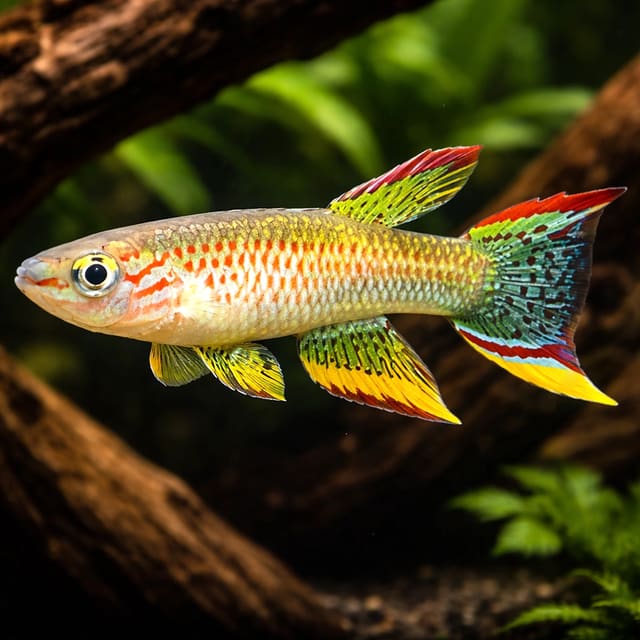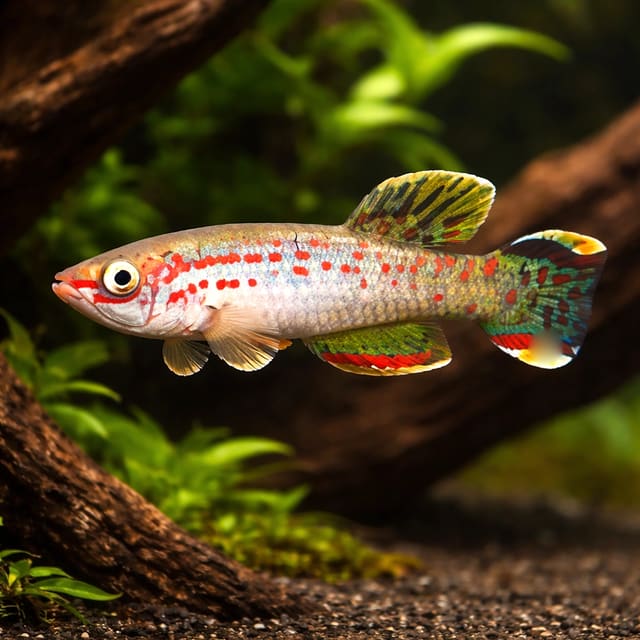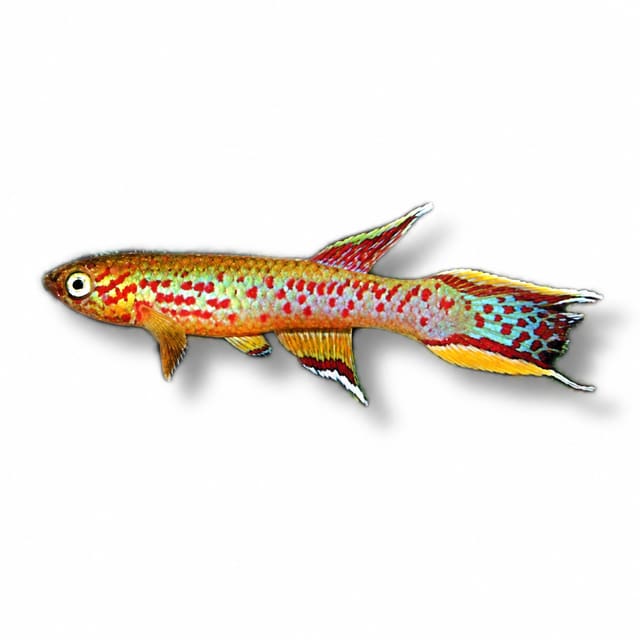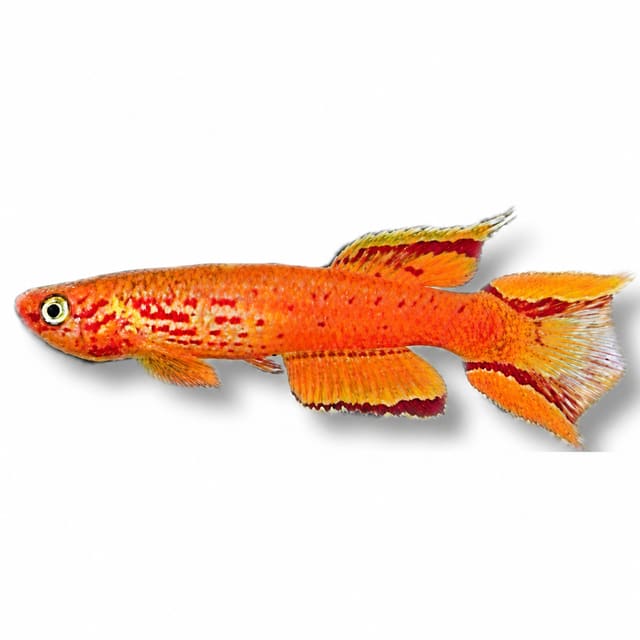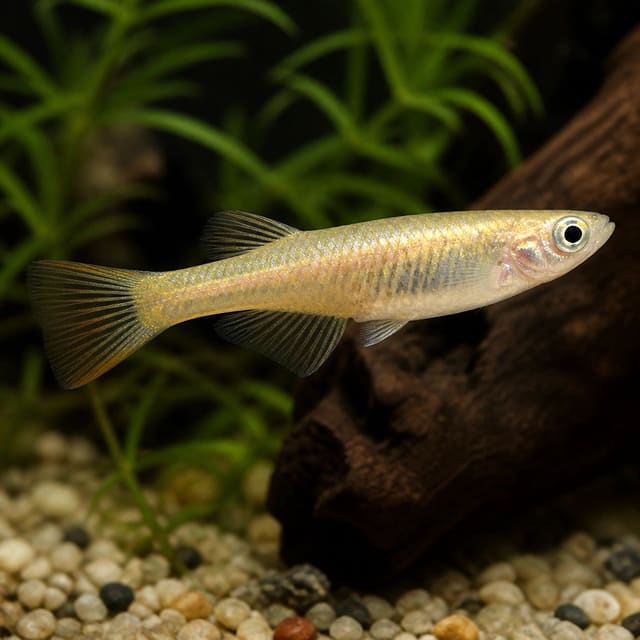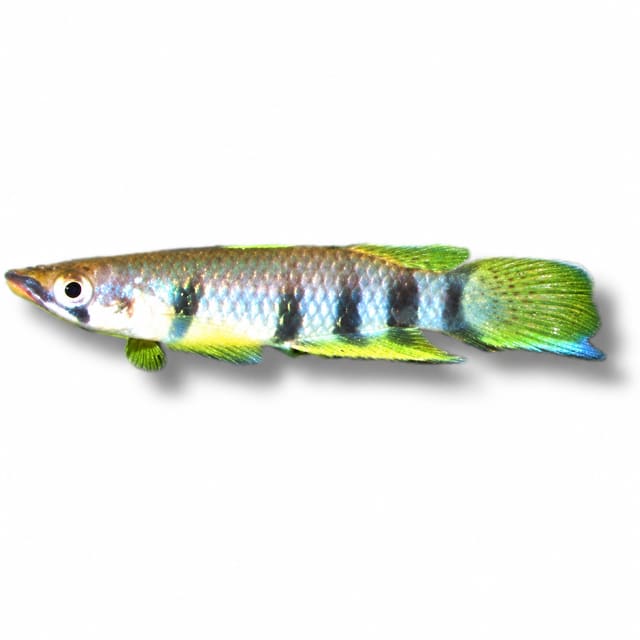
Spotted / Red-Chinned Panchax (Epiplatys dageti) – 3–5cm Sizes
22–23°C · pH 6–7
£7.99

Blue Panchax Killifish is a surface-oriented Asian fish for a mature, securely covered planted aquarium. Plan feeding access and companions carefully. Sold individually with three size choices and no sex guarantee.
Aplocheilus panchax
Save when buying multiple fish. Each quantity is one fish; sex and pair formation are not guaranteed unless the selected variant explicitly states them.
Blue Panchax Killifish is a surface-oriented Asian fish for a mature, securely covered planted aquarium. Plan feeding access and companions carefully. Sold individually with three size choices and no sex guarantee.
Blue Panchax Killifish (Aplocheilus panchax) is an Asian killifish with an elongated body and a strong association with the water's surface. Its interest is in the way it uses that space: holding near cover, watching for food and moving between planted edges and open water. It is a fish to plan an aquarium around, especially if you enjoy observing feeding behaviour and the quieter details of a planted display.
Give as much thought to the upper part of the tank as to the substrate and ornaments. A densely planted bottom does not necessarily offer useful shelter at the surface, and a decorative piece of wood cannot replace a secure lid. A suitable aquarium combines cover, accessible feeding space and a filter that keeps the water in good condition. The arrangement should let you see that every fish is feeding and behaving normally.
One purchase quantity supplies one live fish of the selected size. The size choices are 3–4 cm, 4–5 cm and 6–7 cm; check the selector when choosing your fish. The size you select is the size supplied, not the adult size. Plan for growth from the beginning, even if you choose a smaller fish, so that the aquarium remains suitable after the initial settling period.
Sex is guaranteed only when the selected option explicitly states male or female. This Blue Panchax Killifish listing has no sex-guaranteed option. A photograph showing two fish is not a promise of a breeding pair, and ordering several fish does not establish a particular social balance. If your plan depends on a sex ratio, discuss it before buying.
FishBase places this species in the family Aplocheilidae and records it across southern Asia, including Pakistan, India, Bangladesh, Myanmar and the Indo-Malaysian archipelago. Its habitats include lowland wetlands, ponds, ditches, canals and mangrove creeks. The preference for clear water with dense rooted or floating vegetation is especially useful when thinking about an aquarium: cover and open feeding space can exist together.
The species feeds mainly on insects in the wild and is associated with mosquito control. That background makes watching feeding access particularly worthwhile. Food offered where the fish can find it is more useful than a large amount that sinks out of reach or is taken immediately by other inhabitants. Wild feeding behaviour helps explain the fish's habits; it does not mean you need to collect insects outdoors for the aquarium.
FishBase records a maximum of 9.0 cm total length for male/unsexed specimens. Total length includes the tail. This is a recorded measurement, not a guarantee that every fish will reach exactly that size, but it is enough to show why a purchase grade of a few centimetres should not determine the final aquarium plan. Think of the adult fish and its companions when allocating space.
This species suits someone willing to prepare a planted, covered aquarium and pay attention to the individuals in it. FishBase notes that it can be difficult to maintain in aquaria, so do not choose it solely because killifish are sometimes described collectively as small community fish. The practical demands are a mature filter, measured and stable water, accessible food, careful companions and a plan if the social arrangement needs changing.
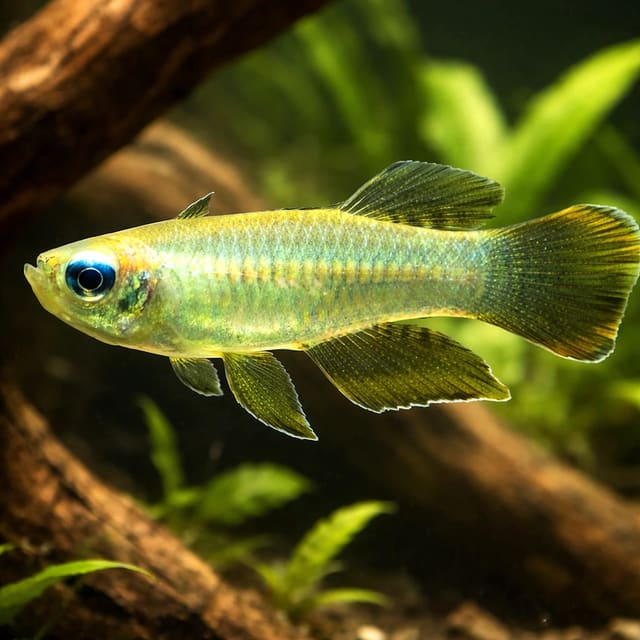
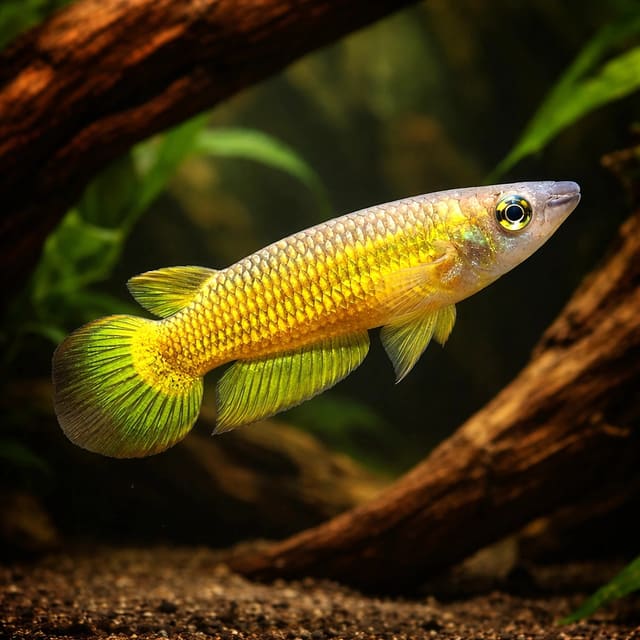
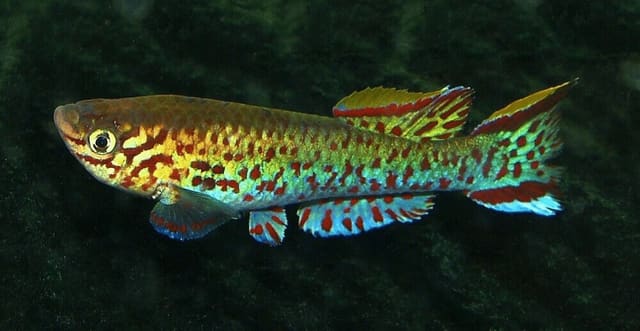
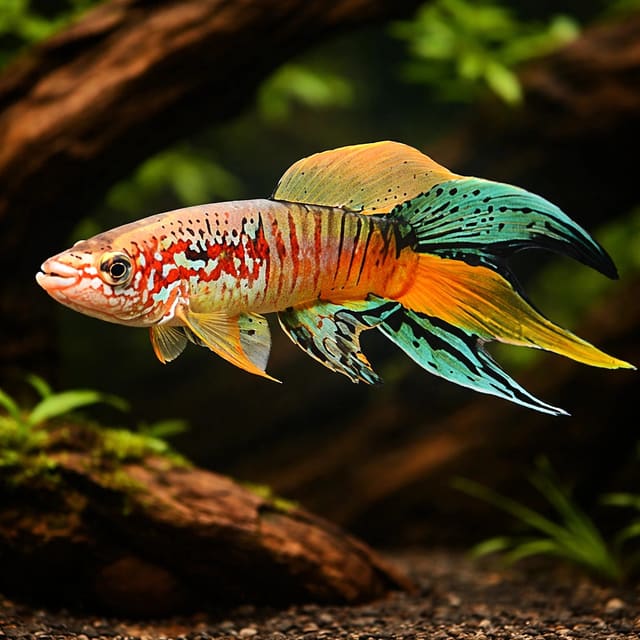
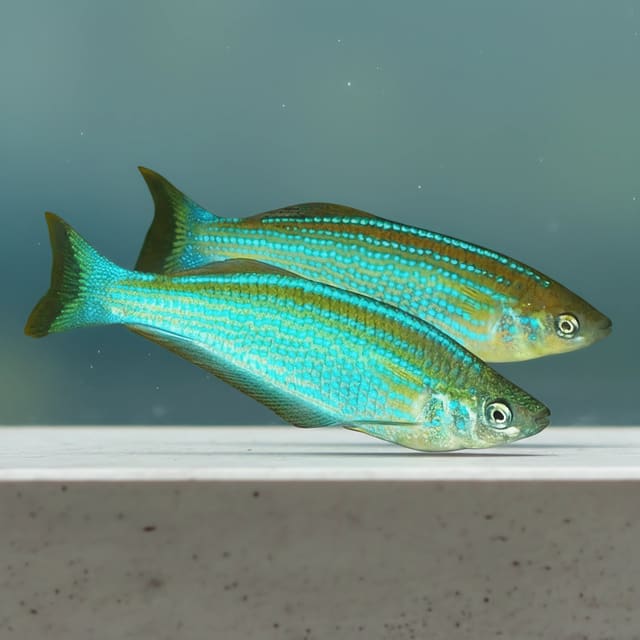
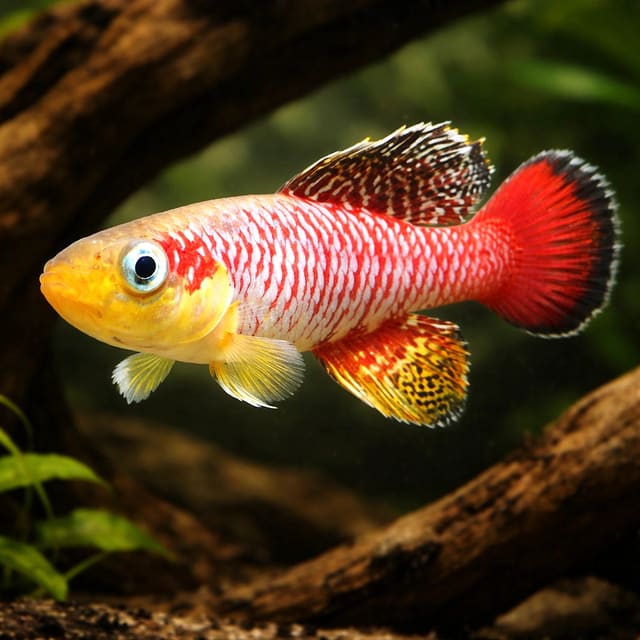
The gallery images are representative of this type of animal rather than photographs of the exact animal supplied, so colours can look slightly different from the live animal. Reflective blue, silver and gold tones can look different as a fish turns under the light. Enjoy that variation without expecting an identical colour intensity or pattern in every individual.
If you are deciding whether this is the kind of aquarium you want, browse the killifish collection and read the individual care information for each species. The common group name covers very different fish. Choose the one whose adult needs fit your tank and routine, then build the community around those needs.
OATA's general killifish guidance recommends at least a 90-litre aquarium for a group of larger species over 7 cm. Blue Panchax belongs on the larger-fish side of that planning discussion because its recorded total length is 9 cm. The 90-litre figure is a group guideline for larger killifish, rather than a species-specific minimum established for every Blue Panchax setup. Use it as a starting point and discuss the actual tank and planned group before purchasing.
Capacity alone cannot describe how usable the aquarium will be. Length, width, plant growth and the space occupied by other fish matter too. A tank can hold a substantial amount of water while offering a restricted surface area between ornaments. Describe the dimensions and the layout when asking for advice, including whether the top is open water, densely covered with floating plants or already occupied by other fish.
FishBase describes a preference for vegetation-rich habitats, and OATA recommends planted cover for killifish. Use rooted and floating plants to create sheltered areas, with open spaces where the fish can move and where you can offer food. Think about the view from within the aquarium: a plant may provide a useful visual boundary even when it does not fill much of the tank.
Keep the layout easy to maintain. You should be able to remove uneaten food and loose plant material without dismantling all the shelter. Leave enough access around wood and other furnishings to check for trapped debris. When plants grow, revisit the arrangement rather than assuming the original open areas will remain open on their own.
If you prefer artificial planting, choose aquarium-safe pieces that provide genuine shelter without sharp edges or awkward traps. OATA includes suitable ornaments and artificial plants as alternatives where live plants are not used. Live or artificial, the goal is a layout the fish can use, with enough room between the furnishings to move comfortably.
Position the filter outlet thoughtfully. The filter must circulate and process the aquarium water, but the fish should also have sheltered places where feeding is manageable. Look at where food goes and where fish choose to remain. If the only feeding area carries food straight into an intake, adjust the practical arrangement before compensating with larger portions.
OATA identifies jumping as a reason a cover is essential for killifish. Check the lid around pipes, cables and corners, not just across the middle. The space behind a filter return is easy to overlook when the aquarium is viewed from the front. Close unnecessary gaps in a way that is compatible with the equipment and leaves the cover secure.
A feeding opening should return to its closed position after use. Make it part of the feeding routine rather than a separate task to remember later. During maintenance, have your tools ready before opening the tank and keep the exposed area limited to what you need. The lid is part of the fish's housing, not an optional accessory for a display that already looks complete.
Choose the aquarium's position with stability in mind. OATA advises avoiding draughts, nearby heat sources, direct sunlight, loud noise and vibration. These can make the environment less consistent or startle fish. Place the tank where you can observe it calmly and maintain it safely, with access to the cover and equipment.
Run the aquarium and its filter before adding livestock, and establish that the water is ready with tests. Have conditioner, a thermometer, suitable food and your normal maintenance tools available. The first tropical tank guide helps put the preparation in order, even if this is a new setup for someone who has kept fish before.
Decide who will receive the fish and where the sealed parcel can be opened safely. Preparation keeps you free to observe the animals when they arrive, instead of assembling equipment at the same time. Check the aquarium temperature and filter operation before the parcel is opened, then follow the acclimatisation guidance on the delivery policy page.
The care figures available here have two different uses. OATA provides broad aquarium guidance for killifish as a group: 22–27°C, pH 6.0–7.5 and general hardness 4–12 dGH. Its sheet explicitly asks keepers to check species-specific needs before purchase. These values are useful for discussing a planned Blue Panchax aquarium, and need checking against the requirements of this particular species.
FishBase records environmental values of 20–25°C, pH 6.0–8.0 and hardness 5–12 dH for the species. Those are natural-history records, not a separate recipe for changing aquarium water. Do not combine the broadest ends of both sets of figures into a new range, or assume that a mathematical overlap establishes an ideal temperature. Confirm the plan using your actual water and the needs of the fish already present.
| Reference | How to use it |
|---|---|
| OATA killifish aquarium guidance | 22–27°C, pH 6.0–7.5, 4–12 dGH; broad group guidance to discuss before choosing the species. |
| FishBase environmental record | 20–25°C, pH 6.0–8.0, 5–12 dH; recorded conditions, not an aquarium optimum. |
| Water quality | OATA calls for zero ammonia and zero nitrite, with regular testing and maintenance. |
| Practical decision | Check the proposed setup and companions before purchasing, then maintain consistent conditions. |
The species is recorded from freshwater and brackish environments, with some unusual high-salinity occurrences also noted. That does not make salt addition a routine freshwater care requirement. A record of where wild fish have been found cannot by itself tell you how the fish in an aquarium should be acclimatised or managed. Avoid making abrupt changes on the basis of a habitat label.
Measure the source water as well as the aquarium when you need to understand a result. pH and general hardness are related to different properties of water and are not interchangeable measurements. The water chemistry guide explains the terms so you can give useful information when discussing suitability.
A clear aquarium can still contain harmful waste compounds. The RSPCA explains that a working biological filter supports bacteria which process ammonia into nitrite and then nitrate. Ammonia and nitrite are toxic, so an attractive, clear tank is not enough evidence that the biological system is ready. Test before adding fish and again when the aquarium's load changes.
Use the water matcher as a way to compare measured water with the guidance you are considering. Keep the source scope in mind, especially where a species page carries group advice. A close chemistry match is only one part of suitability; it cannot resolve social tension, lack of feeding access or an unsuitable aquarium layout.
New fish and extra food increase the waste entering an aquarium. OATA advises increasing stocking slowly because the beneficial bacterial population must grow with that load. Plan introductions around the aquarium's capacity to support them. Do not interpret a recently installed filter or a powerful pump as proof that the tank can immediately support every fish you hope to keep.
When cleaning, protect the biological media. OATA advises a light rinse in aquarium water removed during a water change, rather than washing media under the tap. Check for blocked flow and follow the filter manufacturer's directions. The aim is to keep water passing through the filter while retaining the bacterial community that makes it useful.
Keep a simple record of test results, water changes, filter maintenance and livestock additions. It can be a few lines in a notebook. If a fish later loses its appetite or the water tests change, the record helps you connect the change with what has happened in the tank. It is much more informative than trying to remember several weeks of small adjustments.
OATA's general killifish routine recommends a 25% partial water change at least once a week and water tests at least weekly. Its nitrate guideline is no more than 20 mg/l above the normal level in the tap water. That is a comparison with the source water, not a claim that every aquarium must have the same absolute nitrate reading.
Treat replacement tap water for chlorine or chloramine and avoid a sudden temperature change. Remove visible waste from accessible areas and check the plants for loose material. Look at the fish during the work as well as afterwards; the maintenance routine is a chance to notice a change in body condition or behaviour that is easy to miss during a hurried feed.
Do not wait for a regular water-change day if tests or behaviour show a problem. Check the equipment and water, then seek advice with the results. A routine provides a starting point, while the actual aquarium determines whether more investigation is needed. Avoid adding several remedies at once without understanding the cause.
FishBase describes Blue Panchax as feeding mainly on insects. The supplied natural-history account also describes its surface orientation. In the aquarium, this makes the way food is presented especially relevant: offer suitable small foods where the fish can reach them and watch whether they are actually swallowed. Food passing through the tank is not the same as a fish receiving a meal.
OATA's broad killifish advice recommends a good quality flake or granule, supplemented with small live or frozen items such as Daphnia, brine shrimp or tubifex. Choose appropriately sized food and introduce changes by observing acceptance. A general food description cannot guarantee that every new individual will immediately accept the same preparation.
As a group-level portion guide, OATA advises feeding once daily and only as much as can be eaten within a few minutes. Start with a manageable amount and watch the response. If food is left behind, remove it rather than treating it as a reserve meal. Uneaten food breaks down and adds waste to the aquarium whether it is visible or hidden among plants.
Look at each individual during feeding. The most confident fish may arrive first, while another stays behind cover or approaches from a different part of the tank. Offer food where more than one fish can reach it, then check that the change helps. Simply increasing the total quantity can leave the same fish hungry while adding more waste.
If there are other residents, observe what happens before and after food reaches the water. Fast feeders may intercept it; a territorial fish may control access to a useful area. A companion can appear peaceful between meals yet still prevent another fish eating comfortably. Feeding time is therefore a practical test of the whole stocking arrangement.
Keep the feeding routine compatible with the cover. Open the smallest practical area, feed with attention to the fish, then close it again. Store foods according to their instructions and keep the preparation area tidy. A routine that is straightforward to repeat is easier to maintain consistently than one that depends on elaborate preparation every day.
Watch the usual posture, movement, breathing and appetite of the fish as they settle. OATA recommends looking for changes in swimming, colour, aggression, hiding, breathing, appearance, condition and feeding. What matters is the change from that individual's normal behaviour, especially if several signs appear together.
Surface use is part of this fish's ordinary behaviour, so presence near the top alone is not a diagnosis. Compare it with breathing, balance, feeding interest and the behaviour of other fish. A fish using plant cover calmly is different from one repeatedly avoiding a persistent pursuer. Time spent watching the aquarium helps you recognise those differences.
Check water quality first when concerned, and contact an experienced aquatic retailer or fish vet with the results, a clear description and relevant photographs or video. Include recent changes to stocking, food, equipment or maintenance. Avoid selecting a treatment from a colour change alone; several different problems can look similar from a distance.
If one fish is persistently unable to feed or escape attention, the social arrangement needs attention as well as the water. Have a practical way to separate fish into suitable housing if needed and discuss the next step. Moving the problem between crowded corners of the same tank is unlikely to create a stable long-term arrangement.
OATA's general killifish guidance suggests a group of at least three with two females to each male, explaining that social balance can reduce pressure on females and other inhabitants. That is guidance for a diverse group of fish, not a proven Blue Panchax minimum or a reason to order three unsexed animals and assume the desired ratio will result.
Discuss the intended group and available housing before buying if your plan depends on sex. Planted cover, usable space and observation remain important whatever the number of fish. More fish can increase the demands on the aquarium as well as change its social behaviour, so simply adding another individual is not a universal solution to tension.
OATA warns that some killifish are shy or vulnerable to bullying, while some males can be aggressive towards long-finned species. It also notes that predation on smaller fish varies within the group, particularly mentioning larger-mouthed panchax. Those cautions support a careful assessment; they do not establish that every Blue Panchax behaves identically.
Choose a proposed companion by its adult size, activity, feeding style and water needs. Avoid boisterous fish that continually disturb the surface area, and treat long-finned residents as a caution rather than an automatic match. Small size is not enough to make a companion safe, and a calm appearance in a shop does not show how the completed community will behave at feeding time.
| Community question | What to check |
|---|---|
| Will both fish receive food? | Watch for interception, chasing and control of the surface feeding area. |
| Can each fish use cover? | Provide more than one useful retreat and enough open space between planted areas. |
| Is there a large size difference? | Assess predation risk before mixing small animals with a larger fish. |
| Does a resident have long fins or a timid temperament? | Consider the group-level cautions about harassment and bullying before adding companions. |
Do not rely on the word community as a stocking instruction. A peaceful-looking fish still needs the correct space and may compete with another fish for the same area. The exact residents and the aquarium's layout matter more than a broad category label. When seeking advice, name the species already present rather than describing them only as small tropical fish.
For a display where protecting very small animals or young fish is the priority, do not assume safety from the absence of visible aggression. Predation and territorial behaviour are different questions. A dedicated setup may make it easier to manage the animals you want to protect, while a mixed aquarium needs a specific assessment rather than a blanket shrimp-safe or fry-safe promise.
The related products are browsing alternatives, not a list of recommended companions. Compare their separate needs if you are choosing a different killifish. There is no need to put several related species together to make an interesting display; a well-planned aquarium that lets you observe one species comfortably can be rewarding in its own right.
FishBase records a maximum of 9.0 cm total length for male/unsexed specimens; total length includes the tail. Plan for the adult fish and the complete group rather than the smaller size at purchase.
OATA recommends at least 90 litres for a group of larger killifish over 7 cm. This is broad group planning guidance, not a species-specific minimum. Discuss the tank dimensions, planting and planned residents before buying, and provide a secure cover.
OATA's general killifish guidance suggests at least three with two females to each male. That ratio is broad group advice, not a guaranteed result from buying unsexed fish. Discuss the group before ordering and plan suitable space, cover and separation if needed.
FishBase notes that the species can be difficult to maintain in aquaria. It calls for a prepared keeper who can manage a mature filter, tested water, secure cover, feeding access and careful companions. Discuss your setup first rather than relying on an easy-care label.
The species feeds mainly on insects in the wild. OATA's general killifish advice recommends quality flakes or granules with small live or frozen foods such as Daphnia, brine shrimp or tubifex. Offer suitable small portions and check that each fish feeds.
OATA's broad killifish aquarium guidance is 22–27°C, pH 6.0–7.5 and 4–12 dGH. These are group ranges, not a species optimum. Confirm your aquarium plan before buying; FishBase's separate environmental ranges are natural-history records.
Behaviour needs individual assessment. OATA warns that some male killifish can trouble long-finned species, while some killifish can be bullied by boisterous companions. Provide usable cover and watch feeding access and chasing rather than assuming universal peacefulness.
Assess each proposed companion for adult size, water needs, temperament and feeding competition. OATA's group guidance calls for caution with long-finned fish, boisterous residents and small potential prey. There is no universal companion list or shrimp-safe guarantee.
Tropical Fish Co hand-bags fish with oxygen and uses insulated packaging and a licensed live-animal courier, with heat packs when needed. Be present to receive the parcel and inspect it the same day. For a Live Arrival Guarantee claim, provide your order number and a continuous video showing the sealed parcel being opened and the fish still inside the sealed bag; contact the team the same day.
Read the delivery and Live Arrival Guarantee policy before placing an order. It explains packing, tracking and the confirmed Thursday or Friday delivery date, so you can arrange to receive the parcel. Follow the acclimatisation guidance on the delivery policy page and contact the team promptly if anything is wrong on arrival.
FishBase's Blue Panchax record covers identity, distribution, habitat, feeding and the recorded total length. OATA's killifish care sheet provides broader group guidance for aquarium planning, maintenance, food and compatibility.
The RSPCA aquarium environment guidance explains filtration and the processing of fish waste. Use species information and general aquarium guidance together, keeping the needs of your actual fish and aquarium at the centre of the decision.
No reviews for this item yet. Bought one? Honest reviews only, good or bad.
What customers say about ordering from us
I have a small group of long finned mountain minnows. So was delighted to be able to order ten of this variety to increase the genetics in my tank . The ones I recieved are healthy but it’s to early to give a verdict on wether they are of a long finned type since they are small currently.
Gordon Walker · 23 Sept 2026
100% success travel and "installation". Pleased with quality of purchase. The Siamese fighter a bit "shy" so have not yet seen him at his best yet but looking good. Happy customer. GG
George E Garratt · 21 Sept 2026
Reviews of our shop, collected by Judge.me, an independent third-party review collector. Newest first.