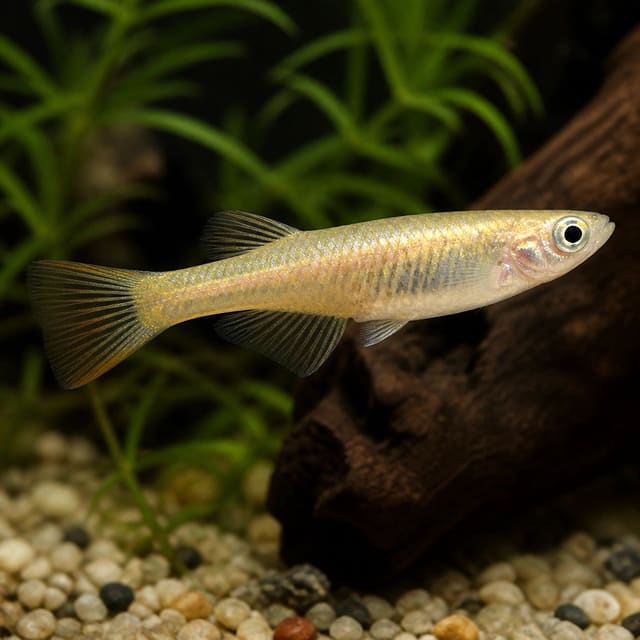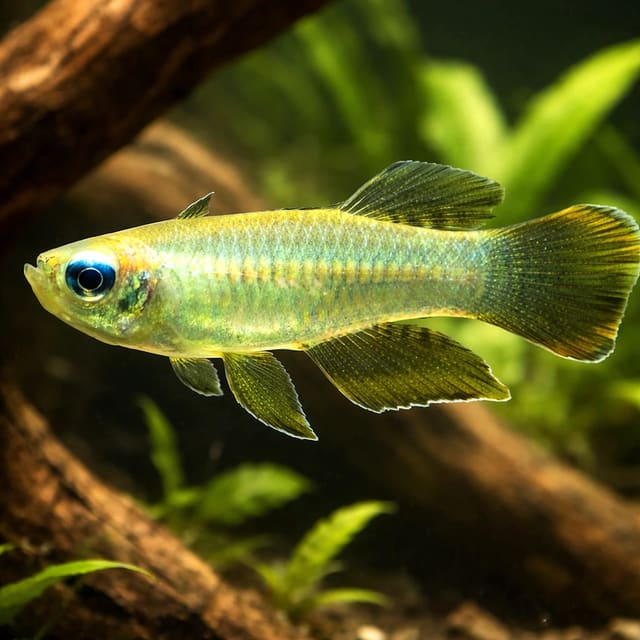
Lampeye (Aplocheilichthys normani)
22–26°C · pH 6.5–7.2
£3.99

The Australe Lyretail Panchax (Aphyosemion australe) is an African freshwater killifish from Angola, Gabon, Cameroon and Congo that reaches 6 cm. It suits keepers able to provide a mature, covered planted aquarium; use at least a 45 × 25 cm base for a pair or trio and the FishBase, Seriously Fish and OATA overlap of 22–24°C, pH 6.0–7.0 and 5–10 dGH. Sold individually as one live fish per purchase.
Adult size is the maximum length this species reaches at full maturity (scientific sources). The livestock you receive will be younger and smaller. Product-photo provenance and any image-specific limitations are stated on the listing.
Aphyosemion australe
Save when buying multiple fish. Each quantity is one fish; sex and pair formation are not guaranteed unless the selected variant explicitly states them.
The Australe Lyretail Panchax (Aphyosemion australe) is an African freshwater killifish from Angola, Gabon, Cameroon and Congo that reaches 6 cm. It suits keepers able to provide a mature, covered planted aquarium; use at least a 45 × 25 cm base for a pair or trio and the FishBase, Seriously Fish and OATA overlap of 22–24°C, pH 6.0–7.0 and 5–10 dGH. Sold individually as one live fish per purchase.
Adult size is the maximum length this species reaches at full maturity (scientific sources). The livestock you receive will be younger and smaller. Product-photo provenance and any image-specific limitations are stated on the listing.
Maintain these water conditions for optimal health and vibrant colors
The Australe Lyretail Panchax is a small African freshwater killifish for keepers who can provide a mature, tightly covered and thoughtfully planted aquarium. Its scientific name is Aphyosemion australe, and FishBase places it in Nothobranchiidae, the African rivulines. Its distribution includes Angola, Gabon, Cameroon and Congo, and FishBase records a maximum of 6 cm total length. This peaceful, shy fish suits a calm aquarium where its feeding can be observed and vigorous companions will not displace it.
Seriously Fish also records the vernacular names golden lyretail and lyretail panchax. These names refer to the same species rather than separate animals. FishBase describes freshwater, benthopelagic and non-migratory habits and records worms, crustaceans and insects in its natural diet.
Keep routine aquarium water at 22–24°C, pH 6.0–7.0 and 5–10 dGH. This is the overlap of FishBase environmental values, the Seriously Fish species aquarium profile and OATA’s killifish guidance. Seriously Fish regards a base of at least 45 × 25 cm, approximately 28 litres, as acceptable for a pair or trio.
| Suits | Not suited to |
|---|---|
| A mature aquarium with established biological filtration | An immature aquarium where ammonia or nitrite is present |
| A tightly covered planted setup with floating cover | An uncovered aquarium or one with gaps around equipment |
| Calm companions that allow this shy fish to feed | Vigorous or boisterous fish that dominate feeding |
| Routine water at 22–24°C, pH 6.0–7.0 and 5–10 dGH | Water outside the planned routine range |
| A keeper prepared to offer small live, frozen or accepted flake foods | A feeding plan that does not account for its small mouth and shy behaviour |
Its jumping ability, need for secure cover and preference for small foods are decisive parts of the choice. Plan the aquarium around the adult size and complete the layout, filtration and water checks before introducing the fish.
One purchase supplies one animal. FishBase records a maximum of 6 cm total length, and the aquarium should be planned around that adult measurement.
Sex is guaranteed only when the selected option explicitly states male or female. This Australe Lyretail Panchax listing has no sex-guaranteed option.
That distinction matters when planning a pair or trio. Seriously Fish uses those social arrangements when giving its minimum footprint, while OATA recommends a female-biased ratio in its wider killifish guidance. Build a deliberate ratio only when the sex of every fish is known, and make sure the aquarium can support every individual without relying on a particular outcome.
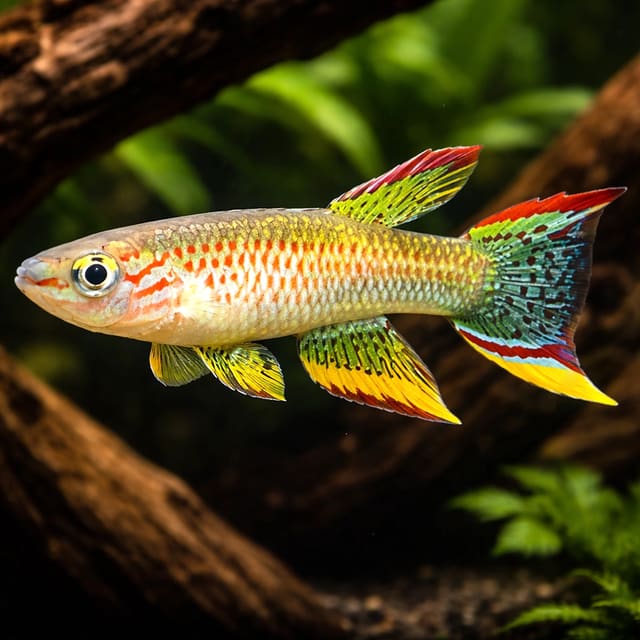
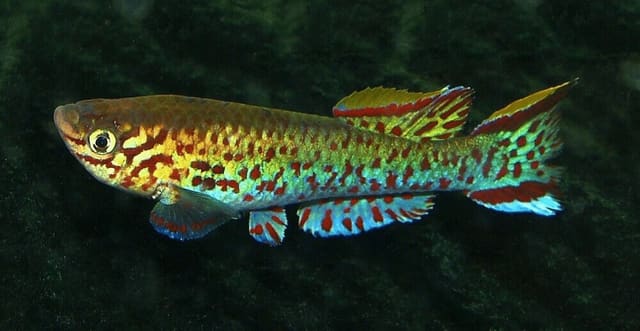
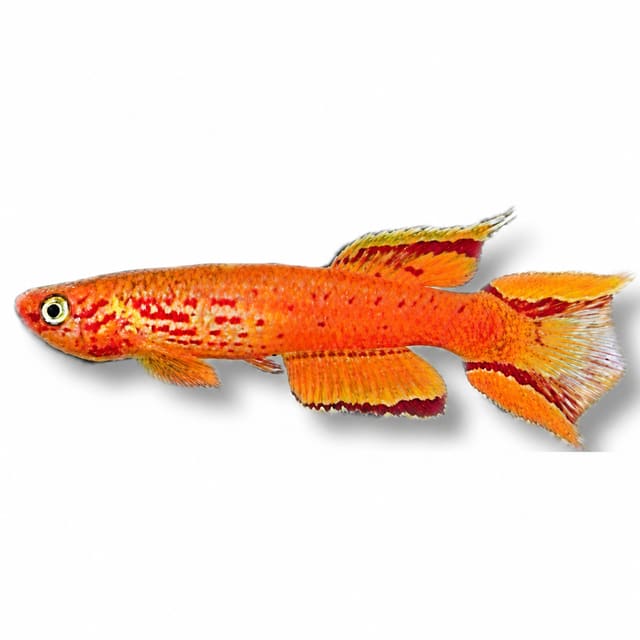
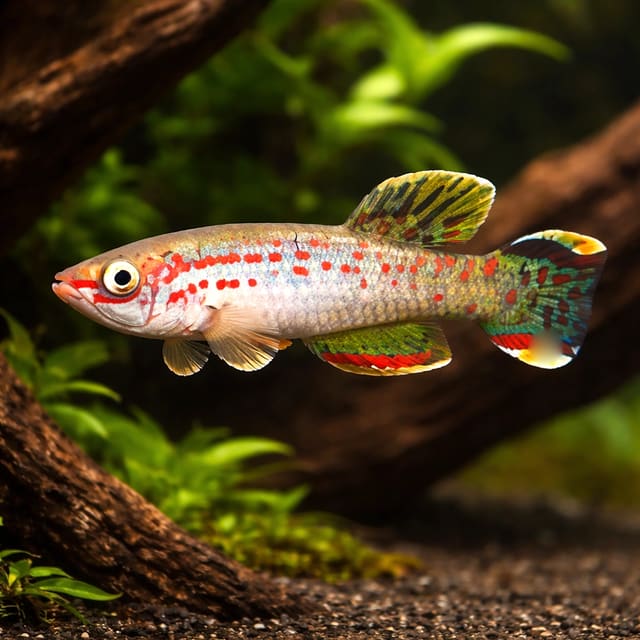
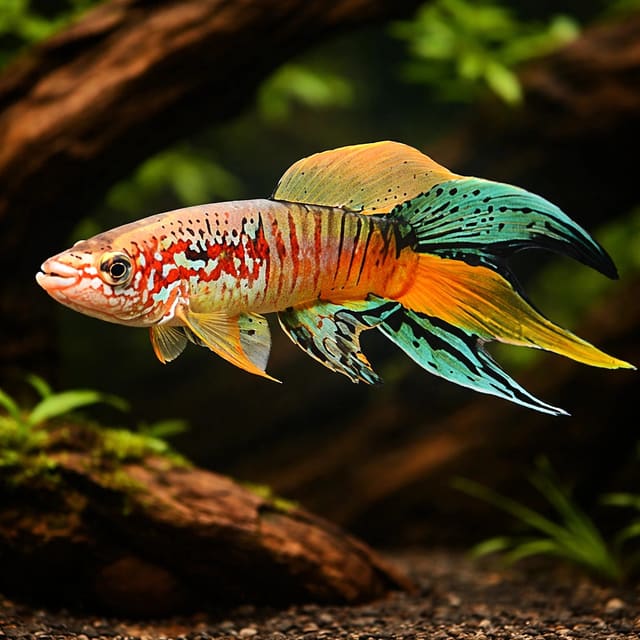
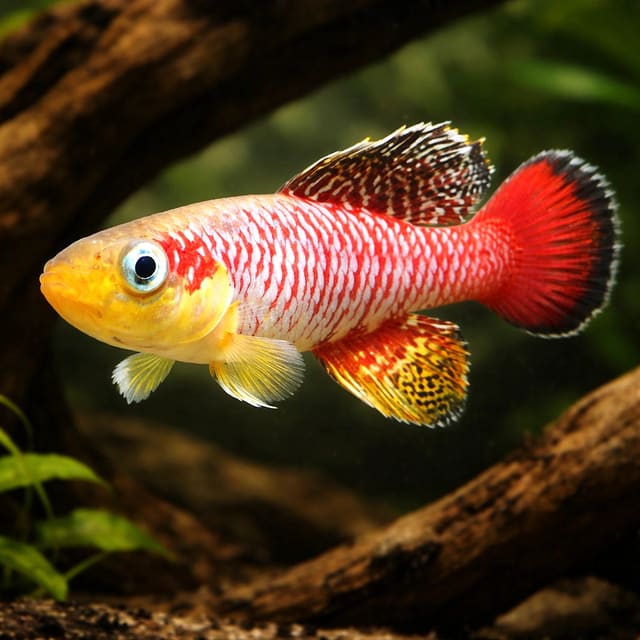
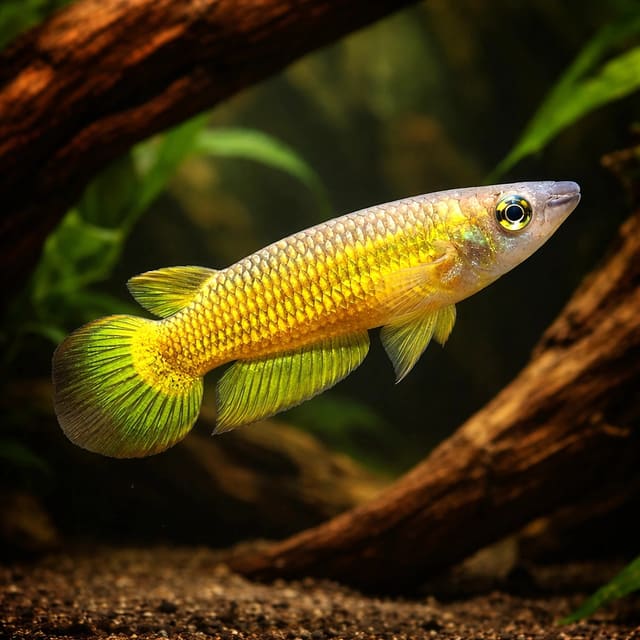
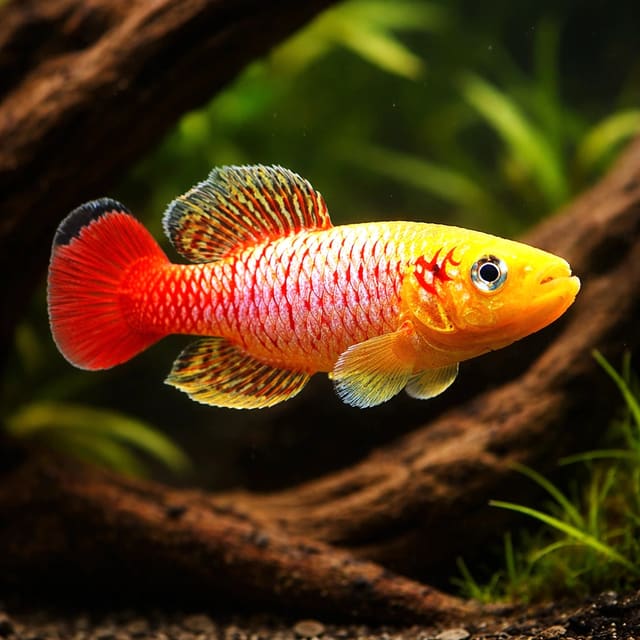
The gallery images are representative, based on reference photographs of this species, so colours can look slightly different from the live animal.
Use the gallery to recognise the general form and markings, not as a promise of colour intensity, fin development or sex. Seriously Fish describes mature males as larger and more brightly coloured, with extensions to the caudal, dorsal and anal fins; females are smaller, plainer and rounder through the belly. These characteristics describe settled mature fish and do not create a sex guarantee for the animal supplied.
If you are comparing this fish with other members of the group, browse the killifish collection and compare adult size, water, social planning and feeding behaviour before choosing by colour or common name.
Start with the aquarium base rather than choosing by litres alone. Seriously Fish regards base measurements upwards of 45 × 25 cm, approximately 28 litres, as acceptable for a pair or trio of Aphyosemion australe. Treat both parts of that guidance as important: a tall container with the same volume but a smaller base does not reproduce the stated footprint.
A 45 × 25 cm base covers 1,125 square centimetres. A 60 × 30 cm base covers 1,800 square centimetres, giving 675 square centimetres more floor area. That larger footprint creates more room to separate cover, feeding positions and lines of sight, although it does not by itself decide how many fish should be kept. Social behaviour, filtration and water quality still set practical limits.
| Area | Planning action |
|---|---|
| Covered retreat | Reserve planted or shaded areas where a shy fish can leave open view. |
| Feeding lane | Keep a clear place where small foods can be seen and every fish can be watched eating. |
| Equipment zone | Position the filter and heater without consuming the full usable footprint. |
| Visual separation | Use plants and cover to break long, exposed views when several fish share the aquarium. |
| Surface access | Keep useful open water while diffusing part of the light with floating plants. |
The 6 cm maximum total length remains the adult planning reference. Every animal needs the full planned footprint, secure cover and established biological filtration from the beginning. Do not use a fish’s current length as a reason to start in an undersized or biologically immature container.
More water gives greater room to organise equipment and cover, but dimensions remain the first check for this species. Measure the unobstructed base after internal equipment and hardscape are placed. If a decorative feature removes a large part of the swimming area, assess the remaining footprint rather than the external glass measurement.
Complete the layout before introducing the fish. Repeatedly moving plants or equipment removes settled cover and can alter water flow. A finished plan should leave the lid easy to open for feeding while ensuring it closes securely every time.
Use a dark substrate where practical and add floating plants to diffuse the light. Seriously Fish recommends both features for this species. Floating cover should shade part of the aquarium while leaving enough clear water for observation, feeding and normal equipment operation. Arrange the remaining plants so a shy fish can move between sheltered and open areas without crossing the full tank in exposed water.
Fit a very tight-fitting cover before livestock enters the aquarium. Aphyosemion australe is described as an accomplished jumper, so inspect openings around cables, airlines, filter pipes and feeding flaps. Recheck the cover whenever equipment is moved. A lid that sits correctly on an empty aquarium may lift or leave a gap after another cable is added.
The RSPCA explains why a well-established biological filter is vital: fish release toxic ammonia, beneficial bacteria convert it to nitrite, and a further bacterial stage converts nitrite to safer nitrate. Prepare and mature that filter before introducing the fish. Our first tropical aquarium guide sets out the preparation sequence.
| Equipment check | Decision |
|---|---|
| Filter capacity | At about 28 litres, use four to five turnovers per hour as the species profile’s starting point. |
| Rated flow | For that example, look around 110–140 litres per hour. |
| Heater power | For about 28 litres in a room near 20°C, the profile estimates roughly 75–100 W. |
| Thermometer | Use an aquarium reading to check the resulting temperature rather than relying only on the heater setting. |
| Lid fit | Close every escape route around the fitted equipment. |
The turnover and heater examples belong to the stated 28-litre setup. Recalculate for a different aquarium rather than carrying the same equipment rating across unchanged. Room temperature affects heater demand, while media, pipework and head height can affect delivered filter flow.
Watch how the fish uses the finished layout. It should be able to hold position, reach its food and withdraw into cover. If equipment placement blocks the feeding lane or leaves the fish exposed everywhere, reorganise the hardware and plants.
Keep routine aquarium water at 22–24°C, pH 6.0–7.0 and 5–10 dGH. This is the overlap of FishBase environmental values, Seriously Fish species aquarium guidance and OATA’s killifish group guidance. Measure the aquarium rather than assuming tap-water values, compare the result with our water matcher, and use the water chemistry guide to understand what each reading means.
FishBase records 21–24°C, pH 6.0–7.0 and 5–12 dH for the species. Seriously Fish gives aquarium limits of 21–32°C, pH 5.5–7.0 and 1–10 dGH. The shared routine range stays within both sets of species-level figures.
OATA’s freshwater killifish sheet gives 22–27°C, pH 6.0–7.5, 4–12 dGH and 3–10 dKH for the group. It also sets ammonia and nitrite at zero mg per litre and says nitrate should not exceed 20 mg per litre above the normal tap-water level.
| Measurement | Action point |
|---|---|
| Temperature | Keep routine conditions at 22–24°C. |
| pH | Keep routine conditions at 6.0–7.0. |
| General hardness | Keep routine conditions at 5–10 dGH. |
| Ammonia | Keep at zero mg per litre. |
| Nitrite | Keep at zero mg per litre. |
| Nitrate | Do not exceed 20 mg per litre above the normal tap-water level. |
Record the readings before introduction and use the same test method during routine maintenance. A single test shows where the aquarium is at that moment; a written sequence shows whether pH, nitrate or temperature is moving over time. Investigate a trend before it becomes a large change.
Prepare replacement water with tap-water conditioner to remove chlorine or chloramine before it reaches the aquarium. Match routine replacement water to the established temperature and chemistry. If a reading falls outside the working range, adjust the preparation method consistently and remeasure before adding the fish.
Offer foods that match this species’ recorded animal-based diet and small mouth. FishBase records worms, crustaceans and insects in nature. Seriously Fish says small live or frozen foods such as daphnia and bloodworm are preferred, while good-quality flake is accepted in most cases. OATA’s broader killifish guidance also includes quality granules, brine shrimp and tubifex.
Feed once a day and give only what the fish can consume within a few minutes. This schedule comes from OATA’s group guidance and provides a clear starting routine. Watch the entire meal rather than judging the portion by how quickly food disappears from the surface; vigorous companions may consume most of it before the Australe reaches a feeding position.
| Food choice | How to use it |
|---|---|
| Daphnia | Offer as a suitably small live or frozen food and confirm every fish can capture it. |
| Bloodworm | Select pieces small enough to swallow and remove persistent leftovers. |
| Brine shrimp | Use as part of the varied live or frozen portion of the diet. |
| Quality flake | Crush to a practical size and check that the individual recognises it as food. |
| Quality granule | Choose a small grade and observe whether it is swallowed rather than repeatedly rejected. |
| Tubifex | Use a suitably sized live or frozen portion within a varied rotation. |
Spread food where the Australe already feels secure. In a community, two small feeding points may reduce direct competition, but the total meal must still remain within the amount eaten in a few minutes. The useful measure is successful feeding by each animal, not the number of pinches added.
Remove food that remains after the feeding period. Uneaten material breaks down and adds waste, working against the zero-ammonia and zero-nitrite targets. Dense planting can hide leftovers, so inspect sheltered edges and the area beneath the normal feeding point during maintenance.
Review body condition and appetite together. A fish approaching food but repeatedly failing to swallow may need a smaller item. A fish that stays behind cover while companions clear the meal needs a calmer feeding arrangement or a compatibility change. Keep the diet varied, but introduce one practical change at a time so the response remains clear.
Finish the aquarium before introduction. The biological filter should be mature, ammonia and nitrite should both read zero mg per litre, routine water should sit at 22–24°C, pH 6.0–7.0 and 5–10 dGH, and the lid should close around every cable and pipe. Test these points again after the final equipment position is set.
Increase the aquarium population slowly. OATA warns that adding fish too quickly can leave the established bacterial population unable to process the increased waste and feeding load, causing new tank syndrome. Calculate the total number of animals being added and assess the filter and footprint for that complete increase.
These arrival steps come from our delivery and Live Arrival Guarantee policy. Keep the aquarium ready before the parcel is received so the fish can move through the stated process without avoidable delay.
| Checkpoint | What to assess |
|---|---|
| Water | Confirm ammonia and nitrite remain at zero and temperature stays at 22–24°C. |
| Breathing | Watch for a change in gill-cover speed or persistent surface hanging. |
| Swimming | Look for appropriate movement rather than erratic swimming or bottom sitting. |
| Feeding | Confirm the fish takes a correctly sized portion without being displaced. |
| Cover use | Check that it can leave shelter to feed and is not kept hidden by another animal. |
| Appearance | Look for intact scales and fins, clear eyes and no new spots, growths, bumps or ulcers. |
Keep the first week predictable. Feed the established once-daily portion, avoid adding further livestock immediately, and record water readings so any movement can be seen. If the fish joins a community, observe who reaches the feeding area first and whether the Australe can retreat without being followed.
Carry out a 25% partial water change at least once every week. OATA strongly recommends this schedule for killifish, alongside water testing at least weekly. Measure the amount changed rather than relying on a visual estimate, and treat replacement tap water with conditioner before it enters the aquarium.
Use a siphon to remove solid waste from accessible substrate, especially beneath the feeding area and around places where small foods settle. Keep the planted cover that makes the fish secure, but prevent trapped food and debris from accumulating unseen. Maintenance should restore water quality without dismantling the layout each week.
| Frequency | Useful action |
|---|---|
| Daily | Count the fish, watch the meal and check temperature and lid position. |
| At least once every week | Test the water and change 25%. |
| When flow is reduced | Check the filter for blockages and clean only as needed. |
| During plant work | Preserve shaded cover while keeping the feeding lane usable. |
When filter media needs cleaning, rinse it lightly in aquarium water removed during the water change. Do not wash it under the tap, because chlorine or chloramine may damage the beneficial bacterial population. Avoid replacing all established media together; the biological filter depends on retaining those bacteria.
Use written readings to judge the routine. Ammonia or nitrite above zero calls for immediate investigation of filtration, stocking, feeding and recent maintenance. Rising nitrate indicates that the balance between waste production and removal needs attention. Make the next decision from the measured trend rather than increasing maintenance at random.
Learn the normal pattern of each fish by watching it before feeding and during the meal. OATA advises monitoring swimming, colour, temperament, breathing, appearance, body condition and food intake. A change in several of these areas deserves prompt attention even when the cause is not immediately obvious.
| Change seen | First response |
|---|---|
| Surface hanging or bottom sitting | Test ammonia, nitrite and temperature, then check filter operation. |
| Erratic swimming | Check water values and observe whether another fish is chasing it. |
| Faster or slower gill movement | Test the aquarium promptly and compare other fish for the same change. |
| More hiding than usual | Assess feeding competition, social pressure and whether adequate cover remains. |
| Reduced food intake | Offer the established small food and watch whether size or competition prevents feeding. |
| Weight or condition change | Review actual food intake and compare the fish over several observations. |
| White spots or fluffy growths | Check water quality and record when the change appeared. |
| Loss of fins or scales | Inspect tank-mate behaviour and the aquarium for an ongoing source of damage. |
Water testing comes first because ammonia and nitrite are toxic and should remain at zero mg per litre. Check recent feeding and maintenance at the same time: uneaten food, a blocked filter or a rapid increase in livestock can all change the load placed on the biological filter.
Social pressure can appear as feeding failure rather than open fighting. A shy Australe that repeatedly reaches the meal after everything has gone needs a practical change in feeding access or companions. Permanent exclusion from useful cover also requires action, even when the chasing itself is brief.
Record the water readings, the timing of the change, appetite, breathing and which animals are affected. If you are concerned about a health change, contact us with those observations for further guidance. Clear information supports a more useful next step than trying several treatments without a diagnosis.
Aphyosemion australe is described as very peaceful and shy, but that temperament does not make every peaceful-looking community suitable. Seriously Fish warns that it is easily outcompeted by more vigorous fish. Feeding speed, adult size and access to planted cover therefore matter as much as aggression.
The species profile lists small characins, rasboras, dwarf cichlids, peaceful catfish such as Corydoras, small loricariids and some anabantoids as possible choices. Treat each as a candidate category rather than a universal tank-mate promise. The individual species must share the planned 22–24°C, pH 6.0–7.0 and 5–10 dGH, fit the aquarium footprint and allow the Australe to feed.
| Screen | Pass condition |
|---|---|
| Water | The candidate’s routine range includes the planned aquarium values. |
| Adult size | The final stocking plan gives every fish appropriate room and cover. |
| Feeding pace | The Australe can reach and swallow its small food before the meal is cleared. |
| Temperament | The candidate does not repeatedly chase or displace a shy fish. |
| Layout | Plants and sheltered positions remain useful after every animal is added. |
| Observation | The keeper can see whether each individual eats and maintains condition. |
Avoid vigorous or boisterous companions that dominate food and keep the Australe confined to cover. OATA’s broader killifish guidance says these generally small, peaceful fish do not appreciate boisterous tank mates. It also advises against keeping killifish with other long-finned species because some males may be aggressive towards them.
Watch the first meals closely after any stocking change. A good result means the Australe leaves cover, takes correctly sized food and returns without persistent pursuit. Repeated hiding, missed meals, altered breathing or declining condition means the combination needs to change.
Species names alone do not decide the outcome; dimensions, numbers, cover, feeding method and individual behaviour all contribute. Contact us with the complete proposed stock list, aquarium dimensions and water readings for a stocking and compatibility assessment.
Seriously Fish gives a base of at least 45 × 25 cm, approximately 28 litres, for a pair or trio. OATA’s broad killifish guidance suggests keeping at least three, arranged as two females to each male to reduce stress on females and other inhabitants. Use the species footprint as the minimum spatial reference and apply OATA’s ratio only when the sex of each fish is known.
Begin with the exact number of animals and provide space for all of them. One purchase supplies one fish, which means three fish require room, cover and feeding access for all three. The aquarium needs enough planting and sheltered positions for each individual to withdraw and feed.
| Planned arrangement | Decision points |
|---|---|
| Pair | Use at least the stated 45 × 25 cm base and watch whether both fish feed and use cover. |
| Trio | Use at least the stated footprint, create several sheltered positions and monitor all three individually. |
| More than three | Increase space and retain OATA’s female-biased ratio when the sexes are known. |
| Community group | Add the feeding speed and behaviour of every other species to the calculation. |
| Unknown sex mix | Provide for every fish without relying on a planned male-to-female ratio. |
Seriously Fish describes mature males as larger and more brightly coloured, with extensions to the caudal, dorsal and anal fins. Females are smaller, plainer and rounder in the belly. Use these characteristics to understand observations among settled mature fish, while remembering that this offer carries no sex guarantee.
Watch for unequal access rather than waiting for serious injury. One fish remaining hidden through feeding, losing condition or being repeatedly displaced from the same shelter indicates that the arrangement is not working. Add useful cover, reassess the feeding pattern and separate individuals when pressure persists.
A larger group adds waste as well as behaviour. Increase livestock slowly so the filter’s bacterial population can adjust to the higher feeding and waste load. Continue testing ammonia and nitrite at least weekly and after a stocking change, with both values kept at zero mg per litre.
FishBase records a maximum of 6 cm total length, so plan the aquarium around that adult size.
Seriously Fish regards a base of at least 45 × 25 cm, approximately 28 litres, as acceptable for a pair or trio; use a mature filter and a very tight-fitting lid.
Seriously Fish plans aquarium space for a pair or trio, while OATA’s group guidance suggests at least three with two females to each male; use that ratio only when the sexes are known.
Seriously Fish regards it as ideal for aquarists new to killifish, provided they can maintain stable water, a mature filter, secure cover and reliable access to suitable food.
Offer small live or frozen foods such as daphnia and bloodworm, with good-quality flake accepted in many cases. Feed once daily and only as much as it eats within a few minutes.
Keep it at the FishBase, Seriously Fish and OATA overlap of 22–24°C, pH 6.0–7.0 and 5–10 dGH; ammonia and nitrite must remain at zero mg per litre.
Seriously Fish describes it as very peaceful and shy, but OATA advises against mixing killifish with other long-finned species because some males may be aggressive towards them.
Possible companions include small characins, rasboras, dwarf cichlids, peaceful Corydoras, small loricariids and some anabantoids, provided their water needs overlap and they do not outcompete it for food.
Someone must be present to receive it. Film every delivery continuously from the sealed parcel as it is opened, with the fish still inside the sealed bag; float the bag for 20–30 minutes before release and never pour the bag water into the aquarium.
No reviews for this item yet. Bought one? Honest reviews only, good or bad.
What customers say about ordering from us
I have a small group of long finned mountain minnows. So was delighted to be able to order ten of this variety to increase the genetics in my tank . The ones I recieved are healthy but it’s to early to give a verdict on wether they are of a long finned type since they are small currently.
Gordon Walker · 23 Sept 2026
100% success travel and "installation". Pleased with quality of purchase. The Siamese fighter a bit "shy" so have not yet seen him at his best yet but looking good. Happy customer. GG
George E Garratt · 21 Sept 2026
Reviews of our shop, collected by Judge.me, an independent third-party review collector. Newest first.