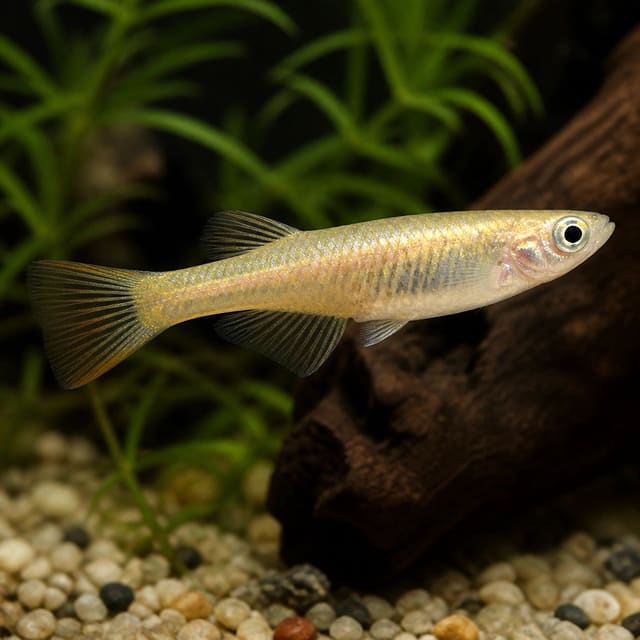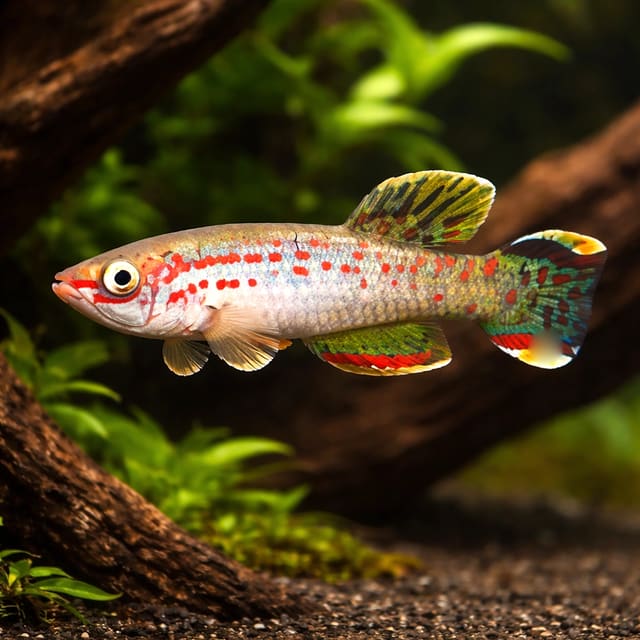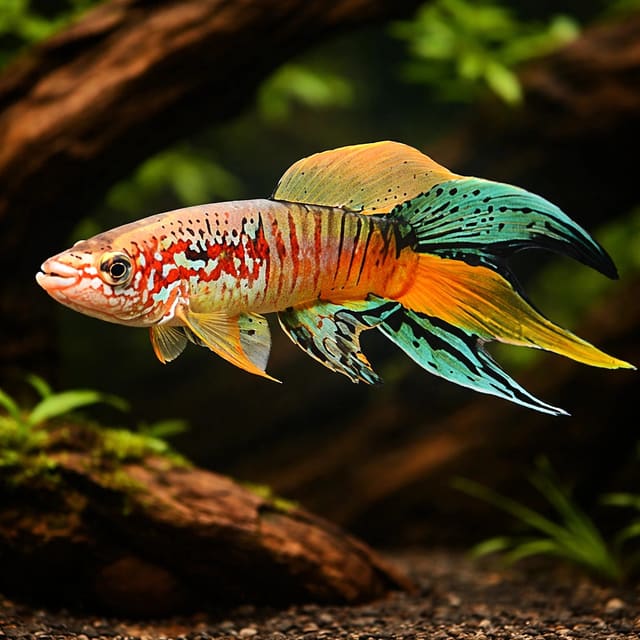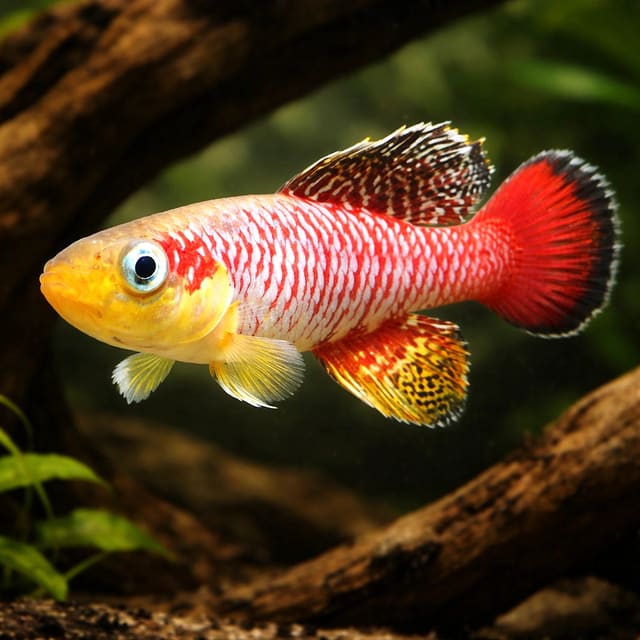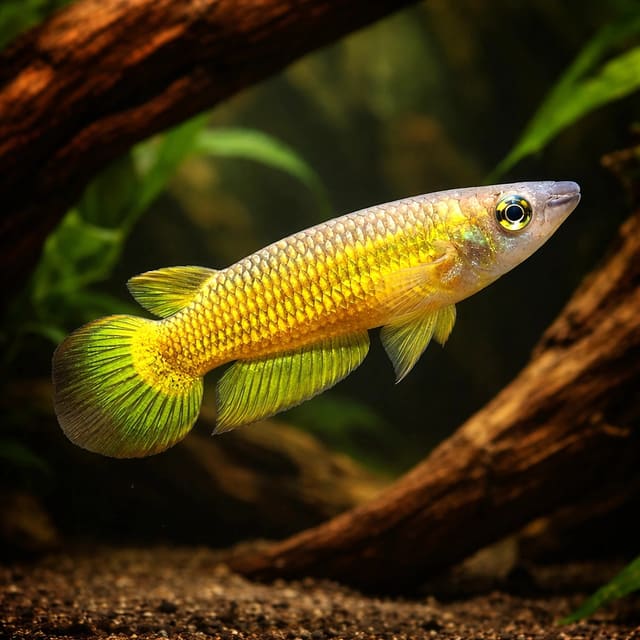
Lampeye (Aplocheilichthys normani)
22–26°C · pH 6.5–7.2
£3.99

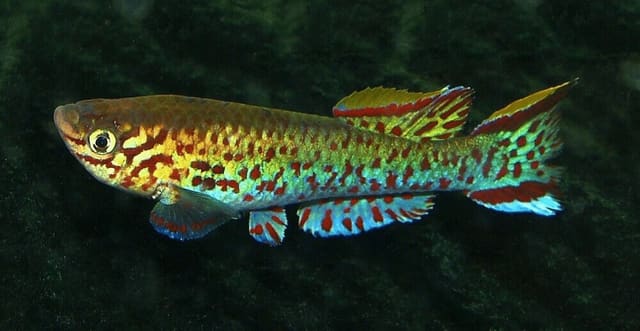
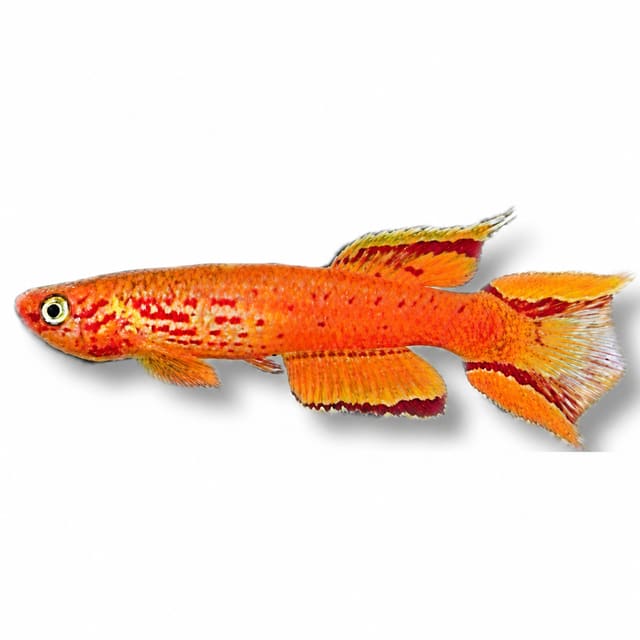
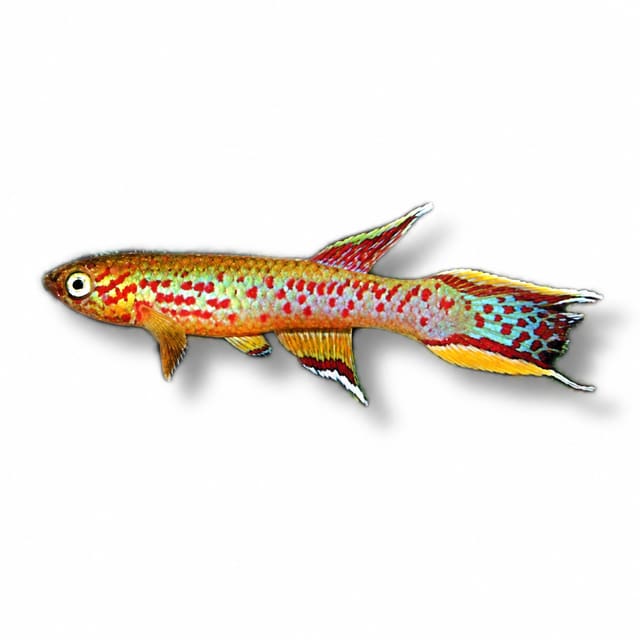
The Yellow-Green Gabon Killie (Aphyosemion gabunense) is a freshwater African rivuline from the Lower Ogowe and Lower Ngounié river systems that reaches 5 cm. It suits keepers planning an OATA-guided group of at least three in at least 40 litres, with the FishBase and OATA overlap of 22–25°C and pH 6.5–7.2. Sold individually at a dispatch size of 3–4 cm.
Adult size is the maximum length this species reaches at full maturity (scientific sources). The livestock you receive will be younger and smaller. Product-photo provenance and any image-specific limitations are stated on the listing.
Aphyosemion gabunense
Save when buying multiple fish. Each quantity is one fish; sex and pair formation are not guaranteed unless the selected variant explicitly states them.
The Yellow-Green Gabon Killie (Aphyosemion gabunense) is a freshwater African rivuline from the Lower Ogowe and Lower Ngounié river systems that reaches 5 cm. It suits keepers planning an OATA-guided group of at least three in at least 40 litres, with the FishBase and OATA overlap of 22–25°C and pH 6.5–7.2. Sold individually at a dispatch size of 3–4 cm.
Adult size is the maximum length this species reaches at full maturity (scientific sources). The livestock you receive will be younger and smaller. Product-photo provenance and any image-specific limitations are stated on the listing.
Maintain these water conditions for optimal health and vibrant colors
The Yellow-Green Gabon Killie is Aphyosemion gabunense, a small freshwater African rivuline in the family Nothobranchiidae. FishBase records this species from the Lower Ogowe and Lower Ngounié river systems in Africa, where it occurs in swamps and brooks within coastal rainforest. It is benthopelagic and non-migratory, and FishBase identifies it as a non-seasonal killifish.
The genus belongs to the African rivulines. A concise overview of the genus Aphyosemion describes it as endemic to Africa and notes that many members are popular aquarium fish. For aquarium planning, the species identity matters: this fish has a recorded maximum length of 5 cm total length rather than the larger dimensions reached by some other killifish.
Use 5 cm as the decisive adult planning length. The dispatch size describes the fish at the time it is supplied; it is not its permanent size. A difference of only 1–2 cm between dispatch and maximum length still affects group space, planting, feeding access and the biological load placed on the filter.
A calm, covered aquarium suits its small size and the wider needs of killifish. Cover should offer retreat without removing open swimming room, while the filter must keep waste under control without turning the aquarium into a busy environment. These priorities make the fish most suitable for a keeper prepared to test the water, feed measured portions and screen every proposed companion for temperament.
| Planning point | Use this figure |
|---|---|
| Scientific name | Aphyosemion gabunense |
| Recorded maximum | 5 cm total length |
| Routine temperature | 22–25°C |
| Routine pH | 6.5–7.2 |
| Social plan | At least three under OATA guidance |
One purchase supplies one animal. The recorded dispatch size is 3–4 cm. Treat that measurement as the supplied size rather than the adult planning size: FishBase records a maximum of 5 cm total length.
Sex is guaranteed only when the selected option explicitly states male or female. This Yellow-Green Gabon Killie listing has no sex-guaranteed option.
OATA’s killifish guidance recommends keeping at least three and suggests two females for each male where sex is known. It also recommends at least 40 litres for a small group of the smallest killifish. Use these as OATA group planning figures. Because each purchase supplies one animal, a planned group of three requires a purchase quantity of three.
Group size is only the first part of the decision. The aquarium must also hold a filter, cover, plants or shelters and enough usable room for each fish to feed without being crowded. A larger aquarium gives the keeper more water volume and makes temperature and water quality more stable. If several males are present, OATA recommends heavy planting to increase cover.
| Suits | Not suited to |
|---|---|
| Covered, filtered aquariums with plants or shelters | Uncovered or unfiltered aquariums |
| OATA-guided groups of at least three | Plans that cannot provide the recommended group space |
| Calm companions sharing the same water range | Boisterous or other long-finned companions |
| Keepers prepared to test and maintain the water weekly | Aquariums where ammonia or nitrite is detectable |
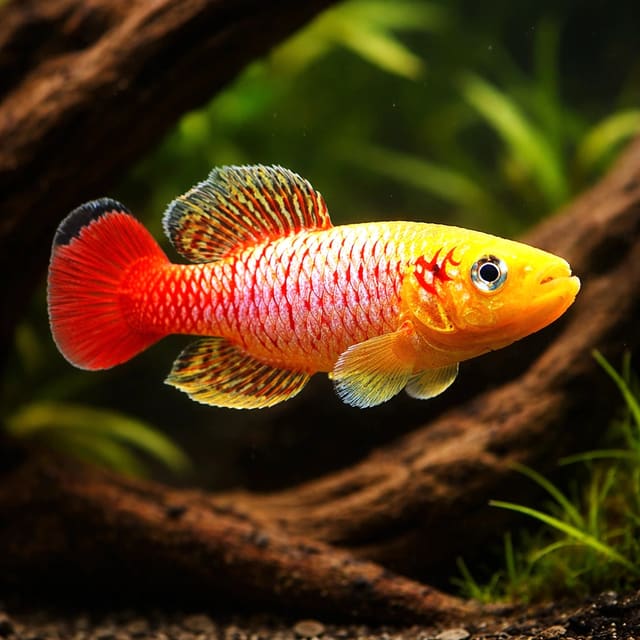
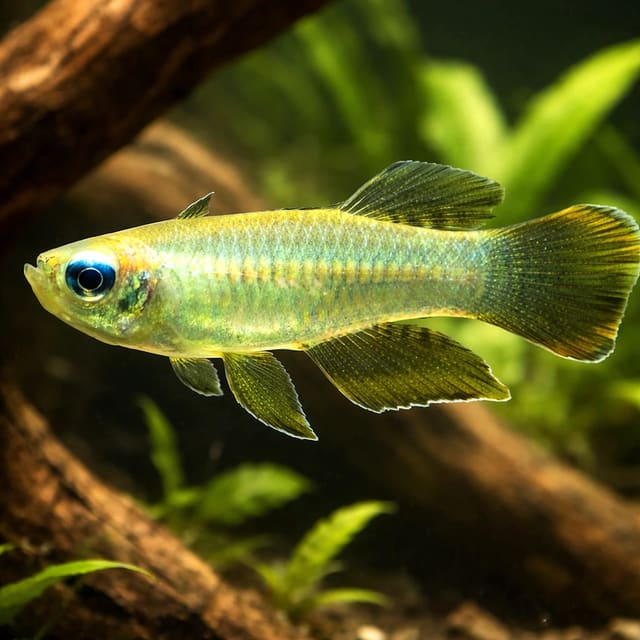
Some gallery images are representative, based on reference photographs of this species, and none shows the exact animal supplied, so colours can look slightly different from the live animal.
If those conditions fit your aquarium, you can compare this fish with others in our current killifish collection while keeping each species’ adult size and water requirements separate.
Start with at least 40 litres when planning the OATA-recommended small group of three. That figure is a practical floor for small killifish as a group, not a reason to stop at exactly 40 litres. More water gives the filter and keeper a larger buffer against sudden changes in temperature or waste concentration.
| Feature | Purpose |
|---|---|
| Secure cover | Prevents killifish from jumping out |
| Established filter | Processes fish waste through beneficial bacteria |
| Plants or shelters | Provide retreat from other fish |
| Gravel or sand | Forms the aquarium base recommended by OATA |
| Open water | Leaves room for normal swimming and feeding |
Use live plants where they fit your routine. If live planting is not practical, OATA also accepts plastic plants and suitable ornaments such as plant pots or model caves. Arrange cover so that a retreat does not become a dead end where another fish can trap the occupant. Multiple patches are more useful than one crowded corner, particularly when several males share the aquarium.
The cover is essential. Check the perimeter after fitting the filter, cables and any airline, because every opening affects how completely the aquarium is enclosed. Recheck it after maintenance rather than assuming it went back into the same position.
Prepare the aquarium before the fish arrives. The filter needs an established population of beneficial bacteria capable of processing the waste produced by the planned stock. Our first tropical aquarium guide explains how to prepare and mature the system before livestock is introduced.
Stand back and identify three distinct functions: sheltered areas, accessible feeding space and clear routes between them. If dense decoration leaves no open route, remove or reposition an item. If the aquarium is visually bare and every fish remains exposed, add suitable plant cover or shelter. The result should be secure without being cramped.
Use 22–25°C and pH 6.5–7.2 for routine planning. These values are the overlap between FishBase’s 22–25°C and pH 6.5–7.2 species range and OATA’s broader killifish ranges of 22–27°C and pH 6.0–7.5. OATA adds soft to medium general hardness of 4–12°dH for killifish as a group; use that hardness range as group guidance.
| Measurement | Working range |
|---|---|
| Temperature | 22–25°C |
| pH | 6.5–7.2 |
| General hardness | 4–12°dH |
| Ammonia | 0 mg/l |
| Nitrite | 0 mg/l |
| Nitrate | No more than 20 mg/l above tap-water level |
Test the aquarium rather than estimating from its appearance. A measured pH of 7.0 sits inside the 6.5–7.2 range; a result of 7.4 does not. A measured temperature of 24°C sits inside 22–25°C; 26°C falls beyond it. This simple comparison prevents a broad “tropical” label from replacing the actual numbers that matter.
Use our water chemistry guide to understand the measurements, then enter the results in the aquarium water matcher. Record the values at comparable times so a genuine trend is easier to distinguish from one isolated reading.
Stability does not mean ignoring the test kit. It means holding the aquarium within the working range while ammonia and nitrite remain at zero. If a result falls outside the range, pause further stocking, check the equipment and review recent feeding and maintenance. Resolve the cause before adding more fish rather than expecting the livestock to absorb the risk.
A working biological filter is essential. The RSPCA’s aquarium welfare advice explains that fish release toxic ammonia, which beneficial bacteria convert first to nitrite and then to the safer nitrate. A filter therefore needs both suitable operation and an established bacterial population; water movement alone does not complete that job.
Do these checks before the fish arrives and continue them after introduction. OATA warns that increasing livestock too quickly can outpace the beneficial bacteria as waste and feeding increase. Add fish gradually when building a wider community, and do not treat spare physical space as spare biological capacity.
For example, a tank may look lightly stocked while still producing measurable ammonia after a change in fish numbers or feeding. That reading means the filter and current waste load are out of balance. Stop further additions, test daily while the issue is being resolved and keep feeding measured rather than adding extra food.
Check the filter for blockages during routine maintenance. If the media needs cleaning, rinse it lightly in aquarium water removed during the partial water change. Do not rinse it under the tap, because chlorine or chloramine may damage the bacterial population living in the media.
Filter care should be proportional to the need. A blocked unit needs attention, but unnecessary aggressive cleaning discards useful bacteria. Combine visual inspection with water tests: normal flow does not replace ammonia and nitrite readings, while a clear test does not excuse a filter that has stopped operating.
OATA describes killifish as omnivorous and recommends a good-quality flake or granule as the regular aquarium food. Small live or frozen items such as daphnia, brine shrimp or tubifex can add variety. Choose pieces small enough for the fish to take without prolonged chasing or repeated rejection.
Feed once a day and offer only what the fish can eat within a few minutes. Start with a restrained amount, watch the group and stop adding food when feeding slows. This observation matters in a mixed aquarium because a fast companion can consume the visible food while a quieter killifish receives little.
A correct portion supports the fish without leaving food to decay. Uneaten food breaks down and releases waste, adding pressure to the biological filter and working against the requirement for zero ammonia and zero nitrite. More food is therefore not automatically more nutrition.
If one fish repeatedly misses the meal, first check whether another fish is bullying or outcompeting it. Use separated feeding points where the aquarium layout allows, while keeping the total portion within what the group consumes in a few minutes. Do not respond by scattering a large excess across the aquarium.
Reduced interest in food can also be an early health warning. Test ammonia, nitrite, nitrate, temperature and pH, then compare the fish’s swimming, breathing, colour and body condition with its normal pattern. A food change should not distract from a water-quality problem.
Change 25% of the aquarium water at least once every week. Use a siphon to remove solid waste from the substrate, and treat replacement tap water with conditioner to remove harmful chlorine or chloramine before it enters the aquarium.
Weekly testing gives the maintenance routine a measurable purpose. Ammonia and nitrite should remain at 0 mg/l. OATA advises that nitrate should not exceed 20 mg/l above the normal level in the tap water. If the tap-water reading is 10 mg/l, that guidance sets 30 mg/l as the aquarium comparison point. If the tap reading is 20 mg/l, the corresponding point is 40 mg/l.
That calculation does not replace maintenance. It helps distinguish nitrate already entering with replacement water from nitrate accumulating inside the aquarium. Record both measurements so the difference remains visible from week to week.
If ammonia or nitrite rises above zero, pause further additions and examine recent changes in stock, feeding, filter operation and cleaning. If nitrate is climbing more quickly than normal, check portion size, uneaten food, accumulated waste and whether the 25% change was completed at least once that week.
Finish by confirming the cover is secure. Maintenance often moves cables, hoses and lids, so the final enclosure check is part of fish care rather than a cosmetic step.
Prepare the aquarium before the delivery window. Confirm the filter is running, the cover fits, ammonia and nitrite are 0 mg/l, and the aquarium sits within 22–25°C and pH 6.5–7.2. Complete maintenance before arrival rather than disturbing the aquarium while the fish is being introduced.
Follow our delivery and Live Arrival Guarantee policy for the current receiving and claim conditions. Someone must be present to receive live fish.
Watch breathing, posture and swimming without repeatedly disturbing the fish. A newly introduced animal should not be used as a reason to add further livestock immediately. OATA advises increasing fish numbers slowly because the filter’s beneficial bacteria must respond as waste and feeding rise.
Offer a restrained meal according to the once-daily schedule, and confirm that food is eaten within a few minutes. If the fish does not feed at the first opportunity, remove uneaten food and check the water rather than adding multiple replacement meals.
During the first week, test ammonia and nitrite more frequently than the normal weekly minimum. Keep both at 0 mg/l, verify that temperature and pH remain in range, and confirm that no companion is blocking access to food or shelter.
Confirm that the fish can move between open water and shelter, that the cover remains secure and that the filter is operating normally. Check for persistent surface hanging, bottom sitting, erratic swimming or unusually rapid or slow gill movement. Test the water if any of those changes appear.
Keep the normal once-daily feeding schedule and watch every fish take food. Record temperature, pH, ammonia and nitrite so that a shift is visible rather than remembered approximately. Ammonia and nitrite must remain at 0 mg/l. Compare nitrate with the normal tap-water reading and complete a 25% water change at least once during the week.
Look for changes in colour, temperament, hiding, body weight, fin condition, scales and skin. White spots, fluffy growths, ulcers, bumps, missing scales or damaged fins all justify an immediate water test and closer assessment. Avoid adding further livestock while a change remains unresolved.
Judge the aquarium by repeated observations rather than one good day. The fish should have access to food, the group should be able to use separate shelters, and water measurements should remain inside 22–25°C and pH 6.5–7.2 with zero ammonia and nitrite.
Check whether the original layout still works now that the fish are using it. If one area is consistently monopolised, redistribute the existing cover to create another retreat. If uneaten food repeatedly reaches the substrate, reduce the next portion or change where it is offered.
Continue testing, a 25% water change at least once every week and filter inspection after the first month. These are permanent parts of keeping the aquarium stable, not temporary arrival measures. If concerning health changes continue after water quality and equipment have been checked, contact us for guidance.
Yellow-Green Gabon Killies may fit a community aquarium only when the other fish are calm and share the same water conditions. OATA describes killifish as generally small and peaceful but warns that they do not appreciate boisterous tank mates. Some species are shy and prone to being bullied, so a species-focused aquarium can be the clearer choice where community behaviour is uncertain.
| Check | Pass condition |
|---|---|
| Temperature | All fish can live at 22–25°C |
| pH | All fish can live at pH 6.5–7.2 |
| Temperament | Companions are calm rather than boisterous |
| Feeding | The killifish can reach its daily food |
A proposed companion fails if its normal care range does not overlap these values. It also fails if its feeding style or activity repeatedly prevents the killifish from eating. Similar adult size alone is not enough to establish a suitable match.
Avoid other long-finned species. OATA notes that some male killifish may be aggressive towards long-finned fish. Also avoid boisterous companions because their activity can intimidate quieter killifish even without direct injury.
Watch access to food, shelter and open water. Persistent chasing, blocked retreats, damaged fins, increased hiding or repeated missed meals means the combination needs intervention. Test the water at the same time, because poor water quality can produce behaviour changes that resemble a social problem.
Compatibility remains conditional on the individuals, aquarium layout, group structure and feeding access. A match that works in one planted aquarium may fail in a smaller or more exposed arrangement. Keep the ability to separate fish rather than treating an initial quiet period as a permanent guarantee.
OATA recommends at least three killifish and suggests two females for each male where sex is known. More may be kept when that ratio and the aquarium’s capacity allow. The recommendation aims to reduce pressure on females and other inhabitants rather than simply filling the aquarium.
One purchase supplies one animal, so a planned group of three requires a purchase quantity of three. Do not stop at the head count: confirm that the aquarium offers at least 40 litres, established filtration, a secure cover and enough shelter for the whole group.
Where several males are present, provide heavy planting or equivalent cover. Arrange separate retreats so one fish cannot control every sheltered area. Check the layout from the fishes’ level: a single tall plant may look dense from above while leaving an open line of sight across most of the aquarium.
If the aquarium is exactly 40 litres, treat it as the OATA floor for a small group and assess how much usable space remains after equipment and shelter are fitted. Larger volume improves environmental stability, but it does not excuse poor cover, incompatible fish or overstocking.
When building a community, do not introduce many additional fish at once. Every increase in livestock and feeding raises the waste load that beneficial bacteria must process. Test ammonia and nitrite after changes and keep both at 0 mg/l before considering another addition.
Use a simple final rule: choose a companion only if its water range overlaps, its temperament is calm, its finnage does not trigger the OATA warning and the aquarium lets every fish reach food and shelter. Where one of those points remains uncertain, use a species-focused plan.
The Yellow-Green Gabon Killie reaches a recorded maximum of 5 cm total length. The supplied fish measures 3–4 cm, so plan the aquarium, group and filtration around the 5 cm adult figure.
OATA recommends at least 40 litres for a small group of the smallest killifish. Use a covered, filtered aquarium with gravel or sand and plenty of plants or suitable shelters; more water provides greater environmental stability.
OATA recommends at least three killifish and suggests two females for each male where sex is known. Provide substantial planted cover when several males are present.
FishBase describes Aphyosemion gabunense as easy to maintain in an aquarium. It suits a beginner who can provide a covered, established filter, test the water, complete a 25% water change at least once every week and screen companions carefully.
Feed a good-quality flake or granule once a day, with small live or frozen daphnia, brine shrimp or tubifex for variety. Offer only what the fish can eat within a few minutes and remove obvious leftovers.
Keep it at 22–25°C and pH 6.5–7.2, the overlap between FishBase’s species range and OATA’s killifish guidance. OATA also gives soft to medium general hardness of 4–12°dH for the group.
OATA describes killifish as generally peaceful, but some males may be aggressive towards other long-finned species. Avoid other long-finned fish and watch for chasing, blocked retreats, damaged fins or missed meals.
Consider only calm fish that share 22–25°C and pH 6.5–7.2 and do not block access to food or shelter. Avoid boisterous and other long-finned fish; the final match depends on the individuals and aquarium layout.
Someone must be present to receive it. Film every delivery continuously from the sealed parcel as it is opened, with the fish still in the bag; float the bag for 20–30 minutes before release, and never pour the bag water into the aquarium.
No reviews for this item yet. Bought one? Honest reviews only, good or bad.
What customers say about ordering from us
I have a small group of long finned mountain minnows. So was delighted to be able to order ten of this variety to increase the genetics in my tank . The ones I recieved are healthy but it’s to early to give a verdict on wether they are of a long finned type since they are small currently.
Gordon Walker · 23 Sept 2026
100% success travel and "installation". Pleased with quality of purchase. The Siamese fighter a bit "shy" so have not yet seen him at his best yet but looking good. Happy customer. GG
George E Garratt · 21 Sept 2026
Reviews of our shop, collected by Judge.me, an independent third-party review collector. Newest first.