Advanced
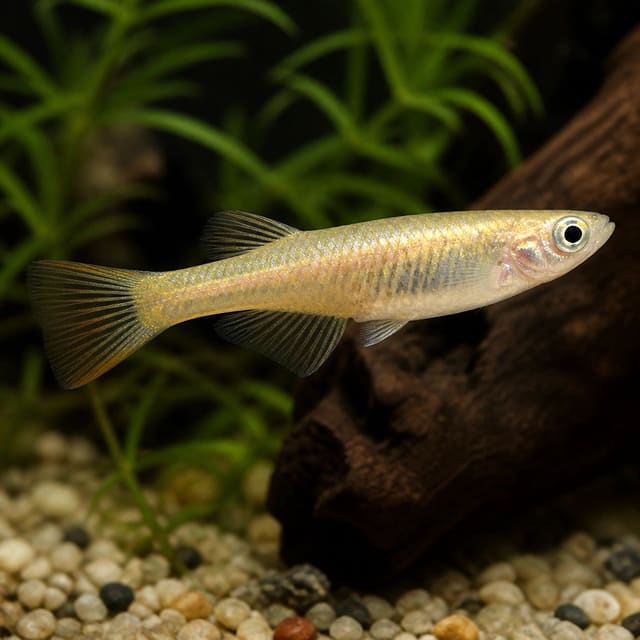
Gunther's Zanzibar Gold Nothobranch (Nothobranchius guentheri)
22–25°C · pH 6–7
£10.99
Albino Rachow's killifish is a red-eyed albino form of Nothobranchius rachovii, an annual killifish from the seasonal floodplain pools of eastern Mozambique. It grows to about 6 cm, needs cool 20–24 °C soft water, a planted, shaded tank and live or frozen food, and typically lives 6–12 months in the aquarium.
Adult size is the maximum length this species reaches at full maturity (scientific sources). The livestock you receive will be younger and smaller. Product-photo provenance and any image-specific limitations are stated on the listing.
Nothobranchius rachovii
Save when buying multiple fish. Each quantity is one fish; sex and pair formation are not guaranteed unless the selected variant explicitly states them.
Albino Rachow's killifish is a red-eyed albino form of Nothobranchius rachovii, an annual killifish from the seasonal floodplain pools of eastern Mozambique. It grows to about 6 cm, needs cool 20–24 °C soft water, a planted, shaded tank and live or frozen food, and typically lives 6–12 months in the aquarium.
Adult size is the maximum length this species reaches at full maturity (scientific sources). The livestock you receive will be younger and smaller. Product-photo provenance and any image-specific limitations are stated on the listing.
Maintain these water conditions for optimal health and vibrant colors
This listing is for the albino form of Nothobranchius rachovii, the annual killifish that British keepers usually call Rachow's killifish or the bluefin notho. The listing has a single option and no pack count, so each one you add to your order is one fish. They leave us at roughly 2.5 to 3.5 cm long. That is a young fish rather than a finished adult: the species reaches about 6 cm in total length, so yours still has some growing to do once it has settled.
We do not choose the sex of the fish on this listing. Neither the title nor the order options name a sex, so please read every mention of males and females in this guide as care information, not as a promise about what is in your bag. With this species that matters more than usual, because Wikipedia's account of it says plainly that males are aggressive towards other males of their own kind. If you order two or three, they could be any mix, and that includes two males. Before you order more than one, decide where a second male would live if that is what turns up.
So who is this fish for? It suits a keeper who wants a small, vivid killifish to watch closely in a modest planted tank, who is happy to feed live or frozen food most days, and who accepts from the start that this is an annual species with a short life. It is a poor fit for a busy community tank of tetras and barbs run at 26 °C, and it is the wrong choice for anyone hoping for a fish that will still be swimming in five years' time. The Seriously Fish profile puts it bluntly: this is not a community fish.
What it offers in return is a great deal of character in a few centimetres. You get a fish whose whole adult life is built around one wet season, a colour form that stands out in any killifish collection, and, if you want to try, one of the more unusual breeding projects in the hobby, where the eggs are stored for months in damp peat before they hatch.
Everything factual on this page comes from published references that we read for this listing: the FishBase species summary, the Seriously Fish species profile, and Wikipedia's articles on the species, the genus and albinism in animals. They are listed with links at the end. Where they disagree, and on a couple of points they do, we tell you which figure comes from where so you can weigh it up yourself.
Nothobranchius rachovii was described by the German zoologist Ernst Ahl in 1926. According to Wikipedia, the species name honours Arthur Rachow (1884–1960), a German aquarist who donated fish specimens to the Museum für Naturkunde. FishBase gives the English name as bluefin notho, Wikipedia adds rainbow nothobranch and Rachow's nothobranch, and in UK shops you will most often see Rachow's killifish. They all mean the same fish. FishBase places it in the family Nothobranchiidae, the African rivulines, in the order Cyprinodontiformes alongside the other killifish.
It is a small, slim fish. FishBase records a maximum of 6.0 cm total length. Seriously Fish gives 55 mm standard length, which is measured to the base of the tail rather than its tip, so the two figures sit comfortably together. Wikipedia also says up to 6 cm. Plan for an adult of a little over 5 cm, with the tail adding the last few millimetres. Both Seriously Fish and Wikipedia note that males are the larger sex and far more colourful, while females are plainer.
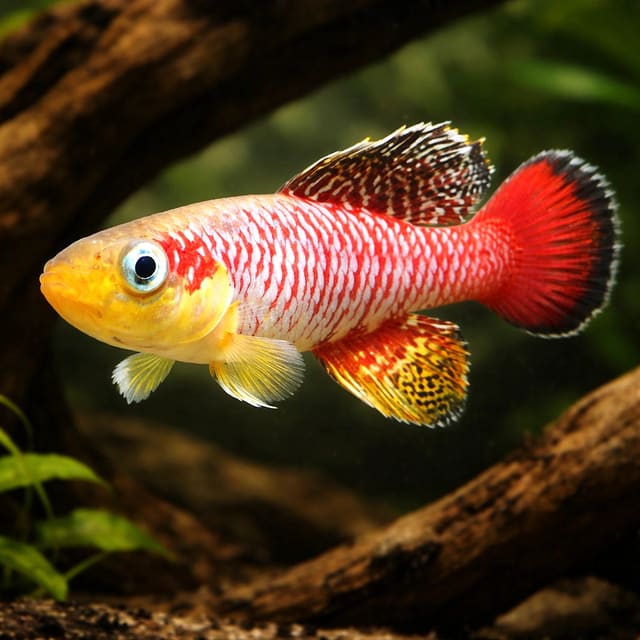
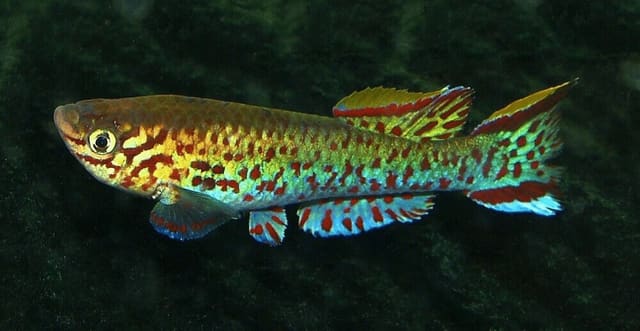
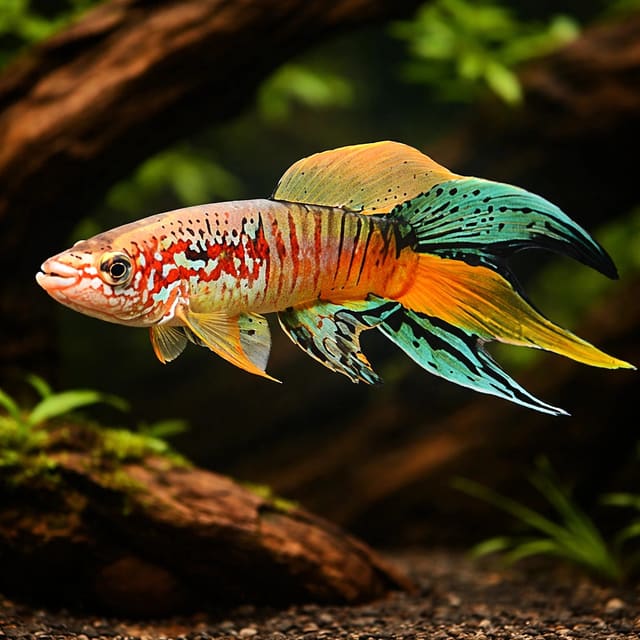
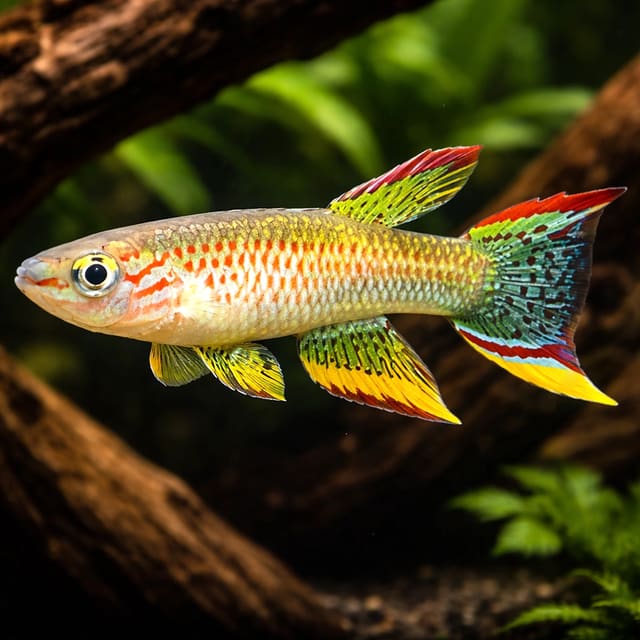
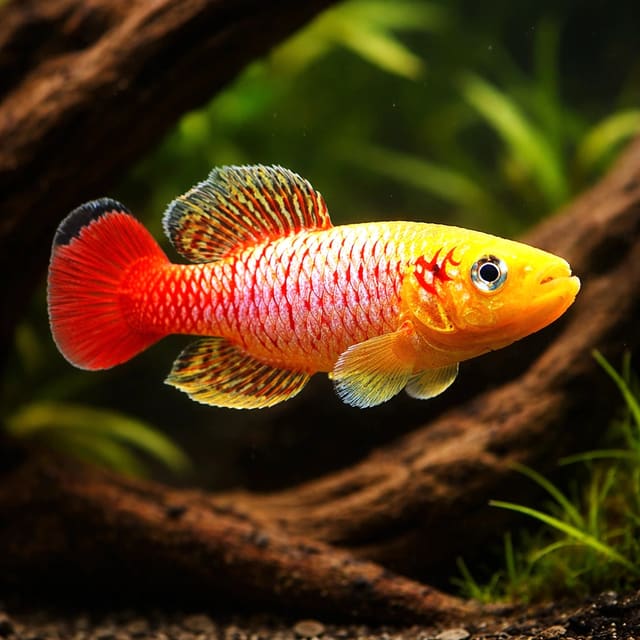
In the normally coloured fish, the blue and orange of the male is what earned the names bluefin and rainbow. Albinism is a lack of pigment from birth, chiefly melanin, the dark pigment, so this form loses the dark tones that frame the pattern in a wild-type fish. What it keeps is the warm colour and the blue. The photograph on this page shows how that looks on a male-pattern fish:
That is a colourful, male-type fish. A female of the same form will be far quieter, so do not expect every fish to look like the photograph, especially as the sex is not chosen on this listing.
The giveaway for any albino is the eye. Wikipedia's article on albinism in animals explains that albino eyes look red because, with no pigment in the iris, the colour of the blood in the retina shows through. In this form you will see a red or pink eye ringed with pale tissue rather than the dark eye of the normal fish, which is the quickest way to tell the two apart across a tank.
A practical point about young fish: at 2.5 to 3.5 cm the fish has not reached full size. Judge yours after a week or two in a planted tank with soft light, not on its first evening out of the bag.
Wild Rachow's killifish come from eastern Mozambique. FishBase records the species from temporary pools and swamps in the floodplains of the lower Pungwe River and the lower Zambezi River, with probable populations in other floodplains between those two river systems. Seriously Fish describes the same range and calls the species endemic to that part of Mozambique. Wikipedia gives the type locality, the place the first described specimens came from, as Beira, the port city at the mouth of the Pungwe.
The habitat explains almost everything about the fish. FishBase describes water-filled depressions on river floodplains where the depth varies and falls as the dry season goes on, until the pool dries out completely. Seriously Fish adds that these pools become completely dry for several months each year. None of it is permanent water. When the rains return the hollows refill, eggs that have been lying in the dried mud hatch, and a new generation has to grow, mature and spawn before the water disappears again.
These are weedy places. FishBase lists grasses along the margins and true aquatic plants in the water, naming species of Nymphaea (water lilies), Ottelia, Lagarosiphon and Utricularia (bladderworts). Seriously Fish gives the wild pH as typically 6.0 to 7.0, and FishBase's temperature range is 20 to 24 °C. Picture a shallow, plant-choked pool of soft, slightly acidic water over a muddy bottom, rather than a river, and you will set up a much better tank than if you treat it as just another tropical fish.
Wikipedia describes the species as benthopelagic, feeding on zooplankton and other small organisms near the bottom, and FishBase gives the same benthopelagic classification. In aquarium terms that means a fish of the lower and middle water, at home among plants and close to the floor rather than cruising at the surface.
The IUCN assesses the species as Least Concern; FishBase dates that assessment to January 2019. The albino colour form itself is an aquarium line kept going by breeders. Wikipedia's article on albinism notes that both naturally occurring albino fish and artificially selected albino varieties are kept in aquariums, and a red-eyed killifish like this one is a product of the hobby rather than something you would expect to net from a Mozambican pool.
This is the section every buyer should read before ordering. Nothobranchius rachovii is an annual fish. FishBase classes it as such, and Wikipedia explains that in nature the adults live only while their pool holds water and die at the end of the breeding season. The species gets through the dry months as eggs in the mud, not as fish. That life history sets the pace for everything else: fast growth, early maturity and a short adult life.
Seriously Fish gives a typical aquarium lifespan of 6 to 12 months. Wikipedia says the fish live for up to a year or a year and a half. In a well-kept tank, the honest planning figure is about a year of life in total, with anything beyond that a bonus. The fish we send are not newly hatched, either: they are already some way into that span by the time they reach dispatch size, so the time you have with them is part of the total, not all of it.
Here the sources disagree sharply. FishBase and Wikipedia both say the species matures after about twelve weeks. Seriously Fish states that sexual maturity is reached at around three weeks of age. We cannot settle that gap from what we have read, so we treat it as a range: Rachow's killifish can be breeding within weeks of hatching and are mature within about three months. Either way, a fish that has grown to 2.5 to 3.5 cm is not far from breeding age, if it is not there already.
It helps to see this fish alongside its relatives. Wikipedia's article on the genus notes that Nothobranchius furzeri, the turquoise killifish, reaches maturity in 17 days and seldom lives beyond six months; the species' own article gives 14 days and says it lives 3 to 16 months in captivity depending on strain and conditions. It is described as the shortest-lived vertebrate kept in captivity, which is why it is studied in research on ageing. Rachow's killifish is not quite as extreme, but it belongs to the same group of fast-living fish.
You buy this fish to enjoy now: the colour, the spawning behaviour, and the odd spectacle of a fish living its whole adult life in a single season. If you want the line to carry on, you have to collect and store eggs, which we explain further down. And when a fish fades and dies after a year, that is usually the natural end of its life rather than a failure on your part. We would rather you knew that before you order than discover it afterwards.
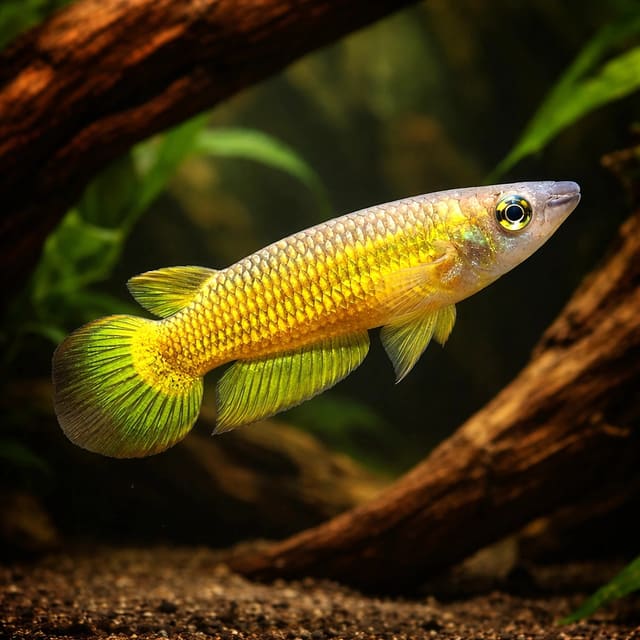
If annual fish suit you, there are other Nothobranchius to try. We also list Gunther's Zanzibar Gold Nothobranch and Gunther's Nothobranch. Keep each species in its own tank rather than mixing them with this one; the breeding section below explains why.
For a single fish, or one male with a female or two, start with a footprint of at least 45 × 30 cm. Seriously Fish uses those base measurements and puts the volume at about 41 litres; Wikipedia's aquarium notes suggest 40 to 60 litres. Within that range, floor area matters more than height. This is a benthopelagic fish of the lower and middle water, and there is little to gain from a tall tank. If you might end up with two males, go bigger and plan the layout as two territories with plants or wood between them.
Set the tank up and let it run until ammonia and nitrite both read zero before you order. A small tank that is still cycling is no place for a fish that is fed rich foods every day.
Planting here is not just decoration. Wikipedia's aquarium notes say the species does well in a heavily planted tank, and its wild pools are full of vegetation. Bunches of fine-leaved stem plants, a carpet of Java moss over wood or stones, and a layer of floating plants on top give the fish cover. They also break the line of sight between rival males and give a female somewhere to go when a male is pressing her. Floating plants cut the light as well, which brings us to the point that matters most for an albino.
An albino lacks the pigment that normally shades the eye. Wikipedia's article on albinism in animals notes that albino animals commonly show abnormal eye development, and that albino vertebrates exposed to intense light typically lose photoreceptors. We would not keep an albino killifish under a bright, unshaded planted-tank light. Use a modest light, cover part of the surface with floating plants, and give the fish shaded areas it can move into whenever it likes. The colour looks better that way too: the orange-red and blue of this form glow against a dark background in soft light instead of looking washed out.
Use a dark, fine sand or small-grade gravel. Seriously Fish points out that the species does not need peat as its substrate, although peat is often used as a spawning medium. A dark floor flatters the albino colour. If you plan to breed, a separate dish of peat for spawning makes egg collection far easier than sifting the whole tank, as described in the breeding section.
Keep filtration gentle. These are fish of still pools rather than streams, so a small air-driven sponge filter or a low-output internal filter is ideal. Strong outflows push small fish about and stir up fine sand. Aim for a gently moving surface, not a churning one.
Fit a close-fitting lid and close the gaps around heater cables and filter pipes. We advise a properly covered tank for every killifish we send out, and it is a small job compared with finding a fish on the floor.
The single most important number for this fish is the temperature. FishBase and Seriously Fish both give 20 to 24 °C, which is noticeably cooler than many UK community tanks are run. Here is how the published figures line up:
| Parameter | FishBase | Seriously Fish | What we suggest |
|---|---|---|---|
| Temperature | 20–24 °C | 20–24 °C | 20–24 °C; set the heater for about 22 °C |
| pH | 6.0–7.0 | 6.0–7.5 | 6.0–7.5, held steady |
| Hardness | 4–6 dH | 3–10 dGH | Soft to moderately soft, 3–10 dGH |
Set the heater for the middle of the range, around 22 °C, and check it with a separate thermometer rather than trusting the dial. In a centrally heated house in winter a small tank may barely need the heater, and in a hot British summer it can drift above 24 °C on its own. If that happens, shade the room, raise the lid a little with mesh across the gap so nothing can escape, and let air move across the surface. Do not let the tank creep up into the high twenties for days at a time.
Wild water in this fish's range is soft and slightly acidic, and Wikipedia notes that the species prefers soft water. FishBase gives pH 6.0 to 7.0 and a hardness of 4 to 6 dH; Seriously Fish gives a wider aquarium range of pH 6.0 to 7.5 and 3 to 10 dGH. Aim for soft to moderately soft water with a pH from slightly acidic to neutral. In hard-water parts of the UK, mixing tap water with reverse osmosis (RO) water is the usual way to bring hardness down. Test after mixing until you know the ratio that gives you the numbers you want, then mix the same way every time.
Do not chase numbers. A steady pH of 7.2 is far kinder to a small fish than one that swings between 6.2 and 7.4 because acids keep going in. Consistency comes from doing the same thing every week.
Change 20 to 30 per cent of the water each week, using water prepared to the same temperature and chemistry. These fish are fed rich live and frozen foods, and in a 40-litre tank the waste from that adds up faster than in a larger tank of flake-fed fish, so the weekly change is not one to skip. Siphon any uneaten food from the substrate as you go, and rinse the sponge filter in old tank water, never under the tap, so you keep the bacteria that process waste.
Test the water a few days before your delivery date and again on the day. If ammonia or nitrite shows anything above zero, sort it out before the parcel arrives.
In the wild this is a small predator. Wikipedia describes it as benthopelagic and feeding on zooplankton and other small organisms near the bottom: in a seasonal pool, that means tiny crustaceans such as water fleas and copepods, among other small animals. Seriously Fish states that small live or frozen foods such as Daphnia, Artemia (brine shrimp) and chopped bloodworm should form the basis of the diet in the aquarium.
A routine that follows that advice looks like this:
Feed small amounts once or twice a day, enough to be cleared within a couple of minutes. In a small tank, uneaten frozen food is the quickest way to spoil the water. Watch the body shape rather than following a fixed portion: a gently rounded belly is what you want, a pinched belly means the fish needs more food or less competition for it, and a bloated look means you are overdoing it.
For the first few days after arrival, offer foods the fish is likely to recognise, such as live or frozen daphnia and brine shrimp, and leave anything dry until it is feeding confidently. If it ignores food on the first evening, do not worry; take the uneaten food out and try again the next day.
Think about the albino eye at feeding time too. Wikipedia's albinism article notes that albino animals commonly show abnormal eye development, so it is sensible to assume this fish may not be the fastest to spot food. In a tank with quick, sharp-eyed fish it could lose out. Feed in two places at once, or target-feed with a pipette, and watch during the first weeks that the killifish is actually getting its share.
Live food is worth the effort if you can manage it. A small culture of daphnia in a garden tub, or a brine shrimp hatchery on a windowsill, gives you a steady supply of the kind of food this fish is built to eat. It will also be needed if you go on to raise fry.
Seriously Fish lists this as a fish to keep in a pair and says plainly that it is not a community fish. Wikipedia adds that males are aggressive towards other males of their own species. Put those together and the picture is clear. The ideal home is a tank of its own, set up for one male with female company, and the main thing you have to manage is rivalry between males.
Because the sex is not selected on this listing, think through the possibilities before you buy more than one:
With two males, the aggression Wikipedia describes is most likely to become a problem in a small, open tank. The answer is more space and more cover, or separate tanks. A female who is being chased all day needs dense plants to slip into, and if she is constantly hiding and not feeding, move her or the male.
If you want to keep it with other species, Seriously Fish's verdict should make you cautious. Wikipedia's aquarium notes mention small, quiet fish such as pencilfish, Corydoras and kuhli loaches as companions. Treat any such list with care, because this killifish wants 20 to 24 °C soft water, and plenty of popular tropical fish are kept warmer than that. Check each candidate's own temperature range and temperament before you add it, and add it only if the two genuinely overlap.
Avoid the following:
The compatibility rule in one line: a species tank is best, and anything else has to be small, peaceful, happy at 20 to 24 °C and slow at the food bowl.
Breeding is where this fish becomes truly fascinating. In the wild, Wikipedia explains, the adults lay their eggs in the mud as the water level falls. The eggs develop while buried in the mud and hatch once rainfall refills the pool. The article on the genus adds that the eggs have a very hard outer shell, resist both drying out and low oxygen, and that the embryos get through the dry season by entering diapause, a pause in development. Seriously Fish describes the same thing in aquarium terms: the fertilised eggs end up encased in the substrate, and they are desiccation-resistant and lie dormant there.
Keepers recreate the cycle with peat. Seriously Fish notes that peat is often used as the spawning medium, even though the fish do not need it as the main substrate. The outline is as follows:
That storage period is the striking part. Five to seven months in damp peat is a large share of the 6 to 12 months that Seriously Fish gives as the species' whole aquarium lifespan, and that is exactly the point: in nature the eggs, not the fish, carry the population from one wet season to the next.
Killifish breeders label their fish by population, and Seriously Fish gives examples for this species such as 'Beira 1998' and collection codes like MOZ 99/1, used so that different populations are not mixed and hybridised. Our listing is sold as the albino form without a population code. If a named line matters to you, we also list Rachovi's Nothobranch Beira 98 Albino, which carries a population label. Keep fish from different listings apart if you intend to breed, so that any eggs you store can be labelled honestly.
You do not have to breed this fish to enjoy it; a single season of watching one is reason enough to buy. But if you do want the line to continue, start collecting eggs early in the fish's adult life rather than waiting, because the clock starts running long before the fish reaches you. A killifish club's hatching guide is worth reading before you wet your first batch of peat.
Please read our delivery and live-arrival information before you order. The aquarium must be ready before the parcel arrives: filter running, water tested, and temperature matched to the 20 to 24 °C this fish needs. Someone must be at the delivery address to receive live animals.
Your fish travels in an oxygen-filled bag inside insulated packaging, with heat packs when the weather calls for them, via a tracked courier licensed to carry live animals. We email the confirmed delivery date and tracking details so you know when to be at home.
Start a continuous video before you open the parcel, while it is still sealed. Open it in the same take and show the fish in its still-sealed bag. If a fish arrives dead, dying or clearly compromised, email hello@tropicalfishco.co.uk on the day of delivery with your order number and that video. Photos alone do not meet the policy. The resolution is a replacement with your next order or a refund for the affected fish, subject to the guarantee terms.
Keep the lights low for the first day and do not worry if the fish hides among the plants at first. Over the next week, watch three things:
If something looks wrong, test the water first, as most early problems in small tanks start there. Then look at tank mates and at whether the fish is actually getting food. Keep the first week's feeding light, keep up your water changes, and resist the urge to rearrange plants or add new fish while it settles.
Once it is settled, enjoy it. A well-kept albino Rachow's killifish in a shaded, planted tank is one of the most eye-catching small fish you can keep, and its short season is part of what makes it special.
These are the references we used for this guide. Each one is worth reading in full if you are new to annual killifish.
No reviews for this item yet. Bought one? Honest reviews only, good or bad.
What customers say about ordering from us
Easy website plenty of info on fish your buying great to pick a time slot
TRACEY DURRANT · 7 Oct 2026
Got some lovely fish thank you
Kevin Mackie · 7 Oct 2026
Reviews of our shop, collected by Judge.me, an independent third-party review collector. Newest first.