Gold Gardneri Killifish (Fundulopanchax gardneri)
20–26°C · pH 6–7.5
£9.99

A colourful West African killifish supplied around 3-4 cm, best in a covered, dim planted aquarium with calm tank mates and small live or frozen foods.
Adult size is the maximum length this species reaches at full maturity (scientific sources). The livestock you receive will be younger and smaller. Product-photo provenance and any image-specific limitations are stated on the listing.
Aphyosemion splendopleure
Save when buying multiple fish. Each quantity is one fish; sex and pair formation are not guaranteed unless the selected variant explicitly states them.
Confirm your email, then we’ll send an availability message for this exact item if it returns within 180 days.
This request is only for this product—no newsletter or other promotions. A mail-provider retry may very rarely duplicate the same availability message. Unconfirmed addresses are removed after 48 hours. See our privacy policy.
A colourful West African killifish supplied around 3-4 cm, best in a covered, dim planted aquarium with calm tank mates and small live or frozen foods.
Adult size is the maximum length this species reaches at full maturity (scientific sources). The livestock you receive will be younger and smaller. Product-photo provenance and any image-specific limitations are stated on the listing.
Maintain these water conditions for optimal health and vibrant colors
The Splendid Killie is Aphyosemion splendopleure, a colourful West African killifish from coastal rainforest brooks and small streams. It is sometimes seen under older or alternate names such as Fundulopanchax splendopleuris or Chromaphyosemion splendopleure, but the customer-facing name for this listing should stay as Aphyosemion splendopleure. The fish supplied for SKU 3032 are around 3-4 cm, so they are young to subadult fish with more colour and fin development still to come.
It is a beautiful fish, but it is not a rough-and-tumble community species for a bright, busy display tank.
FishBase records Aphyosemion splendopleure from southeastern Nigeria through western and southwestern Cameroon, Equatorial Guinea and northwestern Gabon, with a coastal rainforest association. Its habitat is described as quiet parts of brooks and small streams, often near the coast and over fine substrates. Unlike some annual killifish, it is not a seasonal killifish. This matters for care and breeding: do not treat it like an annual species that must have dry peat storage as the default method.
The AKA/WAK locality notes are useful because this species appears in several population forms. One Bombe population was collected about 20 km south of Kumba in a small overgrown stream; another note mentions a Mile 7 / Moliwe Camp locality in a small river with current. That range of local detail explains why the aquarium should be calm and planted, but not dirty or stagnant. It appreciates cover, clear water, oxygen and a mature biological filter.
Splendid Killie males are the reason many keepers fall for this fish. The body can show metallic pink, violet, blue, green, yellow and red tones depending on locality, age and mood. The dorsal, anal and tail fins often carry warm yellow to orange margins, and mature males may develop elegant extensions. Females are plainer and more useful for honest sexing than for display colour: expect a softer brown to olive body with shorter, clearer fins. Young fish may look modest when first delivered, especially after transport. Colour improves with cover, food variety and a settled routine.
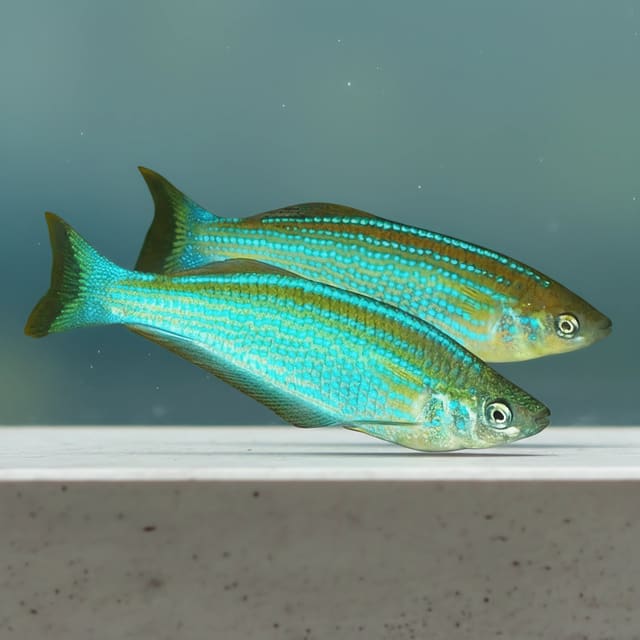
The original reference photo for this SKU shows the type of colour the listing is about: a slender killifish with bright pink-violet body colour, yellow-orange lower fins and a patterned tail. The gallery should help you recognise the fish while the care notes below explain how to keep it settled after arrival.
Use a mature aquarium with a tight lid. Killifish are strong jumpers, and this is one of the easiest mistakes to make. A 45 litre planted tank can work for a pair or trio, but 60 litres or more gives more room for visual breaks and safer group management. Use fine sand or smooth fine gravel, Java moss, Microsorum, Cryptocoryne, floating plants and spawning mops or fine plant roots. The tank should feel sheltered rather than open.
Lighting should be subdued. AquaInfo notes that dim light helps the colours show better, and AKA/WAK notes from the Bombe population also point towards dim conditions. Gentle filtration is ideal: enough movement to keep water clean and oxygenated, but not a hard current that pins the fish into one corner. Keep nitrate low, avoid sudden parameter swings, and be especially careful not to overfeed rich frozen foods in a small aquarium.
Our stock records give 22-25 C, pH 6.0-7.5 and 5-20 dGH. That is broader than many old soft-water-only summaries, so the practical aim is clean, stable water rather than constant chemical adjustment. Killi.co.uk breeder reports include both moderately soft acidic and neutral water, with successful temperatures from 20-23 C and 24-27 C. For a shop customer setup, a stable 22-25 C is the safer headline range, with slow acclimation and regular water changes.
This is a carnivorous micro-predator. Offer small live and frozen foods such as daphnia, mosquito larvae, baby brine shrimp, grindal worms, white worms, microworms and small bloodworm. Some individuals accept fine dry foods or micro pellets, and breeder notes mention flake acceptance, but live and frozen foods usually give better condition and colour. Feed small portions once or twice daily. If food is drifting past them and being stolen by faster fish, the tank mates are wrong.
Splendid Killies are peaceful towards many small fish, but that does not make them ideal for every community aquarium. AquaInfo specifically warns that males can be aggressive towards their own species and may also challenge other Aphyosemion. Killi.co.uk breeder reports describe the fish as not very territorial except with same-species males, which matches the practical pattern: calm with the right companions, risky when males are crowded or when similar killifish are mixed.
The safest choice is a species setup, a pair or trio, or a carefully planned planted aquarium with very calm tank mates. Avoid fin nippers, aggressive fish, large predators, fast barbs, hectic tetras, large livebearers and hard-water species that do not share the same conditions. Shrimplets and tiny fry may be eaten. If you keep more than one male, provide a larger tank with heavy planting and sight breaks.
This is a non-seasonal killifish. Eggs are usually deposited among plants, roots, mosses or mops rather than treated as a purely annual peat-spawning species. AKA/WAK notes for the Bombe population say eggs were mainly found in plant roots and that the fish did not favour mops in that report. AquaInfo describes egg laying among fine-leaved plants and young hatching after about two weeks, while Killi.co.uk reports include long-term colony breeding and spawning mops, with some fry appearing with adults.
For a home attempt, condition the adults with live foods, use Java moss, plant roots or dark mops, and keep careful notes. Fry can usually take newly hatched brine shrimp once ready. Expect variation between population lines and do not panic if the first hatch is uneven; breeder reports mention poor egg survival, skewed sex ratios and the first week of fry rearing as possible weak points.
Choose Splendid Killies if you enjoy small specialist fish, planted aquariums and natural behaviour. They suit keepers who can feed small foods, keep a lid on the tank, and watch male/female dynamics instead of simply adding fish to a busy mixed display. They are less suitable for brand new tanks, uncovered aquariums, bright bare setups or communities where fast fish dominate the food.
When the fish arrive, keep the lights low and acclimate them patiently. Add them to a mature tank, not a fresh setup. Offer a small first meal only once they have settled, then build variety over the next few days. Watch for bullying, especially between males. If one fish is pinned into a corner, add cover, split the group or move the aggressor. Small regular maintenance beats occasional large corrections.
Livestock orders are packed for safe overnight transport when weather and route conditions are suitable. The checkout shows the available service for your order. Our Live Arrival Guarantee applies when the delivery conditions are followed, and first-time customers can use WELCOME10 at checkout. If the weather is unsuitable, we would rather delay dispatch than risk the fish.
Care notes were checked against FishBase for distribution, size, habitat, non-seasonal status and conservation context; AKA/WAK for locality, dim setup and spawning observations; Killi.co.uk breeder reports for water, temperature and breeding-method variation; AquaInfo for male aggression, dense planting, feeding and breeding notes.
No reviews for this item yet. Bought one? Honest reviews only, good or bad.
What customers say about ordering from us
I have a small group of long finned mountain minnows. So was delighted to be able to order ten of this variety to increase the genetics in my tank . The ones I recieved are healthy but it’s to early to give a verdict on wether they are of a long finned type since they are small currently.
Gordon Walker · 23 Sept 2026
100% success travel and "installation". Pleased with quality of purchase. The Siamese fighter a bit "shy" so have not yet seen him at his best yet but looking good. Happy customer. GG
George E Garratt · 21 Sept 2026
Reviews of our shop, collected by Judge.me, an independent third-party review collector. Newest first.