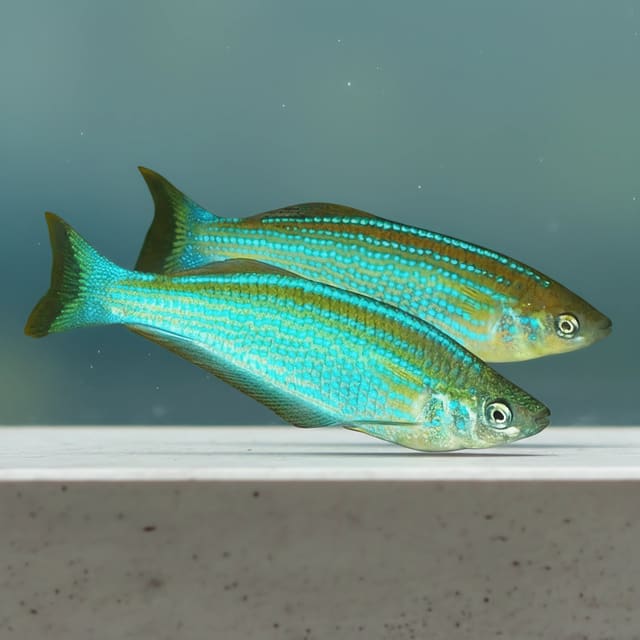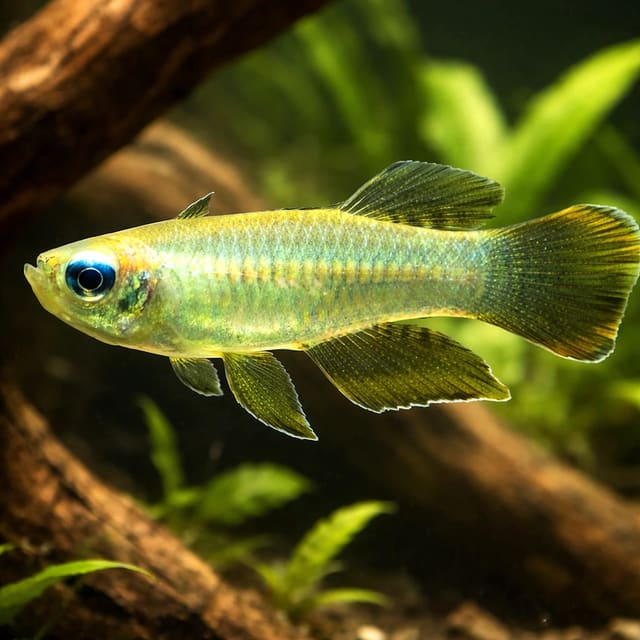
Lampeye (Aplocheilichthys normani)
22–26°C · pH 6.5–7.2
£3.99

Sjoestedti's Killie (Fundulopanchax sjoestedti) is a Nothobranchiidae killifish from southern Nigeria and south-western Cameroon that reaches 14 cm total length. It suits prepared keepers with about 81 litres, a 90 × 30 cm base and the Seriously Fish species range and OATA group guidance overlap of 23–26°C, pH 6.0–7.5 and 5–12 dGH. Sold individually in 3–4 cm, 5–6 cm and 6–7 cm dispatch sizes.
Adult size is the maximum length this species reaches at full maturity (scientific sources). The livestock you receive will be younger and smaller — pick a size above for the actual shipping size. Product-photo provenance and any image-specific limitations are stated on the listing.
Fundulopanchax sjoestedti
Save when buying multiple fish. Each quantity is one fish; sex and pair formation are not guaranteed unless the selected variant explicitly states them.
Sjoestedti's Killie (Fundulopanchax sjoestedti) is a Nothobranchiidae killifish from southern Nigeria and south-western Cameroon that reaches 14 cm total length. It suits prepared keepers with about 81 litres, a 90 × 30 cm base and the Seriously Fish species range and OATA group guidance overlap of 23–26°C, pH 6.0–7.5 and 5–12 dGH. Sold individually in 3–4 cm, 5–6 cm and 6–7 cm dispatch sizes.
Adult size is the maximum length this species reaches at full maturity (scientific sources). The livestock you receive will be younger and smaller — pick a size above for the actual shipping size. Product-photo provenance and any image-specific limitations are stated on the listing.
Maintain these water conditions for optimal health and vibrant colors
Sjoestedti's Killie is a large African killifish in the family Nothobranchiidae. Its scientific name is Fundulopanchax sjoestedti. It occurs around the Niger Delta in southern and south-eastern Nigeria and south-western Cameroon, and FishBase records a maximum of 14 cm total length. This fish suits a prepared keeper who can provide a useful aquarium footprint, a very tight cover, live or frozen staple foods, stable water and careful management of male aggression.
FishBase now lists it as Fundulopanchax sjostedti, while Aphyosemion sjoestedti is an older combination that remains familiar in the hobby. Blue gularis is another established common name.
Its natural habitats include temporary swamps, raphia swamps and swampy parts of slow-flowing brooks in coastal rainforest. FishBase describes it as freshwater, benthopelagic, non-migratory and not a seasonal killifish. It is assessed as Endangered, making careful long-term aquarium management especially appropriate.
This is not one of the approximately 6 cm killifish covered by general small-killifish assumptions. FishBase also records 13 cm standard length; use 14 cm total length as the adult planning figure. That adult scale, combined with male territorial behaviour, means the aquarium needs dense cover and a secure top rather than merely enough water to hold the dispatch-sized fish.
| Suits | Not suited to |
|---|---|
| Keepers able to provide about 81 litres with a 90 × 30 cm base | Aquariums smaller than the stated species plan |
| Secure, densely planted aquariums with wood and floating cover | Uncovered aquariums or lids with open equipment gaps |
| Peaceful companions too large to be considered food | Small fish that could be considered food |
| Known-sex groups with two or three females per male | Crowded arrangements involving multiple males |
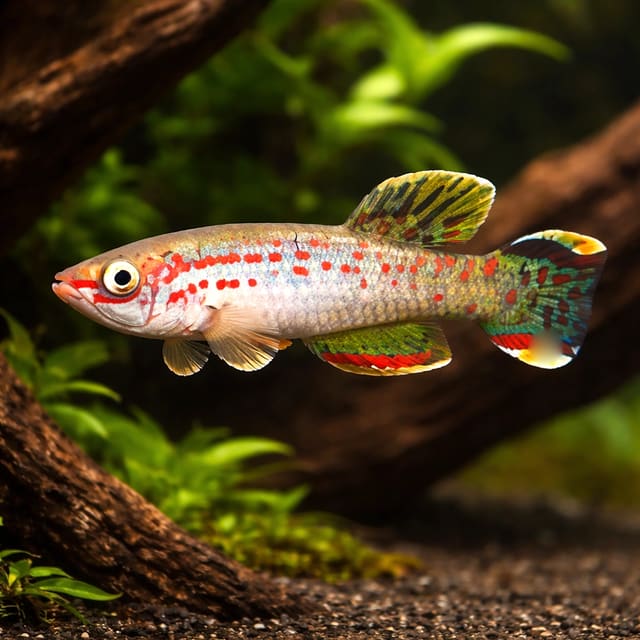
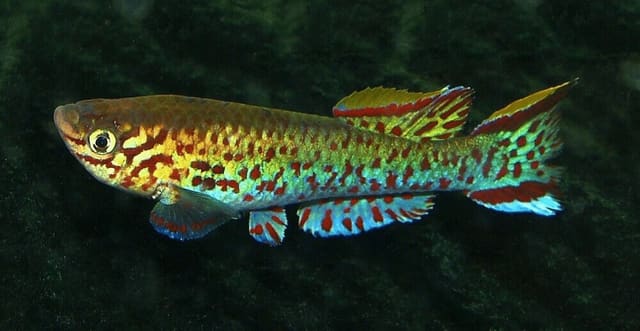
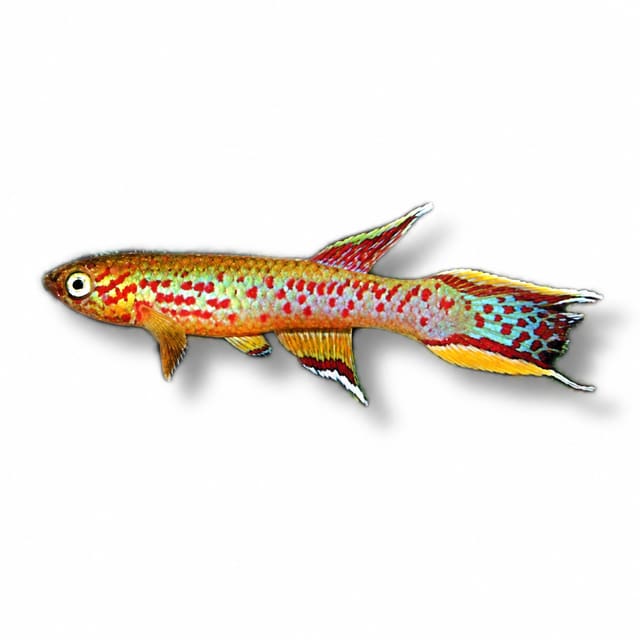
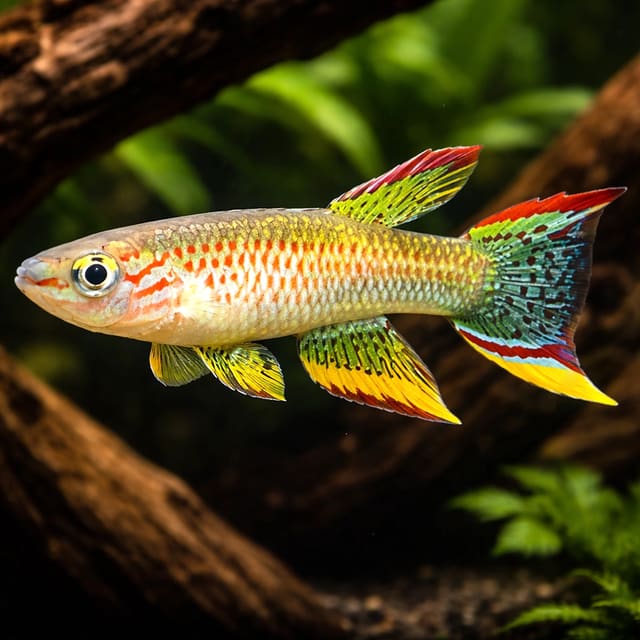
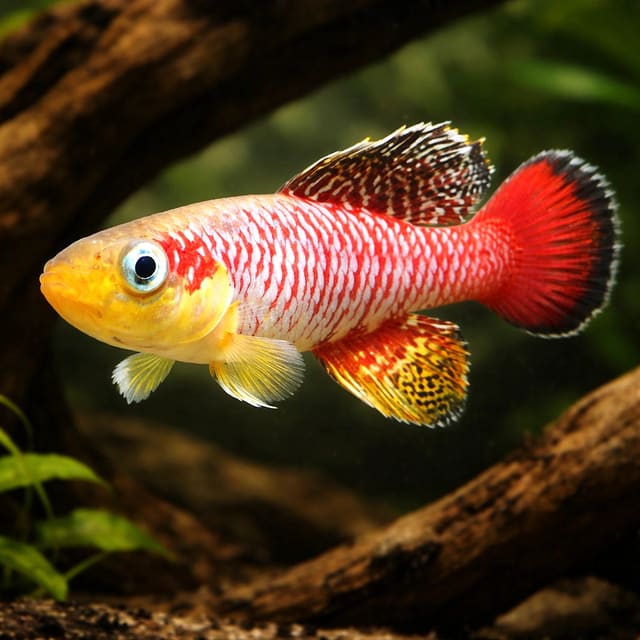
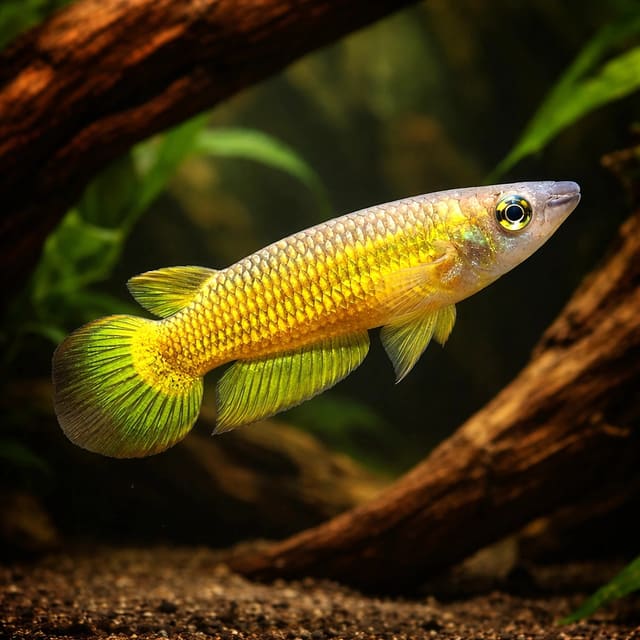
Adult males are described as larger and more brightly coloured than females, with extensions to the caudal, dorsal and anal fins. Those differences describe mature fish rather than guaranteeing the sex or eventual appearance of an animal selected by size.
You can also browse the killifish collection when comparing its adult size and social requirements with other killifish.
One purchase supplies one animal of the selected size. Use the live size selector to choose between the labels shown there rather than treating a dispatch size as a different variety or a promised life stage.
| Selector label | What it means |
|---|---|
| 3–4 cm | One animal measured within this dispatch-size band. |
| 5–6 cm | One animal measured within this dispatch-size band. |
| 6–7 cm | One animal measured within this dispatch-size band. |
The size you select is the size supplied, not the adult size. Every size therefore needs the same adult aquarium plan: allow for a fish that can reach 14 cm total length and do not choose a smaller tank simply because the selected animal begins at 3–4 cm.
A useful worked example is a 4 cm arrival planned against a 14 cm recorded maximum. The fish may begin at less than one-third of that maximum total length, but its permanent aquarium still needs the full footprint, cover and compatible stocking from the start. This avoids moving it simply because its first tank was chosen around the bag size.
Sex is guaranteed only when the selected option explicitly states male or female. This Sjoestedti's Killie listing has no sex-guaranteed option.
Do not use colour, fin length, the gallery or a size label as a substitute for that offer statement. If you intend to build the recommended female-to-male ratio, plan the group only when the sexes of all fish can be established independently of this unsexed selection.
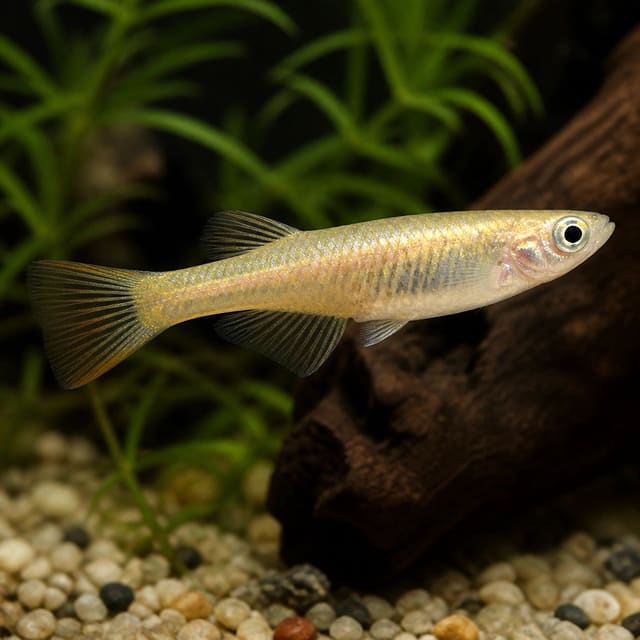
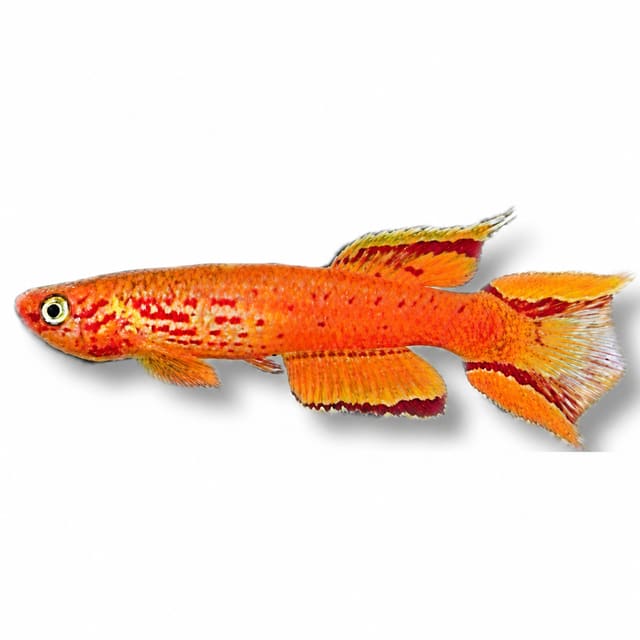
Some gallery images are representative, based on reference photographs of this species, and none shows the exact animal supplied, so colours can look slightly different from the live animal.
The Seriously Fish species profile gives a 90 × 30 cm base and an aquarium of approximately 81 litres for a fish reaching 120 mm standard length. Treat that footprint and volume as the starting point for one suitable setup, then allow more room when adding companions or attempting to manage more than one male.
Its aquarium range is 23–26°C, pH 6.0–8.0 and 5–20 dGH. OATA's killifish sheet gives 22–27°C, pH 6.0–7.5 and 4–12 dGH as group guidance. The overlap gives a practical target of 23–26°C, pH 6.0–7.5 and 5–12 dGH.
| Decision | Planning figure |
|---|---|
| Adult length | Up to 14 cm total length |
| Aquarium | About 81 litres with a 90 × 30 cm base |
| Routine temperature | 23–26°C |
| Routine pH | 6.0–7.5 |
| Routine hardness | 5–12 dGH |
| Ammonia and nitrite | Zero mg per litre |
This fish suits an aquarium keeper prepared to secure every lid gap, offer live or frozen foods as the dietary basis, test the water weekly and manage aggression between males. Its maintenance becomes much clearer when the aquarium is designed around those needs before the fish is introduced.
Start with an aquarium base of at least 90 × 30 cm and a volume of approximately 81 litres. Floor area matters because cover must fit alongside usable swimming and feeding space. A taller but narrow aquarium does not replace the stated base dimensions.
Sjoestedti's Killie is an accomplished jumper. Fit a very tight cover and inspect cable, airline, filter and feeding openings before introducing the fish. A gap that appears minor still defeats the purpose of the lid. Recheck these openings whenever equipment is moved or maintenance leaves the cover displaced.
Use a dark substrate such as peat moss or a similar material, dense areas of planting and pieces of wood for cover. Floating plants can diffuse the light above open swimming areas. Arrange the planting and wood so every fish has access to shelter without losing the open space needed for swimming and feeding.
If more than one male is planned, sufficient space is essential because males are aggressive towards one another. Cover helps fish retreat, but it is not a substitute for space. Watch where each fish spends its time: repeated confinement to one corner means the layout or social plan is not working.
For an 81-litre worked example, begin with the full 90 × 30 cm footprint, establish dense cover at both ends and preserve an open feeding lane between them. This layout provides shelter while allowing uneaten food to remain visible for prompt removal.
Keep the aquarium at 23–26°C, pH 6.0–7.5 and 5–12 dGH for routine care. These figures are the overlap of the Seriously Fish species range and OATA's narrower killifish group guidance.
Test the aquarium rather than estimating from the tap-water area or an earlier result. Our water chemistry guide explains what the main values mean, and the water matcher can compare measured aquarium values with the stated range.
| Test result | Action |
|---|---|
| Ammonia above zero | Pause further stocking, test again and correct the filtration or waste problem. |
| Nitrite above zero | Pause further stocking and address the biological filter immediately. |
| Nitrate rising | Review feeding, waste removal and the weekly water-change routine. |
| pH outside 6.0–7.5 | Compare the aquarium and replacement water before making gradual adjustments. |
| Temperature outside 23–26°C | Check the heater, thermometer and room conditions before moving the setting. |
OATA advises zero mg per litre ammonia, zero mg per litre nitrite and nitrate not exceeding 20 mg per litre above the normal tap-water level. Test at least weekly and write down the results. A short log makes a trend visible before a single reading becomes a persistent water-quality problem.
Match replacement water carefully to the aquarium routine and treat tap water with conditioner to remove chlorine or chloramine before adding it. Stability comes from repeating the same measured process, not from chasing every edge of the wider range. When a value changes unexpectedly, check the test, replacement water, recent feeding and filter flow before altering several things at the same time.
A working biological filter is essential. The RSPCA explains that aquarium filters support beneficial bacteria which convert toxic ammonia to toxic nitrite and then to the safer nitrate. That process only protects the fish when the filter is established, running continuously and maintained without destroying its bacterial population.
For an aquarium of approximately 81 litres, the species profile uses a turnover of four to five times the volume each hour. That gives a worked filter rating of about 325–405 litres per hour. Treat the printed rating as a planning reference: check the actual aquarium for steady circulation, clear intake flow and sheltered areas among the plants and wood.
The same 81-litre example uses roughly 75–100 W of heating to maintain 23–26°C when the room is around 20°C. Choose within that example according to the aquarium, room and heater design, then verify the result with a thermometer rather than relying only on the heater dial.
Prepare and establish the biological filter before introducing the fish. If this is your first setup, follow our guide to preparing and maturing a tropical aquarium. Test for zero ammonia and zero nitrite before the fish goes in, and add further fish slowly so the bacterial population can respond to increased waste and feeding.
A fall in flow, an accumulation of food or a rise in ammonia or nitrite is a reason to inspect the system. Correct the cause rather than treating clear-looking water as proof that filtration is functioning.
Use small live or frozen foods such as daphnia or bloodworm as the basis of the diet. The species profile says dried foods are accepted only occasionally, so do not build the routine around flakes or granules simply because the fish takes them on one occasion.
Feed once a day and offer only what the fish can eat within a few minutes. This schedule comes from the killifish group routine, while the choice of live or frozen staple follows the more specific diet for Fundulopanchax sjoestedti.
| What you see | What to do |
|---|---|
| Food remains after a few minutes | Remove it and reduce the next portion. |
| One fish takes every item | Spread the food across separate covered areas and reassess the social arrangement. |
| Food repeatedly reaches the substrate uneaten | Reduce the amount and offer it where the fish is actively feeding. |
| Interest in food falls | Test water quality and compare behaviour, breathing and body condition. |
Overfeeding leaves organic waste that breaks down in the aquarium and increases pressure on the biological filter. A richer food is not a reason to offer a larger volume. Start with a small measured portion, watch the entire feeding period and remove the remainder.
Variation can be achieved by alternating suitably sized daphnia and bloodworm rather than adding a long menu with uncertain suitability. Keep the food size appropriate to the selected fish and increase it only when the animal can take it cleanly.
When companions share the aquarium, confirm that this killifish receives its portion before faster fish clear the food. Repeated feeding competition is a compatibility warning, not an instruction to keep adding food until some reaches every fish.
Complete the aquarium checks before the parcel arrives: the lid should be secure, the filter and heater should be running, temperature should be 23–26°C, and ammonia and nitrite should both test at zero mg per litre. Make sure someone can receive the parcel because live fish must not be left unattended.
Follow the delivery and Live Arrival Guarantee policy for the order.
Secure every lid opening after release and observe swimming, breathing and use of cover. Do not add several other fish at the same time. OATA advises increasing the aquarium population slowly because the beneficial bacteria established during filter maturation must respond whenever fish numbers and feeding increase. Adding livestock too quickly can allow ammonia and nitrite to rise.
The first observations establish what is normal for that individual. A change is more useful than a single isolated behaviour, especially when it appears alongside altered breathing, appetite or body condition.
Make a 25% partial water change at least once every week. Use a siphon to remove solid waste from accessible substrate, treat the replacement water with conditioner, and keep its temperature and chemistry close to the aquarium routine before adding it.
A regular order reduces missed steps. It also links each test result with the condition of the filter, substrate and feeding routine on that day.
Watch for hanging at the surface, sitting on the bottom, erratic swimming, darker or paler colour, increased aggression, unusual hiding, faster or slower gill movement, white spots, fluffy growths, fin or scale loss, a change in body condition, or reduced feeding interest. These signs have several possible causes, so begin with observation and water testing rather than guessing at a treatment.
If a change appears, test ammonia, nitrite, nitrate and temperature, check filter flow and compare the result with the fish's normal behaviour. Contact us for health guidance when the change persists or the fish shows marked breathing, swimming, appearance or feeding problems.
After four weekly checkpoints, compare the written results. Ammonia and nitrite should have remained at zero mg per litre, nitrate should remain within its stated limit, and the fish should have a consistent feeding and activity pattern. A repeated drift identifies the routine that needs attention: feeding quantity, waste removal, replacement water or filter maintenance.
Fundulopanchax sjoestedti can share an aquarium with peaceful species that are too large to be considered food. Seriously Fish names peaceful cichlids, larger characins, Corydoras catfish and loricariids as examples, but each combination still has to pass the size, temperament, space and feeding checks below.
| Question | Decision |
|---|---|
| Could the companion be considered food? | Avoid the combination. |
| Is it peaceful rather than boisterous? | Continue only if both species can feed and retreat calmly. |
| Will it compete heavily for live or frozen food? | Choose a different companion if this killifish is repeatedly displaced. |
| Does the aquarium exceed the basic 90 × 30 cm footprint when stocking increases? | Add room rather than fitting extra fish into the starting plan. |
| Does every fish have adequate cover? | Add effective shelter or reject the combination. |
OATA advises that killifish generally do not appreciate boisterous tank mates and says community killifish should not be kept with other long-finned species because some males may be aggressive towards them. Avoid other long-finned fish. For this species, male-to-male aggression is directly described, so territorial display should be watched rather than dismissed as harmless colour.
Avoid fish small enough to be treated as food, other long-finned fish and arrangements that crowd multiple males without sufficient room. Treat boisterous companions with caution. Peaceful behaviour is only one part of the compatibility screen: a peaceful but very small fish can still fail the food-size check, while a peaceful but rapid feeder can prevent the killifish receiving its diet.
After introduction, watch feeding access, use of cover and whether any fish is repeatedly held at the surface, bottom or one corner. If the proposed combination is unclear, contact us with the aquarium dimensions, water values, existing fish and proposed numbers for a stocking assessment.
Plan companionship and aggression control together. OATA recommends keeping at least three killifish, using two females to each male. The species profile is slightly more flexible for the same principle: keep females in small groups of two or three per male because they may otherwise be harassed quite heavily.
For a known-sex group, that means one male with two females is the smallest stated ratio, while one male with three females is also supported. This ratio does not remove the need for the 90 × 30 cm base, approximately 81 litres, dense cover or observation. More fish increase the demand on both space and biological filtration.
Every purchase here supplies one animal, and the size choices do not guarantee sex. Build a ratio only from fish whose sex is established independently. A visually colourful animal in the gallery does not turn an unsexed selection into a male.
Males are aggressive towards one another, and sufficient space must be provided if more than one is kept. Start beyond the basic species footprint, provide dense planting and wood, and be ready to separate fish if one is persistently excluded.
Solitary housing avoids a male-to-male dispute but does not follow OATA's companionship recommendation. The preferred plan is therefore a correctly sexed group with two or three females per male, enough room and close observation. When that ratio cannot be built reliably, pause group expansion rather than adding unsexed fish and hoping the balance works.
Sjoestedti's Killie reaches a recorded maximum of 14 cm total length, so plan its permanent aquarium around that adult size rather than its 3–4 cm, 5–6 cm or 6–7 cm dispatch size.
Use an aquarium of approximately 81 litres with a base of at least 90 × 30 cm for Fundulopanchax sjoestedti, then provide additional room when adding companions or attempting to keep more than one male.
For a known-sex group, keep one male with two or three females. OATA recommends at least three killifish at two females per male, while the species profile allows two or three females per male; multiple males need sufficient space.
A beginner should choose Sjoestedti's Killie only when prepared to provide about 81 litres, a tight lid, live or frozen staple foods, weekly testing and careful management of aggression between males.
Feed Fundulopanchax sjoestedti small live or frozen foods such as daphnia or bloodworm as the dietary basis. Feed once daily, offer only what it can eat within a few minutes and use dried foods only occasionally.
Keep Sjoestedti's Killie at 23–26°C, pH 6.0–7.5 and 5–12 dGH. These values are the overlap of the Seriously Fish species range and OATA killifish group guidance.
Males are aggressive towards one another, and OATA says community killifish should not be mixed with other long-finned species because some males may be aggressive towards them. Avoid other long-finned fish and provide sufficient room if keeping multiple males.
Choose peaceful fish too large to be considered food. Seriously Fish names peaceful cichlids, larger characins, Corydoras catfish and loricariids as examples, but each combination still needs suitable water, space and feeding access.
Someone must be present to receive it. Film every delivery continuously from the sealed parcel as it is opened, showing the fish still inside the sealed bag; then float the bag for 20–30 minutes and never pour the bag water into the aquarium.
No reviews for this item yet. Bought one? Honest reviews only, good or bad.
What customers say about ordering from us
I have a small group of long finned mountain minnows. So was delighted to be able to order ten of this variety to increase the genetics in my tank . The ones I recieved are healthy but it’s to early to give a verdict on wether they are of a long finned type since they are small currently.
Gordon Walker · 23 Sept 2026
100% success travel and "installation". Pleased with quality of purchase. The Siamese fighter a bit "shy" so have not yet seen him at his best yet but looking good. Happy customer. GG
George E Garratt · 21 Sept 2026
Reviews of our shop, collected by Judge.me, an independent third-party review collector. Newest first.