Blue Panchax Killifish (Aplocheilus panchax)
£7.99

A Sri Lankan surface-dwelling panchax supplied around 5-6 cm, best kept in a covered planted aquarium with floating cover, gentle flow and similar-sized tank mates.
Adult size is the maximum length this species reaches at full maturity (scientific sources). The livestock you receive will be younger and smaller. Product-photo provenance and any image-specific limitations are stated on the listing.
Aplocheilus dayi
Save when buying multiple fish. Each quantity is one fish; sex and pair formation are not guaranteed unless the selected variant explicitly states them.
Confirm your email, then we’ll send an availability message for this exact item if it returns within 180 days.
This request is only for this product—no newsletter or other promotions. A mail-provider retry may very rarely duplicate the same availability message. Unconfirmed addresses are removed after 48 hours. See our privacy policy.
A Sri Lankan surface-dwelling panchax supplied around 5-6 cm, best kept in a covered planted aquarium with floating cover, gentle flow and similar-sized tank mates.
Adult size is the maximum length this species reaches at full maturity (scientific sources). The livestock you receive will be younger and smaller. Product-photo provenance and any image-specific limitations are stated on the listing.
Maintain these water conditions for optimal health and vibrant colors
Singhalese Panchax, also known as the Ceylon Killifish or Green Panchax, is a Sri Lankan surface-dwelling killifish with a long, pike-like shape and a very alert feeding style. The scientific name for this listing is Aplocheilus dayi. The fish on this Shopify product is supplied around 5-6 cm when available; the care below plans for the adult fish, which FishBase lists at 9 cm total length with a separate 10 cm maximum reference.
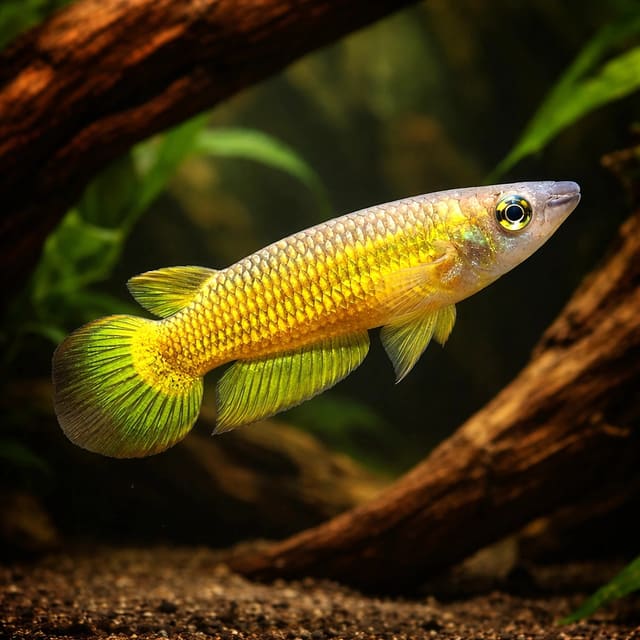
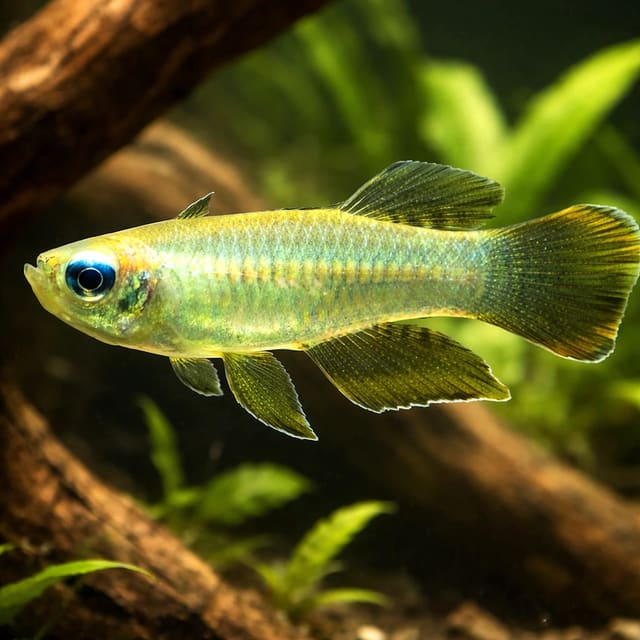
This is a good choice for keepers who enjoy planted aquariums with movement near the surface. It is not a tiny nano fish and it should not be mixed with fry, tiny shrimp or very small tank mates. In the right covered aquarium it becomes a confident top-level fish, showing metallic green, blue and gold tones, yellow-green fins and the distinctive panchax mouth built for taking insects and small prey from above.
FishBase places Aplocheilus dayi as endemic to Sri Lanka, with reports from India and the Malay Peninsula treated separately in the source record. The habitat note is very useful for aquarium care: shallow, heavily shaded forest streams with a silt substrate, and also brackish mangrove swamps where it may occur with Aplocheilus parvus. U.S. Fish & Wildlife Service also lists the common names Ceylon killifish and striped topminnow.
Aquarium Glaser adds a practical trade note: Sri Lanka has distinct Aplocheilus dayi and Aplocheilus werneri populations/species, with A. dayi linked to the Kelani basin and adjacent coastal areas. For customers, the important point is to use the name on this listing, Aplocheilus dayi, and avoid treating it as a generic Golden Wonder or Blue Panchax. It is a Sri Lankan panchax with its own behaviour and care rhythm.
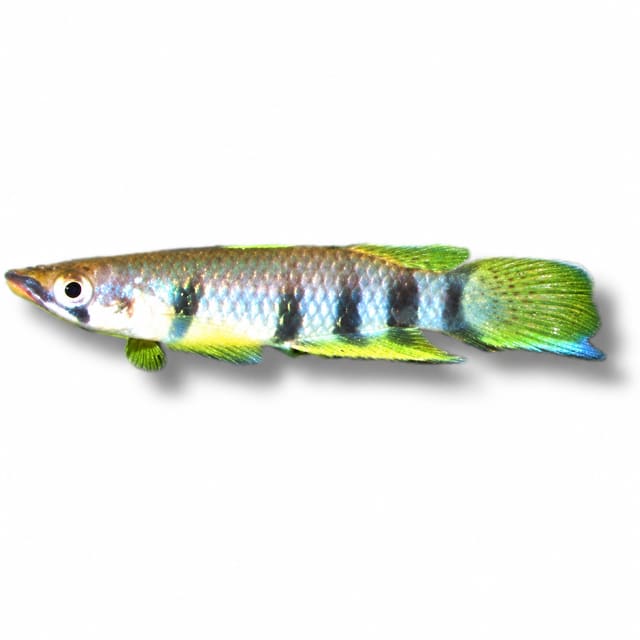
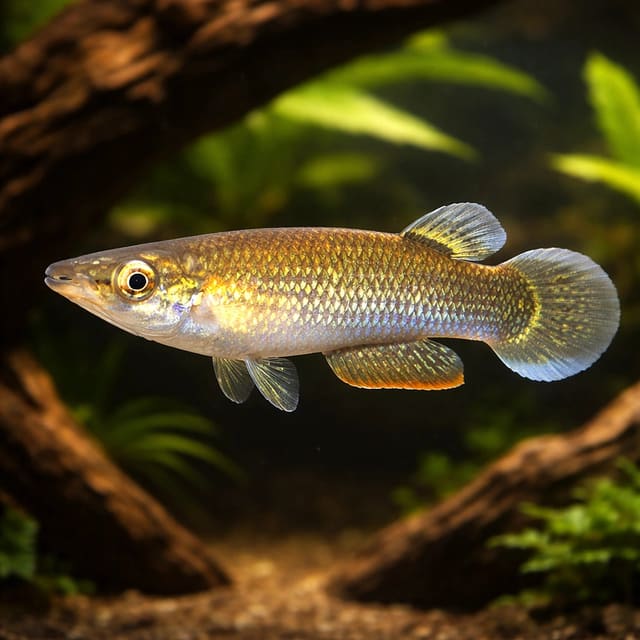
Mature males can be very attractive without needing exaggerated marketing copy. British Killifish Association describes males as metallic gold to olive above, metallic green on the flanks with a bluish sheen, red spotting, a pale blue to violet belly and yellow-green fins with red markings. Females are usually plainer and may show faint darker striping. FishBase and older aquarium references note a dark mark near the rear of the dorsal-fin base, which is one of the useful features hobbyists notice in this species group.
The original reference photo added to this product is kept as the real fish reference for SKU 3050.
Use a mature, covered aquarium. A tight lid is essential because panchax are surface fish and can jump through surprisingly small gaps. A 60 litre tank is a sensible minimum for a pair or small group if the layout is calm and planted. If you want a mixed community, or if males are sparring, give them 75 litres or more with broken lines of sight.
Floating plants make a real difference. Salvinia, frogbit, Pistia, Java moss, trailing roots and shaded corners help the fish settle and show natural behaviour. Keep some open surface area for feeding, but avoid a bare, bright tank with a strong filter jet. BKA specifically notes that the fish do better with good planting, floating cover, subdued light and water that is not heavily disturbed by aeration or filtration. Gentle sponge filtration or a softened return from an external filter suits them well.
The source range is wider than the best everyday target. FishBase lists a tropical line around 20-25 C, BKA gives about 72-77 F, and Aquarium Glaser reports 22-28 C. For this shop listing, 22-28 C is retained as the tolerant range, but a stable 22-25 C target is kinder for long-term care unless you are deliberately conditioning fish for breeding. Use pH 6.0-7.5 and roughly 5-15 dGH as practical aquarium guidance. They are adaptable, but sudden swings, dirty water and hot stagnant tanks are not good for them.
Aplocheilus dayi is a carnivorous surface feeder. FishBase records small insects, insect larvae and fish fry in the diet, which explains both the upturned mouth and the need to avoid tiny tank mates. Offer a varied menu of quality floating micro-pellets, small soft granules, frozen daphnia, brine shrimp, mosquito larvae, bloodworm in moderation, white worm, grindal worm and small live foods where available.
Feed near the surface and watch that slower fish are not taking everything before the panchax settles. Small meals once or twice daily are better than one heavy feed. Remove uneaten food quickly because rich frozen and live foods can spoil a small planted aquarium faster than dry food.
The Singhalese Panchax is best described as a semi-aggressive surface predator rather than a harmless nano community fish. It can work in a planted community, but the other fish need to be too large to swallow, calm enough not to stress it, and quick enough to feed without fin-nipping. Similar-sized rasboras, danios and peaceful lower-level fish can work in a larger tank. Small loaches or catfish that stay away from the surface are often better companions than tiny top-dwellers.
Avoid fry, very small tetras, tiny rasboras, small shrimp, long-finned slow fish and aggressive species that will turn the upper level into a fight. Males may chase females, especially during breeding condition, so plant cover and hiding places matter. If a female is being driven constantly, separate or rearrange the tank rather than hoping it will settle by itself.
This is not a seasonal annual killifish. FishBase lists it as not seasonal, and hobby sources describe it as a plant, root or mop spawner. BKA reports good results with willow root, coconut fibre and strands of Myriophyllum near the surface, with eggs removed regularly and hatching around 11-13 days at about 74 F. Aquarium Glaser reports spawning in Java moss and similar material, with young hatching after about 12-14 days and taking Artemia nauplii from the start.
If breeding is the goal, condition adults with varied live and frozen foods, provide floating cover and fine spawning media, and be ready to protect eggs and fry from adults. The fry are predatory early, so sorting by size helps reduce losses.
Choose this fish if you want a characterful Sri Lankan killifish for the upper level of a planted aquarium and you can provide a lid, floating cover and suitable food. It is less suitable for tiny nano tanks, uncovered aquariums, shrimp breeding setups, or mixed tanks full of very small fish.
Your order is packed for specialist live-fish courier travel and covered by our Live Arrival Guarantee. The first-order code WELCOME10 can be used when eligible at checkout. Those trust points belong in the page because they help customers understand the buying experience, but the care text stays focused on the fish rather than forcing buyer keywords into every paragraph.
Care guidance for this refresh was checked against FishBase for taxonomy, size, habitat, temperature line, diet and non-seasonal status; British Killifish Association for aquarium keeping, floating-cover and breeding detail; Aquarium Glaser for practical trade observations and the 22-28 C range; Killi.co.uk for hobby breeding context; U.S.
No reviews for this item yet. Bought one? Honest reviews only, good or bad.
What customers say about ordering from us
I have a small group of long finned mountain minnows. So was delighted to be able to order ten of this variety to increase the genetics in my tank . The ones I recieved are healthy but it’s to early to give a verdict on wether they are of a long finned type since they are small currently.
Gordon Walker · 23 Sept 2026
100% success travel and "installation". Pleased with quality of purchase. The Siamese fighter a bit "shy" so have not yet seen him at his best yet but looking good. Happy customer. GG
George E Garratt · 21 Sept 2026
Reviews of our shop, collected by Judge.me, an independent third-party review collector. Newest first.