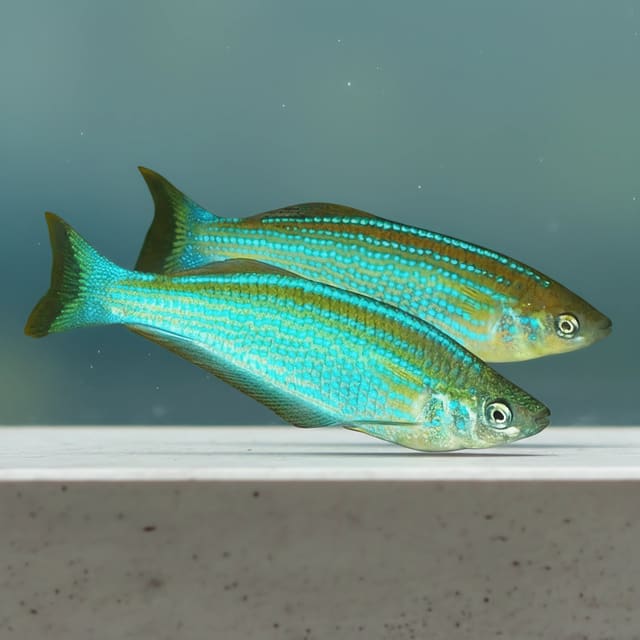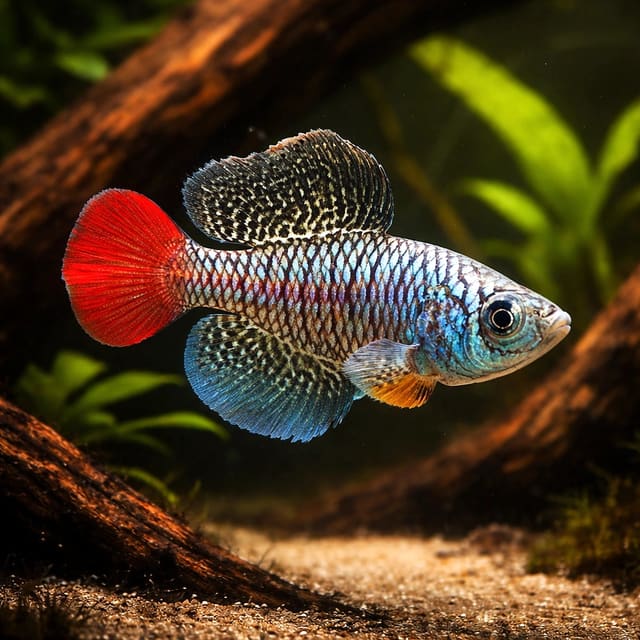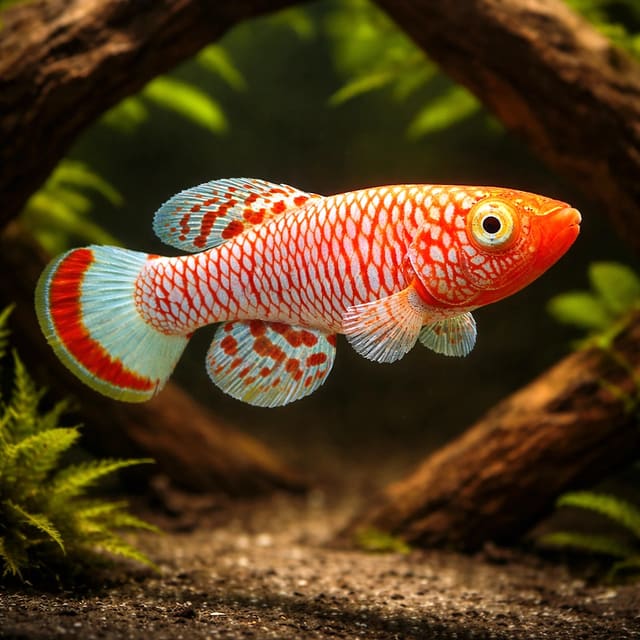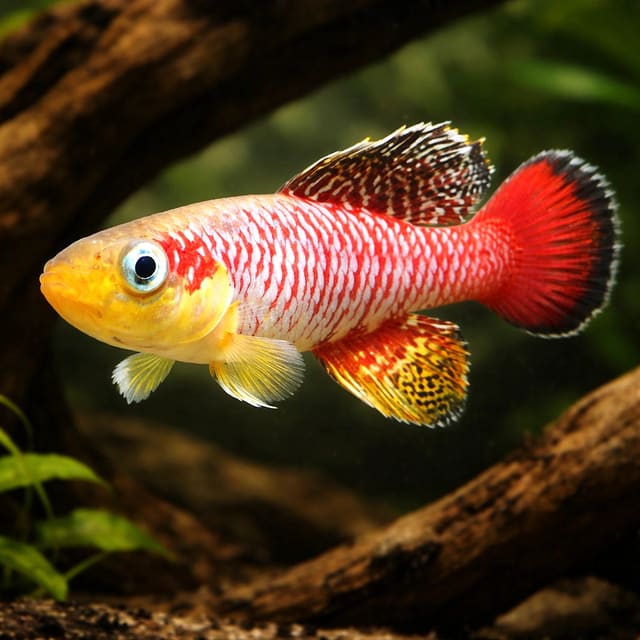
Gunther's Nothobranch (Nothobranchius guentheri)
22–25°C · pH 6–7
£11.99

Gardner's Killie Nsuka is a colourful steel-blue lyretail killifish for planted, covered aquariums. Best for keepers who can offer calm tank mates, live or frozen foods and stable soft to neutral water.
Adult size is the maximum length this species reaches at full maturity (scientific sources). The livestock you receive will be younger and smaller. Product-photo provenance and any image-specific limitations are stated on the listing.
Aphyosemion gardneri green
Save when buying multiple fish. Each quantity is one fish; sex and pair formation are not guaranteed unless the selected variant explicitly states them.
Confirm your email, then we’ll send an availability message for this exact item if it returns within 180 days.
This request is only for this product—no newsletter or other promotions. A mail-provider retry may very rarely duplicate the same availability message. Unconfirmed addresses are removed after 48 hours. See our privacy policy.
Gardner's Killie Nsuka is a colourful steel-blue lyretail killifish for planted, covered aquariums. Best for keepers who can offer calm tank mates, live or frozen foods and stable soft to neutral water.
Adult size is the maximum length this species reaches at full maturity (scientific sources). The livestock you receive will be younger and smaller. Product-photo provenance and any image-specific limitations are stated on the listing.
Maintain these water conditions for optimal health and vibrant colors
Gardner's Killie Nsuka is sold under the trade name Aphyosemion gardneri green, within the wider Fundulopanchax gardneri group. The fish is best understood as a colourful, surface-leaning West African killifish: compact, bright, alert, and very rewarding for aquarists who enjoy planted tanks, careful feeding and breeding behaviour.
| Listing name | Gardner's Killie Nsuka / Steel Blue Lyretail Killifish |
|---|---|
| Source / trade name | Aphyosemion gardneri green |
| Accepted group name | Fundulopanchax gardneri, often sold as Gardner's Killi or Blue Lyretail |
| Typical adult size | About 5.5-6.5 cm depending on sex, age and strain |
| Tank length | 60 cm is the sensible planning point; a well-covered 40 litre species setup can work for an experienced pair/trio keeper |
| Water | Soft to moderately hard, pH around 6.0-7.4, stable and clean rather than extreme |
| Temperature | Best planned around 20-24°C |
| Diet | Small carnivore foods, especially live and frozen foods such as daphnia, mosquito larvae, cyclops and bloodworm |
| Temperament | Generally peaceful with calm fish, but males can spar and the species should not be crowded with fin-nippers |
| Best for | Planted tanks, killifish keepers, careful community tanks and breeding projects |
The male Gardner's Killie Nsuka is the visual reason people fall for this group. Under subdued aquarium lighting the body can show blue-green, turquoise and steel tones, broken by red speckling and red bars through the fins. The lyretail shape gives the fish a sharp, elegant outline, especially when the dorsal and caudal edges catch the light. Females are usually more olive or brown, with softer spotting and less intense fin colour, but they are just as important if you want natural behaviour or breeding success.
Do not judge this fish by a pale dealer-tank moment. Like many killifish, it colours best after settling, feeding well and feeling secure. A dark substrate, floating plants, fine-leaved cover and a calm room all help the fish show its pattern. In a bare bright tank it may look washed out and spend more time hiding. In a planted tank it becomes a small display fish with a lot of movement for its size.
Fundulopanchax gardneri is a West African killifish associated with Nigeria and Cameroon. FishBase records the species from brooks, swamps, pools and streams in humid forested and savanna-influenced habitats, with males reaching about 6.5 cm total length. The British Killifish Association also treats the group as a classic aquarium killifish and notes that adults take live foods readily, with good dried foods used as a supplement.
The naming is messy because the aquarium trade has used Aphyosemion gardneri, Fundulopanchax gardneri, Blue Lyretail, Gardner's Killi and steel-blue killifish at different times. Fundulopanchax gardneri is the accepted modern name and is familiar to many serious hobbyists.
Plan around a covered 60 cm aquarium for the most comfortable long-term display, especially if you want a pair or trio. A specialist keeper can maintain a pair in a smaller mature planted setup, but the bigger tank gives better territory, cleaner water and more room for females to avoid constant male attention. A tight lid is not optional. Killifish are powerful jumpers and will find tiny gaps around cables, filters and feeding holes.
Use gentle water movement rather than a blasting current. Gardneri-type killifish are active, but they do not need a river-tank flow. A sponge filter, small internal filter or well-baffled external outlet is ideal. The filter should keep ammonia and nitrite at zero while leaving calm surface areas for the fish to feed and display.
| Temperature | 20-24°C is a good daily range; avoid repeated swings |
|---|---|
| pH | 6.0-7.4 is a practical range; stable soft to neutral water is better than chasing exact numbers |
| Hardness | Soft to moderately hard water; avoid very hard, alkaline extremes for breeding projects |
| Nitrate | Keep low with small regular water changes and sensible feeding |
| Acclimation | Slow acclimation is recommended, especially after courier travel or if your water differs from the holding system |
The species is not fragile when settled, but it rewards consistency. Sudden temperature changes, dirty water and overfeeding cause more problems than a pH value that is a little above or below a textbook number. If you keep the tank mature, covered, planted and lightly stocked, the fish usually behaves confidently.
Give this fish a planted aquarium with broken sight lines. Floating plants, Java moss, fine-leaved stems, roots, leaf litter and dark areas all help. Spawning mops can also be used if you want to collect eggs without dismantling the aquascape. A dark background and dark substrate make the blue-green body and red markings more visible.
Bright open aquariums are less flattering. The fish may still live, but it will not show the same colour or behaviour. Think shaded stream edge rather than empty showroom tank. Leave enough open surface for feeding, but give the fish places to pause and feel secure.
Gardner's Killie Nsuka is a small carnivore. The safest feeding plan is variety in small portions: frozen daphnia, cyclops, mosquito larvae, bloodworm, brine shrimp, grindal worm and high-quality small floating or slow-sinking prepared foods. Live foods are especially useful for conditioning, but clean frozen foods are more practical for most UK aquarists.
Feed lightly. Killifish have quick appetites, but old food trapped in plants can spoil water and harm eggs or fry. Two small meals are better than one heavy feed if you are conditioning a breeding group. Remove uneaten food and keep the filter mature.
| Daily base | Small frozen foods, quality micro pellets or fine carnivore granules once accepted |
|---|---|
| Conditioning foods | Daphnia, mosquito larvae, cyclops, grindal worm and occasional bloodworm |
| For fry | Infusoria or very fine first foods, then newly hatched brine shrimp or microworm as size allows |
| Avoid | Large hard pellets, stale food, fatty overfeeding and aggressive competition from fast surface feeders |
A fish that refuses all prepared foods is not unusual in specialist killifish. Be patient and use food movement to trigger feeding. Once settled, many individuals learn to take small prepared foods, but live and frozen foods should remain the core for colour, breeding condition and long-term interest.
This is best kept as a species pair/trio or with quiet, similarly sized fish that do not nip fins and do not dominate the surface. Good candidates are calm small tetras, peaceful rasboras, small Corydoras in a suitable tank, gentle dwarf cichlids in the lower zones and other peaceful fish that leave the killifish space. Avoid boisterous barbs, aggressive livebearer groups, large cichlids, predatory fish and fast surface feeders that will outcompete them.
Males may chase females, especially in a small tank with no cover. A trio of one male and two females can spread attention, but only if the tank has enough plants and retreat space. More than one male needs more room and visual breaks. If you see torn fins, constant hiding or one fish being pinned into a corner, the setup is not calm enough.
| Best setup | Species pair/trio in a planted, covered aquarium |
|---|---|
| Good community style | Peaceful, slow to moderate tank mates that avoid fin-nipping and heavy surface competition |
| Risky choices | Barbs, large cichlids, aggressive males, very fast livebearers and fish that need bright open water |
| Invertebrates | Adult shrimp may be ignored, but tiny shrimplets can be eaten; do not rely on this species as shrimp-safe |
This is one of the reasons Gardneri-type killifish have stayed popular for decades. They are not annual killifish and do not need a dry peat cycle like many seasonal species. They spawn among plants or mops, and eggs can be collected and incubated separately if you want better fry survival. The parents may eat eggs or tiny fry, so a dedicated breeding setup is more reliable than a busy community aquarium.
Condition adults with live and frozen foods, then offer floating and sinking mops or dense fine plants. Check mops regularly and move eggs to a small clean container with suitable water if you are collecting them. Good hygiene is essential. Remove infertile or fungus-covered eggs, keep incubation stable and feed fry with appropriately small foods as soon as they need them.
Expect a fish that spends much of its time in the upper half of the aquarium, watching movement and rising quickly for food. Males display with flared fins and sharper colour, while females tend to move more quietly through cover. The fish is curious, but it is also quick to retreat when startled. A calm room, stable routine and planted cover make it much more visible.
Because the fish is compact, it works well as a focus species in smaller planted aquariums where large cichlids or active shoaling fish would overpower the space. It is also a good candidate for keepers who want a breeding project without needing a large fish house. The trade-off is that you must respect the lid, food quality and male-female dynamics.
Healthy individuals should be alert, responsive to food, clear-eyed and steady in the water. Fins should not be clamped, ragged or covered in white edging. The body should be slim but not pinched, and the fish should not gasp at the surface. After delivery or collection, keep lights low at first and give the fish time to recover before heavy feeding.
Most problems come from dirty water, overfeeding, stress, sudden changes or inappropriate tank mates. Fin damage can follow male chasing or nippy companions. Fungal eggs are a separate breeding issue and should not be confused with adult disease. Quarantine is sensible whenever you add new livestock to an established aquarium.
Choose this fish if you want a colourful killifish with real character, a manageable adult size and the possibility of breeding at home. It is a strong fit for aquarists who already understand mature filters, small frozen foods, planted cover and careful acclimation. It is less suitable for uncovered tanks, very bright bare aquariums, rough community tanks or keepers who want a fish that thrives on flake alone.
If you are comparing it with Clown Killifish, Gardner's Killie is larger, bolder and more substantial. If you are comparing it with Golden Wonder Panchax, Gardner's Killie is smaller and usually easier to house in a planted 60 cm aquarium. If you are comparing it with Blue Gularis, Gardner's Killie is more manageable for most home aquariums and less demanding for space.
| Compared with Clown Killifish | Gardner's Killie is larger, bolder and more colourful as a centrepiece pair/trio |
|---|---|
| Compared with Golden Wonder Panchax | Gardner's Killie stays smaller and is easier to plan around in a planted community or species tank |
| Compared with Blue Gularis | Gardner's Killie is usually more manageable and less space-demanding for everyday hobbyists |
| Compared with generic nano fish | It offers stronger individual behaviour and breeding interest, but needs a lid and better food variety |
If you plan a breeding pair or trio, confirm the sex and availability of the fish before ordering; the current option does not specify a sexed group. Gardneri-type killifish are strongly dimorphic, so a bright male and a quieter female can look like different products to a new keeper. A male-only display can work in the right circumstances, but a mixed pair or trio gives better natural behaviour and breeding interest. If you want eggs or fry, ask yourself whether you have space to raise young fish before you encourage spawning.
After arrival, float and acclimate carefully, then release the fish into a dim tank with the lights low. Do not immediately chase it for photos or overfeed because the fish has already experienced shipping stress. Offer a very small first meal only after it has settled and is swimming normally. The next day, feed lightly and watch the fish rather than the food. Strong appetite, upright posture, clean fins and confident surface movement are better signs than instant colour.
Colour often improves over the first week. A male that looked olive in the bag can show blue, green and red once it is feeding and defending a small area. Females should not be dismissed because they provide social balance and are essential to a breeding group. If a male constantly drives a female into one corner, add more plants, move decor to break the line of sight or separate the fish before damage occurs.
A good routine keeps this species easy. Test new tanks until ammonia and nitrite are reliably zero. In established aquariums, change a modest amount of water every week or two, clean the filter gently in old tank water when flow drops, and remove trapped food from moss or plant thickets. The goal is not sterile water; the goal is stable, oxygenated water without waste building up.
Because this fish is often conditioned with rich foods, water quality can slip if feeding is heavy. Use a feeding dish area or a clear front corner so uneaten food is easy to see. If you are raising fry, keep separate fry containers cleaner than the adult tank because tiny fish are less forgiving of bacterial build-up. Small, frequent maintenance is safer than dramatic large changes after the tank has already deteriorated.
| Daily | Check lid gaps, fish posture, appetite and whether any individual is hiding from pressure |
|---|---|
| 2-3 times weekly | Rotate food types and remove uneaten food after feeding |
| Weekly | Small water change, plant trim if needed, wipe viewing glass and check filter flow |
| Breeding weeks | Inspect mops or fine plants, move viable eggs if you are raising fry separately |
| After delivery | Keep lights low, feed lightly and avoid moving decor for the first few days |
The first mistake is an uncovered tank. Even calm killifish jump, and a single fright can be enough. Cover every gap around filter pipes, airline tubing and feeding holes. The second mistake is treating the fish like a hard-water livebearer. It can tolerate a range of conditions, but it is not a guppy or swordtail and should not be used as a rough community filler.
The third mistake is buying for colour without preparing the food. This fish is at its best on small live and frozen foods. If you only feed large flakes or floating sticks, it may survive but it will not show the same condition. The fourth mistake is crowding males or keeping a female in a bare tank with no refuge. Breeding interest is a strength of the species, but only when the aquarium gives the fish choices.
A simple layout works better than a complicated one. Start with a dark fine substrate, add a small piece of wood or leaf litter for shade, place fine-leaved plants or moss near the back and sides, then leave a calm open feeding lane at the front. Floating plants are especially valuable because they dim the surface, make the fish feel less exposed and give females somewhere to pause away from the male.
Do not pack the entire surface with plants. The fish needs access to air-water contact for feeding and display, and you need clear areas to observe appetite and body condition. A balanced layout gives cover at the edges, open water in the centre and a few vertical plant stems that interrupt a chasing male's line of sight. That is the difference between a tank that merely holds the fish and a tank that lets it behave naturally.
If you want photographs, use side light and a darker background rather than intense overhead light. The blue and green tones often appear strongest when the fish is angled slightly to the camera. The red spotting becomes clearer when the fish is settled, well fed and not washed out by pale gravel. These visual details are useful for buyers because they explain why the same fish can look different in a dealer tank, a planted display and a flash photograph.
Before encouraging spawning, decide how you will house the fry. A single successful pair can produce more young fish than expected, and fry need tiny foods, clean water and sorting as they grow. If you only want a display fish, you can leave mops out and enjoy the adults. If you want a breeding project, prepare egg containers, small rearing tanks and first foods before conditioning the adults heavily.
Spawning mops are useful because they let you remove eggs without disturbing the adults. Dark acrylic mops are easy to inspect and do not decay like natural fibre. Java moss and other fine plants can also be used, but eggs are harder to find. Keep records of dates, parent group and incubation conditions if you are maintaining a line. That kind of simple note-taking is one of the habits that separates successful killifish keeping from accidental fry surprises.
Fry should not be placed back with hungry adults too early. Raise them separately until they are large enough to compete for food and avoid being eaten. Feed small meals often, keep water clean and move faster-growing fry if they begin to dominate. The goal is steady growth, clean fins and strong feeding response, not rapid growth at the expense of water quality.
Availability can change quickly. When available, livestock is packed for UK courier movement with insulated packaging and a Live Arrival Guarantee for eligible orders. Please check the current product availability, weather window and delivery terms at checkout before ordering.
For best results, prepare the tank before the fish arrives: mature filter, covered lid, stable temperature, floating cover and suitable food ready in the freezer. If the fish is out of stock, use the page as a care reference and check back rather than buying a different strain by mistake. Similar names in killifish can hide real differences in colour, size, temperament and breeding line.
Care ranges and identity notes were cross-checked against FishBase for Fundulopanchax gardneri, the British Killifish Association species notes, and established aquarium profiles such as Seriously Fish. These references support the adult-size planning, covered aquarium advice, planted setup, carnivore feeding and non-annual spawning notes used above.
No reviews for this item yet. Bought one? Honest reviews only, good or bad.
What customers say about ordering from us
I have a small group of long finned mountain minnows. So was delighted to be able to order ten of this variety to increase the genetics in my tank . The ones I recieved are healthy but it’s to early to give a verdict on wether they are of a long finned type since they are small currently.
Gordon Walker · 23 Sept 2026
100% success travel and "installation". Pleased with quality of purchase. The Siamese fighter a bit "shy" so have not yet seen him at his best yet but looking good. Happy customer. GG
George E Garratt · 21 Sept 2026
Reviews of our shop, collected by Judge.me, an independent third-party review collector. Newest first.