−12%
Moderate
African Glass Catfish (Pareutropius debauwi)
22–27°C · pH 6–8
£12.31£13.99

The Large-Spot Synodontis (Synodontis ocellifer) is a Mochokidae catfish from African river basins that reaches a recorded maximum of 49 cm. It suits beginners able to plan for its adult size; keep it at 23–27°C and pH 6.2–8.0, while a small group requires a refuge for every fish. Sold individually in dispatch sizes from 2.5–3 cm to 7–8 cm.
Adult size is the maximum length this species reaches at full maturity (scientific sources). The livestock you receive will be younger and smaller — pick a size above for the actual shipping size. Product-photo provenance and any image-specific limitations are stated on the listing.
Synodontis ocellifer
Shoaling fish: kept in a group they feel safer, stay calmer and show their best colour.
The Large-Spot Synodontis (Synodontis ocellifer) is a Mochokidae catfish from African river basins that reaches a recorded maximum of 49 cm. It suits beginners able to plan for its adult size; keep it at 23–27°C and pH 6.2–8.0, while a small group requires a refuge for every fish. Sold individually in dispatch sizes from 2.5–3 cm to 7–8 cm.
Adult size is the maximum length this species reaches at full maturity (scientific sources). The livestock you receive will be younger and smaller — pick a size above for the actual shipping size. Product-photo provenance and any image-specific limitations are stated on the listing.
Maintain these water conditions for optimal health and vibrant colors
The Large-Spot Synodontis (Synodontis ocellifer) is a freshwater, benthopelagic catfish in the Mochokidae family. FishBase places it in African river basins including the Senegal, Gambia, Niger and Benue, Volta and Chad systems, as well as the Densu system in Ghana and Kwa Ibo in Nigeria. Its recorded maximum adult length is 49 cm total length. It suits a beginner who is ready to plan around that substantial maximum size, select companions carefully and maintain a filtered aquarium.
Keep it at 23–27°C, pH 6.2–8.0 and 5–18 dGH. Temperature is the overlap of FishBase, Seriously Fish and OATA; pH and hardness are the overlap of Seriously Fish and OATA. OATA’s freshwater-catfish figures are group guidance, not a species-specific optimum. Seriously Fish describes this as one of the hardiest Synodontis and a good beginner choice, but its adult size rules out treating it as a small general-community catfish.
| Suits | Not suited to |
|---|---|
| Keepers planning around a recorded 49 cm maximum | A general community aquarium planned around small fish |
| An aquarium with a soft substrate, hiding places and open floor area | Any setup containing fish small enough to be considered food |
| Water maintained at 23–27°C, pH 6.2–8.0 and 5–18 dGH | An aquarium without a mature, maintained filter |
| A carefully planned small group with one refuge per fish | A group without enough space and individual refuges |
One purchase supplies one Large-Spot Synodontis. Use the live size selector to choose the dispatch label that suits your plan: 2,5 - 3 cm, 4,5 - 5 cm or 7 - 8 cm. The size you select is the size supplied, not the adult size. Every choice therefore needs the same long-term plan for a fish with a recorded maximum of 49 cm.
Do not use dispatch length to infer sex, maturity or origin. Sex is guaranteed only when the selected option explicitly states male or female. This Large-Spot Synodontis listing has no sex-guaranteed option. Seriously Fish notes that reliable examination of the genital papillae is not an amateur method, so appearance or size should not be used to assign sex.
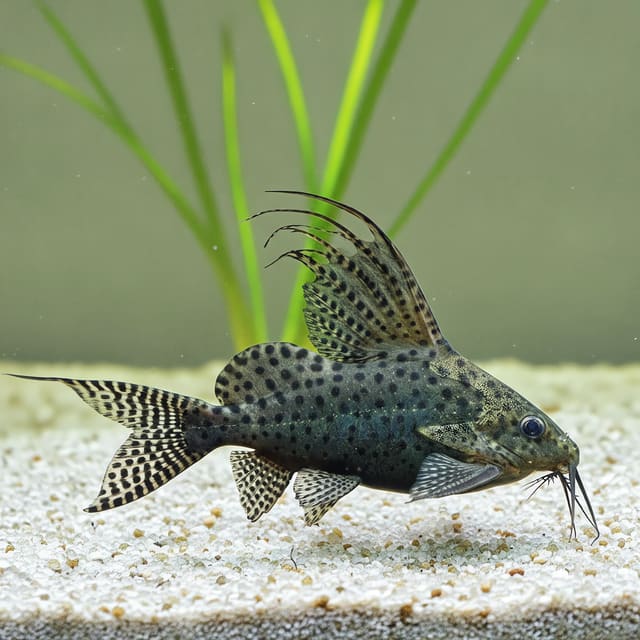
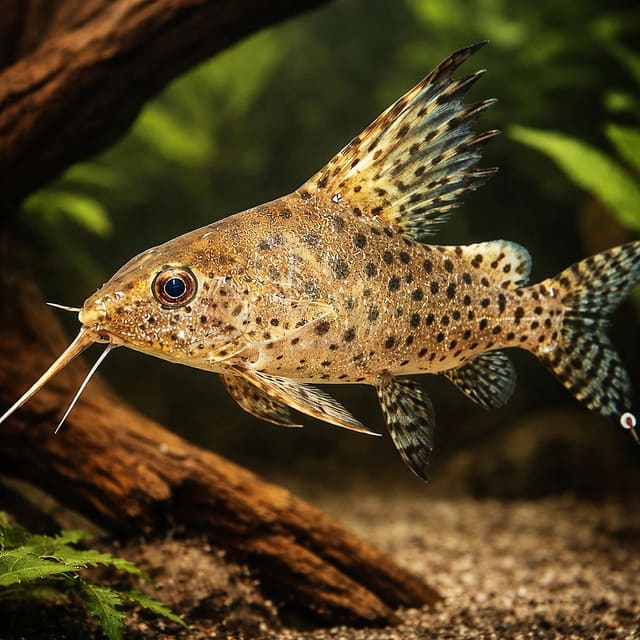
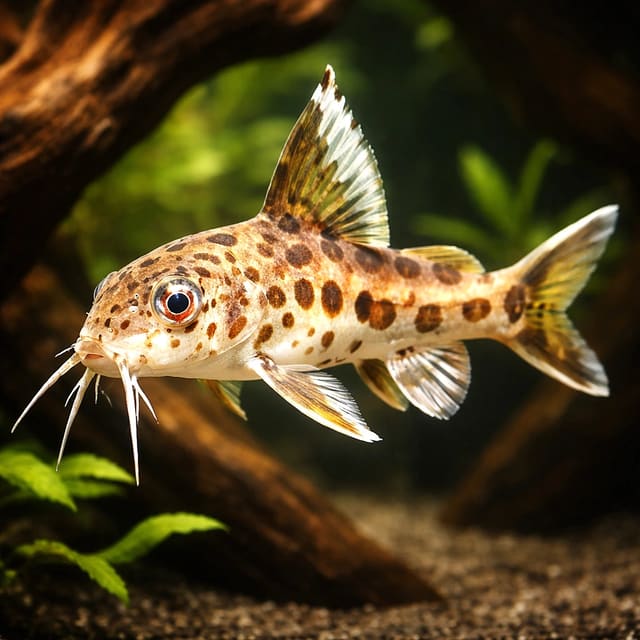
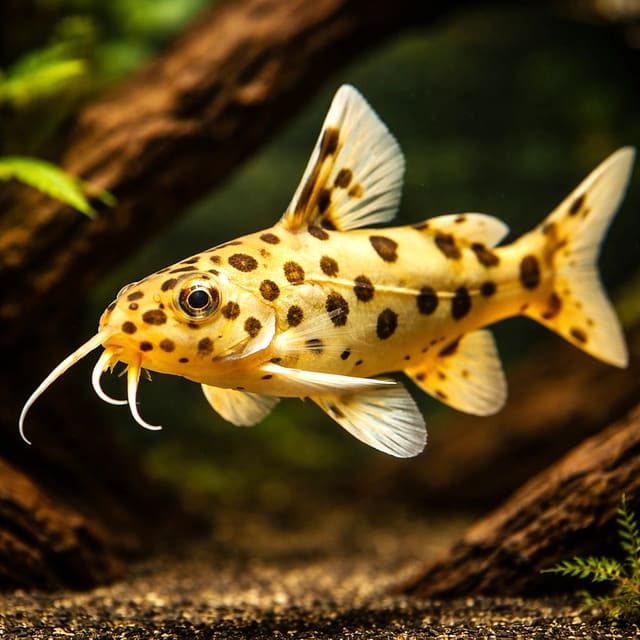
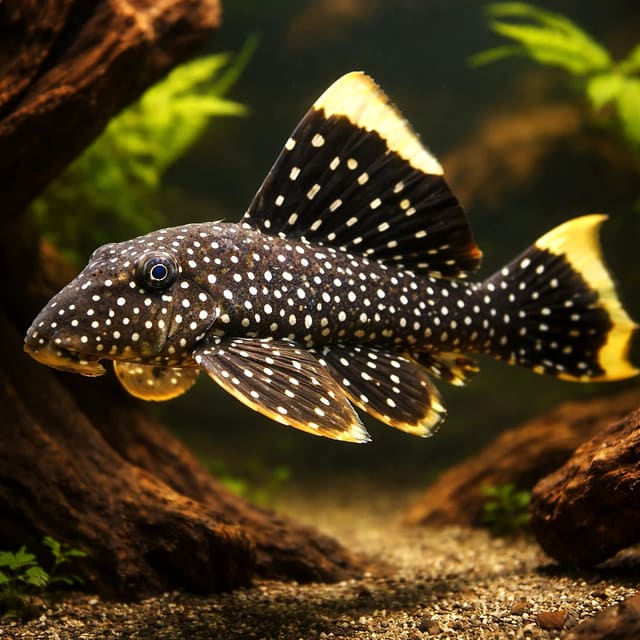
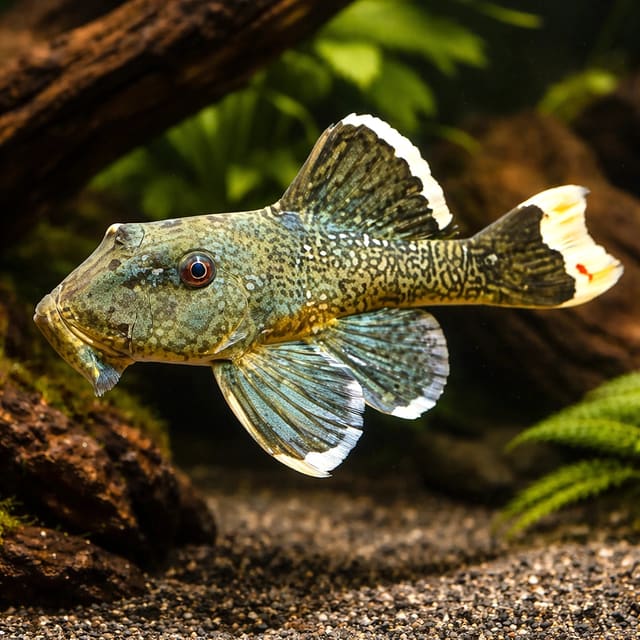
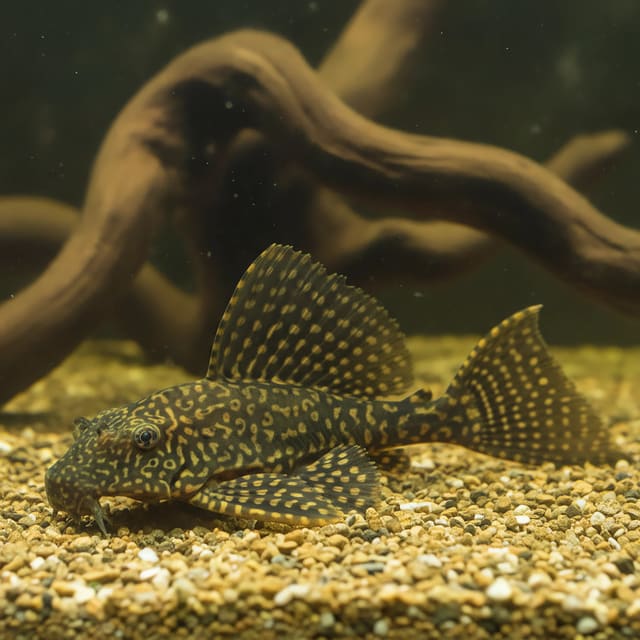
Some gallery images have been digitally enhanced to improve image quality. They show the listed type of animal rather than guaranteeing the exact markings of the individual supplied, so natural colour and pattern can vary. The pictures help illustrate the spotted catfish form, barbels and fin shape, while the aquarium must be planned from the species identity and care figures rather than the apparent scale of a scene.
If this adult size does not fit your aquarium plan, browse the catfish and plecos collection and compare each animal’s adult dimensions, water range and social requirements before choosing.
Plan around the FishBase maximum of 49 cm total length from the beginning. Seriously Fish lists a different aquarium-profile length of 20 cm standard length; its aquarium reference is a 90 × 30 cm base with approximately 81 litres. Use 81 litres and that base as the starting reference, then allow enough usable floor area for the adult fish, its refuge and every intended companion.
The base dimensions matter because rocks, roots and driftwood occupy floor space. A nominal volume can lose much of its usable area when decor is crowded together. Place the principal refuge first, add the soft substrate and additional cover, then check that clear routes remain between those features. For a small group, enlarge the plan and give every fish a refuge of its own.
A dispatch-sized fish does not make a smaller aquarium a suitable long-term choice. Arrange the final footprint, filtration and refuge plan before adding the catfish so that later changes do not depend on squeezing a growing fish around fixed decor.
Use a soft substrate with rocks, pieces of driftwood and twisted roots arranged to create hiding places. Seriously Fish recommends this layout for Synodontis ocellifer, while floating vegetation can diffuse the light entering the aquarium. Other planting is beneficial but not essential.
Start with the principal hiding place and make sure its entrance remains accessible after the substrate and surrounding wood are installed. Add further refuges before adding another Synodontis. The species may become slightly territorial as it matures, particularly towards other Synos, and a small group is appropriate only in a suitably sized aquarium where every fish has a refuge to call home.
Check the arrangement from the catfish’s level. A hiding place should remain usable once neighbouring roots and plants are in position, and each fish in a group should be able to occupy a separate refuge. The adult-size plan still applies after decor has reduced the open footprint.
Soft substrate, structured hiding places and broken-up sight lines create a practical layout without turning the base into a dense obstacle course. This gives the catfish defined cover while preserving the floor area needed for a substantial adult and its screened companions.
Keep the aquarium at 23–27°C, pH 6.2–8.0 and 5–18 dGH. These targets stay inside the overlap described above: FishBase, Seriously Fish and OATA overlap at 23–27°C, while Seriously Fish and OATA overlap at pH 6.2–8.0 and 5–18 dGH. Stability within these values is the routine goal.
Measure your aquarium rather than estimating from tap-water reputation or past livestock. Our water chemistry guide explains what the common tests measure, and the water matcher lets you compare measured values with this range. Record temperature, pH and hardness together so a change in one value is not considered in isolation.
The RSPCA explains that fish release toxic ammonia and that a working biological filter supports bacteria which convert ammonia to nitrite and then to the safer nitrate. OATA’s targets are zero mg per litre ammonia, zero mg per litre nitrite and nitrate no more than 20 mg per litre above the normal tap-water level.
Seriously Fish recommends filtration turning over the aquarium volume four to five times each hour. For its approximately 81-litre reference aquarium, that corresponds to a filter rated around 325–405 litres per hour. Check the actual aquarium volume and the filter’s rated flow rather than copying that example to a differently sized system.
For the same approximately 81-litre reference, Seriously Fish estimates roughly 75–100 W of heating to maintain 23–28°C when the room is around 20°C. Select equipment for the real room temperature and aquarium volume, then use a thermometer to hold this listing’s routine target of 23–27°C.
Carry out a 25% partial water change at least once every week. OATA recommends using a siphon to remove solid waste from the gravel while water is removed. Treat replacement tap water with conditioner to remove chlorine or chloramine before it enters the aquarium.
Test the water at least once per week for ammonia and nitrite, and track nitrate against the tap-water baseline. Ammonia and nitrite should remain at zero mg per litre. Nitrate should not exceed 20 mg per litre above the normal tap-water level. If either ammonia or nitrite appears, make water quality the immediate priority and review recent stocking, feeding and filter performance.
Chlorine or chloramine can kill the beneficial bacterial population established in filter media. Light rinsing in removed aquarium water reduces the amount of bacteria lost while clearing debris. Avoid turning routine cleaning into a complete strip-down when a light rinse is all that is required.
Keep a simple dated record of test results, water changes and filter checks. This makes a rising nitrate trend, declining flow or repeated ammonia reading easier to identify than relying on memory. Pair those records with daily observation of behaviour and feeding so that changes in the fish can be compared with measured conditions.
Feed a varied omnivorous diet. Seriously Fish records frozen, live and dried foods as accepted and recommends a quality dried product alongside an algae-based food. It also records shelled peas and cucumber as vegetable matter that this Synodontis will rasp with the teeth in its lower jaw.
Choose an appropriate sinking food so the catfish receives a deliberate meal rather than depending on food missed by other fish. OATA advises feeding catfish only what they can eat within a few minutes, once a day. Remove uneaten food because it breaks down and releases waste into the water.
| Food decision | How to use it |
|---|---|
| Quality dried food | Use as a regular part of the omnivorous rotation. |
| Algae-based food | Include alongside the quality dried product. |
| Frozen or live food | Rotate for variety within the same measured daily ration. |
| Shelled peas or cucumber | Offer as the recorded vegetable component. |
For foods that require grazing, OATA allows up to 30 minutes when required. Check afterwards and remove what remains. Do not respond to uneaten food by adding another product immediately; first check whether the portion was too large, the food was inaccessible or the fish’s behaviour has changed.
A measured meal helps protect the zero-ammonia and zero-nitrite targets. Increasing food also increases the load placed on the biological filter, so make changes gradually and continue the weekly testing routine. Reduced intake or loss of interest in food belongs in the health check alongside breathing, swimming and body condition.
Have the aquarium, decor, heater and biological filter operating before the fish arrives. The first tropical aquarium guide explains how to prepare and mature the system. Before adding the catfish, confirm that ammonia and nitrite are both zero mg per litre and that temperature, pH and hardness sit inside the stated range.
Add livestock gradually. OATA explains that the beneficial bacterial population established while a filter matures must increase whenever more fish are added and feeding rises. Adding too many fish too quickly can produce new tank syndrome, where nitrifying bacteria cannot process the increased waste and ammonia or nitrite reaches harmful levels.
When a new reading appears, act on the measurement rather than assuming a mature filter has unlimited capacity. Review recent additions and feeding, inspect the filter for blockage and complete the maintenance actions needed to restore zero ammonia and zero nitrite.
Planning the full community in stages also gives time to observe the Synodontis around its refuge. That observation is especially important before considering another Synodontis, because every fish in a small group needs its own refuge and enough aquarium space.
The fish is hand-bagged in pure oxygen, placed in an insulated poly box and given a heat pack when the weather calls for it. A licensed live-animal courier carries the parcel. Read the current delivery and Live Arrival Guarantee policy before the delivery date so the recipient, recording device and prepared aquarium are ready.
Film every delivery from the sealed parcel onward. For a Live Arrival Guarantee claim, the recording must show the sealed parcel, its continuous opening and the fish still inside the sealed bag. Keep the order number with the recording and contact us the same day if a claim is needed.
Once the fish has been released, return attention to the prepared aquarium: the water should already be within 23–27°C, pH 6.2–8.0 and 5–18 dGH, with zero ammonia and zero nitrite. Those aquarium checks come from the care plan; the sealed-parcel recording, floating period and release steps come from the delivery procedure.
Observe swimming, colour, temperament, breathing, appearance, body condition and feeding. OATA identifies changes in these areas as useful early signs that a fish may need attention. Compare what you see with the individual fish’s usual pattern instead of waiting for several signs to appear together.
| If you see | What to do first |
|---|---|
| Hanging at the surface, sitting on the bottom or erratic swimming | Test ammonia, nitrite, nitrate and temperature. |
| Darker or paler colour than normal | Check water readings and review recent aquarium changes. |
| More aggression or hiding than normal | Inspect refuge access and observe interactions with other Synodontis. |
| Gill covers moving faster or slower than normal | Test water quality promptly and check filter operation. |
| White spots, fluffy growths or loss of fins or scales | Record the change, test the aquarium and seek livestock health guidance. |
| Weight change or reduced interest in food | Review portions, remove leftovers and check the full set of water readings. |
Water testing is the first concrete check because ammonia and nitrite should be zero mg per litre and nitrate should remain within the stated limit. Inspect the filter for blockages at the same time. If media requires cleaning, rinse it lightly in removed aquarium water and do not run it under the tap.
Avoid choosing a treatment from appearance alone. Record when the change began, which signs are present, recent test results, feeding and any livestock additions. That concise history makes further guidance more useful while keeping water quality and welfare at the centre of the response.
Avoid any fish small enough to be considered food. Seriously Fish gives that instruction directly and does not recommend Synodontis ocellifer for the general community aquarium because of its adult size. Apply the rule to the adult community plan rather than judging safety from the catfish’s dispatch size.
Seriously Fish names Alestiid tetras, robust cichlids—particularly West African species—Mormyrids, knifefish, gouramis, larger rasboras and larger barbs as ideal examples. These names are starting points for screening, not universal matches. Check that the proposed animals fit the aquarium’s water, usable space and refuge plan and are not small enough to be considered food.
| Decision | Animals or condition |
|---|---|
| Avoid | Any fish small enough to be considered food |
| Avoid | A general community setup planned around small fish |
| Screen as examples | Alestiid tetras, robust West African cichlids, Mormyrids and knifefish |
| Screen as examples | Gouramis, larger rasboras and larger barbs |
| Use caution | Other Synodontis, especially as this fish matures |
For each proposed companion, work through the same sequence: compare adult dimensions, confirm the shared water range, account for the floor area occupied by decor and ensure the companion cannot be considered food. Then review how refuge access will work after every animal is included.
Do not transfer a companion rule from a different fish group into this plan. Use the animals named for Synodontis ocellifer and screen the exact intended combination. Where a proposed animal falls outside those examples, uncertainty remains and the same adult-size, water and space assessment is required.
This species tends to become slightly territorial as it matures, especially towards other Synodontis. Seriously Fish says the aggression is usually less pronounced than in some other members of the genus and permits a small group in a suitably sized aquarium, provided every fish has a refuge to call home.
That permission is not a required group number. Decide from the usable aquarium footprint, the number of complete refuges and the adult-size plan. Do not count a shared piece of wood as several refuges unless it actually creates separate places each fish can occupy.
For a worked example, a plan for two Synodontis begins with two separate refuges, not one larger cave. Place both refuges, then inspect the remaining floor area and routes between them. Add the intended companions to the space calculation and apply the rule excluding fish small enough to be considered food.
If one refuge controls the only clear route through the aquarium, revise the decor before adding fish. The aim is a suitably sized layout in which every Synodontis can occupy its own refuge and the named companion types can be screened without treating any of them as guaranteed matches.
It reaches a recorded maximum of 49 cm total length according to FishBase. Plan the aquarium, refuges and companions around that adult figure rather than the dispatch size.
Start from the Seriously Fish reference of a 90 × 30 cm base and approximately 81 litres, then plan the final usable footprint around this fish’s recorded 49 cm maximum, its refuge and every intended companion.
Seriously Fish says it can be maintained in a small group in a suitably sized aquarium, provided every fish has a refuge. This is permission to keep a group, not a required numerical minimum.
Seriously Fish describes Large-Spot Synodontis as one of the hardiest Synodontis and a good beginner choice. The keeper must still plan for its recorded 49 cm maximum, maintain a mature filter and exclude fish small enough to be considered food.
It is omnivorous and accepts frozen, live and dried foods, plus shelled peas and cucumber. Feed an appropriate sinking food once a day in an amount eaten within a few minutes, using a quality dried product, algae-based food and varied additions.
Keep it at 23–27°C, pH 6.2–8.0 and 5–18 dGH. Temperature is the overlap of FishBase, Seriously Fish and OATA; pH and hardness are the overlap of Seriously Fish and OATA’s freshwater-catfish guidance.
The practical concern is slight territorial behaviour as it matures, especially towards other Synodontis. Give every Synodontis its own refuge and use a suitably sized aquarium when keeping a small group.
Seriously Fish names Alestiid tetras, robust cichlids—particularly West African species—Mormyrids, knifefish, gouramis, larger rasboras and larger barbs as ideal examples. Screen every proposed combination and avoid any fish small enough to be considered food.
Start filming before opening the sealed parcel, keeping the outer box visible. It is hand-bagged in pure oxygen, packed in an insulated poly box and carried by a licensed live-animal courier; receive it in person, inspect it the same day and float the bag for 20–30 minutes before release.
No reviews for this item yet. Bought one? Honest reviews only, good or bad.
What customers say about ordering from us
I have a small group of long finned mountain minnows. So was delighted to be able to order ten of this variety to increase the genetics in my tank . The ones I recieved are healthy but it’s to early to give a verdict on wether they are of a long finned type since they are small currently.
Gordon Walker · 23 Sept 2026
100% success travel and "installation". Pleased with quality of purchase. The Siamese fighter a bit "shy" so have not yet seen him at his best yet but looking good. Happy customer. GG
George E Garratt · 21 Sept 2026
Reviews of our shop, collected by Judge.me, an independent third-party review collector. Newest first.