By Priya Ramesh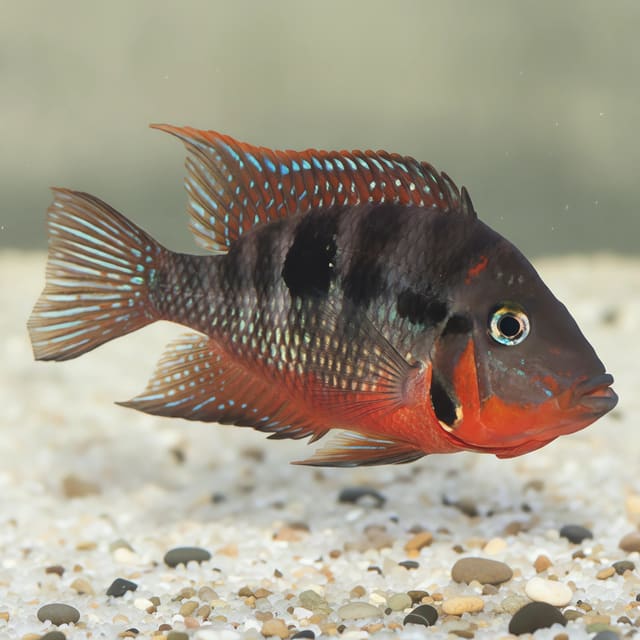
Moderate
Firemouth Cichlid (Thorichthys meeki)
20–32°C · pH 6.5–8.5 · 108L
£5.39
South American Cichlids · Buying Guide
UK firemouth cichlid guide — why it flares that red throat, real tank size, water, honest tank mates and the live Thorichthys meeki we ship. Read it first.
8 products in stock today
Live prices and stock. Every fish covered by our Live Arrival Guarantee.
20–32°C · pH 6.5–8.5 · 108L
21–25°C · pH 6–8 · 250L
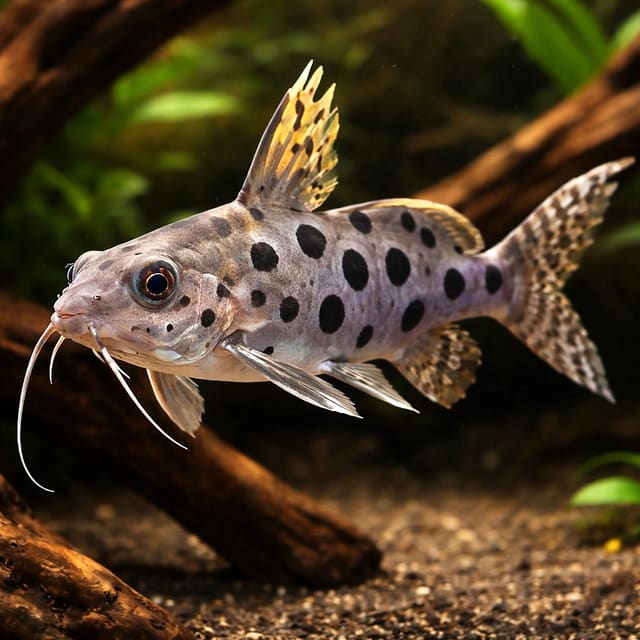
23–27°C · pH 6.2–8 · 81L
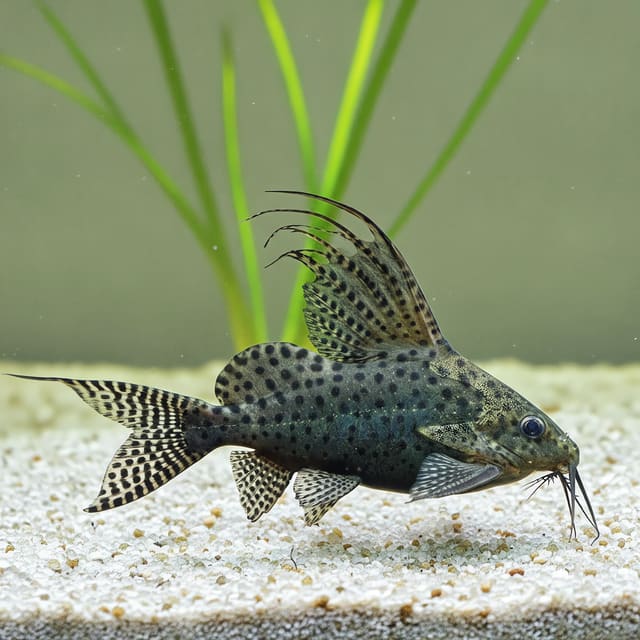
22–26°C · pH 6.2–7.5

20–28°C · pH 6.2–8.2
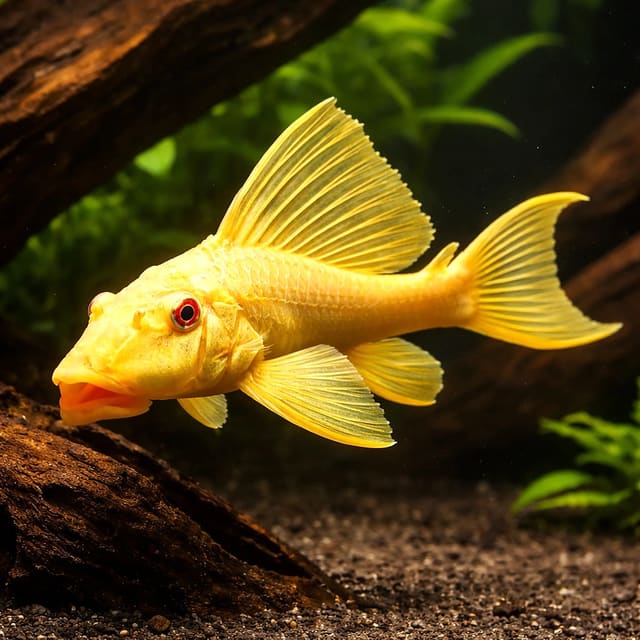
22–27°C · pH 6.2–8
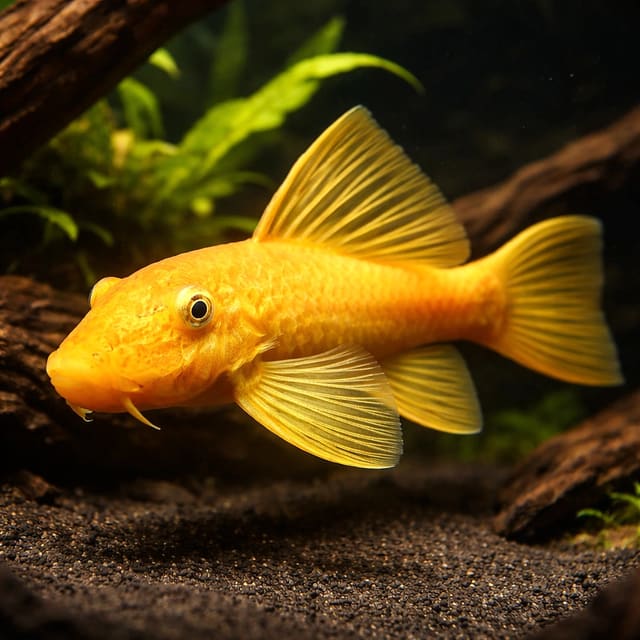
22–27°C · pH 6–8
24–30°C · pH 5–7 · 648L
The shaded band shows the range firemouth cichlid is comfortable in. Match it to your tap water before you buy.
Our trained assistant knows this firemouth cichlid page inside out. Ask it anything — water parameters, tank mates, how many to buy — or have it read the guide aloud while you set up your tank.
You've seen a firemouth cichlid flare in a shop tank and thought that fish looks like it means business — then read three care guides that can't agree whether it's a peaceful community fish or a tank-clearing thug. One says "great beginner cichlid," the next says "will kill everything." Both are half-right, and neither tells you the bit that actually matters: a firemouth is a bluffer, not a brawler.
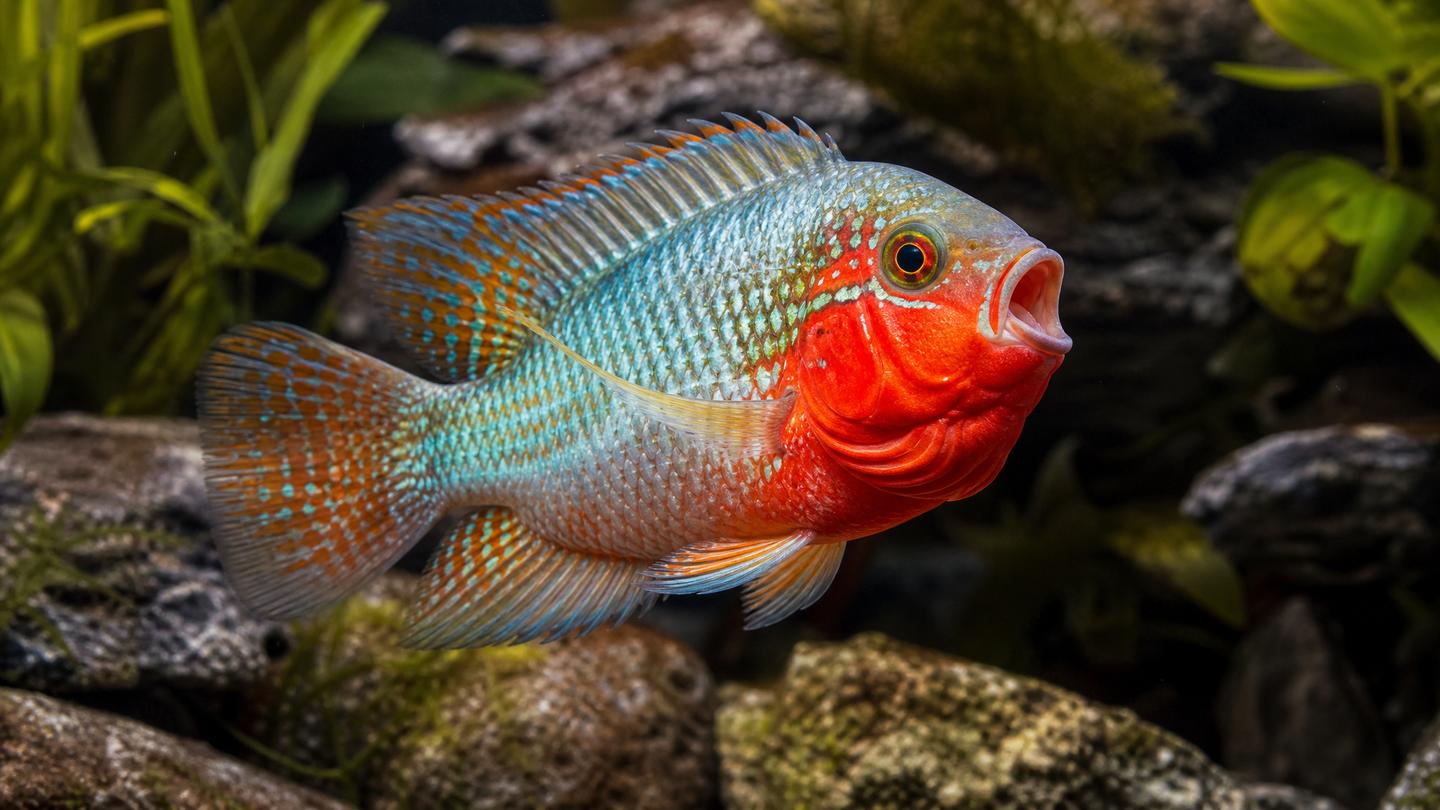
I'm Priya, the cichlid and soft-water specialist here at Tropical Fish Co, and the firemouth (Thorichthys meeki) is the fish I reach for when someone wants the personality of a cichlid — the digging, the pair-bonding, the showing-off — without the carnage of a full-grown Central American. The drama is real, but most of it is theatre. When a firemouth squares up, it drops its jaw, flares its gill covers and lights up a fiery red throat and belly to look twice its size [4]. Nine times out of ten that's where the fight ends.
This page is the answer I'd give a customer who asks: "Is a firemouth too aggressive for my tank, and what do I actually need to keep one properly?" We'll cover why it flares that red throat, the real tank size and water it needs (hard-ish neutral, which suits UK tap water nicely), honest tank mates, and the live firemouths we have in stock right now.
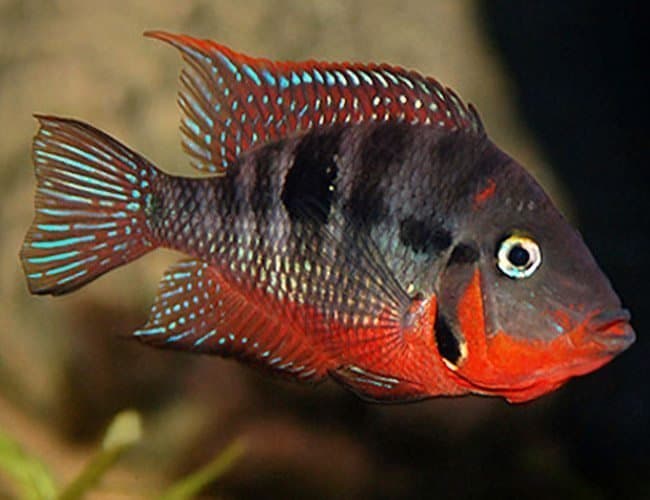
A firemouth cichlid (Thorichthys meeki) from our warehouse — note the red along the lower jaw and belly that the fish can intensify on demand. Credit: Tropical Fish Co.
If you want a cichlid with character but you're not ready to dedicate a tank to a single aggressive monster, the firemouth sits in a useful sweet spot. Here's how it stacks up against the other cichlids UK keepers usually consider as a "first proper cichlid":
| Attribute | Firemouth | Oscar | German blue ram | Convict cichlid |
|---|---|---|---|---|
| Adult size | ~15 cm | 30–35 cm | ~5 cm | 10–14 cm |
| Min tank | 200 L | 400 L+ | 60 L | 150 L |
| Aggression | Bluffer; territorial when breeding | High; messy | Low (but fragile) | High for its size |
| Water | Hard-ish neutral | Adaptable | Soft, warm, pristine | Hard, adaptable |
| Best for | First medium cichlid with manageable temperament | Big-tank "wet pet" keepers | Soft-water nano-cichlid fans | Keepers wanting a tough breeder |
If your honest answer is "I want a medium cichlid that's full of personality but won't demolish a 4 ft community of robust fish," the firemouth is your column. Want something tiny and soft-water instead? Read our German blue ram guide. Want the big-tank wet-pet experience? See the oscar guide.
The firemouth's gill-cover bluff is a textbook honest signal: a bigger, healthier fish can spread a bigger, redder display, so rivals can read fighting ability without actually fighting. Experimental work confirms firemouths key in on that red ventral colour when assessing each other [2]. In your tank it means most disputes are resolved by posturing — which is exactly why they're so much more manageable than their fearsome looks suggest.
Tank size. A firemouth grows to about 15 cm, with males occasionally hitting 17 cm [1]. That little 4 cm fish in the shop is a juvenile. Plan for the adult: a 200 litre (120 cm / 4 ft) tank minimum, and more if you're keeping a group or mixing with other robust cichlids and catfish. Length matters more than height — they're lower-tank fish that patrol and sift the bottom, so footprint beats a tall narrow tank every time.
Substrate and layout. Soft sand, not gravel — they sift it through their gills to feed [5]. Add rockwork, bogwood and a few tough plants to break up sight lines; broken-up territory dramatically reduces squabbling. A flat stone or a slate makes a perfect spawning site if a pair forms.
Water. This is the genuinely good news for UK keepers. Firemouths like hard-ish neutral water — pH 6.5–8.0 and around 8–20 dGH [1][4]. Across most of England the tap water is naturally hard [7], so you're already in range with no RO unit and no chasing a soft, acidic blackwater setup. Keep it warm and stable at 25–27 °C, dechlorinate, and stay on top of weekly water changes. For the full breakdown of UK tap water and how to test it, see our water chemistry guide.
Unlike soft-water Amazonians (discus, cardinal tetras, wild angels), firemouths actually prefer the harder, neutral-to-slightly-alkaline water most British taps deliver [7]. If you're in a hard-water area — London, the South East, much of the Midlands — you can fill a firemouth tank straight from the tap once it's dechlorinated and cycled. Soft-water areas (Wales, the South West, parts of Scotland) may want a little crushed coral or aragonite sand to nudge the hardness up.
The single rule that keeps a firemouth tank peaceful: match tank mates by adult size, not by looks. A firemouth is semi-aggressive and will eat fish small enough to fit in its mouth — Seriously Fish notes plainly that it "may eat much smaller fishes" [4]. A 3 cm neon tetra alongside a 15 cm firemouth isn't a tank mate, it's a meal.
What works — robust, similarly-sized, lower-conflict species:
What to avoid: neon and ember tetras, guppies, sparkling gouramis, shrimp — anything bite-sized. Also skip hyper-aggressive heavyweight cichlids (large Amphilophus, adult oscars) that will out-muscle a firemouth and turn the tank into a war zone. The firemouth wins the bluff; it loses the actual fight to a fish twice its mass.
A customer buys one firemouth and a shoal of neon tetras "because they looked fine together in the shop." Six weeks later the neons start disappearing one by one. The shop fish were all juveniles the same size — but the firemouth grew, the tetras didn't, and biology took over. I now ask every firemouth buyer the same question: how big is the smallest fish in your tank going to be next to a 15 cm cichlid? If the answer is "small enough to swallow," we rethink the stocking list together.
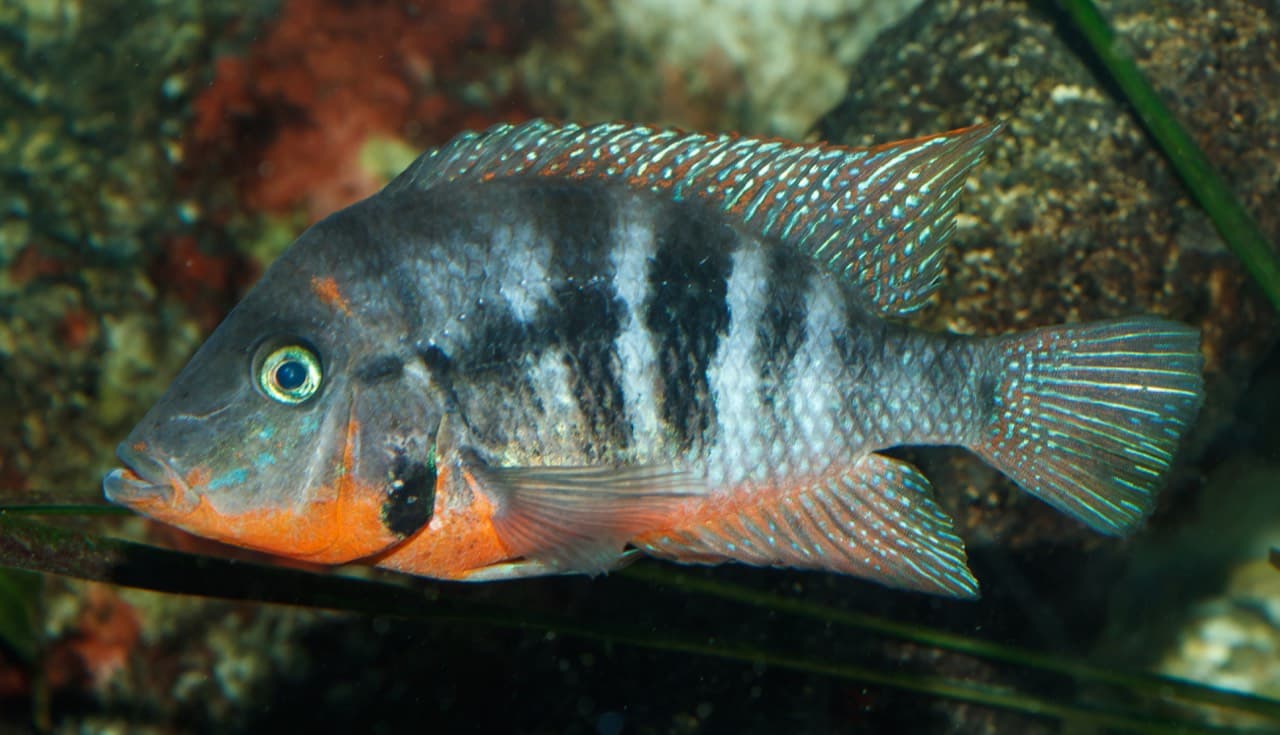
An adult firemouth showing the body shape and finnage of a mature, well-conditioned fish. Photo: H. Zell, Wikimedia Commons (CC BY-SA 3.0).
Firemouths travel well — they're hardy and tolerant — but they still arrive stressed after a courier journey, and a guarding adult can be touchy. Take it slow:
Give a new firemouth a week to claim its territory before you judge its temperament — a fish that's flaring at its own reflection on day one is just nervous, not aggressive. For the wider picture of settling cichlids in and reading their behaviour, our cichlid care guide goes deeper.
If you're building a community of robust fish, add the firemouth after the others are established. Going in last means it can't claim the whole tank as its own territory before anyone else arrives — it has to negotiate, which keeps the peace. The reverse (firemouth first, then adding fish to "its" tank) is how you end up with one bully and a lot of chased tank mates.
Build the rest of the setup and decide what else goes in the tank:
Still deciding between cichlids? The firemouth is the gentlest of the medium Central Americans — if it sounds too bold, our angelfish guide covers a tall, graceful South American alternative; if you want bolder, the oscar guide is where to go next.
Visual route into the rest of our UK live-fish range.
Material factual claims cite the sources below; store policy and cautious inference are labelled in the article. Sources are grouped by type so you can judge their weight at a glance.
Experimental study showing firemouths respond strongly to the red ventral colour in conspecific displays.
Confirms the genus placement of meeki within Thorichthys (away from the old Cichlasoma).
Source for max length (17 cm TL), pH 6.5–7.5, 26–30 °C, dH to 10, and Central American distribution.
Husbandry, group behaviour (gregarious in 8+), red-throat ID and breeding territoriality.
UK-specific husbandry, substrate-sifting feeding behaviour, regional 'black firemouth' morph.
Video walk-through of firemouth temperament, gill-flaring and tank setup.
Government factsheet — native range and cichlid ID markers (single nostril, two-part lateral line).
UK tap-water hardness reference — most of southern England is hard, which suits firemouths.
Fishkeeping moves fast and we want every guide spot-on. If you think something here is wrong, out of date, or could be clearer, tell us — our team reads every message and updates the page.
Suggest an editCompare African lake, South American and Central American cichlids by adult size, water, social behaviour and aquarium footprint before choosing.
Learn which freshwater aquarium water parameters to test, how to read ammonia, nitrite, nitrate, pH, GH and KH, and when a result needs action.
Evidence-checked UK angelfish care: adult size and height, tank planning, pair or group needs, water, feeding, tank mates, health and breeding.
Discus & Cichlid Expert · 15+ years in the hobby
Priya has bred discus commercially in Leicester since 2016 — supplying Tropical Fish Co and two other UK retailers with F1 tank-bred juveniles. Before that she spent seven years on South American dwarf cichlids. Her discus and cichlid guides on this site are written from the perspective of someone who has actually hatched, grown out, and shipped the fish — not from library research alone.