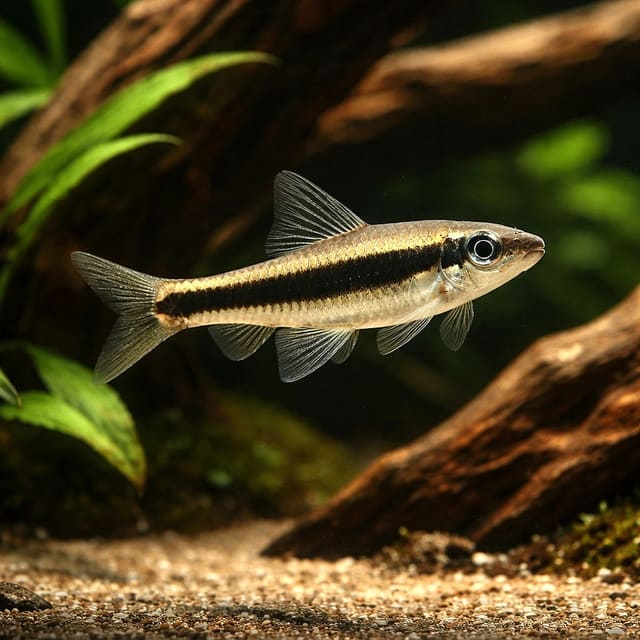
Kuhli Loach (Acanthophthalmus kuhli)
24–27°C · pH 6.5–6.5
£2.99

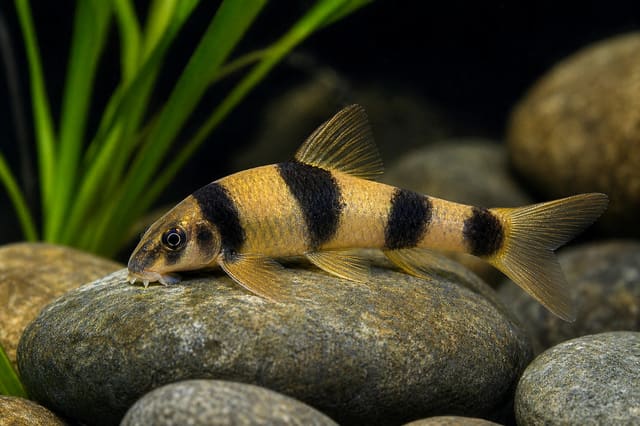
The Clown Loach (Chromobotia macracanthus) is a freshwater botiid from Sumatra and Borneo that reaches 40 cm standard length. It suits advanced keepers who can house at least five at 24–30°C and pH 5.0–7.0. Sold individually in sizes from 2.5–3 cm to XXXL.
Adult size is the maximum length this species reaches at full maturity (scientific sources). The livestock you receive will be younger and smaller — pick a size above for the actual shipping size. Product-photo provenance and any image-specific limitations are stated on the listing.
Chromobotia macracanthus
Shoaling fish: kept in a group they feel safer, stay calmer and show their best colour.
The Clown Loach (Chromobotia macracanthus) is a freshwater botiid from Sumatra and Borneo that reaches 40 cm standard length. It suits advanced keepers who can house at least five at 24–30°C and pH 5.0–7.0. Sold individually in sizes from 2.5–3 cm to XXXL.
Adult size is the maximum length this species reaches at full maturity (scientific sources). The livestock you receive will be younger and smaller — pick a size above for the actual shipping size. Product-photo provenance and any image-specific limitations are stated on the listing.
Maintain these water conditions for optimal health and vibrant colors
Clown Loach is the familiar common name of Chromobotia macracanthus, a freshwater, bottom-associated member of the family Botiidae. Older aquarium trade labels may use Botia macracantha, but Chromobotia macracanthus is the accepted name used here. The species is endemic to Indonesia, specifically Sumatra and Borneo; that natural distribution describes the species rather than the origin of an individual aquarium fish.
FishBase records a maximum of 30.5 cm total length. The Seriously Fish species profile records a different figure of 40 cm standard length and specifies an adult-group aquarium base of at least 180 × 60 cm. Use 30.5 cm as the adult-size figure throughout this listing and reserve enough turning room and shelter space for a substantial adult group.
This is an advanced long-term project in our store assessment. The challenge is not an elaborate feeding technique: it is providing enough room for at least five large, active fish, maintaining a substantial filtered aquarium and choosing companions that will not be intimidated or have trailing fins nipped. A small Clown Loach can fit physically into many aquariums that cannot meet the needs of its adult group.
| Suits | Not suited to |
|---|---|
| An advanced keeper able to reserve an aquarium of approximately 648 litres with a base of at least 180 × 60 cm | A small aquarium without the adult footprint |
| A plan for at least five Clown Loaches | Permanent solitary keeping |
| Water maintained at 24–30°C, pH 5.0–7.0 and 1–12 dGH | Water outside the aquarium range |
| Communities screened for adult size, activity and fin shape | Much smaller fish or slow-moving, long-finned fish |
Begin with the adult group rather than asking how long the selected fish can remain in the aquarium already at home. Once the footprint, filtration and group capacity work at full scale, the dispatch size becomes a practical choice instead of a way to postpone the main husbandry decision.
One purchase quantity supplies one animal of the selected option. The live size selector carries the labels below, and the centimetre labels describe dispatch size rather than eventual growth. The size you select is the size supplied, not the adult size.
| Selector label | How to use it |
|---|---|
| 2.5–3 cm | Dispatch-size band |
| 3–4 cm | Dispatch-size band |
| 4–5 cm | Dispatch-size band |
| 5–6 cm | Dispatch-size band |
| 6–7 cm | Dispatch-size band |
| 7–8 cm | Dispatch-size band |
| 9–12 cm | Broader dispatch-size band |
| XXXL | Named trade grade rather than a centimetre band |
A quantity of five therefore means five animals, while a quantity of one means one animal. The welfare requirement to maintain a group of at least five does not turn the product into a pack. When adding to an established group, count every Clown Loach already present and assess the adult capacity of the whole aquarium before setting the order quantity.
Sex is guaranteed only when the selected option explicitly states male or female. This Clown Loach listing has no sex-guaranteed option.
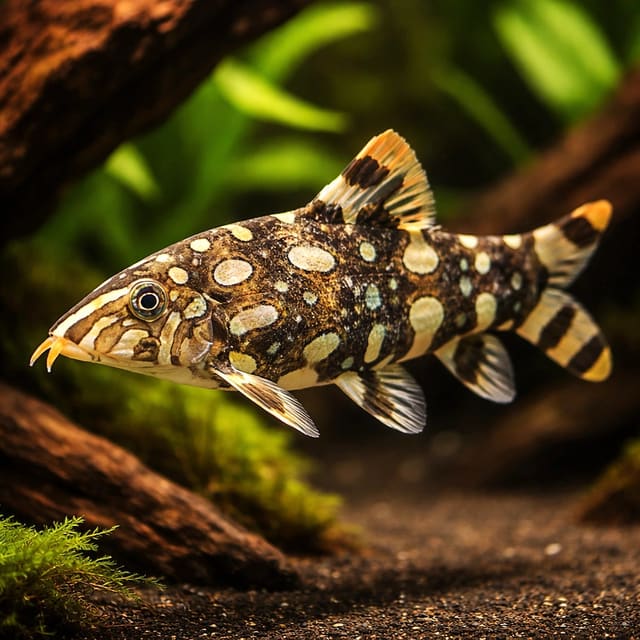
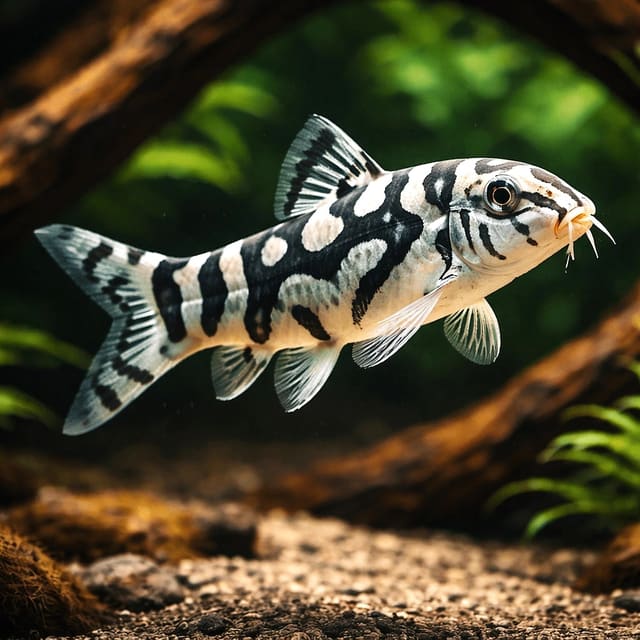
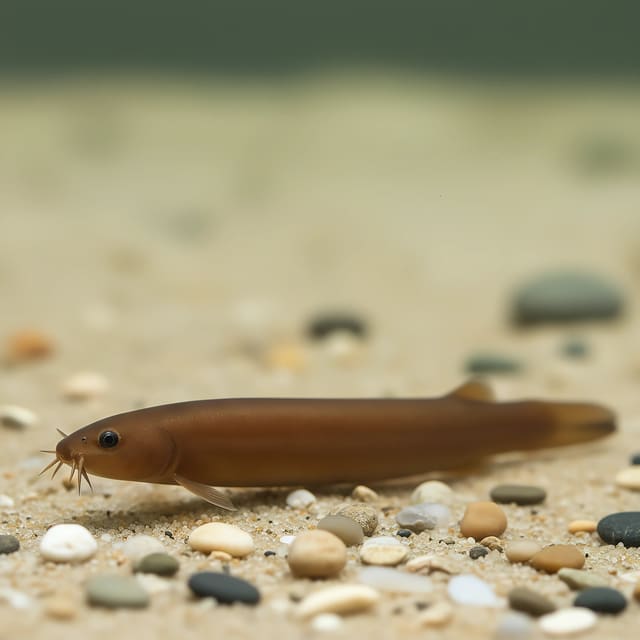
Some gallery images have been digitally enhanced to improve image quality. They show the listed type of animal rather than guaranteeing the exact markings of the individual supplied, so natural colour and pattern can vary.
Use the live selector for the order you are placing rather than relying on a static sentence about a particular size. A centimetre band does not establish sex, maturity or geographic origin, and the XXXL label should be treated only as the named dispatch grade shown in the selector.
Before arranging livestock transport, read our delivery and Live Arrival Guarantee policy. It explains the store’s dispatch day and the reporting process connected with the guarantee without changing the care decisions required before the fish travels.
Chromobotia macracanthus is gregarious and forms complex social hierarchies. Maintain at least five Clown Loaches together; OATA also advises that more than five is better for shoaling loaches when the aquarium can carry the resulting adult space and waste load. Five is a minimum group decision, not a stocking target that overrides the dimensions of the aquarium.
Other loach species do not replace members of this group. They may occupy similar levels of the aquarium, but they have their own social structures, adult sizes and feeding needs. Count only Clown Loaches when assessing whether the group reaches five, then count every animal in the aquarium when sizing filtration and usable space.
| Starting situation | Action |
|---|---|
| Planning a new group | Reserve adult capacity for at least five before choosing dispatch sizes |
| One fish already kept alone | Secure a suitable adult-group aquarium before increasing the number |
| Two to four already present | Plan for at least five without overloading a smaller system |
| Mixed loach aquarium | Meet each species’ own group requirement separately |
| More than five planned | Increase footprint, shelter, filtration and maintenance capacity with the group |
Provide several places to withdraw and more than one route through the décor. A complex hierarchy does not automatically mean harmful aggression, but each fish should retain access to cover and food. Observe the group at feeding time so a quieter member is not consistently displaced.
Do not solve an undersized group by placing more fish into an aquarium that fails the adult requirement. The correct order is adult space first, filtration second and group size third. Once all three work together, the fish can express social behaviour without the aquarium becoming crowded as they grow.
The absolute minimum described for a group is an aquarium with a base of 180 × 60 cm or equivalent and a volume of approximately 648 litres. Treat both measurements as one requirement. A tall aquarium with the same headline volume but a shorter or narrower base does not offer the same movement and turning space.
The 180 cm length supports group travel, while the 60 cm front-to-back measurement leaves room to pass around substantial shelters. The volume supports dilution and filtration, but litres alone cannot describe the layout. Arrange wood, rocks and resting places without consuming the open routes that large fish need.
| Proposed aquarium | Decision |
|---|---|
| At least 180 × 60 cm base and about 648 litres | Meets the published absolute minimum starting point for a group |
| About 648 litres but less than 180 cm long | Choose a longer footprint |
| 180 cm long but less than 60 cm front to back | Choose greater turning width |
| Larger than both minimum dimensions | Assess the final group, companions, décor and filter capacity |
| Small temporary grow-on aquarium | Use only for young specimens with several partial water changes each week |
A smaller grow-on aquarium is a conditional temporary route, not the adult home. Seriously Fish limits that route to young specimens and calls for several partial water changes every week. Make the move while the larger aquarium still provides a clear improvement, rather than waiting for the group to look cramped.
Before choosing the fish, mark out a 180 × 60 cm base in the intended room and account for safe access to filters, heaters and water-change equipment. This simple exercise tests whether the adult plan fits the household as well as whether the aquarium fits the fish.
Place temporary markers at the four corners of the proposed base, then walk the route used for routine maintenance. Allow room to open equipment, remove filter components and carry replacement water without moving the aquarium. Check that the long side remains accessible enough to inspect the group and that permanent furniture will not block service access.
Next, sketch the footprint from above. Mark the space occupied by wood, rocks and shelters, then trace at least one open route along the length of the aquarium and another route around the main cover. If the hardscape divides the base into narrow dead ends, simplify the arrangement before adding fish. This planning step protects the useful footprint instead of treating every litre behind décor as equally usable swimming space.
Finally, compare the complete adult plan with the room rather than the dispatch fish with an empty tank. A small size may leave wide open space at first, but the base, shelters, filtration and maintenance route must already make sense for at least five large fish. If that full arrangement cannot be reserved, choose a smaller species before equipment and livestock commitments begin.
Maintain aquarium water at 24–30°C, pH 5.0–7.0 and 1–12 dGH. These are aquarium values from the specialist species profile. Choose conditions within all three ranges and compare them with the needs of every proposed companion rather than selecting temperature, pH and hardness independently.
| Value | Working instruction |
|---|---|
| Temperature | Keep within 24–30°C |
| pH | Keep within 5.0–7.0 |
| General hardness | Keep within 1–12 dGH |
| Ammonia | Maintain at 0 mg/L |
| Nitrite | Maintain at 0 mg/L |
| Nitrate | Do not exceed 20 mg/L above the normal tap-water level |
OATA’s loach guidance gives zero ammonia, zero nitrite and nitrate no more than 20 mg/L above normal tap water as group guidance; use the narrower specialist aquarium values above for temperature, pH and hardness. Test the aquarium and the replacement water so each reading has a meaningful comparison.
Use our aquarium water chemistry guide to interpret pH, hardness and nitrogen-cycle readings. Once you have measured values, the water matcher helps compare them with the intended aquarium range.
Respond to an ammonia or nitrite reading as a water-quality problem, even when the fish still appear active. Check recent stocking, feeding and filter operation, then make husbandry changes based on repeat measurements. Nitrate should be read against the tap-water baseline because OATA’s limit is expressed as the increase above that starting point.
A biological filter is essential. The RSPCA explains that beneficial filter bacteria convert toxic ammonia into nitrite and then into the safer nitrate. Maturation therefore means establishing a working bacterial population in the filter, not simply leaving an aquarium full of water for a set number of days.
For an aquarium of approximately 648 litres, the specialist profile calls for turnover of four to five times the aquarium volume each hour. Multiplying 648 litres by four gives 2,592 litres per hour; multiplying by five gives 3,240 litres per hour. Its worked example uses two filters rated at 1,295–1,620 litres per hour each.
| Equipment decision | Worked reference |
|---|---|
| Filter turnover | Four to five aquarium volumes per hour |
| 648-litre total flow | Approximately 2,592–3,240 litres per hour |
| Two-filter example | Each rated at approximately 1,295–1,620 litres per hour |
| Heating example | Roughly 150–225 W across four heaters, assuming a room near 20°C |
The heating figures are a worked example tied to the stated aquarium volume and room temperature, not a universal equipment prescription. Check the heater manufacturer’s instructions and position equipment so the entire aquarium remains within the measured temperature range.
At least once every week, OATA strongly recommends a partial water change of 25%. Treat replacement tap water with conditioner for chlorine or chloramine, siphon out solid waste, check filters for blockages and test ammonia and nitrite at least weekly.
When filter media needs cleaning, rinse it lightly in aquarium water removed during the water change rather than beneath the tap. This reduces the loss of beneficial bacteria. Record test results and maintenance dates so a rising waste trend is visible before it becomes an emergency.
A written baseline separates a genuine change from a vague impression. If ammonia rises above 0 mg/L after fish or feeding are added, do not wait for the next routine test. Recheck the result, inspect filter operation and reduce the immediate waste pressure through appropriate maintenance. Apply the same response to nitrite because its target is also 0 mg/L.
Do not clean every part of a multi-filter system at the same time. Stagger attention so working biological media remains in service, and avoid replacing established media merely because it looks stained. Mechanical debris should be removed as needed, while biological media should be handled gently in removed aquarium water. The objective is dependable processing and flow, not making mature media look unused.
Use a well-structured aquarium with sand or fine gravel, smooth water-worn rocks, pebbles, driftwood roots and branches. Clown Loaches explore gaps and crevices, so every opening must remain wide enough for the fish to enter, turn or leave without becoming wedged as its body grows.
Provide plenty of cover while retaining open routes across the base. Rocks, wood, flower pots and aquarium ornaments can be combined, but each item should stay stable when fish investigate around it. Check enclosed ornaments for narrowing internal spaces rather than judging safety only from the entrance.
| Feature | Practical choice |
|---|---|
| Substrate | Sand or fine gravel around sensitive skin and barbels |
| Hardscape | Smooth rocks, pebbles, roots and branches |
| Cover | Several accessible shelters with safe exits |
| Open space | Clear routes between shelters and feeding areas |
| Lighting | Relatively subdued if that suits the chosen plants |
| Plants | Java fern, Java moss or Anubias attached to décor for shade |
Soft-leaved plants may be eaten as vegetative matter, so planting should not be the only source of cover. Plants that tolerate subdued lighting and attach to décor can add shade without occupying every part of the substrate.
Loaches have a spine beneath each eye and should be handled carefully. They also have reduced or absent scales and may be intolerant of some medicines. If treatment is being considered, obtain species-aware advice before choosing a product or dose rather than treating every aquarium fish identically.
Clown Loaches appear to be chiefly carnivorous but also eat vegetative matter when it is accessible, including some soft-leaved aquatic plants. Their natural diet includes aquatic molluscs, insects, worms and other invertebrates. In the aquarium, build meals from several suitable food types rather than depending on one favourite item.
| Food choice | How it fits |
|---|---|
| Quality dried food | Use a suitable sinking product as a regular foundation |
| Bloodworm, Tubifex or Artemia | Offer appropriate live or frozen variety |
| Cucumber or courgette | Provide clean plant-rich variety |
| Melon or blanched spinach | Use as another fresh addition and remove remains |
| Chopped earthworm | Use sparingly as a protein source |
| Aquatic snails | Possible prey, not a complete diet or infestation remedy |
OATA’s feeding schedule for loaches is once a day, offering only what they can finish within a few minutes. Spread sinking food across more than one location so each group member has a route to a meal. Watch the whole group rather than judging the ration by the first fish to feed.
Remove uneaten food before it breaks down and increases the waste load. If leftovers remain after a few minutes, reduce the next portion. If one fish repeatedly misses food while the others feed, change the distribution points and observe whether social pressure or a health change is affecting access.
Clown Loaches may prey on aquatic snails, but they should never be chosen as the answer to an infestation because they are not obligate molluscivores. Manage the cause of excess snails separately and feed the fish a varied, deliberate ration whether snails are present or not.
Prepare and mature the aquarium before adding the group. Our first tropical aquarium guide explains how to establish the system before livestock arrives. Confirm that the filter is working and test ammonia and nitrite; both must read 0 mg/L.
Increase aquarium stocking carefully because the beneficial bacterial population must grow as fish numbers and feeding increase. Adding more waste than the filter can process can cause new tank syndrome, with ammonia and nitrite reaching harmful levels. Size and mature the filtration for the intended group rather than expecting the fish to mature the filter.
| Checkpoint | What to assess |
|---|---|
| Before introduction | Adult space, working filter, suitable temperature and zero ammonia and nitrite |
| At each feeding | Interest in food and access for every group member |
| During observation | Swimming, breathing, colour, temperament and use of cover |
| Weekly | Ammonia, nitrite, nitrate, filter blockages and water-change routine |
| After any change | Repeat tests and compare behaviour with the group’s normal pattern |
Healthy fish should have clear bright eyes, undamaged fins, intact skin and appropriate swimming behaviour. Watch for hanging at the surface, persistent bottom-sitting, erratic swimming, unusually fast or slow gill movement, white spots, fluffy growths, fin loss, body-condition changes or reduced feeding.
A single observation becomes more useful when paired with water tests and recent maintenance details. If a health change concerns you, test the water immediately and contact us with the results, temperature, recent additions and a clear description of what changed. Avoid choosing medication before the likely problem and loach sensitivity have been considered.
Immediately before introduction, write down the aquarium temperature and the ammonia and nitrite results. Check that shelters remain accessible and that sinking food can reach more than one part of the base. This gives the group several feeding routes and makes it easier to see whether every fish is participating.
During the first feeding observations, use a modest once-daily portion and watch until the few-minute feeding window has passed. Remove remains rather than adding extra food for a fish that stays under cover. At the next meal, distribute the ration between separate points and compare participation. Repeatedly missing food matters more than one cautious response during settling.
In the following days, compare swimming, breathing, colour and shelter use at a similar time each day. Test ammonia and nitrite again after the new waste load reaches the filter, and keep both at 0 mg/L. If behaviour changes across the whole group, begin with water and equipment checks. If one fish changes while the others remain consistent, record its feeding access and visible condition alongside the same water results.
At the first weekly checkpoint, combine the water tests with the recommended partial change, blockage check and maintenance record. This creates a useful starting pattern for later comparisons. Continue increasing the wider aquarium population slowly so biological filtration can adjust to each change in fish numbers and feeding.
Clown Loaches are not especially aggressive, but adult size and active behaviour shape the community around them. Avoid much smaller fish because they may be intimidated. Also avoid slow-moving, long-finned species such as ornamental bettas, guppies and many cichlids because trailing fins can be nipped.
| Candidate type | Screening decision |
|---|---|
| Much smaller fish | Avoid because the size and activity difference may intimidate them |
| Slow-moving, long-finned fish | Avoid because trailing fins can be nipped |
| Peaceful open-water cyprinids | Potentially suitable after water, adult-size and space checks |
| Other botiids | Possible when each species’ social and shelter needs are met |
| Other bottom-dwellers | Check floor space, cover and feeding competition carefully |
| Aquatic snails | Do not combine them when the snails must be protected from predation |
Open-water companions reduce direct competition for caves and substrate, but swimming level alone is not enough. Their full aquarium temperature range must overlap 24–30°C, and they must also suit pH 5.0–7.0 and hardness of 1–12 dGH. The adult population must fit the aquarium after the five-or-more Clown Loach group has been counted.
Bottom-dwellers need a stricter assessment because shelter entrances and sinking food are shared resources. Other botiids, some cobitid or nemacheilid loaches and various catfishes may be possible in a sufficiently large arrangement, but each candidate still needs its own group, water and space requirements met.
Assess the whole community as adults rather than comparing only the fish at dispatch size. Begin with the Clown Loach group and its 180 × 60 cm minimum base, then add the adult space, swimming level and feeding method of every companion. A fish described as peaceful can still be unsuitable when it is too small, too slow or dependent on long fins.
For example, a candidate that shares the temperature range still fails if it has trailing fins and slow movement. A robust open-water candidate still fails if the final population exceeds the aquarium’s adult capacity. A bottom-dweller may pass the water check but require a redesigned shelter and feeding plan.
Browse the loaches and oddballs collection to compare identities and adult requirements, not to assume that fish in the same collection can share an aquarium. For a stocking and compatibility assessment, ask us with the aquarium dimensions, measured water values, filter details and complete adult stock plan.
Individual behaviour and aquarium layout can still change the outcome, so compatibility remains conditional after the screening checks pass. Observe new interactions and retain enough space and cover for fish to move away from one another.
A candidate can pass one check and still fail the full assessment. If its water range overlaps but its adult size remains much smaller, stop at the size check. If its body size looks robust but it moves slowly and carries trailing fins, stop at the fin-and-speed check. Passing the temperature test never cancels a documented behavioural risk.
Use the same method for another bottom-dweller. First confirm water overlap, then map the shelters and feeding points it would share with at least five Clown Loaches. If both species depend on the same limited caves or the same patch of sinking food, redesign the aquarium or reject the combination. Extra nominal litres do not resolve a resource conflict when the useful base remains crowded.
For an open-water cyprinid, confirm its own adult size and social requirement before treating its swimming level as an advantage. Add that entire group to the adult stock plan, not one example fish. The combination remains conditional on the final population fitting the aquarium and every species receiving appropriate food without persistent displacement.
It is a freshwater, bottom-associated botiid endemic to the Indonesian islands of Sumatra and Borneo, commonly known in the aquarium trade as the Clown Loach.
One purchase quantity supplies one animal of the selected option. The requirement to maintain at least five does not turn the product into a group pack.
The live selector carries 2.5–3, 3–4, 4–5, 5–6, 6–7, 7–8 and 9–12 cm dispatch bands, plus the nonnumeric XXXL trade grade.
Use an aquarium with a base of at least 180 × 60 cm and a volume of approximately 648 litres for the group; these are absolute minimum planning figures.
Plan to maintain at least five together because they are gregarious and form complex social hierarchies. Other loach species do not replace members of this group.
Keep aquarium water at 24–30°C, pH 5.0–7.0 and 1–12 dGH, with ammonia and nitrite at 0 mg/L.
Offer a varied diet of quality dried food, suitable live or frozen invertebrate foods and fresh plant matter once daily, limited to what is eaten within a few minutes.
Use a mature, filtered aquarium and confirm ammonia and nitrite are 0 mg/L before introduction. Monitor swimming, breathing and feeding as the fish settles.
Peaceful open-water cyprinids may suit after full water, space and adult-size checks. Avoid much smaller fish and slow-moving, long-finned species that may be intimidated or nipped.
No reviews for this item yet. Bought one? Honest reviews only, good or bad.
What customers say about ordering from us
I have a small group of long finned mountain minnows. So was delighted to be able to order ten of this variety to increase the genetics in my tank . The ones I recieved are healthy but it’s to early to give a verdict on wether they are of a long finned type since they are small currently.
Gordon Walker · 23 Sept 2026
100% success travel and "installation". Pleased with quality of purchase. The Siamese fighter a bit "shy" so have not yet seen him at his best yet but looking good. Happy customer. GG
George E Garratt · 21 Sept 2026
Reviews of our shop, collected by Judge.me, an independent third-party review collector. Newest first.