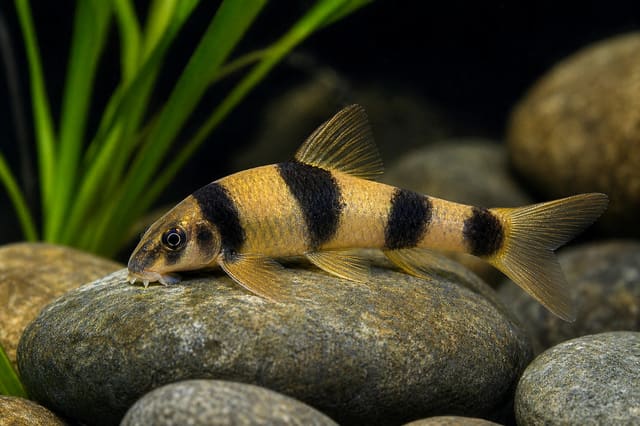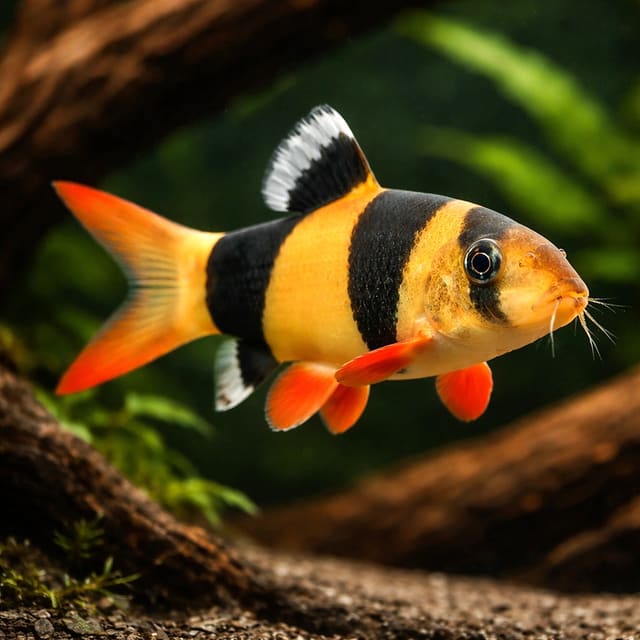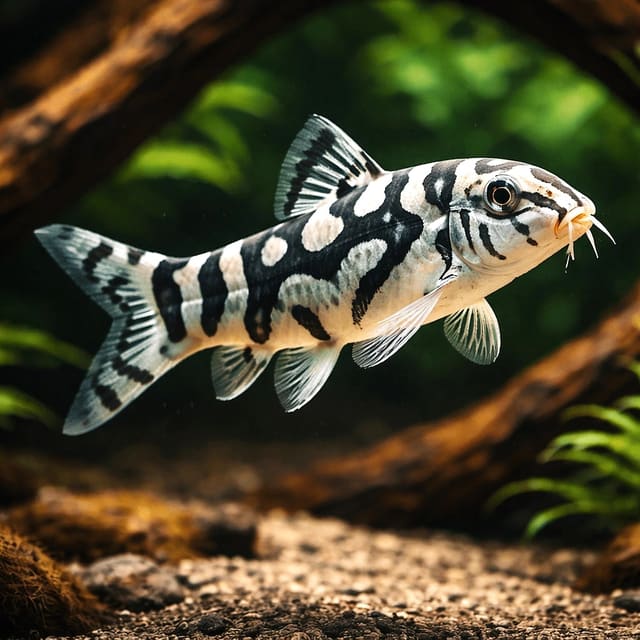
YoYo Loach (Botia lohachata)
24–27°C · pH 6.5–8
£5.99

Albino Rainbow Shark / Red-Finned Shark (Epalzeorhynchos frenatum) is a pale, red-finned river cyprinid that grows to about 15 cm and turns territorial with age. Keep one in an aquarium with a base of at least 120 × 45 cm, with plenty of cover and active, robust companions.
Adult size is the maximum length this species reaches at full maturity (scientific sources). The livestock you receive will be younger and smaller — pick a size above for the actual shipping size. Product-photo provenance and any image-specific limitations are stated on the listing.
Epalzeorhynchos frenatum
Shoaling fish: kept in a group they feel safer, stay calmer and show their best colour.
Albino Rainbow Shark / Red-Finned Shark (Epalzeorhynchos frenatum) is a pale, red-finned river cyprinid that grows to about 15 cm and turns territorial with age. Keep one in an aquarium with a base of at least 120 × 45 cm, with plenty of cover and active, robust companions.
Adult size is the maximum length this species reaches at full maturity (scientific sources). The livestock you receive will be younger and smaller — pick a size above for the actual shipping size. Product-photo provenance and any image-specific limitations are stated on the listing.
Maintain these water conditions for optimal health and vibrant colors
The Albino Rainbow Shark, also sold as the albino Red-Finned Shark, is the pale ornamental form of Epalzeorhynchos frenatum, a river fish from mainland Southeast Asia. It is not a shark at all. It belongs to Cyprinidae, the carp and minnow family, and takes the name from its pointed snout, tall dorsal fin and quick, purposeful swimming.
Each purchase is one live fish in the size you choose. The juveniles are slim and often shy, but this species grows to about 15 cm and becomes increasingly territorial as it matures. Buying one is really a decision about the aquarium it will live in as an adult: a long tank with a base of at least 120 × 45 cm, plenty of cover, and companions robust enough to hold their own.
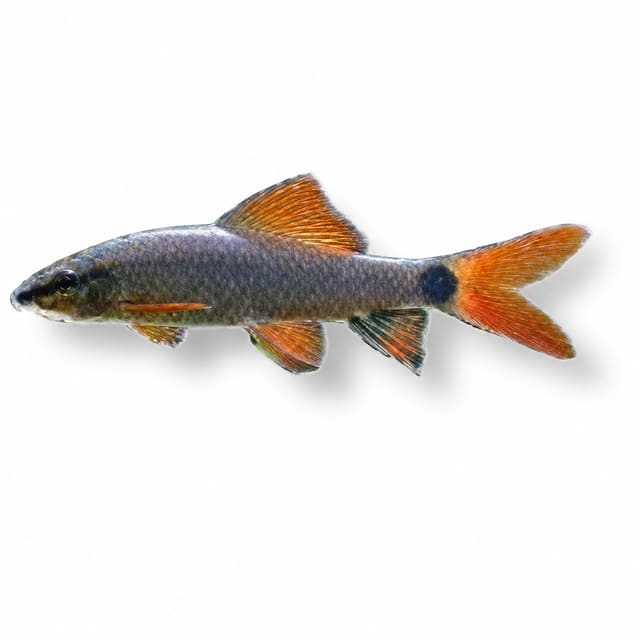
The albino form swaps normal pigment for a creamy white body, red fins and red eyes, which stand out well against dark wood and stone. It is widely kept, and it is often sold as an algae-eater. It does graze, but it is better chosen as a characterful centrepiece for the lower half of a large aquarium than as a cleaning crew.
| Suits | Keepers with a mature aquarium of at least 120 × 45 cm who want one bold, active fish for the lower and middle water |
|---|---|
| Poor fit for | Small or newly set-up tanks, other shark-shaped fish, and buyers looking mainly for algae control |
| Adult size | About 15 cm |
| Routine water | 24–26 °C, pH 6.5–8.0 (near neutral preferred), 5–12 dGH |
| Diet | Omnivorous grazer: sinking foods, fresh vegetables and small frozen or live foods |
| Keeping | Usually one per aquarium |
In the trade you may also meet the label Labeo frenatus. The accepted scientific name is Epalzeorhynchos frenatum, and Seriously Fish lists Labeo erythrura, a name first given to a very colourful wild form, as a junior synonym. Whatever the label, it is the same species with the same care needs.
There are four dispatch sizes: 3–4 cm, 4–5 cm, 5.5–7 cm and 7–8 cm. The size you select is the size supplied, not the adult size. Even the largest choice is only about half of the length this fish can reach, so plan the aquarium around the adult rather than the juvenile in the bag. The product page shows which sizes can be ordered when you buy.
Size also changes how the first months look. Seriously Fish notes that small specimens tend to hide away much of the time, while growing fish become more and more territorial. A 3–4 cm or 4–5 cm fish gives you a long, gentle run-in while it gains confidence. A 5.5–7 cm or 7–8 cm fish is nearer the stage at which it starts claiming ground, so the layout and companions need to be right from the first day.
Sex is guaranteed only when the selected option explicitly states male or female. This Albino Rainbow Shark / Red-Finned Shark listing has no sex-guaranteed option. Juveniles of this species cannot be sexed reliably, so no size is sold as a guaranteed male or female.
Gallery images have been digitally enhanced to improve image quality. Natural colour, pattern, size and maturity can vary between live animals. The fish you receive will be a juvenile at the size you selected, so expect a slimmer, younger-looking fish than a mature adult.
This species sits in our loaches and oddball fish collection alongside bottom-orientated fish with very different sizes and temperaments, so use that range for ideas rather than as a list of ready-made companions.
FishBase records Epalzeorhynchos frenatum from the Mekong, Chao Phraya and Xe Bangfai basins, and from the Maeklong basin, in mainland Southeast Asia. It is a benthopelagic freshwater fish, living close to any solid surface at midwater and bottom depths in streams and rivers, and it has been observed over sandy ground. It also moves into seasonally flooded habitats and returns to the rivers as the floodwaters recede. The species is listed as Least Concern by the IUCN.
That background explains most of what the aquarium needs:
Floor area is the figure to plan around. Seriously Fish treats an aquarium base of 120 × 45 cm, roughly 243 litres, as the smallest to consider for a single specimen and says a group needs larger quarters. FishBase also gives 120 cm as the minimum aquarium size for the species. The OATA care sheet for freshwater sharks mentions at least 120 litres for rainbow and red-tailed black sharks, but that is a general figure for the group; the longer species footprint is the better plan for an adult fish.
Seriously Fish suggests an aquarium designed to resemble a flowing river, which suits a fish from streams and rivers well:
Seriously Fish describes this species as relatively unfussy about décor provided there is enough cover. Spread several caves, wood overhangs and planted areas along the full length of the tank rather than clustering them at one end. That gives the rainbow shark a home base and gives other fish their own places to retreat, which matters more as it grows into its territorial adult stage. Leave open water along the front and middle for swimming.
A long tank also helps the whole community. The OATA sheet points out that larger aquariums keep temperature and water quality more stable, and a longer tank gives a territorial fish and its neighbours more room to keep apart.
The routine targets below are the band where the species profile, the FishBase species data and the OATA sheet for freshwater sharks agree. Stability matters more than chasing an exact number.
| Temperature | 24–26 °C as a routine target |
|---|---|
| pH | 6.5–8.0, close to neutral usually recommended |
| General hardness | 5–12 dGH |
| Ammonia and nitrite | Zero |
| Nitrate | No more than 20 mg per litre above your tap water level |
Seriously Fish gives 20–26 °C for aquarium keeping, and the OATA sheet gives 22–27 °C as a general range for freshwater sharks. FishBase records 24–27 °C for the species in its natural environment, which describes the rivers rather than a tank setting. Holding the aquarium at 24–26 °C keeps you inside all three. For pH, Seriously Fish says the fish is happy within 6.5–8.0 but that a value close to neutral is usually recommended. For hardness, Seriously Fish gives a wide 2–15 dGH; FishBase's 5–12 dH and the OATA group figure of 4–12 °dH narrow that to a comfortable 5–12 dGH.
Like many fish from running water, this species is quite intolerant of accumulating organic waste and does best with a high level of dissolved oxygen and moderate water movement. For a tank of around 243 litres, Seriously Fish's rule of thumb is a turnover of four to five times the tank volume an hour, which means a filter rated at roughly 970–1,215 litres per hour, and about 125–175 W of heating in a room at around 20 °C.
A filter is essential whatever the tank size. As the RSPCA guidance on aquarium filters explains, fish release ammonia, which is toxic; beneficial bacteria in a working biological filter convert it to nitrite, which is also toxic, and then to nitrate, which is safer. The OATA sheet adds that freshwater sharks can be stressed by even the smallest amounts of ammonia, so a fully matured filter is the foundation of keeping this fish well.
If you are unsure what each reading means, our guide to aquarium water parameters explains what to test and why. You can also enter your own results in the water parameter matcher to see how your tap and tank water compare with these targets before the fish arrives.
FishBase describes the natural diet as algae, periphyton, phytoplankton and some zooplankton. Seriously Fish calls the species primarily an aufwuchs grazer: it rasps the film of algae and tiny animals from rocks and wood, and in the wild also takes small crustaceans and insect larvae. In the aquarium, the aim is to recreate that mix of plant matter and small animal foods.
The OATA sheet for freshwater sharks recommends feeding only what the fish can eat within a few minutes, once a day, and warns against overfeeding because uneaten food breaks down and releases toxic waste into the water. Take out any vegetable pieces that have not been eaten before they start to break down. Once it has settled, this fish will often rise into midwater to feed and to browse the film on rockwork, so food does not have to land right under its nose.
This species is often sold as an algae-eater. It does browse algae, but Seriously Fish notes that it does not do so as effectively as some Crossocheilus species and that there is little point in buying it for that purpose. Treat grazing as a bonus, feed it properly, and choose it because you want the fish itself.
The companions that suit a rainbow shark best, such as danios, barbs and rainbowfish, are quick feeders in open water. Sinking pellets, wafers of algae-based food and vegetable pieces give the rainbow shark its own share at the level where it prefers to graze, while flakes and granules go to the fish higher up. Watch at feeding time for the first few weeks to be sure the new fish is actually eating, especially a small juvenile that is still spending much of the day in cover.
Good husbandry is essential for freshwater sharks, and a steady weekly routine does most of the work. The OATA care sheet for freshwater sharks sets out the basics:
Filter bacteria need time to catch up whenever you add fish and feed more. Adding too many fish at once, or stocking a new aquarium too quickly, can cause new tank syndrome: there are not enough nitrifying bacteria to deal with the extra waste, ammonia and nitrite rise, and fish can become ill or die. Before adding any fish, check that ammonia and nitrite read zero. If this will be your first tropical aquarium, our guide to setting up a first tropical tank walks through setting up and maturing the tank properly before any livestock arrives.
Every order is hand-packed by our team. Fish are bagged in pure oxygen and packed in an insulated poly box, with a heat pack when the weather calls for it, then carried by a tracked, licensed live-animal courier. We email the tracking number and your confirmed delivery date so you know when to be in. The full details are on our delivery and Live Arrival Guarantee page.
Have the aquarium ready before the fish is ordered, not on the morning it arrives:
The Live Arrival Guarantee needs someone at the address to receive the parcel, the parcel opened and inspected on the day it arrives, and a continuous unboxing video showing the parcel still sealed at the start.
Expect a small rainbow shark to spend a lot of time hidden at first; that is normal for young fish of this species. Seriously Fish notes that once settled it often moves up into midwater to feed and graze, and it will gradually become bolder and start to patrol a favourite area. Keep the rest of the aquarium routine steady and watch how it and the other fish interact as it grows.
A healthy fish has clear bright eyes, undamaged fins, intact scales, no ulcers or bumps and normal swimming behaviour. Those are the things to check once it is out of the bag and exploring.
All fish vary slightly in behaviour and appearance, so learn what is normal for yours and look for changes. The OATA sheet lists the signs worth watching:
If you are worried about any fish, test the water quality first. Poor water is a common trigger, and rainbow sharks are sensitive to ammonia and organic waste. Then get in touch for further guidance.
Freshwater sharks generally grow quite slowly, according to the OATA sheet. That slow growth is one reason juveniles end up in tanks that are too small: a small juvenile can look settled for a long time before the adult size and temperament arrive. Seriously Fish observes that this species is rarely kept in ideal conditions and that juveniles are often sold with little information about temperament or eventual size. Buying one is a long-term commitment, and the right aquarium from the start saves a difficult rehoming later.
According to Seriously Fish, sexually mature females are noticeably thicker-bodied than males, but it is impossible to sex juveniles accurately. The fish you receive will be a juvenile, so its sex will not be known when it arrives.
As far as Seriously Fish knows, this species has not been bred in private aquaria. The large numbers seen in the hobby are produced on fish farms for the ornamental trade with the aid of hormones. The albino is an ornamental variant that has become extremely popular in the hobby. A home aquarium should be planned for one fish to live out its life, not for spawning.
Temperament is the part of this fish that catches people out. The OATA sheet describes rainbow sharks as reasonably peaceful when younger, becoming more aggressive and territorial as they grow. Seriously Fish adds that it becomes increasingly territorial with growth and can show particularly high levels of aggression towards similar-looking species.
Individuals also differ. Some are more belligerent than others, and Seriously Fish mentions reports of apparent alliances with other species such as the clown loach, Chromobotia macracanthus. It is not known whether those behavioural differences relate to sex.
The practical rule is to plan for the adult. A mix that works while the rainbow shark is 4 cm long may not work once it is nearly full grown and holding the best cave in the tank. Keep one per aquarium in most homes, give it room and cover, and be prepared to rehome or separate a fish that keeps harassing its tank mates.
Seriously Fish rates this species as a slightly better community choice than its relative, the red-tailed black shark Epalzeorhynchos bicolor, but says tank mates must still be chosen with care. Here is how the main groups of fish work out.
Keep a close eye on companions that use the bottom of the tank. Anything that competes for the same caves or grazing surfaces is more likely to be treated as a rival than a fish that spends its time in open water.
The OATA sheet asks for companions that are slightly larger than the rainbow shark, not smaller. A fish that is already bigger than it is far less likely to be pushed around, while very small fish have nowhere to go once a territorial adult claims the lower half of the tank. Remember that the rainbow shark itself keeps growing towards 15 cm, so judge companions against the adult size rather than against a 4 cm juvenile.
Planted aquariums are no problem. Seriously Fish says this species should not harm softer-leaved plants, and epiphytes such as Microsorum, Bolbitis and Anubias attached to wood and stone suit the river-style layout well. The plants and hardscape double as the cover that lets other fish break contact with a patrolling rainbow shark.
Bullying often shows up first in the fish being bullied. The warning signs the OATA sheet lists for any fish apply here: a tank mate hiding far more than normal, damaged or missing fins, a fall in appetite or body condition, or faster breathing. Check the rainbow shark's own temperament as well; a change in its level of aggression is one of those signs too. If one fish is being pinned down repeatedly, test the water first, then be ready to separate or rehome the fish involved rather than waiting for the situation to settle on its own.
Plan for a fish of about 15 cm. FishBase gives a maximum length of 15 cm and Seriously Fish gives 150 mm, so the adult will be about double the length of the largest juvenile size and five times the smallest. It grows quite slowly, which makes it easy to underestimate, so set up the aquarium for the adult from the start.
For one adult Epalzeorhynchos frenatum, plan an aquarium with a base of at least 120 × 45 cm, which Seriously Fish calculates at around 243 litres. Length and floor area matter most for a fish that patrols the lower levels, and a group needs a larger aquarium than that minimum.
In most home aquariums, keep one. This species directs its strongest aggression at similar-looking fish, members of its own genus are among the fish it attacks most, and Seriously Fish treats a group as something for larger quarters than the single-fish minimum.
Only for a beginner who already has a long, mature and stable aquarium. Freshwater sharks are usually undemanding about water chemistry, but this one needs a 120 cm tank, grows territorial and must be matched with robust companions. For a small starter aquarium, choose a different fish.
It is an omnivorous grazer. Offer sinking pellets with a high algae content and good dried granules or flakes, rotate small frozen or live foods such as bloodworm, Daphnia and Artemia, and add fresh vegetables such as shelled peas, cucumber, blanched courgette or spinach. It browses algae and biofilm but is a poor choice if algae control is the main reason for buying.
Aim for 24–26 °C, pH 6.5–8.0 with a value close to neutral usually recommended, and general hardness of 5–12 dGH. Those routine targets sit inside the ranges given by FishBase, Seriously Fish and the OATA care sheet for freshwater sharks as a group.
Young Epalzeorhynchos frenatum are fairly peaceful and often shy, but they become increasingly territorial as they grow. The aggression is aimed mainly at similar-looking fish, some individuals are more belligerent than others, and slow or delicate companions are a poor match.
The OATA care sheet suggests active, slightly larger and robust species such as danios, barbs and rainbowfish. Seriously Fish reports that Botia, Chromobotia, Syncrossus and Yasuhikotakia loaches are usually left in peace, although not every loach can share a tank. Other Epalzeorhynchos, and Crossocheilus, Garra and Gyrinocheilus algae-eaters, tend to be attacked constantly, so leave them out.
It is hand-bagged in pure oxygen, packed in an insulated poly box with a heat pack when the weather calls for it, and carried by a licensed live-animal courier, so someone must be in to receive it. Before opening, start a continuous unboxing video showing the sealed parcel, the opening and the fish still in the sealed bag; this is needed for any Live Arrival Guarantee claim. Then float the bag for 20–30 minutes before releasing the fish, without adding the bag water to your tank.
No reviews for this item yet. Bought one? Honest reviews only, good or bad.
What customers say about ordering from us
I have a small group of long finned mountain minnows. So was delighted to be able to order ten of this variety to increase the genetics in my tank . The ones I recieved are healthy but it’s to early to give a verdict on wether they are of a long finned type since they are small currently.
Gordon Walker · 23 Sept 2026
100% success travel and "installation". Pleased with quality of purchase. The Siamese fighter a bit "shy" so have not yet seen him at his best yet but looking good. Happy customer. GG
George E Garratt · 21 Sept 2026
Reviews of our shop, collected by Judge.me, an independent third-party review collector. Newest first.