Kuhli Loach (Acanthophthalmus kuhli)
24–27°C · pH 6.5–6.5
£2.99
The Spotted Garra (Garra spilota) is a freshwater cyprinid from Myanmar that reaches 6.1 cm standard length. It suits keepers able to provide a mature 90 × 30 cm aquarium and a group of at least three to four; the overlap of Seriously Fish and OATA guidance is 22–26°C, pH 6.0–7.5 and 4–12 dGH. Sold individually as one live fish per purchase.
Adult size is the maximum length this species reaches at full maturity (scientific sources). The livestock you receive will be younger and smaller. Product-photo provenance and any image-specific limitations are stated on the listing.
Garra spilota
Shoaling fish: kept in a group they feel safer, stay calmer and show their best colour.
The Spotted Garra (Garra spilota) is a freshwater cyprinid from Myanmar that reaches 6.1 cm standard length. It suits keepers able to provide a mature 90 × 30 cm aquarium and a group of at least three to four; the overlap of Seriously Fish and OATA guidance is 22–26°C, pH 6.0–7.5 and 4–12 dGH. Sold individually as one live fish per purchase.
Adult size is the maximum length this species reaches at full maturity (scientific sources). The livestock you receive will be younger and smaller. Product-photo provenance and any image-specific limitations are stated on the listing.
Maintain these water conditions for optimal health and vibrant colors
Spotted Garra is a small freshwater cyprinid with the scientific name Garra spilota. FishBase places it in the family Cyprinidae, describes it as benthopelagic, records a maximum of 6.1 cm standard length and gives its natural distribution as Myanmar. It suits a keeper prepared to provide a biologically mature aquarium with moving, oxygen-rich water, established grazing surfaces and room for a social group.
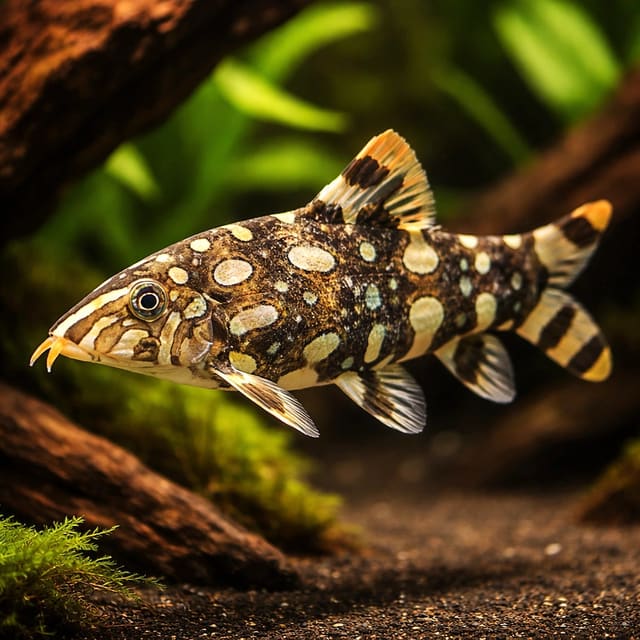
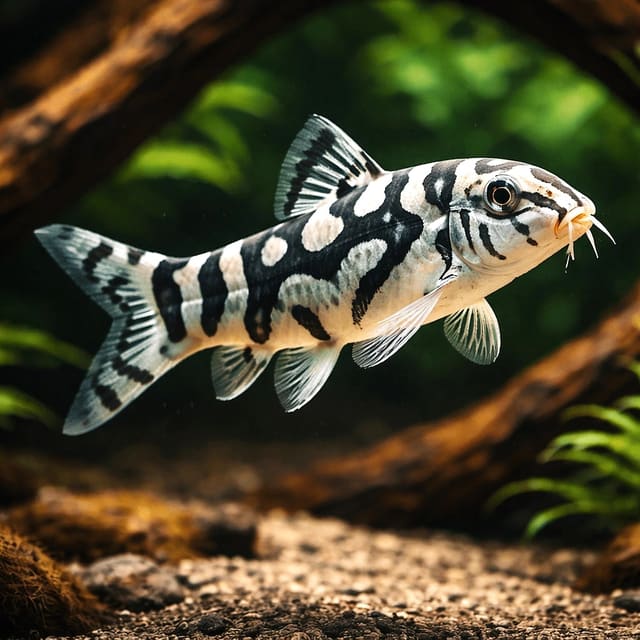
Dark blotches along the flanks help distinguish this Garra from related species. The detailed species description also refers to reddish fins and a distinctive upper-lip structure. These features combine with an elongated body suited to moving around rocks, gravel, wood and other solid surfaces.
Use the 6.1 cm FishBase maximum as the consistent adult-size figure. Seriously Fish lists a different aquarium reference of 6.9 cm standard length; its species profile also supplies the aquarium footprint, flow and husbandry guidance used below.
The wild population is assessed as Near Threatened. That status describes the species in nature; it does not identify the origin of an individual aquarium fish. Treat the animal in front of you according to its aquarium needs: clean water, strong oxygenation, suitable flow, an established biological filter and dependable feeding.
This fish suits a keeper prepared to build the aquarium around moving, oxygen-rich water and established grazing surfaces. Seriously Fish recommends a base of at least 90 × 30 cm, equivalent to approximately 81 litres, and regards that footprint as the smallest that should be considered. A biologically mature aquarium is essential because the fish grazes biofilm and depends on stable water conditions.
The routine target developed from the species profile and the narrower overlap with Garra guidance is 22–26°C, pH 6.0–7.5 and 4–12 dGH. Water must remain clean and well oxygenated. Turnover preferably above ten times the aquarium volume per hour, supported by a powerhead or airstone when necessary, creates a much better fit than a quiet aquarium with weak surface movement.
| Suits | Not suited to |
|---|---|
| A biologically mature aquarium with a base of at least 90 × 30 cm | A biologically immature setup |
| Clean, strongly oxygenated water with substantial movement | A quiet aquarium with weak circulation or oxygenation |
| A planned group of at least three to four | A stocking plan that cannot accommodate the social group |
| A varied diet alongside established grazing surfaces | Being added as a substitute for aquarium maintenance or complete feeding |
Although it grazes algae and biofilm, this is not an animal to add as a substitute for aquarium maintenance. It is an omnivorous grazer that also requires suitable sinking foods, vegetable matter and meaty foods. Its diet, social group and current requirements all need to be included in the stocking plan before purchase.
A first aquarium should be completely established before livestock is introduced. Use our guide to preparing and maturing a tropical aquarium to plan the biological filter and initial testing. Spotted Garra is most rewarding when those foundations are already working rather than being developed around a newly introduced fish.
One purchase supplies one animal. The dispatch grade associated with this offer is 3–4 cm; this is the size prepared for dispatch, not the adult planning size. Organise the aquarium around the 6.1 cm adult-size figure.
Seriously Fish recommends a minimum group of at least three to four specimens. Because the purchase unit is one animal, select the quantity needed for the planned group rather than assuming that one purchase represents a pack. Check the 90 × 30 cm minimum base, filtration capacity and total stocking before deciding the quantity.
Sex is guaranteed only when the selected option explicitly states male or female. This Spotted Garra listing has no sex-guaranteed option.
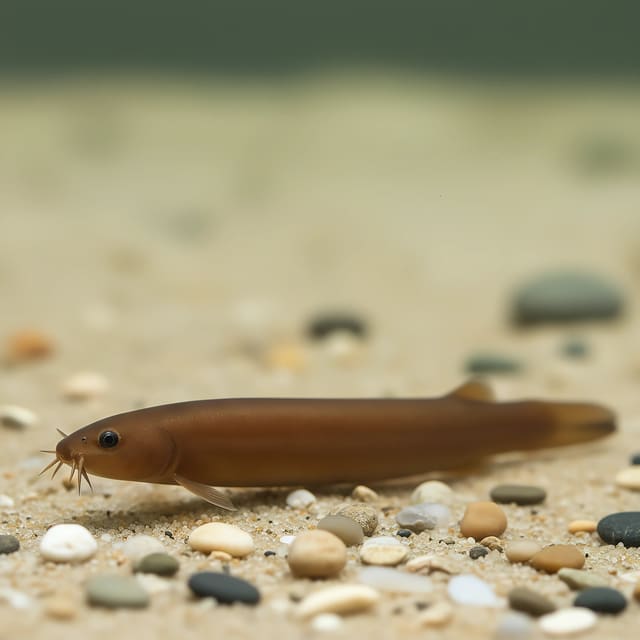
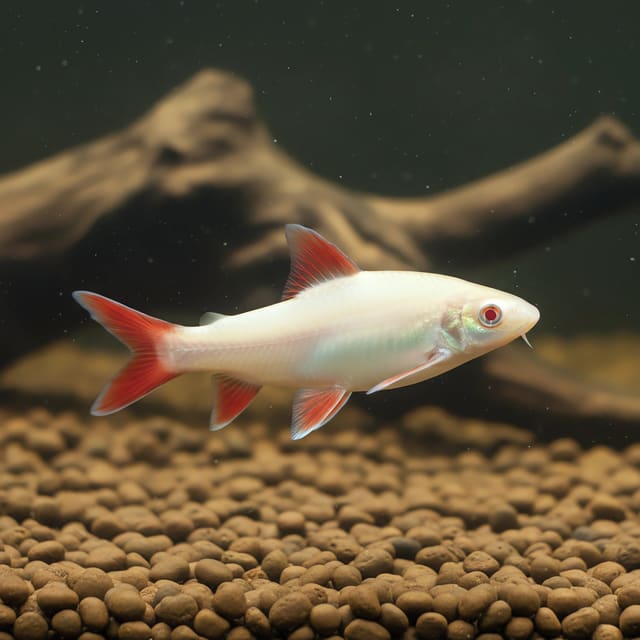
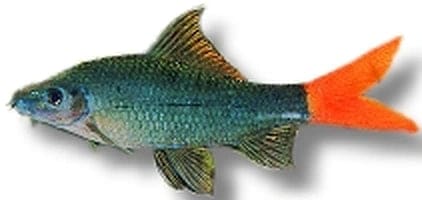
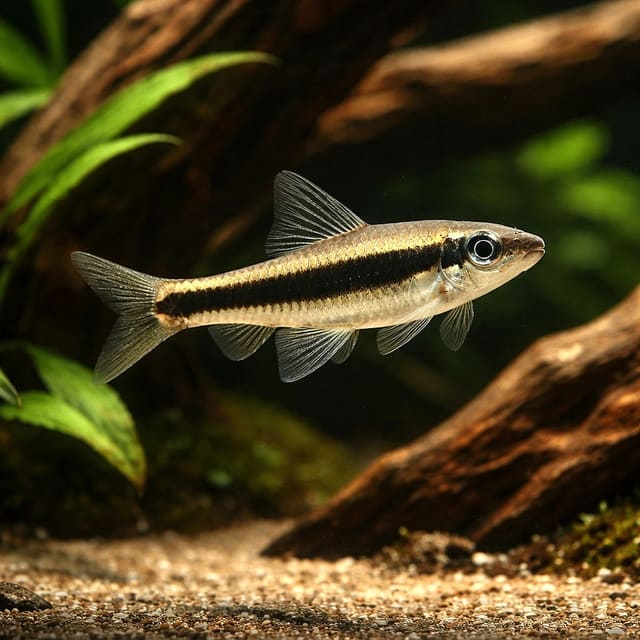
The gallery images are representative of this type of animal rather than photographs of the exact animal supplied, so colours can look slightly different from the live animal.
| Offer decision | What to use |
|---|---|
| Purchase unit | One animal per purchase |
| Dispatch planning | Associated grade 3–4 cm |
| Adult planning | Allow for 6.1 cm standard length |
| Social planning | At least three to four specimens |
Start with a base measuring at least 90 × 30 cm. The corresponding volume is approximately 81 litres, but the base dimensions remain the decisive part of the recommendation. A tall aquarium can hold a similar number of litres while offering less of the horizontal footprint used by a bottom-oriented fish moving among rocks, gravel and wood.
Measure the clear internal base rather than relying only on the aquarium’s marketed capacity. A base measuring 90 × 30 cm has an area of 2,700 cm² and meets the stated minimum dimensions. A 60 × 45 cm base has the same calculated area, but it does not meet the 90 cm length recommendation. The footprint should therefore be treated as two required dimensions, not converted into area and reshaped freely.
Apply the same reasoning to nominal volume. An aquarium labelled around 81 litres may lose usable water volume to substrate and décor, while a tall design may still have a short base. Choose the 90 × 30 cm base first, then confirm that the system is approximately 81 litres or larger.
Review the base again after the substrate, rocks and wood are positioned. The nominal dimensions do not help if a continuous wall of décor divides the usable area or blocks the main route through the current. Keep several connected paths across the footprint, with solid surfaces beside them for grazing and cover. If a proposed group cannot move through the finished layout without crowding around one route, simplify the hardscape or choose a larger aquarium before introduction.
The dispatch grade does not reduce these requirements. A 3–4 cm fish still needs an aquarium chosen for its adult size, social needs and flowing-water behaviour. Starting with the adult plan prevents the filter, footprint and community from becoming unsuitable as the fish grows.
Spotted Garra comes from fast-flowing water and needs clean, well-oxygenated conditions. Seriously Fish prefers water turnover above ten times the aquarium volume per hour. For an aquarium of approximately 81 litres, ten times the volume is about 810 litres per hour, giving a concrete reference when comparing the planned circulation.
The same profile illustrates a filter rated at 325–405 lph alongside a powerhead rated at 325–565 lph for an aquarium of this size. The filter supports biological processing and physical cleaning, while the additional water movement helps create the current and oxygenation this fish needs. An airstone can also be used when extra aeration is necessary.
| Job | Planning question |
|---|---|
| Biological filtration | Is the filter established and able to process fish waste? |
| Water movement | Does circulation reach the aquarium rather than leaving broad stagnant areas? |
| Oxygenation | Is there strong water movement and effective gas exchange? |
The RSPCA explains why a working biological filter is essential: fish release toxic ammonia, beneficial bacteria convert it to nitrite, and further bacteria convert nitrite to safer nitrate. A newly installed filter is not equivalent to a biologically established one, even if the pump is moving plenty of water.
Check circulation after rocks, wood and plants are installed because these features alter the route taken by the water. Arrange the current so the fish can use flowing areas while still moving around the hardscape. If the water lacks movement or oxygenation, improve circulation or aeration before introducing the group rather than expecting the animals to adapt to a quiet setup.
A stream-style aquascape gives this fish the solid surfaces and cover associated with its husbandry. Use a mixture of sand or fine gravel, variably sized water-worn rocks, a few small boulders and driftwood roots or branches. These materials form a more useful environment than a bare base because the fish can move among them and graze the biofilm that develops on exposed surfaces.
| Feature | Purpose in the layout |
|---|---|
| Sand or fine gravel | Forms the main substrate recommended for the stream-style display |
| Rounded rocks and cobbles | Add hard grazing surfaces and shape routes through the base |
| Driftwood | Adds cover and further established surfaces |
| Hardy attached plants | Add planting without relying on soft, rooted growth |
Microsorum, Bolbitis and Anubias are specifically suggested because they can be grown attached to décor. Fix them to rock or wood while leaving gaps around the hardscape, rather than using plants to block the full width of the aquarium. The result should combine cover with clear routes through the current.
Bright lighting encourages biofilm development on solid surfaces. Use that growth as one part of the feeding environment, not as the complete diet. A biologically mature aquarium should already have established surfaces before the fish is introduced; a newly cleaned or newly assembled display lacks the same grazing base and biological stability.
Keep the arrangement practical. The filter intake, powerhead and airstone need clear positions, and the keeper must be able to inspect the base and remove uneaten food. If one large piece of wood blocks circulation across much of the aquarium, reposition it until water movement reaches the surrounding areas. The best layout joins together current, oxygenation, cover and access rather than treating the aquascape as decoration alone.
The species profile gives 20–26°C, pH 6.0–7.5 and 2–12 dGH. OATA’s broader Garra guidance gives 22–27°C, pH 6.0–8.0 and 4–12 dGH. Use the overlap: maintain 22–26°C, pH 6.0–7.5 and 4–12 dGH. This stays within the species range while using the narrower group limits where they differ.
| Routine value | Target |
|---|---|
| Temperature | 22–26°C |
| pH | 6.0–7.5 |
| General hardness | 4–12 dGH |
| Ammonia | 0 mg/l |
| Nitrite | 0 mg/l |
| Nitrate | Not to exceed 20 mg/l above the normal tap-water level |
Test the aquarium once a week and record the result rather than relying on how clear the water looks. Ammonia and nitrite must remain at zero, while nitrate should not exceed the stated limit above the normal tap-water level. These measurements show whether the established filter and maintenance routine are keeping waste under control.
Use our water chemistry guide to understand the role of each measurement. Once the aquarium has been tested, the water matcher can compare the measured temperature, pH and hardness with the target range.
Stable values within the range are more useful than repeated movement between its limits. Confirm the baseline before adding the group, then continue the weekly tests so a change is identified through measurement.
Spotted Garra grazes algae when it is present, but it is not an exclusive herbivore. Build the diet around good-quality sinking dried food, including products with a significant proportion of vegetable matter such as Spirulina, and rotate these with suitable meaty foods. Live or frozen bloodworm, Tubifex and Artemia, plus chopped prawn, are among the foods described for the species.
Fresh fruit and vegetables can be offered occasionally. Suitable examples include cucumber, melon, blanched spinach and courgette. Wash produce thoroughly before use because pesticide residues may harm aquarium animals; organically grown produce is another option. Remove uneaten fresh food before it breaks down and adds waste to the aquarium.
| Need | Supported food type |
|---|---|
| Routine sinking food | Quality dried product containing vegetable matter |
| Meaty variety | Bloodworm, Tubifex, Artemia or chopped prawn |
| Occasional fresh food | Cucumber, melon, blanched spinach or courgette |
| Natural grazing | Biofilm and algae on established solid surfaces |
Offer a measured portion and watch how the fish feed. Some algae-grazing fish take extra time over algal foods, so distinguish active grazing from food left to decay. If prepared food remains after the fish have finished feeding, reduce the next portion rather than adding another food on top of it. Uneaten food breaks down and releases waste, increasing the load on the biological filter.
Do not use visible algae as the feeding measure. A clean-looking pane does not remove the need for prepared food, and heavy algae growth does not make a complete diet. Keep established grazing surfaces in the aquascape while continuing the varied feeding plan.
In a community, confirm that the sinking food reaches the area used by the Garra. Observe the meal itself: the practical target is that the fish can access the food and that the portion is consumed without a residue accumulating among rocks or wood. This connects the food choice, portion and aquarium layout to water quality.
Complete the setup before the delivery day. The aquarium should be biologically mature, the filter should be established, and the measured water should sit within 22–26°C, pH 6.0–7.5 and 4–12 dGH. Confirm that ammonia and nitrite are both 0 mg/l and that the planned circulation is producing clean, well-oxygenated water.
The current delivery and Live Arrival Guarantee policy explains the attendance, unpacking and claim requirements that apply to the order. Contact us the same day if something has gone wrong, with the order number and continuous unboxing video.
Before opening the transport container, inspect the system as a complete habitat rather than checking each item in isolation. Confirm that the filter and additional circulation are running, the hardscape is stable, open routes remain around the rocks and wood, and the measured water remains inside the planned range. If a pump has been moved or décor has shifted, correct the circulation before release. This final check connects the mature filter, flowing water, oxygenation and grazing surfaces prepared for the group.
Once the fish has been released without adding bag water, keep the filter and circulation operating as planned. The first practical checkpoint is the environment itself: correct temperature, strong oxygenation, unobstructed circulation and stable décor. Continue the established weekly testing routine rather than treating acclimatisation as a substitute for ongoing water management.
Spotted Garra will graze algae and biofilm, but algae-eating fish are not substitutes for regular maintenance or appropriate stocking. Add this species because its adult size, social needs, diet and flowing-water requirements fit the aquarium, not because the aquarium has developed an algae problem.
Persistent algae can indicate an underlying water-chemistry or maintenance issue. When algae increases, test the water and review the established routine before changing the livestock. Adding more animals also adds waste for the biological filter to process, so an algae response based only on extra stocking can work against the water-quality target.
| Observation | Action |
|---|---|
| New aquarium with little biofilm | Allow the aquarium and biological filter to mature before introduction |
| Persistent algae growth | Test water chemistry and review maintenance and stocking |
| Fish grazing hard surfaces | Continue the complete prepared diet rather than relying on grazing alone |
| Uneaten food among rocks | Reduce the next portion and remove the residue |
A mature aquarium does not need every grazing surface scrubbed back at the same time. Keep useful established rock and wood in the layout while maintaining the aquarium as a whole. This preserves natural grazing opportunities without turning visible algae into the sole measure of either cleanliness or food supply.
Weekly test results give a firmer maintenance checkpoint than the appearance of the glass. Keep ammonia and nitrite at 0 mg/l, keep nitrate from exceeding 20 mg/l above the normal tap-water level, and hold the routine temperature, pH and hardness within range. The fish’s grazing activity can then remain one part of a balanced aquarium rather than being expected to correct a water-quality problem.
Seriously Fish describes Garra spilota as relatively peaceful and less territorial or competitive with its own kind than some other Garra species. It appears to appreciate conspecific company, with at least three to four specimens recommended as the minimum group. Plan that group before using the remaining aquarium space for other fish.
One purchase supplies one animal, so a group requires the corresponding purchase quantity. Assess the group against the 90 × 30 cm minimum base, approximately 81-litre reference, adult planning length and total biological load. The social recommendation does not turn one purchase into a multi-fish pack or remove the need to calculate the complete stocking level.
Sexual differences are subtle in this species. Head and snout tuberculation, which can be more obvious in males of some Garra, is described as only rudimentary in G. spilota. Mature females may be rounder, especially when gravid, but body shape should not be used as a purchasing guarantee. Build the group around the recommended count rather than an assumed sex ratio.
The group still needs the environmental features planned in the care tab: a mature biological filter, strong oxygenation, current, suitable water and a varied diet. These are shared requirements for every animal in the group, so scale the stocking decision before introduction rather than adding individuals first and assessing the system later.
| Group decision | Minimum plan |
|---|---|
| Number | At least three to four specimens |
| Base | At least 90 × 30 cm |
| Water | 22–26°C, pH 6.0–7.5, 4–12 dGH |
| Environment | Mature, clean, strongly oxygenated and flowing |
Spotted Garra can suit a well-chosen, larger community of stream-dwelling Indochinese fish. That description is a screening rule rather than a universal tank-mate list. Choose candidates whose adult size, water requirements, flow preference, oxygen demand and temperament all fit the completed aquarium.
Compatibility beyond the described stream-community profile depends on the exact species, aquarium dimensions and total stocking. For a stocking assessment, contact us with the aquarium base measurements, volume, measured water values, filtration, circulation and the full species counts.
Do not treat a shared shop category as proof that two animals should live together. If you are comparing other bottom-oriented choices, browse the loaches and oddballs collection to compare identities, adult sizes and care requirements before making a separate decision.
A candidate should pass every check, because one matching value does not cancel a conflict elsewhere. Two fish may share the same temperature range yet require different current, or both may favour moving water while their pH and hardness ranges fail to overlap. Feeding access also matters in a community built around rocks and wood: a candidate that consumes all sinking food before the Garra reaches it creates a practical mismatch even when the water suits both. Work through each condition for the complete adult community and revise any failed part before combining the fish.
| Candidate result | Decision |
|---|---|
| All five checks overlap | Continue with a complete stocking assessment |
| Water range does not overlap | Choose a different community candidate |
| Fish is unsuited to strong current | Do not force both animals into one flow regime |
| Adult group exceeds the footprint | Revise the stocking plan before purchase |
It reaches 6.1 cm standard length according to FishBase; plan its aquarium, group and community around that adult-size figure.
Use a biologically mature aquarium with a base of at least 90 × 30 cm, approximately 81 litres, plus clean, strongly oxygenated water and substantial circulation.
Keep at least three to four specimens, which Seriously Fish recommends as the minimum because this fish appears to appreciate the company of its own kind.
It is not difficult in a well-maintained setup, but the keeper must provide a mature biological filter, strong oxygenation, substantial water movement and stable water values.
Offer good-quality sinking dried food containing vegetable matter and vary it with bloodworm, Tubifex, Artemia or chopped prawn; washed cucumber, melon, blanched spinach or courgette can be given occasionally.
Maintain 22–26°C, pH 6.0–7.5 and 4–12 dGH, the overlap of Seriously Fish species guidance and OATA Garra guidance; ammonia and nitrite must remain at 0 mg/l.
It is relatively peaceful and less territorial or competitive with its own kind than some other Garra species. Assess temperament, space, flow and feeding access for every proposed community.
Choose well-matched, larger stream-dwelling Indochinese community fish that share 22–26°C, pH 6.0–7.5, 4–12 dGH, strong current and high oxygenation; assess each proposed species individually.
Start filming the sealed parcel before it is opened, with the outer box visible, and keep one continuous take through opening until the fish is shown inside the sealed bag; someone must be present to receive it. Float the bag for 20–30 minutes before release, and never pour the bag water into the aquarium.
No reviews for this item yet. Bought one? Honest reviews only, good or bad.
What customers say about ordering from us
Easy website plenty of info on fish your buying great to pick a time slot
TRACEY DURRANT · 7 Oct 2026
Got some lovely fish thank you
Kevin Mackie · 7 Oct 2026
Reviews of our shop, collected by Judge.me, an independent third-party review collector. Newest first.