Moderate
Rainbow Shark (Epalzeorhynchos frenatum)
24–26°C · pH 6.5–8 · 243L
£5.99

Red Tail Black Shark (Epalzeorhynchos bicolor) is a territorial 12-15 cm cyprinid. Keep one in 120L+ at 23-26 C; each quantity is one unsexed fish.
Adult size is the maximum length this species reaches at full maturity (scientific sources). The livestock you receive will be younger and smaller — pick a size above for the actual shipping size. Product-photo provenance and any image-specific limitations are stated on the listing.
Epalzeorhynchos bicolor (Smith, 1931)
Shoaling fish: kept in a group they feel safer, stay calmer and show their best colour.
Red Tail Black Shark (Epalzeorhynchos bicolor) is a territorial 12-15 cm cyprinid. Keep one in 120L+ at 23-26 C; each quantity is one unsexed fish.
Adult size is the maximum length this species reaches at full maturity (scientific sources). The livestock you receive will be younger and smaller — pick a size above for the actual shipping size. Product-photo provenance and any image-specific limitations are stated on the listing.
Maintain these water conditions for optimal health and vibrant colors
The Red Tail Black Shark (Epalzeorhynchos bicolor) is a dark-bodied freshwater cyprinid with a vivid red caudal fin and a confident, shark-like swimming style. It is not a true shark. It is a territorial tropical fish from the minnow and carp family, best chosen for a mature, well-structured aquarium where one specimen can establish a territory without dominating every other fish.
Choose from the six listed size grades in the option menu, then choose the quantity. Each quantity is one unsexed fish; no option promises a male, female, pair, exact age or exact individual. Juveniles can look less intensely black after transport or under bright lighting, but the adult aquarium must still be planned around the species' full size and territorial behaviour.
| Care point | Practical guidance |
|---|---|
| Accepted scientific name | Epalzeorhynchos bicolor (Smith, 1931) |
| Supplier name | Labeo bicolor, the original combination and an older trade synonym |
| Other clear common names | Red-tailed Black Shark, Redtail Shark and Redtail Sharkminnow |
| Care level | Moderate; suitable for a prepared keeper who understands territorial fish |
| Adult size | Approximately 12-15 cm; FishBase records 13 cm total length and OATA advises around 15 cm |
| Adult aquarium | At least 120 litres for one according to OATA; a longer 150-litre-or-larger aquarium is a more flexible community target |
| Social plan | Keep one Red Tail Black Shark in most home aquariums |
| Temperament | Semi-aggressive and territorial, particularly with maturity and around the lower aquarium |
| Temperature | Supplier range 23-27°C; a practical overlap with FishBase is 23-26°C |
| pH | Supplier range 6.0-7.8; aim for a stable 6.5-7.5 where practical |
| General hardness | Supplier range 5-20 dGH; OATA's group guidance is 4-12 dGH |
| Diet | Omnivorous; complete sinking food with algae-rich and vegetable variety plus measured frozen or live food |
| Aquarium region | Primarily lower to middle levels, with a regular patrol route around shelter and open lanes |
| Sale unit | One unsexed fish from the selected size grade |
The current accepted name is Epalzeorhynchos bicolor. Eschmeyer's Catalog of Fishes records that the species was originally described as Labeo bicolor by Smith in 1931 and now treats that name as the original combination under the valid species Epalzeorhynchos bicolor. The older Labeo name remains common in aquarium trade records; both names refer to this species.
The word “shark” describes the fish's profile, upright dorsal fin and active movement. It is a ray-finned freshwater fish in Cyprinidae, not a marine or freshwater member of the true shark lineage. For care, this means a Red Tail Shark needs normal tropical freshwater husbandry, biological filtration and species-appropriate companions, not a specialist marine system.
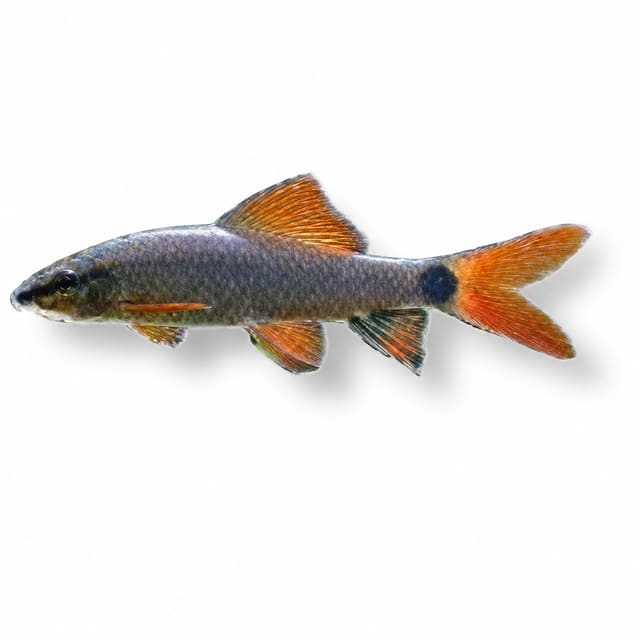
The body-and-fin pattern is also diagnostic. The classic Red Tail Black Shark has a dark body and a red or orange-red tail, while the Rainbow Shark, Epalzeorhynchos frenatum, generally carries red colour on several fins. “Ruby Shark” is commonly used for the Rainbow Shark, not reliably for this species, so that name should not be used to identify this fish. Our Rainbow Shark guide explains the comparison in more detail.
The size selector lists six grades: 2-3 cm, 3-4 cm, 4-5.5 cm, 5.5-7 cm, 6-8 cm and over 9 cm. Check the selector for current availability and price for each grade. A size band is a commercial range, not a promise of an exact measurement, age, sex, rank or level of colour.
| Selected grade | Planning point | Not guaranteed |
|---|---|---|
| 2-3 cm | A small juvenile that still requires a complete adult housing plan | Beginner temperament, permanent small size or sex |
| 3-4 cm | A juvenile; monitor feeding access and avoid large intimidating companions | Exact age or settled adult colour |
| 4-5.5 cm | More visible body size, but territorial behaviour can still increase with growth | A community-safe adult |
| 5.5-7 cm | Introduce to a fully prepared layout with hiding places already established | A proven temperament or individual selection |
| 6-8 cm | A larger fish that needs adequate transport-day shelter and open swimming room | Sex, breeding condition or final size |
| Over 9 cm | A larger grade whose territorial needs should be treated as an adult-level concern | An exact length, age or mature sex |
Do not buy a smaller grade as a way to postpone the correct aquarium. Use the tank volume calculator with the aquarium's internal dimensions and keep the permanent footprint, filtration and stocking plan in view from the start.
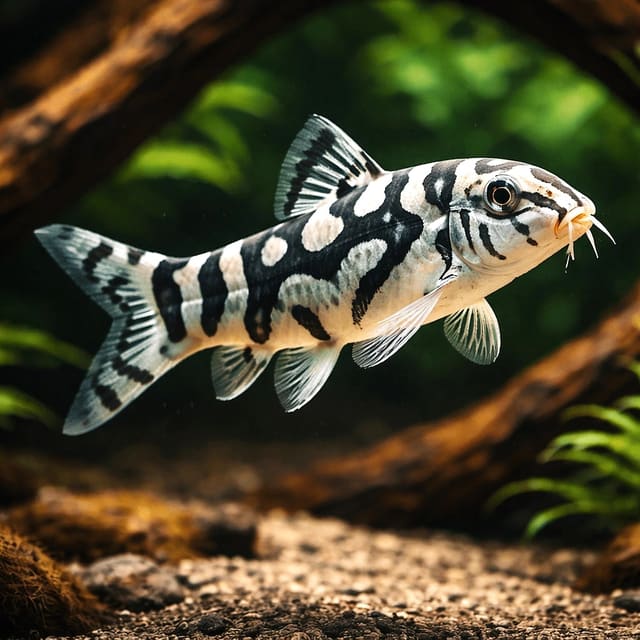
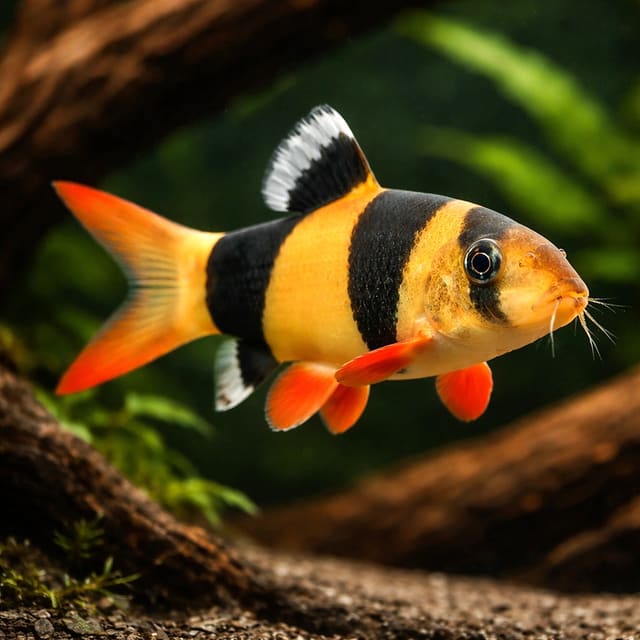
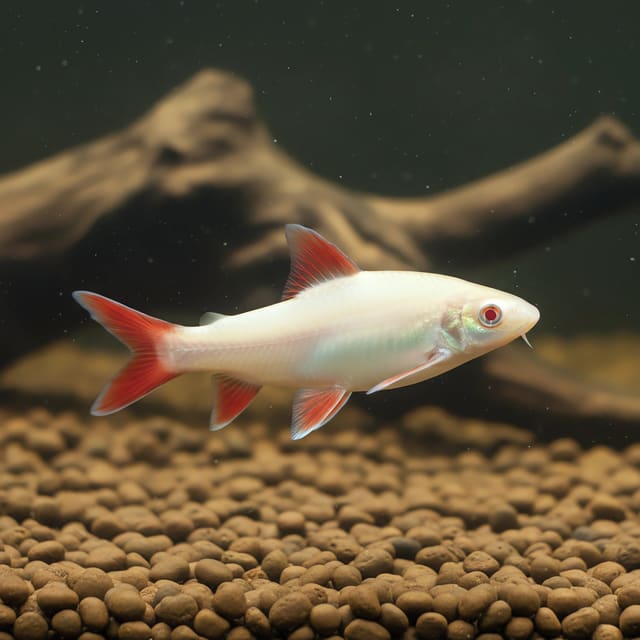
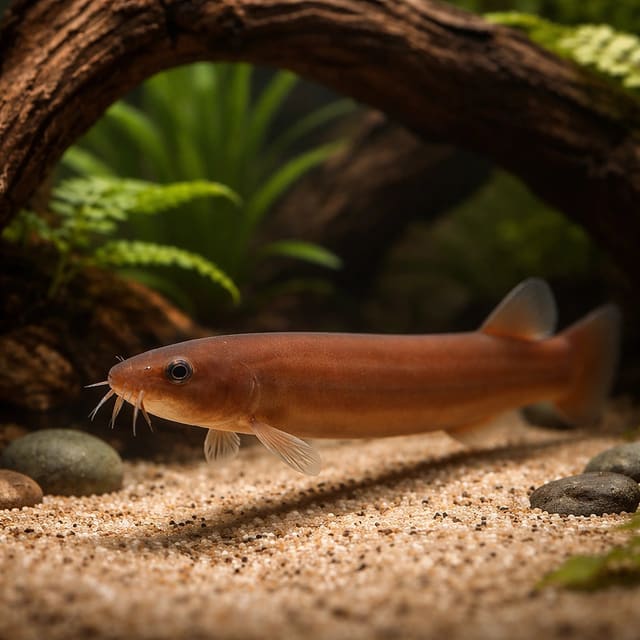
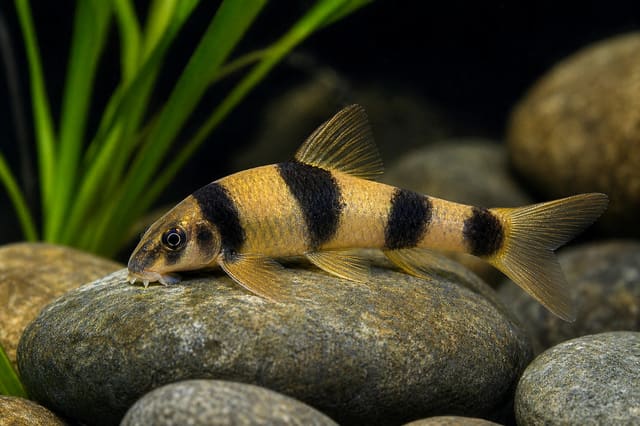
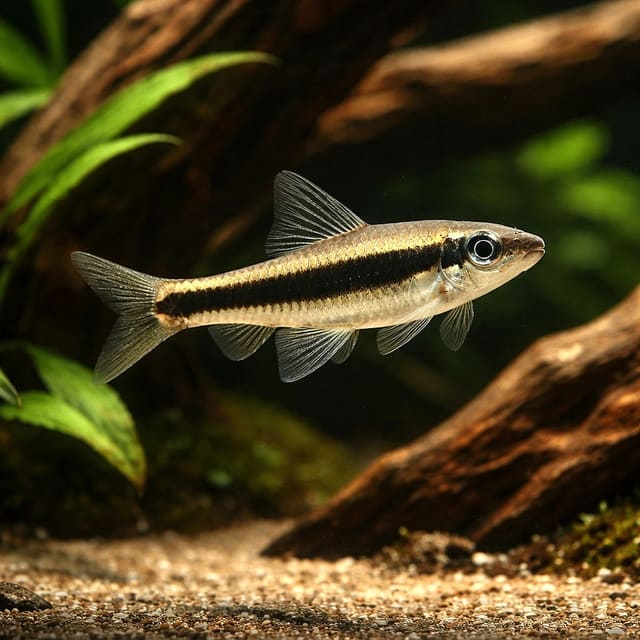
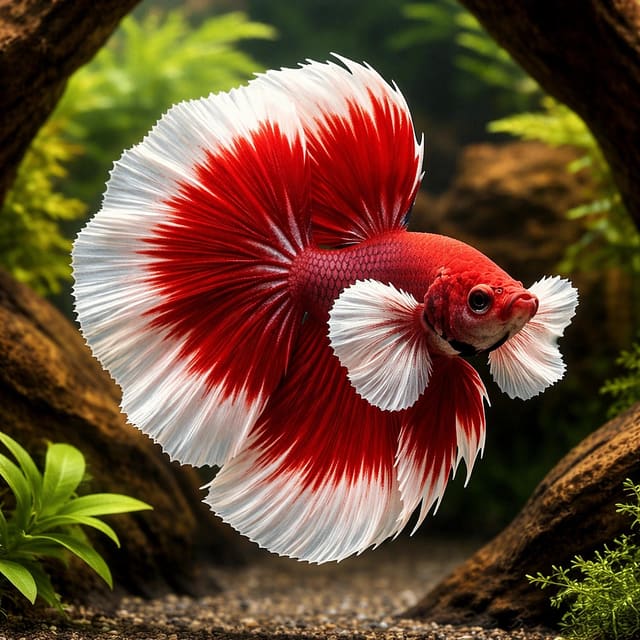
The first gallery image is a small reference image, not a view of the exact fish that will be dispatched. The other four are aquarium illustrations. Use the scientific name and written offer to confirm what is sold; gallery scenes do not guarantee the appearance of an individual fish.
The illustrations should be used only for a broad sense of a shark-like body and red-tail colour direction. They are not reliable identification plates: some show body or fin colour that does not perfectly match the accepted dark-body, red-tail pattern. One illustration contains two fish; that is an artistic scene and not a recommendation to keep a pair. The option menu still supplies one fish per quantity.
FishBase records a maximum length of 13 cm total length, while OATA advises that Red-tailed Black Sharks grow to around 15 cm. The difference is small enough to plan conservatively around a solid 15 cm adult. Body length alone understates the space requirement because this fish patrols, accelerates and defends a lower-level territory.
OATA recommends an aquarium of at least 120 litres for a Red-tailed Black Shark. That is a welfare floor for one fish, not a target for ambitious stocking. A longer aquarium around 150 litres or more usually provides a more useful footprint for caves, visual barriers, robust tank mates and an open route to swim. An aquarium with generous length is preferable to a tall narrow tank of the same volume.
| Situation | Recommendation |
|---|---|
| Single specimen, lightly stocked | At least 120 litres with a mature filter, shelter and open swimming room |
| Community aquarium | A longer 150-litre-or-larger system gives more room to separate territories and feeding zones |
| Busy lower-level stocking | Increase the footprint or reconsider the shark; litres do not prevent competition for the same caves |
| Two Red Tail Black Sharks | Not recommended for an ordinary home aquarium; adults are territorial and OATA advises keeping them singly |
| Temporary juvenile setup | Only acceptable when the adult aquarium already exists and transfer is planned; sale size does not reset adult needs |
Young fish may appear reasonably peaceful, but territorial behaviour often strengthens as the fish matures. A settled specimen can claim a cave, a route between wood and rocks, or a feeding area. Chasing is most likely when another fish repeatedly enters that zone, resembles another freshwater “shark”, or competes for the same lower-level shelter.
The safest default is one Red Tail Black Shark per aquarium. Keeping a pair does not create a social benefit, and casual group keeping can produce repeated pursuit and injury. A large specialist system may change the amount of available territory, but it does not change the species' adult behaviour enough to make multiple fish a routine recommendation.
Normal boundary-setting should not become constant harassment. Repeated high-speed pursuit, a tank mate pinned in one corner, damaged fins, missed meals or a fish that cannot leave cover are signs that the stocking or layout is failing. Use the tank-mate planning tool as a first screen, then assess the exact adult size, speed, aquarium zone and temperament of every species.
A successful layout combines shelter with open swimming room. Use smooth rocks, stable wood, robust plants and more than one cave-like retreat. Break long sight lines so the shark does not monitor the entire aquarium from a single position. At the same time, leave a clear lane for movement and enough access to clean behind the hardscape.
| Element | Useful approach | Avoid |
|---|---|---|
| Substrate | Sand or fine rounded gravel that protects the mouth and barbels | Sharp gravel and waste-filled pockets |
| Shelter | Several stable caves, wood arches or shaded spaces | One contested cave for all bottom fish |
| Sight lines | Plants and wood that divide the lower aquarium into zones | A bare tank where every fish remains in view |
| Swimming room | An open route along the front or middle of the tank | Filling every centimetre with decor |
| Lid | A secure cover with cable and filter gaps closed | Open gaps that an active or startled fish can reach |
| Maintenance access | Space to siphon under and behind structures | Unmovable decor that traps food and waste |
Plants are useful for cover and visual separation, but the species does not require a heavily planted aquarium. Choose robust plants that tolerate the selected light and water conditions. Secure newly planted stems and keep enough bare substrate visible to monitor waste and feeding.
Our stock records show 23-27°C, pH 6.0-7.8 and 5-20 dGH for this stock. FishBase gives 22-26°C and pH 6.5-7.5, while OATA's broader freshwater-shark guidance gives 22-27°C, pH 6.5-8.0 and 4-12 dGH. A practical routine target is therefore 23-26°C, pH 6.5-7.5 and moderate hardness, without making abrupt corrections to a stable aquarium.
| Parameter | Routine target | Action boundary |
|---|---|---|
| Temperature | 23-26°C | Check the heater and thermometer if temperature moves unexpectedly |
| pH | 6.5-7.5 | Do not chase a number with sudden chemical dosing |
| General hardness | About 5-12 dGH where source water permits | Measure before altering mineral content |
| Ammonia | 0 mg/l | Any detectable result requires immediate investigation |
| Nitrite | 0 mg/l | Any detectable result is unsafe |
| Nitrate | No more than 20 mg/l above the tap-water baseline under OATA guidance | Review feeding, stocking and water changes if the trend rises |
Use a mature biological filter and maintain good oxygen exchange. FishBase associates the species with rivers and floodplains; that ecological context supports clean, well-circulated water, but the aquarium does not need a punishing current. Diffuse the return so circulation reaches the whole tank without forcing the fish to fight a narrow jet. Compare your readings with the water parameter matcher before ordering.
The filter must be established before the fish arrives. A new aquarium is not made mature by bottled claims or by waiting a fixed number of days; test data and a functioning nitrogen cycle matter. Keep ammonia and nitrite at zero, record nitrate rather than guessing, and service mechanical media without destroying the biological population.
| Frequency | Task | What to observe |
|---|---|---|
| Daily | Count fish and check breathing, posture, fins, colour and appetite | Hiding, repeated chasing, rapid breathing or missed food |
| After feeding | Remove uneaten food and inspect the lower aquarium | Whether the shark and quieter tank mates both ate |
| Weekly | Test temperature, ammonia, nitrite, nitrate and pH | Actual readings and trends |
| Weekly | Carry out an appropriate partial water change with conditioned, temperature-matched water | Stable temperature and normal behaviour during and after the change |
| As required | Clean mechanical media in removed aquarium water and restore flow | Reduced output, trapped debris or noisy equipment |
| Monthly review | Inspect heater, thermometer, lid, cables, hoses and seals | Wear, drift and backup-equipment needs |
FishBase describes Epalzeorhynchos bicolor as omnivorous, taking plant matter and small benthic animals. OATA recommends sinking pellets with a high algae content and suitable live or frozen foods such as bloodworm or brine shrimp. Use a complete sinking omnivore or algae-rich pellet as the regular foundation, then add measured vegetable and animal-based variety.
| Food type | Role | Control point |
|---|---|---|
| Complete sinking pellet or wafer | Balanced staple delivered to the lower aquarium | Choose a size the fish can take cleanly |
| Algae-rich or spirulina food | Plant-rich variety that supports natural grazing behaviour | It does not turn the fish into a substitute for aquarium maintenance |
| Blanched vegetable | Occasional texture and plant matter | Offer a small portion and remove leftovers |
| Frozen or live food | Measured variety and feeding interest | Use a trusted source and avoid turning rich food into the whole diet |
| Natural algae and biofilm | Supplementary grazing surface | Cannot provide complete nutrition by itself |
OATA advises one measured daily feed for freshwater sharks, limited to what is eaten within a few minutes. In a mixed aquarium, several small feeding points can stop one territorial fish from controlling every sinking item. Watch the food reach each animal rather than scattering extra “just in case”; overfeeding leaves waste exactly where this fish patrols.
The best companions are active, robust fish that occupy different areas, tolerate the same water and are not easily intimidated. OATA specifically gives danios, barbs and rainbowfish as examples. That is a starting point, not permission to mix every member of those groups. Adult size, group size, fin shape, swimming speed and the aquarium footprint still need checking.
| Candidate type | Assessment |
|---|---|
| Active medium danios | Often a better fit when kept in the correct group and given open upper-level room |
| Robust medium barbs | Can work in a sufficiently large group and aquarium; avoid known fin-nipping pressure on slower fish |
| Suitable rainbowfish | Active open-water companions where adult size, group needs and water overlap are met |
| Calm but sturdy midwater fish | Case by case; confirm they will not be trapped or outcompeted |
| Other bottom dwellers | Higher risk because caves, substrate and sinking food are shared resources |
| Other freshwater “sharks” | Avoid as the default because body shape and territory overlap can trigger aggression |
Avoid tiny, delicate, very slow or long-finned fish, ornamental shrimp, and timid bottom dwellers that cannot escape a defended zone. Corydoras and loaches are not automatic companions merely because they are community fish; in a small or crowded aquarium they may be chased whenever they cross the shark's route. Browse the wider tropical fish collection only after the territorial plan is settled.
Common names around freshwater “sharks” are inconsistent. Compare scientific identity and adult requirements before buying by name alone.
| Fish | Colour clue | Key planning difference |
|---|---|---|
| Red Tail Black Shark E. bicolor |
Dark body with the red colour concentrated on the tail | Territorial; keep one in most home aquariums |
|
Albino Rainbow Shark E. frenatum |
Pale body with red colour on several fins | Different species and colour form; also territorial |
|
Black Shark Labeo chrysophekadion |
Dark body without the Red Tail Black Shark pattern | Much larger fish requiring a substantially larger specialist aquarium |
| Bala or Silver Shark Balantiocheilos melanopterus |
Silver body with dark-edged fins | A large shoaling species, not a solitary territorial substitute |
“Ruby Shark” commonly refers to the Rainbow Shark, Epalzeorhynchos frenatum, a different fish with its own care needs.
Prepare the aquarium before dispatch. Test the water, confirm the heater and filter are working, close gaps in the lid and decide where the fish can shelter without being trapped. Read the current delivery information and Live Arrival Guarantee terms before the parcel arrives so the reporting process is understood in advance.
A new Red Tail Black Shark may hide, pale temporarily or explore repeatedly during the first days. The trend should move towards steady breathing, open fins, a regular patrol route and confident feeding. Constant frantic swimming, surface gasping or being attacked by resident fish is not normal settling.
Look for clear eyes, intact fins, a smooth body line, steady respiration and a full but not swollen abdomen. Colour alone is not a diagnosis because stress and lighting can make the body appear grey or the tail less intense. Combine any colour change with appetite, breathing, posture, skin, fins and water-test results.
| Observation | First response |
|---|---|
| Rapid breathing or hanging near flow | Test ammonia, nitrite, temperature and oxygenation; inspect equipment immediately |
| Persistent hiding and missed meals | Check bullying, shelter, water quality and recent changes |
| Faded body or tail | Review stress and environment rather than treating colour alone |
| Torn fins or abrasions | Identify aggression and sharp decor, then restore clean stable water |
| Weight loss despite interest in food | Isolate where appropriate and seek qualified fish-health advice |
| White spots, growths or unusual mucus | Quarantine and diagnose before medicating the display aquarium |
Do not choose medication by keyword or appearance alone. Similar signs can result from water quality, injury, parasites, bacterial disease or social stress, while the wrong treatment can harm the biological filter and other livestock. Persistent or serious signs need advice from an aquatic veterinary professional or suitably qualified fish-health specialist.
OATA notes that freshwater sharks are difficult to sex. This listing therefore supplies unsexed fish and does not promise a breeding pair. Size, colour strength and fin shape should not be treated as reliable sex guarantees for a retail juvenile.
The ornamental trade breeds the species at commercial scale, but OATA considers home-aquarium reproduction unlikely because adults require territories that are difficult to provide together. Buying two fish does not create a breeding project; it is more likely to create territorial conflict. A specialist breeding programme would need much more space, controlled broodstock management and a plan for separating incompatible adults.
Epalzeorhynchos bicolor is native to Thailand. FishBase records river and floodplain habitat in the Chao Phraya basin, and a 2014 field paper reported the species again from the Mae Klong basin after a long period of serious concern about its wild status. That conservation history should not be used as scarcity marketing.
FishBase reports that ornamental exports are captive-bred, and OATA says most freshwater sharks in the trade are captive-bred because some wild species are threatened. This fish is not sold with documented breeder, farm, lineage or collection-locality details. Ask before ordering if traceable origin matters to your aquarium plans.
| Good fit when | Poor fit when |
|---|---|
| The aquarium is mature, at least 120 litres and has a useful horizontal footprint | The aquarium is new, small, tall and narrow, or already crowded |
| You want one active territorial feature fish and can plan around it | You want a pair, group or several similar “sharks” |
| Tank mates are robust, active and occupy compatible zones | The community relies on timid bottom dwellers, shrimp or slow long-finned fish |
| The layout has several shelters, broken sight lines and open swimming room | The lower aquarium has one cave or no visual separation |
| You test water, control feeding and can act on persistent chasing | You need a passive “algae cleaner” that requires no dedicated care |
If the fit remains uncertain, use the contact page before ordering and include aquarium dimensions, litres, water readings and the full current stock list. A clear “not for this tank” decision is better than relying on the fish's small sale size.
Use the live option menu for current size, price and availability. Each grade can have a different price and availability. Review the full Loaches and Algae Eaters collection or broader freshwater fish guide when comparing alternatives, but do not treat every bottom-oriented species as compatible.
Review the current delivery, returns and live-arrival terms for your postcode before ordering.
The references below support the species identity and broader care guidance; they do not document the origin or condition of an individual fish.
External sources describe the species, not the exact fish dispatched. Where ranges differ, use the stable conservative overlap described above and avoid abrupt water changes.
No. It is a tropical freshwater cyprinid in the minnow and carp family. The common name refers to its shark-like outline and movement.
The accepted name is Epalzeorhynchos bicolor. Labeo bicolor is the original combination and remains common in supplier and aquarium-trade records.
Yes, when the name refers to Epalzeorhynchos bicolor. Redtail Shark and Red-tailed Black Shark are common-name variants, so check the scientific name whenever a retailer uses shortened wording.
Not reliably. Ruby Shark is commonly used for the Rainbow Shark, Epalzeorhynchos frenatum. These are different species.
Plan for approximately 12-15 cm. FishBase records 13 cm total length and OATA advises that Red-tailed Black Sharks grow to around 15 cm.
OATA recommends at least 120 litres for one. A longer aquarium around 150 litres or more gives better scope for territory, shelter and compatible community stocking.
Not as a routine home-aquarium plan. Adults are territorial and are best kept singly. The gallery image containing two fish is an illustration, not a pair-keeping recommendation.
They are territorial rather than indiscriminate predators. Aggression commonly increases with maturity and is directed towards similar-shaped fish or animals entering the same lower-level territory.
Robust, active danios, suitable barbs and suitable rainbowfish can work when their exact group, adult size and water needs are met. Avoid tiny, timid, slow, long-finned and competing bottom-dwelling species.
Only with caution. They share the lower aquarium, caves and sinking food, so territorial pressure can become a problem even when the other species is normally peaceful.
That is not recommended as the default. Their similar shape, behaviour and preferred territory can create repeated conflict.
Use a complete sinking food as the staple, with algae-rich and vegetable variety plus measured frozen or live foods. Natural algae and leftovers are not a complete diet.
A practical target is 23-26°C. Our stock records show 23-27°C and FishBase records 22-26°C; stability matters more than pushing to an edge.
A stable pH of 6.5-7.5 is a sensible target within the supplier and FishBase ranges. Avoid rapid chemical adjustments.
It grazes algae and plant-rich material, but it is an omnivore and still needs complete food. It should never be purchased as a replacement for cleaning, water changes or algae control.
No. The first image is a small reference image and the other four are illustrations. None shows the exact individual supplied, and some illustrative details are not reliable for species identification.
Quantity one supplies one unsexed fish from the size grade selected. It does not include a pair or guarantee an exact measurement within the commercial band.
Check the current delivery and returns pages for postcode eligibility, live-arrival terms and reporting requirements before ordering.
No reviews for this item yet. Bought one? Honest reviews only, good or bad.
What customers say about ordering from us
I have a small group of long finned mountain minnows. So was delighted to be able to order ten of this variety to increase the genetics in my tank . The ones I recieved are healthy but it’s to early to give a verdict on wether they are of a long finned type since they are small currently.
Gordon Walker · 23 Sept 2026
100% success travel and "installation". Pleased with quality of purchase. The Siamese fighter a bit "shy" so have not yet seen him at his best yet but looking good. Happy customer. GG
George E Garratt · 21 Sept 2026
Reviews of our shop, collected by Judge.me, an independent third-party review collector. Newest first.