Moderate
Rainbow Shark (Epalzeorhynchos frenatum)
24–26°C · pH 6.5–8 · 243L
£5.99

Black Sharkminnow (Labeo chrysophekadion), one live unsexed fish in the selected approximate 4-5 cm or 8-10 cm band. An advanced, territorial cyprinid with a 90 cm published maximum that requires a custom adult aquarium well over 1,500 litres.
Labeo chrysophekadion
Confirm your email, then we’ll send an availability message for this exact item if it returns within 180 days.
This request is only for this product—no newsletter or other promotions. A mail-provider retry may very rarely duplicate the same availability message. Unconfirmed addresses are removed after 48 hours. See our privacy policy.
Black Sharkminnow (Labeo chrysophekadion), one live unsexed fish in the selected approximate 4-5 cm or 8-10 cm band. An advanced, territorial cyprinid with a 90 cm published maximum that requires a custom adult aquarium well over 1,500 litres.
Maintain these water conditions for optimal health and vibrant colors
Black Sharkminnow is the accepted common name for Labeo chrysophekadion, a very large Southeast Asian freshwater cyprinid also sold as Black Shark or Black Labeo. It is not a marine shark, Red Tail Black Shark or Rainbow Shark. That distinction matters: FishBase records a maximum total length of 90 cm and a maximum published weight of 7 kg, so this is a specialist large-fish commitment rather than a permanent choice for an ordinary community aquarium.
Two approximate purchase sizes may appear in the selector: 4-5 cm and 8-10 cm. Each selected quantity means one live, unsexed fish in the chosen approximate size band. It does not mean a pair, shoal, sexed animal or exact measured length. Both options are juveniles with the same adult potential; choosing the smaller size does not create a dwarf form or reduce the permanent enclosure required.
A responsible long-term plan starts with a custom adult system. For one fish, Tropical Fish Co recommends a planning floor around 250 x 100 cm footprint and well over 1,500 litres, with approximately 300 x 120 cm and 2,000 litres or more preferred. These dimensions are a welfare-led recommendation based on the documented adult scale, heavy build, turning radius, activity and filtration load. They are not a tank-size figure published by FishBase, and litres alone cannot compensate for inadequate length or front-to-back width.
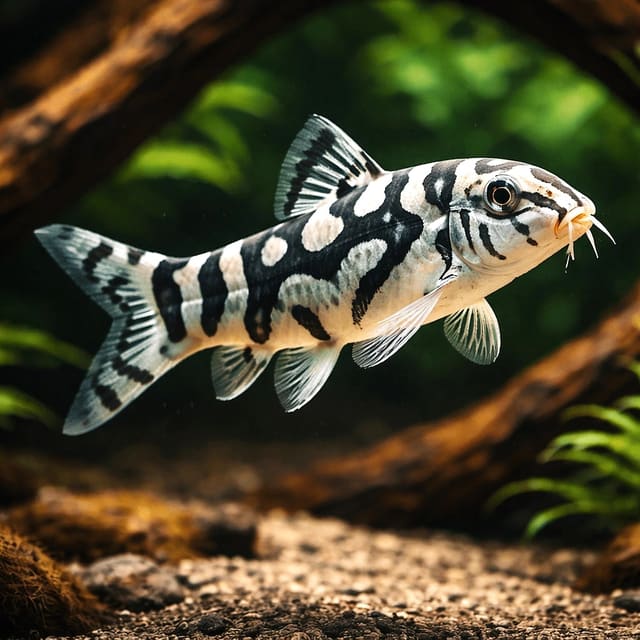
The four gallery images help illustrate the dark juvenile form but are not photographs of the exact fish dispatched. One scene contains two fish for visual context; that does not make this a pair listing or recommend keeping two together. Live colour, proportions, size, sex and temperament vary, and large adults may become greyer with an iridescent point on each scale.
Do not buy this fish on the assumption that a small juvenile can remain in a modest aquarium or be easily rehomed later. Secure the permanent footprint, floor support, filtration, cover, maintenance access and long-term budget before purchase. A temporary grow-out tank is a managed stage, not the adult plan.
Labeo chrysophekadion is a freshwater member of the carp and minnow family. The name "shark" describes its tall dorsal profile and purposeful swimming shape; it does not place the fish among marine sharks. The current Catalog of Fishes accepts Labeo chrysophekadion and places it in Cyprinidae: Labeoninae. Older literature may use Rohita chrysophekadion or Morulius chrysophekadion, but those historic combinations are not separate retail species.
Juveniles are notable for an all-dark body and fins. FishBase describes larger adults as becoming grey, with an iridescent spot on each scale. That change is normal species development and means a young black fish should not be marketed as if its exact shade will remain fixed for life. Lighting, background, stress, age and individual variation also affect how dark an aquarium fish appears.
The accepted scientific identity prevents a serious care error. Rainbow Shark, Epalzeorhynchos frenatum, and Red Tail Black Shark, Epalzeorhynchos bicolor, are much smaller fish with different adult plans. Silver or Bala Shark, Balantiocheilos melanopterus, is a separate large shoaling cyprinid. None is a synonym for this product, and advice written for one must not be copied onto another.
| Name seen online | How this page treats it | Important boundary |
|---|---|---|
| Black Sharkminnow | Preferred accepted common name | Large freshwater cyprinid, not a marine shark |
| Black Shark | Familiar secondary trade name | Too ambiguous to use without the scientific name |
| Black Labeo | Valid secondary common name | Refers here to L. chrysophekadion |
| Labeo chrysophekadion | Current accepted scientific name | The identity used for adult care and taxonomy |
| Morulius chrysophekadion | Historic scientific combination | Not an additional species supplied in this listing |
| Rainbow or Red Tail Black Shark | Different Epalzeorhynchos species | Smaller-fish care must not be substituted |
The size selector describes approximate live-trade bands. A moving juvenile cannot be promised to the millimetre, and its size does not establish age, sex, growth rate or final dimensions. The selected variant controls the current price and availability; this body deliberately avoids hard-coding either because Shopify remains the live source.
Each quantity adds one fish. A quantity of two would mean two individual juveniles, not a compatible pair, bonded pair or planned group. This species can become strongly territorial, especially towards its own kind and similarly shaped bottom-oriented fish. The site therefore uses the solo pricing presentation rather than a shoal recommendation.
Choose between the size bands only after checking the current aquarium inhabitants. A very small juvenile may be vulnerable to a large companion or a powerful intake, while a larger juvenile may dominate a modest grow-out system sooner. Both require the same permanent adult commitment and both need a secure separation option if behaviour changes.
| Selector choice | What it means | What it does not mean |
|---|---|---|
| Approximately 4-5 cm | One smaller juvenile in that approximate band | Not a dwarf form, exact measurement or small-tank adult |
| Approximately 8-10 cm | One larger juvenile in that approximate band | Not a sexed adult or reduced adult commitment |
| Quantity one | One live, unsexed fish | Not one pair or one shoal |
| Quantity two or more | That number of separate fish | Not a compatibility or group-care recommendation |
FishBase and USGS record a maximum length of 90 cm, while FishBase also reports a maximum published weight of 7 kg. Aquarium fish do not all reach a database maximum, and no seller can promise an exact adult length. Responsible planning nevertheless uses credible maximum potential rather than a convenient smaller number. The cost of underestimating this species is restricted movement, unstable water quality and a difficult rehoming problem.
Length is only part of the space calculation. This is a thick-bodied, muscular fish that needs room to turn without bending around glass or decor. Front-to-back width becomes critical as it matures. A tall but narrow aquarium can hold many litres while still denying usable movement, and a large ornament can reduce an apparently adequate footprint to a narrow corridor.
Growth varies with genetics, starting age, food, temperature, health and water quality. Keeping a fish in a small aquarium does not safely "stop it growing." Restricted space can suppress normal behaviour while waste load rises faster than the system can manage. Monitor actual length, body depth, turning clearance and behaviour at regular intervals, and move the fish before the current enclosure becomes limiting.
| Stage | Planning focus | Common mistake |
|---|---|---|
| 4-10 cm juvenile | Safe intake, appropriate food, mature water and a secured adult plan | Treating purchase size as permanent size |
| Growing fish | Measure body and turning room; increase filtration and footprint early | Waiting until the fish already struggles to turn |
| Large adult | Custom width, long swimming route, protected equipment and heavy waste capacity | Judging the system by litres alone |
| Any stage | Keep a humane separation and emergency-support plan | Assuming a shop or public aquarium will accept a large unwanted fish |
For one adult, use a custom system with a planning floor around 250 cm long by 100 cm front-to-back and well over 1,500 litres. A footprint around 300 x 120 cm with 2,000 litres or more is preferred because it provides a more credible turning circle, longer swimming route and room to protect equipment. The exact gross volume depends on water depth; usable space after substrate and structure matters more than a marketing litre figure.
This is a planning recommendation from Tropical Fish Co, not a tank dimension quoted by FishBase. It follows the documented 90 cm maximum, 7 kg potential, active river-fish form and general welfare principle that adult size, oxygen, filtration and behaviour all influence required space. An unusually large individual, multiple large fish or bulky decor can require still more.
Assess the building as well as the glass. Water alone weighs about one kilogram per litre, before the aquarium, stand, filtration, rock and people are added. Obtain qualified structural advice where required. Plan doorway access, drainage, safe electrics, service clearance, replacement-pump access and a route for moving a large fish without lifting it in a small net.
| Adult-system element | Planning floor | Why it matters |
|---|---|---|
| Length | About 250 cm; around 300 cm preferred | Provides an actual swimming run rather than repeated tight turns |
| Front-to-back width | About 100 cm; around 120 cm preferred | A 90 cm potential fish needs credible turning clearance |
| Water volume | Well over 1,500 litres; 2,000+ preferred | Supports stability and dilution but does not replace footprint |
| Cover | Rigid, close fitting and equipment-gap safe | Protects a strong active fish from escape and injury |
| Structure | Stable, smooth and open around the swimming path | Prevents trapping, collapse and abrasion |
| Building support | Professionally assessed where needed | A complete custom system can weigh several tonnes |
A properly managed grow-out aquarium can protect a small arrival, make feeding observable and keep it away from adult tank mates that could injure it. It is acceptable only when the permanent system and transfer schedule already exist. "I will upgrade when it gets big" is not a complete plan because custom builds, structural work and rehoming options take time.
The grow-out tank must still be mature, covered and wide enough for normal turning. Keep the decor simple enough to inspect the fish and remove waste, but include secure shelter and visual relief. Protect heater guards, pipework and intakes. A growing fish can rapidly outpace an enclosure that looked generous on delivery day.
Record length and body depth monthly using a repeatable non-invasive method, such as a reference scale visible through the glass. Do not chase or net the fish merely to measure it. Set upgrade triggers before purchase: usable turning width, swimming length, filter loading and behaviour are better triggers than waiting for a particular birthday.
| Grow-out question | Acceptable answer | Warning sign |
|---|---|---|
| Where is the adult home? | Specified dimensions, support and equipment are secured | Depends on a future buyer or unknown upgrade |
| When will transfer happen? | Triggers are set before turning becomes restricted | Transfer waits until the fish looks cramped |
| Can the juvenile feed safely? | Food reaches it and leftovers can be observed | Larger tank mates take every meal |
| Is equipment protected? | Intakes, heaters and gaps are guarded | Fish can enter a pipe gap or strike bare glass equipment |
The documented range spans tropical Southeast Asia. FishBase lists the Mekong and Chao Phraya basins, Malay Peninsula, Sumatra, Java and Borneo. USGS likewise describes the Mekong and Chao Phraya systems across Cambodia, Thailand, Laos and Vietnam, plus Malaysia and the major Sunda islands. This is a freshwater river and floodplain fish, not a coastal or reef species.
USGS describes upstream spawning migration from large deep pools and channels into shallow floodplain habitat during the rainy season. The Mekong River Commission report places that movement in a broader cycle linking dry-season refuges, river channels and seasonally inundated feeding areas. An aquarium cannot reproduce a river basin, but it can respect the need for open movement, clean oxygenated water, varied surfaces and stable seasonal care.
Wild distribution does not certify the origin of an individual retail fish. This listing does not promise a particular country, river, wild-caught history, captive-bred generation or genetic locality. The responsible claim is the documented species identity, not an invented collection story.
Use a stable practical target of 24-27°C, pH 6.5-7.5 and approximately 5-15 dGH. The current acclimated care range extends hardness to 20 dGH, but stability and acclimation history matter more than forcing a fish from one acceptable value to another. Test the source water and aquarium before ordering, then make changes gradually.
Ammonia and nitrite should remain at zero. Keep nitrate low and stable through adequate filter capacity, controlled feeding and measured water changes. Clear water is not proof of safe water; dissolved waste can be invisible. Use reliable liquid tests and keep a written baseline so a change in behaviour can be compared with actual chemistry.
Temperature, oxygen and waste load interact. Warm water holds less oxygen, while a large active fish consumes more and produces substantial waste. Provide broad surface movement and avoid a single violent jet that forces continuous station holding. If respiration changes, test water and equipment immediately rather than assuming the fish is merely active.
| Parameter | Practical target | Action boundary |
|---|---|---|
| Temperature | 24-27°C | Avoid rapid swings; verify heaters and oxygen during heat |
| pH | 6.5-7.5 | Stable suitable pH is safer than abrupt correction |
| General hardness | About 5-15 dGH | Current care range reaches 20 dGH; acclimate rather than chase numbers |
| Ammonia | 0 mg/L | Any detectable reading requires immediate investigation |
| Nitrite | 0 mg/L | Any detectable reading is unsafe |
| Nitrate | Low and stable | Respond to the trend and fish load, not one universal threshold |
| Oxygenation | Strong gas exchange throughout | Urgent checks for changed breathing or gathering at outlets |
Use the Water Parameter Matcher to compare source water with the target, and review the water chemistry guide before making pH or hardness changes. Those tools support planning; they do not override measured acclimation or professional fish-health advice.
A mature adult needs high-capacity biological filtration backed by effective mechanical waste capture. Design the system around the fish's eventual biomass, not the juvenile's first-week feeding. Multiple filter paths or pumps can add resilience, but only if a failure is noticed and service can be completed without leaving the aquarium unprotected.
Prefilters should be accessible because plant-rich foods and a large grazing fish can create visible solids. Rinse biological media only as needed in dechlorinated or removed aquarium water, and avoid replacing all mature media together. Protect every intake so the fish cannot become trapped, and guard heaters against impact.
There is no honest universal water-change percentage for every 2,000-litre system. Measure nitrate trend, dissolved waste indicators where available, food input and fish condition, then establish a repeatable schedule. Replace water with dechlorinated, temperature-matched water and avoid a sudden chemistry shift. Large systems benefit from safe drains and refill controls, but automation must have overflow and failure protection.
| System task | Routine | Failure to avoid |
|---|---|---|
| Water testing | Record ammonia, nitrite, nitrate, pH and temperature | Relying on clarity or smell |
| Mechanical filtration | Remove trapped solids before they decay | Letting blocked media reduce flow and oxygen |
| Biological filtration | Keep mature media oxygenated and stable | Replacing or cleaning all media at once |
| Water replacement | Base volume and frequency on measured trend | Large unconditioned or temperature-mismatched changes |
| Redundancy | Test backup air, pumps and power response | Owning spare equipment that cannot be connected quickly |
| Pipework | Inspect guards, valves and overflows | Leaving a strong fish access to an intake or open gap |
Prioritise one long, unobstructed swimming circuit. Use large smooth wood and rounded rock only when they are stable under the expected force of a heavy fish. Structures must not create narrowing slots, collapse points or one-way caves. Test every opening against the adult body, not the juvenile that first enters it.
Natural feeding includes algae, periphyton, plant material and detritus, so assume that soft plants may be grazed, uprooted or damaged. Robust plants can be protected behind structure or grown in inaccessible filtration zones, but this is not a fish for a delicate show aquascape. Smooth surfaces that develop biofilm are more useful than sharp decorative complexity.
Fit a rigid close-fitting cover and secure every cable, overflow and pipe gap. Keep equipment serviceable without creating a temporary escape route. Use subdued zones and sight breaks, but maintain enough visibility to check body condition and skin. A dark background may make a juvenile easier to settle, yet it can also make an all-black fish harder to inspect, so provide controllable lighting.
USGS describes this species as primarily herbivorous, consuming algae, periphyton, terrestrial plant material and detritus. FishBase's ecology summary similarly places it at a low trophic level and identifies plant/detritus feeding. The trade name "shark" must not turn that evidence into a meat-heavy predator diet.
Build the aquarium diet around quality sinking grazer pellets or wafers, spirulina-rich foods, cultured biofilm and controlled portions of fish-safe vegetables. Add modest varied protein through balanced prepared foods and occasional suitable invertebrate material, but do not make bloodworm, mussel or high-fat meat the daily base. Remove leftovers before they break down.
Young fish need food pieces they can handle and direct observation to confirm intake. A large adult may consume impressive amounts, but appetite is not a reason to feed continuously. Adjust portions to body condition, activity, waste production and water tests. A rounded, powerful body is expected; persistent abdominal swelling, hollowing or sudden appetite change is not.
| Food type | Role | Use note |
|---|---|---|
| Quality sinking grazer pellet | Daily nutritional base | Choose a size the fish can take without excessive crumbs |
| Spirulina or algae wafer | Plant and algal content | Place where the fish can feed without competing at the surface |
| Fish-safe greens | Texture and plant variety | Offer controlled portions and remove uneaten material |
| Biofilm-coated surfaces | Natural grazing opportunity | A supplement, not proof that no prepared food is needed |
| Balanced omnivore food | Micronutrients and modest protein | Use within a plant-led plan |
| Rich animal foods | Occasional variety only | Avoid using mammal or poultry meat as routine food |
Territoriality is a central planning issue. A juvenile may appear manageable in a dealer or grow-out group, but that temporary observation does not guarantee adult tolerance. As size and confidence increase, the fish may claim a large lower-water area and repeatedly chase its own kind or similarly shaped grazing fish.
For most private adult systems, plan around one Black Sharkminnow. Keeping several would require a substantially larger, professionally designed enclosure with multiple territories, visual separation, feeding stations and immediate division capacity. A shop's quantity discount or a gallery showing two fish must never be interpreted as biological evidence that six, ten or twenty should live together.
Individual temperament varies. Watch for repeated pursuit, blocking access to food, one fish remaining in a corner, damaged fins, scraped sides, colour change and weight loss. Occasional displacement is not the same as stable compatibility. If one animal cannot rest, feed and move normally, separate before injuries become severe.
| Behaviour | Possible meaning | Response |
|---|---|---|
| Brief investigation of a new object | Normal environmental assessment | Observe without provoking repeated display |
| Repeated route patrol | Normal activity or emerging territory | Check whether other fish can still use the full aquarium |
| Persistent chasing of one fish | Unstable compatibility | Separate; do not wait for visible wounds |
| Blocking food or shelter | Resource control | Add separation and reassess the stocking plan |
| Frantic dashing or collision | Stress, aggression, water or environmental problem | Test water, reduce disturbance and inspect for injury |
No companion is automatically safe. Adult dimensions, mouth size, swimming level, territorial behaviour, water chemistry and feeding speed must all overlap. A companion that shares 25°C water can still be unsuitable because it is too small, delicate, slow or interested in the same lower-water territory.
In a very large adult system, robust midwater fish too large to be bullied or swallowed may sometimes be considered. The aquarium must provide more space than the solo minimum, and the keeper needs a mature separation system capable of holding either animal. Do not add another "shark", large loach or benthic grazer merely because the common names sound related.
Avoid small community fish, long-finned or slow species, persistent attackers and anything likely to rasp the body or compete at the same feeding point. Shrimp and small snails should not be treated as protected companions. Compatibility can fail after years as the Black Labeo grows, so an early peaceful period is not a lifetime guarantee.
| Potential companion | Decision | Reason |
|---|---|---|
| Another Black Sharkminnow | Normally avoid | Serious conspecific territorial risk and enormous combined space demand |
| Rainbow or Red Tail Black Shark | Avoid | Similar shape and lower-water territory invite conflict |
| Large robust midwater fish | Case-by-case caution | Needs extra adult space, matching water and separation capacity |
| Small tetras, livebearers or rasboras | Avoid | Vulnerable to stress, injury or predation as size disparity grows |
| Large loaches and benthic grazers | Usually avoid | Compete for territory, food and lower-water routes |
| Slow long-finned fish | Avoid | Cannot reliably escape pursuit and may lose feeding access |
| Shrimp and small snails | Do not rely on compatibility | Can be consumed or injured |
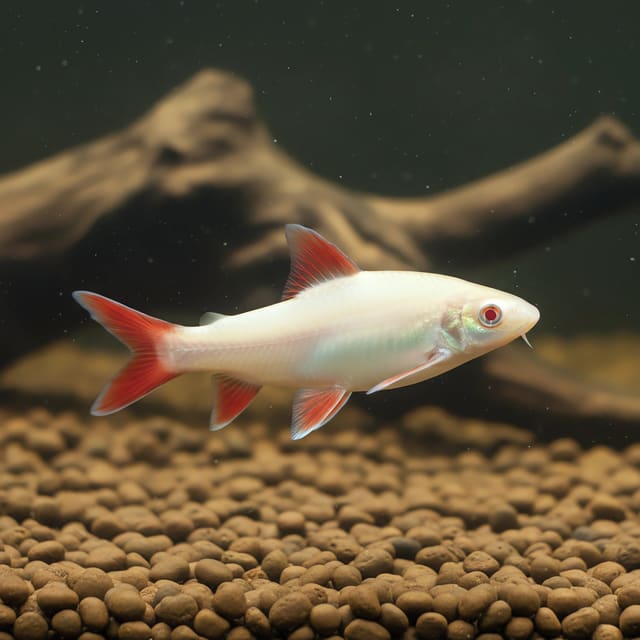
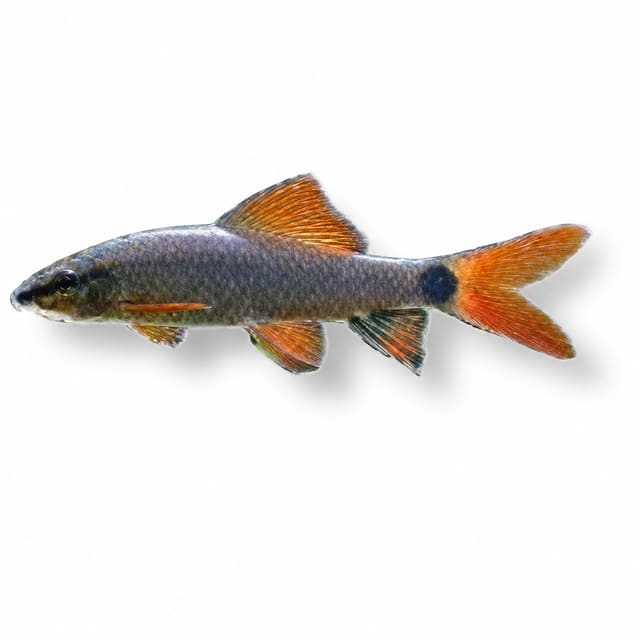
Common-name comparison is useful because UK search results repeatedly mix different fish. The Red Tail Black Shark is Epalzeorhynchos bicolor, recognised by a dark body and red tail. The Albino Rainbow Shark is an Epalzeorhynchos frenatum colour form. Both are separate smaller species and are comparison links only, not suggested tank mates.
The Silver or Bala Shark is Balantiocheilos melanopterus, another large cyprinid but a social open-water fish with very different group needs. It should not be housed by copying the territorial solo plan from this page. Marine blacktip sharks are cartilaginous saltwater animals and have no relevance to this freshwater listing.
For wider freshwater cyprinid browsing, use the barbs and related fish collection, then return to the exact species page before making a decision. A category can organise products; it cannot safely merge adult size, temperament and water requirements across unrelated species.
| Trade name | Scientific identity | Key planning difference |
|---|---|---|
| Black Sharkminnow / Black Labeo | Labeo chrysophekadion | Up to 90 cm; specialist custom solo system |
| Red Tail Black Shark | Epalzeorhynchos bicolor | Much smaller but territorial; separate care profile |
| Rainbow Shark | Epalzeorhynchos frenatum | Much smaller species; not this product's scientific name |
| Silver / Bala Shark | Balantiocheilos melanopterus | Large active social fish with group and swimming-length needs |
| Blacktip reef shark | Carcharhinus melanopterus | Marine cartilaginous fish; entirely unrelated |
Cycle and test the aquarium before dispatch. Confirm zero ammonia and nitrite, stable temperature, a protected filter intake, a close-fitting cover and a quiet shelter. Turn down the lights and remove hazards before the parcel arrives. Do not start building the enclosure after the fish is in transport.
Follow the instructions supplied with the order and the current new-fish acclimation guide. Avoid leaving a sealed transport bag unattended or mixing transport water into the aquarium without need. Use a container and method appropriate to the fish's size rather than forcing a strong animal through a small net.
After transfer, restore normal filtration and surface movement, keep the area quiet and observe breathing and balance. Offer a small suitable meal only after the fish has settled. Photograph and record any arrival concern promptly. The delivery information and Live Arrival Guarantee terms are the current source for dispatch, evidence and support requirements.
A settled juvenile should move in a controlled way, hold an even body line, maintain appropriate muscle behind the head and take suitable food. An all-black body can hide marks, so inspect from both sides under neutral light. Learn the individual's normal resting position, breathing and response to feeding rather than comparing it with an edited reference image.
Warning signs include persistent refusal of food, hollowing, swelling, sores, white patches, reddening, fin damage, repeated rubbing, loss of balance, unusual breathing or sudden collision behaviour. Test ammonia, nitrite, nitrate, pH and temperature first, inspect equipment and check for aggression. Seek an aquatic veterinarian or qualified fish-health professional for persistent or severe signs.
Do not medicate a multi-thousand-litre system by guesswork. Diagnosis, actual water volume, active ingredient, oxygen demand and filter effects matter. A hospital or isolation facility for a growing fish must be large enough to preserve welfare and stable enough to support treatment; a bucket is not a long-term quarantine plan.
| Observation | First checks | Escalation |
|---|---|---|
| Missed food after arrival | Water, light, shelter, food size and disturbance | Act if refusal persists or body condition declines |
| Rapid or changed breathing | Ammonia, nitrite, heat, oxygen, flow and gill appearance | Urgent response for distress or loss of balance |
| Scrapes or fin damage | Sharp decor, unstable structure, gaps and aggression | Professional advice for worsening redness or tissue loss |
| Hollowing despite feeding | Actual intake, food quality, competition and faeces | Fish-health assessment for persistent weight loss |
| Sudden repeated dashing | Water change, electrical fault, reflection, noise and pursuit | Remove the cause and separate if another fish is involved |
The offered fish are unsexed. Juvenile external appearance is not a reliable sex guarantee, and this listing does not promise a male, female or ratio. A gallery image cannot sex the live animal that will be supplied. If sex is essential to a managed breeding project, obtain an individually assessed mature fish with documented evidence rather than relying on a generic product page.
The species is a migratory river and floodplain spawner in nature and has been bred in aquaculture research, but that does not make it a practical casual home project. Mature size, territoriality, seasonal cues, broodstock handling and the capacity to rear large numbers of growing fish place breeding beyond a normal domestic setup.
Do not order multiple juveniles in the hope that a compatible pair will form. Their sex is unknown, adult tolerance is not guaranteed and each fish can require a huge separate home. This product makes no breeding, fertility, sex or offspring guarantee.
No. The current gallery contains four existing aquarium references. They are retained under the additive-media safeguard and help illustrate a dark juvenile Black Sharkminnow shape. They are not photographs of the exact stock, and they do not certify sex, purchase size, adult colour, scale detail or temperament.
The planted scene shows two fish, but one selected quantity still means one live unsexed fish. The image does not demonstrate adult compatibility or recommend a group. As the real fish grows, its colour and proportions can differ considerably from a stylised juvenile scene.
Confirm the selected approximate size, live availability, permanent adult footprint, building support, mature filtration, protected equipment, secure cover and maintenance access. Check every existing animal at adult size and behaviour, and keep a mature separation option. If the adult home depends on an uncertain future upgrade or hoped-for rehoming, wait.
Use the Tank Volume Calculator to check gross dimensions, then subtract substrate and structure when considering usable water. Volume is only one part of suitability: record internal length, front-to-back width and the narrowest turning point. Keep equipment models, water results and emergency contacts with the care record.
WELCOME10 currently gives 10% off where checkout eligibility and current terms allow. It is not described here as a verified first-order-only offer. A discount never changes the welfare decision, and solo pricing is intentional for this territorial large fish. The live selector remains the source for stock and price.
This fish best suits an experienced large-fish keeper with a custom adult system already secured, realistic structural and running-cost plans, plant-led feeding knowledge and the ability to house one territorial 90 cm-potential cyprinid for its full life.
Each selected quantity supplies one live, unsexed fish in the chosen approximate size band. It is not a pair or group. A two-fish gallery scene is illustrative and does not define sale quantity or compatibility.
For the species on this page, FishBase records 90 cm total length and a maximum published weight of 7 kg. Do not apply the 12-15 cm adult size of Rainbow Sharks to Labeo chrysophekadion.
For one adult, plan around at least a 250 x 100 cm footprint and well over 1,500 litres, with approximately 300 x 120 cm and 2,000 litres or more preferred. This is a welfare recommendation based on adult scale and turning room, not a FishBase tank-size value.
No. The smaller variant is a juvenile with the same adult potential as the 8-10 cm option. A grow-out aquarium is temporary and should be used only when the permanent adult system is already planned and secured.
No. It is a freshwater cyprinid in the carp and minnow family. "Shark" is a trade name based on body shape. It is unrelated to marine sharks and needs freshwater care.
No. This listing is Labeo chrysophekadion. Rainbow Shark is Epalzeorhynchos frenatum, a different and much smaller species. Their adult-size and tank advice are not interchangeable.
Keep a stable 24-27°C and pH 6.5-7.5. Aim for roughly 5-15 dGH, while recognising that the current care range extends to 20 dGH. Avoid sudden attempts to force water to a chosen number.
Use a plant-led diet based on quality sinking grazer foods, algae or spirulina foods, fish-safe vegetables and grazing surfaces. Add modest balanced protein variety, but do not use a meat-heavy predator diet.
It grazes algae and periphyton, but it is not an aquarium-cleaning tool. It creates a very large waste load and still needs a complete diet, mechanical cleaning, water testing and water changes.
Normally plan for one per system. Conspecific territoriality can intensify with growth. Keeping several would require a substantially larger specialist enclosure, multiple territories and immediate separation capacity; ordering two does not create a pair.
This is not recommended. Both can defend lower-water territory and their similar shape increases conflict risk. The product comparison link helps identification and is not a tank-mate endorsement.
No. It is an advanced specialist fish because of its 90 cm potential, territorial behaviour, huge adult footprint, structural load, filtration demand and difficult rehoming. Small juvenile size can hide that commitment.
Provide well-oxygenated, circulated water with broad surface movement and no stagnant zones. Avoid forcing the fish to hold continuously against one narrow jet. Flow should support gas exchange, filtration and normal movement.
Do not plan a delicate planted display. Natural feeding includes plant material, algae and periphyton, and a large active fish can graze or uproot plants. Use robust or protected planting without narrowing the swimming route.
A reliable species-specific aquarium lifespan is not promised here. Treat it as a long-term commitment and plan for the full adult system before purchase. Outcome varies with age, genetics, health, environment and care.
The offered fish are unsexed, and juvenile appearance does not provide a reliable customer guarantee. Ordering several does not guarantee a male, female, ratio or breeding pair.
No. The four protected images are aquarium references. The live fish can differ in size, colour, proportions, sex and adult appearance. The two-fish scene does not change the one-fish sale unit.
FishBase notes that juveniles are all black while large adults become grey with an iridescent spot on each scale. Normal development, lighting, background and individual variation can all change the apparent shade.
Separate before repeated pursuit causes injury or feeding exclusion. Test water and check whether the aquarium offers enough adult footprint and sight breaks, but do not rely on decor alone to solve serious territorial conflict.
Have a mature covered aquarium, protected equipment, stable 24-27°C water, zero ammonia and nitrite, suitable food and a quiet arrival plan. Read the delivery, acclimation and Live Arrival Guarantee terms before dispatch.
The taxonomy, maximum size, water, distribution, feeding and welfare boundaries on this page were checked against accessible scientific, government and animal-welfare sources:
Scientific names and practical husbandry can change as new evidence appears. The live Shopify selector controls current size availability and price; this care profile controls the intended species identity and welfare plan. Neither replaces an aquatic veterinarian's assessment of an ill fish or a structural engineer's assessment of a multi-tonne aquarium installation.
No reviews for this item yet. Bought one? Honest reviews only, good or bad.
What customers say about ordering from us
I have a small group of long finned mountain minnows. So was delighted to be able to order ten of this variety to increase the genetics in my tank . The ones I recieved are healthy but it’s to early to give a verdict on wether they are of a long finned type since they are small currently.
Gordon Walker · 23 Sept 2026
100% success travel and "installation". Pleased with quality of purchase. The Siamese fighter a bit "shy" so have not yet seen him at his best yet but looking good. Happy customer. GG
George E Garratt · 21 Sept 2026
Reviews of our shop, collected by Judge.me, an independent third-party review collector. Newest first.