Kuhli Loach (Acanthophthalmus kuhli)
24–27°C · pH 6.5–6.5
£2.99

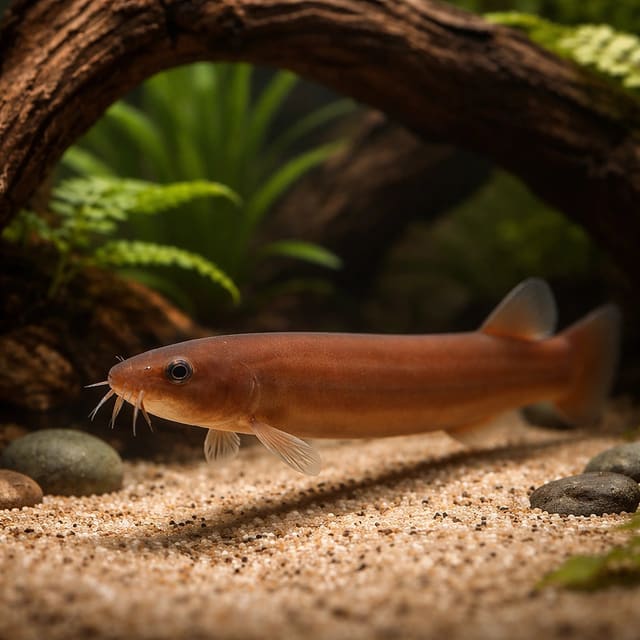
Eel Kuhli Loach (Pangio sp.) is a slender, peaceful eel loach that burrows in soft sand and should be kept in a group of at least five or six. It needs a well-covered aquarium with gentle flow, hiding places and small, peaceful companions.
Pangio sp.
Shoaling fish: kept in a group they feel safer, stay calmer and show their best colour.
Eel Kuhli Loach (Pangio sp.) is a slender, peaceful eel loach that burrows in soft sand and should be kept in a group of at least five or six. It needs a well-covered aquarium with gentle flow, hiding places and small, peaceful companions.
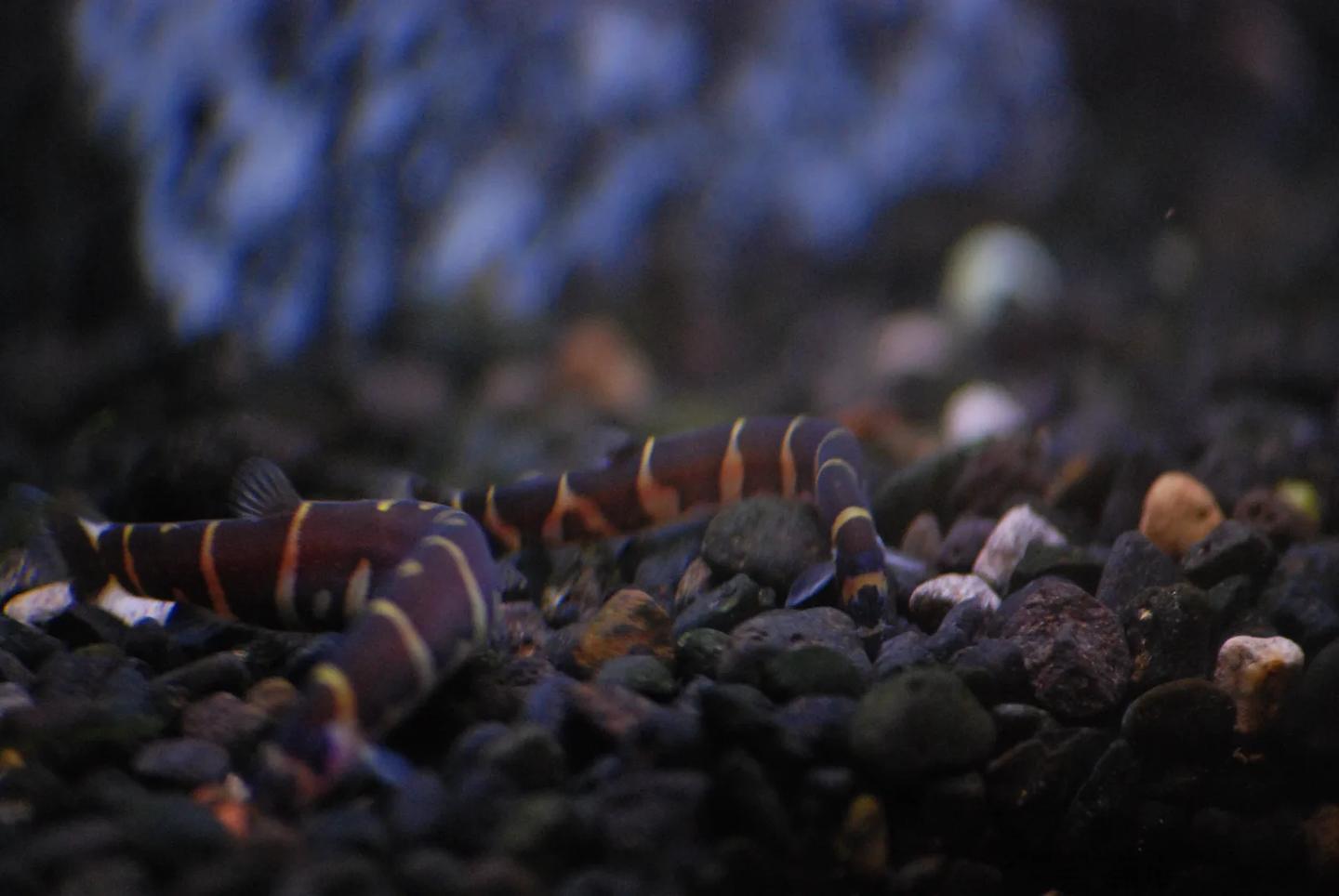
Kuhli loaches are peaceful, slender Pangio loaches that need an established, escape-resistant aquarium with cover and a social group. As a conservative UK planning floor, use at least five compatible individuals and an aquarium of at least 80 litres for the smallest loaches; adult identity, dimensions, water, companions and filtration can require more.
Maintain these water conditions for optimal health and vibrant colors
The Eel Kuhli Loach is a slender, eel-shaped loach from the genus Pangio, a group of peaceful bottom-dwellers that spend much of their lives burrowing in soft sand. Each purchase is one live fish. These are group fish for a calm, well-covered aquarium: plan for at least five or six together, give them soft sand to dig in, and choose small, peaceful companions.
The name needs a word of explanation. You may see this fish labelled Pangio kuhlii anguillaris, a label that joins two separate species names, Pangio kuhlii and Pangio anguillaris. Seriously Fish notes that a handful of Pangio species are traded under the generic name eel loach, and that Pangio anguillaris belongs to a group of closely related species told apart by details such as vertebra counts, barbels and cheek scales rather than at a glance. The genus itself is certain: WoRMS lists Pangio as an accepted genus in the family Cobitidae. The exact species has not been identified, so the care advice here follows the genus Pangio and its care group.
In practice that means two kinds of guidance on this page. Advice written for loaches as a group comes from the OATA care sheet. Where a single-species figure helps with planning, it comes from the FishBase and Seriously Fish profiles for Pangio anguillaris, one of the species sold as eel loaches, and it is named as such each time.
The good news for buyers is that the uncertainty affects less than you might think. The loach care sheet and the Pangio anguillaris profile agree on the essentials: keep a group rather than a single fish, provide a sand substrate and give plenty of shelter. What the species name would mainly settle is the adult size and the finer details of colour and pattern.
| Suits | Think twice if |
|---|---|
| A calm community of small, peaceful fish | Your tank holds boisterous or aggressive fish |
| A group of at least five or six eel loaches | You only want one or two |
| A soft sand substrate they can burrow into | Your substrate is coarse gravel |
| A tight-fitting cover and guarded filter intakes | The tank has gaps around the lid or pipework |
| Keepers who enjoy fish that are often hidden | You want a fish that is always on show |
| Feature | Detail |
|---|---|
| Identity | Pangio sp., family Cobitidae |
| Size at dispatch | About 6–7 cm |
| Group | At least five or six |
| Water | 22–27 °C, pH 6.5–7.5, 4–8 dGH (broad guidance) |
| Substrate | Soft sand |
| Diet | Sinking foods plus live or frozen small foods |
| Temperament | Peaceful |
Each fish is supplied at a dispatch size of about 6–7 cm. That is the size at dispatch, not the adult size, and because adult length depends on the exact species, plan the aquarium with room for your loaches to keep growing.
Expect these fish to keep a low profile. FishBase describes Pangio anguillaris spending much of its time buried in the sand or slowly foraging across its surface, and Seriously Fish notes that eel loaches will often pack themselves into a single nook, cranny or cave when at rest. A group that has vanished into the sand is behaving normally; the reward is watching them emerge and sift through the substrate together.
Sex is guaranteed only when the selected option explicitly states male or female. This Eel Kuhli Loach listing has no sex-guaranteed option. Seriously Fish describes some differences between adult males and females in Pangio anguillaris, covered in the breeding notes below, but they apply to adults of that one species.
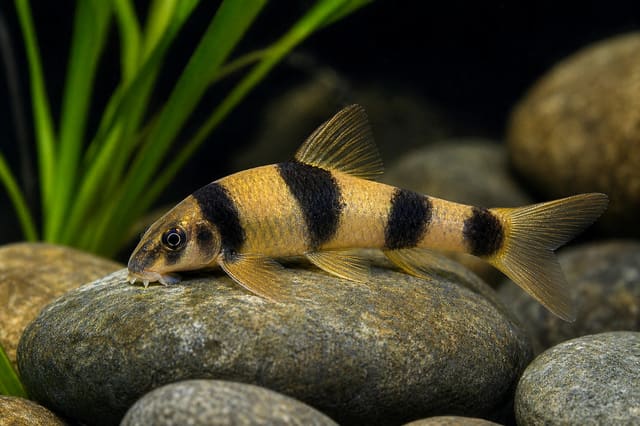
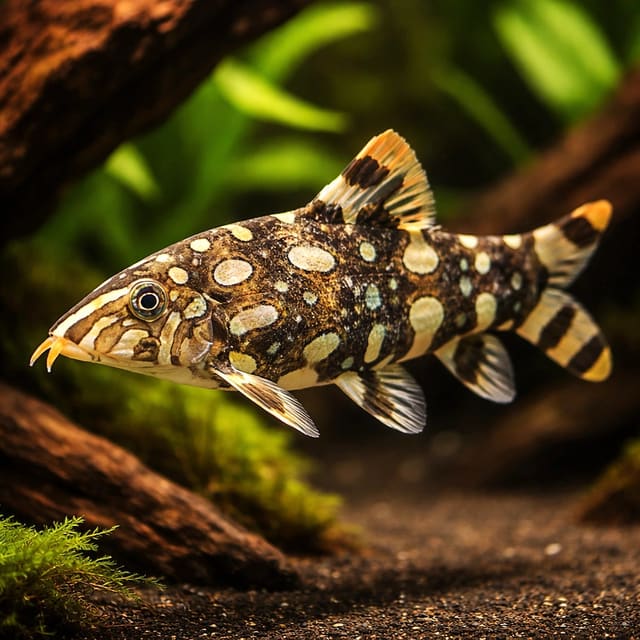
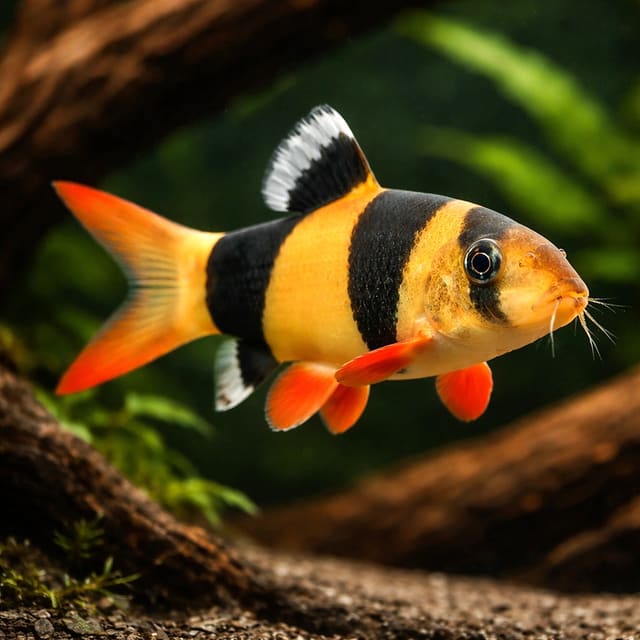
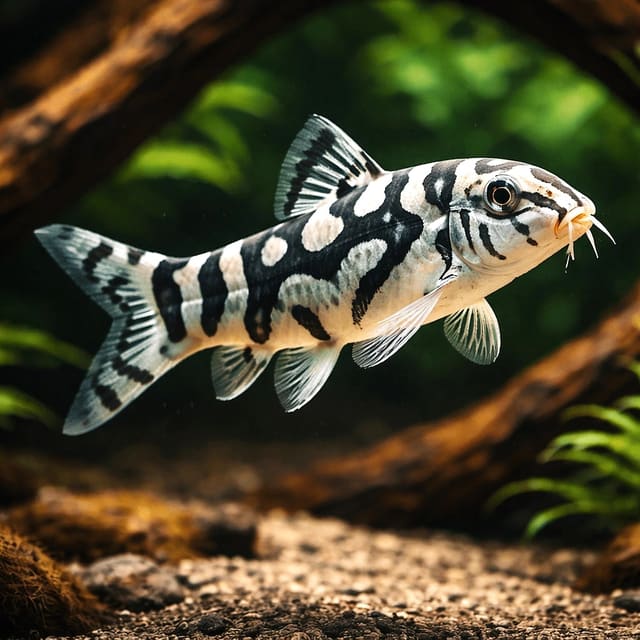
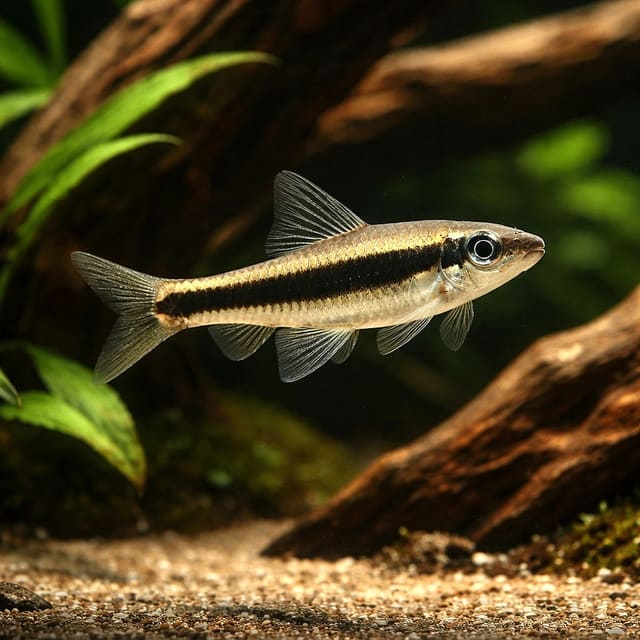
Gallery images have been digitally enhanced to improve image quality. Natural colour, pattern, size and maturity can vary between live animals. Seriously Fish also records that wild populations of Pangio anguillaris differ in colour pattern, some with a stronger stripe along the side and others with fine dark spots, so the fish you receive may not match the photograph exactly.
Knowing where eel loaches live explains most of what they need. FishBase records Pangio anguillaris in medium to large rivers across the Mekong and Chao Phraya basins, the Malay Peninsula, Sumatra and Borneo. It lives near the bottom over sand or silt, among debris and decaying vegetation in stretches with slow current, and spends much of its time buried in the sand.
Seriously Fish adds that Pangio anguillaris is most commonly available as bycatch among shipments of other fishes.
| In the wild | In your tank |
|---|---|
| Sand or silt bottoms | A soft sand substrate deep enough to burrow into |
| Debris and decaying vegetation | Leaf litter, driftwood and shaded hiding places |
| Slow current | Gentle filtration rather than strong flow |
| Foraging for small invertebrates | Sinking foods plus live or frozen small foods |
| Large aggregations | A group of at least five or six |
OATA's general rule for loaches is to buy an aquarium as large as is reasonable, and ideally one that can hold at least a small shoal. It recommends an aquarium of at least 80 litres for a shoal of the smallest loach species. Seriously Fish suggests a base of at least 60 × 30 cm, or equivalent, for Pangio anguillaris. For a group of five or six eel loaches, treat 80 litres as the sensible starting point and favour floor space over height, since these fish live on the bottom.
Seriously Fish is clear that eel loaches need a soft, sandy substrate, because they like to dig and spend some of their time completely buried. On coarser gravel they may become stressed or damage themselves, and their feeding can be inhibited. OATA makes the same point for loaches in general: fine gravel or, ideally, sand protects their sensitive skin and barbels when they bury themselves.
A filter is essential in every aquarium. The RSPCA explains why: fish release ammonia, and a working biological filter lets beneficial bacteria convert it first into nitrite and then into the safer nitrate. For eel loaches, Seriously Fish recommends gentle filtration with a little surface agitation, and advises avoiding high flow rates.
Two practical details matter more with these fish than with most. First, make sure small specimens cannot enter the filter intakes. Second, cover the aquarium well, because Seriously Fish notes that most loaches jump at times, especially when introduced to a new environment. Check for gaps around the lid, cable cut-outs and pipework before the fish arrive.
Leave open stretches of sand for foraging and put the cover, such as wood, leaf litter and planted areas, around them. Because eel loaches often rest together in one spot, a few generous shared hiding places close to the sand suit them well. A layout like this also lets you see the group when it comes out to feed.
The filter must be fully matured before any fish go in. Our guide to setting up and maturing a tropical tank walks through that process step by step.
Because the species is unconfirmed, the water targets on this page combine two sources. The OATA care sheet for loaches gives broad guidance for the group, and the Seriously Fish profile gives aquarium ranges for Pangio anguillaris. The targets below sit where the two agree.
| Measure | Aim for |
|---|---|
| Temperature | 22–27 °C |
| pH | 6.5–7.5 |
| General hardness | 4–8 dGH |
| Ammonia | Zero |
| Nitrite | Zero |
| Nitrate | No more than 20 mg per litre above your tap water level |
For reference, OATA's full loach guidance is 22–27 °C, pH 6.5–8.0, general hardness of 4–12 °dH and carbonate hardness of 3–10 °dKH. That is broad guidance for many loaches at once rather than a species-specific optimum. Seriously Fish gives 22–29 °C, pH 6.0–7.5 and 0–8 dGH for Pangio anguillaris in the aquarium.
The wild picture is more acidic still. FishBase records the habitat of Pangio anguillaris at 24–26 °C, pH 5.0–6.0 and 5–12 dH. Those are wild river figures rather than aquarium targets, but they point towards soft to moderately hard water rather than very hard, alkaline conditions.
Test your tap water before you buy, so that you know where it sits against these ranges. Our guide to aquarium water parameters explains what each test measures and why it matters, and the water parameter matcher lets you compare your own readings with the targets above. Whatever your water, stability matters more than chasing an exact number: keep ammonia and nitrite at zero, stop nitrate building up, and make any change gradually.
If your tap water sits well above these ranges, decide how you will bring it down before the fish arrive, and prepare every batch of replacement water the same way, so that the aquarium does not swing between soft and hard water from one change to the next.
Eel loaches feed from the bottom. Seriously Fish describes Pangio anguillaris as chiefly a micropredator that sifts mouthfuls of substrate through its mouth and gills, extracting insect larvae, small crustaceans and similar food, with some organic detritus and plant material also taken in. FishBase records its wild diet as mostly benthic invertebrates.
OATA's guidance for loaches is to feed only what they can eat within a few minutes, once a day. Take care not to overfeed: uneaten food breaks down and releases toxic waste into the water. Because eel loaches forage on and in the sand, make sure the food actually sinks to where they are, and remove any leftovers once they have finished.
Vary the menu across the week rather than relying on one food. Seriously Fish recommends regular meals of live and frozen foods alongside dried food, which is closer to their natural diet of small invertebrates.
In a community aquarium, keep an eye on whether the loaches are getting their share. Sinking foods placed where the group emerges help them get a share before faster fish take everything from the upper water.
Loaches reward a steady routine. The OATA care sheet recommends:
When siphoning a sand bed, work gently over the surface so that you lift waste without disturbing buried loaches. OATA adds that good husbandry is essential because loaches can be stressed by even the smallest amounts of ammonia.
OATA notes two features of loaches that call for care. They have a spine just underneath each eye, so handle them carefully. They also have reduced or absent scales, so they may be intolerant of some medications; check that any treatment is suitable for scaleless or loach species before you use it.
Because eel loaches are often hidden, it helps to see them at feeding time and take a quick look at each fish. OATA lists these changes to watch for:
If you are concerned, test your water quality first, as OATA advises, and get in touch with us if you would like guidance.
Keep a simple log of test results, water changes and how many loaches you counted at feeding time. With fish that spend so much time out of sight, a regular head count is the easiest way to notice if one is missing, unwell or has found its way out of the tank.
Most problems with eel loaches can be prevented before the fish are ordered. Work through this list first:
It also helps to check any treatments you keep in the cupboard. OATA notes that loaches may be intolerant of some medications, so know in advance which products are unsuitable for scaleless fish.
We hand-bag fish in pure oxygen and pack them in an insulated poly box, with a heat pack when the weather calls for it. A licensed live-animal courier carries the parcel on a tracked service, and we email you the tracking number and your confirmed delivery date so that you know when to be in. The full conditions are on our delivery and Live Arrival Guarantee page.
Before any fish go in, OATA advises checking that the aquarium is the right size for the number of loaches you plan to keep and that ammonia and nitrite both read zero. It also warns that adding too many fish too quickly can cause new tank syndrome, when there are not enough nitrifying bacteria to cope with the extra waste, so build up the rest of the community gradually.
Put the cover back on as soon as the fish are released. Seriously Fish notes that loaches are especially likely to jump when introduced to a new environment. Eel loaches often head for the sand or a shared hiding place, so do not be alarmed if you see little of them at first; check on them at feeding time instead.
Healthy fish, OATA notes, have clear bright eyes, undamaged fins and intact scales, with no ulcers or bumps.
Eel loaches are not a fish to buy with breeding in mind. Seriously Fish states that Pangio anguillaris has not been bred in captivity as far as it knows, and cites Rainboth (1996) for spawning in shallow water with abundant vegetation. FishBase describes the species breeding in very shallow water with a lot of vegetation, most commonly in flooded forests or grasslands along the water's edge. There is no dependable home-breeding method to follow, so buy these fish to enjoy as a group rather than as a breeding project.
For Pangio anguillaris, Seriously Fish describes adult females as typically heavier-bodied and a little larger than males. In adult males, the first ray of the pectoral fin is branched and thickened, and the pectoral fins are upturned and longer than those of females. Mature males of some populations develop what appears to be a hump on the head. These describe adults of Pangio anguillaris, so treat them as a rough guide at best for fish whose species is unconfirmed.
Seriously Fish describes Pangio species as peaceful both with one another and with other fishes, and knows of no reports of them harming tank mates, although they may prey on eggs or fry. In nature they are often found in large aggregations, and in the aquarium they will often pack themselves into a single nook, cranny or cave when at rest. For that reason, Seriously Fish recommends a group of at least 5–6 as the minimum purchase.
OATA reaches the same number for loaches as a group: keep them in groups of at least five in the home aquarium, and more is better.
The best companions are small, peaceful fish from similar environments. Seriously Fish names genera such as Boraras, Sundadanio, smaller Rasbora, Trichopsis, Sphaerichthys and Kottelatlimia as the best tank mates for eel loaches. Some sand-dwelling loaches from the family Nemacheilidae are also suitable, but research each species properly first, as some can be excessively territorial, aggressive or competitive.
| Good choices | Avoid |
|---|---|
| Boraras and Sundadanio species | Aggressive loaches such as the red-tailed botia or skunk loach |
| Smaller Rasbora species | A single eel loach kept on its own |
| Trichopsis and Sphaerichthys species | Tanks where you want to raise eggs or fry of other fish |
The OATA loach care sheet covers loaches as a whole. It notes that loaches are compatible with most community fish, that loaches may be too active for some shy species, and that some species, such as the red-tailed botia and the skunk loach, can be quite aggressive and should only be mixed with larger, more robust fish. A small, peaceful eel loach is not a robust companion for those species. For Pangio in particular, Seriously Fish's list of small, peaceful fish from similar habitats is the better guide.
If you are planning a wider loach community, browse our loaches and oddballs range with care. It covers species with very different adult sizes and temperaments, and OATA notes that the clown loach, for example, can grow to over 30 cm and needs a large aquarium from the outset.
Choose companions that share the same water. Many of the small fish Seriously Fish recommends come from similar environments, so a community built around them can be kept at one steady set of values instead of a compromise that suits nobody. Add fish gradually, as OATA advises, so that the filter bacteria can keep pace with each increase in stocking and feeding. Eel loaches are easy to overlook once they have buried themselves, so count them into the stocking level of the tank from the start.
Because eel loaches may prey on eggs or fry, a community in which other fish are breeding needs a separate plan for any young you want to raise.
Adult size depends on the exact species, and this fish has been identified to the genus Pangio rather than to species. Eel loaches are long, slender fish, so choose an aquarium with room for growth beyond the size at dispatch.
OATA recommends an aquarium of at least 80 litres for a shoal of the smallest loach species, and Seriously Fish suggests a base of at least 60 × 30 cm for Pangio anguillaris. Choose generous floor space and a well-fitting cover, because loaches jump at times.
Keep at least five or six. Seriously Fish says Pangio species are often found in large aggregations in nature and recommends 5–6 as the minimum group, and OATA advises groups of at least five for loaches, adding that more is better.
It suits a patient keeper with a mature, stable aquarium. OATA describes loaches as usually easy-going and undemanding of water chemistry, but these fish still need soft sand, a secure cover, a group of at least five and consistently clean water.
Seriously Fish describes Pangio anguillaris as a micropredator that sifts sand for insect larvae and small crustaceans. Offer good-quality sinking pellets or granules with regular meals of live or frozen daphnia, Artemia, bloodworm, micro worm or grindal worm, feeding only what the fish can eat within a few minutes, once a day.
Aim for 22–27 °C, pH 6.5–7.5 and 4–8 dGH. That is broad OATA loach guidance, narrowed to where it overlaps the Seriously Fish profile for Pangio anguillaris, because the exact species is unconfirmed. Keep conditions stable.
No. Seriously Fish describes Pangio species as peaceful both with one another and with other fishes, with no reports of them harming tank mates, although they may prey on eggs or fry.
Choose small, peaceful fish from similar habitats. Seriously Fish names genera such as Boraras, Sundadanio, smaller Rasbora, Trichopsis, Sphaerichthys and Kottelatlimia. Some sand-dwelling Nemacheilidae loaches can also work, but research each one, and avoid aggressive loaches such as the red-tailed botia or skunk loach.
We hand-bag fish in pure oxygen inside an insulated poly box and send them with a licensed live-animal courier on a tracked service. Be in to receive the parcel, film one continuous unboxing video from the sealed parcel to the fish still in the bag, then float the bag for 20–30 minutes before releasing the fish without the bag water.
No reviews for this item yet. Bought one? Honest reviews only, good or bad.
What customers say about ordering from us
I have a small group of long finned mountain minnows. So was delighted to be able to order ten of this variety to increase the genetics in my tank . The ones I recieved are healthy but it’s to early to give a verdict on wether they are of a long finned type since they are small currently.
Gordon Walker · 23 Sept 2026
100% success travel and "installation". Pleased with quality of purchase. The Siamese fighter a bit "shy" so have not yet seen him at his best yet but looking good. Happy customer. GG
George E Garratt · 21 Sept 2026
Reviews of our shop, collected by Judge.me, an independent third-party review collector. Newest first.