Moderate
Meeli Shelldweller (Lamprologus meeli)
23–25°C · pH 8–8.6
£12.99

A secretive Tanganyika rock and crevice cichlid for hard alkaline aquariums, best kept as a carefully planned pair with secure caves and stable water.
Adult size is the maximum length this species reaches at full maturity (scientific sources). The livestock you receive will be younger and smaller — pick a size variant above for the actual shipping size. Product-photo provenance and any image-specific limitations are stated on the listing.
Neolamprologus obscurus
Save when buying multiple fish. Each quantity is one fish; sex and pair formation are not guaranteed unless the selected variant explicitly states them.
Confirm your email, then we’ll send an availability message for this exact item if it returns within 180 days.
This request is only for this product—no newsletter or other promotions. A mail-provider retry may very rarely duplicate the same availability message. Unconfirmed addresses are removed after 48 hours. See our privacy policy.
A secretive Tanganyika rock and crevice cichlid for hard alkaline aquariums, best kept as a carefully planned pair with secure caves and stable water.
Adult size is the maximum length this species reaches at full maturity (scientific sources). The livestock you receive will be younger and smaller — pick a size variant above for the actual shipping size. Product-photo provenance and any image-specific limitations are stated on the listing.
23–25°C · pH 8–8.6

24–28°C · pH 8–9 · 243L

23–25°C · pH 7.5–8.5

23–27°C · pH 8–8.6
Cichlids are a family of roughly 1,800 accepted species, not one care type. Before buying, identify the exact species and source, then compare adult measurement, usable tank dimensions, social system, territory, tested water, diet and an exit plan. No family-wide minimum tank, water range or tank-mate list is safe.
Maintain these water conditions for optimal health and vibrant colors
The Mottled Lamprologus (Neolamprologus obscurus) is a secretive Lake Tanganyika cichlid for aquarists who enjoy rockwork, cave territories and behaviour you can actually watch develop over time. It is still often traded under the older name Lamprologus obscurusNeolamprologus obscurus. This is not a soft-water community fish and it is not a casual mixed-tank filler. It is a compact, territorial lamprologine that belongs in a hard, alkaline Tanganyika aquarium with stable water, broken sight lines and plenty of tight rocky cover.
Our active Shopify product covers the 4-5 cm and 5.5-6 cm sale sizes. Those are buying sizes, not the final planning size. FishBase records a maximum length of 8.2 cm total length, while Tanganyika specialist notes describe males reaching about 8 cm in the lake and sometimes a little more in aquaria, with females usually smaller. Plan the aquarium for adult behaviour rather than the size in the bag, especially if you want to keep a pair or place them with other Tanganyika cichlids.
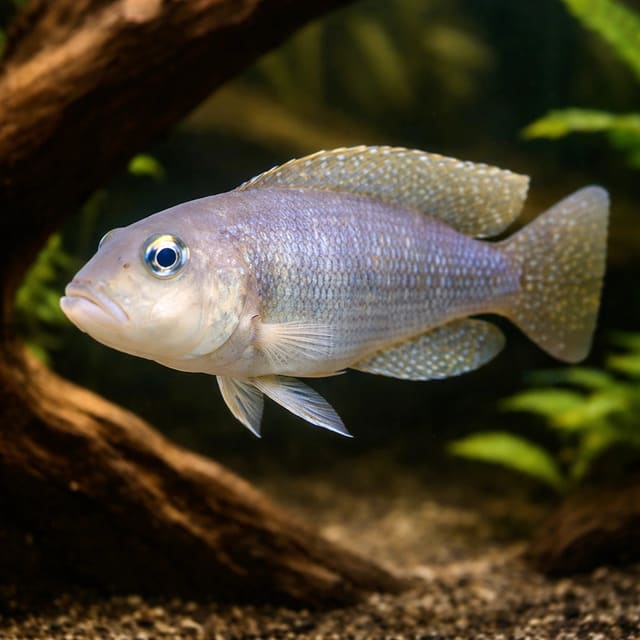
Mottled Lamprologus have a restrained, stone-coloured beauty rather than the bright colour of a Malawi mbuna. Expect a compact cichlid with brown, grey, charcoal and cream mottling, a solid head, alert eyes and a body shape built for staying close to cover. In a bare shop tank they can look modest; in a mature Tanganyika layout they make much more sense. Their markings work like camouflage against shadowed rock, sand and sediment, and the fish often appears most confident when it can hover close to a cave mouth or slip between stones.
Do not judge this species only by a quick thumbnail. The detail is in the posture and behaviour: short advances from cover, careful watching from a cave entrance, fast retreats when startled, and stronger colour or body tension when a territory is being defended. Males are generally larger and can be darker than females. Because juveniles and sale-size fish are not always easy to sex, a stable pair should be allowed to form with space and escape routes rather than being forced into a cramped layout.
Neolamprologus obscurus is endemic to the southern part of Lake Tanganyika. FishBase describes it as a freshwater, benthopelagic cichlid from 6-30 m depth, associated with hard water and warm tropical temperatures. The habitat note that matters most for aquarium care is that the species occurs in crevices of sediment-rich rocky biotope. Tanganyika.si adds the practical aquarium translation: fine sand with rock structures forming numerous caves and crevices, because this is a secretive lamprologine that stays close to shelter and does not spend its day cruising open water.
That habitat point is important for SEO and for husbandry. Some older seed keywords pushed shell-dweller language, but this species is better presented as a rock and crevice cichlid. Shells can be used as extra visual cover in a Tanganyika aquarium, but they should not replace proper rock structure. Build the tank around stable caves, shaded gaps, sand-rock transitions and broken lines of sight.
Use a tank with more footprint than height. A formed pair is best planned around at least 150 litres, with larger aquariums needed if you want other Tanganyika fish in the same system. The key is territory layout. Place rock directly on the base or on a secure support before adding sand, then build caves and cracks that cannot collapse if the fish dig. Leave some open sand around the rockwork so territories have edges, but avoid a wide empty tank where one fish can see and chase another from end to end.
Good layouts usually include several cave entrances, narrow crevices and visual barriers. If you keep only one pair, give them a main rocky zone and a few spare retreats. If they share a community Tanganyika aquarium, separate rock piles and open swimming lanes help different species use different parts of the tank. Avoid sharp rock that could scrape the flanks, and avoid unstable stacks. This species is small enough to use tight gaps, but assertive enough to make those gaps matter.
Mottled Lamprologus should be kept in clean, mineral-rich water with stable chemistry. FishBase gives 23-28C, pH 7.0-8.5 and 10-15 dH as source parameters; in a home Tanganyika aquarium, aim for the upper alkaline side rather than soft acidic water. Stability matters more than chasing a perfect number every day. Sudden swings in pH, temperature or hardness are more stressful than a steady value within the right range.
Use strong biological filtration, good oxygenation and regular water changes. Keep nitrate under control, rinse mechanical media before it clogs, and avoid heavy feeding that leaves protein waste in the rockwork. If your tap water is soft, use a proper Tanganyika buffer or remineralising plan rather than guessing. A reliable heater, thermometer and liquid test kit are part of the setup, not optional extras for this type of fish.
This is a carnivorous micro-predator. Source notes and lamprologine behaviour point toward small invertebrates such as crustaceans, insect larvae and small snails in the wild. In the aquarium, use a varied diet of quality small cichlid granules, fine carnivore pellets, frozen cyclops, daphnia, brine shrimp, mysis and occasional bloodworm. Feed small portions once or twice daily, and make sure food reaches the lower rock zone where the fish feels safe.
Avoid large oily foods, mammal or bird meat, and repeated overfeeding. Over-rich feeding can pollute a Tanganyika tank quickly, especially where food drifts behind rockwork. A lean, varied diet gives better condition, cleaner water and more natural behaviour than a single heavy meal.
Expect territorial behaviour. Tanganyika.si describes strong aggression toward conspecifics, and that matches the way many small lamprologines defend caves and breeding spaces. A bonded pair can be fascinating, but two rival males or unbalanced groups can become a problem in a small tank. Give each fish somewhere to disappear, and watch for one individual being kept away from food or forced into an upper corner.
In a larger Tanganyika community, possible companions include carefully chosen Julidochromis, smaller Altolamprologus, suitable open-water Tanganyika species, or robust bottom dwellers that do not try to occupy the same cave. Avoid soft-water community fish, slow long-finned fish, delicate nano species, very aggressive cichlids, and close-looking lamprologines in cramped quarters. If you are building a dedicated Tanganyika tank, choose tank mates by water chemistry and territory shape rather than colour alone.
Mottled Lamprologus are cave spawners. A pair will usually choose a tight cave or crevice, clean the surface and defend the entrance. Tanganyika.si notes relatively small clutches, with both parents involved in brood care: the female tending eggs and fry close inside the cave while the male defends the surrounding territory. Fry need tiny foods such as newly hatched brine shrimp once free swimming, and they benefit from very clean, stable water.
Breeding is not the reason to overcrowd them. If anything, it is the reason to give more structure. A pair with the right cave and calm surroundings can show excellent parental behaviour; a pair squeezed into a busy mixed tank may only show stress and aggression. If breeding is your goal, keep the aquarium species-focused or use very careful Tanganyika companions that stay out of the pair's cave zone.
Choose fish that hold themselves level, respond to food, breathe steadily and keep clear eyes and intact fins. Sale-size Mottled Lamprologus may hide when disturbed, so do not mistake a cautious posture for poor quality. What you do not want is pinched body shape, laboured breathing, clamped fins, white patches, frayed fins or repeated scratching. Once home, acclimate slowly and keep the lights low while the fish finds cover.
Because this species relies on structure, have the aquarium ready before delivery. Adding rockwork after the fish arrive creates avoidable stress. The best result comes from a mature hard-water system with caves already built, temperature stable and the first few feeding spots planned.
Every live fish order is packed for the species, season and weather window, then sent through a licensed live-animal courier service. The listing keeps the promise evergreen and accurate: Live Arrival Guarantee, careful packing and support if you need help settling the fish in. Delivery timing depends on livestock condition, courier routing and safe dispatch conditions, so this page does not make fixed courier-day or guaranteed-date claims.
When your fish arrives, float the sealed bag to equalise temperature, then gradually mix small amounts of aquarium water before release. Keep the room calm, dim the lights and let the fish move into the rockwork without being chased by existing tank mates. The first day should be about safety and oxygen, not heavy feeding.
Yes for shopping and care purposes. The fish is still widely traded as Lamprologus obscurus, while FishBase lists the current name as Neolamprologus obscurus. This listing uses both names so customers and search engines can connect the supplier name, the older trade name and the current taxonomy.
FishBase records a maximum of 8.2 cm total length. The fish sold here are smaller sale sizes, so plan the aquarium around adult territory and behaviour rather than the arrival size.
It is better treated as a rock and crevice lamprologine. Its source-backed habitat is sediment-rich rocky biotope with crevices. Shells can be extra decor, but the main aquarium requirement is secure rockwork with caves.
It should not be mixed with soft-water community fish. Keep it with carefully chosen Tanganyika species that enjoy the same hard alkaline water and do not compete directly for the same cave territories.
Use at least 150 litres for a formed pair, with more room for a mixed Tanganyika aquarium. The floor plan, rock layout and sight breaks matter as much as the litre number.
Offer small carnivore foods: fine cichlid granules, small sinking pellets, brine shrimp, daphnia, mysis and occasional bloodworm. Feed modest portions and keep waste out of the rockwork.
Yes. Tropical Fish Co live fish orders are covered by the Live Arrival Guarantee when the delivery and acclimation guidance is followed.
Care and identity were checked against FishBase for Neolamprologus obscurus, Tanganyika.
Max adult size is the length this species reaches at full maturity (from scientific sources). The livestock you receive will be younger and smaller — pick a size variant on the buy box for the actual shipping size. Product-photo provenance and any image-specific limitations are stated on the listing.
Best planned as a formed pair or in a carefully structured Tanganyika aquarium with many rock caves and sight breaks.
Always research specific species before adding them to your tank. Consider:
No reviews for this item yet. Bought one? Honest reviews only, good or bad.
What customers say about ordering from us
I have a small group of long finned mountain minnows. So was delighted to be able to order ten of this variety to increase the genetics in my tank . The ones I recieved are healthy but it’s to early to give a verdict on wether they are of a long finned type since they are small currently.
Gordon Walker · 23 Sept 2026
100% success travel and "installation". Pleased with quality of purchase. The Siamese fighter a bit "shy" so have not yet seen him at his best yet but looking good. Happy customer. GG
George E Garratt · 21 Sept 2026
Reviews of our shop, collected by Judge.me, an independent third-party review collector. Newest first.
