Moderate
Amiet's Killie (Fundulopanchax amieti)
23–26°C · pH 6–7 · 30L
£11.99

A striking Cameroon killifish supplied around 3-4 cm, best in a covered, quiet, soft-water planted aquarium with small live or frozen foods.
Adult size is the maximum length this species reaches at full maturity (scientific sources). The livestock you receive will be younger and smaller. Product-photo provenance and any image-specific limitations are stated on the listing.
Fundulopanchax puerzli
Save when buying multiple fish. Each quantity is one fish; sex and pair formation are not guaranteed unless the selected variant explicitly states them.
Confirm your email, then we’ll send an availability message for this exact item if it returns within 180 days.
This request is only for this product—no newsletter or other promotions. A mail-provider retry may very rarely duplicate the same availability message. Unconfirmed addresses are removed after 48 hours. See our privacy policy.
A striking Cameroon killifish supplied around 3-4 cm, best in a covered, quiet, soft-water planted aquarium with small live or frozen foods.
Adult size is the maximum length this species reaches at full maturity (scientific sources). The livestock you receive will be younger and smaller. Product-photo provenance and any image-specific limitations are stated on the listing.
Maintain these water conditions for optimal health and vibrant colors
Puerzl's Killifish is a striking Cameroon killifish best treated under the accepted name Fundulopanchax puerzli. The older aquarium and supplier name Aphyosemion puerzli is still useful for recognition, so it is kept here as synonym context rather than pushed into the copy as a repeated keyword.
This listing is for young fish supplied at approximately 3-4 cm. They are already recognisable, but the full display comes with maturity: FishBase lists males up to 8 cm total length, and the British Killifish Association describes captive adults around 2.75-3 inches. That makes this a small-specialist fish rather than a tiny nano species.
The species is named for Eduard Puerzl, an Austrian aquarist and collector linked with the original Cameroon material. FishBase places the natural range in the Henda, Nkwoh and Wuri river drainage systems of western Cameroon, while Killi.co.uk also describes slow-moving waters around those same rivers.
These habitats are not open, bright, fast-flowing community-tank conditions. They are rainforest brooks, swampy margins and shallow sheltered waters with plant cover, roots, leaf litter and low to gentle flow. That habitat explains why this fish settles best in a quiet aquarium with shade, cover and stable soft water.
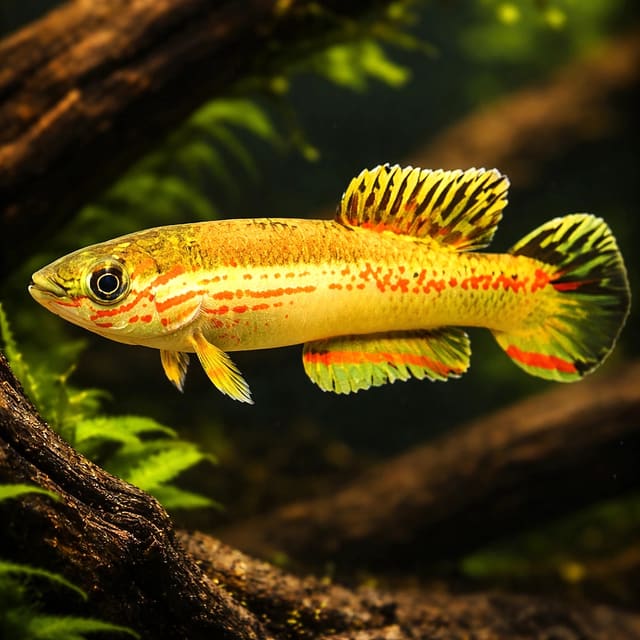
Adult males are the real showpiece. The British Killifish Association describes greenish-blue flanks, olive tones over the back, a pale belly, red markings across the body, spotted fins and an extended caudal edge. The exact intensity varies with sex, maturity, diet, lighting and confidence, so newly arrived juveniles may look paler than settled adults.
Females are subtler but still attractive, and they matter if you want natural behaviour. A male-only or single-fish purchase can miss much of the display value. In a calm planted setup, males patrol cover, show colour and interact more naturally than they will in a bare or busy aquarium.
A pair or trio can be kept in a mature, well-covered species aquarium from around 40 litres when filtration is gentle and water quality is stable. For a display group, use more space, more cover and several broken lines of sight so fish can avoid constant attention from one another.
Use a tight lid with no open gaps. Killifish are excellent jumpers, especially when startled, newly introduced or competing at feeding time. Floating plants, moss, Java fern, Anubias, fine-leaved plants, roots and leaf litter all help to create shade and security. A dark substrate makes the colours easier to see and gives the tank the quieter feel this species prefers.
Filtration should be efficient but not forceful. A sponge filter or softened outlet is ideal. Avoid harsh flow, bare glass boxes and bright overhead light without plant cover. This is a fish for careful aquascaping rather than a quick add-on to a noisy mixed tank.
FishBase gives 21-24 C, pH 6.0-7.0 and soft water around 5-8 dH. The current supplier range is broader at 21-25 C, pH 5.8-7.2 and 0-15 dGH, so the practical target is stable, clean, soft to moderately soft water rather than chasing an extreme number.
Keep ammonia and nitrite at zero and nitrate low through regular small water changes. If your tap water is very hard, a gradual blend with remineralised RO water can help long-term condition and breeding attempts, but sudden chemistry changes are more dangerous than a slightly imperfect reading.
Puerzl's Killifish is a small carnivorous predator. Offer live or frozen daphnia, cyclops, mosquito larvae, brine shrimp, grindal worm, white worm in moderation and finely chopped bloodworm. Some individuals will also accept quality micro pellets or soft granules, but live and frozen foods bring out the best colour and breeding condition.
Feed small portions once or twice daily and remove uneaten food quickly in compact tanks. A varied feeding routine is especially important for new arrivals because confident feeding is one of the clearest signs that a killifish has settled.
This species is generally peaceful, but it is not a robust community fish for fast tank mates. The safest choice is a species-focused aquarium with one male and two females, or a small group in a planted layout with enough cover for weaker fish to step away.
If tank mates are used, choose only very calm, similarly sized fish that enjoy soft, quiet water and will not rush the food. Avoid fin nippers, boisterous tetras, large cichlids, predatory fish, hard-water specialists and anything big enough to view a slim killifish as food. Very small shrimp fry may be eaten.
FishBase records the species as a bottom spawner with an incubation period of about two months. The British Killifish Association describes breeding over peat moss, peat fibres or sphagnum, with eggs laid frequently and either water-incubated or dry-stored. Killi.co.uk also records successful breeding in moderately soft acidic water.
A separate breeding tank is best. Use soft clean water, shade, a peat layer or suitable spawning medium, and condition adults with live and frozen foods. Fry are small but can take fine Artemia after hatching according to specialist reports, with very small first foods useful where fry are not ready for larger prey.
Do not plan this fish around the supplied size alone. A little extra tank space makes the fish easier to settle, easier to feed and less likely to jump.
Do not use a bright uncovered tank, do not keep one lonely specimen in a busy display, and do not rely only on dry flake. The difference between a nervous killifish and a colourful settled one is usually cover, quiet water, small foods and patience.
Choose Puerzl's Killifish if you enjoy specialist fish with detailed behaviour rather than constant movement. It suits keepers who are happy to keep the aquarium covered, feed small foods and watch water stability closely. It is especially rewarding for aquarists who like planted tanks, botanicals, quiet observation and the possibility of trying killifish breeding methods later.
It is less suitable for a first hard-water community aquarium, a tank with strong flow or a display already dominated by fast feeders. The fish is not fragile when kept correctly, but it does ask for a calmer style of fishkeeping. That is exactly why it can become such a memorable species in the right hands.
The source photo added to this listing is used to show the real supplier type alongside the existing aquarium visuals. As with most live fish, exact colour on arrival can vary with sex, age, stress level, lighting and recent diet. Young 3-4 cm fish may not yet show the full adult pattern, so judge new arrivals by condition, alertness and feeding response as much as by immediate colour.
Because the species matures larger than the supplied size, plan the adult aquarium before ordering. A covered tank with spare space is kinder than trying to upgrade after fish have already learned to jump or hide from stronger tank mates.
Your fish should be acclimated slowly into a mature aquarium with matching temperature and gentle lighting. Float the bag to equalise temperature, then add small amounts of tank water gradually over 30-45 minutes. Keep the lights low for the first evening and offer a small feed only after the fish are settled and alert.
Tropical Fish Co ships live fish with care, oxygen, insulation and weather-aware packing. Eligible livestock orders are supported by our Live Arrival Guarantee, provided the delivery and acclimation guidance is followed and any issue is reported promptly with clear photos.
Care notes were checked against FishBase for taxonomy, range, water and adult-size data; the British Killifish Association for colour, maintenance and breeding notes; Killi.co.uk for common-name, Cameroon range and keeper breeding context.
No reviews for this item yet. Bought one? Honest reviews only, good or bad.
What customers say about ordering from us
I have a small group of long finned mountain minnows. So was delighted to be able to order ten of this variety to increase the genetics in my tank . The ones I recieved are healthy but it’s to early to give a verdict on wether they are of a long finned type since they are small currently.
Gordon Walker · 23 Sept 2026
100% success travel and "installation". Pleased with quality of purchase. The Siamese fighter a bit "shy" so have not yet seen him at his best yet but looking good. Happy customer. GG
George E Garratt · 21 Sept 2026
Reviews of our shop, collected by Judge.me, an independent third-party review collector. Newest first.


