Moderate
Amiet's Killie (Fundulopanchax amieti)
23–26°C · pH 6–7 · 30L
£11.99

A specialist West African killifish for calm, covered planted aquariums, supplied around 3-4 cm. Best in soft, shaded water with tiny live or frozen foods.
Adult size is the maximum length this species reaches at full maturity (scientific sources). The livestock you receive will be younger and smaller. Product-photo provenance and any image-specific limitations are stated on the listing.
Fundulopanchax ndianus
Save when buying multiple fish. Each quantity is one fish; sex and pair formation are not guaranteed unless the selected variant explicitly states them.
Confirm your email, then we’ll send an availability message for this exact item if it returns within 180 days.
This request is only for this product—no newsletter or other promotions. A mail-provider retry may very rarely duplicate the same availability message. Unconfirmed addresses are removed after 48 hours. See our privacy policy.
A specialist West African killifish for calm, covered planted aquariums, supplied around 3-4 cm. Best in soft, shaded water with tiny live or frozen foods.
Adult size is the maximum length this species reaches at full maturity (scientific sources). The livestock you receive will be younger and smaller. Product-photo provenance and any image-specific limitations are stated on the listing.
Maintain these water conditions for optimal health and vibrant colors
The Ndian Killie, also known in the trade as the Red-Tail Killie, is a colourful West African killifish best suited to keepers who enjoy quiet planted aquariums and careful observation. Our supplier lists this fish under the older name Aphyosemion ndianum; the accepted name used by FishBase and specialist killifish references is Fundulopanchax ndianus. Keeping both names on the page helps aquarists match the fish to older books, supplier lists and modern taxonomy without forcing keywords into the copy.
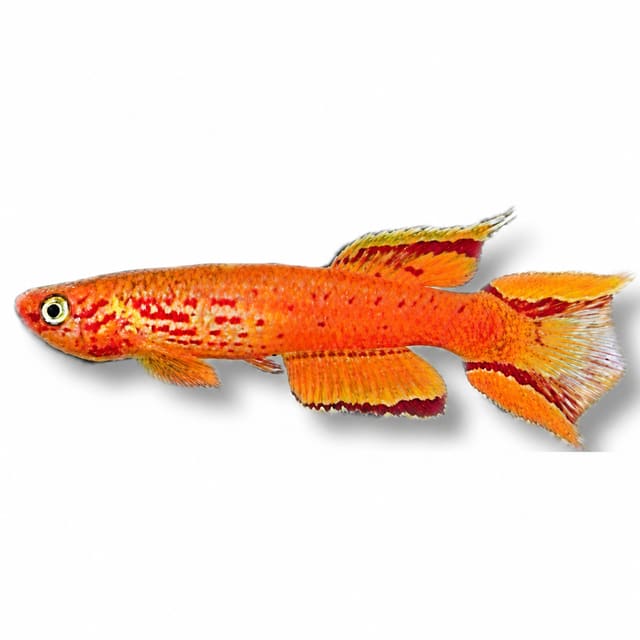
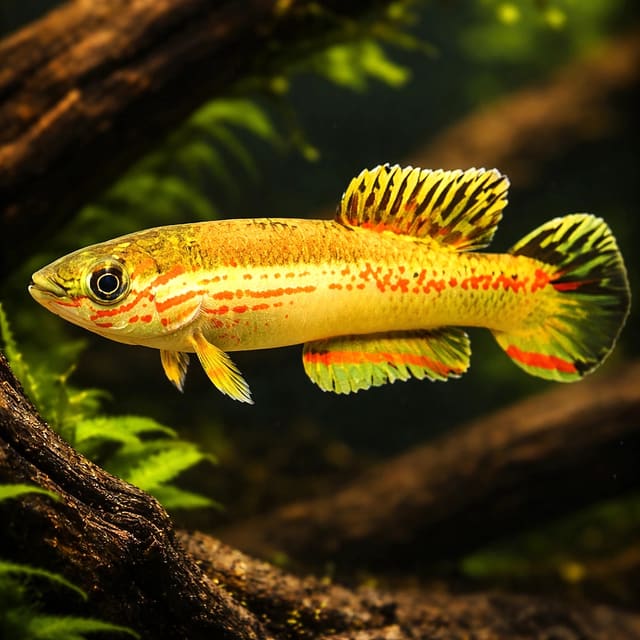
This is not a throw-in community fish. It is small on arrival, usually around 3-4 cm, but mature adults can reach about 7 cm and males become much more confident and colourful once settled. The attraction is the detail: blue-green body tones, red spotting, red edging through the tail and fins, and the alert, deliberate behaviour typical of larger African killifish.
Specialist killifish references place F. ndianus around rainforest swamps and swampy brook margins in the Nigeria/Cameroon border region. That matters for care: this fish is built for cover, broken shade, still or gentle water, and small live prey rather than bright open aquariums with fast tank mates.
In a bare tank it may look nervous, washed out or reluctant to feed. In a planted aquarium with floating plants, Java moss, roots, botanicals and a dark background, males settle into patrol routes and display their fin colour more clearly. A tight-fitting lid is essential. Killifish are famous jumpers, and this species should be treated as a serious escape risk during feeding, maintenance or chasing between fish.
Use a mature aquarium with stable filtration and gentle flow. A small pair or trio can be kept in a specialist species tank, but a longer tank is easier if you plan to keep more than one male. Around 60-80 cm of front swimming length gives subordinate fish space to avoid pressure and lets you build separate visual territories with plants and wood.
Fine-leaved plants, spawning mops, moss, floating plants and leaf litter all help. Keep lighting subdued and avoid strong current. The water should be clean but not sterile-looking: tannins from botanicals are useful if your tap water allows it, and regular small water changes are safer than occasional large swings. Because these fish are shipped small, acclimate slowly and give them a quiet first week rather than moving them into a busy display straight away.
A practical target is 21-24 C, pH 6.0-7.0 and roughly 4-8 dH. Stability is more important than chasing a number every day, so avoid sudden pH shifts, overheated summer tanks and hard alkaline setups.
Do not keep them in a high-flow hillstream layout or a bright, hard-water community. They are much better treated like a specialist West African killifish: shaded, covered, peaceful, fed well, and monitored closely for stress after arrival.
Feed small protein-rich foods. Good choices include live or frozen daphnia, cyclops, mosquito larvae, brine shrimp and finely chopped bloodworm, with quality micro granules accepted by many settled fish. Offer modest portions once or twice daily and remove uneaten food, especially in smaller tanks.
Condition and colour improve noticeably with variety. If a new fish is shy, start with moving foods such as daphnia or live baby brine shrimp, then transition gradually to frozen and prepared foods. Very large pellets and aggressive surface-feeding competition are poor matches for this species.
The Ndian Killie is usually peaceful toward unrelated small fish, but it is not ideal for a busy mixed community. Males can pressure each other and may chase females during breeding condition, so the layout must include cover and escape routes. A pair, trio or carefully watched small group in a species-focused aquarium is the cleanest option.
If you do keep tank mates, choose tiny, calm, non-competitive species that enjoy similar soft water and will not nip fins. Avoid large fish, boisterous barbs, fin-nippers, fast feeding shoals and anything that treats a 3-4 cm killifish as food. Snails are generally fine. Small shrimp adults may survive in planted tanks, but shrimplets can be eaten.
This is a semi-annual/bottom-spawning style killifish rather than a simple beginner livebearer. Eggs may be placed in bottom mops, fine plants or peat-style substrate. Specialist records describe water incubation of roughly 3-5 weeks, with damp peat or dry-style incubation taking longer. Fry are small but can take suitably tiny live foods once free-swimming.
Breeding success depends on mature adults, high-quality small foods, clean soft water and patience. If your aim is simply a beautiful display fish, keep the setup stable and do not force breeding conditions. If you want to breed them, plan a dedicated spawning tank and be ready to separate eggs or fry from the adults.
For a first attempt, a single pair or one male with two females is often easier to manage than a crowded group. If several males are kept together, use a longer aquarium with broken sight lines so the weaker male can leave the dominant male's display area. Watch the females as carefully as the males; in breeding condition they can be followed persistently and need moss, roots, caves or plant thickets where they can rest.
Colour is also linked to confidence. A newly arrived male may look pale, especially after shipping, but should brighten over several days once he is feeding and has cover. Strong colour is not a reason to push the fish into brighter light. Subdued lighting, floating plants and a darker base usually show the fish better and keep stress lower.
Your fish should be floated and drip-acclimated slowly, then released into a dim, covered aquarium. Leave the lights low on the first day and offer only a small feed once the fish is settled. Watch for jumping, hiding, heavy breathing or refusal to feed; these are signs to reduce disturbance and check water quality.
We sell live fish only when they are suitable for dispatch, and this listing is covered by our Live Arrival Guarantee. For best results, prepare the aquarium before ordering, match the water as closely as practical, and contact us quickly if you need help after delivery.
No reviews for this item yet. Bought one? Honest reviews only, good or bad.
What customers say about ordering from us
I have a small group of long finned mountain minnows. So was delighted to be able to order ten of this variety to increase the genetics in my tank . The ones I recieved are healthy but it’s to early to give a verdict on wether they are of a long finned type since they are small currently.
Gordon Walker · 23 Sept 2026
100% success travel and "installation". Pleased with quality of purchase. The Siamese fighter a bit "shy" so have not yet seen him at his best yet but looking good. Happy customer. GG
George E Garratt · 21 Sept 2026
Reviews of our shop, collected by Judge.me, an independent third-party review collector. Newest first.