Moderate
Amiet's Killie (Fundulopanchax amieti)
23–26°C · pH 6–7 · 30L
£11.99

A colourful West African killifish for calm, covered, soft-water planted aquariums. Supplied around 3-4 cm; best with tiny live or frozen foods.
Adult size is the maximum length this species reaches at full maturity (scientific sources). The livestock you receive will be younger and smaller. Product-photo provenance and any image-specific limitations are stated on the listing.
Aphyosemion bivittatum
Save when buying multiple fish. Each quantity is one fish; sex and pair formation are not guaranteed unless the selected variant explicitly states them.
Confirm your email, then we’ll send an availability message for this exact item if it returns within 180 days.
This request is only for this product—no newsletter or other promotions. A mail-provider retry may very rarely duplicate the same availability message. Unconfirmed addresses are removed after 48 hours. See our privacy policy.
A colourful West African killifish for calm, covered, soft-water planted aquariums. Supplied around 3-4 cm; best with tiny live or frozen foods.
Adult size is the maximum length this species reaches at full maturity (scientific sources). The livestock you receive will be younger and smaller. Product-photo provenance and any image-specific limitations are stated on the listing.
Maintain these water conditions for optimal health and vibrant colors
The Red Aphyosemion, also known as the Two-Stripe Lyretail, is a small West African killifish with far more character than its size suggests. It is listed by the supplier as Aphyosemion bivittatum, and that name is still widely used by FishBase, killifish keepers and aquarium suppliers. You may also see some population forms discussed as Chromaphyosemion bivittatum, because killifish specialists often use Chromaphyosemion as a subgenus for this group.
This listing is written for the fish we supply at around 3-4 cm, not just for a generic killifish keyword. Adults are usually planned at around 5 cm, with males carrying stronger colour, extended fins and the red/blue-green striping that gives the group its lyretail appeal. It is peaceful with the right company, but it is still a specialist soft-water fish that deserves a quiet, covered aquarium.
FishBase records Aphyosemion bivittatum from south-eastern Nigeria and south-western Cameroon, restricted to brooks in coastal rainforest. That is why the old automated geography line was wrong. This is an African rivuline from shaded, plant-rich, low-flow water rather than a generic community tetra.
In the wild-style aquarium, think broken shade, fine plants, roots, moss, leaf litter and gentle filtration. A bright open tank can leave these fish timid and pale, while a planted layout with floating cover lets males hold small display areas and show better colour. The fish is non-seasonal, so it is not treated like a short-lived annual killifish from temporary pools.
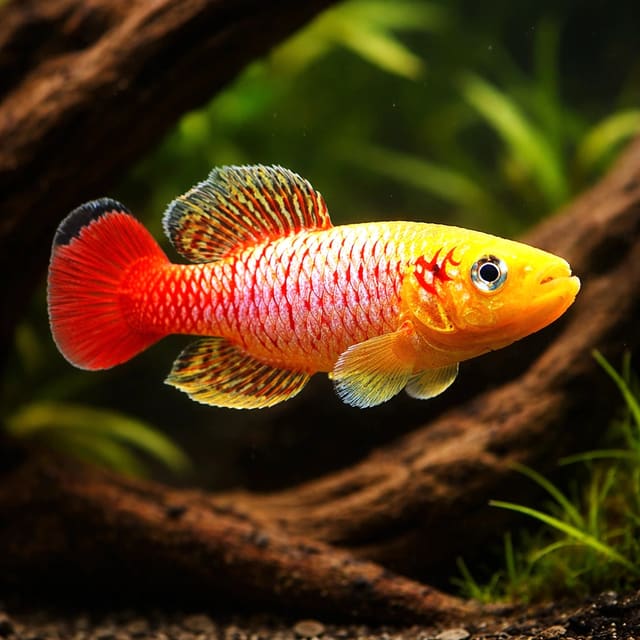
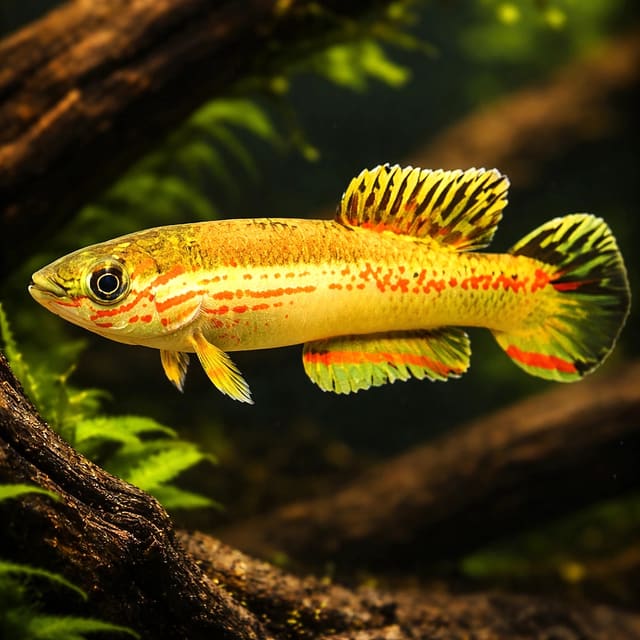
Males are the showpiece: brighter body colour, red striping, patterned fins and more extended dorsal, anal and caudal fins. Females are usually quieter in colour, which is normal and should not be mistaken for poor condition. Young shipped fish can look understated at first, then colour up after feeding, cover and stable water.
Red Aphyosemion is not a tight shoaling fish. It is better described as a peaceful killifish that lives well as a pair, trio or small watched group. Males may display, chase and defend preferred cover, especially in breeding condition, so the aquarium needs visual breaks rather than one open box of water.
A pair or trio can work in a smaller specialist aquarium, but a longer, more stable planted tank is easier and kinder. Around 40 litres is a sensible practical minimum for display care, and more length is useful if keeping several adults. Use a sponge filter or gentle outlet, avoid harsh current, and keep the top completely covered.
Good decor includes Java moss, spawning mops, fine-leaved plants, floating plants, roots and dark botanicals. A dark substrate and shaded corners help them feel secure. Avoid sharp rocks, strong flow and bright bare setups. They are excellent fish for a calm keeper who enjoys a natural, low-disturbance aquarium rather than constant rearranging.
A reliable target is 22-24 C, pH 6.0-6.5 and low hardness around 1-6 dH. Some experienced breeders report success across slightly wider ranges, but the safest customer guidance is to keep them cool-to-warm, soft, clean and stable. Do not place them in hard alkaline water just because they are small.
Use small regular water changes, matched temperature and slow acclimation. These fish can be sensitive to sudden swings, especially after shipping. If your tap water is hard, use a tested soft-water approach rather than guessing. Stable soft water with tannins is usually better than chasing a perfect number every day.
Feed small protein-rich foods. Live or frozen daphnia, cyclops, brine shrimp, mosquito larvae and small bloodworm are all useful. Quality micro granules can be offered once fish are settled, but do not rely on dry food alone if you want strong colour and breeding condition.
Aquarium Glaser notes that this species can be a very eager feeder and may even eat its own eggs. That matches the practical care approach: offer varied small foods, avoid overfeeding, and keep water quality high. New arrivals may respond best to moving foods first, then gradually accept frozen and prepared options.
The safest setup is species-focused: one pair, a trio, or a carefully watched group with plenty of cover. In larger planted soft-water aquariums, they can live with very calm small fish that will not nip fins or steal every food item. Suitable companions must be peaceful, small-mouthed and comfortable in similar water.
Avoid large fish, boisterous barbs, aggressive cichlids, fin-nippers, fast surface feeders and anything that may treat a 3-4 cm killifish as prey. Adult snails are usually fine. Shrimp may survive in a dense planted tank, but shrimplets and tiny fry can be eaten.
Aphyosemion bivittatum is an adhesive egg layer, placing eggs among fine plants, roots or spawning mops. Aquarium Glaser gives an egg development time of about 14 days, while hobby breeding reports show success with spawning mops, soft acidic water and long-term planted setups where fry sometimes appear with adults.
For controlled breeding, use a dedicated soft-water tank, feed well with live foods, and check mops regularly. Eggs and fry are safer if separated from hungry adults. Fry start tiny and need appropriately small live foods, then grow onto baby brine shrimp and fine prepared foods as they develop.
Prepare the tank before ordering: mature filter, covered top, soft stable water and hiding places already in place. Float and acclimate slowly, release with the lights low, and avoid chasing the fish around the tank on day one. Offer a small feed only once they are settled.
This listing is covered by our Live Arrival Guarantee. If you need help after delivery, contact us quickly with clear photos and water details so we can advise properly. The best results come when the aquarium is ready before dispatch rather than adjusted after the fish arrives.
No reviews for this item yet. Bought one? Honest reviews only, good or bad.
What customers say about ordering from us
I have a small group of long finned mountain minnows. So was delighted to be able to order ten of this variety to increase the genetics in my tank . The ones I recieved are healthy but it’s to early to give a verdict on wether they are of a long finned type since they are small currently.
Gordon Walker · 23 Sept 2026
100% success travel and "installation". Pleased with quality of purchase. The Siamese fighter a bit "shy" so have not yet seen him at his best yet but looking good. Happy customer. GG
George E Garratt · 21 Sept 2026
Reviews of our shop, collected by Judge.me, an independent third-party review collector. Newest first.