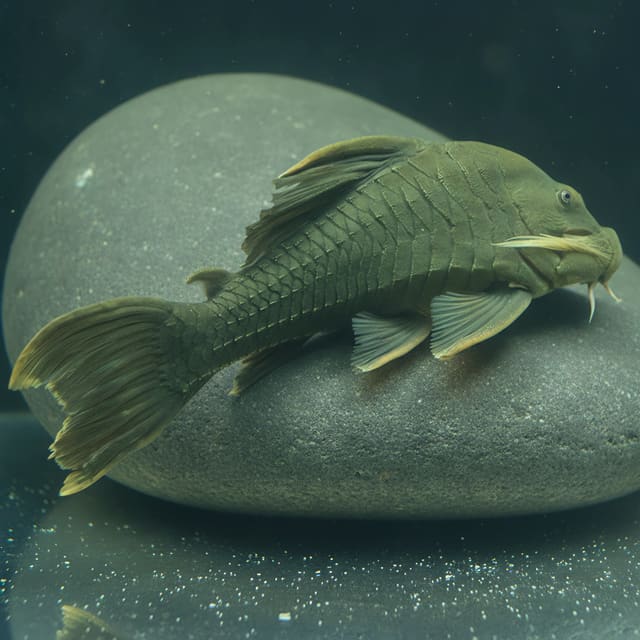
Panaque titan
£450.99
Photo coming soon
The size, price and care details on this page are for this listing.
L273, the Titanicus pleco, is an undescribed cactus pleco (Pseudacanthicus sp.) from Brazil's Rio Tapajós that reaches about 30 cm standard length. It is a territorial, meat-eating catfish for a large, well-oxygenated river tank at 23 to 28 °C. You receive one fish per unit ordered.
Adult size is the maximum length this species reaches at full maturity (scientific sources). The livestock you receive will be younger and smaller. Product-photo provenance and any image-specific limitations are stated on the listing.
Pseudacanthicus sp. (L273)
L273, the Titanicus pleco, is an undescribed cactus pleco (Pseudacanthicus sp.) from Brazil's Rio Tapajós that reaches about 30 cm standard length. It is a territorial, meat-eating catfish for a large, well-oxygenated river tank at 23 to 28 °C. You receive one fish per unit ordered.
Adult size is the maximum length this species reaches at full maturity (scientific sources). The livestock you receive will be younger and smaller. Product-photo provenance and any image-specific limitations are stated on the listing.
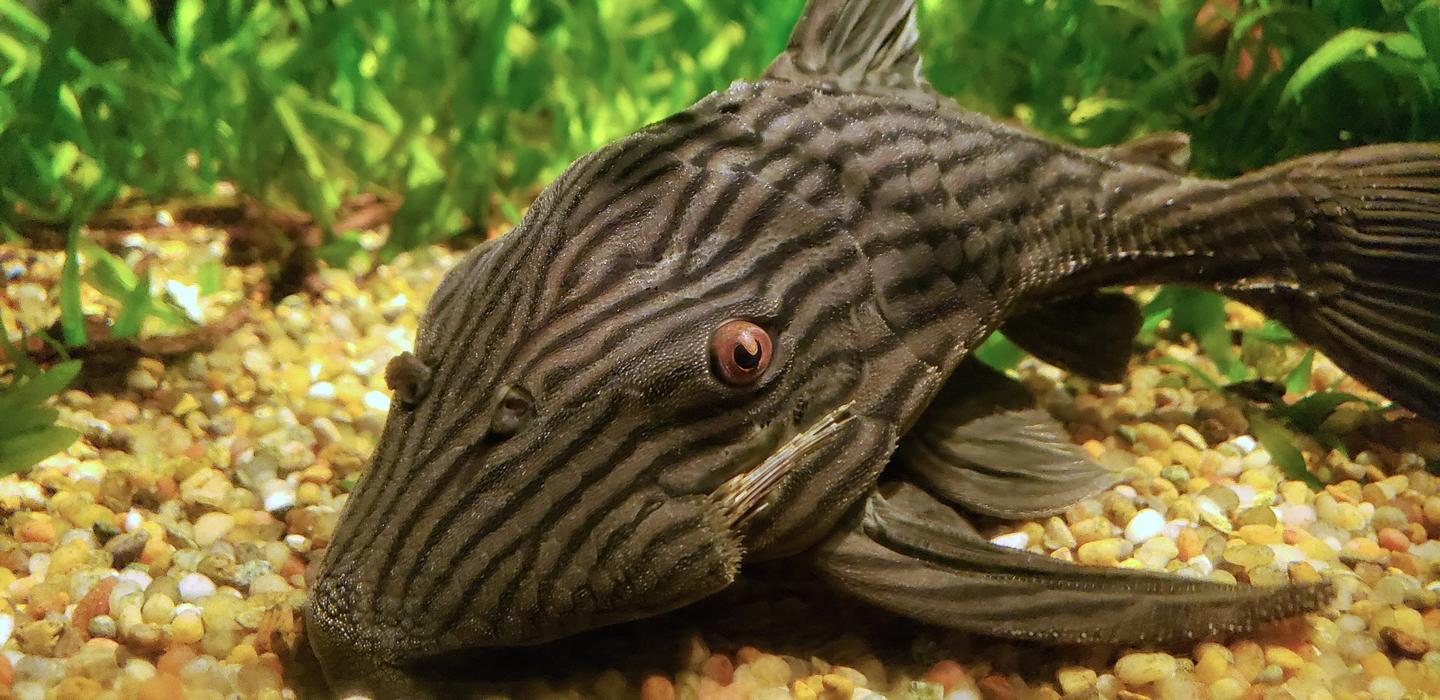
‘Pleco’ is a loose aquarium-trade label, not one species or one care sheet. Before buying, confirm the scientific name or defensible L-number, adult size and measurement method, required footprint, temperature and water, diet, social plan and source. No universal pleco tank size, menu or algae result is honest.
Maintain these water conditions for optimal health and vibrant colors
L273 is a cactus pleco from the Rio Tapajós in Brazil: a big, heavily armoured suckermouth catfish in the genus Pseudacanthicus. Planet Catfish, the specialist catfish reference, files it as Pseudacanthicus sp. (L273). Its English trade name there is the Titanicus Pleco, and in Denmark it goes by Tapajos-leopardsugemalle. The "sp." matters. It tells you nobody has yet published a formal scientific description of this fish, so it has no species name of its own.
You will sometimes see it labelled "Pseudacanthicus titanicus", and now and again with the genus misspelt as "Pseudoacanthicus". Neither is a real scientific name. "Titanicus" is a trade nickname that has been given a Latin-looking ending, and the genus is spelt Pseudacanthicus. That is why our title keeps the L-number and the trade name and puts the genus, with "sp.", in brackets. It is the honest way to label a fish that science has not yet named.
L-numbers started in 1988, when the German aquarium magazine DATZ began photographing unfamiliar loricariid catfish as they came in with imports and giving each one a number. The idea was practical. Keepers, importers and shops needed a shared label so that a fish could be talked about, kept and tracked long before a scientist got round to describing it. Another magazine, Das Aquarium, ran a parallel series under the prefix LDA.
An L-number is a label, not a classification. Wikipedia's article on the system points out that some species have collected several L-numbers for different populations, and that occasionally a single number has ended up covering more than one species. Once a fish is formally described, the advice is to use the scientific name from then on and let the number retire.
For L273 that day hasn't come. Wikipedia lists nine valid species of Pseudacanthicus. The newest is P. nyktos, described in 2024 from the Rio Xingu by Lopes, Sousa and Chamon in the journal Neotropical Ichthyology. None of the nine has been tied to L273, and Planet Catfish still keeps L273 as its own undescribed entry, separate from every named species in the genus. So Pseudacanthicus sp. it stays, and we will not pretend otherwise.
Planet Catfish gives the pronunciation as "SUE-dah-KAN-thi-cuss". The name is Greek for "false Acanthicus", a nod to the genus being similar to the lyre-tail plecos of Acanthicus and yet distinct from them. German-speaking keepers call the whole genus the cactus pleco, and once you have seen the rows of spines along the flanks, you can see why.
| Point | Detail |
|---|---|
| Scientific name | Pseudacanthicus sp. (L273), undescribed |
| Trade names | L273, Titanicus Pleco |
| Family | Loricariidae, the suckermouth armoured catfishes |
| Wild home | Rio Tapajós, Pará, Brazil |
| Adult size | About 30 cm (11.8 in) standard length, not counting the tail |
| Temperature | 23 to 28 °C |
| pH | 6.0 to 7.0 |
| Diet | Carnivore: prawn, mussel and other meaty foods, with some vegetable |
| Temperament | Generally peaceful, but territorial from a young age |
| What you receive | One fish per unit ordered; the sex isn't specified |
Cactus plecos belong to a group that catfish scientists call the Acanthicus clade, along with Acanthicus, Leporacanthicus and Megalancistrus. Planet Catfish sets out what marks the group apart from other loricariids, and a few of those features are easy to see on a living fish:
Inside that group, Pseudacanthicus is separated from its relatives by two small plates at the back of a skull bone called the compound pterotic, and by narrow jaws carrying a small number of long, curved teeth. You won't check the skull plates on a fish in a bag. The teeth are worth knowing about, though, because they tell you how this fish feeds, which we come back to in the feeding section.
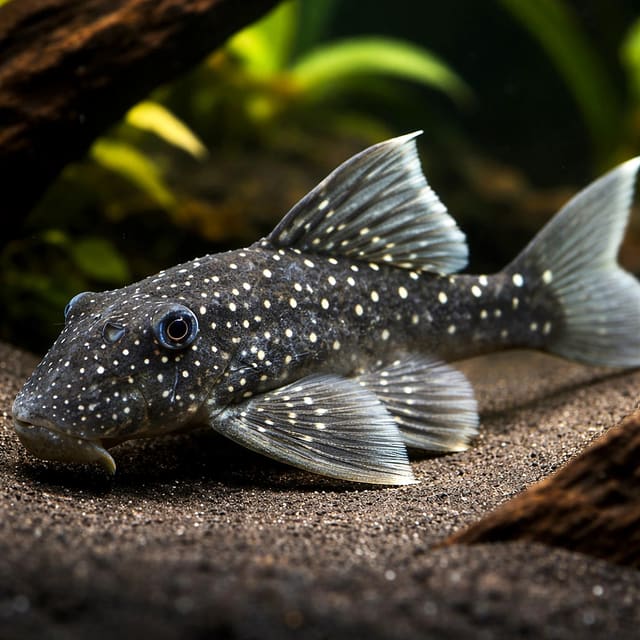
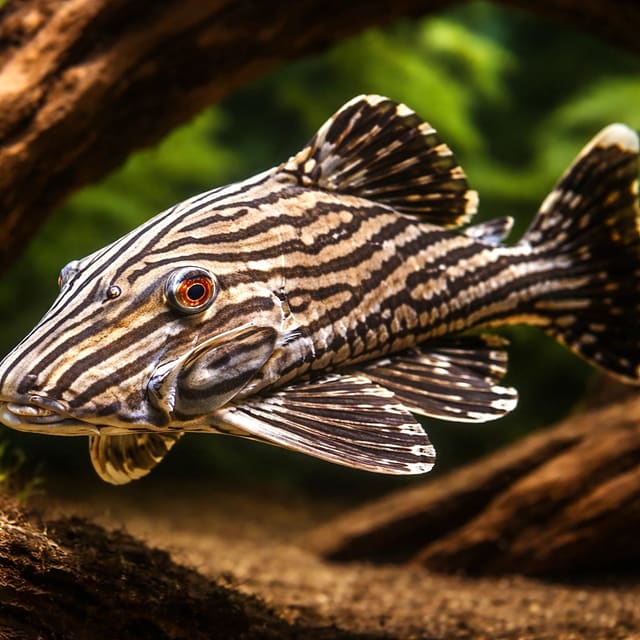
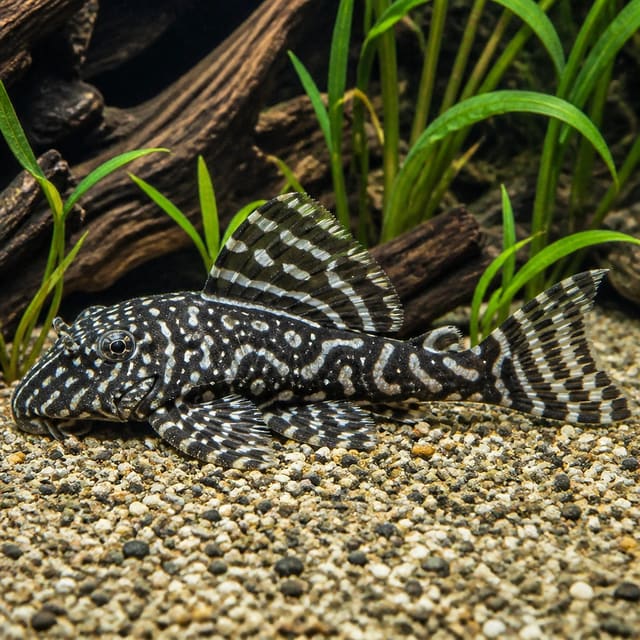
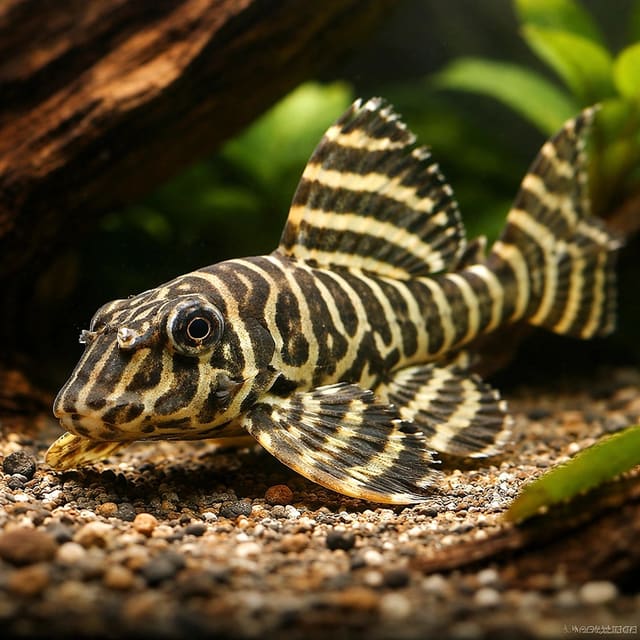
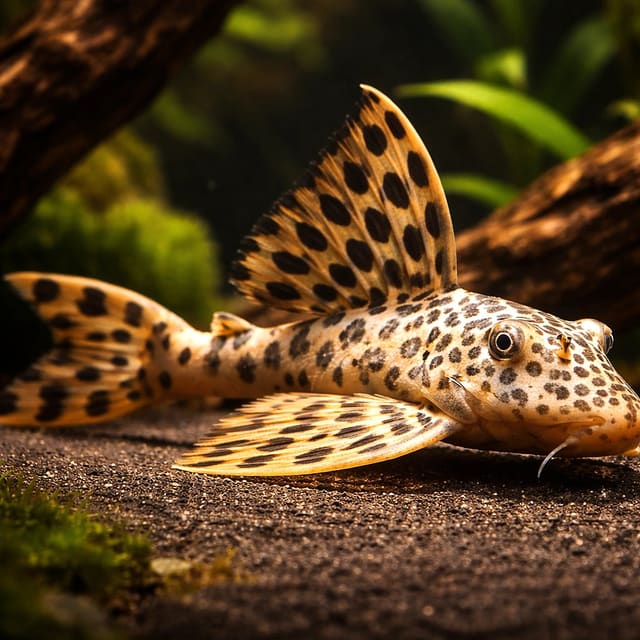
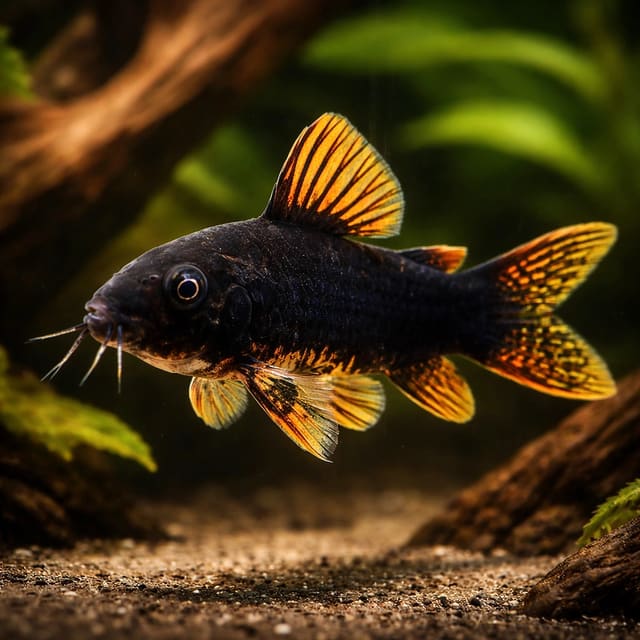
Planet Catfish describes L273 as a variably marked species. The best individuals are strikingly patterned. Others are far plainer and would never stop you in your tracks. What they share, and what Planet Catfish gives as the identifying feature, is an unusual, almost metallic sheen across the back half of the body. If you are looking at a cactus pleco and trying to decide whether it could be L273, that sheen on the rear of the fish is the thing to look for.
Expect variety. The 2024 paper describing P. nyktos notes that telling Pseudacanthicus species apart has always been hard, because colour patterns vary so widely and the body shape differs so little between species. The authors found that colour, combined with skeletal and anatomical characters, was what finally separated their new species. In practice that means two L273 can look quite different from each other, and an individual's pattern is not something any shop can promise in advance.
According to Planet Catfish, males seem to carry the brighter, more attractive patterning, while females are duller, and that difference shows even in young fish. In two related cactus plecos, adult males also grow heavier odontodes on the pectoral-fin rays: Seriously Fish records this for L114, and the P. nyktos description records it on the pectoral spine, gill cover and cheeks. Nobody has published that detail for L273 itself, so treat it as a hint rather than a rule. We sell L273 unsexed.
Planet Catfish gives the type locality for L273 as the Rio Tapajós in Pará, Brazil, and places it in the Amazon, Lower Amazon and Tapajós regions on its distribution list. Its habitat photographs for the species were taken at Itaituba, on the middle Tapajós. Itaituba sits on the bank of the river, and the Tapajós's flow is measured there.
The Tapajós is a serious river. Counted together with its headwater, the Juruena, it runs about 2,080 km through the Amazon rainforest before joining the Amazon near Santarém, also in Pará. Wikipedia describes its upper reaches as a more or less continuous series of formidable cataracts and rapids. The lowest stretch, roughly 303 km, can be navigated by large vessels.
The Tapajós was historically one of the great clearwater rivers of the Amazon. Its water was very clear, greenish in colour and at most somewhat acidic, with a typical pH of about 6.5. That sits right in the middle of the pH 6.0 to 7.0 range Planet Catfish gives for keeping L273, which is reassuring: the aquarium figures and the river line up.
The river has changed, sadly. Wikipedia reports that illegal mining now dumps an estimated 7 million tonnes of sediment a year into the Tapajós, turning the "blue river" light brown, so it now behaves as a man-made whitewater river. Mercury used without regulation has poisoned people living along it, including indigenous communities, and dams have been planned on the river, including São Luiz do Tapajós and Jatobá. The basin is rich in fish. About 325 species are known from it, 65 of them found nowhere else, and conservative estimates suggest more than 500 will eventually be recognised.
Wikipedia describes Pseudacanthicus species in general as living mainly in fast-flowing water, sometimes quite deep. The authors of the P. nyktos paper suggest that the heavy odontodes typical of the group are linked to the fast, strong currents these catfish usually live in. In the paper, odontodes are also linked to territorial disputes and to protecting young fish from predators. Planet Catfish's care notes for L273 ask for clean, clear and well-oxygenated water and a cave, preferably of wood, to hide in.
Put those together and you have the brief for the aquarium: warm, clean, oxygen-rich water with a definite current, and solid cover to retreat into. Get those right and a cactus pleco has most of what it needs.
Planet Catfish gives L273 a size of 300 mm standard length, which is 11.8 inches. Standard length is measured from the snout to the base of the tail and leaves the tail fin out, so a fully grown fish is noticeably longer from nose to tail tip. This is the number to plan around, whatever size the fish is when it arrives. For context, Wikipedia notes that the largest members of the genus reach up to 90 cm standard length. L273 is not one of the giants, but a 30 cm armoured catfish is still a big animal with a big appetite.
No source we trust has published a tank size specifically for L273. The nearest guide comes from a close relative. Seriously Fish profiles L114, the leopard cactus pleco, which tops out at about 250 mm. For that fish it recommends a tank with a base of at least 180 × 60 cm, around 648 litres, laid out to feel like a flowing river. L273 grows larger than L114, so we treat 180 × 60 cm as the absolute floor for an adult, not a target. More floor area is better than more height for a fish that spends its life on the bottom.
If you buy a younger fish, plan for its adult size from day one. It is far easier to set up the right aquarium now than to find a home for a 30 cm catfish that has outgrown your tank.
Planet Catfish says L273 needs a cave of suitable size, preferably made of wood, and describes it as quite secretive. Seriously Fish's advice for L114 fills in the rest of the picture: rocks of different sizes, a sand and fine gravel substrate, driftwood, terracotta pipes and plant pots, arranged to create a network of nooks, crannies and shaded spots. A layout along those lines works well for L273:
Clean, well-oxygenated water is the one point Planet Catfish stresses about L273's water. For the 180 × 60 cm L114 tank, Seriously Fish suggests two filters that together turn the tank volume over four to five times an hour, and heating of roughly 150 to 225 watts. Use that as a starting point and scale up for a bigger tank. Point at least one outlet along the length of the tank to give a river-like current, and keep the water surface moving so that oxygen is exchanged freely. A meat-eating fish this size produces real waste, so generous filtration is not optional.
Planet Catfish gives L273 a pH of 6.0 to 7.0 and a temperature of 23 to 28 °C, and asks for water that is clean, clear and well oxygenated. Those are the figures we use, and they match what we know of the Tapajós: clear water with a typical pH of around 6.5.
Seriously Fish's figures for the related L114 are a little wider: 24 to 30 °C, pH 5.5 to 7.5 and a general hardness of 1 to 15 dGH. No hardness range has been published for L273 itself. Given its clearwater home and the soft-to-moderate range recorded for its relative, soft to moderately hard water is the sensible target. If your tap water is very hard, talk to us before you order.
Aim somewhere in the middle of Planet Catfish's range, around 25 to 26 °C. That leaves headroom on both sides for a hot summer or a cold snap. Bear in mind that warm water holds less dissolved oxygen than cool water. If the tank creeps towards the top of the range in summer, increase surface movement or add an air stone.
OATA, the UK trade body for ornamental fish, publishes a care sheet for freshwater catfish that sets clear targets:
For a large carnivorous catfish fed on prawn and mussel, the nitrate target is the one to watch. Uneaten mussel and prawn left to rot raise ammonia and nitrate quickly. Large, regular water changes and a filter that is cleaned before it clogs will do more for this fish than any additive.
Keep conditions steady, too. Match the temperature and pH of new water reasonably closely during water changes rather than letting conditions swing.
Many buyers assume every pleco eats algae. L273 is not one of them. Planet Catfish calls it a carnivore, though not a predator. Prawns and chopped mussel appear to be its favourite foods, and Planet Catfish says they promote good growth, with some vegetable matter added to balance the diet. In its notes on tank mates, Planet Catfish adds that cactus plecos only eat vegetables when their preferred food isn't available. Do not buy one to clean the glass.
The teeth explain it. Pseudacanthicus has narrow jaws with a small number of long, curved teeth. The authors of the P. nyktos paper link that tooth shape to a broader diet that can include molluscs and crustaceans, not just algae scraped from surfaces, and so to a tendency towards eating meat. Loricariids with wide jaws and rows of many small teeth are the ones built to graze biofilm and detritus off rocks.
Build the diet around meaty foods and give some variety:
OATA's catfish care sheet advises feeding what the fish can eat within a few minutes, once a day. Overfeeding fouls the water. A secretive fish like this may not feed in the open at all while the lights are on, so drop food near its cave in the evening or just after lights-out. Check the next morning and lift out anything left uneaten.
Planet Catfish also points out that the waste a cactus pleco produces depends on its diet, but that it is considerably less than a Panaque or Pterygoplichthys of similar size. That doesn't make L273 a clean fish, only a cleaner one than those. A 30 cm fish eating seafood still needs the filtration and water changes described above.
If it shares the tank, watch at feeding time to make sure the food actually reaches it. Planet Catfish warns that faster fish of similar size can push cactus plecos around, and a pleco that loses every race to the food will lose condition.
Planet Catfish sums up L273's temperament as generally peaceful but territorial from a young age. Some large individuals become aggressively territorial and can cause trouble when kept with other large fish that are active at night. Give it a cave of its own from the start.
Plan on one L273 per tank unless you have a very large aquarium and plenty of experience. Seriously Fish advises keeping its relative L114 alone and says it is not a community fish. The P. nyktos paper notes that its territorial nature often leads to fighting when two of them share the same space. Nobody has recorded anything to suggest L273 is more tolerant of its own kind than its relatives.
Other large plecos and big catfish that are active at night are the tank mates most likely to fall out with it, because they are after caves and food at the same time of night. If you do mix them, give every bottom-dweller its own cave, with plenty of spares, and break up sightlines with rock and wood.
Planet Catfish makes a point that surprises people. With large, tough plecos, keepers are often tempted to add other large, tough fish such as Oscars and other boisterous characters. That works quite well for most omnivorous or mainly vegetarian plecos. Cactus plecos, despite all their armour, can be bullied by faster-moving fish of a similar size. Armour does not help much if a quicker tank mate takes every bit of food before the pleco reaches it.
The best companions are calm fish that live in the middle and upper water, like the same warm, soft-to-neutral, well-oxygenated and moving water, and don't compete hard for food on the bottom. Choose them for the conditions L273 needs, and make sure they are not so fast and greedy that the pleco goes hungry.
The care points that matter most for L273 are the ones already covered: clean water to OATA's targets, plenty of oxygen, meaty food and no bullies. Get those right and you have dealt with the usual causes of trouble before they start.
OATA's catfish care sheet lists the changes to watch for:
With a secretive fish, you have to make a point of looking. Planet Catfish describes L273 as quite secretive, so spending the day in its cave is normal and no cause for worry. A healthy fish still comes out to feed. If yours stops feeding, or you see it breathing hard at the mouth of its cave, test the water first: ammonia, nitrite, nitrate and temperature. Check the water before you reach for any medication.
Planet Catfish's insistence on well-oxygenated water is worth taking literally. In a hot spell, or after a power cut that stops the filter, oxygen can run short quickly. Add surface movement or an air stone straight away if the fish looks distressed.
Those keels are made of sharp odontodes. The P. nyktos description records sharp, conspicuous odontodes covering the head, body and pectoral and pelvic fin spines in that species, and Planet Catfish lists keels of pointed odontodes as a feature of the whole group. OATA's care sheet recommends double-bagging catfish for transport because of their spines. At home, move the fish in a container or a large, soft net worked gently, and if a spine catches in the mesh, keep the net in the water and ease it free rather than pulling. When you are working in the tank, keep your hands clear of the cave mouth.
OATA reminds UK keepers that the Animal Welfare Act 2006 requires owners to meet their animals' needs: a suitable environment, a suitable diet, the chance to behave normally, appropriate housing with or apart from other animals, and protection from pain, injury and disease. It also asks that aquarium animals and plants are never released into the wild. For a fish that reaches 30 cm, that means planning for the adult before you buy the youngster.
Very little. Planet Catfish lists L273's breeding as unknown, adds that it is almost certainly a cave or pipe spawner, and records no breeding report. Its gallery for the species does include several photographs captioned as courting, so the behaviour has at least been photographed, but no successful spawning has been written up there.
Two relatives give a sense of what to expect. Seriously Fish describes L114 as a cave spawner in which the male looks after the brood, and says it has been bred in aquariums. The authors of the P. nyktos paper report that in that species, during the breeding period, males usually keep the female shut inside the burrow until she has finished laying. That is an observation from a different species, not a record for L273.
Breeding L273 would mean keeping at least two adults in a very large aquarium, with enough caves and space that the territorial behaviour Planet Catfish describes doesn't turn into injuries. Telling males from females relies on the pattern difference Planet Catfish notes, with males brighter and females drabber, and possibly on the heavier odontodes seen in males of related species. Anyone who manages it would have something well worth writing up.
We sell L273 as single, unsexed fish, so a pair cannot be ordered here. This is a species to buy for itself, not as a breeding project.
A large cactus pleco is a considered purchase, and the first few days set the tone. Before you order, read our delivery and live-arrival information so you know exactly how the process works.
We email you the confirmed delivery date and tracking details. Fish travel in oxygen-filled bags inside insulated packaging, with heat packs when the weather calls for them, and go by a tracked courier licensed to carry live animals.
Start a continuous video before you open the parcel, while it is still sealed, and keep filming in one take as you open it, until you have shown the fish in its unopened bag. If a fish arrives dead, dying or clearly in poor condition, email hello@tropicalfishco.co.uk on the day of delivery with your order number and that video. Photographs alone don't meet the policy. Under our live-arrival guarantee terms, the remedy is a replacement sent with your next order or a refund for the affected fish.
Keep the lights low. Expect the fish to head for cover and stay there; a secretive catfish hiding for its first days is behaving normally. Offer a small amount of meaty food near its cave after lights-out from the second evening, and take away anything left uneaten the next morning. Over the first week, watch its breathing, its appetite and how it behaves when it does come out. If something doesn't look right, check the water first and then get in touch with us.
These are the sources we used for this guide, all worth reading if you are serious about cactus plecos:
Our main species source is the L273 data sheet in Planet Catfish's Cat-eLog, under Pseudacanthicus sp. (L273). Search for "L273" on planetcatfish.com to find it, along with its photographs.
No reviews for this item yet. Bought one? Honest reviews only, good or bad.
What customers say about ordering from us
Easy website plenty of info on fish your buying great to pick a time slot
TRACEY DURRANT · 7 Oct 2026
Got some lovely fish thank you
Kevin Mackie · 7 Oct 2026
Reviews of our shop, collected by Judge.me, an independent third-party review collector. Newest first.