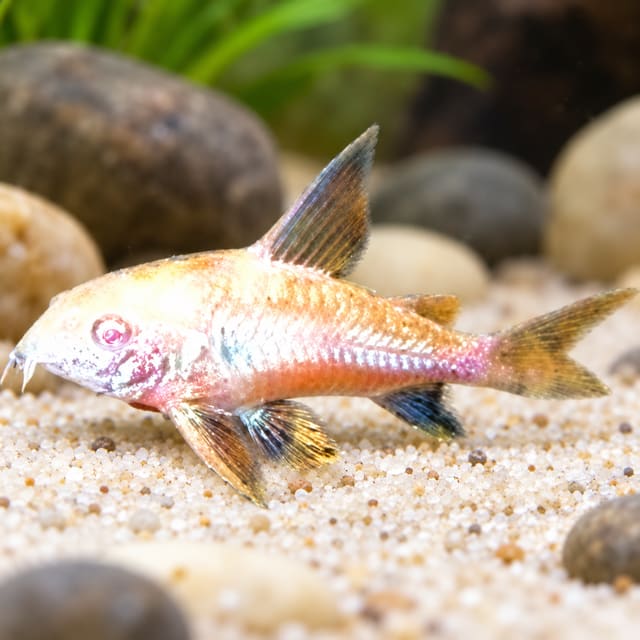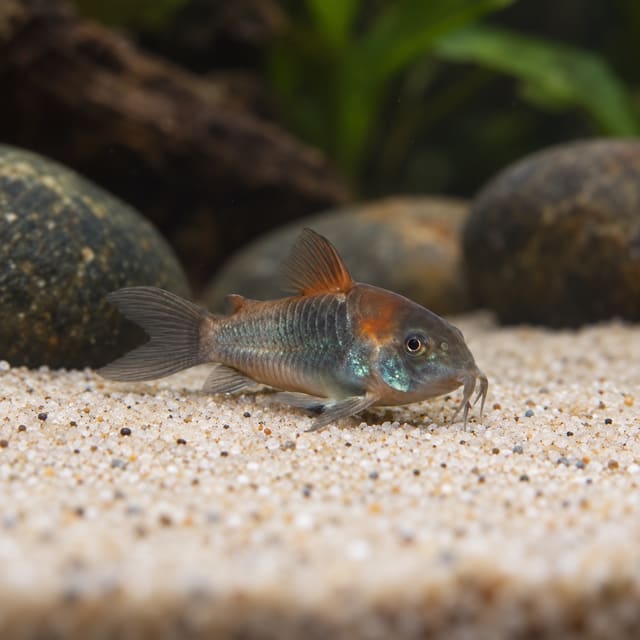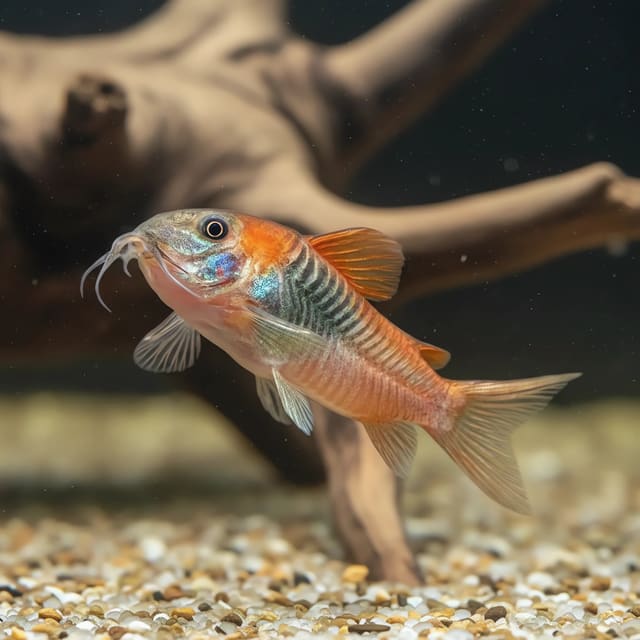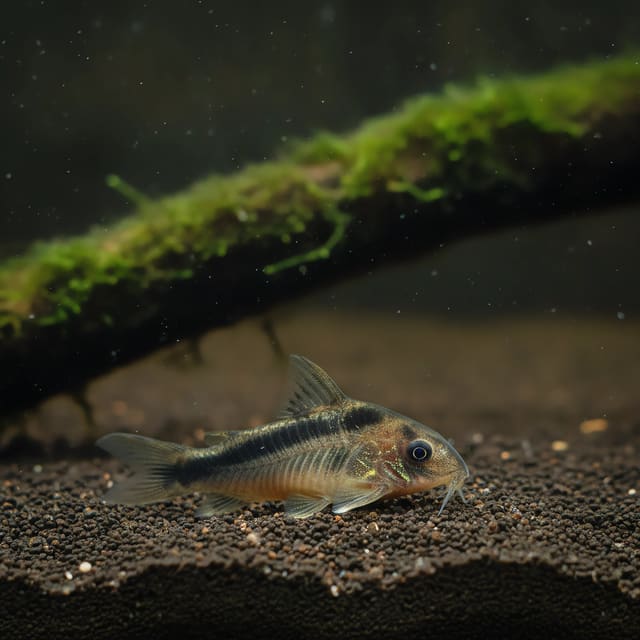
Panda Cory Catfish (Corydoras panda)
22–25°C · pH 6–7.4
£7.29
Photo coming soon
The size, price and care details on this page are for this listing.
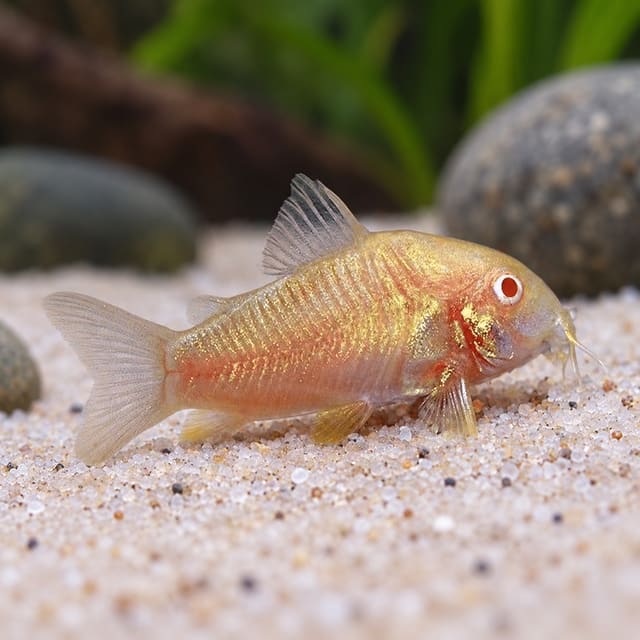
Gold Panda Corydoras is a gold colour form of Hoplisoma panda, the panda cory, sold as single fish. Keep six or more on clean sand at 20-25°C, pH 6.0-7.4, in 80 litres or more; mature females reach about 5.5 cm SL and males stay smaller.
Adult size is the maximum length this species reaches at full maturity (scientific sources). The livestock you receive will be younger and smaller. Product-photo provenance and any image-specific limitations are stated on the listing.
Hoplisoma panda
Gold Panda Corydoras is a gold colour form of Hoplisoma panda, the panda cory, sold as single fish. Keep six or more on clean sand at 20-25°C, pH 6.0-7.4, in 80 litres or more; mature females reach about 5.5 cm SL and males stay smaller.
Adult size is the maximum length this species reaches at full maturity (scientific sources). The livestock you receive will be younger and smaller. Product-photo provenance and any image-specific limitations are stated on the listing.
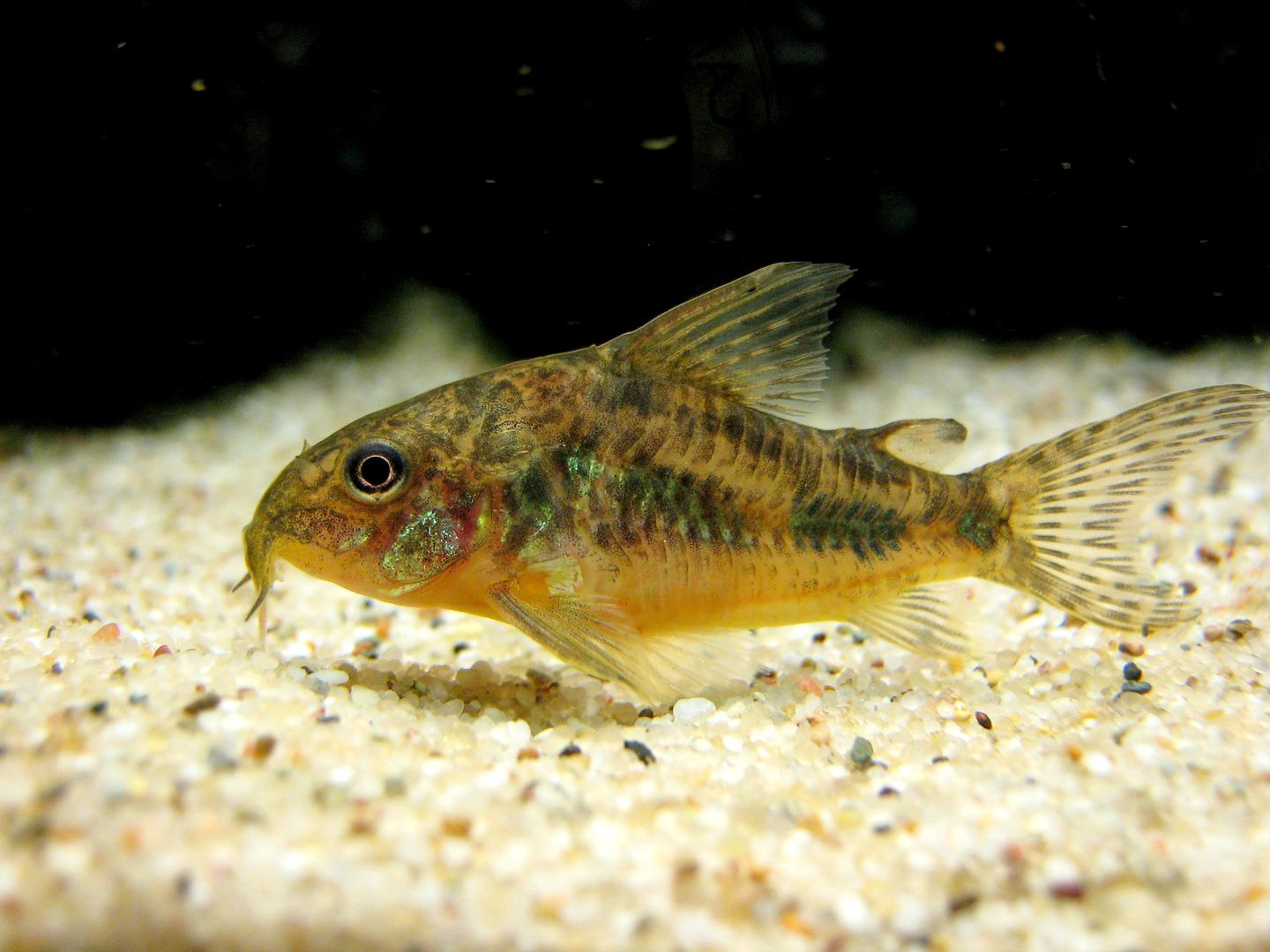
Identify the exact cory catfish before choosing care. Our starting policy for many common medium species is six compatible conspecifics, a mature 60 x 30 cm aquarium of about 60 litres, smooth fine sand and measured species-appropriate water.
Maintain these water conditions for optimal health and vibrant colors
This listing sells gold panda corydoras one fish at a time. There are no size options and no pack count, so each unit you add to your basket is a single fish. We do not publish a dispatch size for it; if you need to know before ordering, ask us. Because panda corys are shoaling fish, almost everyone who buys them should be buying several. Seriously Fish recommends a group of at least six. Wikipedia puts the minimum at eight. OATA's catfish care sheet says Corydoras should be kept in groups of at least five, and warns that catfish kept singly or in too small a group will often become stressed. Six is the floor we work to, and eight or more is better if the tank has room.
The scientific name has changed recently. Nijssen and Isbrücker described the panda cory in 1971 as Corydoras panda, and that is still the name on most tank labels and in most books. Seriously Fish records its move to Hoplisoma in 2024, and FishBase now lists it as Hoplisoma panda, which is why our title uses the new name. The fish has not changed, only the genus it is filed under, so any older care guide written for Corydoras panda still describes this animal.
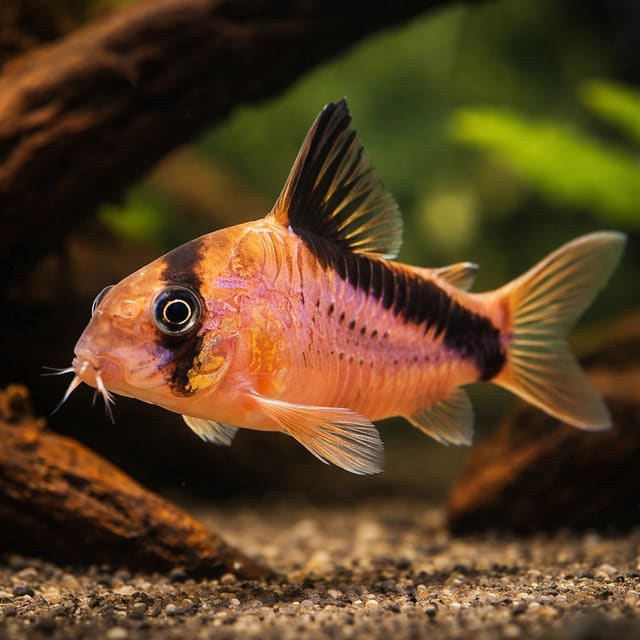
Now the word "gold". Our stock records list this fish as a gold form of the panda cory. The scientific accounts we rely on describe the wild colour pattern only, and none of them describes a gold form. So we will not promise you a particular shade, and we will not make up a history for the line. What the sources do support is everything that decides whether the fish thrives: its markings, size, water, diet and social needs. A colour form belongs to the same species, so all of the care on this page applies to it.
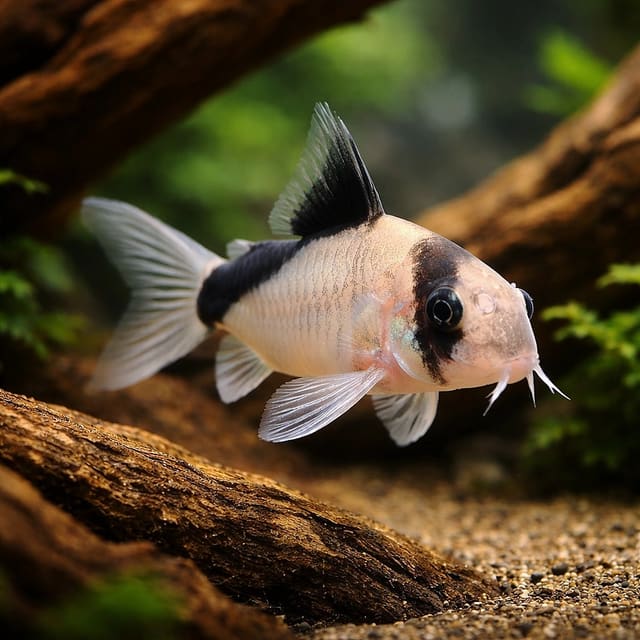
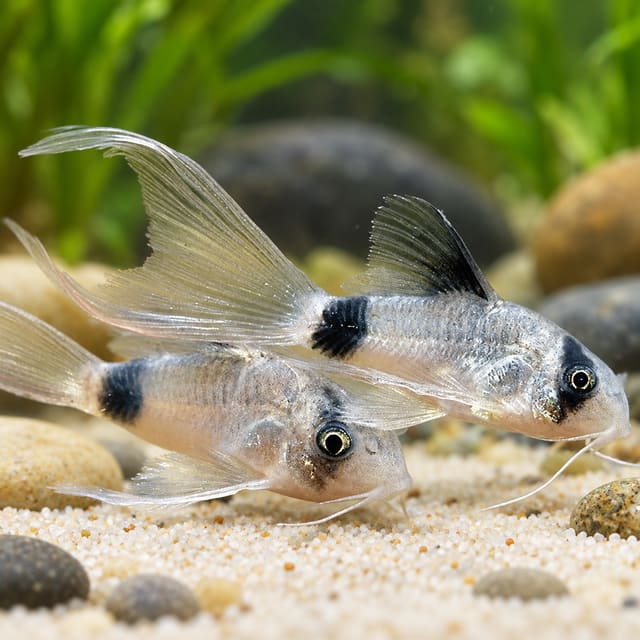
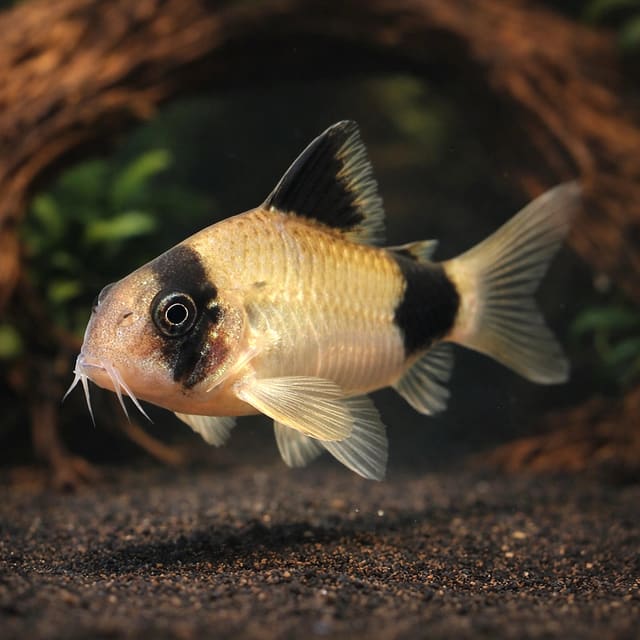
The common name makes sense the moment you see the wild-type fish. Wikipedia describes an off-white to pinkish-orange body with black patches running down from the top of the head over each eye, a black blotch covering almost the whole dorsal fin, and a black band around the caudal peduncle, the narrow part of the body just in front of the tail. Seriously Fish says that mix of dark and light brings the giant panda to mind, and Wikipedia explains that the species name itself is an allusion to those black eye patches.
| Feature | What to look for |
|---|---|
| Eye patch | A black patch from the top of the head down over each eye |
| Dorsal fin | A black blotch covering almost the entire fin |
| Tail base | A black band around the caudal peduncle |
| Wild-type body colour | Off-white to pinkish-orange |
| Body covering | Rows of bony plates called scutes, not scales |
| Barbels | Three pairs: one maxillary pair and two rictal pairs |
All of the features in that table come from Wikipedia's description. The armour of scutes is shared by every member of the family Callichthyidae. The barbels are delicate: OATA asks for sand or fine gravel to protect them, and Seriously Fish links a dirty substrate to barbel loss. Look after the barbels and you look after the fish; the set-up and health sections explain how.
Size is where the sources seem to disagree, and the explanation is sex. FishBase gives a maximum of 3.8 cm standard length for males or unsexed fish. Wikipedia says mature females reach 55 mm standard length and that males remain smaller. Seriously Fish gives 50 mm. Standard length is measured from the snout to the base of the tail fin, so the tail adds a little on top. We list the adult size as 5.5 cm, the figure Wikipedia gives for a mature female, and expect males to stay smaller than that.
Seriously Fish advises looking down on the fish from above: the female has a more rounded belly and is likely to be slightly larger, which fits Wikipedia's size figures. We do not sort fish by sex, so a group bought here will be a natural mix of whatever is dispatched. We cannot promise a ratio, or that both sexes will be present.
If you would rather have the familiar colouring described above, our Panda Cory Catfish (Corydoras panda) listing is the same species in its standard form. For a different species that is also sold for its dark mask, compare the Masked Corydoras (Hoplisoma metae). Keep any two cory varieties in the same tank only if both suit the 20-25°C range this fish needs.
FishBase places H. panda in the upper Amazon River basin. Wikipedia narrows that to Peru and Ecuador, in particular the Huánuco region of Peru, in streams of the Río Pachitea and the wider Río Ucayali system. Seriously Fish describes it as native to parts of the upper Amazon in Peru and does not mention Ecuador, so Peru is the part of the range every source agrees on. Wikipedia also records that the species was first collected by Randolph H. Richards in 1968, three years before it was formally described.
The habitat descriptions explain most of the fish's needs. Wikipedia describes clear, relatively fast-flowing, well-oxygenated river water over soft sand or fine gravel, poor in minerals and neutral to slightly acid. Seriously Fish adds that the species lives in both clear and blackwater streams and tributaries, often over sandy bottoms, and that water temperatures can fall to around 19°C where streams are fed by Andean meltwater.
That last point is the one most keepers miss. The panda cory comes from cooler water than many fish sold as tropical, and Wikipedia notes a marked preference for the cooler part of its temperature range. Wikipedia puts that down to the Andes nearby: the species copes with cooler water than the norm for tropical fish, and the flip side is that heat is the bigger risk.
FishBase lists it as a demersal fish, living on the bottom, and as a facultative air-breather. That means that as well as breathing with its gills it can rise to the surface and gulp air. You will see your group do this now and then, and it is quite normal for the species.
FishBase gives the IUCN Red List status as Near Threatened, assessed on 24 April 2014. Seriously Fish notes that wild specimens are rare in the trade and that virtually all panda corys sold are commercially farmed, mainly in Eastern Europe or the Far East. It also records that the species was expensive when it was first imported in the late 1970s, and that it is now mass-produced and one of the most popular cory species in the hobby.
Going by the sources, two things matter most with panda corys: temperature, and cleanliness. Hardness and pH need to sit inside sensible limits, and the sources give a fairly wide band for both.
| Source | Range given | Context |
|---|---|---|
| FishBase | 20-25°C | Species range |
| Wikipedia | 20-25°C | Ideal aquarium range; wild fish recorded at 16-28°C, preferring the cooler part |
| Seriously Fish | 22-25°C | Aquarium range |
| OATA | 22-27°C | General guidance for aquarium catfish, not specific to this species |
We list 20-25°C, the range FishBase and Wikipedia agree on. If you want the band every species-specific source shares, aim for 22-25°C. Wikipedia notes that the fish can briefly survive water as cold as 12°C. Treat that as a measure of how hardy it is in a cold snap, not as a target. The upper end is the limit that needs watching: Wikipedia records that young fry die of heat stress above 26°C and do best at 22°C or below.
In practice that rules some tanks out. An aquarium run at 28°C or more to suit warm-water species is the wrong home for panda corys, however peaceful everyone is. Keep them in a separate tank instead. During a summer hot spell, check the thermometer every day. A heater cannot cool water, so if the tank creeps past 25°C, turn the lights off for longer, prop the lid open a little and run a small fan across the surface.
| Parameter | Range we list | Source notes |
|---|---|---|
| pH | 6.0-7.4 | Seriously Fish 6.0-7.4; FishBase 6.0-8.0; wild water neutral to slightly acid (Wikipedia) |
| General hardness | 2-12 dGH | Seriously Fish 1-12 dGH; FishBase 2-25; wild water poor in minerals (Wikipedia) |
| Ammonia | 0 mg per litre | OATA catfish care sheet |
| Nitrite | 0 mg per litre | OATA catfish care sheet |
| Nitrate | No more than 20 mg per litre above your tap water | OATA catfish care sheet |
FishBase's wide ranges show how much the species can tolerate, but Seriously Fish's narrower aquarium figures match what Wikipedia says about the wild water, so those are the ones we list. If your tap water falls inside them, adult fish need no special treatment beyond a dechlorinator.
Wikipedia is blunt here. It calls the species intolerant of poor aquarium maintenance and says it succumbs to stress and disease rapidly when conditions are wrong. Seriously Fish adds that the substrate must be kept scrupulously clean to prevent barbel loss. OATA's catfish care sheet gives the routine to follow:
For a cory tank, add one habit of your own: run the siphon over the surface of the sand at every water change, especially in the corners and under the front of the décor where uneaten food collects. Corys live on that sand, so it needs to be the cleanest part of the tank, not the dirtiest.
Seriously Fish gives a minimum base of 45 × 30 cm, with 30 cm of height, about 41 litres, for a small group. OATA's catfish care sheet sets a higher starting point of 80 litres for smaller catfish such as Corydoras. For the group of six to eight we recommend, follow the OATA figure. Floor area counts for more than height with a fish that spends its life on the bottom, so a long, shallow tank beats a tall one of the same volume.
Every source points the same way. Wikipedia describes soft sand or fine gravel in the wild, Seriously Fish recommends river sand, and OATA asks for sand or fine gravel to protect the fish's sensitive barbels. Smooth sand is the safest choice, since coarse or sharp gravel is exactly what OATA's advice is meant to steer you away from. Keep the layer fairly shallow so that waste does not build up out of reach of the siphon.
Seriously Fish also advises against undergravel filtration for this species, so use an internal or external filter instead.
Wikipedia recommends a well-furnished aquarium with live plants and solid furnishings that give caves, sheltered areas and hiding places, and notes that floating plants for shade are appreciated. Seriously Fish suggests a few driftwood branches and dried leaves. OATA lists wood, pots or caves for shelter, and live plants for cover. A layout that uses all of that might look like this:
Because the panda cory is a facultative air-breather, the fish need to reach the surface easily. Keep floating plants to part of the surface, and leave a gap between the water and the lid.
In the wild the species lives in relatively fast-flowing, well-oxygenated water, according to Wikipedia, and Seriously Fish notes that eggs are laid on the glass in areas of strong flow. So a good current along part of the tank is welcome, as long as there is calmer water elsewhere. Point the filter outlet along the front glass or across the surface, and you get both oxygen and a little movement over the sand.
The filter must be mature before the group arrives. Ammonia and nitrite should both read zero on several tests in a row, with nitrate under control. A new tank that has not finished cycling is the worst possible start for a species Wikipedia describes as intolerant of poor conditions.
Corys are often thought of as scavengers that tidy up after other fish. Wikipedia says plainly that the panda cory feeds mainly on animal matter and should not be relied on as an aquarium scavenger. It needs high-quality foods and a varied diet, and Wikipedia lists live foods such as bloodworm, Daphnia, brine shrimp and Tubifex. Seriously Fish describes the species as omnivorous and recommends good sinking pellets backed up with live or frozen Daphnia, Artemia (brine shrimp) and bloodworm.
OATA's catfish care sheet says catfish should get sinking foods suited to their diet and be fed what they can eat within a few minutes, once a day. With corys, the "few minutes" rule needs watching from the front of the tank, because the food is on the sand and easy to lose sight of.
In a community tank the risk is that faster fish higher in the water take the food before it sinks, leaving the corys short. A few tricks help:
Food that the group does not find in a few minutes ends up rotting in the sand. That links straight back to Seriously Fish's warning that a dirty substrate leads to barbel loss. If food is regularly left over, feed less, and siphon the sand at the next water change.
If a new fish is still not foraging after several days, test the water and watch whether faster fish are taking everything first.
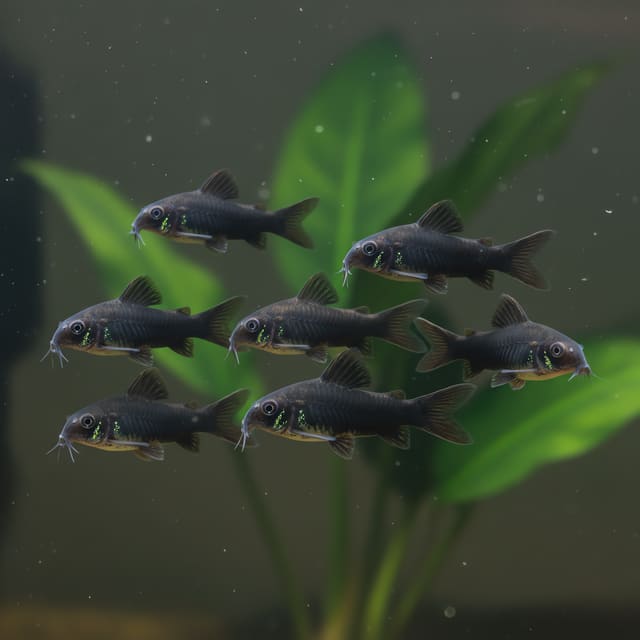
Wikipedia describes the panda cory as highly gregarious and says the fish form schools. That is the behaviour you are buying them for: a small group foraging over the sand together and moving as a school. A single panda cory, or a pair, never shows you that, and OATA's warning that catfish kept singly or in too small a group often become stressed is the welfare side of the same point.
You will also see individuals dash up to the surface for a gulp of air and drop straight back down. FishBase lists the species as a facultative air-breather, so that is normal. What is not normal is a group making constant trips to the surface. That suggests a shortage of oxygen or a water-quality problem, and the health section explains what to check.
Seriously Fish describes the species as very peaceful and suitable for many community tanks, and lists small characins, cyprinids, anabantoids, dwarf cichlids and peaceful catfish as compatible. Two conditions apply on top of that list:
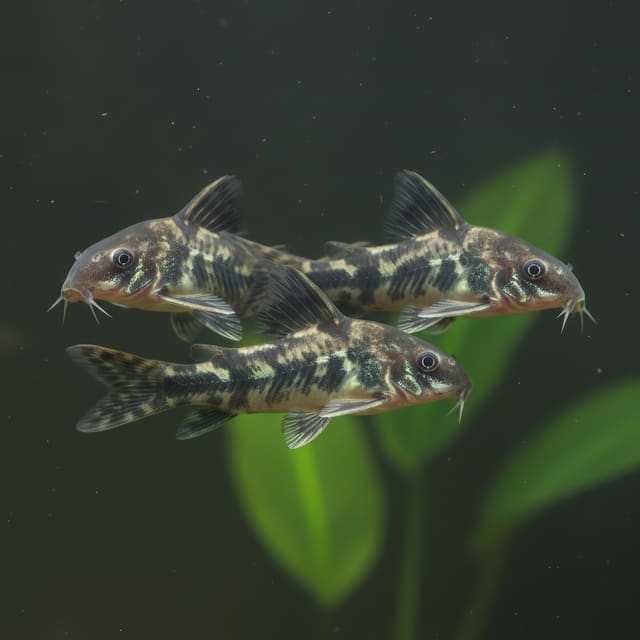
A lot of people searching for gold corys are actually thinking of the golden or bronze corys sold under the name Corydoras aeneus. That is a different species from the panda cory, with its own care needs, so check which fish you want before ordering. Our Longfin Bronze Corydoras (Corydoras aeneus) page covers that species. The fish on this page is a panda cory first and a gold fish second.
Peaceful catfish are on Seriously Fish's list of companions, so corys of other species can share a tank with pandas if the temperature suits both. Keep each species in its own proper group rather than one or two of each, so every fish has its own kind to school with.
Panda corys breed in home aquariums, and Wikipedia gives an unusually detailed account of how.
Many corys are said to spawn after a drop in temperature. Wikipedia notes that for the panda cory the temperature drop matters much less, and that the addition of new, clean, well-oxygenated water seems to be the main stimulus. In other words, a generous water change with well-matched fresh water is the likely trigger.
According to Wikipedia, males chase the females, and once a female is receptive there is a short courtship of touching and caressing around the tail base and head. The pair then adopt the "T position" typical of corys, which in this species is often more acrobatic than usual and may happen in mid-water. Seriously Fish describes the same T position and says the eggs are placed on the tank glass in areas of strong flow.
Wikipedia describes newly hatched fry as about 4 mm long and translucent, with fully formed barbels and at least a hint of the adult eye patches. After about four weeks the fins differentiate. Colour changes begin at 8-9 mm, and only after 10-12 weeks do the young reach adult colouring at 12-14 mm.
The fry are more delicate than their parents. Wikipedia records that they are particularly sensitive to changes in water chemistry and to high temperatures, that they die of heat stress above 26°C, and that they survive best at 22°C or below. It also advises bringing in new water gradually during the first 21 days of life. So a fry tank needs a steady, cool temperature and small, careful water changes rather than big ones.
OATA's catfish care sheet describes a healthy fish as having clear, bright eyes, undamaged fins, intact scales and no ulcers or bumps. Corys have scutes rather than scales, so read that last point as intact body armour with no sores. The warning signs OATA lists are clamped fins, flicking against gravel or décor, and shimmying, a shaking on the spot.
Worn, shortened or missing barbels are worth watching for, and Seriously Fish ties barbel loss directly to a dirty substrate. If you see it, look at the sand before anything else: siphon it thoroughly, check nitrate, and feed less until leftovers stop appearing.
The odd dash for air is normal for a facultative air-breather, as FishBase lists this species. Frequent trips by the whole group, or fish hanging near the surface, are a different matter. Check that the filter is running freely, that the outlet still moves the surface, and that the temperature has not crept above 25°C, since warm water holds less oxygen. Then test for ammonia and nitrite.
Wikipedia describes the species as intolerant of poor aquarium maintenance and quick to succumb to stress and disease when conditions slip. So when something looks wrong, check the basics before reaching for any treatment: missed water changes, a tank running too warm, too small a group or bullying tank mates.
OATA notes that catfish carry spines on the front, pectoral, fins and just behind the gills, which is why they are double-bagged for transport. Take the same care yourself: use a soft net, lift the fish clear rather than dragging it, and if a spine catches in the mesh, lower the net back into the water and let the fish free itself.
Kept well, this is a long-term fish. Wikipedia says well-cared-for panda corys live for more than ten years. That is worth bearing in mind when you plan the group: you are setting up a tank for a decade, not a season.
If something does not look right and you are not sure why, send us a short video of the group in the tank along with your latest test results. Behaviour shows far more on film than in a description.
Before you order, read our delivery and live-arrival information. Have the aquarium fully ready ahead of delivery day: filter cycled and running, water tested, and the heater holding the tank at a steady temperature within 20-25°C. Somebody has to be at the delivery address to take the parcel in, because live animals must not be left outside.
The fish are packed in oxygen-filled bags inside insulated packaging, with heat packs added when the weather calls for them. A tracked courier licensed to carry live animals brings the parcel, and we email you the confirmed delivery date along with the tracking details.
Begin a continuous video while the parcel is still sealed. Keep recording as you open it, so the same take shows the fish inside the bags before any bag is opened. If any fish arrives dead, dying or clearly compromised, email hello@tropicalfishco.co.uk on the day of delivery, giving your order number and attaching the video. Photographs on their own do not meet the policy. Under the guarantee terms, the affected fish are replaced with your next order or refunded.
Keep the lights low for the rest of arrival day. New fish may head for cover or sit still on the sand at first; give them peace. Offer a small amount of sinking food the following day and check later that nothing has been left to rot.
Through the first week, keep an eye on breathing, appetite and behaviour. Fish foraging together across the sand, steady breathing and the odd trip to the surface for air are all good signs. Fish hanging at the surface, clamped fins or a fish that will not join the group need a closer look and a water test. Wait until the group is settled and feeding well before you add any more fish to the tank.
The figures on this page come from these sources:
No reviews for this item yet. Bought one? Honest reviews only, good or bad.
What customers say about ordering from us
Easy website plenty of info on fish your buying great to pick a time slot
TRACEY DURRANT · 7 Oct 2026
Got some lovely fish thank you
Kevin Mackie · 7 Oct 2026
Reviews of our shop, collected by Judge.me, an independent third-party review collector. Newest first.