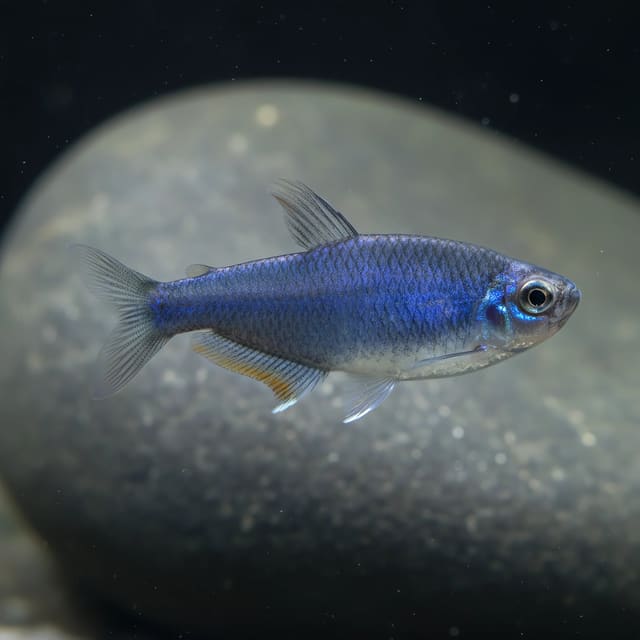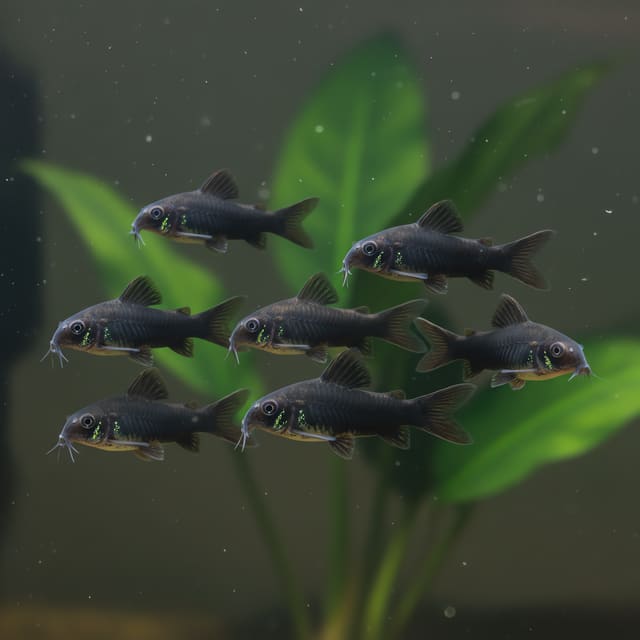
10 × Black Corydoras (Corydoras sp. Black Venezuela)
22–27°C · pH 6–8
£75.99

The Peppered Corydoras (Corydoras paleatus) is a freshwater armoured catfish from Argentina, Brazil and Uruguay that reaches 7 cm standard length. It suits a peaceful smaller community when kept in a group of at least five; the FishBase and Seriously Fish water-range overlap is 22–23°C and pH 6.0–7.0. Sold as one pack of three live fish.
Adult size is the maximum length this species reaches at full maturity (scientific sources). The livestock you receive will be younger and smaller. Product-photo provenance and any image-specific limitations are stated on the listing.
Corydoras paleatus
The Peppered Corydoras (Corydoras paleatus) is a freshwater armoured catfish from Argentina, Brazil and Uruguay that reaches 7 cm standard length. It suits a peaceful smaller community when kept in a group of at least five; the FishBase and Seriously Fish water-range overlap is 22–23°C and pH 6.0–7.0. Sold as one pack of three live fish.
Adult size is the maximum length this species reaches at full maturity (scientific sources). The livestock you receive will be younger and smaller. Product-photo provenance and any image-specific limitations are stated on the listing.
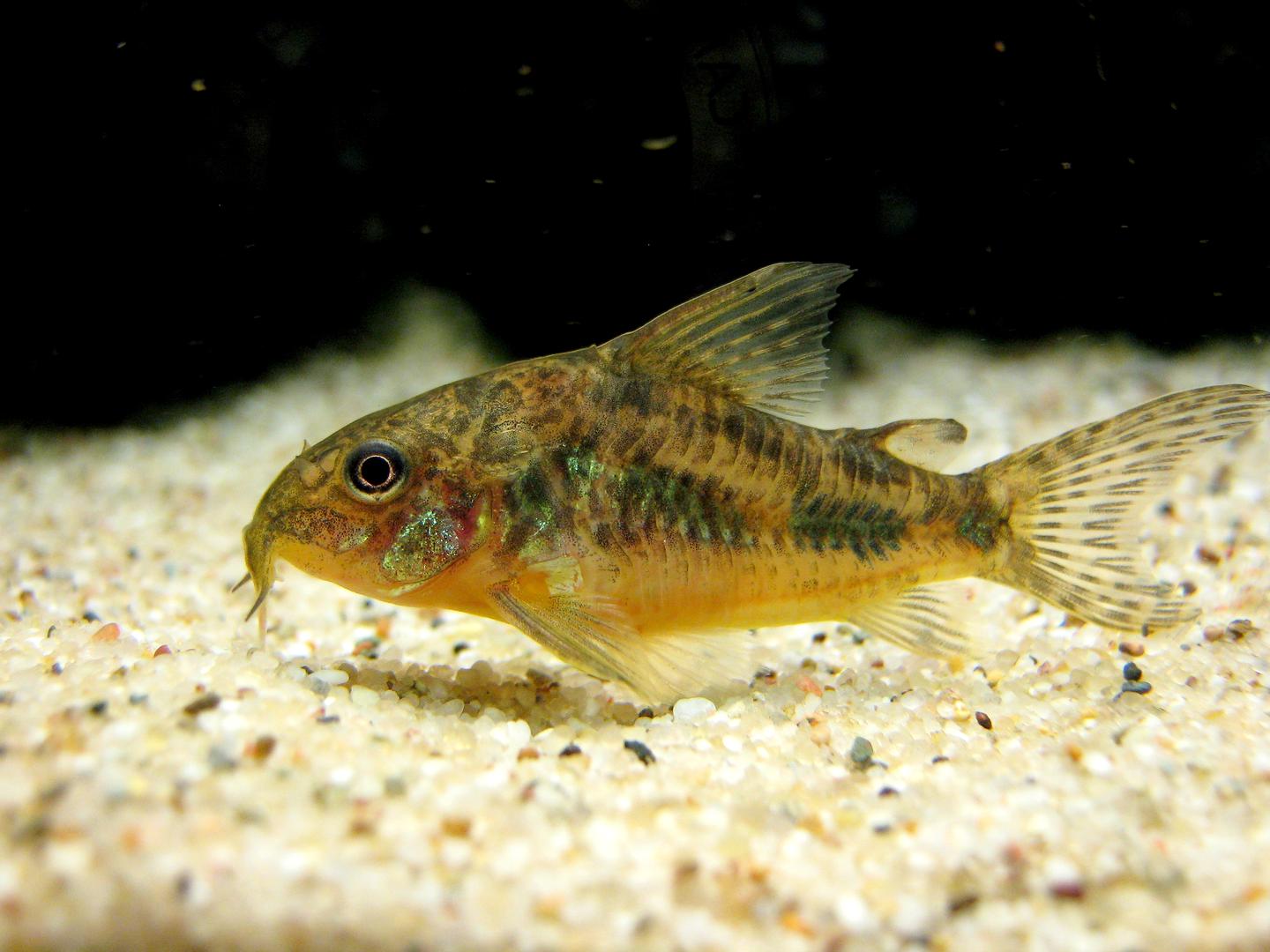
Identify the exact cory catfish before choosing care. Our starting policy for many common medium species is six compatible conspecifics, a mature 60 x 30 cm aquarium of about 60 litres, smooth fine sand and measured species-appropriate water.
Maintain these water conditions for optimal health and vibrant colors
The Peppered Corydoras (Corydoras paleatus) is a small, bottom-dwelling freshwater catfish from Argentina, Brazil and Uruguay. It belongs to the Callichthyidae armoured-catfish family and reaches up to 6.6 cm standard length. This peaceful fish suits a smaller community aquarium when the keeper can provide a group of at least five, a broad sandy floor, suitable water and a mature biological filter.
The FishBase species account now lists it as Hoplisoma paleatum and treats Corydoras paleatus as a synonym. FishBase describes a freshwater, demersal fish found in ponds and records facultative air-breathing, so an occasional trip to the surface for a gulp of air can form part of its normal behaviour.
Its natural diet includes worms, crustaceans, insects and plant matter. That varied diet makes it an opportunistic omnivore, not a dedicated algae-eating fish or a substitute for aquarium cleaning. Give it its own sinking food and maintain the substrate through normal water changes rather than expecting the group to live on scraps.
| Suits | Not suited to |
|---|---|
| A peaceful smaller community | A plan based on keeping only one fish |
| A group of at least five Peppered Corydoras | A permanent trio with no route to a full group |
| A broad sandy base with cover | Poorly maintained gravel that can affect the barbels |
| A mature, filtered freshwater aquarium | An aquarium without established biological filtration |
| Water held in the FishBase and Seriously Fish overlap of 22–23°C and pH 6.0–7.0 | Companions whose water needs fall outside that range |
The decisive commitment is social as well as physical. The three fish in this pack need to join or become part of a group containing at least five of their own kind. Plan the complete group, its floor space and its biological load before adding the fish.
Plan around a maximum recorded length of 6.6 cm standard length. FishBase supplies that figure for the species; Seriously Fish gives 7 cm standard length. Using the FishBase figure consistently keeps the growth plan tied to the scientific identity, while the slightly larger profile figure is a useful reminder not to choose floor space too tightly.
Seriously Fish recommends an aquarium base of 61 × 38 cm and a volume of approximately 70 litres. FishBase also gives a minimum aquarium length of 60 cm. Floor dimensions matter because these catfish feed, rest and move mainly around the bottom; extra height does not replace a sufficiently long and broad base.
For a complete shoal of smaller Corydoras, OATA’s freshwater-catfish guidance recommends an aquarium of at least 80 litres. This is group guidance rather than a measurement tailored only to this species, and it gives a stronger planning target when the aquarium must accommodate at least five fish plus any community companions.
A nominal 80-litre aquarium can still be a poor choice if it gains most of its volume from height and has a narrow base. Compare the actual base dimensions first, then consider the filter capacity and every other fish that will share the system. If two aquariums hold a similar volume, choose the one offering the broader usable floor.
One purchase supplies one pack of three live Peppered Corydoras. This is a social head start rather than a complete long-term group: keep at least five individuals, so these three should join at least two Peppered Corydoras already present or be part of a plan to build the group to five or more.
Sex is guaranteed only when the selected option explicitly states male or female. This 3 × Peppered Corydoras listing has no sex-guaranteed option.
Do not use body shape, colour or the gallery scene to assign the sex, life stage or origin of the fish in the pack. Seriously Fish notes that mature females can grow larger and become more rounded, but that general difference does not identify the sex of the animals selected for an order.
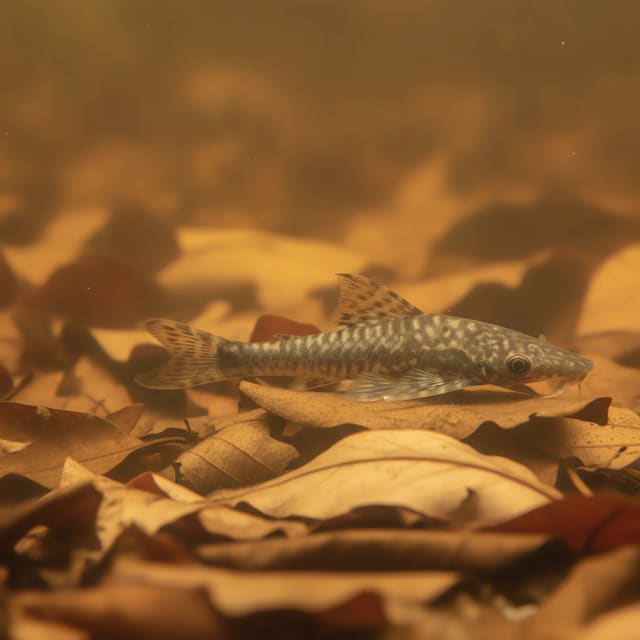
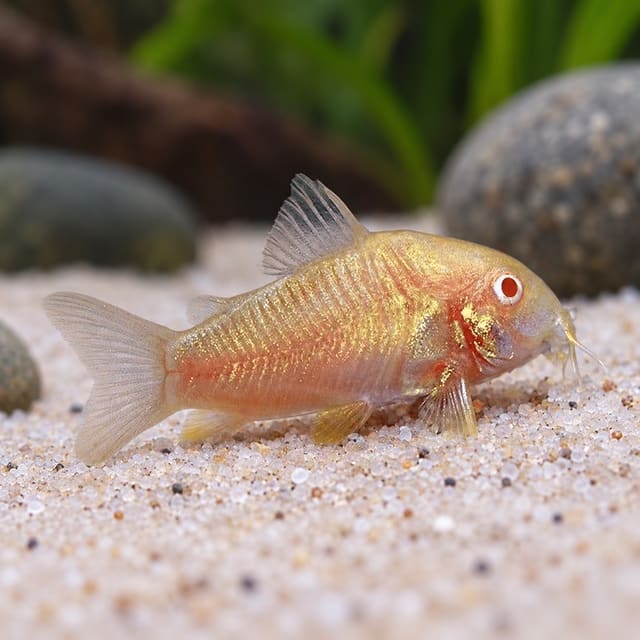
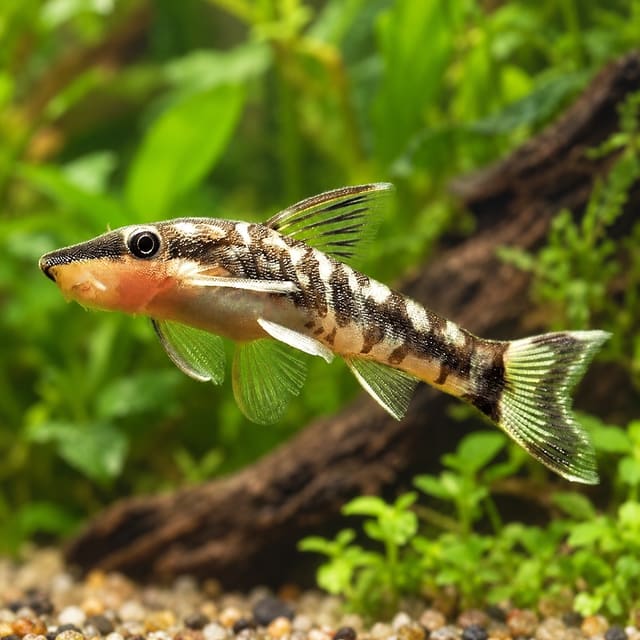
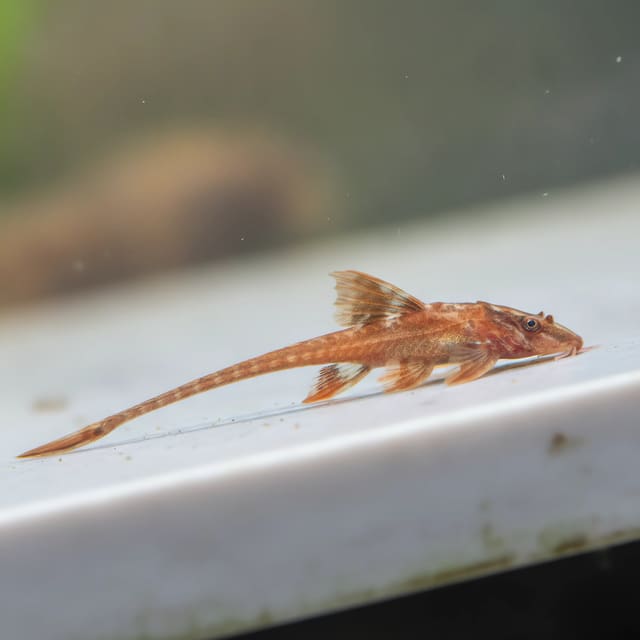
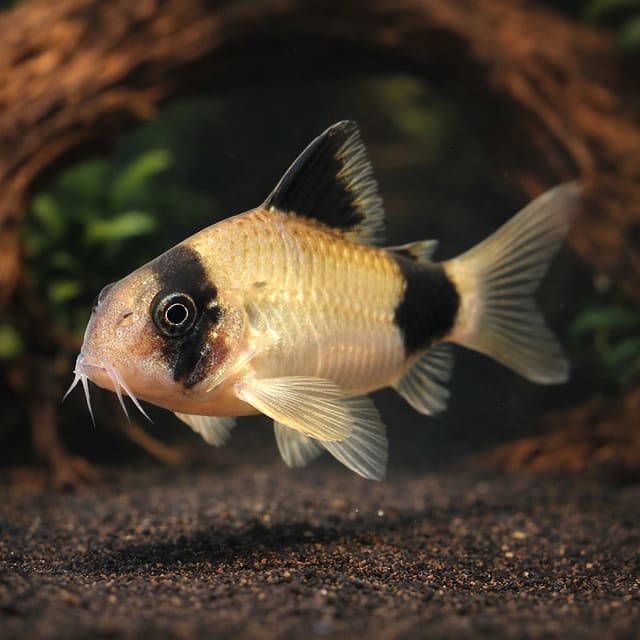
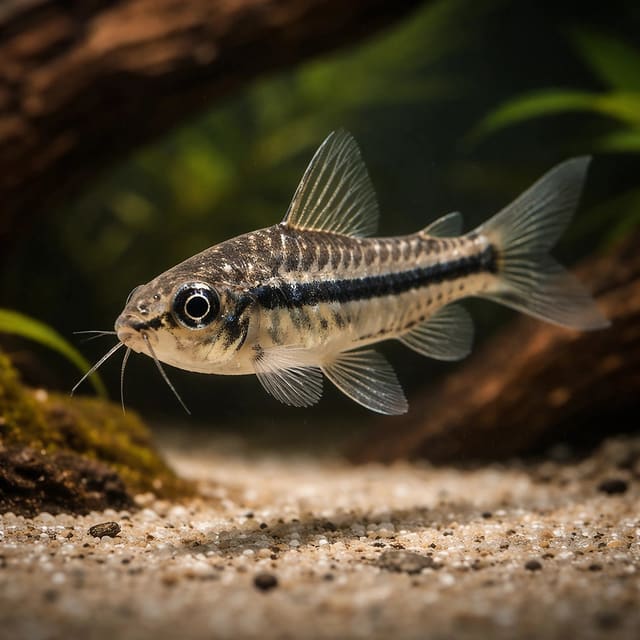
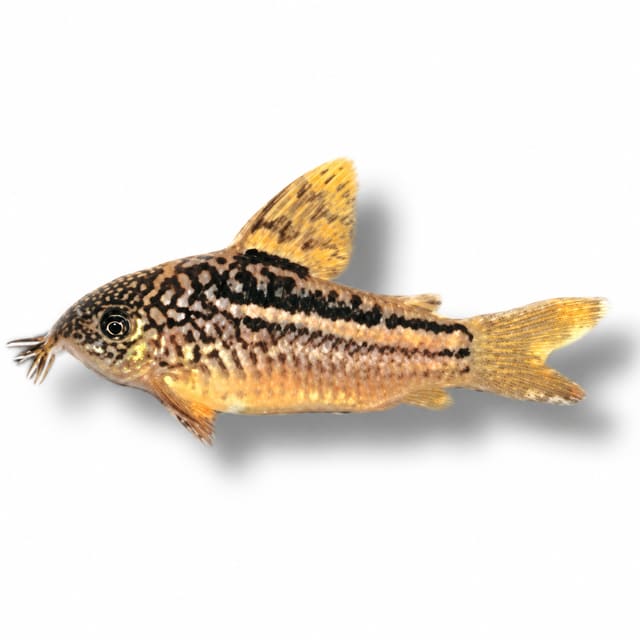
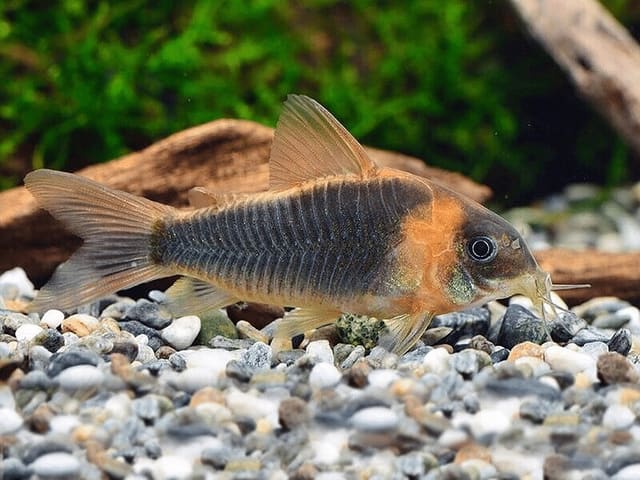
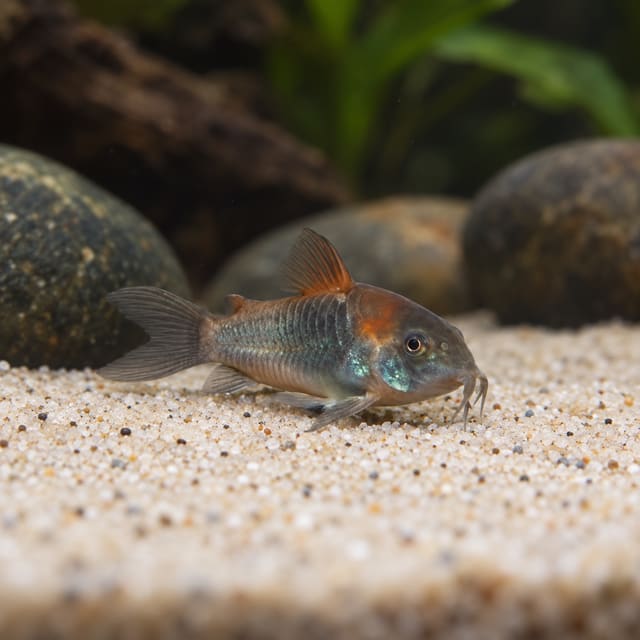
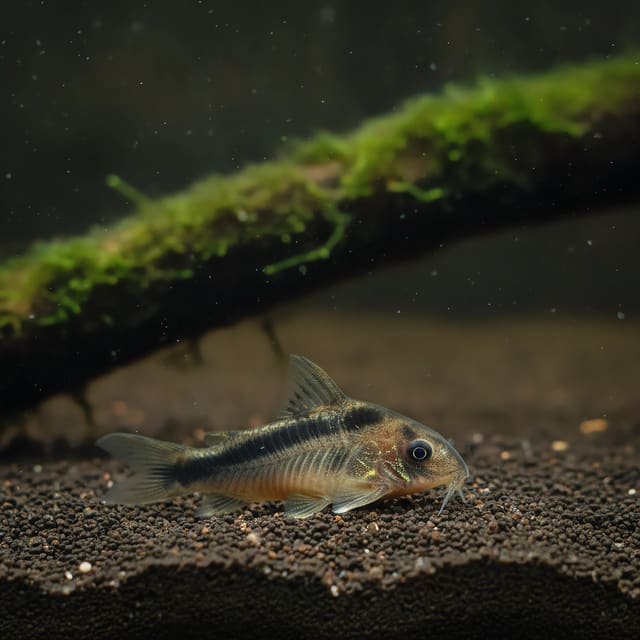
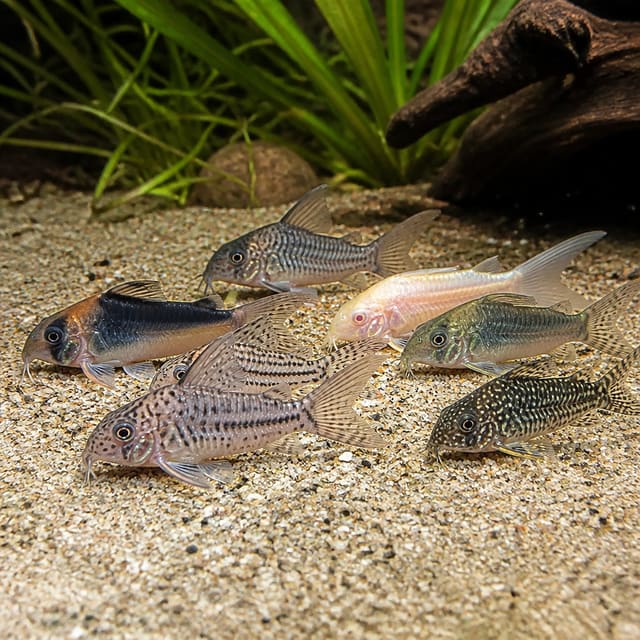
The gallery images are representative of this type of animal rather than photographs of the exact animal supplied, so colours can look slightly different from the live animal.
The photograph shows three fish together and helps illustrate the peppered pattern, tall dorsal fins and mouth barbels. Base the aquarium plan on the adult measurements and group requirement above rather than on apparent scale in the scene.
Keep Peppered Corydoras at 22–23°C, pH 6.0–7.0 and 5–12 dGH. These routine values are the overlap of FishBase’s recorded species environment of 18–23°C, pH 6.0–8.0 and 5–19 dGH and Seriously Fish’s aquarium range of 22–26°C, pH 6.0–7.0 and up to 12 dGH. OATA’s freshwater-catfish figures of 22–27°C, pH 6.0–8.0 and 4–18 dGH also contain this tighter range.
Treat the numbers as boundaries for planning, then prioritise consistency within them. Measure the aquarium rather than relying on a tap-water estimate, and check temperature as well as pH and hardness before choosing companions. Our aquarium water chemistry guide explains what each reading means, while the water matcher helps compare measured values with this range.
| Reading | Decision |
|---|---|
| 22°C, pH 6.5, 8 dGH | Inside the FishBase and Seriously Fish overlap; keep it stable. |
| 25°C, pH 6.5, 8 dGH | Inside the Seriously Fish aquarium range but above the FishBase environmental maximum; bring the routine plan into the 22–23°C overlap. |
| 22°C, pH 7.5, 8 dGH | Inside FishBase and OATA figures but above the Seriously Fish aquarium range; target pH 6.0–7.0. |
| 22°C, pH 6.5, 15 dGH | Above the Seriously Fish hardness maximum; use water within 5–12 dGH. |
Ammonia and nitrite should remain at zero milligrams per litre. OATA advises keeping nitrate no more than 20 mg/l above the normal tap-water level. Test the tap water as well as the aquarium so the nitrate comparison has a meaningful baseline, and investigate any ammonia or nitrite reading immediately.
Make adjustments carefully rather than chasing a target through repeated abrupt changes. The useful result is a stable aquarium that remains within the full FishBase and Seriously Fish overlap of 22–23°C, pH 6.0–7.0 and 5–12 dGH between maintenance days.
Use sand across the main feeding area. Seriously Fish describes sand as the preferred substrate for Corydoras because they root through it for food and warns that poorly maintained gravel can leave their barbels prone to infection. The important combination is a suitable surface and regular removal of trapped waste.
Leave a broad, accessible feeding area rather than filling the whole base with ornaments. The fish need room to move as a group, inspect the substrate and reach sinking food. Arrange cover around that open area so shelter does not prevent you from seeing whether every fish is feeding.
Do not judge a substrate only by how smooth it looks on the day it is installed. The maintenance routine determines whether food and waste remain trapped around the fish’s mouth and barbels. During each partial water change, inspect the open feeding area, the edges of wood and rock, and any sheltered pockets where debris collects.
A planted aquarium can provide additional structure, but preserve the usable base dimensions. Plants and ornaments should frame the floor rather than reduce a 61 × 38 cm base to a few narrow corridors. Watch the group at feeding time: if several fish repeatedly cannot reach a clear patch of substrate, rearrange the layout before increasing stocking.
The result should be easy for both fish and keeper to use. The catfish gain open sand for rooting and nearby cover for resting, while you retain clear sight lines for checking barbels, body condition, feeding response and swimming behaviour.
Use a well-established biological filter and confirm that ammonia and nitrite are both zero before the fish enter the aquarium. The RSPCA’s aquarium guidance explains that fish release toxic ammonia, which filter bacteria convert first to toxic nitrite and then to the safer nitrate. A filter is therefore essential waste-processing equipment, not an optional way to make the water look clear.
Seriously Fish recommends turnover of four to five times the aquarium volume each hour. Its approximately 70-litre example corresponds to a filter rated at 280–350 litres per hour. Use that as a concrete starting calculation, then check the manufacturer’s rating for the actual aquarium and account for the complete community rather than only this pack.
OATA warns that adding too many fish too quickly can produce new tank syndrome because the bacterial population has not increased enough to process the additional waste. This matters when planning a group of at least five: prepare capacity for the full social group, but introduce livestock at a pace the mature filter can support.
Check the filter for blockages during routine maintenance. When the media needs cleaning, rinse it lightly in aquarium water removed during a partial water change. Do not rinse established media under the tap, because chlorine or chloramine may damage the beneficial bacterial population.
If an ammonia or nitrite test rises above zero after stocking, treat that reading as the immediate problem. Check feeding, stocking pace, filter operation and maintenance rather than adding more animals.
Use a good-quality dried sinking food as the daily foundation, then add regular small live or frozen foods for variety. Seriously Fish recommends this pattern for Peppered Corydoras, while FishBase records worms, crustaceans, insects and plant matter in the natural diet. The combination reflects an opportunistic omnivore that needs food of its own.
Feed once a day and offer only what the fish can eat within a few minutes. This amount and schedule come from OATA’s freshwater-catfish guidance. Watch the whole group until the food has reached the bottom and each fish has had an opportunity to feed; food eaten by mid-water companions does not count as a meal for the Corydoras.
| Food role | How to use it |
|---|---|
| Daily foundation | Offer a quality dried sinking food in a portion eaten within a few minutes. |
| Regular variety | Supplement with small live or frozen foods that fit the recorded diet. |
Place the sinking food in more than one accessible point when a larger group or community tank makes competition uneven. Separate feeding points are useful only if you can still observe them and remove the cause of any persistent accumulation through maintenance.
Do not treat leftover community food, algae or material in the substrate as a complete diet. The recorded diet includes animal and plant matter, but it does not make this fish a specialist algae grazer. A clean aquarium and a properly fed group are compatible goals: feed directly, keep portions controlled and remove solid waste during the weekly routine.
Use body condition and feeding response as checks. OATA identifies reduced intake and changes in body weight or condition as warning signs. If one fish repeatedly misses food while the others feed normally, first change the placement so the sinking meal reaches its part of the floor. If the whole group loses interest, test the water and inspect the wider pattern of behaviour and breathing.
Change 25% of the water at least once every week. OATA strongly recommends this schedule for freshwater catfish and advises testing at least weekly so ammonia and nitrite do not build up. Keep both at zero and keep nitrate no more than 20 mg/l above the normal tap-water level.
Treat replacement tap water with a suitable conditioner before it enters the aquarium so chlorine or chloramine is removed. Match the replacement water to the aquarium plan closely enough to preserve stable temperature and chemistry. The aim is a predictable weekly process, not a series of corrections after waste has accumulated.
A weekly test is also a decision tool. Zero ammonia, zero nitrite and controlled nitrate support the planned routine. Any detectable ammonia or nitrite calls for prompt attention to filter operation, feeding, stocking pace and waste removal. A rising nitrate trend shows that the aquarium’s waste input and maintenance are moving out of balance even when the water still looks clear.
Keep the open sandy floor easy to reach during maintenance. Move only what is necessary to remove trapped debris around wood, rocks and feeding areas, then return cover securely. Consistent access is one reason to avoid crowding the base with décor.
Do not replace all filter media as a routine task. The established bacterial population performs the biological work described by the RSPCA, while light cleaning in removed aquarium water preserves more of that population. Replace media only according to its condition and the equipment instructions, without stripping the filter of all mature biological material at once.
Arrange for someone to receive the parcel because live fish cannot be left unattended. Our delivery and Live Arrival Guarantee policy explains that fish are hand-bagged in pure oxygen, placed in an insulated poly box and given a heat pack when the weather calls for it. Transport is handled by a licensed live-animal courier.
Prepare the aquarium before the parcel arrives. Use the FishBase and Seriously Fish overlap of 22–23°C, pH 6.0–7.0 and 5–12 dGH. OATA advises confirming that ammonia and nitrite are both zero. Check that the filter is operating and that the open sandy feeding area and cover are already in place.
Separately, OATA advises increasing fish numbers slowly because the biological filter’s bacterial population must grow as waste and feeding increase. This pack contains three fish, so include their combined biological load in the stocking plan rather than treating them as a single addition.
An occasional surface gulp can be normal for this facultative air-breathing catfish. Judge it alongside breathing rate, swimming, appetite and water tests rather than treating that one action in isolation.
Expect a peaceful bottom-dwelling fish that forages over the substrate, rests around cover and associates with its own kind. An occasional trip to the surface for air can be normal because Peppered Corydoras can absorb oxygen through the gut. The useful health check is whether the fish’s overall pattern remains consistent.
OATA recommends watching for changes in swimming, colour, temperament, breathing, appearance, body condition and feeding. Healthy fish should have clear, bright eyes, undamaged fins, intact scales and no ulcerations or bumps, alongside appropriate swimming behaviour.
| Observation | Response |
|---|---|
| An occasional surface gulp followed by normal bottom activity | Continue observing the whole pattern and maintain routine testing. |
| Hanging at the surface, erratic swimming or a marked change in bottom activity | Test ammonia, nitrite, nitrate and temperature promptly. |
| Gill covers moving noticeably faster or slower | Check water quality and filter operation, then compare every fish. |
| Darker or paler colour than normal | Look for accompanying changes in hiding, feeding, breathing or swimming. |
| White spots, fluffy growths, damaged fins, lost scales, bumps or ulcerations | Record what is visible, test the water and contact us for health guidance. |
| Reduced appetite or changing body condition | Confirm food reaches the bottom, review portions and test the water. |
Start with water tests because ammonia and nitrite are toxic and should remain at zero. Then check the filter for blockages, review whether stocking or feeding increased recently, and inspect the substrate for accumulated waste. These steps address the shared environmental factors before any health decision is made.
Do not diagnose a condition from one behaviour alone. Surface movement has a known biological explanation in this species, while sitting on the bottom can be either ordinary for a demersal catfish or concerning when it represents a marked change. Appetite, breathing, colour, posture, external appearance and test results provide the context.
A short written baseline helps reveal gradual changes. Record weekly readings and note how the group normally feeds, rests and uses the aquarium. A keeper who knows the usual pattern can respond sooner when one fish separates from the group, repeatedly misses food or changes condition.
Seriously Fish describes Peppered Corydoras as peaceful catfish for a smaller community aquarium and names small tetras and dwarf cichlids as examples of suitable companions. Treat those as candidate kinds, then check the exact species for water requirements, adult size, temperament, feeding behaviour and use of the bottom.
The shared water test comes first: every companion must fit the FishBase and Seriously Fish overlap of 22–23°C, pH 6.0–7.0 and 5–12 dGH. A fish described broadly as peaceful is still a poor candidate if it needs warmer water or a different chemistry. Likewise, an animal that spends much of its time on the floor must leave enough usable base and feeding access for at least five Peppered Corydoras.
| Candidate | What to check |
|---|---|
| Small tetras | Confirm the exact tetra fits the full FishBase and Seriously Fish water-range overlap and peaceful community plan. |
| Dwarf cichlids | Confirm the exact species, temperament, adult space and bottom-area use. |
| Other proposed fish | Compare adult size, water needs, feeding competition and behaviour individually. |
| Other bottom dwellers | Calculate the remaining floor space and confirm all fish can reach food. |
For animals beyond the two kinds named above, compatibility remains case-specific. Do not turn a shared regional origin, small purchase size or peaceful trade description into a universal pairing rule. Use the adult form and the conditions each species needs.
Observe feeding when a community is first assembled. The Corydoras need sinking food that reaches the floor, while faster fish may intercept food above them. Multiple visible feeding points can reduce uneven access, but they do not justify increasing the total portion beyond what the animals finish within a few minutes.
Ask us for a stocking and compatibility assessment if you want to combine a particular set of species. Give the aquarium’s base dimensions and volume, current livestock, intended adult group sizes, temperature, pH, hardness and recent ammonia and nitrite results so the assessment can address the whole system.
Keep at least five Peppered Corydoras together. FishBase gives five or more as the aquarium group size, while OATA warns that Corydoras kept singly or in groups that are too small will often become stressed. The three fish in this pack therefore need a clear route into a complete group.
| Starting position | Group decision |
|---|---|
| No Peppered Corydoras present | This pack creates a group of three; plan for at least two more of the same kind. |
| Two already present | Adding this pack creates the minimum group of five. |
| Three or more already present | Check that the aquarium, filter and floor can support the larger total before adding the pack. |
| Mixed community planned | Reserve space and filter capacity for the complete Corydoras group before allocating capacity to companions. |
Count Peppered Corydoras when applying the group requirement rather than treating unrelated bottom fish or mid-water shoalers as substitutes. Tetras and dwarf cichlids may be community candidates, but they do not replace the social group of this catfish.
Use the 61 × 38 cm species-profile base as the minimum dimensional reference and approximately 70 litres as its volume reference. For the complete shoal, OATA’s at-least-80-litre recommendation gives more room for the group and more stable environmental conditions. Add community fish only after their adult space and biological load have been included.
Check the feeding floor after every increase in group size. All fish should be able to reach the sinking diet, and the portion should still disappear within a few minutes. If food competition increases, spread the same controlled meal across additional visible points rather than compensating with an excessive portion.
Watch how the fish use cover and open sand. A larger social group still needs a broad foraging area, so remove or reposition décor if the usable floor becomes fragmented. The group plan succeeds when social numbers, floor space, filtration, water quality and feeding access work together.
It reaches up to 6.6 cm standard length according to FishBase. Plan the aquarium around that adult figure rather than the apparent size of fish in the gallery.
Seriously Fish recommends approximately 70 litres with a 61 × 38 cm base, while FishBase gives a minimum length of 60 cm. OATA recommends at least 80 litres for a shoal of smaller Corydoras, making that the stronger group-planning target.
Keep at least five. FishBase gives five or more for aquarium keeping, and OATA warns that Corydoras kept singly or in groups that are too small will often become stressed.
It can suit a beginner who has already matured a filtered aquarium and can provide a group of at least five, a broad sandy floor, approximately 70 litres or more, water within the FishBase and Seriously Fish overlap of 22–23°C, and weekly testing and maintenance.
Feed a good-quality dried sinking food with regular small live or frozen foods. FishBase records worms, crustaceans, insects and plant matter in its natural diet, while OATA advises one daily portion eaten within a few minutes.
Keep it at 22–23°C, pH 6.0–7.0 and 5–12 dGH. This is the overlap of FishBase’s recorded environment and Seriously Fish’s aquarium range, and it also falls within OATA’s freshwater-catfish figures.
Seriously Fish describes it as a peaceful catfish for a smaller community aquarium. Screen every companion for matching water needs, adult size, temperament, floor-space use and feeding access, then monitor behaviour after introduction.
Seriously Fish names small tetras and dwarf cichlids as examples of companions. Check each exact species against the FishBase and Seriously Fish overlap of 22–23°C, pH 6.0–7.0 and 5–12 dGH, the aquarium’s adult stocking level and the Corydoras group’s need for bottom space.
Film every delivery continuously from the sealed parcel onward: show the sealed parcel, open it in one continuous take and show the fish still in the bag. Fish are hand-bagged in pure oxygen, placed in an insulated poly box with a heat pack when weather calls for it, and carried by a licensed live-animal courier. Someone must receive the parcel; float the bag for 20–30 minutes before release and do not pour bag water into the aquarium.
No reviews for this item yet. Bought one? Honest reviews only, good or bad.
What customers say about ordering from us
I have a small group of long finned mountain minnows. So was delighted to be able to order ten of this variety to increase the genetics in my tank . The ones I recieved are healthy but it’s to early to give a verdict on wether they are of a long finned type since they are small currently.
Gordon Walker · 23 Sept 2026
100% success travel and "installation". Pleased with quality of purchase. The Siamese fighter a bit "shy" so have not yet seen him at his best yet but looking good. Happy customer. GG
George E Garratt · 21 Sept 2026
Reviews of our shop, collected by Judge.me, an independent third-party review collector. Newest first.