Easy
Napo Cory (Gastrodermus napoensis)
22–26°C · pH 6–7.4 · 41L
£15.99

Green Gold Cory is a peaceful Colombian Corydoras-type catfish for mature sand-bottom community aquariums. Keep in a shoal, feed sinking foods and provide shaded planted cover.
Adult size is the maximum length this species reaches at full maturity (scientific sources). The livestock you receive will be younger and smaller — pick a size above for the actual shipping size. Product-photo provenance and any image-specific limitations are stated on the listing.
Osteogaster melanotaenia
Shoaling fish: kept in a group they feel safer, stay calmer and show their best colour.
Confirm your email, then we’ll send an availability message for this exact item if it returns within 180 days.
This request is only for this product—no newsletter or other promotions. A mail-provider retry may very rarely duplicate the same availability message. Unconfirmed addresses are removed after 48 hours. See our privacy policy.
Green Gold Cory is a peaceful Colombian Corydoras-type catfish for mature sand-bottom community aquariums. Keep in a shoal, feed sinking foods and provide shaded planted cover.
Adult size is the maximum length this species reaches at full maturity (scientific sources). The livestock you receive will be younger and smaller — pick a size above for the actual shipping size. Product-photo provenance and any image-specific limitations are stated on the listing.
Identify the exact cory catfish before choosing care. Our starting policy for many common medium species is six compatible conspecifics, a mature 60 x 30 cm aquarium of about 60 litres, smooth fine sand and measured species-appropriate water.
Maintain these water conditions for optimal health and vibrant colors
The Green Gold Cory, usually sold in the trade as Corydoras melanotaenia and now also placed by many taxonomic references in Osteogaster melanotaenia, is a peaceful Colombian cory with a warm bronze-green body, yellow-gold fin glow and classic shoaling-catfish behaviour. It is a much better fish to describe as a social bottom forager than as an algae-control shortcut. In the aquarium it spends its time sifting fine sand, exploring shaded edges, picking through settled foods and moving with its group across the lower level of the tank. That makes it useful in a community aquarium, but it should still be fed properly and kept in clean water rather than expected to live on scraps.
This listing is for the Green Gold Cory from our South American catfish section. It suits aquarists who want a calm, attractive Corydoras-type catfish for a planted or blackwater-inspired tropical aquarium. The most important care points are simple: keep a proper group, use smooth sand, provide shaded cover, keep the water mature and oxygenated, and feed sinking foods that actually reach the substrate. When those basics are right, the species becomes bolder, colours more strongly and shows the busy group behaviour that makes corys so loved.
I have cleaned that away in the customer-facing copy because it was not natural or helpful. Green Gold Corys may graze soft biofilm while they search the substrate, but they are not a replacement for algae management, a bristlenose pleco or a Siamese algae eater. Their real value is gentler: they are peaceful, social, compact, visually attractive and excellent at bringing life to the bottom third of a well-kept community aquarium.
The name matters here because this fish sits at the crossroads of hobby language and updated taxonomy. Many aquarists still search for and recognise the species as Corydoras melanotaenia. FishBase currently lists the accepted combination as Osteogaster melanotaenia, while the older Corydoras name remains important for trade, our stock records and customer search. The page therefore keeps both names clearly: Green Gold Cory for the common name, Corydoras melanotaenia for the familiar aquarium name and Osteogaster melanotaenia for current taxonomic context.
It is sometimes confused with Bronze Cory forms because the body shape and olive-bronze colour can look related at first glance. The Green Gold Cory is more elongate, with a distinctive green-gold sheen and yellowish fin colour when settled. In good condition, the body catches side light beautifully, especially over natural sand, leaf litter and darker wood. Mature females are normally deeper-bodied than males, particularly when viewed from above, while males tend to look slimmer and more streamlined.
This is not a novelty name or a generic clean-up fish. It is a real South American cory with a defined distribution, care profile and social behaviour. Treating it as a named species rather than stuffing the page with unrelated fish keywords is better for the customer and better for long-term SEO. A person searching for Green Gold Cory care wants to know whether the fish will fit their tank, how many to buy, what substrate to use, what it eats, and what kind of companions make sense.
| Name used | How to understand it | Use on this page |
|---|---|---|
| Green Gold Cory | Common aquarium name | Main customer-facing name |
| Corydoras melanotaenia | Longstanding trade and hobby name | Kept for search and supplier clarity |
| Osteogaster melanotaenia | Current/updated genus used by modern references | Explained as taxonomic context |
| Green Gold Catfish | Supplier/common catalogue wording | Used naturally, not as forced sales text |
Green Gold Corys come from Colombia, with FishBase placing the species in the Meta River basin. Specialist catfish references also discuss the Rio Manacacias, a tributary of the Rio Meta, and other Colombian locations. This background gives useful clues for aquarium care. The fish is built for warm tropical freshwater, soft edges, fine substrate, calmer margins and a bottom layer rich in small foods. It is demersal, meaning it lives close to the bottom rather than cruising the open upper water like a tetra or rainbowfish.
In nature, corys use the river edge like a feeding mat. They probe with their barbels, sift fine material through the mouth and search for worms, tiny crustaceans, insect larvae, plant fragments and edible organic matter. A good aquarium does not need to be a perfect biotope, but it should respect that feeding style. Smooth sand, leaf litter, wood shadows and open foraging lanes give the fish a more natural environment than sharp gravel or a bare, bright tank.
The species is tropical but not a hot-water specialist. A practical home-aquarium range of 22-26C works well, while a middle target around 23-25C suits most peaceful community layouts. Water should be stable, mature and well oxygenated. Corys can gulp air at the surface as part of normal physiology, but frequent frantic dashing can also indicate stress, low oxygen or poor water quality, so context matters.
Because this is a Colombian softwater-associated fish, it is a natural fit for planted tanks, wood-and-leaf layouts, gentle blackwater-inspired displays and community tanks with small peaceful species. It is not a UK pond fish, not a cold-water fish and not a heavy algae-control tool. Keeping that distinction clear avoids disappointed customers and helps the right aquarist choose it for the right reason.
The best Green Gold Cory tank starts with the footprint. A group of corys uses horizontal floor space constantly, so a long tank is better than a tall narrow one. A 60 litre aquarium can work for a small group if it has a good base area, mature filtration and sensible tank mates. For a more comfortable long-term community, 75-90 litres or more is a better target because it allows a larger group and more feeding room.
Use smooth sand wherever possible. This is one of the few care details I would treat as close to non-negotiable. The barbels around the mouth are sensory tools, and the fish uses them all day. Sharp gravel, trapped dirt and abrasive substrate can contribute to barbel wear and infection. Fine inert sand lets them browse naturally and is much easier to keep clean with light surface vacuuming.
Decor should create a mix of open and shaded zones. Open sand gives them feeding lanes. Driftwood, smooth stones, plants and leaf litter give security. Floating plants can also help by softening bright light. You do not need a crowded tank; in fact, too much clutter can make feeding and cleaning harder. Aim for a calm edge-of-river feeling: open floor in front, cover at the sides and back, and plenty of gentle hiding points.
Filtration should be mature rather than aggressive. A sponge filter, well-baffled internal filter or external filter with gentle flow all work. The water should be oxygen-rich, but the bottom should not be blasted by a direct jet. If the corys are constantly being pushed around while feeding, adjust the outlet. If debris settles heavily between cleaning sessions, improve circulation and maintenance rather than relying on the fish to solve it.
| Setup area | Recommended choice | Why it matters |
|---|---|---|
| Tank size | 60L minimum; larger for mixed communities | Gives floor space for a proper shoal |
| Substrate | Fine smooth sand | Protects barbels and encourages natural sifting |
| Cover | Wood, plants, leaf litter and shaded edges | Reduces stress and brings out daytime activity |
| Flow | Gentle to moderate with good oxygenation | Keeps water fresh without making feeding difficult |
| Lighting | Moderate, softened by plants or shade | Helps shy fish settle and show colour |
For everyday aquarium care, keep Green Gold Corys around 22-26C, pH 6.0-7.5 and soft to moderately hard water. FishBase gives a broad pH and hardness tolerance, and specialist aquarium care normally keeps the species in a softer, slightly acidic to neutral range. In a shop and home aquarium, stability is more important than chasing a perfect number. Avoid rapid pH swings, uncycled tanks and sudden temperature changes.
Weekly maintenance matters because corys live where waste collects. Change 20-30 percent of the water weekly in a normal community tank, or adjust according to nitrate and stocking. Vacuum the sand lightly rather than plunging deep into it every time. The goal is to remove surface debris while leaving the tank mature. Rinse filter sponges in old tank water when flow slows, not under chlorinated tap water.
Ammonia and nitrite should always read zero. Nitrate should be kept modest, especially in a tank with bottom dwellers. If corys clamp fins, sit unusually still, gasp repeatedly, lose barbel length or stop feeding, test water before assuming disease. Many cory health problems begin with substrate hygiene, immature filtration or inconsistent maintenance.
| Parameter | Practical target | Notes |
|---|---|---|
| Temperature | 22-26C | 23-25C is a good everyday middle |
| pH | 6.0-7.5 | Slightly acidic to neutral is ideal for many setups |
| Hardness | Soft to moderately hard | Stability is more important than a single exact value |
| Ammonia/nitrite | 0 ppm | Critical for barbel and gill health |
| Water changes | 20-30% weekly | Adjust to stocking, feeding and nitrate level |
Green Gold Corys are omnivorous foragers. They should receive real food, not only leftovers. A good staple is a sinking micro pellet, cory wafer or small catfish tablet that softens on the bottom. Add frozen or live foods such as bloodworm, daphnia, cyclops, brine shrimp and tubifex-style foods from clean sources. A little vegetable or algae-based wafer can be useful, but it should not be the only food.
Feed after the upper-water fish have had their share, or drop food in several places so the cory group gets access. In busy tanks, evening feeding can help because corys become more confident as the lights dim. Watch the group for a few minutes. If food remains after they have fed, reduce the portion. If the midwater fish steal everything before it reaches the bottom, use heavier sinking foods or feed in a calmer area.
The species is sometimes described as useful because it picks through the substrate, but that does not mean it can survive on waste. No aquarium fish should be bought as a waste disposal system. Healthy corys need a varied diet with enough protein, minerals and fibre. Good feeding supports colour, activity, spawning condition and immune strength.
| Food type | How often | Purpose |
|---|---|---|
| Sinking cory pellets or micro wafers | Daily staple | Reliable complete nutrition at the bottom |
| Frozen bloodworm, daphnia or brine shrimp | 2-4 times weekly | Conditioning, protein and natural feeding response |
| Small live foods from safe sources | Occasional | Breeding condition and enrichment |
| Vegetable or algae-based wafers | Occasional supplement | Variety, not a complete diet by itself |
| Leftover community food | Incidental only | Useful to clear, but not a feeding plan |
Green Gold Corys should be kept in groups. Six is the minimum I would recommend, and a larger shoal is better when the tank allows. In small numbers, corys often become cautious, hide more and show less natural movement. In a proper group, they browse together, rest together and make short coordinated dashes around the lower levels of the aquarium.
They are peaceful rather than territorial. A group may jostle during feeding, but genuine aggression is not normal. You may see them resting on sand, perching on leaves, moving through plant bases and occasionally darting up for air. That surface dash is normal for Corydoras-type catfish, as long as it is occasional and the fish otherwise look settled. Constant surface rushing, gasping or lethargy deserves a water-quality check.
This is also a good species for aquarists who enjoy observing subtle fish behaviour. The colour is attractive, but the real charm is in the group. They bring movement to a zone of the aquarium that can otherwise look empty, and they do it without bullying tank mates or uprooting plants.
Green Gold Corys fit best with peaceful fish that do not harass the bottom. Good companions include small tetras, pencilfish, rasboras, peaceful livebearers, hatchetfish, small rainbowfish, gentle dwarf cichlids and other calm community species. Shrimp can work in planted tanks, especially with adult shrimp and good cover, although tiny shrimplets may always be at some risk in any fish community.
Avoid large predatory fish, aggressive cichlids, fin-nippers that keep the tank stressed, and rough bottom dwellers that compete for the same space. Large plecos can outcompete corys for food and disturb the bottom simply by size. Territorial bottom cichlids can also make the corys reluctant to feed. The best community gives the Green Gold Cory open sand and peaceful company.
Mixing different Corydoras species can work, but each species still benefits from its own group. Three of one cory and three of another is not as good as six of one species. If you want a mixed cory display, plan a larger footprint and keep numbers high enough for each type to feel secure. For most customers, a single strong shoal of Green Gold Corys looks better and behaves more naturally than a scattered mix of singles.
| Tank mate type | Suitability | Reason |
|---|---|---|
| Small tetras and rasboras | Excellent | Peaceful midwater activity without bottom conflict |
| Dwarf cichlids | Good with care | Choose calm species and provide territories away from feeding lanes |
| Shrimp | Usually suitable with cover | Adult shrimp often work; tiny young are less predictable |
| Large plecos | Use caution | May dominate food and disturb resting areas |
| Aggressive cichlids or predators | Avoid | Green Gold Corys are peaceful and easily stressed by bullying |
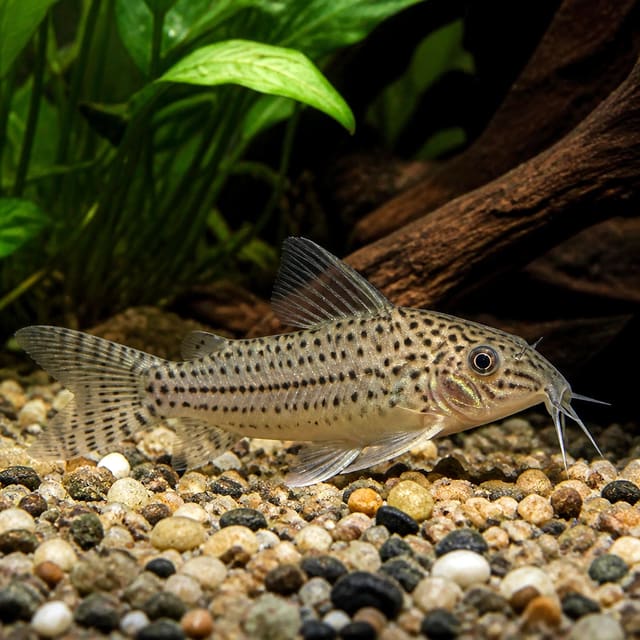
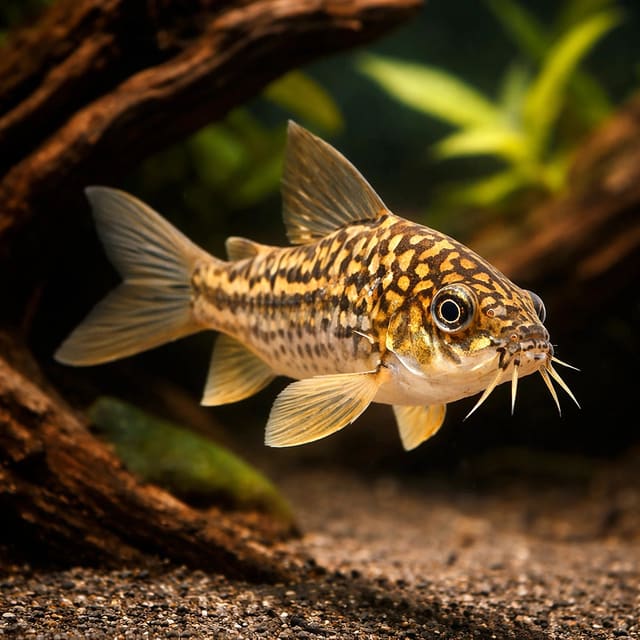
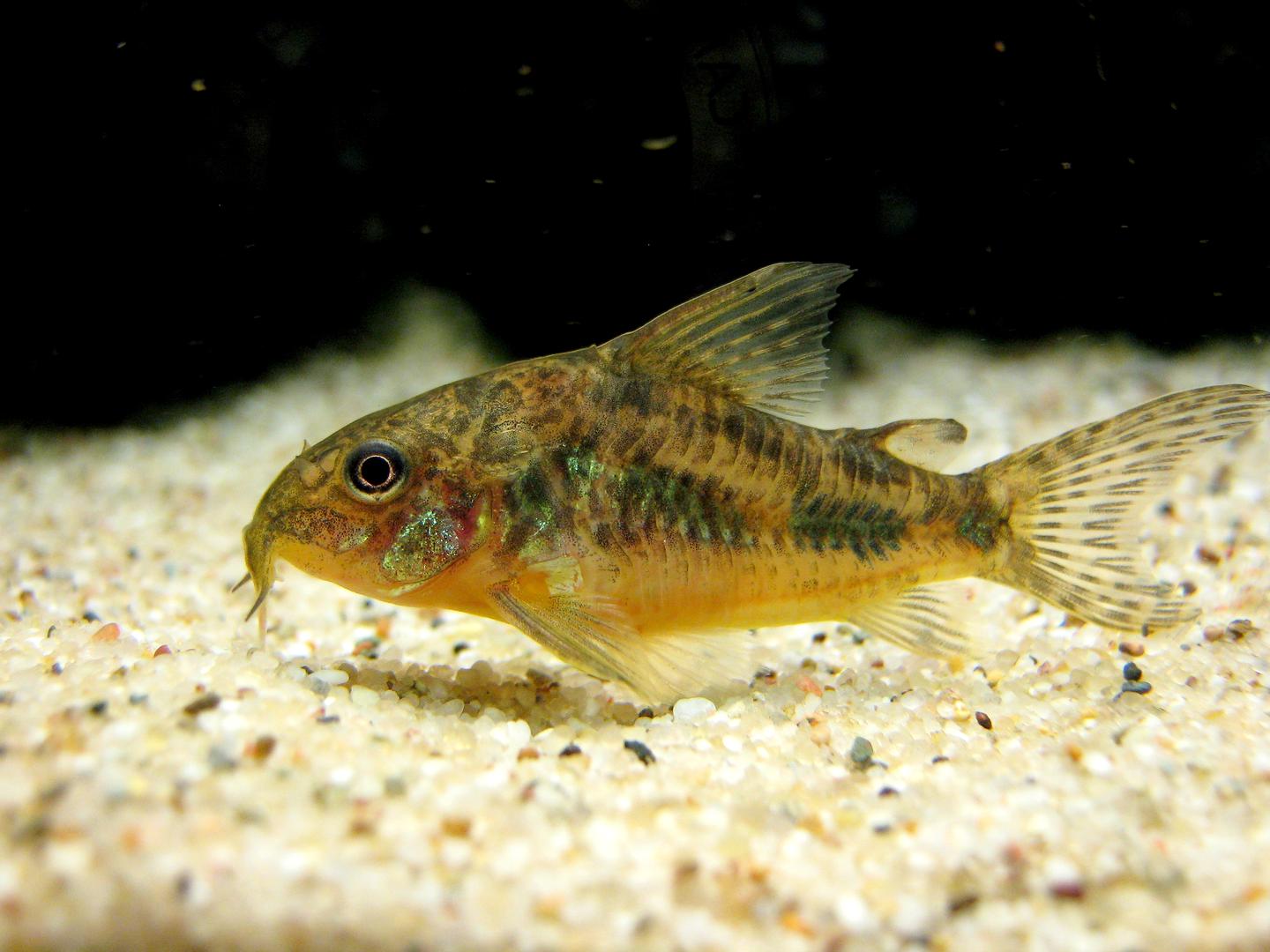
The Green Gold Cory is named well. The body has a green, bronze and gold cast rather than a flat grey colour. The fins can show a yellow to orange glow, particularly in settled adults and breeding-condition fish. The shape is more stretched than some chunkier Corydoras types, with the armoured plates, rounded underside and downturned mouth typical of the group.
Females usually become broader and deeper as they mature. Males are often slimmer and may look more agile during spawning activity. These differences are easiest to see from above in a mature group, not in young fish just after arrival. Do not expect obvious bristles or dramatic external sexing markers; those belong to different catfish groups.
Colour can change with stress. A newly arrived fish may look paler than it will after a week in a settled tank. Provide shade, keep a group, dim the lights for the first day if needed, and avoid chasing the fish around the aquarium. Once settled, they usually regain the warmer green-gold sheen that makes the species so attractive.
Breeding Green Gold Corys is possible but should be treated as a moderate project rather than an accident-proof beginner task. FishBase notes captive spawning with eggs attached to broad plant leaves and hatching after about five days, with large spawning events possible. Specialist hobby accounts describe classic Corydoras-style conditioning: feed the group well, keep the water clean, and use cooler water changes or weather changes as triggers.
If you want to raise fry, use a mature breeding setup or remove eggs carefully to a safe hatching container. Adult corys do not provide parental care in the way some cichlids do, and eggs or fry can be eaten in a community tank. Fine fry foods, clean water and stable temperature matter more than speed. Even if breeding is not your aim, a well-conditioned group may still show courtship behaviour, which is one of the pleasures of keeping corys properly.
Do not buy just a pair and expect reliable results. A group gives better social behaviour and better breeding odds. Feed a varied diet, include frozen/live foods and keep the substrate clean. Spawning attempts are usually a sign that the fish are comfortable, but fry-raising is a separate level of care.
Most Green Gold Cory health problems are prevented by the same basics: mature filtration, clean sand, sensible feeding, stable water and a proper group. Watch the barbels. Shortened, red or missing barbels can point to abrasive substrate, dirty bottom conditions or bacterial irritation. Watch the belly too. A healthy cory should not look pinched or hollow after settling.
During acclimation, keep lights lower and avoid adding the fish to an immature tank. Match temperature carefully, then release them into a calm area with cover. They may hide at first. That is normal. Offer food only once they have had time to settle, and remove any leftovers. In the first week, look for steady breathing, normal group movement and interest in sinking foods.
Because corys live on the bottom, medications and salt should be used carefully and only when appropriate. Many problems are better solved by water testing, substrate cleaning and improved oxygenation before reaching for treatment. If disease is suspected, identify symptoms clearly rather than treating blindly.
| Sign to watch | Possible cause | First check |
|---|---|---|
| Worn barbels | Sharp/dirty substrate or bacterial irritation | Sand condition, ammonia, nitrite and nitrate |
| Hiding constantly | Small group, bright light or bullying | Group size, cover and tank mates |
| Repeated gasping | Low oxygen or water-quality stress | Surface movement, temperature and test results |
| Thin body | Not enough food reaching bottom | Feeding method and competition |
| Pale colour after arrival | Transport or acclimation stress | Give shade, stable water and quiet time |
The current product is a multi-size listing. SKU 8203 represents the smaller 2.5-3 cm size, while sibling variants 8207 and 8205 cover larger sizes when available. Smaller fish are often easier to build into a young community, but they need gentle tank mates and careful feeding. Larger fish can look more settled sooner, but the same group-size rule applies. Buy for the group, not just for one individual.
If your tank already contains other corys, think about whether you are strengthening the existing group or starting a new species group. Green Gold Corys look best in numbers, and a single fish added to a mixed bottom community will not show the same confidence. For a first cory group, start with six or more Green Gold Corys in a mature sand-bottom tank.
Before ordering, check your tank is cycled, the substrate is suitable and tank mates are peaceful. If the aquarium is new, wait until ammonia and nitrite have been stable at zero. Corys are hardy when kept correctly, but they should not be used to test a new filter. A settled aquarium gives them the best start and gives you the best view of their colour and behaviour.
The Green Gold Cory is a subtle fish rather than a loud colour morph, so the photographs are important. A settled fish should show a metallic olive, bronze or green-gold side tone, with yellowish fins and the armoured cory body shape. In a shop photograph or a newly arrived group, the colour may look softer because transport, bright light and a pale background can wash the fish out. Once the group has shade, sand and clean water, the warmer gold tones normally become easier to see.
Look at the mouth and barbels first when assessing condition. Healthy barbels should be visible and even, not worn down to stubs. The belly should look gently rounded after feeding, not hollow. The dorsal line should be smooth, the eyes clear and the fish should rest upright on the substrate. Corys sometimes sit still between feeding bursts, so stillness by itself is not a problem. Stillness combined with clamped fins, rapid breathing or refusal to join the group is different and should prompt a water-quality check.
The images can still help customers picture the fish in planted and driftwood layouts, but the source photo is the most important trust signal.
When the fish arrives, prepare the aquarium before opening the bag. Lights should be low, the tank should be mature, and the feeding area should be calm. Float or temperature-match carefully, then acclimate without rushing. Corys can be sensitive to poor water in shipping bags, so the goal is a smooth transfer into clean, stable aquarium water rather than a long stressful process. Once released, give the group time to settle before feeding heavily.
The first week is about observation. Check that the group stays upright, breathes steadily and begins to explore the substrate. Offer a very small sinking feed after the fish have had time to settle, then remove any uneaten food. If other fish rush the bottom, feed in two or three spots so the corys are not pushed away. Do not judge colour on day one. Pale colour, hiding and cautious movement can be normal after transport. Stronger colour and more confident shoaling usually come after the tank feels safe.
Quarantine is always the careful option when you have an established display aquarium. A simple bare quarantine tank with a mature sponge filter, a sand tray or smooth-bottom feeding area, and a few hides gives you time to watch the group without competition. If you add directly to a display, make sure there are no aggressive bottom fish waiting to claim the same feeding area.
Choose Green Gold Corys when you want a peaceful group fish with colour, movement and a manageable adult size. They are less bulky than many plecos, less territorial than many bottom cichlids and more social than many solitary catfish. They also suit planted aquariums because they do not dig in the destructive sense; they sift the top layer of sand rather than uprooting established plants. Delicate foreground plants may still need protection while rooting, but normal hardy plants are usually fine.
Compared with a Bronze Cory, the Green Gold Cory has a more distinctive elongated profile and a warmer metallic sheen. Compared with smaller pygmy-style corys, it is more visible and better able to hold its own in a standard community tank. Compared with larger catfish, it is easier to feed in a group and easier to house without overloading the bottom level. This makes it a strong choice for aquarists who want one well-planned cory shoal rather than a random mix of bottom fish.
The species is also a good teaching fish for newer keepers because its behaviour tells you a lot about the aquarium. Active browsing, relaxed resting and group movement suggest the bottom zone is comfortable. Hiding, barbel wear or poor feeding often tell you the substrate, tank mates or maintenance routine needs attention. In that sense, Green Gold Corys are not just decorative; they help you read the health of the lower level of the tank.
| Question | Good answer before buying | Why it matters |
|---|---|---|
| Is the tank cycled? | Ammonia and nitrite have stayed at 0 ppm | Corys sit where poor water and waste show quickly |
| Is the substrate safe? | Smooth sand or very smooth fine gravel | Protects barbels and supports natural feeding |
| Can I buy a group? | 6 or more fish, or a plan to build the shoal | Singles are shy and do not show normal behaviour |
| Are tank mates calm? | No aggressive bottom fish or large predators | Green Gold Corys need peaceful feeding space |
| Will food reach them? | Sinking foods and calm feeding spots are ready | They cannot thrive on leftovers alone |
If any answer is not ready yet, fix the setup before adding the fish. That is better for welfare and usually cheaper than solving problems later. A proper group of Green Gold Corys in a prepared tank is easy to enjoy. A single cory on sharp gravel in a new aquarium is where avoidable trouble begins.
Green Gold Corys are peaceful Colombian cory catfish for mature tropical aquariums with smooth sand, gentle cover and a proper shoal. They are attractive, social bottom foragers with a bronze-green body and yellow-gold fin tones. Keep them in groups of 6 or more, feed sinking foods, maintain clean water and choose calm tank mates. They are useful community bottom dwellers, but they are not a dedicated algae-control species.
Yes. In the aquarium trade the fish is widely known as Corydoras melanotaenia. Current taxonomic references may place it in Osteogaster, so both names are useful. This page keeps the trade name for clarity while explaining the accepted-name context.
Keep at least 6. A larger group is better if the tank footprint allows. They are shoaling fish, and a proper group makes them more confident, more active and less stressed.
They may pick at soft biofilm while foraging, but they are not specialist algae removers. Feed them sinking pellets, wafers and small frozen/live foods. Buy them for peaceful bottom activity and group behaviour, not as an algae-control tool.
Smooth fine sand is best. It protects the barbels and allows natural sifting. Avoid sharp gravel and dirty pockets of trapped waste.
They can usually live with adult shrimp in a planted tank with cover. Very small shrimplets may still be vulnerable in any fish community, so breeding shrimp colonies need dense moss and hiding places.
They are suitable for careful beginners with a mature tank. The tank must be cycled, the substrate should be sand, and they should be bought as a group rather than as a single fish.
A 60 litre tank is a practical minimum for a small group, provided the footprint is useful and the tank is mature. A larger aquarium is better for bigger shoals and community setups.
Use sinking cory pellets or small wafers as a staple, then add frozen bloodworm, daphnia, brine shrimp or similar foods several times a week. Make sure the food reaches the bottom.
They may spawn in good conditions, but eggs and fry are unlikely to survive well in a busy community. Use a dedicated plan if you want to raise fry.
Because it was not accurate enough. Green Gold Corys are social bottom foragers. Natural copy that explains the real fish is better than forcing unrelated algae-eater phrases into the listing.
This listing was checked against FishBase for Osteogaster melanotaenia, ScotCat species and breeding notes, Seriously Fish species guidance, Maidenhead Aquatics Green Gold Cory care notes and our stock records for current trade sizing and source media. The care advice above is written for practical home-aquarium use and keeps the older Corydoras melanotaenia name because that is still the wording most aquarists and supplier systems recognise.
No reviews for this item yet. Bought one? Honest reviews only, good or bad.
What customers say about ordering from us
I have a small group of long finned mountain minnows. So was delighted to be able to order ten of this variety to increase the genetics in my tank . The ones I recieved are healthy but it’s to early to give a verdict on wether they are of a long finned type since they are small currently.
Gordon Walker · 23 Sept 2026
100% success travel and "installation". Pleased with quality of purchase. The Siamese fighter a bit "shy" so have not yet seen him at his best yet but looking good. Happy customer. GG
George E Garratt · 21 Sept 2026
Reviews of our shop, collected by Judge.me, an independent third-party review collector. Newest first.