Moderate
Pantanal Cory C005 (Brochis pantanalensis)
23–26°C · pH 6.5–7.2
£28.29
Corydoras CW101, the V Cory, is an undescribed, deeper-bodied corydoras from the Rio Tapajós drainage in Brazil, discovered in 2014 and now listed as Brochis sp. (CW101). It grows to about 6–6.5 cm and needs a group of at least five on soft sand at 22–26°C and pH 6.5–7.2. One live fish per purchase.
Adult size is the maximum length this species reaches at full maturity (scientific sources). The livestock you receive will be younger and smaller. Product-photo provenance and any image-specific limitations are stated on the listing.
Brochis sp. (CW101)
Quantity discounts are pricing offers, not a group-size recommendation. Check the full care guidance and your existing animals before choosing a quantity.
Corydoras CW101, the V Cory, is an undescribed, deeper-bodied corydoras from the Rio Tapajós drainage in Brazil, discovered in 2014 and now listed as Brochis sp. (CW101). It grows to about 6–6.5 cm and needs a group of at least five on soft sand at 22–26°C and pH 6.5–7.2. One live fish per purchase.
Adult size is the maximum length this species reaches at full maturity (scientific sources). The livestock you receive will be younger and smaller. Product-photo provenance and any image-specific limitations are stated on the listing.
Identify the exact cory catfish before choosing care. Our starting policy for many common medium species is six compatible conspecifics, a mature 60 x 30 cm aquarium of about 60 litres, smooth fine sand and measured species-appropriate water.
Read the full care guidance when planning conditions for your aquarium.
Corydoras CW101 is an undescribed armoured catfish from the Rio Tapajós drainage in Brazil, sold in the hobby as the V Cory. ScotCat records that it was discovered in 2014, found in the Tapajós alongside the cory then known as CW083, which has since been described as Corydoras caramater. The "CW" code is a Corydoras World number, used for distinct corys that science has not yet named. Planet Catfish describes CW101 as a peaceful, shoaling community fish.
It is a sturdier fish than the small spotted corys. ScotCat places it in lineage 8, the "intermediate long-snouts" with deeper bodies. When Dias and colleagues published their 2024 reclassification of the corydoradine catfishes, that group was moved into the revived genus Brochis, so the current label is Brochis sp. (CW101). Many import lists and older websites still use Corydoras sp. CW101, which is why we keep "Corydoras CW101" at the front of the title.
| Name | Where you will meet it | What it means |
|---|---|---|
| Corydoras CW101 | Shop labels and import lists | The Corydoras World number |
| V Cory | Common name on Planet Catfish | The trade name |
| Brochis sp. (CW101) | ScotCat and Planet Catfish today | The current genus after the 2024 reclassification |
| Corydoras sp. CW101 | Older sources | The pre-2024 label |
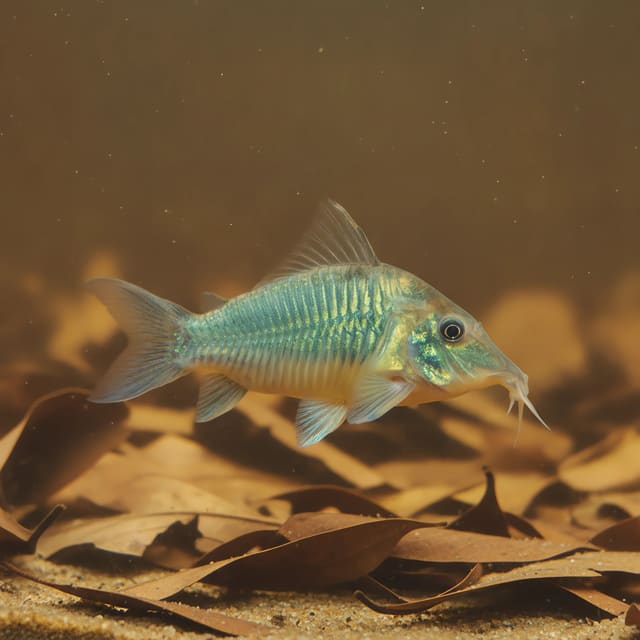
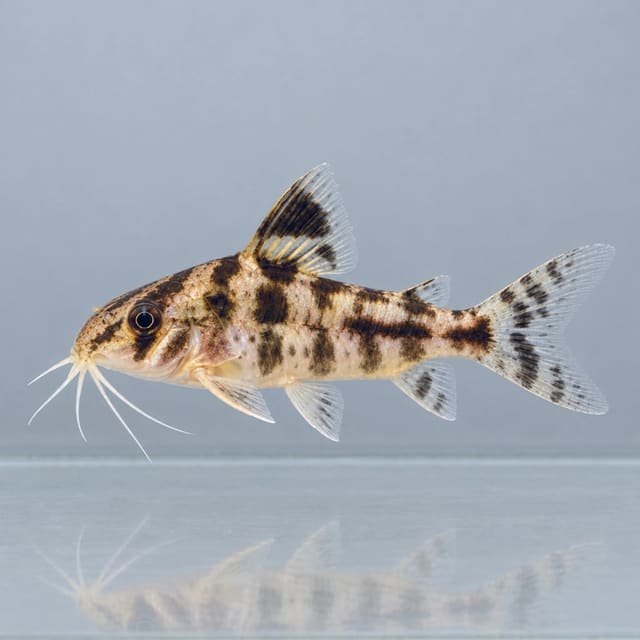
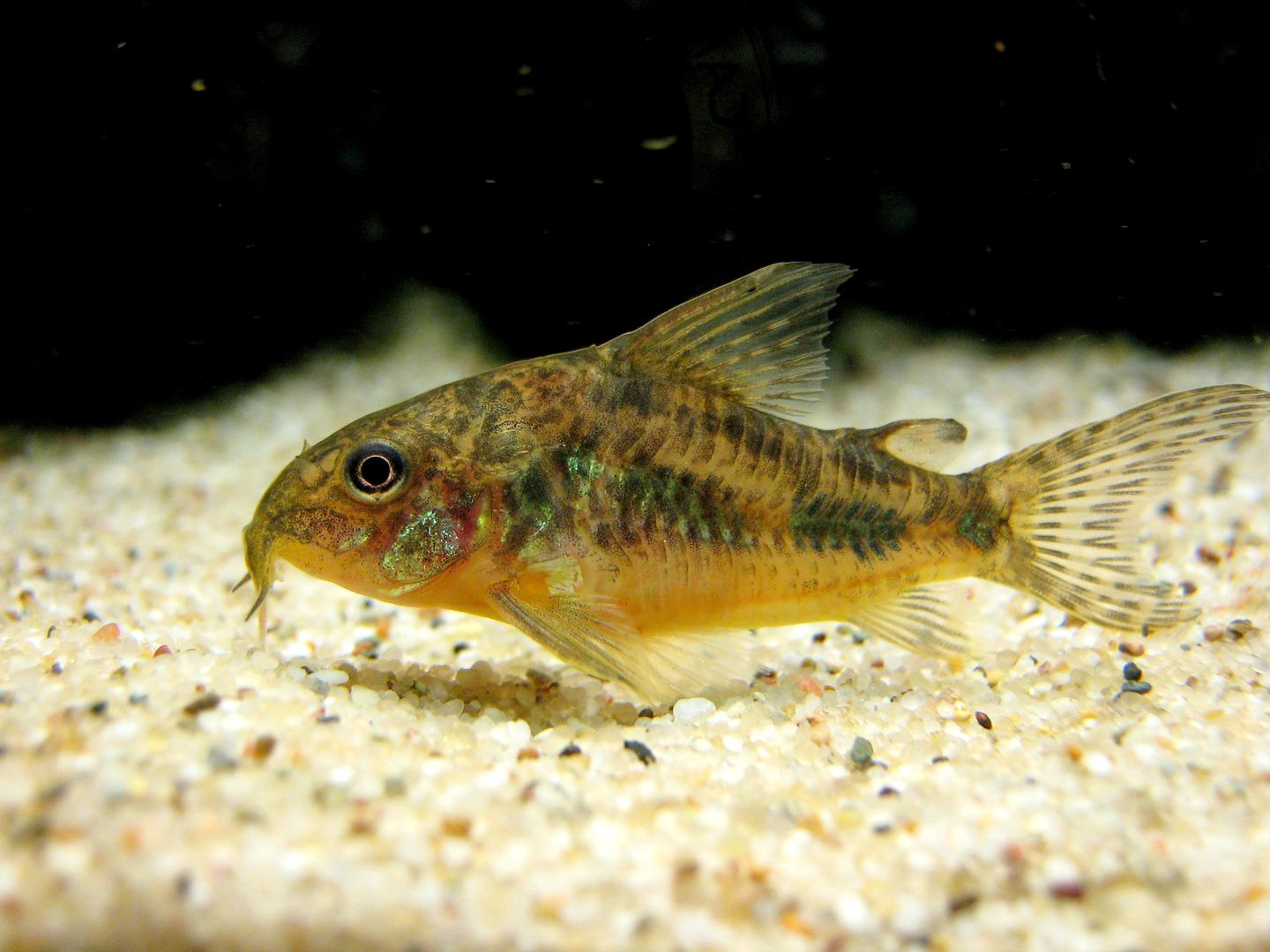
In the photographs on ScotCat's factsheet, CW101 is a deep-bodied cory with olive-grey to bronze flanks finely lined with dark speckles, a dark mask running through the eye, a metallic green sheen on the gill cover and a bright golden band curving down behind the head. The fins are clear. Colour shifts with lighting and mood, and some fish show a warmer, orange-bronze tone.
CW101 shares its streams with fish that look very similar. Tencatt and colleagues, describing Corydoras caramater in Neotropical Ichthyology in 2024, watched it shoaling in a Tapajós stream with CW101 and CW102, all sharing a similar colour pattern. They separate C. caramater from CW101 because CW101 has backward-pointing, blade-like serrations along the rear edge of its dorsal-fin spine. The table below compares CW101 with CW102, the look-alike you are most likely to see on the same import list.
| Feature | CW101 (V Cory) | CW102 (Gold Bow Cory) |
|---|---|---|
| Current genus | Brochis | Hoplisoma |
| Group (ScotCat) | Lineage 8, intermediate long-snouts with deeper bodies | Lineage 9, short-snouted corys |
| Adult size (ScotCat) | 6.0 cm male, 6.5 cm female | 3.5 cm male, 4.0 cm female |
| pH (ScotCat) | 6.5–7.2 | 6.0–7.2 |
| In the stream studied by Tencatt and colleagues | Less abundant | The most abundant of the three look-alikes |
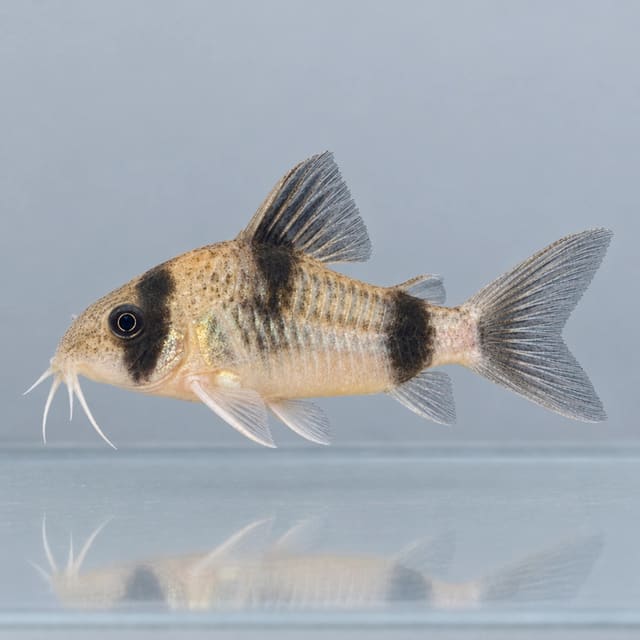
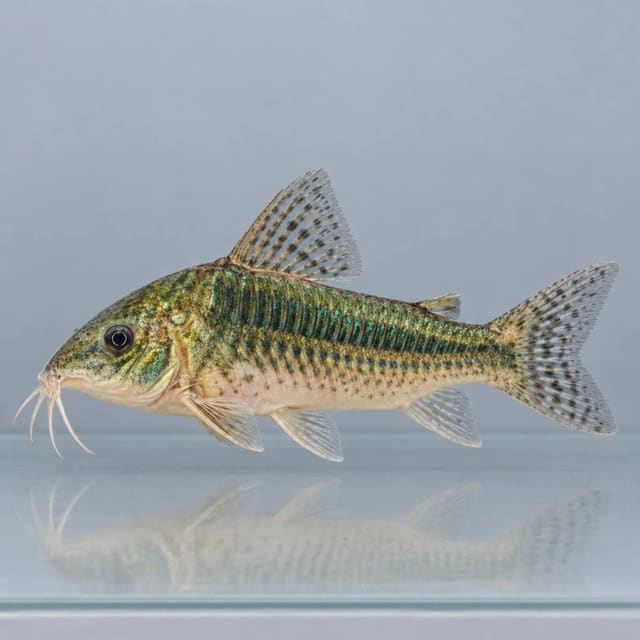
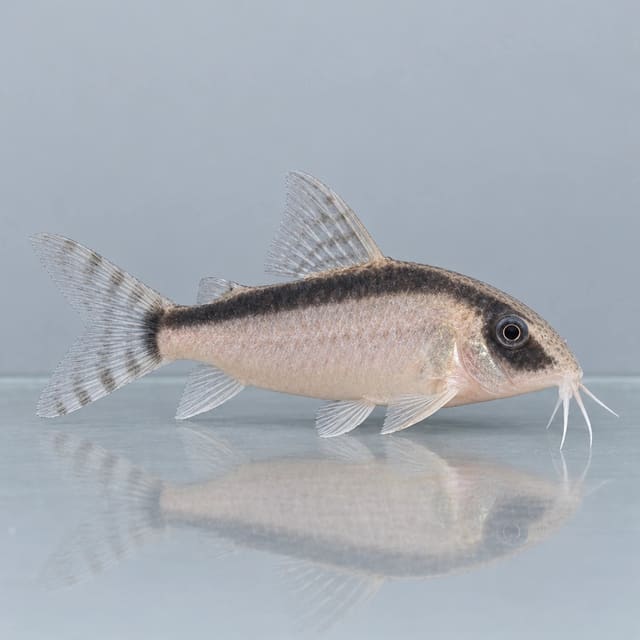
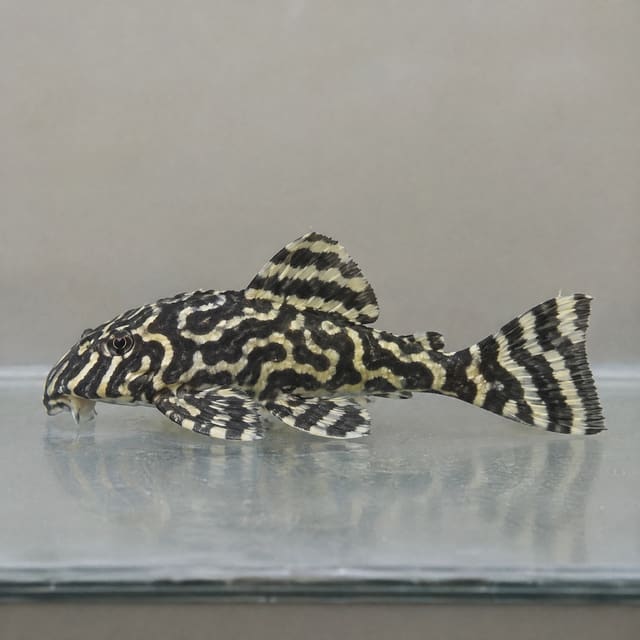
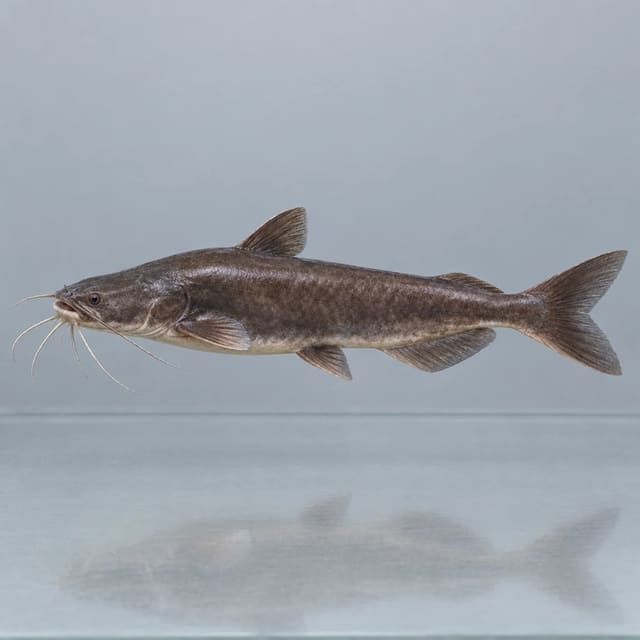
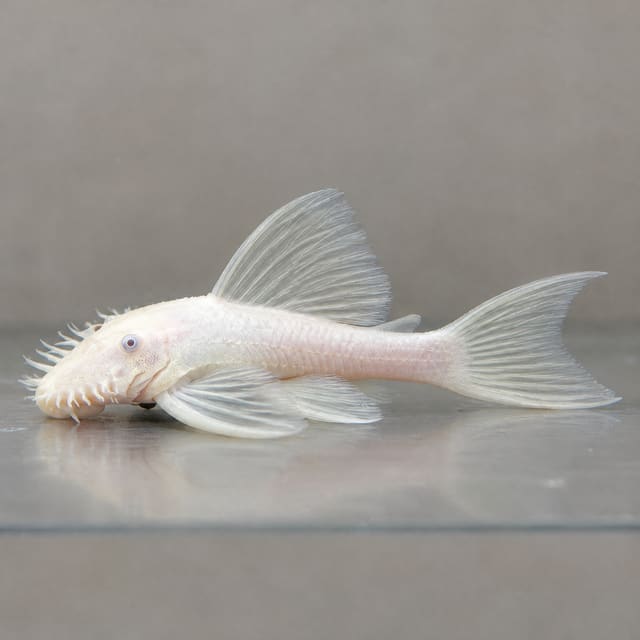
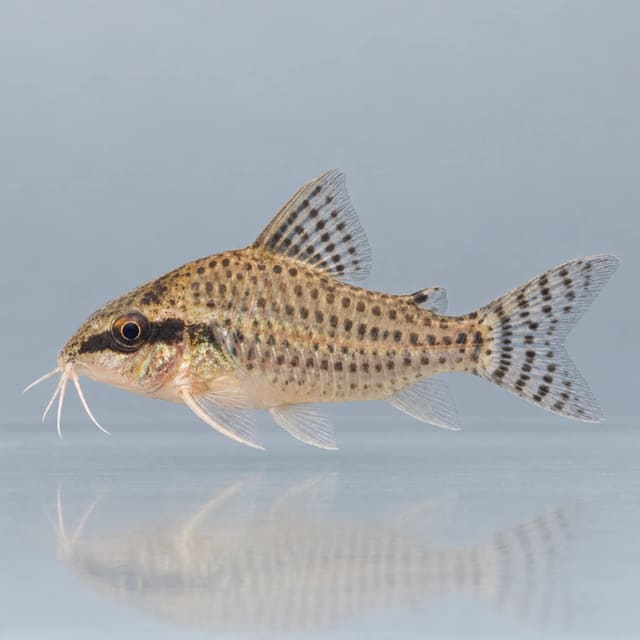
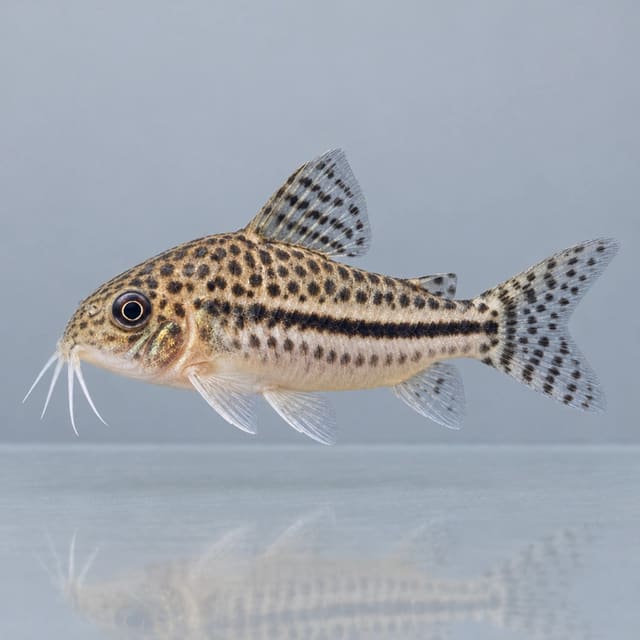
Each purchase supplies one live Corydoras CW101 in the standard size we receive, sex not chosen. Planet Catfish explains that adult females grow larger and more full-bodied, best judged from above, while males develop more pointed fin tips as they mature. The gallery images are representative, prepared from a reference photograph; they do not show the fish you will receive, and individual markings vary.
| Plan | Group | Reason |
|---|---|---|
| Smallest sensible group | 5 fish | OATA's minimum for corydoras; smaller groups are often stressed |
| Community shoal | A larger group where the floor allows | Planet Catfish describes it as shoaling, and wild fish live in mixed shoals |
| Breeding attempt | A group in a species tank | ScotCat's suggestion for breeding |
Because this is a scarce, undescribed fish, it is best to buy the whole group at once rather than adding one or two at a time later, when matching fish may not be available.
With adults of 6.0–6.5 cm, CW101 is close to twice the length of the smallest corys, and a group of deep-bodied fish needs real floor space. OATA sets at least 80 litres as the starting point for a shoal of small catfish such as corydoras; treat that as the absolute minimum here. As a yardstick for a similar fish, Seriously Fish suggests a base of 75 × 30 cm for the related and slightly larger Brochis pantanalensis. Length and depth of the floor matter more than height, because the shoal works the sand together.
Tencatt and colleagues describe the stream where CW101 shoals as shallow, mostly up to about 30 cm deep and one to three metres wide, with slow to moderate current, a floor of fine sand and gravel, areas of leaf litter, submerged branches and logs, and aquatic plants. That is an easy picture to copy in an aquarium. Planet Catfish advises a sand substrate, with rounded gravel as an imperfect alternative, and warns against rough-edged, chipped gravel because it damages the barbels when the fish dig. Edge the sand with driftwood and plants, leave an open area for feeding and swimming, and add shade from arching wood, tall plants or floating plants.
| Substrate | Verdict | Reason |
|---|---|---|
| Fine, smooth sand | Best choice | Lets the fish sift food naturally, as Planet Catfish and OATA advise |
| Small, rounded gravel | Acceptable | An imperfect alternative; harder for the fish to sift |
| Sharp or chipped gravel | Avoid | Wears and damages the barbels |
| Leaf litter over sand | Good in moderation | Adds cover like the wild streams; remove leaves as they break down |
ScotCat gives 22–26°C and a pH of 6.5–7.2 for CW101. That pH band is fairly narrow, so stability matters more than hitting an exact number. No hardness value is published for this fish; OATA's general guide for catfish covers soft to hard water at 4–18°dH, and the softer part of that range is the safer choice for a Tapajós cory.
| Value | Target | Source |
|---|---|---|
| Temperature | 22–26°C | ScotCat (CW101) |
| pH | 6.5–7.2 | ScotCat (CW101) |
| General hardness | Not published for CW101; keep within 4–18°dH, towards the softer end | OATA catfish guide |
| Ammonia and nitrite | Zero | OATA |
| Nitrate | No more than 20 mg per litre above tap water | OATA |
Tap water across the UK ranges from soft to hard and alkaline depending on where you live, and many supplies sit above pH 7.2. Test your tap water before the fish arrive and decide in advance how you will hold the pH inside the 6.5–7.2 band, for example by blending tap water with purified water and testing every change. Our guide to aquarium pH explains the options, and the water matcher tool compares your readings with the fish you plan to keep.
Temperature, pH and hardness are the habitat values to hold steady. Ammonia, nitrite and nitrate are waste readings that must stay at or near zero. A mature filter, built up through the nitrogen cycle, is what keeps the waste readings down; our nitrogen cycle guide explains how it works and why a new tank needs time.
A filter is essential in every aquarium, as OATA says. For CW101, aim for clean, well-oxygenated water with a gentle to moderate flow across the floor, like the slow to moderate current of its home streams. Make sure the filter intake cannot pull sand or small fish against it, and position the outflow so that waste is carried towards the intake rather than settling in a corner of the sand.
Planet Catfish says CW101 readily accepts all prepared foods that reach the bottom, such as tablets, granules and larger flakes, and that live or frozen bloodworm, white worm, grindal worm, Daphnia and Tubifex are readily accepted and help condition a group for spawning. ScotCat recommends a good flake and tablet base with occasional frozen or live food. OATA describes corydoras as omnivores and says catfish should be given proper sinking foods, not left to live on scraps.
Add fish only to a mature aquarium where ammonia and nitrite read zero. OATA advises that catfish travel double-bagged because their spines can pierce bags, and describes the floating bag method: lights off, float the sealed bag for about 10 minutes, add small amounts of tank water to the bag over up to 20 minutes, then release the fish with as little bag water as possible. Our acclimatisation guide shows the steps. Corys can catch their fin spines in a net, so guide them into a container instead of lifting them out in mesh.
| When | Check |
|---|---|
| Before arrival | 22–26°C, pH 6.5–7.2, ammonia and nitrite zero |
| Arrival day | Lights low; no food until the evening, then a very small sinking meal |
| Days two to four | Count the fish and confirm all are feeding |
| Day four or five | Retest ammonia and nitrite |
| Day seven | Full test and the first partial water change |
A settled group of V Corys forages together across the sand, rests in a loose huddle near wood or plants and grows bolder as it learns the feeding routine. OATA's catfish care sheet lists the warning signs to watch for: unusual swimming, colour turning darker or paler than normal, hiding more than usual, breathing faster or slower, white spots or fluffy growths, fin or scale loss, and changes in weight or appetite.
| If you see | Do this |
|---|---|
| The group sifting the sand together | Normal behaviour; keep the routine |
| Barbels shortening or reddening | Clean the sand, test the water and check for sharp grains |
| Fish crowding in a corner or breathing fast | Test ammonia, nitrite and temperature at once |
| One fish thin while others are rounded | Feed at a fixed spot and check tank mates are not taking the food |
| White spots, fluffy growths or ragged fins | Test the water and get fish-health advice before treating |
ScotCat describes CW101 as very peaceful and best kept with small to medium tank mates such as tetras, rasboras and danios, or in a species tank. Choose fish that live in the middle and upper water, share 22–26°C and a pH around neutral or slightly below, and will not compete hard for food on the sand.
| Suits | Avoid |
|---|---|
| Peaceful shoaling tetras | Large or boisterous fish |
| Rasboras and small danios | Territorial bottom-dwelling cichlids |
| Pencilfish and hatchetfish | Fast, greedy bottom feeders that take all the food |
| Other peaceful corys | Fish that need hard, alkaline water |
From our range, consider the Rummy Nose Tetra, the Green Neon Tetra or the Three-Lined Pencilfish above the corys, checking that their own water needs overlap. For other members of the same genus, see the Delphax Cory, the Reticulated Cory and the larger Emerald Catfish, or browse all our Brochis catfish. The full range is in our corydoras collection, the South American catfish category and our rare collector fish, and our guide to keeping corydoras covers the group as a whole. Check any combination with the tank mates checker, and see the delivery page for dispatch days.
Planet Catfish has no breeding report for CW101, so spawning it would be genuinely useful information. ScotCat recommends a species tank for breeding attempts, and Planet Catfish names live and frozen bloodworm, white worm, grindal worm, Daphnia and Tubifex as good conditioning foods. Begin with a well-fed group in which the larger, broader females can be told from the slimmer males, keep the water clean and steady, and note temperatures, water changes and feeding so that any success can be repeated.
It is an undescribed corydoras from the Rio Tapajós drainage in Brazil, sold as the V Cory. CW101 is its Corydoras World number. ScotCat records that it was discovered in 2014, and since the 2024 reclassification it is listed as Brochis sp. (CW101).
ScotCat gives about 6.0 cm for males and 6.5 cm for females. It belongs to the deeper-bodied, intermediate long-snouted group of corys, so it looks sturdier than the small spotted species.
No. The two live together in the same Tapajós streams and look alike at a glance, but they are different fish. CW101 grows to about 6–6.5 cm and is now placed in Brochis; CW102 stays at about 3.5–4 cm and is placed in Hoplisoma.
At least five, as OATA advises for corydoras, and more if your floor space allows. Planet Catfish describes it as a peaceful, shoaling fish, and a group is more confident and active.
ScotCat gives 22–26°C and pH 6.5–7.2. No hardness figure is published for this fish, so stay within the softer part of OATA's general catfish band and keep conditions steady. Ammonia and nitrite must read zero.
Sinking tablets, granules and larger flakes, plus live or frozen bloodworm, white worm, grindal worm, Daphnia and Tubifex. Planet Catfish lists all of these as readily accepted.
Peaceful tetras, rasboras and danios, as ScotCat suggests, and other calm bottom dwellers. Avoid large, boisterous or territorial fish.
Planet Catfish holds no breeding report for CW101, so any spawning would add to what is known. ScotCat suggests a species tank for breeding attempts.
No reviews for this item yet. Bought one? Honest reviews only, good or bad.
What customers say about ordering from us
Easy website plenty of info on fish your buying great to pick a time slot
TRACEY DURRANT · 7 Oct 2026
Got some lovely fish thank you
Kevin Mackie · 7 Oct 2026
Reviews of our shop, collected by Judge.me, an independent third-party review collector. Newest first.
Moved by UK carriers licensed to handle live animals
Hand-packed with oxygen bags, poly box, heat pack
Email photos the same day; an optional unboxing video helps us review problems faster — claim terms apply
Klarna & PayPal Pay in 3 at checkout