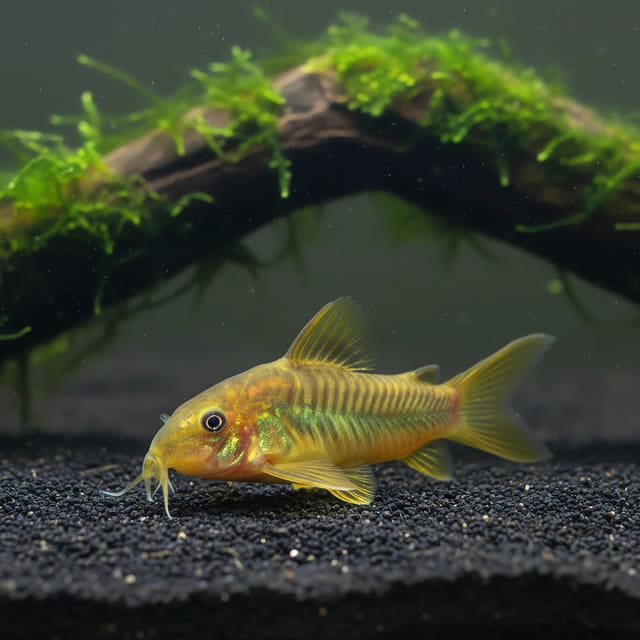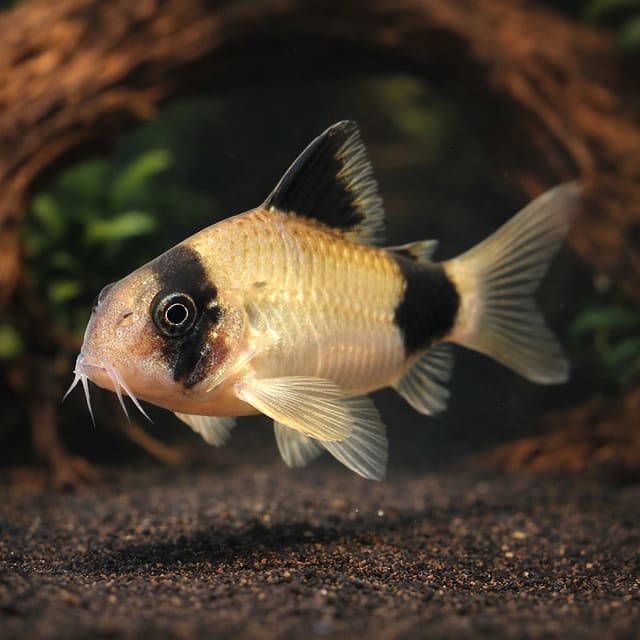
Panda Cory Catfish (Corydoras panda)
22–25°C · pH 6–7.4
From £8.69Some sizes on sale

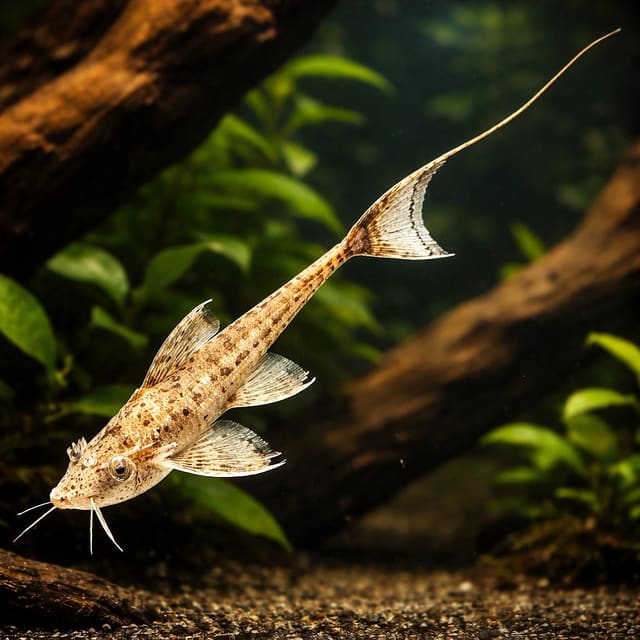
Farlowella acus is a South American whiptail catfish recorded at 16 cm standard length. It suits a mature, well-filtered freshwater aquarium at least 80 cm long, kept in a group of five or more at 24–26°C, pH 6.0–7.0 and 3–8 dGH. One purchase supplies one unsexed fish in the selected 6–20 cm dispatch size.
Adult size is the maximum length this species reaches at full maturity (scientific sources). The livestock you receive will be younger and smaller — pick a size above for the actual shipping size. Product-photo provenance and any image-specific limitations are stated on the listing.
Farlowella acus
Farlowella acus is a South American whiptail catfish recorded at 16 cm standard length. It suits a mature, well-filtered freshwater aquarium at least 80 cm long, kept in a group of five or more at 24–26°C, pH 6.0–7.0 and 3–8 dGH. One purchase supplies one unsexed fish in the selected 6–20 cm dispatch size.
Adult size is the maximum length this species reaches at full maturity (scientific sources). The livestock you receive will be younger and smaller — pick a size above for the actual shipping size. Product-photo provenance and any image-specific limitations are stated on the listing.
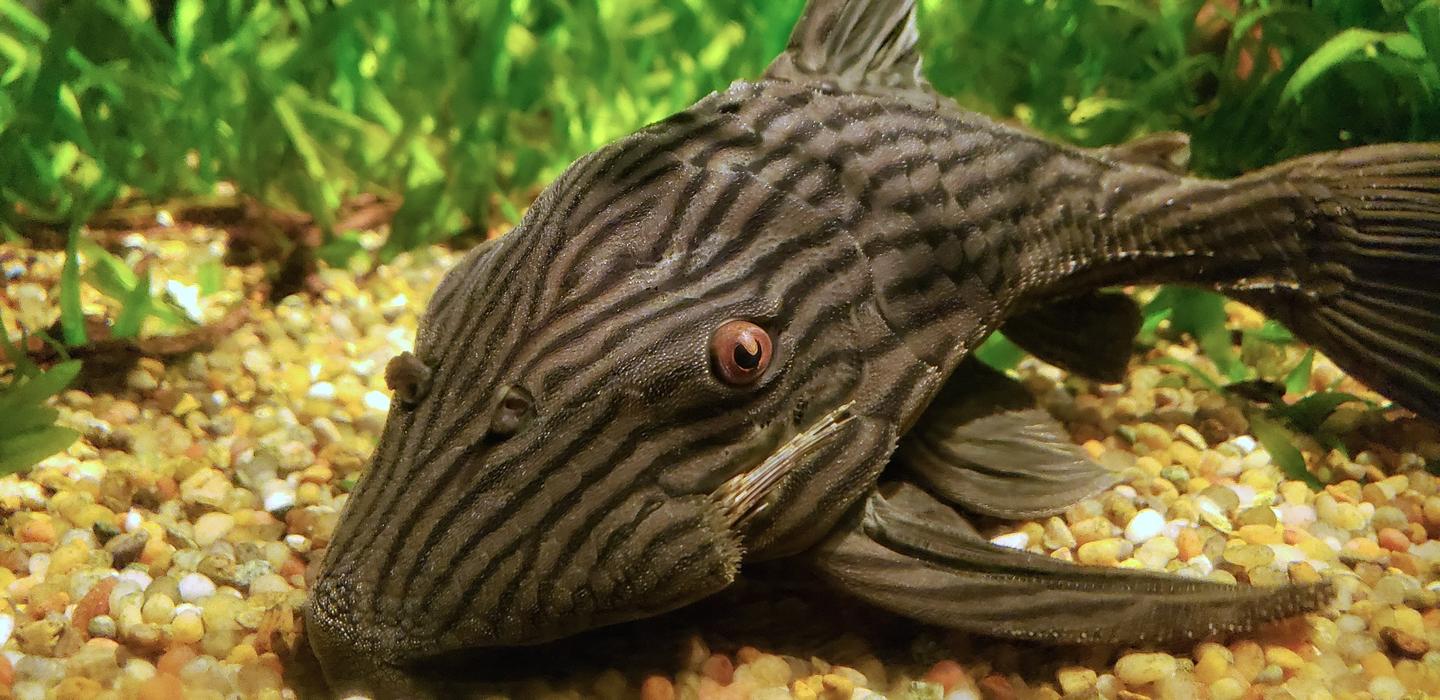
‘Pleco’ is a loose aquarium-trade label, not one species or one care sheet. Before buying, confirm the scientific name or defensible L-number, adult size and measurement method, required footprint, temperature and water, diet, social plan and source. No universal pleco tank size, menu or algae result is honest.
Maintain these water conditions for optimal health and vibrant colors
Farlowella acus is a South American whiptail or twig catfish in the Loricariidae family. Its long narrow profile and suckermouth-catfish ancestry make it an unusual presence, but the buying decision should start with the verified adult plan rather than an image or an algae-eater label. FishBase records it from the Lake Valencia and Torito River basins, with a maximum length of 16 cm standard length, a minimum aquarium length of 80 cm and aquarium groups of five or more.
One purchase supplies one live fish in the selected size. The shop carries 6–7 cm, 7–10 cm, 10–13 cm, 13–17 cm and 17–20 cm dispatch choices. The size you select is the size supplied, not the adult size. These trade labels describe the fish supplied and do not redefine the scientific maximum, which is reported as standard length. The larger dispatch labels may use a different measuring basis; they must not be turned into a new adult-length claim.
Sex is guaranteed only when the selected option explicitly states male or female. This Farlowella acus listing has no sex-guaranteed option. Choose on the basis of species, size and suitability rather than expecting a male, female or pair. One fish per purchase also means that a buyer planning the FishBase group of at least five must select the total quantity deliberately.
| Suits | Pause before buying if |
|---|---|
| A mature freshwater aquarium at least 80 cm long | The tank is shorter, newly set up or biologically unstable |
| A planned group of five or more Farlowella acus | You intend to keep a single fish without a species-based reason |
| Stable 24–26°C water at pH 6.0–7.0 and 3–8 dGH | Your source water sits far outside those values or changes abruptly |
| A keeper prepared to provide appropriate sinking food and monitor every fish | You expect the catfish to live on scraps or solve an algae problem |
The FishBase species account places F. acus in Loricariidae, the armoured catfishes, and records it as a freshwater demersal fish from the Lake Valencia and Torito River basins in South America. The whiptail catfish summary also identifies it as a South American freshwater loricariid and the type species of Farlowella. Whiptail catfish and twig catfish are established common names for the species.
FishBase describes facultative air breathing at genus level and notes aquarium feeding on plants and roots. The first point is natural-history context, not permission to tolerate poor oxygen. The second means this fish needs a deliberate feeding plan; it should not be bought as a self-sufficient cleaner. OATA's broader catfish guidance likewise warns that catfish have varied diets and need appropriate sinking food rather than whatever reaches the bottom by accident.
The 6–20 cm dispatch span is useful when matching the fish to an established group, but every choice belongs to the same species plan. Prepare an aquarium at least 80 cm long and house five or more. Match food size and handling to the fish received while keeping the long-term water and group requirements constant. Never assume that a larger dispatch fish is mature, sexed or able to cope with inappropriate water simply because it looks robust.
The smallest size still needs access to food within a group. The largest size still needs careful transfer and observation. When mixing dispatch sizes, watch whether every fish can rest and feed without persistent displacement. Beyond the group minimum, use the observable welfare of each fish to decide whether the layout and food distribution are working.
Browse the catfish and pleco collection if you are comparing alternatives, but do not treat another bottom-dweller as an automatic companion. Different catfish can have incompatible water, adult size, diet and social needs.
This species suits a keeper who already knows the aquarium's measured temperature, pH, hardness and usable length, and who can prepare for a complete group. It is a poor impulse choice for a new aquarium, an unknown water supply or a tank chosen only by its nominal volume. Confirm the real conditions first, including the room left after furniture and equipment are fitted.
The group and feeding requirements belong together. Five fish in suitable water still need five observable routes to food over time; a tidy-looking tank is not enough if one individual consistently loses condition. Plan how sinking food will be distributed, how every fish will be counted and how water tests will be recorded. That preparation is more useful than choosing by a cleaner-fish nickname or assuming that a long dispatch specimen needs less support.
Gallery images have been digitally enhanced to improve image quality. Natural colour, pattern, size and maturity can vary between live animals.
FishBase gives a minimum aquarium size of 80 cm in length for Farlowella acus. Length is the verified measure; converting it into a universal litre number would add false precision because width, height and shape vary. Choose a tank whose actual internal layout still leaves an 80 cm or longer usable footprint after filters, wood, plants and other structures are installed.
The same species account says to keep groups of five or more. Plan that group at adult scale rather than fitting five juveniles around temporary gaps. Long fish need routes that allow them to turn and move without rubbing against sharp edges, and every group member needs access to resting surfaces and food. Keep the layout open enough that all five or more animals can be counted and visually checked.
OATA's freshwater catfish care sheet says aquarium size varies widely across the group, with larger tanks generally offering more stable conditions. That broad advice reinforces the value of space but does not replace the 80 cm species figure or create a species-specific volume. Base the purchase on the known length requirement and the real adult group, then choose more room if other residents or décor reduce usable space.
FishBase records 24–26°C, pH 6.0–7.0 and 3–8 dGH for the species' environment. Work within that species-level range and favour consistency. A fish moved repeatedly through pH, hardness or temperature swings is not receiving stable care simply because each individual reading falls inside an endpoint.
Test the source water before ordering. The aquarium water-parameter guide explains pH, hardness, ammonia, nitrite and nitrate, while the water matcher helps compare measured water with the target values. Record the actual readings rather than relying on a regional average or a memory of the last test.
Ammonia and nitrite must remain at zero. OATA's broad catfish guidance says nitrate should not exceed 20 mg per litre above the incoming tap-water level. Treat that as group-level welfare context while using the narrower FishBase temperature, pH and hardness values for this species. If nitrate rises quickly, review feeding, stocking, filter performance and the water-change routine together.
Match replacement water closely enough to avoid abrupt change. Condition tap water before it enters the aquarium. Avoid rapid attempts to force pH with unmeasured additives; first understand the carbonate hardness and source-water behaviour. A stable result at a suitable point is better than repeated adjustment towards a theoretical midpoint.
The RSPCA aquarium-filter guidance explains that fish release toxic ammonia, a working biological filter converts it to nitrite and then to safer nitrate, and no fish should be kept without a properly established filter. A group of whiptail catfish should enter only after the filter is mature and water tests confirm that the system controls waste.
If the aquarium is new, follow the first tropical aquarium guide before selecting livestock. Maturity is more than waiting a fixed number of days. The system must show that beneficial bacteria are established, temperature is dependable and ammonia and nitrite remain at zero under an appropriate load.
Choose filtration that reaches the whole tank without leaving waste trapped in inaccessible corners. OATA says filters are essential and should be checked for blockages. Inspect the outlet and intake during every maintenance session. If media needs cleaning, rinse it lightly in removed aquarium water rather than under the tap, where chlorine or chloramine can damage beneficial bacteria.
Maintain surface movement and good gas exchange. The genus is described as facultatively air-breathing, but that does not make low dissolved oxygen acceptable. Repeated surface visits combined with fast breathing, loss of appetite or unusual posture should prompt immediate water tests and an equipment check.
FishBase's aquarium note mentions feeding on plants and roots. Provide substantial surfaces that can be reached and inspected, using smooth wood and robust planting where appropriate. Secure every piece so it cannot roll or trap a long-bodied fish. Avoid tight openings that suit a small dispatch fish but become unsafe as it grows.
The goal is not to copy an unevidenced habitat scene. It is to create an aquarium that supports the verified feeding note, keeps the group observable and makes maintenance possible. Leave enough open front or side viewing area to assess body condition. A long slender fish can lose condition without the change being obvious from above.
Do not sterilise every surface during one cleaning session. Remove harmful waste and keep water quality high while retaining a stable mature environment. Clean glass or selected furniture as needed, but make sure the fish still receives a complete appropriate diet rather than relying on natural films.
FishBase records aquarium feeding on plants and roots. OATA's broad catfish guidance adds that catfish have very different diets, should receive appropriate sinking food and should not be treated as scavengers. For F. acus, choose a quality sinking food with a plant-based profile and place it where the group can reach it. Fresh plant material may be offered when it is suitable for aquarium use and removed before it decays.
Feed what the fish can consume within a few minutes once a day under OATA's general catfish routine. The same sheet recognises that grazing species may need up to 30 minutes. Use those times as observation points rather than an excuse to leave food indefinitely. Remove persistent leftovers and adjust the next portion.
Watch each individual eat. In a group of five or more, one fish feeding well leaves the condition of the others unconfirmed. Spread sinking food across several reachable positions and check the body line from the side. If one fish repeatedly misses food, change placement or separate it safely for supported feeding rather than simply increasing the total ration and polluting the tank.
Natural algae is not a complete feeding guarantee, and this listing should not promise algae control. Aquarium algae can vary in type and nutritional value, and some surfaces remain inaccessible. The purchase makes sense because you want to keep Farlowella acus, not because you want a maintenance problem solved.
OATA strongly recommends a partial water change of 25% at least once every week for freshwater catfish. Use 25% as the stated partial change and carry it out at least once every week; a larger change is not automatically better. Test before maintenance when possible, so the reading reflects conditions the fish have experienced.
Begin by counting every group member and noting posture, breathing, fin condition and body shape. Watch how the fish respond to food before disturbing the aquarium. Then inspect filter flow, heater operation and surface movement. Siphon accessible waste, especially around feeding positions, while avoiding sudden large changes to the physical environment.
Prepare replacement water with conditioner and suitable temperature and chemistry. Refill without exposing fish to a strong jet. Once the system is running again, confirm that circulation has returned and recheck any suspicious value. Write results down; a simple log makes gradual nitrate or pH drift visible before it becomes a crisis.
OATA lists changes in swimming, colour, breathing, appearance, weight and feeding as reasons to investigate. Start with water testing and a review of recent maintenance, food and stocking changes. This guide does not supply a disease treatment or medication protocol. Persistent health problems need a diagnosis suited to the fish and the whole aquarium.
FishBase reports a maximum of 16 cm standard length. Standard length and a supplier's trade size label may measure different points, so the 17–20 cm dispatch choice does not by itself justify changing the scientific maximum. Keep both statements in their proper roles: 16 cm SL is the biological record; 6–20 cm is the range of supplied size labels.
Match food size and handling to the fish delivered, but design the aquarium for the scientific adult plan and the group minimum. As animals grow, reassess turning routes, access to food and the filter's ability to hold ammonia and nitrite at zero. Increase care capacity before the system becomes crowded.
List the five or more intended fish, every existing resident and the adult size of each before placing an order. Mark out the real 80 cm minimum inside the aquarium and note any space lost to internal filters, large wood or dense planting. Check that long-bodied fish can move along the tank and that no single ornament blocks the only route between resting and feeding areas.
Plan how sinking food will reach several positions. A group that meets the head-count rule can still fail if one animal receives every portion. Choose at least as many observable feeding points as the layout requires, and make sure they are accessible without forcing a fish through a narrow gap. Review how each fish could be reached safely if welfare intervention became necessary, but do not crowd permanent usable space with unnecessary equipment.
Test the actual source water on more than one day. Confirm that the heater can hold 24–26°C and that the aquarium sits within pH 6.0–7.0 and 3–8 dGH without abrupt chemical correction. Check the filter after feeding the existing stock, not only when the tank is empty. Ammonia and nitrite must remain zero, and nitrate must be controlled by a routine the keeper can sustain.
Finally, prepare for one fish per purchase. A five-fish group requires five sold units, even though size is chosen separately. Select dispatch sizes that can be housed and fed together, and be ready to protect smaller individuals from being crowded at food. The live size choice does not change the need for a mature filter, an 80 cm minimum aquarium and a group of at least five.
On the first day, record the number of fish, their dispatch sizes, breathing, posture and visible body condition. Photographing each side from outside the glass can help you compare body shape later without handling the fish. Note which resting areas they use and whether every individual remains easy to locate.
During the first week, test ammonia and nitrite more often because the biological filter has received a new load. Observe at each feed and mark which fish reaches food. If an individual repeatedly misses the ration, adjust placement immediately; do not simply add more food throughout the tank. Extra uneaten food increases waste and can obscure the original problem.
In weeks two to four, compare the same observations at similar times of day. Look for a stable or improving body line, regular access to food and normal movement around the aquarium. A worsening pattern in breathing, weight, colour or activity should trigger water tests, an equipment check and a review of competition. The value of a written log is the trend: one quiet period matters less than several missed feeds or a steady rise in nitrate.
Review the maintenance load at the end of the month. If the 25% weekly change no longer controls nitrate or solid waste, reassess feeding, filtration and total stocking rather than waiting for visible illness. The long-term plan must work with adult fish, so use early data to create capacity while there is still room to act.
Choose the heater and filter for the completed aquarium rather than for an empty glass box. Wood, plants, substrate and existing residents all affect circulation and maintenance access. The useful test is not a marketing label: it is whether the system holds the species range, keeps ammonia and nitrite at zero, controls nitrate and moves water through the occupied areas without making feeding positions unusable.
Before the fish arrives, compare the thermometer at different times and look at water movement around the full length of the aquarium. Check that the filter intake remains accessible for inspection and that a loss of flow would be noticed promptly. Confirm that surface movement continues after routine cleaning and after food has been placed. These observations connect equipment choice to the actual welfare outcomes described in the RSPCA and OATA guidance.
Do not discard every piece of filter material at once simply because it looks stained. Beneficial bacteria live on mature media, so maintenance should preserve biological function while removing blockages and accumulated waste. Clean only what needs attention, use removed aquarium water for media, restart the equipment and confirm that normal flow has returned. A written note of what was cleaned helps explain any later change in water readings.
Avoid chasing an unevidenced universal turnover rate or wattage in place of testing. Aquarium shape, room temperature, furniture and stocking make those numbers context-dependent. Select equipment with enough capacity for the real setup, then verify temperature, water chemistry and circulation with measurements. If a value drifts, investigate the cause before adding another device or chemical treatment.
Build the routine around individual access rather than the amount dropped into the aquarium. At feeding time, identify each member by size, markings or its usual resting area and watch where it approaches the food. Move suitable sinking portions among reachable locations when one position is dominated. The aim is for every fish to feed without leaving excess food to decay.
Use side-on observation to compare body shape over time. A single glance cannot diagnose health, but repeated notes can show that one animal is becoming thinner, remaining inactive or missing feeds while the others appear normal. That pattern calls for water tests, an equipment check and a closer review of competition. Simply increasing the total ration may feed the dominant fish again and increase the load on the filter.
Review food choice as well as access. FishBase's plants-and-roots note supports a plant-oriented feeding plan, while OATA warns against treating catfish as scavengers and recommends appropriate sinking foods. Use a complete suitable sinking diet as the dependable base. Any fresh plant material should be aquarium-safe, offered in a manageable amount and removed before it spoils; visible algae alone is not proof that the group is fed.
Connect feeding records to maintenance records. Note whether leftovers collect around the same wood or plant base, whether flow carries food beyond reach, and whether nitrate rises as portions change. Adjust one part of the routine at a time so the result can be observed. This makes the care plan practical: food reaches the intended fish, waste remains controllable and the mature filter is not asked to compensate for guesswork.
Read Tropical Fish Co's delivery and Live Arrival Guarantee policy before the delivery date. Someone must be present to receive live fish, and the parcel must be opened and inspected on the day it arrives.
Prepare the aquarium before the parcel arrives. Do not make major filter or layout changes during introduction. After arrival, watch water quality and feeding access closely while the biological filter adjusts to the added waste.
The clearest compatibility fact is internal: FishBase says to keep Farlowella acus in groups of five or more. Reserve space and feeding access for that group before considering other species. One purchase supplies one fish, so the buyer must choose enough individuals deliberately rather than assuming a single product quantity forms the recommended social unit.
Use the 80 cm minimum length as a starting boundary, not as proof that every 80 cm aquarium can hold five adults plus a community. Width, furniture, filter position and other fish all reduce usable space. If the intended community prevents the whiptails from feeding or resting as a group, the community plan is unsuitable even when the water chemistry matches.
First, compare water. Every resident must remain healthy at 24–26°C, pH 6.0–7.0 and 3–8 dGH. A fish that needs much harder, more alkaline or hotter water is not made compatible by being peaceful.
Second, compare adult size and behaviour. OATA explains that catfish range from small peaceful species to large predators. Avoid predatory or aggressive fish and any animal likely to injure, swallow or persistently displace a slender whiptail. Avoid fin-nipping behaviour and forceful feeding competition.
Third, compare food use. Every F. acus must reach suitable sinking food. A busy bottom-dweller or assertive grazer may consume the same ration before the whiptail group can feed. Distribute food and observe outcomes rather than assuming two bottom fish divide the aquarium neatly.
Fourth, compare physical space. All residents need room to turn, rest and move away. Wood, plants and equipment should not reduce the whiptails' usable length below the species minimum. A visually full aquarium can still be functionally empty if every useful surface is controlled by another animal.
OATA says Corydoras, Otocinclus and smaller plecos can make excellent additions to community aquariums, while other catfish can be extremely predatory. That is broad group guidance, not a direct declaration that those named groups are ideal companions for F. acus. Use it to understand the diversity of catfish, then research each proposed species against the four-stage screen.
Small peaceful midwater fish that share the water range and leave sinking food alone may be candidates, but no universal tank-mate list is promised. Do not assume shrimp are safe companions; check a reliable species-specific compatibility source before combining them. Another loricariid may look similar yet compete directly for the same food and surfaces.
After any addition, count the whiptail group and watch each fish feed. Look for repeated displacement, a pinched body, fast breathing, damaged fins or a fish restricted to one area. Check ammonia and nitrite because every new animal increases the filter load. Even without visible chasing, food access may still be uneven.
If one animal is repeatedly excluded, act early. Separation, reduced competition or a different stocking plan is safer than leaving the weakest fish to decline. Adding more food without observing who eats it can worsen water quality without helping the intended fish.
| Compatibility check | Requirement |
|---|---|
| Species group | Keep five or more Farlowella acus. |
| Water | All residents must suit 24–26°C, pH 6.0–7.0 and 3–8 dGH. |
| Food | Every whiptail must reach appropriate sinking food. |
| Behaviour | Avoid predatory, aggressive, fin-nipping or persistently boisterous fish. |
| Space | Protect the 80 cm minimum usable aquarium length and adult group room. |
FishBase records a maximum of 16 cm standard length. The shop's 6–20 cm choices are dispatch-size labels and may use a different measuring basis, so they do not replace the scientific adult record.
Use an aquarium at least 80 cm long, as stated in the FishBase aquarium record, and keep enough usable space for the full group. A universal litre conversion would be misleading because tank shapes and layouts differ.
Keep Farlowella acus in a group of five or more. One purchase supplies one fish, so select the total quantity deliberately and make sure every individual can rest and reach appropriate sinking food.
It is best treated as an intermediate fish. The aquarist must provide a mature filter, stable 24–26°C water at pH 6.0–7.0 and 3–8 dGH, a group of at least five, and reliable feeding access for every fish.
FishBase notes aquarium feeding on plants and roots. Offer suitable plant-based sinking food and appropriate fresh plant material, while OATA's broad catfish guidance says to feed only what can be eaten within a few minutes, allowing up to 30 minutes for grazing species.
Species-level environmental records give 24–26°C, pH 6.0–7.0 and 3–8 dGH. Keep those values stable, with zero measurable ammonia and nitrite, rather than moving repeatedly between the endpoints.
The main practical risk is a group member being displaced from food or resting space. Keep five or more, avoid aggressive or predatory companions, distribute food and watch for any fish being excluded or unable to feed.
Consider peaceful freshwater fish that share 24–26°C, pH 6.0–7.0 and 3–8 dGH without competing heavily for sinking food or space. Avoid predatory, aggressive, fin-nipping and persistently boisterous fish, and research every proposed species separately.
Tropical Fish Co hand-packs live fish in oxygen with an insulated box and uses a licensed live-animal courier. Someone must receive the parcel. For a Live Arrival Guarantee claim, record a continuous unboxing video from the sealed parcel through to the fish still in its sealed bag, inspect it the same day and contact the shop before release.
The FishBase species account supports the accepted identity, Loricariidae family, Lake Valencia and Torito River range, 16 cm SL maximum, 24–26°C, pH 6.0–7.0, 3–8 dGH, 80 cm minimum aquarium length, group of five or more and aquarium feeding note. The whiptail catfish summary supports the South American freshwater loricariid identity and common names.
OATA's freshwater catfish sheet supplies broad group-level aquarium, feeding, maintenance and observation guidance; it does not replace the narrower species values. The RSPCA supplies general biological-filtration guidance. Arrival and claim steps follow Tropical Fish Co's current delivery and Live Arrival Guarantee policy.
No reviews for this item yet. Bought one? Honest reviews only, good or bad.
What customers say about ordering from us
I have a small group of long finned mountain minnows. So was delighted to be able to order ten of this variety to increase the genetics in my tank . The ones I recieved are healthy but it’s to early to give a verdict on wether they are of a long finned type since they are small currently.
Gordon Walker · 23 Sept 2026
100% success travel and "installation". Pleased with quality of purchase. The Siamese fighter a bit "shy" so have not yet seen him at his best yet but looking good. Happy customer. GG
George E Garratt · 21 Sept 2026
Reviews of our shop, collected by Judge.me, an independent third-party review collector. Newest first.