Expert
Red-Tailed Catfish (Phractocephalus hemioliopterus)
22–28°C · pH 6–7.5 · 1500L
£26.99
The Tiger Shovelnose x Redtail Catfish is a farmed hybrid of a tiger shovelnose catfish (Pseudoplatystoma) and the red-tailed catfish (Phractocephalus hemioliopterus), with tiger-striped flanks, a long flat snout and a red tail. It grows fast to about a metre, eats any fish it can swallow and needs a custom system of several thousand litres for life. Sold individually as one live juvenile.
Adult size is the maximum length this species reaches at full maturity (scientific sources). The livestock you receive will be younger and smaller. Product-photo provenance and any image-specific limitations are stated on the listing.
Pseudoplatystoma sp. × Phractocephalus hemioliopterus (hybrid)
The Tiger Shovelnose x Redtail Catfish is a farmed hybrid of a tiger shovelnose catfish (Pseudoplatystoma) and the red-tailed catfish (Phractocephalus hemioliopterus), with tiger-striped flanks, a long flat snout and a red tail. It grows fast to about a metre, eats any fish it can swallow and needs a custom system of several thousand litres for life. Sold individually as one live juvenile.
Adult size is the maximum length this species reaches at full maturity (scientific sources). The livestock you receive will be younger and smaller. Product-photo provenance and any image-specific limitations are stated on the listing.
The Tiger Shovelnose x Redtail Catfish is a hybrid between two of the largest catfish in South America: a tiger shovelnose catfish of the genus Pseudoplatystoma and the red-tailed catfish, Phractocephalus hemioliopterus. Both belong to the family Pimelodidae, the long-whiskered catfish. The cross does not exist as a natural species. It is produced on fish farms, and the youngster you buy is small, striking and very cheap compared with the system it will need as an adult.
We want to be completely honest about that last point before anything else. This fish grows to about a metre, eats any fish it can swallow, may live for decades and needs a custom aquarium of several thousand litres. It is a fish for an experienced keeper who already owns, or has firmly planned and budgeted, a very large system. It is not a fish to "grow on" in an ordinary aquarium and sort out later.
| Name | What it means |
|---|---|
| Tiger Shovelnose x Redtail Catfish | The name we use: the two parents, with the "x" showing a cross |
| Redtail Tiger Shovelnose, Tiger Redtail, TSN x RTC | Common hobby names and abbreviations for the same kind of hybrid |
| Pseudoplatystoma × Phractocephalus | The scientific way of writing a cross between two genera; there is no single species name |
| Red-tailed catfish (P. hemioliopterus) | The redtail parent, a giant of the Amazon and Orinoco basins |
| Tiger shovelnose (Pseudoplatystoma spp.) | The striped parent; which of the eight species was used is not recorded for trade fish |
The striped parent is less clear-cut than the name suggests. Practical Fishkeeping names Pseudoplatystoma fasciatum, while SCOTCAT notes that crosses of this kind "may be" Pseudoplatystoma × Phractocephalus. The genus itself was revised in 2007, when Buitrago-Suárez and Burr recognised eight species of Pseudoplatystoma, all fished commercially and all with juveniles in the ornamental trade. On Brazilian farms, Hashimoto and colleagues (2016) describe a red-tailed catfish cross called cachapira, bred from a female Pseudoplatystoma reticulatum and a male P. hemioliopterus.
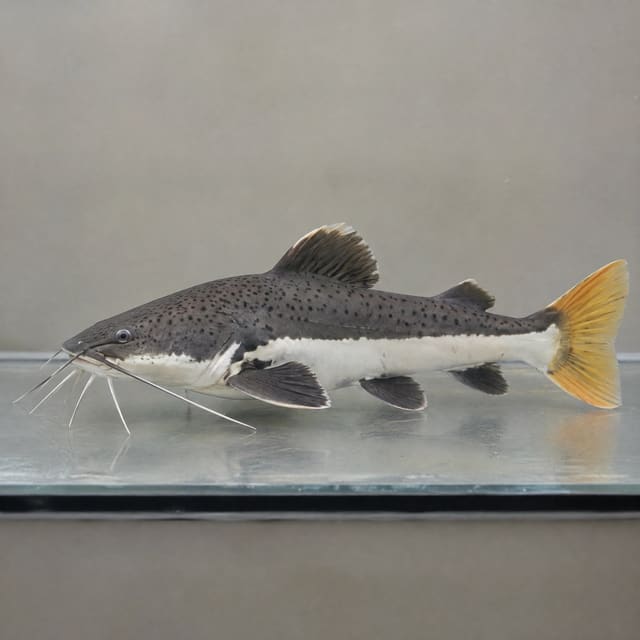
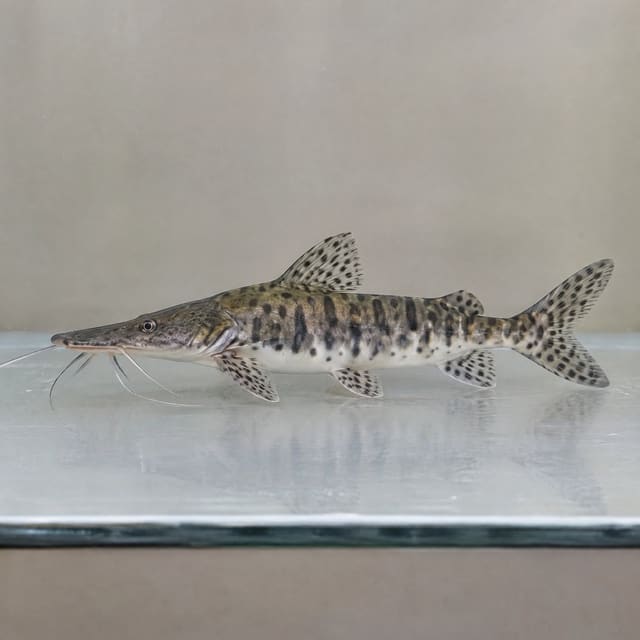
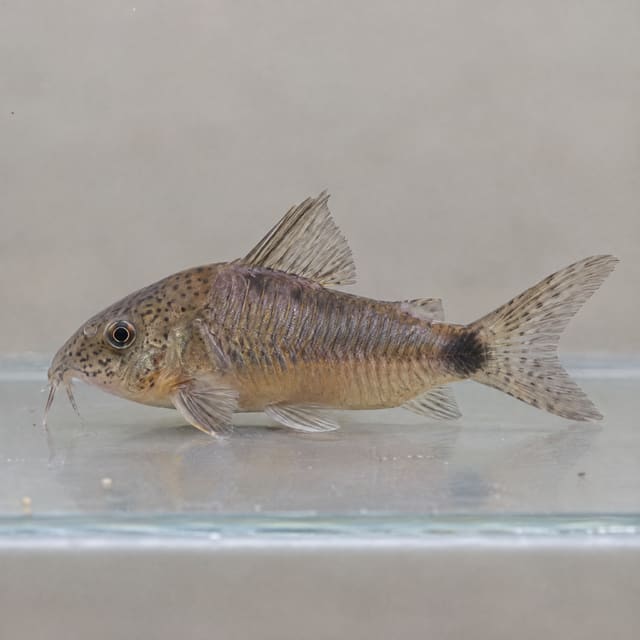
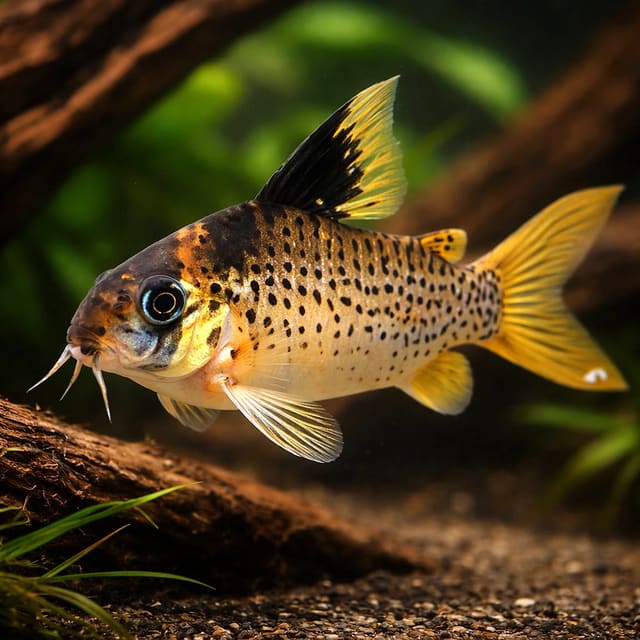
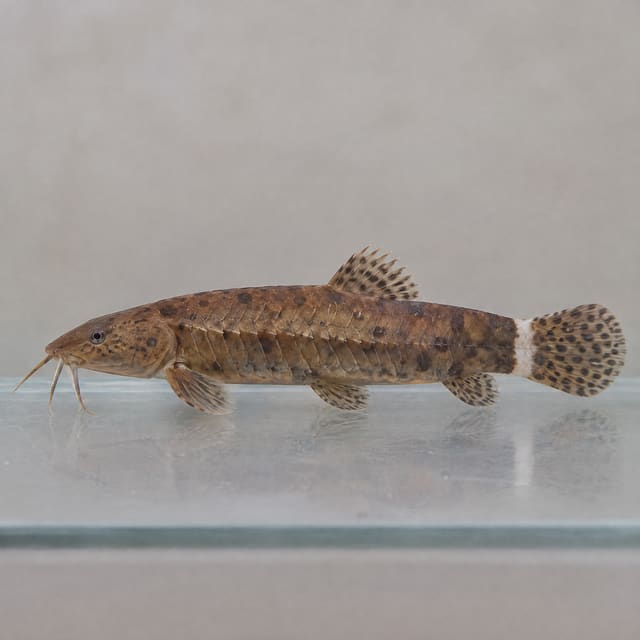
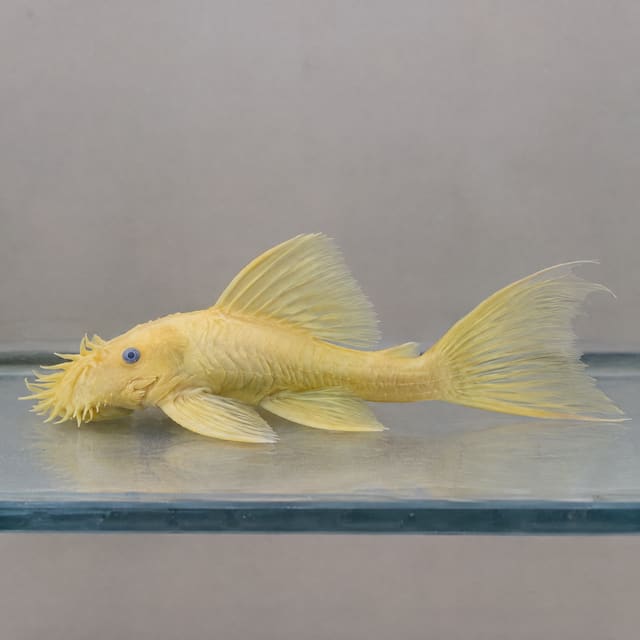
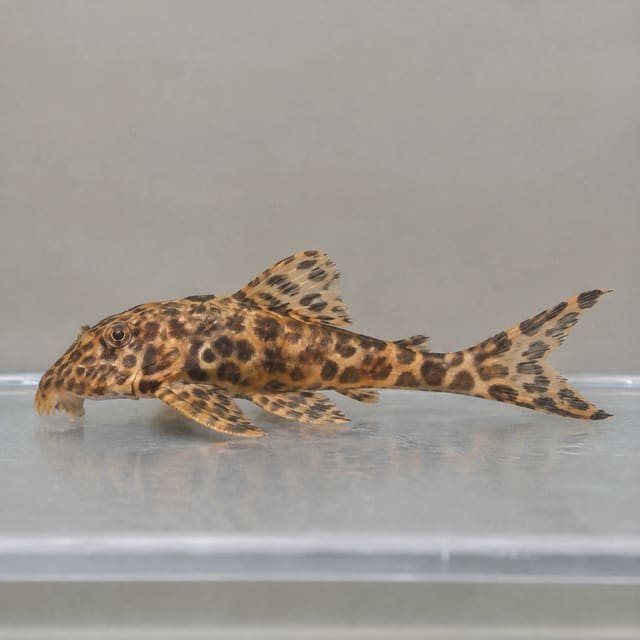
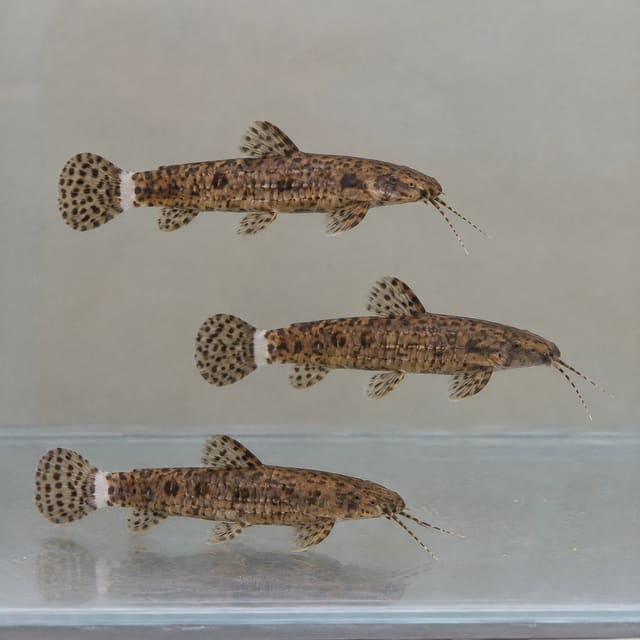
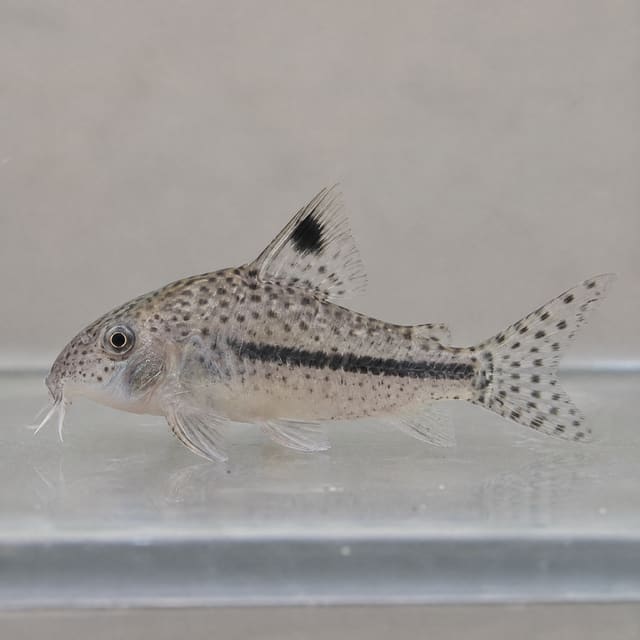
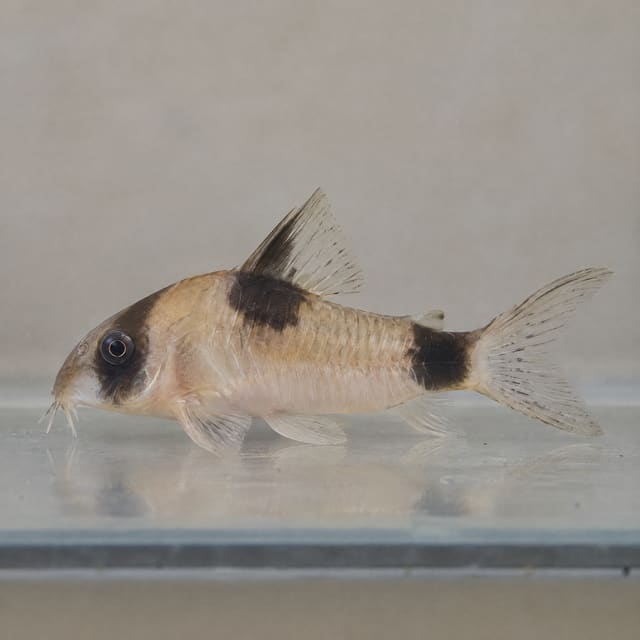
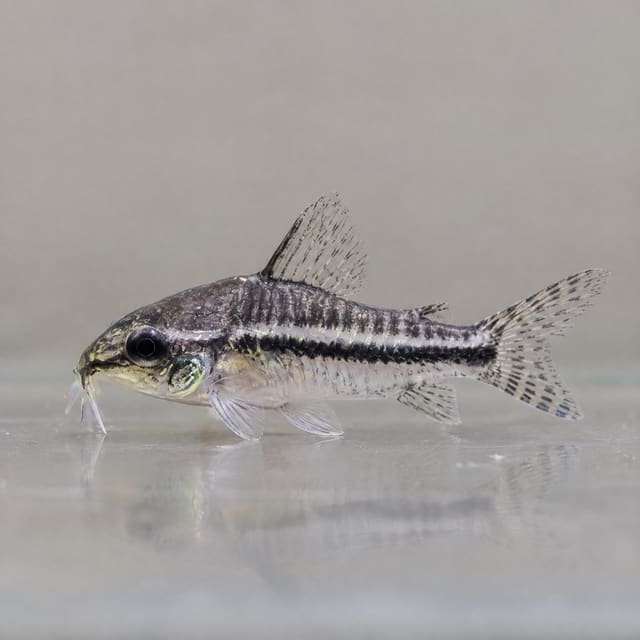
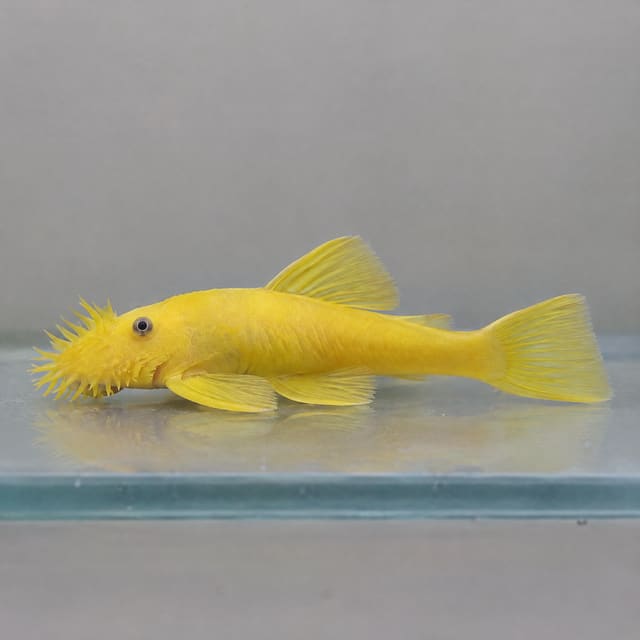
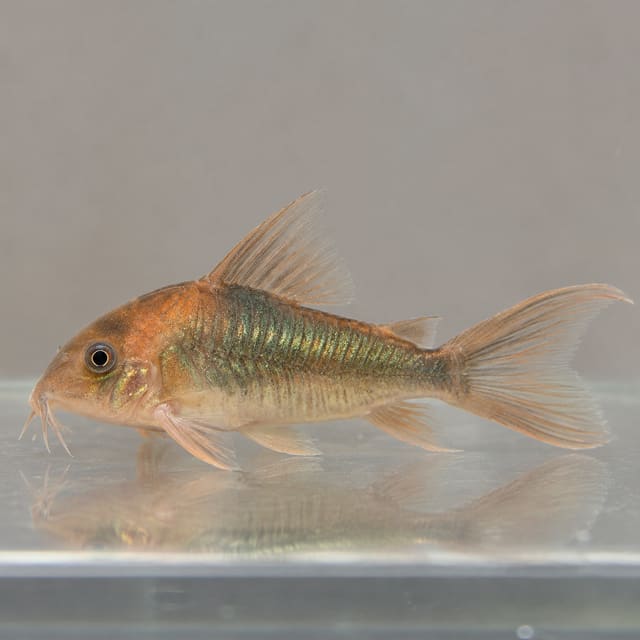
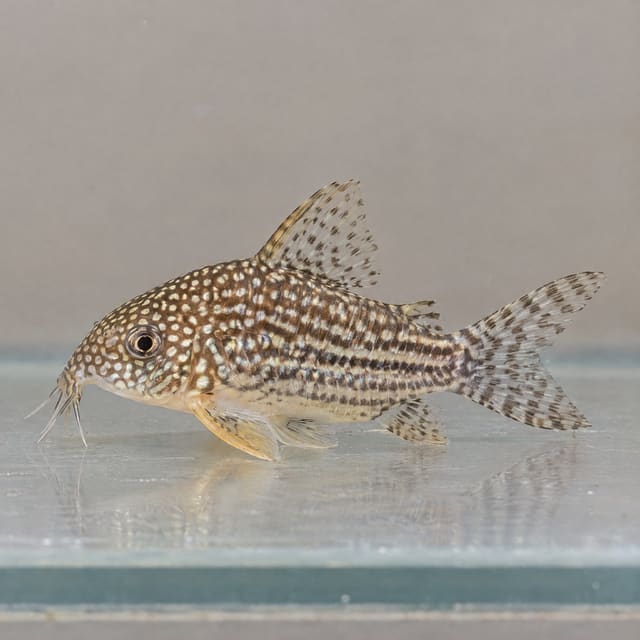
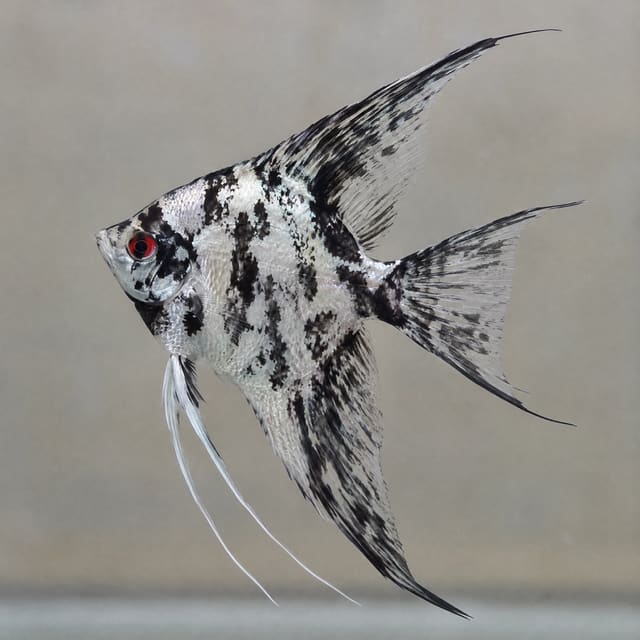
Our photographs show the look these hybrids are sold for: a long, flattened shovel-shaped snout with long white barbels, a bronze to olive body crossed by dark, wavy tiger bars, a clean white belly, spotted dorsal and adipose fins and a bright orange-red tail with black spots. Hybrids are not uniform. SCOTCAT stresses that a hybrid is simply the offspring of two different species, and Hashimoto and colleagues found that hybrids cannot be identified reliably by eye, especially as juveniles and beyond the first generation. Expect each fish to differ in stripe pattern, tail colour and head shape.
No scientific body has published a maximum size for the hybrid, so we use the best figures available. SCOTCAT gives 90 cm and says it could reach 110 cm. Practical Fishkeeping says the size of the hybrid is unknown, notes that adult red-tailed catfish commonly reach 90 cm or more and that tiger shovelnoses can grow just as large, and warns that hybrids may grow faster and larger than either parent.
| Fish | Seriously Fish | FishBase |
|---|---|---|
| Red-tailed catfish, P. hemioliopterus | 1340 mm standard length | 135 cm total length, 44.2 kg |
| Tiger shovelnose, P. fasciatum | 1040 mm standard length | 105 cm standard length, 70 kg |
| The hybrid | No profile | No entry; SCOTCAT gives 90 cm, possibly 110 cm |
Standard length is measured from the snout to the base of the tail, so the fish is longer still with its tail. Growth is fast. Practical Fishkeeping reports hybrids reaching "a couple of feet in less than 18 months" and stock that trebled in size in a few months, and Seriously Fish says P. fasciatum reaches close to its maximum size quickly in captivity. A juvenile that fits in your hand today can outgrow a 2-metre aquarium within a few years.
Plan for a long life too. No lifespan has been published for the hybrid, but Seriously Fish says the tiger shovelnose parent can live for well over 20 years.
One purchase supplies one live Tiger Shovelnose x Redtail Catfish. The size option is "Standard": the fish is sent at the size currently available, which is a juvenile far below adult size. Sex is not chosen or guaranteed, and the photographs show the form rather than the individual you will receive.
If any answer is "no", please choose one of our smaller catfish and plecos instead. If every answer is "yes", read our delivery and Live Arrival Guarantee information before you order and have the first aquarium running, heated and matured before the fish arrives.
Sources agree on the scale, if not the exact figure. Practical Fishkeeping advises a 3 × 1.2 × 1.2 m tank, about 4,320 litres, for one hybrid, with a very large filtration system. Seriously Fish gives 360 × 240 × 120 cm, about 10,368 litres, as an absolute minimum for an adult red-tailed catfish, and the same dimensions for an adult P. fasciatum, adding that even this does not let the fish swim as it would in the wild. OATA says very large aquarium fish often need tanks in excess of 500 litres; for this hybrid, that is only a starting point for a juvenile.
Many keepers of fish this size use a purpose-built indoor tank or a heated indoor pond with a large pond filter. Whatever you build, it must hold steady tropical temperatures all year, so an outdoor UK pond is not suitable.
Keep the layout simple and strong. Practical Fishkeeping recommends heavy, smooth boulders or large pieces of bogwood so the fish keeps plenty of swimming room. OATA adds three safety rules for big fish: secure all rocks and décor, protect heaters from damage and fit a fish-proof cover, because large fish can be jumpy, particularly in new surroundings.
| Area | Purpose |
|---|---|
| Long open floor | Room to cruise and turn along the bottom, where these catfish spend much of their time |
| Large bogwood or smooth boulders at one end | Shade and cover without sharp edges |
| Fine sand or a bare base | Easy cleaning of the heavy waste a big carnivore produces |
| Guarded heaters and pipework | Prevents burns and broken equipment when a large fish bumps into them |
| Heavy, secure lid | Stops a frightened fish leaping out |
Leave out small loose stones, delicate ornaments and anything sharp. A metre-long catfish moves décor easily, and anything that can be shifted can crack glass or trap the fish.
The parents come from the Amazon, Orinoco and other South American river basins. Seriously Fish describes the red-tailed catfish in habitats from rapids to flooded forest, and P. fasciatum in large rivers, lakes and flooded forest. Practical Fishkeeping notes that both parents come from soft, acidic water but are hardy and adaptable, so more alkaline water is usually fine.
| Source | Temperature | pH | Hardness |
|---|---|---|---|
| Seriously Fish, red-tailed catfish | 21–26°C | 6.0–7.5 | 2–12 dGH |
| Seriously Fish, P. fasciatum | 22–26°C | 6.0–7.6 | 2–30 dGH |
| FishBase, red-tailed catfish | 20–26°C | 5.5–6.8 | up to 10 dH |
| FishBase, P. fasciatum | 24–28°C | 6.0–8.0 | 4–30 dH |
| SCOTCAT, the hybrid | 20–26°C | 6.0–7.0 | not given |
| Our recommendation | 22–26°C | 6.0–7.5 | 2–12 dGH |
Our recommendation is the overlap of the two Seriously Fish parent profiles, and it sits inside the hybrid temperature range SCOTCAT gives. Whatever your figures, keep them stable: in thousands of litres, stability is easier to achieve than in a small tank, but large water changes must be matched for temperature and treated with a dechlorinator.
UK tap water varies from very soft to very hard depending on where you live. Test your supply before you plan, and use our water matcher and water chemistry guide to compare your readings with the range above. Keep ammonia and nitrite at zero and nitrate no more than 20 mg/l above your tap water, as OATA advises.
A big carnivorous catfish produces a lot of waste from a single meal. OATA says a filter is always essential for very large fish and that several large filters, or a pond filter, may be needed. Practical Fishkeeping calls for a very large filtration system for one hybrid. Our guide to aquarium filtration explains mechanical and biological stages, and the nitrogen cycle explained shows why a new system must mature before any fish goes in.
Fit heaters with guards and consider several smaller heaters rather than one, so a single failure does not chill the whole system.
In the wild, Seriously Fish says the red-tailed catfish eats fish, invertebrates and fallen fruit. In captivity both parents usually accept dead foods: prawns, mussels, cockles, lancefish and earthworms, with white fish fillet for larger specimens. Practical Fishkeeping suggests whole shrimp and other bulky frozen foods for young hybrids and chopped or whole trout for large ones, fed only a few times a week so each meal can be digested.
| Stage | How often | What to offer |
|---|---|---|
| Juvenile | Every other day (Seriously Fish) | Prawns, mussel, cockle, earthworms, large carnivore pellets |
| Adult | One meal a week at most (Seriously Fish) | Lancefish, whole prawns, white fish fillet |
| Never | — | Beef heart, chicken or other mammal meat; live feeder fish |
The sources differ on frequency for big fish in general: OATA's general advice is to feed once a day only what is eaten within a few minutes. For these giant catfish we follow the species advice from Seriously Fish, which warns that overfeeding and high-protein diets cause obesity, that the fat in mammal meats can damage organs and that feeder fish such as livebearers or small goldfish carry a disease risk.
Switch off the aquarium lights, then float the sealed bag for 10 minutes to match temperature. Add small amounts of tank water to the bag over up to 20 minutes before releasing the fish, as OATA describes. If a larger fish arrives in a box or bucket, add tank water slowly, for example with an airline siphon, and do not let the water cool too much. Our guide on how to acclimatise new fish walks through both methods.
| Checkpoint | What to do |
|---|---|
| Arrival day | Lights low, lid secured, no food |
| Days 2–3 | Offer one small meaty meal and remove anything uneaten |
| Days 4–7 | Settle into the every-other-day juvenile routine |
| Every day | Test ammonia and nitrite; OATA advises close monitoring for the first week |
A new catfish often hides at first. Steady breathing, a clean body and interest in food by the end of the first week are good signs.
This hybrid is a predator. Seriously Fish describes both parents as peaceful towards similarly sized fish but ready to eat smaller ones, and territorial towards their own kind and other large pimelodid catfish. Practical Fishkeeping notes that many tank mates could be eaten and suggests keeping the hybrid alone. Remember that its mouth grows as fast as its body: a companion that is safe today may not be safe next year.
| Suits | Avoid |
|---|---|
| Living alone in its own large system | Any fish that can fit in its mouth, now or later |
| Very large, robust fish, only in public-aquarium-scale systems; Seriously Fish names the big doradid catfish Oxydoras niger and Pterodoras granulosus for the parents | Another hybrid of the same kind, or a Red-Tailed Catfish, Yellowtail Redtail Catfish or Tiger Shovelnose Catfish |
| Large characins and cyprinids in a very deep tank, according to Seriously Fish | Slow, delicate or long-finned fish, and live feeder fish |
The pure parents we sell, linked above, need the same giant systems and are no easier. If you want a shovel-snouted catfish on a far smaller scale, compare the Shovelnose Catfish (Sorubim lima), and if you mainly want a big bottom-dweller, the Common Pleco is another large fish that needs planning. Check any proposed mix with our tank mates tool, and browse the South American catfish category, the Phractocephalus red-tailed catfish page, our centrepiece fish and our rare and collector fish.
OATA lists the signs that something is wrong: clamped fins, flicking against objects, hanging at the surface or sitting on the bottom, colour change, white spots or fluffy growths, damaged fins or scales, changed breathing and reduced appetite. In a giant catfish, the commonest problems follow water quality and feeding, so test first.
| If you see | Do this |
|---|---|
| Rapid breathing or gasping | Test ammonia, nitrite and temperature at once and increase surface movement |
| Swollen belly, sluggish fish | Review meal size and frequency against the Seriously Fish advice |
| Food left uneaten | Remove it the next day and test the water before offering more |
| Scrapes or split fins | Check for sharp décor, loose rocks and unguarded heaters |
| Fish leaping at the surface | Check the lid, lighting changes and water quality |
| White spots or cotton-like patches | Test the water and get fish-health advice before treating |
Breeding is not realistic. Seriously Fish says breeding the red-tailed catfish is not thought to have been achieved in the hobby, and this hybrid is a farm product. Rehoming is the real risk. Seriously Fish reports that cheap juveniles have led to so many adult red-tailed catfish in public aquaria that they often refuse to take more, and that released fish now live in several US states and other countries. SCOTCAT records hybrids of this kind caught in a river in Thailand.
Kept properly, the Tiger Shovelnose x Redtail Catfish is an impressive, long-lived centrepiece. Kept without a plan, it becomes a fish nobody can house. We would rather you buy it knowing exactly which of those it will be.
It is a farmed hybrid between a tiger shovelnose catfish (genus Pseudoplatystoma) and the red-tailed catfish (Phractocephalus hemioliopterus), two giant South American catfish of the family Pimelodidae. It does not occur as a natural species. Trade fish usually show tiger-striped flanks, a long flattened snout and a red tail.
Expect a fish of about a metre. SCOTCAT gives 90 cm for the hybrid and says it could reach 110 cm, and Practical Fishkeeping reports hybrids reaching a couple of feet in under 18 months. The parents are bigger still: Seriously Fish gives the red-tailed catfish 1340 mm and Pseudoplatystoma fasciatum 1040 mm standard length.
A custom system of several thousand litres. Practical Fishkeeping advises a 3 × 1.2 × 1.2 m tank (about 4,320 litres) for one hybrid, and Seriously Fish gives 360 × 240 × 120 cm (about 10,368 litres) as the absolute minimum for an adult of either parent. No standard home aquarium is big enough for an adult.
Only with very large, robust fish that cannot fit in its mouth, and only in a system big enough for both. It eats any fish it can swallow, and Seriously Fish describes both parents as territorial towards their own kind and other large pimelodid catfish. Practical Fishkeeping suggests keeping the hybrid alone.
Meaty sinking foods: prawns, mussels, cockles, lancefish, earthworms and, for big fish, white fish fillet. Seriously Fish advises feeding juveniles every other day and adults one meal a week at most, because these catfish easily become overweight. Avoid mammal meats and live feeder fish.
No lifespan has been published for the hybrid. Seriously Fish says its tiger shovelnose parent can live for well over 20 years, so plan for a commitment of two decades.
Do not rely on it. Seriously Fish reports that public aquaria already hold many adult red-tailed catfish and often refuse to accept any more. Plan the adult system before you buy.
Never release it. OATA states that releasing aquarium animals into the wild is illegal and usually fatal to the fish. An outdoor UK pond is also far too cold for a tropical catfish that needs about 22–26°C all year.
One live juvenile fish of the standard size currently available. Sex is not chosen or guaranteed, and the photographs show the form rather than the individual you receive.
No reviews for this item yet. Bought one? Honest reviews only, good or bad.
What customers say about ordering from us
Easy website plenty of info on fish your buying great to pick a time slot
TRACEY DURRANT · 7 Oct 2026
Got some lovely fish thank you
Kevin Mackie · 7 Oct 2026
Reviews of our shop, collected by Judge.me, an independent third-party review collector. Newest first.
Moved by UK carriers licensed to handle live animals
Hand-packed with oxygen bags, poly box, heat pack
Email photos the same day; an optional unboxing video helps us review problems faster — claim terms apply
Klarna & PayPal Pay in 3 at checkout