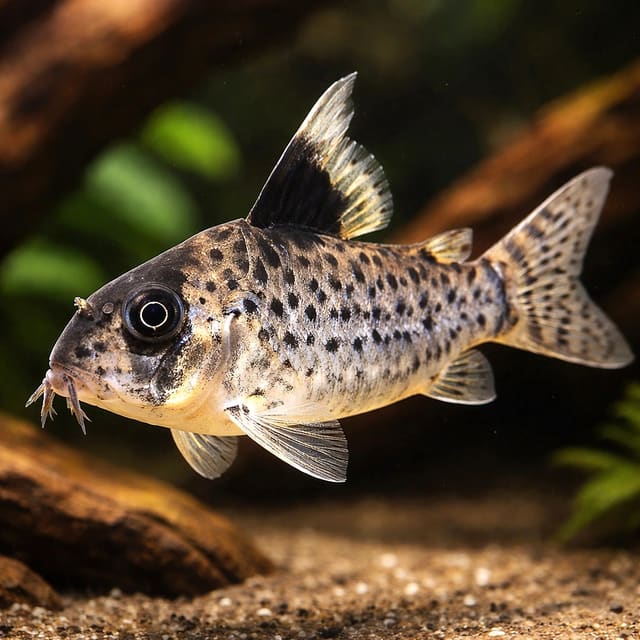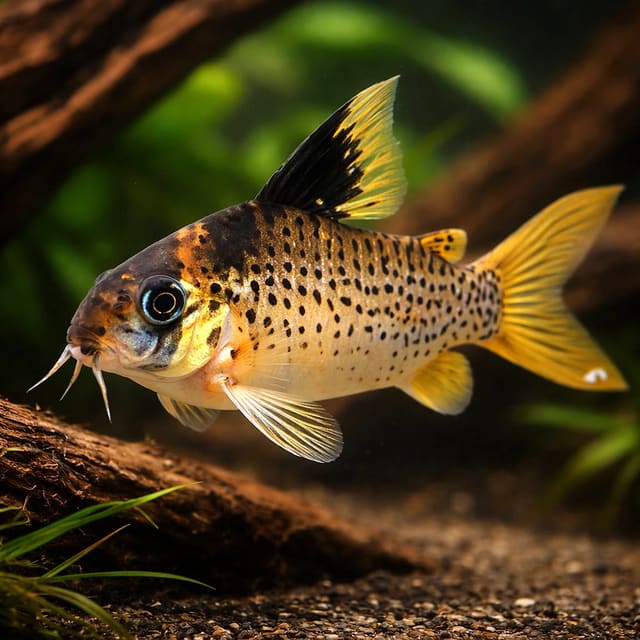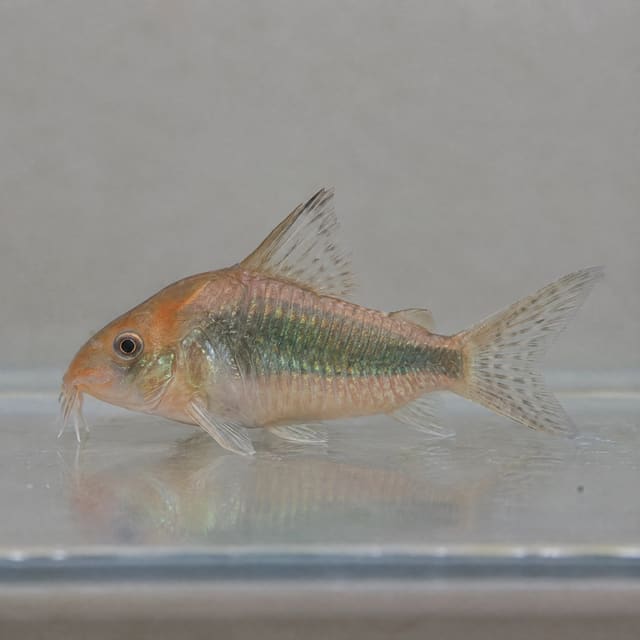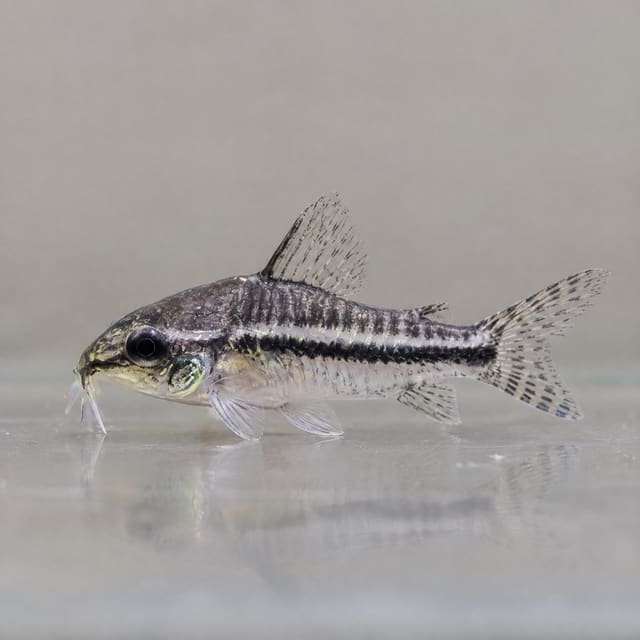
Pygmy Corydoras (Corydoras pygmaeus)
22–26°C · pH 6.4–7.4 · 41L
£3.49
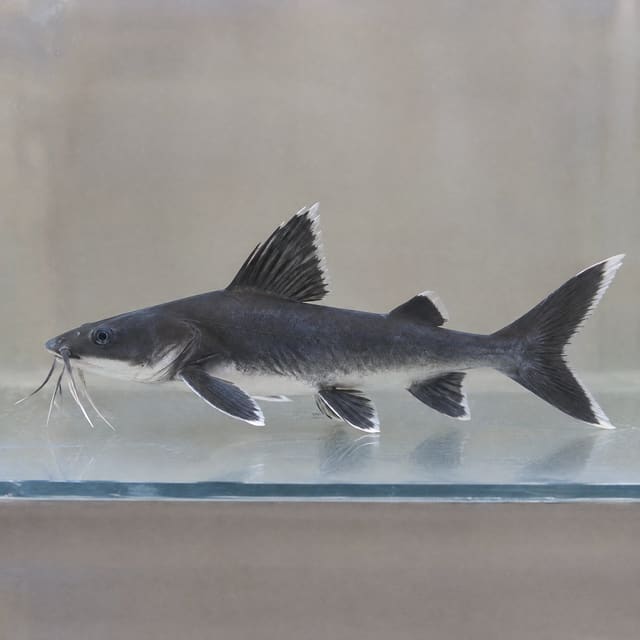
The Whale Catfish sold as Cetopsis sp. 'Orinoco' is a smooth, scaleless, torpedo-shaped whale catfish from the Orinoco region with tiny eyes and a big appetite. Its relatives scavenge and bite pieces out of other fish, so plan a dim, fast-flowing species tank for a fish that may reach about 26 cm. One live fish per purchase.
Cetopsis sp. 'Orinoco' (trade label)
The Whale Catfish sold as Cetopsis sp. 'Orinoco' is a smooth, scaleless, torpedo-shaped whale catfish from the Orinoco region with tiny eyes and a big appetite. Its relatives scavenge and bite pieces out of other fish, so plan a dim, fast-flowing species tank for a fish that may reach about 26 cm. One live fish per purchase.
Read the full care guidance when planning conditions for your aquarium.
The Whale Catfish sold as Cetopsis sp. 'Orinoco' is a member of the Cetopsidae, the whale catfishes of South America. FishBase describes the family as whale-like catfishes with a naked, scaleless body, three pairs of barbels and no adipose fin; the name Cetopsis means whale-like. They are smooth, slimy, torpedo-shaped fish with small eyes, built for swimming in the open water of large, flowing rivers.
We want every buyer to know exactly what this fish does. The best-known member of the genus, Cetopsis coecutiens, which lives in the Orinoco, is a scavenger and opportunistic predator. Seriously Fish describes it swimming in voracious feeding groups in the wild, homing in on weakened fish by smell and burrowing into prey, and says it will bite chunks out of tank mates much bigger than itself. It is a remarkable oddball for a specialist with a species tank, not a fish for any community aquarium.
| Question | What the sources say |
|---|---|
| Family | Cetopsidae, whale catfishes: scaleless body, three pairs of barbels, no adipose fin (FishBase) |
| Adult size | Up to 26.5 cm standard length if it is C. coecutiens; 9.4 cm if it is C. orinoco |
| Aquarium | At least 120 × 45 × 45 cm (Seriously Fish); 72 × 24 × 24 inches for adults (Chris Ralph) |
| Water | 22-26°C, pH 6.0-7.4, strong flow, dim light |
| Behaviour | Eats smaller fish and bites larger ones; best kept alone or in a species group |
| Conservation | Least Concern for both candidate species (FishBase, assessed 2020) |
'Orinoco' here is a trade label for where the fish was exported from, not a confirmed species. More than one whale catfish lives in the Orinoco basin, and young ones are hard to tell apart. Planet Catfish notes that C. coecutiens is an uncommon import and that several other members of the family are imported rarely. These are the two named species most relevant to this label:
| Species | Range | Maximum size |
|---|---|---|
| Cetopsis coecutiens, Blue Whale Catfish | Amazon, Tocantins and Orinoco basins | 26.5 cm standard length (Seriously Fish, Planet Catfish); 27.3 cm total length (FishBase); wild fish over 30 cm caught in Peru (Planet Catfish) |
| Cetopsis orinoco | Orinoco system, Venezuela | 9.4 cm standard length (FishBase, Planet Catfish) |
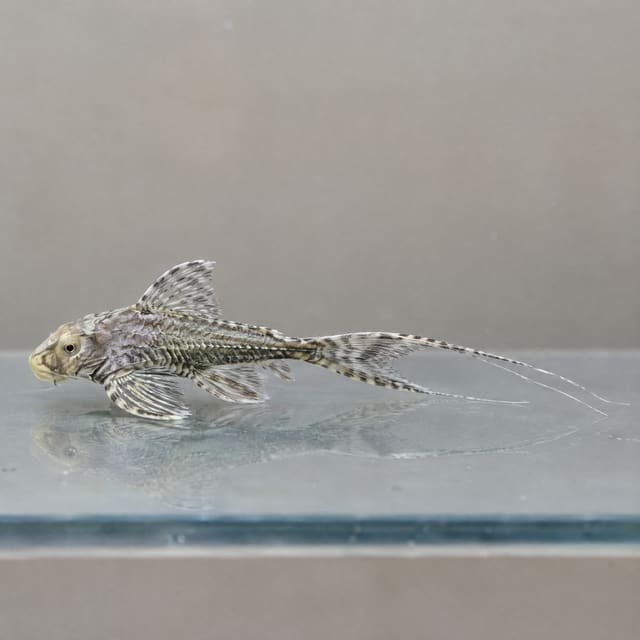
Because the species cannot be guaranteed, this page plans for the larger, better-documented C. coecutiens, and all care values below come from that species. If your fish stays small and slim, it may be one of the smaller species; the care principles are the same. One purchase quantity supplies one live fish in a single Standard option, because no size grade is recorded. The photographs show the type of fish, not the individual you receive, and gallery images are representative.
Whale catfish are midwater swimmers that keep moving. For an adult C. coecutiens, Seriously Fish gives a minimum of 120 × 45 × 45 cm, about 243 litres. Chris Ralph, who caught these fish in Peru and wrote about them for Planet Catfish and ScotCat, suggests 72 × 24 × 24 inches, about 183 × 61 × 61 cm, to keep them to adult size. We recommend the larger figure if you plan a group. Use our tank volume calculator to check the real volume of your tank.
Seriously Fish says décor is not critical but water movement is: position the filter return so it breaks the surface, or add a powerhead at one end. It also recommends dim lighting, because the species' natural waters are usually deep and murky and it is much more active in low light. Planet Catfish agrees: a sparse, dimly lit tank with only minimal cover, and sand or rounded gravel on the bottom because the fish often comes to rest there.
| Area | Purpose |
|---|---|
| Open midwater lane along the length | Constant swimming, especially at night |
| Fine sand or smooth, rounded gravel | Safe resting place for a scaleless fish |
| One or two rocks or pieces of wood | Minimal daytime shelter |
| Powerhead or filter return at one end | Strong flow and surface movement for oxygen |
Planet Catfish suggests a dim actinic or night light so you can watch its nocturnal prowling. Keep sharp décor out: a scaleless fish damages easily.
The sources agree closely for C. coecutiens, so the target is simple.
| Source | Temperature | pH | Hardness |
|---|---|---|---|
| Seriously Fish | 22-26°C | 6.0-7.4 | 2-15 dGH |
| Planet Catfish | 22-26°C | 6.0-7.4 | Not given |
| FishBase | 22-28°C | Not given | Not given |
| ScotCat | 22-28°C | 6.0-7.4 | Not given |
| Our target | 22-26°C | 6.0-7.4 | 2-15 dGH |
This is a forgiving range. Soft water from much of Scotland, Wales and the north-west usually fits, and so does moderately hard water; only very hard, alkaline tap water may push pH above 7.4. Test your supply and use our water matcher to compare it with the target, and see our water chemistry guide if you need to adjust it. Seriously Fish lists this species as needing a steady temperature, so use a reliable heater and keep the tank away from draughts and sunlight. Keep ammonia and nitrite at zero and nitrate no more than 20 mg per litre above tap water, as OATA advises for catfish.
Planet Catfish describes the whale catfish as an open-water fish that needs strong current and good oxygenation, and Seriously Fish asks for a good degree of flow through the tank. Choose a filter rated well above the tank volume, aim its return to break the surface, and add a powerhead if needed. Our guide to aquarium filtration explains how to size it, and our guide to the nitrogen cycle explains why the tank must be mature first.
Seriously Fish says there is no need to provide live fish because it is an eager and aggressive feeder: offer frozen and live foods such as prawns, mussel, cockle, lancefish and earthworms, and some individuals even accept dried foods. Planet Catfish names chopped mussel and live earthworms as favourites, warns against weaning it onto feeder fish, and advises trying shrimp-based tablet foods from a young age.
| Food | How to use it |
|---|---|
| Frozen mussel meat and frozen cockle meat | Thawed and chopped to mouth size; the core of the diet |
| Prawns, lancefish and earthworms | Thawed or live earthworms for variety |
| Sinking krill granules or shrimp-based tablets | Introduce early so it accepts prepared foods |
| Live feeder fish | Do not use (Planet Catfish) |
Both Seriously Fish and Planet Catfish warn that it gorges itself and that overfeeding comes very easily. OATA advises feeding only what the fish eats within a few minutes, once a day; for this fish, err on the small side and watch that the body stays sleek rather than bloated. Feeding after the lights dim matches its night-time habits.
Seriously Fish warns that the whale catfish could inflict a nasty bite, so take care during maintenance. Keep hands out of the water at feeding time, and use a long siphon and tools. OATA advises care when handling any catfish because most carry spines on the pectoral fins; whale catfish pectoral spines are not serrated (Planet Catfish), but the bite is the real risk.
For arrival, OATA recommends the floating-bag method, or slow drip acclimatisation for sensitive fish, with the lights off and as little transport water as possible going into the tank. Our guide to acclimatising new fish explains both, and our delivery and Live Arrival Guarantee policy covers dispatch days and what to do if there is a problem.
| Sign | What to check |
|---|---|
| Swollen, bloated body | Overfeeding; reduce meal size and frequency |
| Scratches or sores on the skin | Sharp décor or gravel; scaleless fish injure easily |
| Fast breathing or hanging at the surface | Oxygen, flow and temperature |
| White spots, fluffy growths or cloudy eyes | Water quality first; OATA lists these among the signs to act on |
Scaleless fish can react badly to some medications, so check any treatment is safe for catfish without scales and improve the water before treating.
Seriously Fish advises keeping it alone, because it will eat smaller tank mates and often bites chunks out of larger fish too. Planet Catfish says it is not a fish to be trusted with others: its natural adult behaviour is biting lumps out of large river catfish such as the scaleless pimelodids, and Chris Ralph reports these whale catfish being found inside the body cavities of larger fish such as the Red-Tailed Catfish and Tiger Shovelnose. Younger aquarium fish seem less dangerous, perhaps because they are well fed, but they will always eat smaller fish. Test any idea in our tank mates tool.
| Suits | Avoid |
|---|---|
| Living alone, the safe default (Seriously Fish) | Any fish smaller than itself |
| A small group of its own kind in a species tank; Chris Ralph suggests two or three as a minimum if you keep a group | Large scaleless catfish such as the Red-Tailed Catfish or Tiger Shovelnose Catfish, its natural victims |
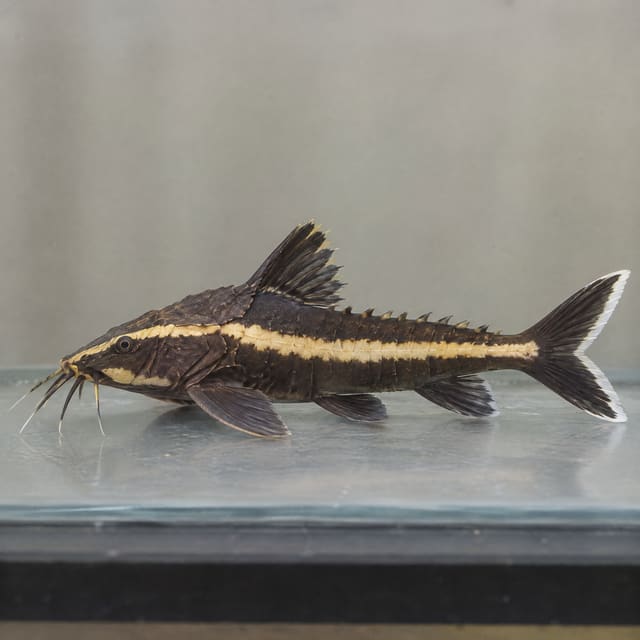
| If you must mix, Planet Catfish suggests armoured catfish as the best bet, such as the Painted Talking Catfish or Striped Raphael Catfish, with everyone kept well fed | Slow, weak or sick fish, which it homes in on by smell |
Even the armoured option is a risk, and Chris Ralph would keep no other fish with them. Browse more South American catfish and our rare and collector fish in the catfish and plecos range.
Chris Ralph describes C. coecutiens as one of the largest of the so-called candiru, a name used loosely for several small South American catfish that feed on other fish. It is not the tiny parasitic candiru of popular stories, but in the wild it is an opportunist that bites flesh from other fish and scavenges carcasses, and it is found in large numbers. FishBase notes that whale catfishes have an extremely small swim bladder enclosed in a bony capsule.
Breeding has never been achieved in the hobby (Seriously Fish). Mature females are fuller-bodied, and males are slimmer with a dorsal fin that tapers to a more pointed tip (Seriously Fish, Planet Catfish). FishBase lists both C. coecutiens and C. orinoco as Least Concern on the IUCN Red List.
It is a whale catfish (family Cetopsidae) exported from the Orinoco region of South America under a trade label rather than a confirmed species name. Whale catfishes are smooth, scaleless, torpedo-shaped catfish with small eyes; the best known, Cetopsis coecutiens, scavenges and bites pieces from other fish in the wild.
That depends on the species, which is not confirmed. The large Cetopsis coecutiens, which lives in the Orinoco, reaches 26.5 cm standard length (Seriously Fish, Planet Catfish), while the described Cetopsis orinoco reaches only 9.4 cm (FishBase). Plan for the larger figure.
Yes, very likely. Seriously Fish says Cetopsis coecutiens eats smaller tank mates and often bites chunks out of larger fish, and in nature it rips flesh from fish much bigger than itself. Keep it in a species tank.
For a fish that may reach 26.5 cm, Seriously Fish gives a minimum of 120 × 45 × 45 cm (about 243 litres). Chris Ralph, writing for Planet Catfish and ScotCat, suggests 72 × 24 × 24 inches (about 183 × 61 × 61 cm) for adults. Both stress strong flow and dim light.
Seriously Fish gives 22-26°C, pH 6.0-7.4 and 2-15 dGH; Planet Catfish 22-26°C and pH 6.0-7.4; FishBase and ScotCat allow up to 28°C. Aim for 22-26°C and pH 6.0-7.4 with strong current and plenty of oxygen.
Meaty foods: prawns, mussel, cockle, lancefish and earthworms, with chopped mussel and live earthworms as favourites. Some accept shrimp-based tablets or dried foods. Do not use feeder fish, and feed carefully because it gorges itself.
Possibly. In the wild these fish feed in groups, and Seriously Fish reports some success with groups because they seem less likely to treat their own kind as food. Chris Ralph suggests two or three in a species-only tank, but Seriously Fish still advises keeping one alone as the safe default.
It belongs to the whale catfishes, a different family from the tiny parasitic candiru of popular stories, though Planet Catfish calls Cetopsis coecutiens one of the largest of the so-called candiru. It can bite, so keep hands clear during maintenance.
No reviews for this item yet. Bought one? Honest reviews only, good or bad.
What customers say about ordering from us
Easy website plenty of info on fish your buying great to pick a time slot
TRACEY DURRANT · 7 Oct 2026
Got some lovely fish thank you
Kevin Mackie · 7 Oct 2026
Reviews of our shop, collected by Judge.me, an independent third-party review collector. Newest first.
Moved by UK carriers licensed to handle live animals
Hand-packed with oxygen bags, poly box, heat pack
Email photos the same day; an optional unboxing video helps us review problems faster — claim terms apply
Klarna & PayPal Pay in 3 at checkout