−15%
Easy
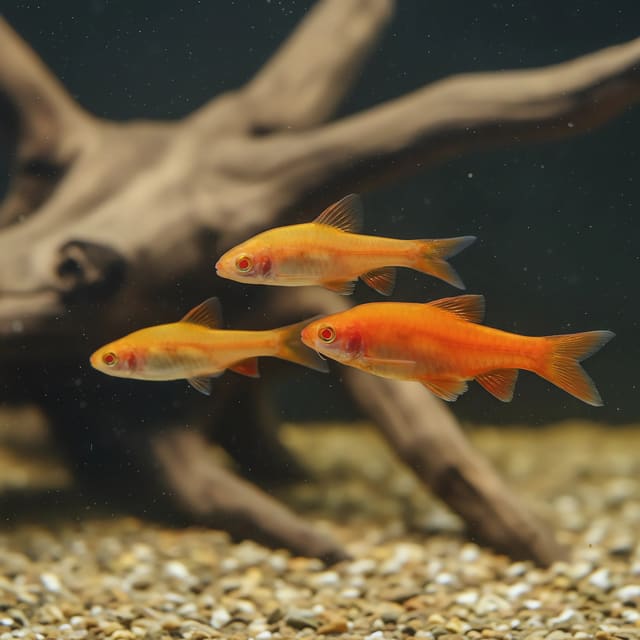
Albino Cherry Barb (Rohanella titteya)
20–27°C · pH 6–8 · 54L
£6.79£7.99

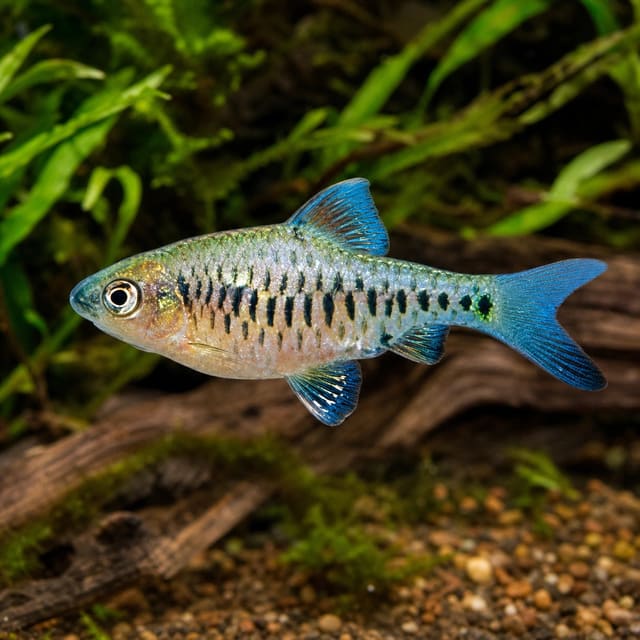
The Black Ruby Barb (Pethia nigrofasciata) is a freshwater cyprinid from Sri Lanka that reaches 6 cm. It suits a mature community aquarium planned for 6–10 fish; the overlap of FishBase, Seriously Fish and OATA is 22–26°C, pH 6.0–6.5 and 5–12 dGH. Sold individually in dispatch sizes from 2.5–3 cm to over 4 cm.
Adult size is the maximum length this species reaches at full maturity (scientific sources). The livestock you receive will be younger and smaller — pick a size above for the actual shipping size. Product-photo provenance and any image-specific limitations are stated on the listing.
Pethia nigrofasciata
Shoaling fish: kept in a group they feel safer, stay calmer and show their best colour.
Minimum of 2 per order.
The Black Ruby Barb (Pethia nigrofasciata) is a freshwater cyprinid from Sri Lanka that reaches 6 cm. It suits a mature community aquarium planned for 6–10 fish; the overlap of FishBase, Seriously Fish and OATA is 22–26°C, pH 6.0–6.5 and 5–12 dGH. Sold individually in dispatch sizes from 2.5–3 cm to over 4 cm.
Adult size is the maximum length this species reaches at full maturity (scientific sources). The livestock you receive will be younger and smaller — pick a size above for the actual shipping size. Product-photo provenance and any image-specific limitations are stated on the listing.
Maintain these water conditions for optimal health and vibrant colors
The Black Ruby Barb (Pethia nigrofasciata), also called the Ruby Barb or purple-headed barb, is a freshwater cyprinid from forest streams between Sri Lanka’s Kelani and Nilwala basins. It reaches 6 cm and suits a keeper who wants an active shoal rather than a solitary centrepiece fish, with room for 6–10 fish, stable water, open swimming space and planted cover.
FishBase records its Sri Lankan distribution and forest-stream habitat. Wild fish inhabit clear, cool, shaded water over gravel or sand, including quiet pools along stream and river margins. That background explains why planting, wood, shade and some water movement all make useful aquarium choices.
In nature it feeds mainly on filamentous algae and detritus. Aquarium feeding can be broader, but plant or algal content should remain part of the diet rather than treating this fish as a strict insect-eater.
| Suits | Not suited to |
|---|---|
| A mature, filtered community aquarium | An unfiltered or newly established aquarium |
| A group of 6–10 Black Ruby Barbs | Solitary keeping or a group below six |
| At least an 80 × 30 cm aquarium base | A short footprint without open swimming room |
| Peaceful companions sharing the same water range | Combinations that fail the water, space or behaviour checks |
Adult males are described as smaller, slimmer and more colourful than females. Their pattern may darken during spawning condition, with reddish-purple colour over the head and front of the body. Colour and body shape can guide observation, but they should not be used to assume the sex of a dispatch-size fish.
For other cyprinids with related aquarium needs and different adult sizes or temperaments, browse our barbs collection.
FishBase records a maximum of 6 cm total length for the Black Ruby Barb. Seriously Fish gives 55 mm standard length as a separate planning figure; use the 6 cm recorded maximum when checking space around décor and other occupants.
Seriously Fish recommends base dimensions of at least 80 × 30 cm or an equivalent footprint, with an approximate volume of 72 litres. The footprint is the decisive minimum because a shoal needs horizontal swimming room. A taller aquarium with a shorter base does not provide the same usable route.
| Planning decision | Use this figure |
|---|---|
| Recorded maximum length | Up to 6 cm total length |
| Aquarium base | At least 80 × 30 cm or equivalent |
| Approximate volume | About 72 litres |
| Shoal | At least six; plan for 6–10 |
This is a schooling species. Plan for at least six fish, with six to ten giving a stronger social group and a more natural display. Seriously Fish notes that this number can make the fish less skittish, while competition among males may encourage stronger colour. FishBase gives five as its aquarium minimum, but the more detailed aquarium recommendation of at least six is the better planning threshold.
Check the full adult group against the aquarium’s footprint before selecting a dispatch size. Décor, wood and dense planting should not reduce an 80 cm tank to a narrow pocket with no continuous swimming route.
Use the live size selector to choose between the labels 2,5 - 3 cm, 3 - 3,5 cm, 3,5 - 4 cm and > 4 cm. One purchase supplies one animal of the selected option. To build a group of six, for example, set the purchase quantity to six after choosing the required size label.
The size you select is the size supplied, not the adult size. Every size must therefore be planned against an adult length of up to 6 cm, the same 80 × 30 cm minimum footprint and the same requirement for a proper shoal. A larger dispatch size does not remove the need to accommodate growth, swimming activity or companions.
Sex is guaranteed only when the selected option explicitly states male or female. This Black Ruby Barb listing has no sex-guaranteed option.
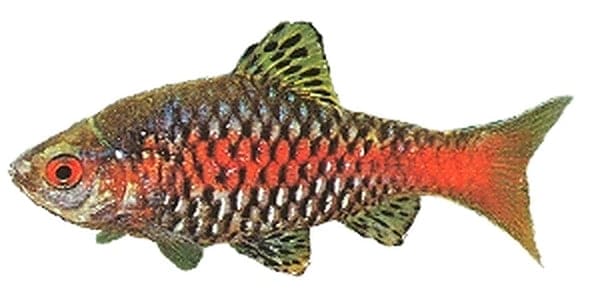
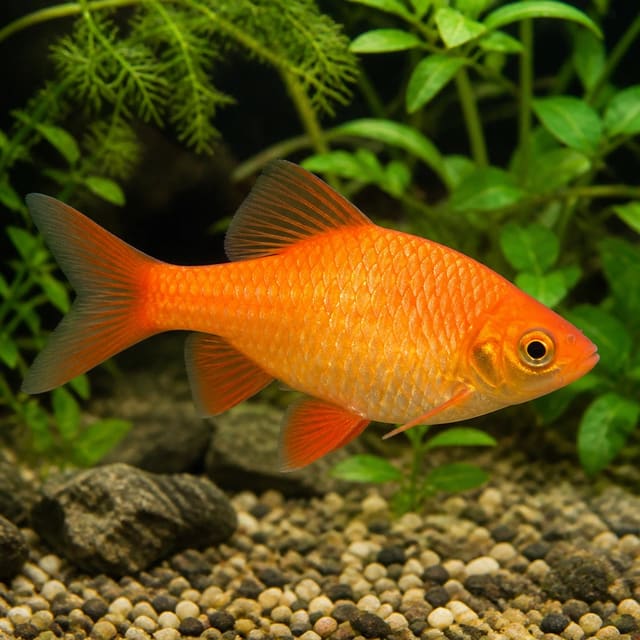
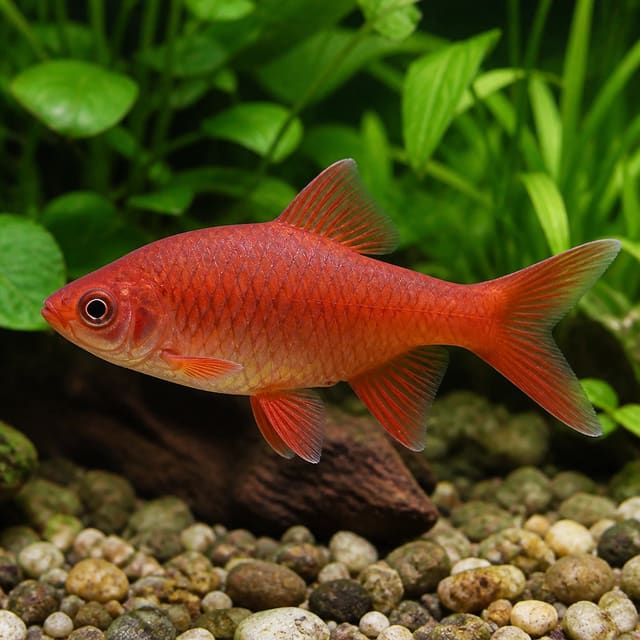
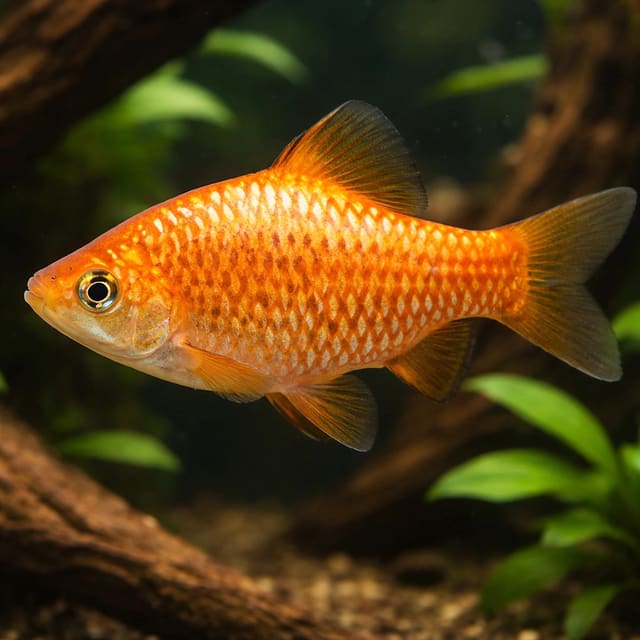
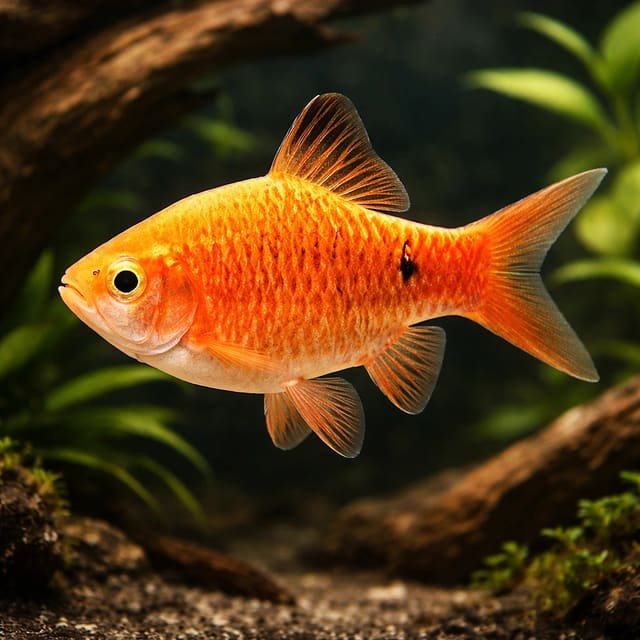
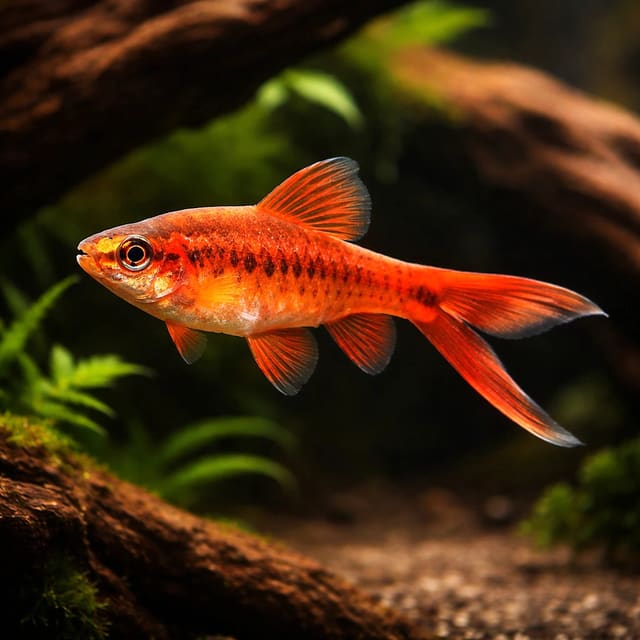
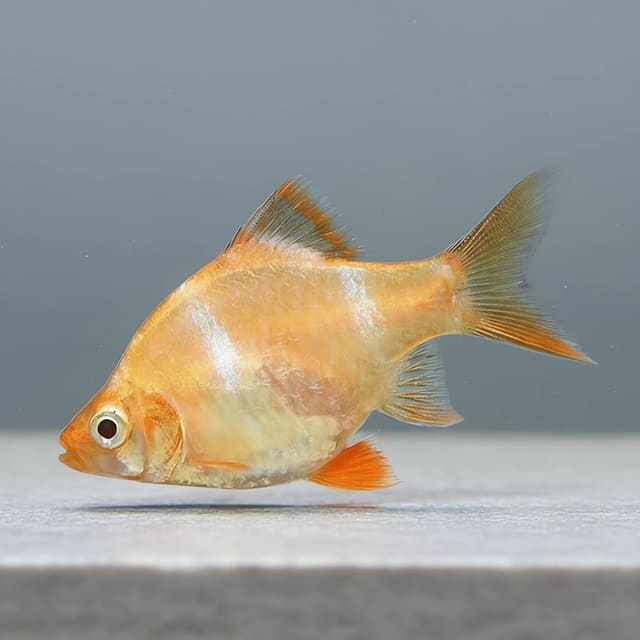
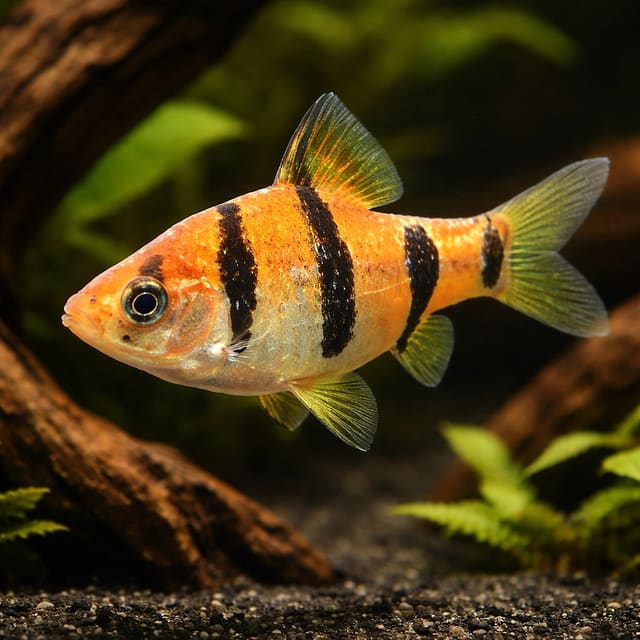
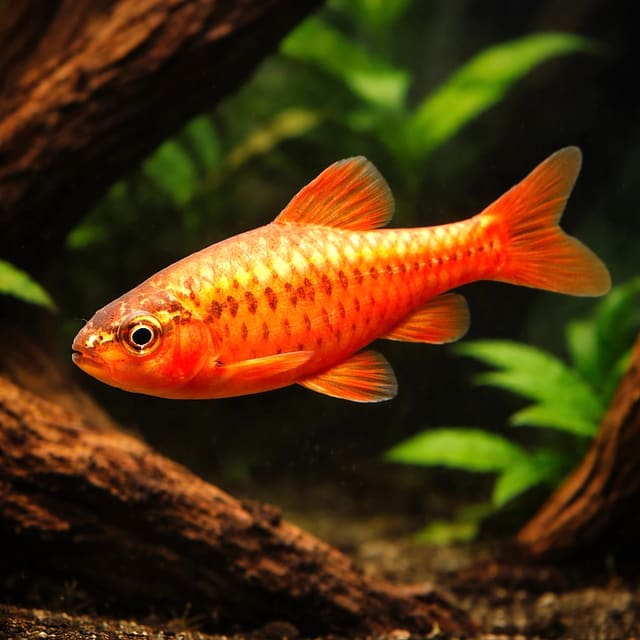
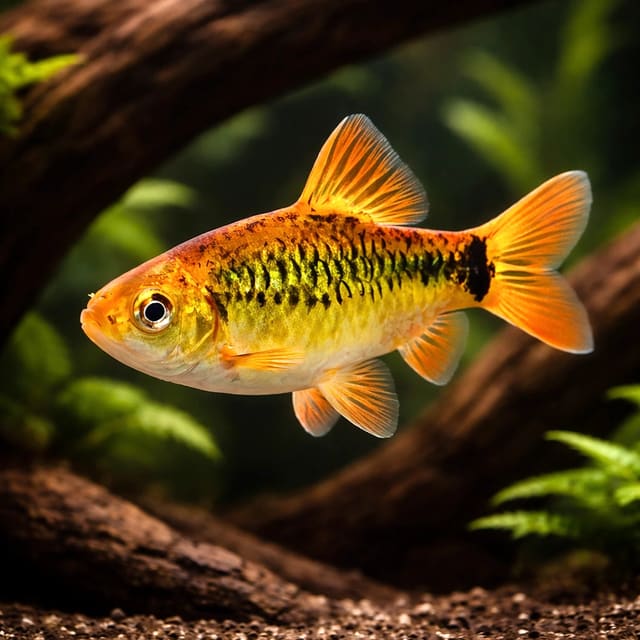
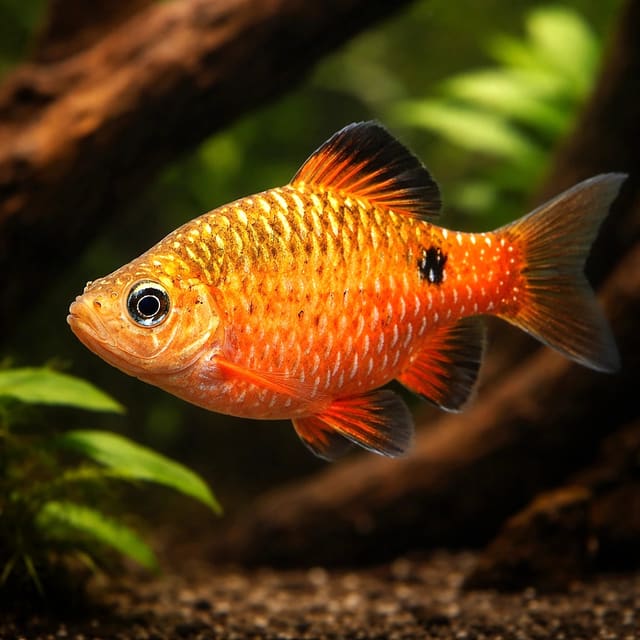
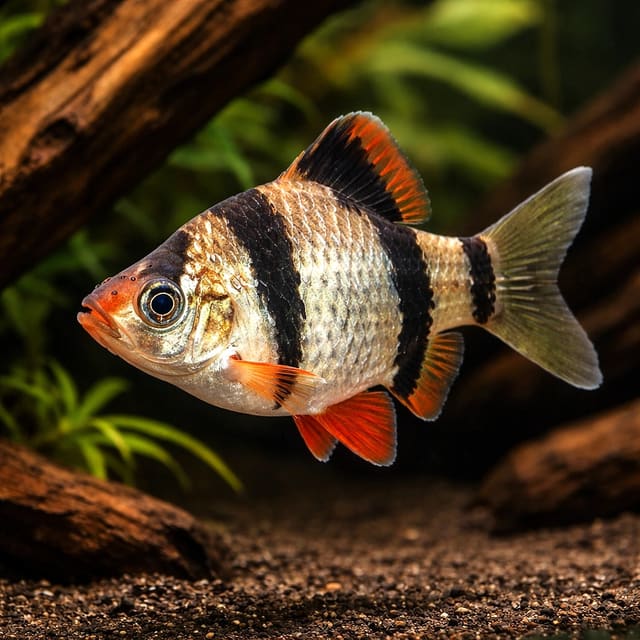
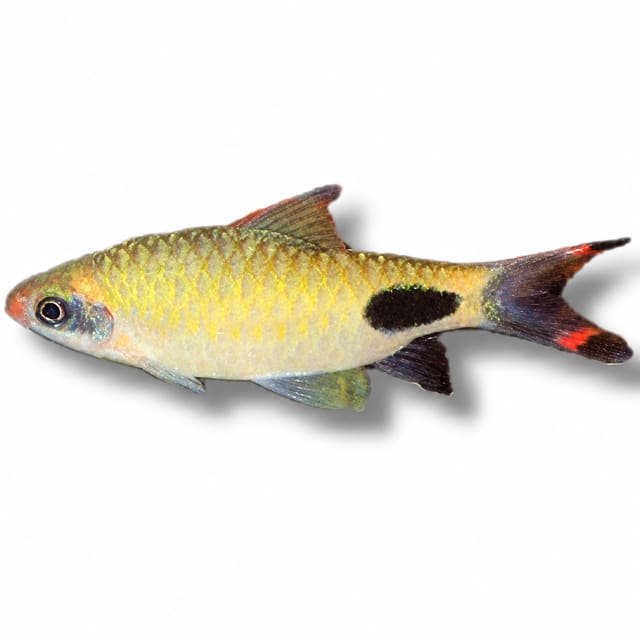
The gallery images are representative, based on reference photographs of this species, so colours can look slightly different from the live animal.
Judge incoming fish by health and behaviour rather than expecting an exact match to a gallery colour. Healthy barbs should have intact scales and fins, clear eyes and appropriate swimming behaviour. Final adult colour may also reflect sex and spawning condition.
Keep the aquarium at 22–26°C, pH 6.0–6.5 and 5–12 dGH. This is the overlap of Seriously Fish’s aquarium range, FishBase’s recorded environmental range and OATA’s group-level barb guidance. OATA also gives 3–10 dKH for barbs.
| Value | Routine target |
|---|---|
| Temperature | 22–26°C |
| pH | 6.0–6.5 |
| General hardness | 5–12 dGH |
| Carbonate hardness | 3–10 dKH |
| Ammonia | 0 mg/l |
| Nitrite | 0 mg/l |
| Nitrate | Up to 20 mg/l above the normal tap-water level |
Test the aquarium rather than judging it by clarity. A reading of 24°C, pH 6.4 and 10 dGH sits within the routine ranges. A pH reading of 6.8 falls outside them even if the water looks clean, so pause the introduction until the aquarium is suitable.
Use our water chemistry guide to understand what each test measures, then enter the measured values into the water matcher when comparing this fish with your aquarium. Consistent readings within the stated range are more useful than choosing a single number and ignoring ammonia, nitrite or nitrate.
A working biological filter is essential. The RSPCA explains that filter bacteria convert toxic ammonia into nitrite and then into safer nitrate. Both ammonia and nitrite must still test at 0 mg/l before fish are introduced.
Prepare and mature the aquarium before ordering the shoal. Our first tropical tank guide covers the setup sequence, while regular tests show whether the biological filter is coping with the fish and their food. A clear-looking new aquarium is not a substitute for a mature filter and measured water quality.
For a tank of about 72 litres, Seriously Fish recommends filtration turning over four to five times the aquarium volume each hour. The worked figure is about 290–360 litres per hour. Choose the filter with the intended décor and full shoal in mind, then make sure plants or wood do not block its intake or outlet.
Strong flow across every part of the aquarium is unnecessary, but this species appreciates some water movement and can suit a hill-stream-style arrangement. Use the décor to leave calmer sheltered areas while preserving an open route through moving water.
Seriously Fish estimates roughly 50–75 W of heating for an aquarium of this size when the room is around 20°C. This is a planning reference for maintaining its aquarium temperature, not a reason to choose equipment without checking the aquarium volume and room temperature.
Introduce the intended Black Ruby Barb group to an established aquarium, then delay further stocking while the filter responds to the increased waste and feeding. OATA warns that adding too many fish too quickly can exceed the bacterial population’s capacity and cause new tank syndrome. Do not solve that risk by keeping a lone barb for an extended period; prepare the filtration for the proper shoal instead.
Décor is flexible, but the Black Ruby Barb tends to show stronger colour in a heavily planted aquarium with a dark substrate. Floating plants, driftwood roots or branches and leaf litter can add shade and create a forest-stream character. Gravel or sand also reflects the substrates recorded from its Sri Lankan habitat.
Start with the required base of at least 80 × 30 cm, then judge every ornament by the swimming room left after it is installed. A long branch may look natural but should be repositioned if it divides the tank into cramped ends. The same test applies to dense planting: cover is useful only when the shoal can still travel together.
Filtration does not need to create an exceptionally strong current. A degree of movement is appropriate, and a hill-stream-style setup can work, but the fish should also be able to rest away from the main outlet. Watch whether the group uses both the open and covered zones rather than remaining pressed into one corner.
Dark substrate and shade may help colour presentation, but they do not determine health or sex. Use clear eyes, intact scales and fins, regular feeding and appropriate swimming as the practical health checks.
Wild Black Ruby Barbs forage on filamentous algae and detritus, while the broader aquarium diet described by Seriously Fish includes algae, organic material, small insects, worms, crustaceans and zooplankton. Recreate that variety with a quality dried staple plus small live or frozen foods.
| Food role | Suitable choices |
|---|---|
| Dried staple | Quality flakes or granules |
| Plant component | Choose some dried food with plant or algal content |
| Live or frozen variety | Daphnia, small bloodworm or Artemia |
Feed once a day and give only what the group can consume within a few minutes. Watch the whole shoal during that period. Food should be distributed so that active individuals do not take every item while quieter fish remain away from the feeding area.
More feeding does not automatically improve growth or colour. OATA warns that uneaten food breaks down and adds toxic waste to the water. If food remains after a few minutes, reduce the next portion rather than adding another meal later that day.
A consistent response to food helps establish what is normal for the group. Reduced intake or a loss of interest is a reason to check ammonia, nitrite, temperature and the fish’s appearance. Also look for unusual breathing, hiding, surface hanging or bottom sitting rather than treating appetite as an isolated sign.
Match each item to a fish that reaches up to 6 cm. The cited aquarium diet calls for small foods, so choose flakes, granules and live or frozen items that the fish can take promptly. Plant or algal content should remain part of the regular rotation because algae and detritus are central to its natural feeding biology.
Have the mature, filtered aquarium at 22–26°C before the parcel arrives, and make sure someone is present to receive the live fish without leaving it unattended. The selected Black Ruby Barb should enter an aquarium already prepared for its full group rather than a temporary unfiltered container.
Follow our delivery and Live Arrival Guarantee policy. Keep the continuous video with the order details; include it if a claim is needed.
OATA advises watching swimming, breathing and balance as the fish settles. Look for surface hanging, bottom sitting, erratic movement, unusually fast or slow gill-cover movement, damaged fins, missing scales, white spots or fluffy growths.
Do not respond to a concerning sign by adding an unspecified treatment. Test ammonia, nitrite and temperature first because water quality is the immediate measurable condition. Follow the policy instructions if an arrival claim is needed under its stated terms.
Carry out a 25% partial water change at least once every week. Use a siphon to remove solid waste from the substrate, especially where detritus settles behind wood or dense plants. Treat replacement tap water with conditioner before it enters the aquarium so chlorine or chloramine does not damage fish or filter bacteria.
When filter media needs cleaning, rinse it lightly in aquarium water removed during the partial change. Do not rinse it under the tap, because chlorine or chloramine may kill part of the established bacterial population. The aim is to clear obstructing waste without stripping away the biology that processes ammonia and nitrite.
Link actions to measurements. If ammonia or nitrite rises above 0 mg/l, stop further livestock additions, check the filter and feeding level, and carry out the water-quality maintenance above. If nitrate climbs beyond 20 mg/l over the tap-water baseline, review water-change regularity, waste removal and uneaten food.
Small changes in appearance or behaviour may be the first sign of a problem. Watch for darker or paler colour than normal, increased hiding, altered aggression, surface hanging, bottom sitting, erratic swimming, unusual breathing, loss of scales or fins, white spots, fluffy growths, body-condition changes or reduced appetite. Test the water whenever these signs appear. If the concern continues after the immediate water checks and maintenance, contact us for health guidance.
Use the shoal’s normal pattern as your reference. A settled group should use the swimming space, respond to food and move between open water and cover. Record what is normal for your aquarium so a change in hiding, aggression, breathing or position is easier to notice.
| If you see this | Take this action |
|---|---|
| The group remains skittish | Confirm there are at least six fish and that planted or wooden cover is present. |
| One fish receives repeated attention | Check the group size, swimming footprint and whether décor has created a confined route. |
| Fish gather at the surface or bottom | Test ammonia, nitrite and temperature immediately. |
| Food remains after a few minutes | Reduce the next daily portion and siphon settled remains. |
| Water movement has weakened | Inspect the filter for a blockage and clean media only in removed aquarium water. |
Do not judge group quality by colour alone. Adult males may become more colourful in the presence of rivals, especially in spawning condition, but colour can also become darker or paler when behaviour or health changes. Combine colour with appetite, body condition, fin condition, breathing and swimming.
Plan the intended shoal before adding unrelated fish. OATA advises increasing the total aquarium population slowly because beneficial bacteria must respond whenever waste and feeding increase. For this social species, that means preparing the mature filter for at least six Black Ruby Barbs, introducing the group, and postponing further community additions while you observe the aquarium’s water quality and behaviour.
Over the first month, keep the routine consistent: one measured daily feed, weekly testing, a 25% water change at least once every week and regular observation. Stability lets you distinguish a persistent compatibility issue from a brief reaction to changed surroundings.
Seriously Fish describes the Black Ruby Barb as generally very peaceful and suitable for a well-researched community aquarium. Small cyprinids, tetras, livebearers, rainbowfish, anabantoids, catfishes and loaches are named as possible companions, but each candidate still has to pass the same water, space, size and behaviour checks.
| Check | Decision rule |
|---|---|
| Water | Every occupant must suit 22–26°C, pH 6.0–6.5 and 5–12 dGH. |
| Space | The aquarium must retain an open swimming route after every adult fish and piece of décor is considered. |
| Social needs | Reserve capacity for 6–10 Black Ruby Barbs before counting other groups. |
| Temperament | Choose peaceful community fish and observe interactions carefully. |
OATA warns that some barbs can be semi-aggressive or nip fins, while the account for this particular species describes it as peaceful. Keep that distinction clear: do not assume all barbs behave alike, but do not ignore fin-directed behaviour simply because the intended combination looks suitable on paper.
If this shoal shows fin-nipping behaviour, do not keep it with slow-swimming, timid or long-finned fish. Check that every companion can feed normally, use cover and swim without persistent attention from the shoal.
Tank-mate names alone are not enough. A tetra, catfish or loach whose required temperature, water chemistry, social group or adult space falls outside this aquarium is not a suitable match. Assess the exact animal and the final adult community rather than treating a broad category as a guarantee.
Keep at least six Black Ruby Barbs and plan for six to ten. A proper group makes the fish less skittish, gives social activity a natural focus and can produce a more effective display. OATA also notes that larger barb groups help reduce fin-nipping behaviour.
Do not use unrelated tank mates as substitutes for members of the same species. A community may contain other schooling fish, but they do not remove the Black Ruby Barb’s need for its own shoal.
When behaviour changes, examine the whole arrangement. Repeated chasing can point to inadequate group numbers, limited swimming space or an unsuitable companion. Increased hiding may indicate stress, while a new loss of appetite or abnormal breathing also calls for immediate water tests. Address the measured water condition and the group arrangement rather than assuming every chase is normal shoaling.
Males may develop stronger colour when conspecific rivals are present, but this should not be used to identify the sex of a selected fish. The practical compatibility decision remains the same for every dispatch size: provide the full social group, adequate cover and an uninterrupted swimming route.
Introduce further community fish only after the shoal is feeding, using the aquarium normally and maintaining stable test results. This separates two decisions: first establish that the Black Ruby Barb group and filter are functioning well, then assess whether the aquarium has room and compatible conditions for another species.
The Black Ruby Barb reaches up to 6 cm total length. Plan the aquarium around this adult size rather than the fish’s dispatch size.
Use a mature, filtered aquarium with a base of at least 80 × 30 cm or equivalent and an approximate volume of 72 litres. Preserve open swimming room alongside plants, shade and wood cover.
Keep at least six Black Ruby Barbs and plan for a group of 6–10. Seriously Fish gives this range for a less skittish group and more natural social display.
It suits a keeper who can provide a mature filtered aquarium, test the water, maintain a group of 6–10 and preserve an 80 × 30 cm swimming footprint. Prepare the aquarium before adding the shoal.
Feed quality flakes or granules, including some plant or algal content, with small live or frozen foods such as Daphnia, bloodworm or Artemia. Feed once daily and only what is eaten within a few minutes.
Keep it at 22–26°C, pH 6.0–6.5 and 5–12 dGH. These values are the overlap of FishBase, Seriously Fish and OATA; ammonia and nitrite should remain at 0 mg/l.
Seriously Fish describes the Black Ruby Barb as generally very peaceful, while OATA warns that some barbs may nip fins. Keep 6–10, monitor interactions and do not mix a fin-nipping shoal with slow-swimming, timid or long-finned fish.
Possible companions include peaceful small cyprinids, tetras, livebearers, rainbowfish, anabantoids, catfishes and loaches that share 22–26°C, pH 6.0–6.5 and 5–12 dGH. Check each species’ adult space and social needs before combining them.
Someone must be present to receive it. Film every delivery continuously from the sealed parcel as it is opened, showing the fish still inside the sealed bag; then float the bag for 20–30 minutes and never pour the bag water into the aquarium.
No reviews for this item yet. Bought one? Honest reviews only, good or bad.
What customers say about ordering from us
I have a small group of long finned mountain minnows. So was delighted to be able to order ten of this variety to increase the genetics in my tank . The ones I recieved are healthy but it’s to early to give a verdict on wether they are of a long finned type since they are small currently.
Gordon Walker · 23 Sept 2026
100% success travel and "installation". Pleased with quality of purchase. The Siamese fighter a bit "shy" so have not yet seen him at his best yet but looking good. Happy customer. GG
George E Garratt · 21 Sept 2026
Reviews of our shop, collected by Judge.me, an independent third-party review collector. Newest first.