Moderate
Pterophyllum scalare platinum panda
24–27°C · pH 6.5–7.4 · 200L
£14.99
Photo coming soon
The size, price and care details on this page are for this listing.
Pterophyllum scalare red devil is a colour form of the freshwater angelfish, a South American cichlid that grows to about 15 cm long and often 20–25 cm tall including its fins. Keep it as a compatible pair or a small group in a tall, planted aquarium of around 200 litres.
Adult size is the maximum length this species reaches at full maturity (scientific sources). The livestock you receive will be younger and smaller — pick a size above for the actual shipping size. Product-photo provenance and any image-specific limitations are stated on the listing.
Pterophyllum scalare
Save when buying multiple fish. Each quantity is one fish; sex and pair formation are not guaranteed unless the selected variant explicitly states them.
Minimum of 2 per order.
Pterophyllum scalare red devil is a colour form of the freshwater angelfish, a South American cichlid that grows to about 15 cm long and often 20–25 cm tall including its fins. Keep it as a compatible pair or a small group in a tall, planted aquarium of around 200 litres.
Adult size is the maximum length this species reaches at full maturity (scientific sources). The livestock you receive will be younger and smaller — pick a size above for the actual shipping size. Product-photo provenance and any image-specific limitations are stated on the listing.
Freshwater angelfish are tall South American cichlids, not small community fish. OATA gives 120 litres as an industry floor for a compatible pair and says the aquarium must be sufficiently tall. We prefer planning around roughly 200 litres, a 100 × 40 cm footprint and about 50 cm height for an adult pair, with more space and an exit plan for a group.
Maintain these water conditions for optimal health and vibrant colors
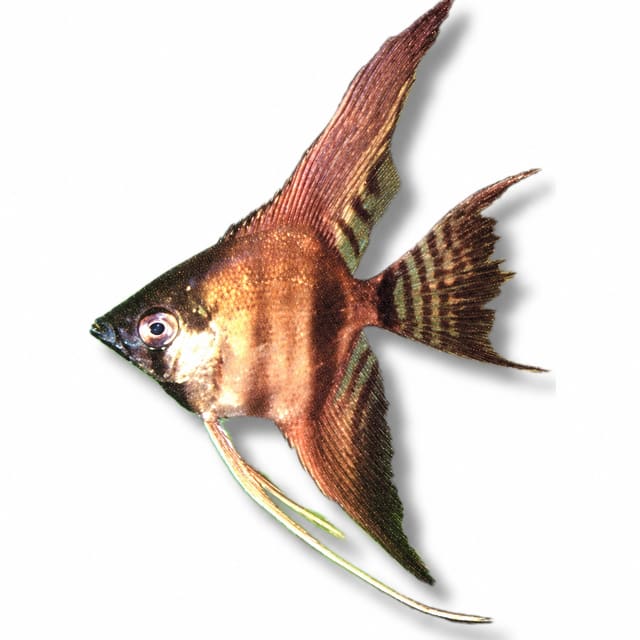
Pterophyllum scalare red devil is a colour form of the freshwater angelfish, the tall, laterally compressed South American cichlid that FishBase describes as one of the most popular of all tropical aquarium fish. Red devil is the trade name for this form, and the gallery shows a fish coloured orange-red from snout to tail, with long trailing ventral fins. There is no good evidence that one angelfish colour form is hardier or calmer than another, so its care is the same as for any Pterophyllum scalare.
Each purchase is one live fish of the size you select, and every size on offer is a young fish with a lot of growing ahead. That is the single most important planning point on this page. An angelfish bought at a few centimetres becomes an adult of about 15 cm long and often 20–25 cm tall including its fins, so it needs a tall aquarium planned for the adult rather than the juvenile. For an adult pair we plan around roughly 200 litres, a 100 × 40 cm footprint and about 50 cm of usable height.
| Suits | Think twice if |
|---|---|
| A mature, cycled aquarium of around 200 litres with real height | Your tank is short or sized only for a juvenile |
| A compatible pair, or a group with extra space and a fallback tank | You want a single angelfish kept on its own |
| Calm, robust companions too large to be eaten | You keep small tetras, shrimp or persistent fin-nippers |
| Keepers who test their water and watch behaviour closely | You have no room for a second tank if a pair turns territorial |
The size menu has nine grades: 1 cm, 1.5–2 cm, 2.5–3 cm, 3–3.5 cm, 4–5 cm, 5–5.5 cm, L (5.5–6 cm), XL (6–7 cm) and XXL (over 7 cm). Not every grade can be ordered at all times, and the size menu shows what is available to order. The size you select is the size supplied, not the adult size. The smaller grades are young juveniles, and even the largest grades still have plenty of growing to do before they reach adult size.
One unit is one angelfish. If you want a pair or a group, order the number of fish you need in your chosen size.
Sex is guaranteed only when the selected option explicitly states male or female. This Pterophyllum scalare red devil listing has no sex-guaranteed option. Angelfish are quite difficult to sex. Seriously Fish notes that the male's smaller, pointed genital papilla can usually be seen only when the fish are spawning, and forehead shape, fin angle and temperament are not reliable ways to sex a juvenile.
Smaller grades suit keepers who already have the adult aquarium running and want to watch their fish grow up in it. The larger grades have a head start on growth, so you wait less time to see adult shape and full fins. If you are buying several angelfish, choosing one size for all of them keeps the group evenly matched at feeding time, which matters in a fish that can push weaker rivals away from food.
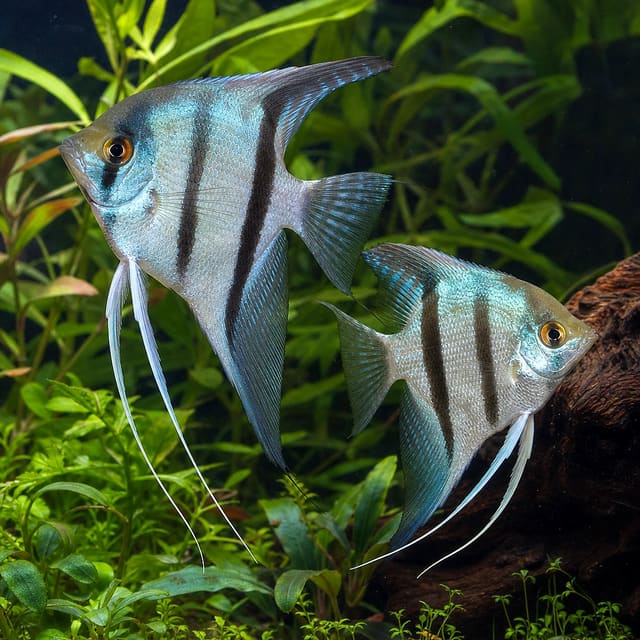
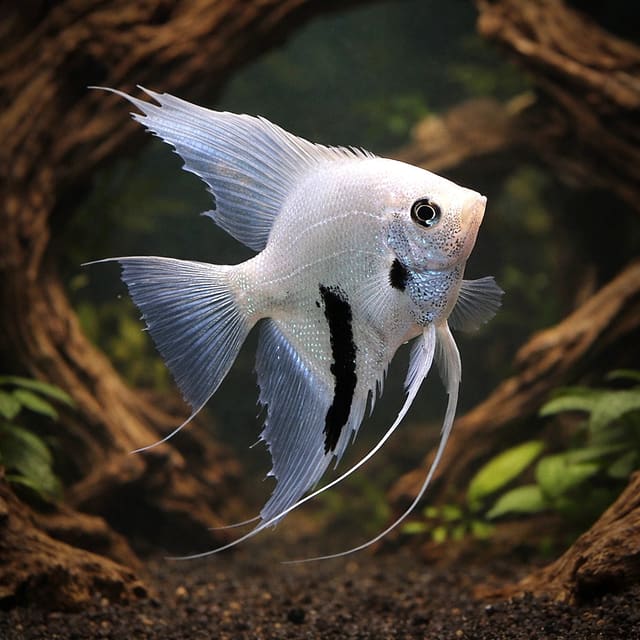
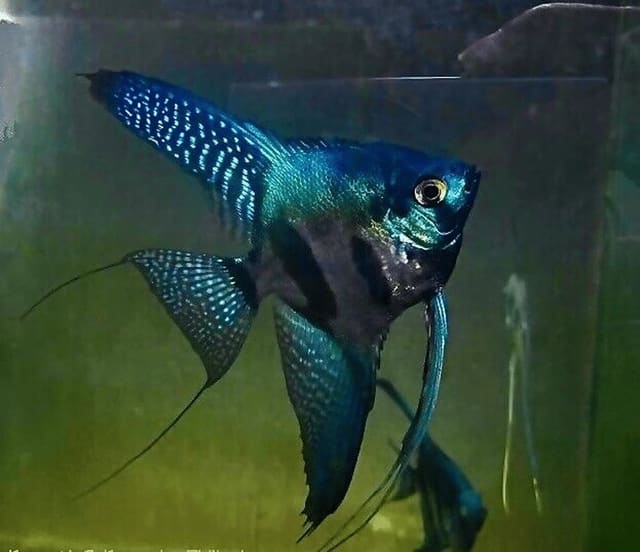
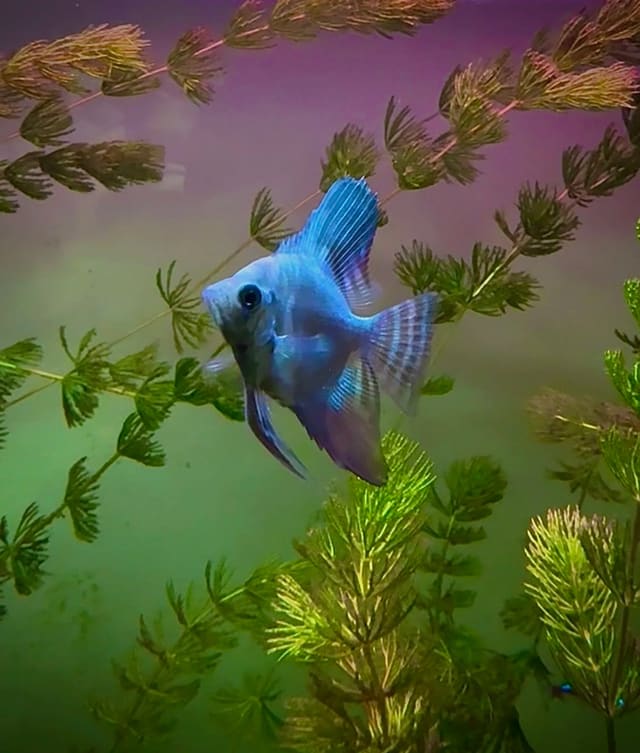
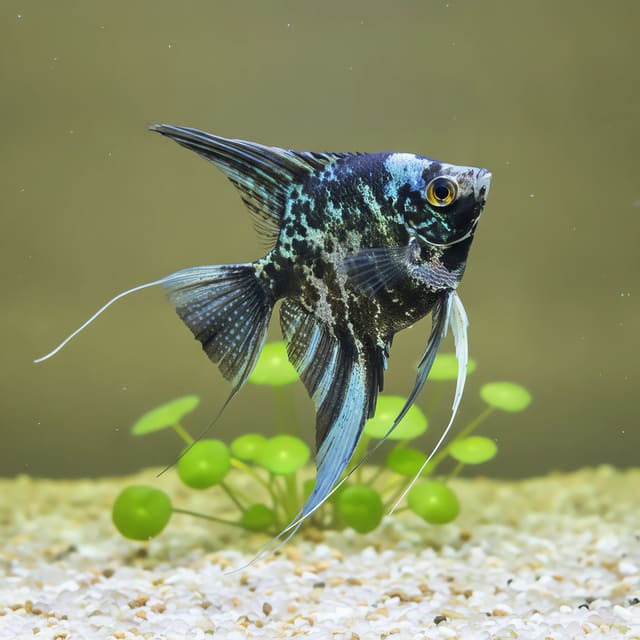
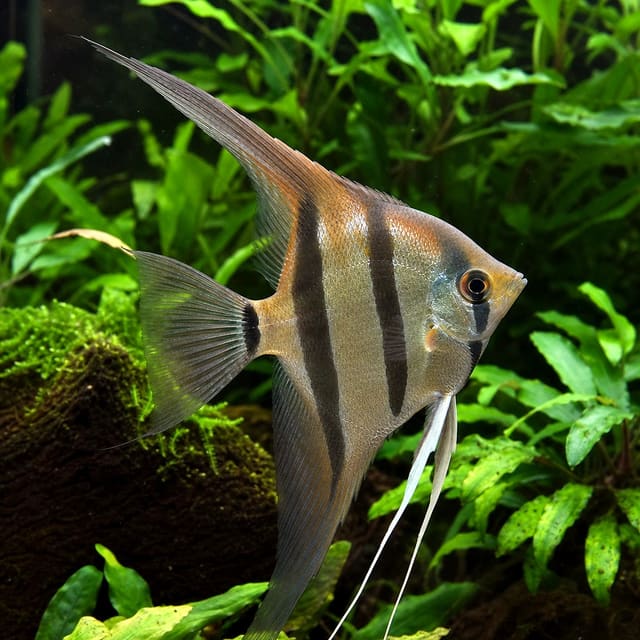
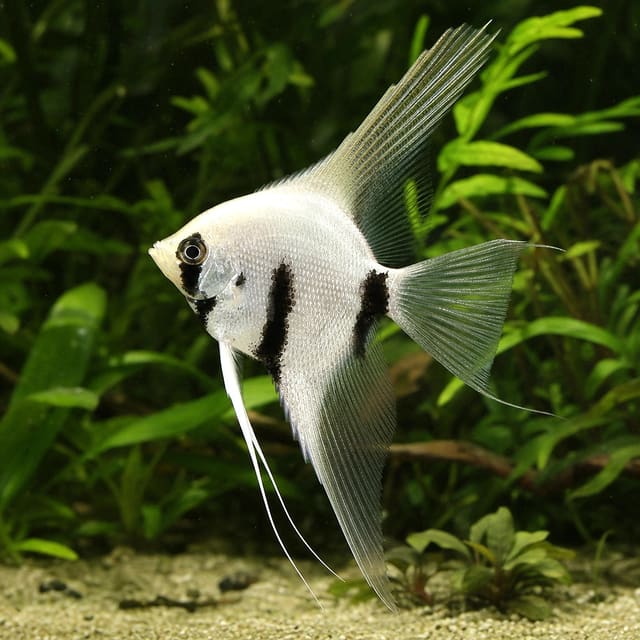
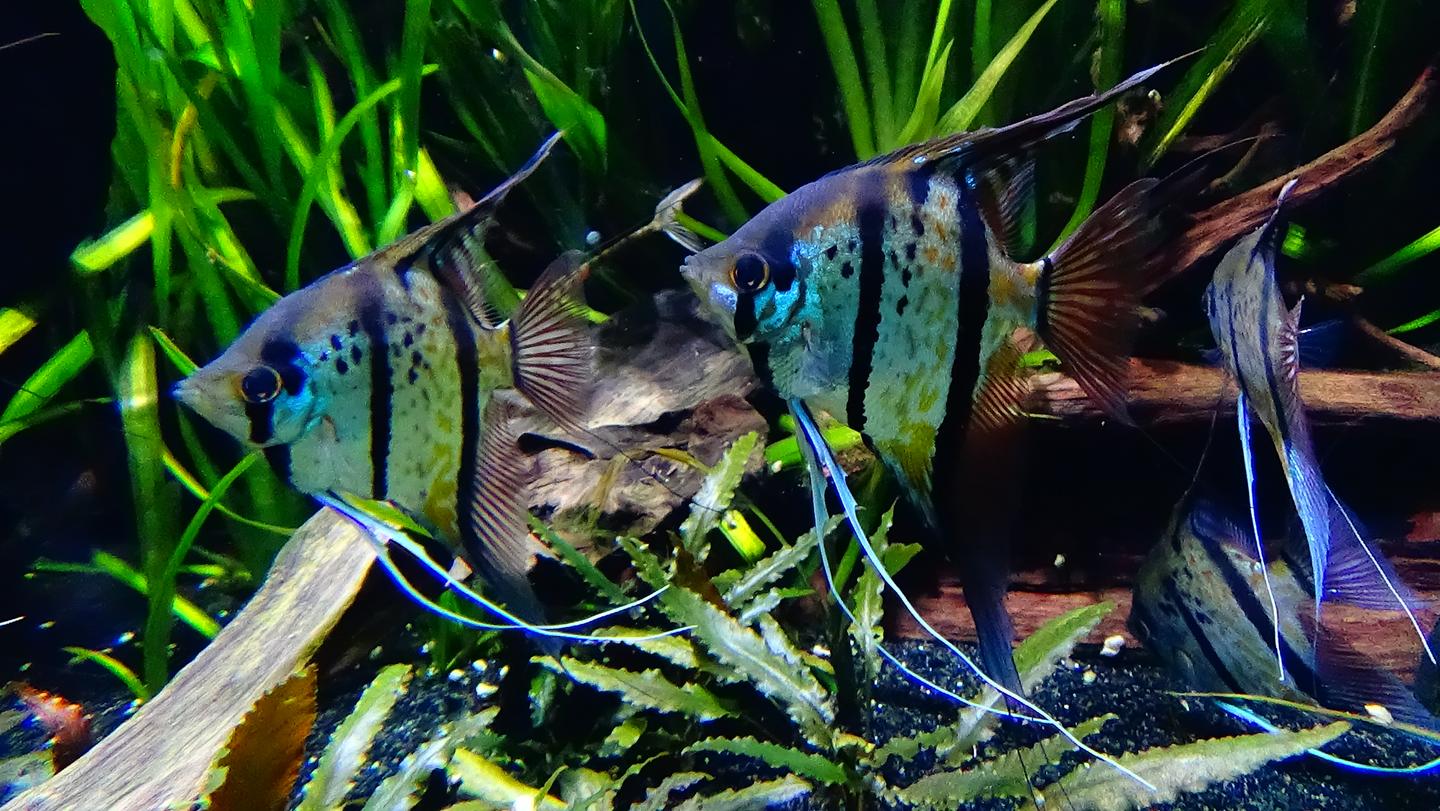
The photograph shows a fully finned fish in a planted aquarium, orange-red all over with a paler edge to the long ventral fins. The fish you receive will be the size you select, so it will look younger and smaller than the fish pictured. Gallery images have been digitally enhanced to improve image quality. Natural colour, pattern, size and maturity can vary between live animals.
| Feature | Detail |
|---|---|
| Scientific name | Pterophyllum scalare (Schultze, 1823) |
| Form | Red devil colour form |
| Family | Cichlidae |
| Native range | Amazon basin in Brazil, Colombia and Peru; rivers of Amapá, French Guiana and Guyana |
| Adult size | About 15 cm long; often 20–25 cm tall including fins |
| Aquarium | About 200 litres, 100 × 40 cm footprint and 50 cm height for an adult pair |
| Social needs | A compatible pair or a small group; not kept alone |
| Temperature | 24–27°C routine target |
| pH | 6.5–8.0 |
| Hardness | About 5–12 dGH |
| Diet | Complete cichlid pellet, granule or flake, plus frozen or freeze-dried variety |
| Our care rating | Intermediate |
Our full freshwater angelfish care guide goes deeper into the evidence behind these figures. The sections below apply it to the red devil you are choosing.
Size figures for angelfish are easy to misread because they mix length with height. The FishBase species summary keeps the familiar aquarium figure of 15 cm total length alongside a smaller field record of 10.5 cm, and Seriously Fish quotes 150 mm. Height is what catches people out: the long dorsal and anal fins can make an adult roughly 20–25 cm tall from fin tip to fin tip.
For planning, assume about 15 cm long and 20–25 cm tall. Individual fish and domestic lines vary, so treat those as planning figures rather than a guarantee for your fish.
| Source | Guidance |
|---|---|
| Seriously Fish | 100 × 40 × 50 cm, about 200 litres, as the smallest aquarium to consider |
| FishBase | A minimum aquarium length of 100 cm |
| OATA, for all American cichlids | At least 120 litres for a pair of smaller species; allow 40 litres per adult angelfish when stocking |
| Tropical Fish Co | Roughly 200 litres, a 100 × 40 cm footprint and about 50 cm usable height for an adult pair |
OATA's 120 litres is a broad UK trade floor for a compatible pair of smaller American cichlids. It is not a sign that every nominal 120-litre tank can house every pair. Our planning figure is more conservative and matches the Seriously Fish species profile. A group needs more room than a pair, so scale up rather than squeezing extra fish into the same volume.
OATA says angelfish need an aquarium that is sufficiently tall when they are fully grown, and Seriously Fish recommends a tank at least 50 cm tall for adults. A shallow starter tank can look fine for a 3 cm juvenile and still leave an adult unable to turn without dragging its fins. Height alone is not enough either. Adults need horizontal room to turn and to hold territory, which is why the footprint matters as much as the depth of water.
Because the sizes sold are juveniles, it is tempting to start in a small tank and upgrade later. The safer plan is to set up the adult aquarium from the start. If you do begin in a smaller tank, have the full-size aquarium matured and ready well before the fish outgrow the first one, and keep an eye on fin condition and turning space as they grow.
Seriously Fish recommends a well planted tank with tall, leafy plants such as Amazon swords, and gentle water flow. FishBase records wild adults in swamps and flooded ground where aquatic and riverine vegetation is dense and the water is clear or silty. Plants, roots and upright structure are therefore sensible inspiration, although no single plant, substrate colour or tannin level is essential.
OATA's general cichlid sheet notes that American cichlids may dig up or eat live plants. Angelfish are among the calmer species and Seriously Fish recommends planting for them, but keep an eye on new plantings in the first weeks.
For a tank of about 200 litres, Seriously Fish suggests a filter rated around 800–1000 litres per hour, a turnover of four to five times the volume each hour. Choose filtration for water quality and oxygen exchange without forcing the fish to fight a strong current all day, and cover any intake that could catch a fin. Low flow never means stagnant water. A filter is always essential, and the RSPCA is clear that no fish should be kept without a well set up and maintained filter.
To hold 24–30°C in a tank of that size, Seriously Fish estimates a heater of roughly 200–275 W, assuming a room around 20°C. Check the temperature with a thermometer rather than trusting the heater dial alone. Keep a secure lid too. If an angelfish ever jumps out, return it to aquarium water immediately, handling it with wet hands or a wet soft net and keeping its time out of water to an absolute minimum.
| Equipment | Starting point for an adult pair |
|---|---|
| Aquarium | About 200 litres, 100 × 40 cm footprint, 50 cm tall |
| Filter | Around 800–1000 litres per hour, with gentle outflow |
| Heater | Roughly 200–275 W in a room near 20°C |
| Substrate | Fine gravel or sand |
| Cover | Tall plants and upright wood, plus a secure lid |
Angelfish cope with a fairly wide range of water, provided it is clean and stable. Use these as your routine targets:
| Water value | Routine target |
|---|---|
| Temperature | 24–27°C |
| pH | 6.5–8.0 |
| General hardness | About 5–12 dGH |
| Ammonia | 0 mg per litre |
| Nitrite | 0 mg per litre |
| Nitrate | No more than 20 mg per litre above your tap water |
FishBase lists 24–30°C, pH 6.0–8.0 and 5–13 dH for the species. Seriously Fish gives 24–30°C, pH 6.0–7.4 and 0–15 dGH. OATA's care sheet for American cichlids offers broad guidance for the whole group of 22–27°C, pH 6.5–8.0 and 4–12 dH, with zero ammonia and nitrite and nitrate kept no more than 20 mg per litre above tap water.
Our routine target sits where the FishBase and OATA ranges overlap. The warmest part of the FishBase and Seriously Fish temperature range is an outer limit rather than an everyday setting. If your water is naturally soft and slightly acidic, the Seriously Fish figures show the species is comfortable there as well.
Keep conditions steady and make any elective change slowly. Do not copy a fixed recipe of RO and tap water: tap water differs from place to place, so measure GH, KH and pH first and plan from your own readings. A detectable ammonia or nitrite reading is different. That is a water-quality emergency to act on straight away, not a reason to adjust pH or hardness.
Our guide to which aquarium water values to test and why explains GH, KH and pH in plain terms, and the water parameter matcher lets you compare your own readings with a listed range before you order.
Fish release ammonia, which is toxic. The RSPCA's guidance on aquarium environments explains that a working biological filter lets beneficial bacteria convert ammonia to nitrite, which is also toxic, and then to nitrate, which is safer. OATA warns that American cichlids can be stressed by even the smallest amounts of ammonia.
In the wild, angelfish feed predominantly on zoobenthos such as small crustaceans and other aquatic invertebrates, Seriously Fish explains, while tank-bred fish accept pellets or flakes and relish live or frozen foods. OATA adds that American cichlids are omnivorous but often prefer meaty foods.
Diet quality matters. A controlled feeding study on freshwater angelfish found that feed type affected growth and reproductive performance, which supports offering a varied diet built on a complete staple, even though it does not set one menu for every home aquarium.
OATA's guidance for American cichlids is to feed only what the fish can eat within a few minutes, once a day. They can eat large amounts in one sitting, so take care not to overfeed. Excess food and faeces break down and release toxic waste into the water.
Watch every fish at feeding time, including any that hang back. In a pair or group, a subordinate angelfish can be pushed away from food, so spread the portion or feed in two places if one fish is missing out. Remove uneaten food and check each body profile over time.
Many of the sizes sold are only a few centimetres long. Choose the smallest pellet or granule size, or a fine flake, so every fish can swallow it, and include small frozen foods such as daphnia and brine shrimp. As the fish grow, move up to a larger pellet size.
Angelfish should only go into a fully cycled aquarium. If you are setting up for the first time, our guide to setting up and maturing a first tropical tank covers the process step by step. Confirm zero ammonia and nitrite with a test kit before ordering; a calendar cannot prove that a tank has cycled.
OATA also advises increasing fish numbers slowly, because the beneficial bacteria in a matured filter need to grow each time more fish are added and feeding increases. Overstocking, or stocking too quickly, can cause "new tank syndrome", with unhealthy levels of ammonia and nitrite that may cause fish to become ill and die.
If you already keep fish, plan a quarantine setup for new arrivals. Veterinary guidance cited in our angelfish care guide recommends at least 30 days in a separate, mature system with its own equipment.
Our team hand-packs every order, bagging the fish in pure oxygen inside an insulated poly box, with a heat pack when the weather calls for it. A licensed live-animal courier carries the parcel, and we email the tracking number and your confirmed delivery date so you know when to be in. Someone must be at the address to receive it, because live fish cannot be left unattended.
The parcel has to be opened and inspected on the day it arrives. If anything has gone wrong, contact us the same day, with WhatsApp the quickest route, and send your order number and the unboxing video so we can arrange a replacement or refund under the Live Arrival Guarantee. Read the full terms on our delivery and Live Arrival Guarantee page.
Check before ordering that every current fish is too large to be swallowed as the angelfish grow, that none are persistent fin-nippers and that their water needs overlap. Add the angelfish after any quarantine period, and watch the first few feeds closely to make sure the newcomers are not being outpaced by faster fish.
A settled, healthy angelfish swims steadily, breathes at a regular rate, has clear eyes, holds its fins open and undamaged, keeps a normal body profile and feeds consistently. Test the water more often than usual while the filter adjusts to the new fish, and keep portions small until every fish is feeding with confidence.
OATA lists changes that help you spot problems early: hanging at the surface or sitting on the bottom, erratic swimming, colour turning darker or paler, hiding more or a change in aggression, gill covers moving faster or slower than normal, white spots or fluffy growths, lost fins or scales, weight change and reduced appetite. Our care guide adds clamped or damaged fins, gasping, flashing, wounds and unusual balance. These are warning signs, not a diagnosis.
The RSPCA's fish health and welfare advice follows the same order: check water quality first, then look for the cause. Avoid online treatment recipes such as raising the temperature to 32°C for white spot; the right response depends on a confirmed problem, the fish, the water and an authorised product.
OATA notes that American cichlids can live for several years in a well matured setup with good water quality. Stable water, a complete diet and a sensible social plan give your angelfish the best chance of a long life.
Angelfish spawn on vertical surfaces such as slate, broad-leaved plants or even the aquarium glass, and Seriously Fish notes that a bonded pair needs little encouragement. FishBase suggests keeping pairs in small tanks for breeding.
Pair choice matters. A behavioural study cited in our care guide supports serial monogamy in captive angelfish, meaning partners can change, so "mates for life" is too absolute. Clutch size, hatch time and parenting success vary between pairs, and preventive medication recipes are no part of a sensible breeding plan.
The accepted name is Pterophyllum scalare (Schultze, 1823), in the cichlid family Cichlidae. Eschmeyer's Catalog of Fishes records the lower Amazon in Brazil as the type locality. The altum angelfish, Pterophyllum altum, is a separate species rather than a premium colour strain, so it is not interchangeable with this fish.
FishBase gives the native distribution as the Amazon River basin in Peru, Colombia and Brazil, along the Ucayali, Solimões and Amazon rivers, together with rivers of Amapá in Brazil, the Rio Oyapock in French Guiana and the Essequibo River in Guyana. A Suriname occurrence is introduced rather than native. Wild adults live in swamps and flooded ground with dense vegetation, in water that is either clear or silty, and FishBase notes that their colour is deeper in clear water. The species is listed as Least Concern on the IUCN Red List.
Seriously Fish notes that angelfish are available in many colour forms, including black, gold and koi strains as well as the standard silver. Domestic P. scalare also comes in marble, platinum, zebra, smokey and long-fin forms. Red devil is the trade name for this orange-red form. Whatever the colour, choose the individual fish, the adult plan and the welfare fit rather than treating colour as a care rating.
By cichlid standards the angelfish is calm. Seriously Fish describes it as generally peaceful and a good community fish, but it may squabble with its own kind and may eat small fish such as tetras. It is still a cichlid, so some aggression should be expected from time to time, especially when a pair forms or spawns.
OATA's guidance is that angelfish should be kept in groups or as a pair at minimum, because they are social and those kept singly may become stressed. FishBase gives groups of five or more for aquarium keeping, while Seriously Fish suggests small groups because of squabbling. There is no single correct number for every tank, so plan by space and behaviour:
Before buying a group, have a second suitable aquarium or a realistic rehoming route ready. A fish that is persistently chased away from food or cover is a welfare problem to act on, not a squabble to ignore.
OATA says calmer American cichlids such as angelfish can be mixed in a robust community aquarium with larger shoaling species, while the more aggressive cichlids must be kept alone or with equally aggressive species. Test every proposed companion against five questions:
| Check | Why it matters |
|---|---|
| Adult body size | A fish small enough to swallow may become prey; juveniles look deceptively harmless |
| Fin behaviour | Persistent fin-nippers can damage the long dorsal, anal and ventral fins |
| Temperament and territory | Breeding pairs and other territorial fish may compete for the same space |
| Water and temperature | A peaceful fish with different water needs is still a poor match |
| Feeding speed and level | Fast surface feeders can leave slower or subordinate fish underfed |
Corydoras and bristlenose plecos are popular with angelfish because they use the lower levels of the tank, but that is not a guarantee. Their adult size, floor space and water needs still have to fit the same aquarium.
Mixing angelfish colour forms is a different matter, because they are all the same species. If you are building a pair or group, you can compare other forms in our angelfish range, applying the same pair and space planning to every fish.
Plan for about 15 cm in total length and often 20–25 cm from the tip of the dorsal fin to the tip of the anal fin. FishBase also holds a smaller field record of 10.5 cm, but 15 cm is the familiar aquarium figure.
For an adult pair we plan around 200 litres with a 100 × 40 cm footprint and about 50 cm of usable height, and Seriously Fish treats 100 × 40 × 50 cm as the smallest to consider. A group needs more space.
Keep a compatible pair or a small group rather than a single fish. OATA warns that angelfish kept singly may become stressed, and Seriously Fish notes they may squabble with their own kind, so a group needs extra space and a fallback tank.
It is manageable for a prepared keeper, and we rate it intermediate rather than beginner level. It needs a fully cycled, tall aquarium, regular water tests and a plan for territorial behaviour.
Feed a complete cichlid pellet, granule or flake sized to swallow, with frozen or freeze-dried daphnia, brine shrimp or bloodworm for variety. Offer only what they eat within a few minutes, once a day.
Our routine target is 24–27°C, pH 6.5–8.0 and about 5–12 dGH, where the FishBase and OATA ranges overlap. Keep ammonia and nitrite at zero and make any change to water chemistry slowly.
They are generally peaceful for cichlids but can squabble with their own kind and defend a pair or spawning site. The bigger fin risk runs the other way, because persistent fin-nippers can damage their long fins.
OATA says calmer cichlids such as angelfish can share a robust community with larger shoaling fish. Corydoras and bristlenose plecos are often chosen, but check their adult size and space needs. Keep out small tetras, shrimp, fry, fin-nippers and aggressive cichlids.
It is hand-packed in pure oxygen in an insulated box and carried by a licensed live-animal courier. Be in to receive it, film a continuous unboxing video from the sealed box onwards, then float the sealed bag for 20–30 minutes before releasing the fish. Any Live Arrival Guarantee claim needs that video and must be reported the same day.
No reviews for this item yet. Bought one? Honest reviews only, good or bad.
What customers say about ordering from us
Easy website plenty of info on fish your buying great to pick a time slot
TRACEY DURRANT · 7 Oct 2026
Got some lovely fish thank you
Kevin Mackie · 7 Oct 2026
Reviews of our shop, collected by Judge.me, an independent third-party review collector. Newest first.