Moderate
Rio Nanay Angelfish (Pterophyllum scalare)
25–28°C · pH 6–7.5 · 150L
£19.99
Pterophyllum scalare red cap is a freshwater angelfish (Pterophyllum scalare), a South American cichlid from the Amazon basin that reaches 15 cm. It suits prepared keepers planning a compatible pair or a group of five or more; the overlap of FishBase, Seriously Fish and OATA guidance is 24–27°C, pH 6.5–7.4 and 5–12 dGH. Sold individually in dispatch sizes from 1 cm to XXL over 7.5 cm.
Adult size is the maximum length this species reaches at full maturity (scientific sources). The livestock you receive will be younger and smaller — pick a size above for the actual shipping size. Product-photo provenance and any image-specific limitations are stated on the listing.
Pterophyllum scalare
Save when buying multiple fish. Each quantity is one fish; sex and pair formation are not guaranteed unless the selected variant explicitly states them.
Minimum of 2 per order.
Pterophyllum scalare red cap is a freshwater angelfish (Pterophyllum scalare), a South American cichlid from the Amazon basin that reaches 15 cm. It suits prepared keepers planning a compatible pair or a group of five or more; the overlap of FishBase, Seriously Fish and OATA guidance is 24–27°C, pH 6.5–7.4 and 5–12 dGH. Sold individually in dispatch sizes from 1 cm to XXL over 7.5 cm.
Adult size is the maximum length this species reaches at full maturity (scientific sources). The livestock you receive will be younger and smaller — pick a size above for the actual shipping size. Product-photo provenance and any image-specific limitations are stated on the listing.
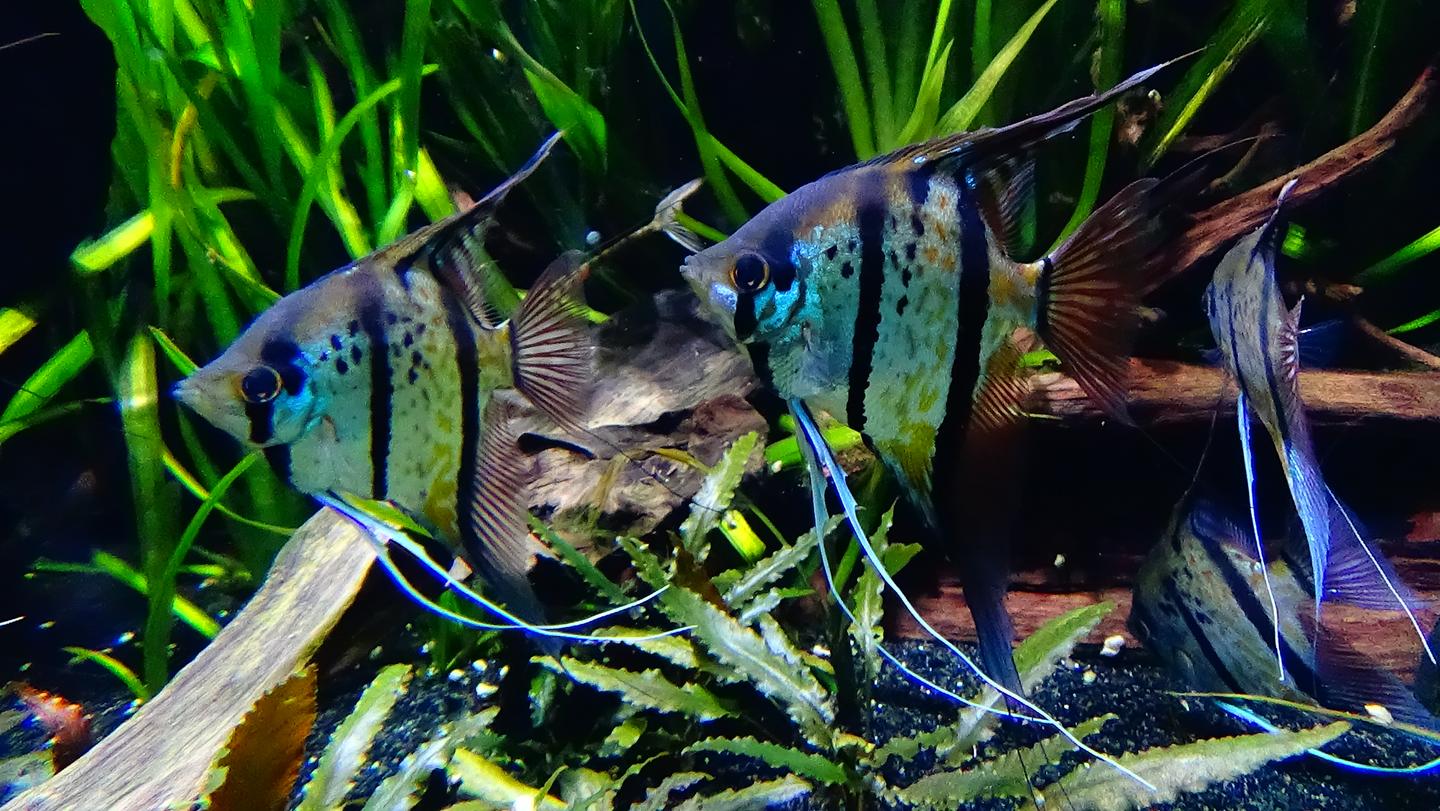
Freshwater angelfish are tall South American cichlids, not small community fish. OATA gives 120 litres as an industry floor for a compatible pair and says the aquarium must be sufficiently tall. We prefer planning around roughly 200 litres, a 100 × 40 cm footprint and about 50 cm height for an adult pair, with more space and an exit plan for a group.
Maintain these water conditions for optimal health and vibrant colors
The red cap freshwater angelfish (Pterophyllum scalare) is a tall-bodied freshwater cichlid from South America’s Amazon basin. It reaches 15 cm in total length and needs considerable vertical room for its extended fins. This colour form suits an intermediate keeper who can provide a mature, tall aquarium, stable warm water and a plan for social and territorial behaviour.
FishBase places Pterophyllum scalare in the cichlid family Cichlidae and records its distribution across the Amazon basin in Peru, Colombia and Brazil, with further localities in French Guiana and Guyana. Adults inhabit swamps and flooded ground where aquatic and riverside vegetation is dense and the water may be clear or silty. Eschmeyer’s Catalog of Fishes also recognises Pterophyllum scalare as the accepted name.
The red cap wording identifies the colour form offered here; its care should still be planned around the adult shape and behaviour of P. scalare. A small fish can look comfortable in a shallow juvenile setup while lacking the height, turning room and territory it will need as it grows.
| Suits | Not suited to |
|---|---|
| A mature, filtered freshwater aquarium | A new aquarium judged ready by its age instead of by tests |
| Roughly 200 litres for an adult pair | A shallow tank sized around a juvenile |
| A compatible pair or deliberately planned group | One isolated fish by default |
| Calm, robust companions screened for adult behaviour | Tiny prey-sized fish, fin-nippers or highly aggressive competitors |
| A keeper prepared to manage territorial disputes | A community where separation is impossible |
One purchase supplies one red cap freshwater angelfish in the size selected. Use the live size selector to choose from the labels shown there: 1 cm, 1.5-2 cm, 2.5-3 cm, 3 - 3,5 cm, 4 - 5 cm, 5 - 5,5 cm, L (5.5-6 cm), XL (6-7 cm) or XXL (>7.5 cm). The size you select is the size supplied, not the adult size.
Those labels describe dispatch size, so use them to judge the fish’s immediate feeding needs, companion size and safe introduction. They do not reduce the adult aquarium requirement. A smaller angelfish still needs a long-term plan for a 15 cm fish with tall extended fins, while a larger grade must have suitable adult-scale space ready before it arrives.
Sex is guaranteed only when the selected option explicitly states male or female. This Pterophyllum scalare red cap listing has no sex-guaranteed option. Do not use forehead shape, fin angle, colour, dispatch size or a gallery scene to choose a sex.
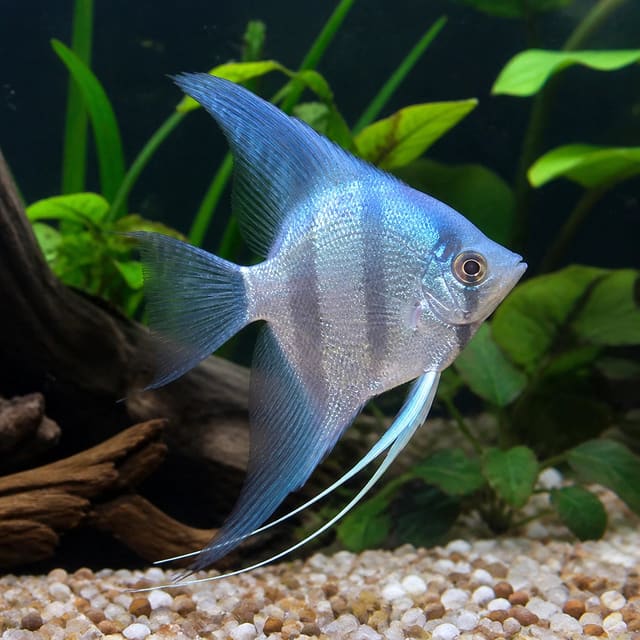
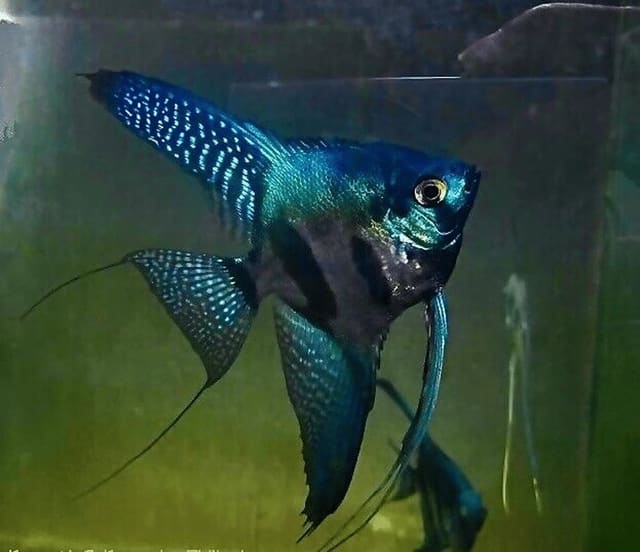
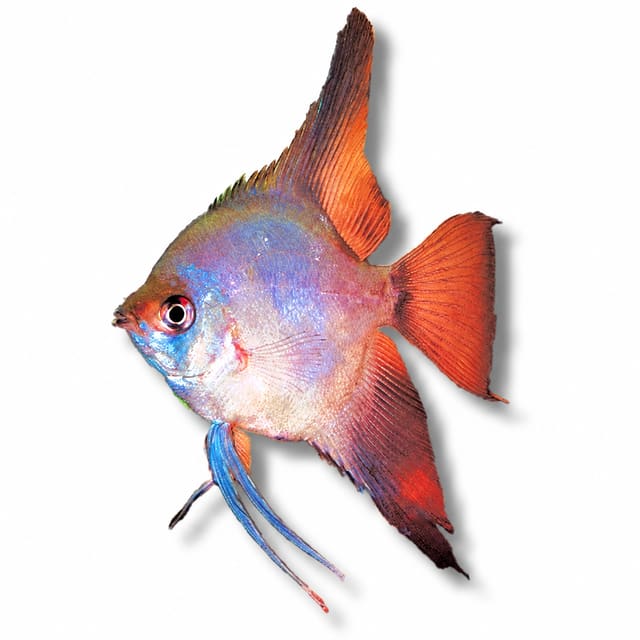
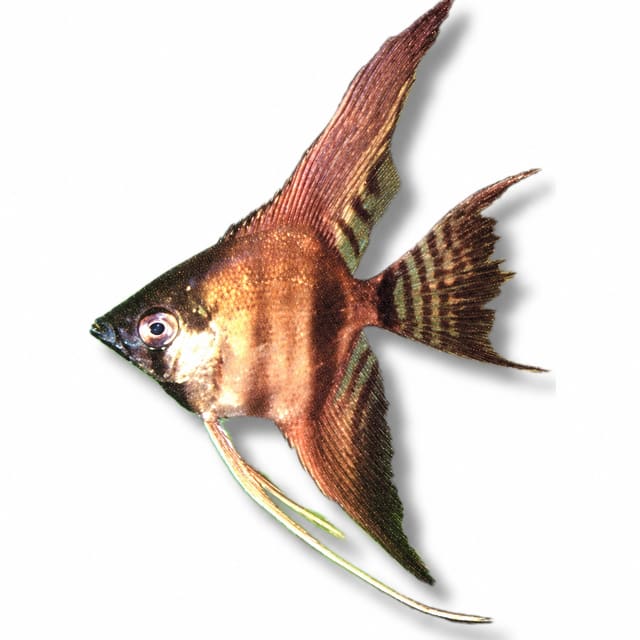
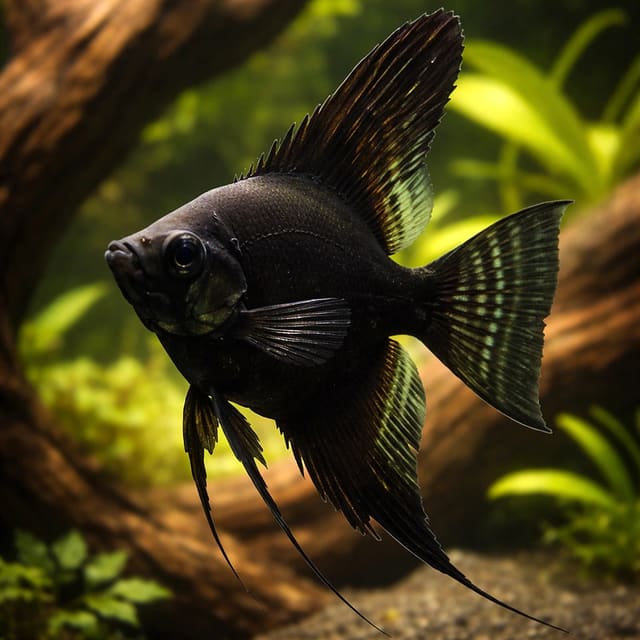
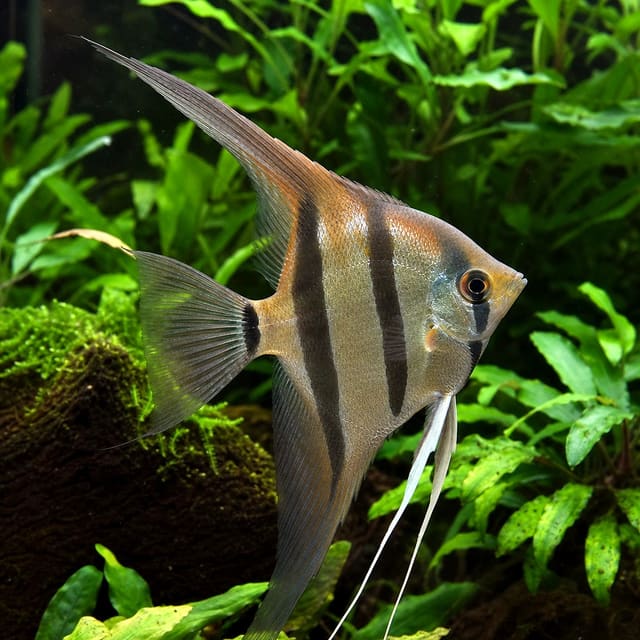
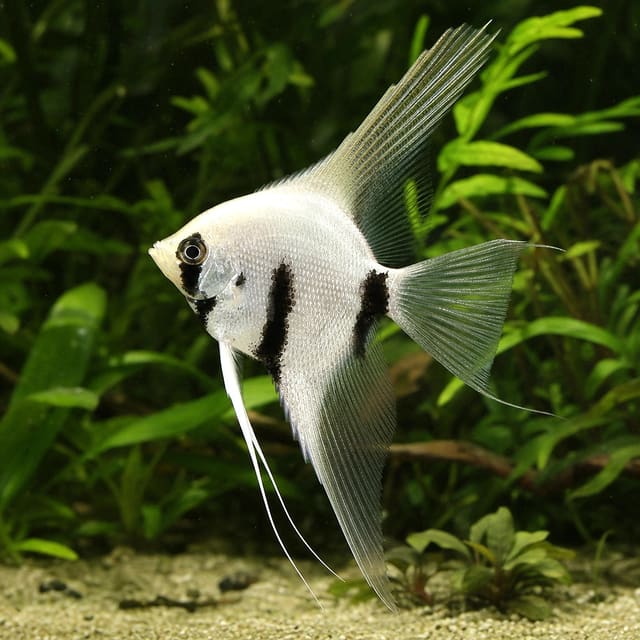
Some gallery images have been digitally enhanced to improve image quality. They show the listed type of animal rather than guaranteeing the exact markings of the individual supplied, so natural colour and pattern can vary. The scenes show the tall angelfish shape, and the body pattern and colour of the fish you receive can differ from them; one image showing two fish does not change the sold unit of one animal per purchase.
If you are comparing colour forms before settling on this one, browse our angelfish collection and apply the same adult-space, water and temperament checks to every choice.
Plan around roughly 200 litres, a 100 × 40 cm footprint and about 50 cm of usable height for an adult pair. A group or mixed community needs more room, broken sight lines and a practical way to separate or rehome a fish if territorial behaviour becomes persistent.
Read our complete freshwater angelfish care guide when planning the whole aquarium. The litres, dimensions, group structure and exit plan work together; no single number can compensate for poor dimensions or incompatible fish.
Use roughly 200 litres with a base around 100 × 40 cm and about 50 cm of usable height as the adult-pair plan. Seriously Fish describes a 100 × 40 × 50 cm aquarium, approximately 200 litres, as the smallest that should be considered. Horizontal room still matters because an adult must turn, feed and move away from its companion without dragging long fins through decor.
OATA’s American-cichlid sheet gives at least 120 litres for a compatible pair of smaller species and says an adult angelfish aquarium must be sufficiently tall. That is broad group guidance rather than a promise that every nominal 120-litre tank has suitable dimensions. Tropical Fish Co therefore uses roughly 200 litres as the more useful adult-pair planning point.
Plan for 15 cm total length. Measure that 15 cm from snout to tail tip; the tall dorsal and anal fins add height on top of it. The Tropical Fish Co guide notes that extended fins can make an adult roughly 20–25 cm tall, so tank height cannot be inferred from body length alone.
| Tank feature | Decision |
|---|---|
| Volume | Start the adult-pair plan at roughly 200 litres |
| Footprint | Provide about 100 × 40 cm or more |
| Usable height | Provide about 50 cm after substrate and clearance |
| Group space | Increase space and add visual barriers |
| Contingency | Prepare a mature separation setup or rehoming route |
A long but shallow aquarium fails the height test, while a tall narrow aquarium may fail the turning-room and territory tests. Measure the usable internal space rather than relying only on the manufacturer’s headline volume.
Keep routine water at 24–27°C, pH 6.5–7.4 and 5–12 dGH. This range overlaps FishBase’s 24–30°C, pH 6.0–8.0 and 5–13 dGH values, Seriously Fish’s 24–30°C, pH 6.0–7.4 and 0–15 dGH aquarium range, and OATA’s 22–27°C, pH 6.5–8.0 and 4–12 dGH American-cichlid guidance.
Stability matters more than chasing a single ideal reading. Test the aquarium before choosing the fish, then compare the measured temperature, pH and hardness with the routine range. Use our water matcher to compare those readings without assuming that every value inside a broad range is equally suitable for an abrupt transfer.
If GH, KH and pH are unfamiliar, read the water chemistry guide before altering tap water. Do not copy a fixed mixture of tap and reverse-osmosis water from another aquarium. The resulting hardness, buffering and pH depend on the water being mixed, so test both the starting water and the prepared replacement water.
A sudden pH, hardness or temperature change can add stress even when the final number sits inside the target range. Make routine adjustments gradually. Detectable ammonia or nitrite is different: treat it as an urgent water-quality problem and act promptly to protect the fish.
Add this angelfish only after testing confirms zero detectable ammonia and nitrite. A mature biological filter must process the waste produced by the fish and its food; elapsed time alone cannot show whether that capacity exists. If this is your first setup, follow our guide to preparing and maturing a tropical aquarium before livestock is introduced.
The RSPCA explains that a working biological filter supports bacteria that convert toxic ammonia into nitrite and then into safer nitrate. Test results reveal whether that process is coping with the aquarium’s actual waste load.
Seriously Fish uses a turnover of four to five times the aquarium volume per hour for its approximately 200-litre example, equivalent to a filter rated around 800–1000 litres per hour. Treat the rating as a starting point because media, pipework and maintenance can affect real flow. Angelfish prefer gentle movement, so distribute the return instead of forcing them to fight a concentrated current throughout the day.
Extra litres help buffer change, but volume does not replace filtration, testing or maintenance. Likewise, a powerful filter cannot make overcrowding safe if the aquarium lacks territory, height or oxygen exchange. Match the biological load, filter capacity and social plan rather than treating one piece of equipment as the whole solution.
Arrange tall plants or upright wood around open turning space. FishBase records wild adults among dense aquatic and riverside vegetation in swamps and flooded ground, while Seriously Fish recommends a well-planted aquarium with tall leafy plants and gentle flow. Use that structure to provide cover and interrupt long lines of sight without filling every route through the tank.
For a pair, create more than one sheltered zone so either fish can move out of direct view. For a group, repeat those barriers across the aquarium rather than placing one dense clump at an end. A fish that is repeatedly chased needs a route to leave the aggressor’s sight, not merely a decorative cave that can become a dead end.
Watch how the fish use the layout. If one individual stays pinned behind equipment, cannot approach food or is chased whenever it enters open water, revise the barriers and use the separation plan. If every route is cramped, remove or reposition decor rather than adding more cover blindly. The aim is a tall, structured aquarium with genuine movement and choice, not a bare box or an impassable thicket.
Use a nutritionally complete cichlid pellet, granule or suitable flake as the staple, choosing a size the fish can swallow. Seriously Fish describes P. scalare as omnivorous and notes that wild fish feed predominantly on zoobenthos such as small crustaceans and other aquatic invertebrates. It also records acceptance of dried foods and enjoyment of live or frozen items in aquaria.
Add suitable frozen or freeze-dried foods for variety. OATA names daphnia, brine shrimp and bloodworm for smaller American cichlids, but these attractive foods should supplement rather than replace a complete staple. A controlled angelfish feeding study supports the importance of feed composition and variety without creating one fixed household menu.
OATA advises feeding once a day and offering only what the fish can consume within a few minutes. Start conservatively, observe every fish eating and remove excess. Increase or reduce the amount from direct observation rather than assuming that a larger mouth or enthusiastic response means the fish needs an unrestricted portion.
| What you see | What to do |
|---|---|
| Food remains after a few minutes | Remove it and reduce the next portion |
| One fish takes nearly everything | Spread the food so subordinate fish gain access |
| Food is repeatedly spat out | Check particle size, condition and water quality |
| Body condition steadily falls | Check feeding access and seek a health assessment |
| Waste rises after feeding | Reduce excess and test ammonia and nitrite |
Overfeeding creates uneaten food and excess waste, which can raise toxic nitrogen compounds. Underfeeding a subordinate fish can occur even when the group appears eager, so watch individuals rather than judging the aquarium by the fastest feeder. A consistent body profile, regular interest in food and clean water are more useful checkpoints than dramatic feeding behaviour.
Make a 25% partial water change at least once every week and test the water at least once a week, keeping a closer routine whenever readings, stocking or feeding call for it. OATA strongly recommends a 25% partial water change at least once every week for American cichlids, with testing at least once a week so ammonia and nitrite do not build up.
Keep a simple record of readings and maintenance. A sequence shows whether nitrate is climbing faster, the filter is losing output or a change followed increased feeding. Waiting for cloudy water or obvious distress allows a manageable trend to become a welfare problem.
Look for steady swimming, regular breathing, clear eyes, open undamaged fins, intact scales, a consistent body profile and reliable feeding. Warning signs include gasping, erratic balance, sitting unusually at the surface or bottom, clamped fins, white spots, fluffy growths, wounds, sudden hiding or loss of appetite. The RSPCA’s fish-health guidance supports checking visible condition and water quality promptly.
If a change appears, test the water immediately and compare it with the fish’s established conditions. Treat detectable ammonia or nitrite as urgent. Move a fish only when the separate aquarium is mature and suitable, and seek specialist fish-vet advice for diagnosis or treatment. Do not use a temperature increase, fasting routine or medication recipe as a substitute for identifying the problem.
Start filming every delivery before the parcel is opened. Make one short, continuous unboxing video showing the parcel still sealed, the parcel being opened and the fish still inside the bag before anything is disturbed.
Arrange for someone to receive the parcel because live fish cannot be left unattended. Tropical Fish Co hand-bags fish in pure oxygen, uses an insulated poly box and adds a heat pack when the weather calls for it. A licensed live-animal courier carries the parcel, with tracking and the confirmed delivery details sent by email.
Float the bag for 20–30 minutes before releasing the fish, and never pour the bag water into the aquarium. These steps and the claim requirements are set out in the delivery and Live Arrival Guarantee policy.
Complete these aquarium checks before the fish is introduced:
OATA advises increasing aquarium populations slowly because the beneficial bacteria in a mature filter must adjust when waste and feeding rise. After introduction, observe swimming, breathing, fin position, colour, feeding access and interactions with every companion. A fish hiding briefly and a fish being persistently excluded require different responses, so look for a pattern rather than reacting to one moment.
If breathing changes, fins clamp, balance becomes unusual or appetite drops, test ammonia, nitrite, nitrate and temperature before guessing at a cause. If another fish blocks food or chases the newcomer repeatedly, use the prepared compatibility response rather than waiting for torn fins or weight loss.
Choose companions by adult size, fin behaviour, temperament, water overlap, feeding speed and territory. Angelfish can live in a robust community, but they remain cichlids and may defend a partner or spawning surface. Individual behaviour changes the outcome, so a stocking plan is conditional rather than a promise of harmony.
| Screening question | Reason |
|---|---|
| Can the adult companion fit in the angelfish’s mouth? | Very small fish may be eaten |
| Does it nip extended fins? | Persistent nipping can damage the dorsal, anal and pelvic fins |
| Does it defend the same territory? | Overlapping claims can create repeated conflict |
| Does its water range overlap 24–27°C and pH 6.5–7.4? | A peaceful temperament cannot fix unsuitable water |
| Can every fish reach food? | Much faster feeders may leave an angelfish or subordinate fish underfed |
Avoid tiny prey-sized fish, including very small tetras, small shrimp and fry, as well as persistent fin-nippers, highly aggressive competitors and much faster-feeding species. Seriously Fish specifically warns that small fish such as tetras may be eaten, while the Tropical Fish Co guide extends that predation warning to very small tetras, small shrimp and fry. Small size at introduction is not protective because companions and angelfish change as they grow.
OATA identifies robust, larger shoaling fish as a possible community category for calmer American cichlids such as angelfish. That category still requires compatible water, enough swimming room and a feeding plan. Corydoras and bristlenose plecos are sometimes considered because they use different aquarium levels, but species, adult size, floor area and water requirements must still be checked.
Before mixing animals, write down the adult size and water range of each one, then identify where it feeds and which territory it uses. If any answer depends on a juvenile staying small or a territorial fish never breeding, change the plan before introduction.
Keep a genuinely compatible pair or a deliberately planned group. FishBase advises five or more angelfish, Seriously Fish recommends small groups because individuals may squabble, and OATA says a pair or group should be the minimum because a singleton may become stressed. These positions describe different workable social plans rather than making two randomly selected fish a bonded pair.
| Social plan | What it requires |
|---|---|
| Compatible adult pair | Roughly 200 litres, adult dimensions and a response if the relationship changes |
| Juvenile group | More space, equal feeding access and preparation for pair formation |
| Adult group | Substantially more room, repeated sight barriers and close observation |
| Community | Adult-size, water, fin and territory screening for every species |
A juvenile group can allow a pair to form, but social rank within the group then changes feeding and aggression. Breeding behaviour can also make a previously calm fish defend a vertical leaf, slate, glass panel or surrounding territory. Treat prolonged hiding, missed meals or torn fins as signs that the arrangement needs intervention.
Use feeding and movement as practical checks. Every individual should be able to cross the aquarium, leave another fish’s line of sight and obtain food. Persistent chasing, cornering or blocked feeding calls for the same response. Rearranging barriers may help when the layout is the problem, but separation or rehoming is the appropriate response when aggression continues.
For a worked example, an aquarium holding a compatible pair and robust larger shoaling fish still needs more than the pair’s basic footprint because the community shares swimming and feeding space. A group of five angelfish needs more than multiplying a nominal litre allowance: territory shape, visual barriers, filtration and an exit plan all affect whether weaker individuals can escape pressure.
It reaches 15 cm in total length. Its extended dorsal and anal fins also require a tall aquarium, so plan around adult dimensions rather than the dispatch size.
Plan roughly 200 litres with about a 100 × 40 cm footprint and 50 cm of usable height for an adult pair. A group or community needs more room, visual barriers and a separation plan.
Use a genuinely compatible pair or a deliberately planned group. FishBase advises five or more, while OATA says a pair or group is the minimum and warns that a singleton may become stressed.
Pterophyllum scalare red cap has an intermediate care level. It suits a prepared keeper with a mature, tall aquarium who can test water, screen companions and respond to territorial aggression.
Feed a complete cichlid pellet, granule or suitable flake as the staple, with suitable frozen or freeze-dried variety. OATA advises one daily portion consumed within a few minutes.
Keep this fish at 24–27°C, pH 6.5–7.4 and 5–12 dGH. These routine values are the overlap of FishBase, Seriously Fish and OATA guidance.
Treat it as semi-aggressive: it is generally peaceful but may squabble and become territorial during pair formation or breeding. Keep persistent fin-nippers away because they can damage its extended fins.
Robust larger shoaling fish with overlapping water needs may suit a carefully planned community. Avoid tiny prey-sized fish, including very small tetras, small shrimp and fry, as well as fin-nippers, highly aggressive competitors and much faster-feeding species.
Start filming every delivery before opening the parcel, making one short, continuous unboxing video that shows it still sealed, then being opened and the fish still in the bag. It is hand-bagged in pure oxygen and placed in an insulated poly box with a heat pack when weather calls for it. Someone must receive the parcel; float the bag for 20–30 minutes before release and never pour bag water into the aquarium.
No reviews for this item yet. Bought one? Honest reviews only, good or bad.
What customers say about ordering from us
Easy website plenty of info on fish your buying great to pick a time slot
TRACEY DURRANT · 7 Oct 2026
Got some lovely fish thank you
Kevin Mackie · 7 Oct 2026
Reviews of our shop, collected by Judge.me, an independent third-party review collector. Newest first.