Moderate
Pterophyllum Scalare Bulgarian seal points
24–27°C · pH 6.5–7.4 · 200L
£12.99

Elegant freshwater angelfish with graceful fins and striking shape. Ideal for community setups with the right tank mates. Buy online for UK delivery today.
Adult size is the maximum length this species reaches at full maturity (scientific sources). The livestock you receive will be younger and smaller. Product-photo provenance and any image-specific limitations are stated on the listing.
Pterophyllum scalare
Save when buying multiple fish. Each quantity is one fish; sex and pair formation are not guaranteed unless the selected variant explicitly states them.
Minimum of 2 per order.
Elegant freshwater angelfish with graceful fins and striking shape. Ideal for community setups with the right tank mates. Buy online for UK delivery today.
Adult size is the maximum length this species reaches at full maturity (scientific sources). The livestock you receive will be younger and smaller. Product-photo provenance and any image-specific limitations are stated on the listing.
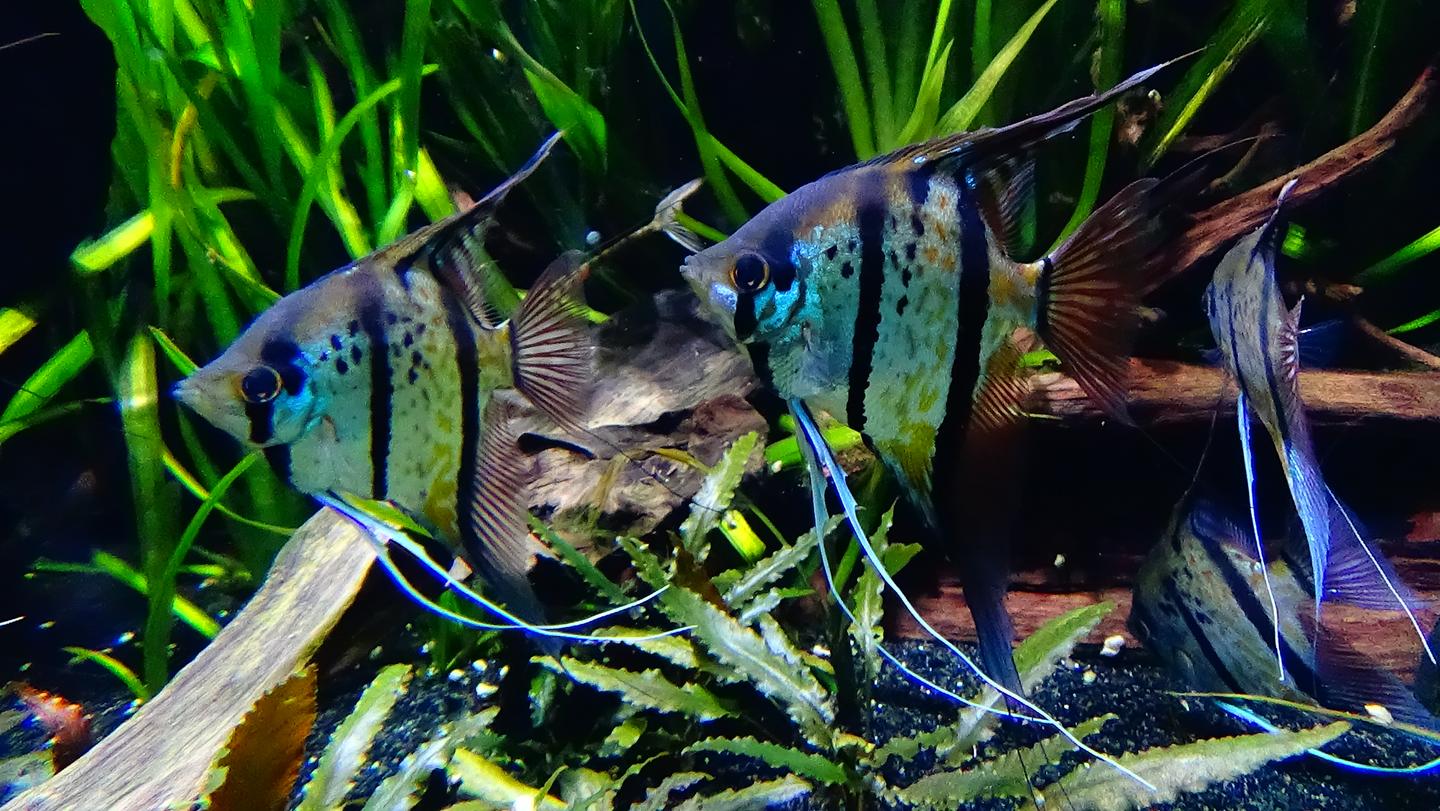
Freshwater angelfish are tall South American cichlids, not small community fish. OATA gives 120 litres as an industry floor for a compatible pair and says the aquarium must be sufficiently tall. We prefer planning around roughly 200 litres, a 100 × 40 cm footprint and about 50 cm height for an adult pair, with more space and an exit plan for a group.
Maintain these water conditions for optimal health and vibrant colors
If you want a striking centrepiece fish but also need realistic advice on angelfish tank mates, the freshwater angelfish Pterophyllum scalare remains one of the smartest choices for a tall tropical aquarium. Native to slow-moving parts of the Amazon basin, these elegant freshwater angelfish combine long trailing fins, bold body height, intelligent angelfish behaviour, and a surprisingly broad range of angelfish colors and patterns. Adult angelfish size usually reaches 15-20 cm in height and body length combined, so this is not a fish for cramped tanks; understanding angelfish tank size, angelfish minimum tank size, and suitable angelfish aquarium requirements is essential before you buy. With the right angelfish tank setup, stable angelfish water parameters, and carefully chosen companions, they can thrive for 7-10 years, making angelfish lifespan in aquarium much better than in poorly planned community tanks.
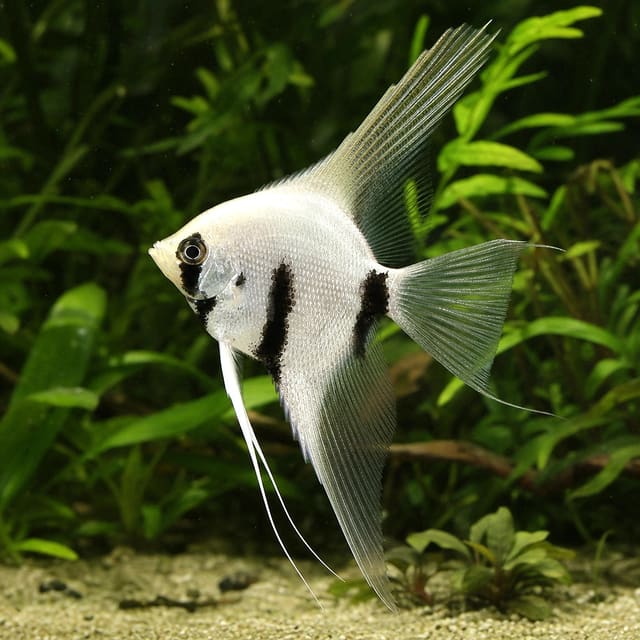
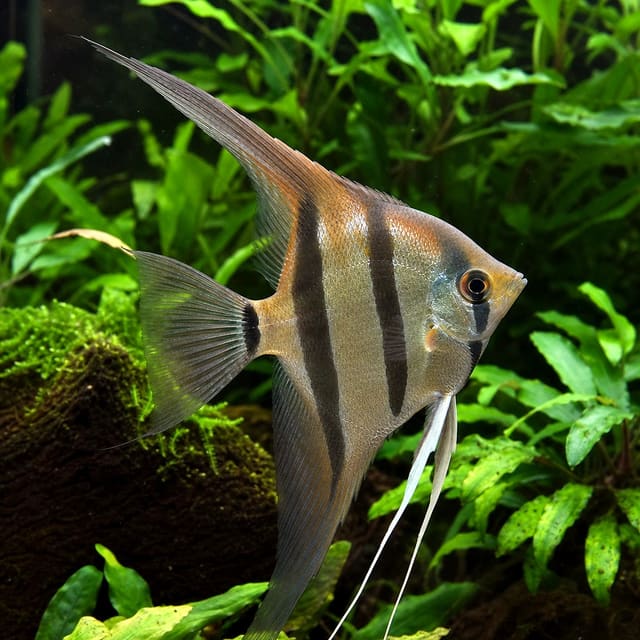
See our detailed photos showing body shape, finnage, and the kind of spacing needed for Angelfish for community tank planning. Whether you are researching best angelfish for beginners, comparing angelfish types, or looking for practical advice on Angelfish with tetras, this guide covers real-world care for hobbyists in the UK. For aquarists searching for aquarium angelfish UK options that look impressive without needing discus-level precision, angelfish offer a rewarding middle ground: beautiful, interactive, and highly adaptable when their tank mates are chosen with care.
Pterophyllum scalare is the classic aquarium angelfish and the species most aquarists mean when they discuss common angelfish. It belongs to the cichlid family, making it a true cichlid angelfish with the intelligence, pair bonding, and territorial instincts expected from South American cichlids. In the hobby, it sits between beginner-friendly community fish and more demanding species such as discus, which is why many keepers compare angelfish vs discus before choosing a display fish for a planted tropical aquarium.
The natural angelfish habitat is the Amazon basin across Colombia, Guyana, Suriname, Peru, and Brazil. In the wild, freshwater angelfish are found in calm floodplain waters, slow tributaries, and heavily structured margins with roots, reeds, and submerged branches. This matters because the best angelfish aquarium setup ideas copy that vertical structure: tall plants, shaded areas, and open midwater lanes for gliding.
Wild fish often live in warm, soft, slightly acidic water. That is why angelfish pH level and angelfish water hardness are worth paying attention to, even though tank-bred fish are more adaptable than wild imports. Their native environment is rich in insect larvae, small crustaceans, plant matter, and tiny fish, which explains the flexible angelfish diet and also why very small tank mates may be viewed as food.
Because they are laterally compressed, angelfish can slip between stems and roots while still appearing large from the front. This body shape is one reason they do so well angelfish in planted tank layouts with Amazon swords, Vallisneria, and tall background planting. Hobbyists often ask about good companion fish for angelfish because wild behaviour is not truly schooling in the tetra sense; instead, angelfish are social cichlids that establish hierarchy and territory as they mature.
Among South American cichlids UK keepers, angelfish are popular because they bring Amazon character without the extreme size or aggression of larger cichlids. If you are building an Angelfish for large aquarium display, their natural look is especially impressive against wood and broad-leaf plants. They are not threatened in the hobby due to extensive captive breeding, and many domestic strains now include marble angelfish, zebra angelfish, platinum, smoke, and koi angelfish forms.
Mimicking the natural habitat improves angelfish health and brings out calmer behaviour. Tall décor, broken lines of sight, and subdued flow reduce chasing and help semi-aggressive adults share space more successfully.
A successful angelfish tank setup starts with height, not just volume. The usual mistake is buying a long but shallow aquarium and assuming the litres alone are enough. Because adult angelfish size includes tall dorsal and anal fins, they need a tank with real vertical swimming room. The practical angelfish minimum tank size is 200 litres for a small group or a settled pair, while a more comfortable angelfish tank size is 300 litres if you want mixed angelfish freshwater tank mates and room for hierarchy to settle.
For juveniles, many keepers ask about angelfish tank mates 20 gallon, angelfish tank mates 29 gallon, or angelfish tank mates in a 30 gallon. In practice, these sizes are too limited for adult angelfish communities. A 20 gallon is not suitable long term. A 29 gallon or 30 gallon may work only as a temporary grow-out for young fish, not as a permanent display. Better planning starts at the level of angelfish tank mates 40 gallon for a pair, while angelfish tank mates 55 gallon, angelfish tank mates 60 gallon, and angelfish tank mates 75 gallon open up much safer stocking options.
Reliable angelfish water temperature is one of the most important factors in long-term care. Ideal angelfish temperature is around 27°C, though safe angelfish temperature requirements range from 24-30°C. Keep the heater stable rather than chasing daily fluctuations. For chemistry, aim for angelfish ideal water conditions around pH 6.8, with acceptable angelfish water parameters of pH 6.0-7.4 and hardness 0-15 dGH. Tank-bred fish tolerate neutral water well, but sudden shifts are more harmful than slightly imperfect numbers.
Choose filtration that keeps water polished without blasting the fish. Angelfish prefer moderate flow, so external canisters with spray bars or adjustable outlets work well. Strong current can stress long-finned forms such as veil strains. Mechanical filtration removes debris from heavy feeding, while biological media supports the stable nitrogen cycle needed for good freshwater angelfish care.
There is no strict angelfish substrate preference, but dark sand or smooth fine gravel often gives the best visual effect and encourages confident behaviour. Corydoras companions do best on smooth substrates, so this choice also supports mixed communities. A natural-looking base works well in angelfish in planted tank systems.
Use tall plants and vertical décor. Amazon swords, Vallisneria, Cryptocoryne, floating plants, and pieces of branchwood all help. Broad leaves can also become spawning sites during angelfish breeding. If you enjoy colour morphs, compare varieties such as Platinum White Angelfish - Pterophyllum Scalare, Dalmatin Angelfish Pterophyllum Scalare South Stunning, Koi Angelfish, and Smoke Angelfish - Pterophyllum Scalare - to build a display around different patterns.
Moderate lighting for 7-9 hours suits most planted displays. Too much light in sparse décor can make angelfish skittish. Floating cover softens the tank and helps display fish settle. This is especially useful in angelfish aquarium setup ideas designed around natural Amazon ambience.
Always cycle the tank for 4-6 weeks before adding angelfish. Stable biofiltration matters more than chasing exact numbers, and it is one of the biggest differences between average and excellent angelfish care.
The natural angelfish diet is omnivorous. In the wild they pick at insect larvae, worms, tiny crustaceans, and plant material, so the best captive plan mixes protein-rich staples with variety. A proper angelfish feeding guide should focus on quality, portion control, and enough diversity to support growth, colour, and breeding condition.
Use a high-quality tropical granule or cichlid micro pellet as the daily base. This supports steady angelfish growth rate without the bloating often seen from low-grade flake-only diets. Juveniles benefit from smaller meals twice daily, while adults usually do well on one to two measured feeds.
Frozen bloodworm, brine shrimp, mysis, daphnia, and finely chopped krill all work well. These foods are useful for conditioning pairs for angelfish breeding and for enhancing the contrast in angelfish colour varieties. Many keepers notice stronger finnage and better body depth when fish receive mixed frozen foods rather than pellets alone.
For show fish such as koi angelfish, marble angelfish, and the most colourful angelfish strains, carotenoid-rich foods can intensify reds, oranges, and gold tones. This is also helpful when comparing koi angelfish vs marble angelfish in a display tank. Occasional live foods can stimulate feeding response, but use reputable sources to reduce parasite risk.
| Time | Food | Amount |
|---|---|---|
| Morning | High-quality granule or small cichlid pellet | What they finish in 30-60 seconds |
| Evening | Frozen brine shrimp, bloodworm, or daphnia | Small pinch, no leftovers after 1 minute |
When people search buy angelfish UK, order Angelfish online UK, or compare Angelfish price UK, feeding is often overlooked. Yet diet strongly affects angelfish lifespan, body shape, and disease resistance. A fish that is cheap to buy but poorly fed will not develop into the elegant adult seen in established display tanks.
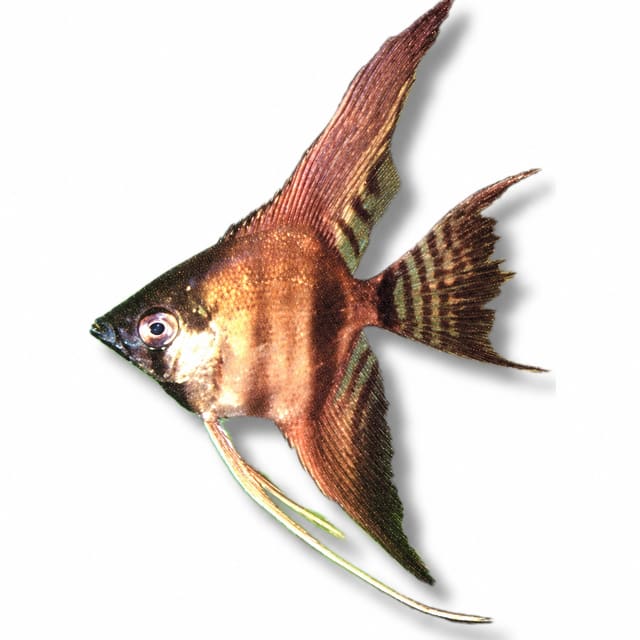
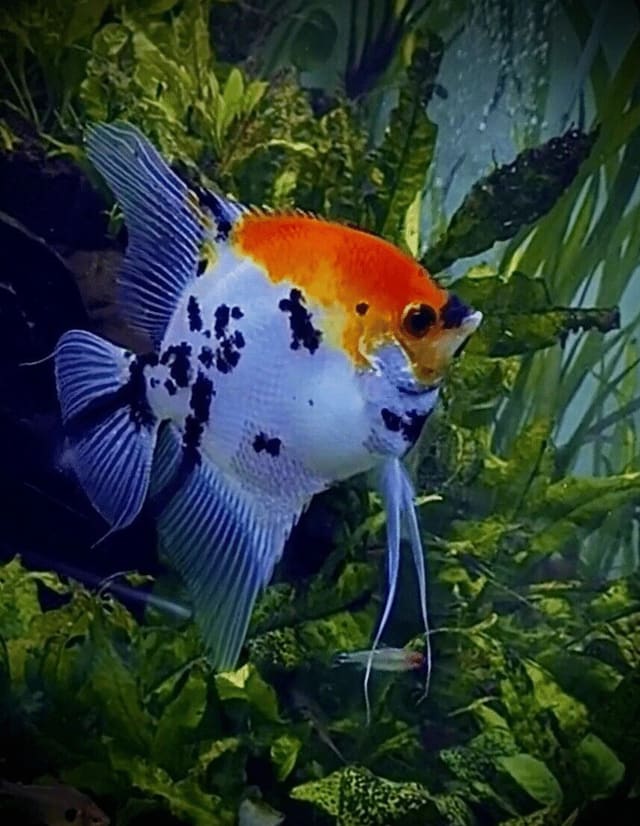
A popular choice if you want a bold orange-white pattern and a fish that responds well to varied frozen foods and quality granules.
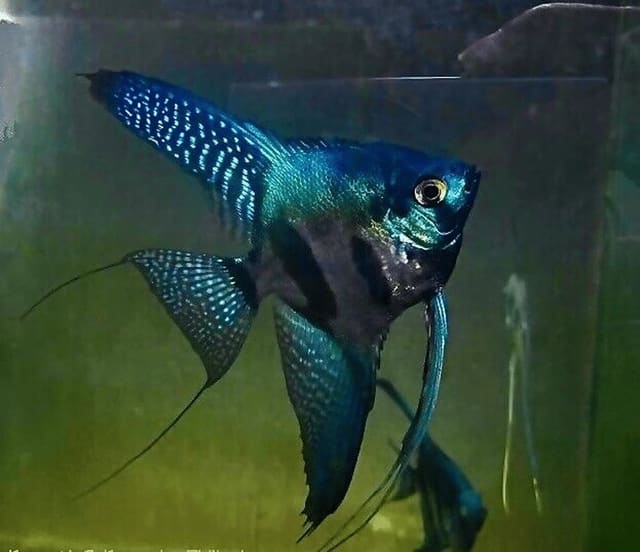
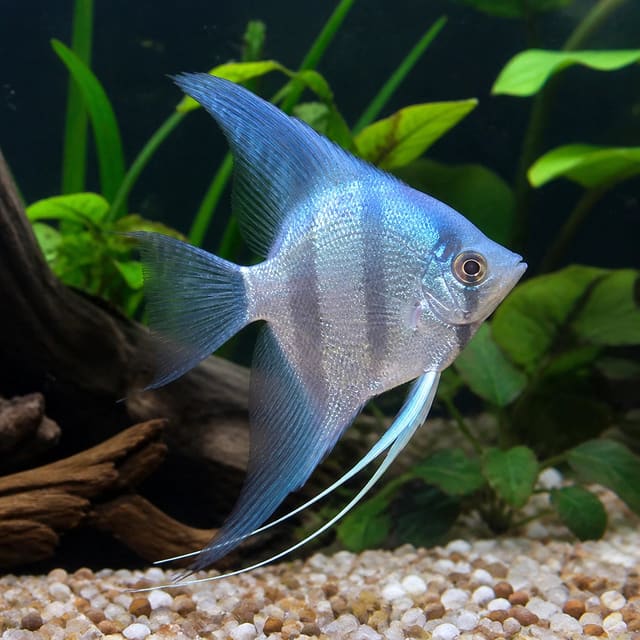
An eye-catching option for aquarists who want cool-toned colour contrast in a planted Amazon-style setup.
Overfeeding causes ammonia spikes, dirty substrate, and poor water quality. Angelfish are eager feeders, but swollen bellies, stringy waste, and leftover food are signs to cut portions back immediately.
Angelfish are famous for their tall, triangular profile and long, sail-like fins. Adult body length is often around 15 cm, but overall height can approach 20 cm in mature specimens, especially long-finned strains. That dramatic silhouette is why a tall aquarium matters so much more than many beginners expect.
There are many angelfish types in the hobby, from silver wild-type fish with vertical bars to smoky, marbled, platinum, blue, zebra, and koi strains. Popular examples include zebra angelfish, marble angelfish, and bright orange-white koi angelfish. Some aquarists look for the most colourful angelfish types, while others prefer understated silver or smoke forms that resemble wild fish.
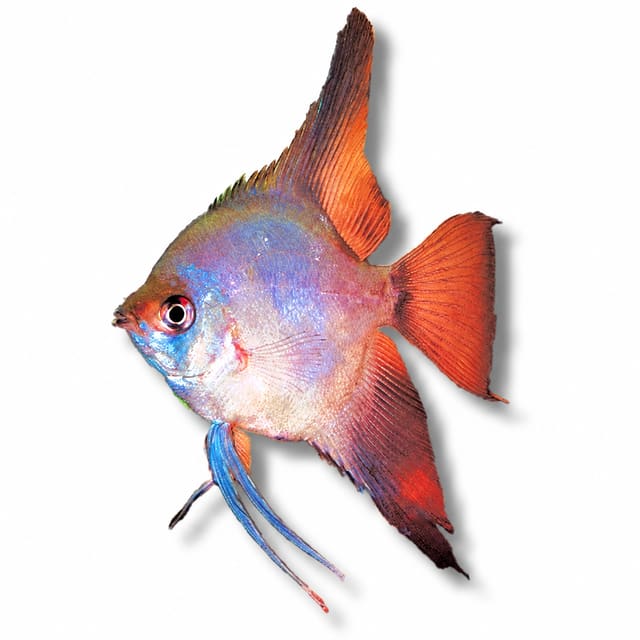
Our photos show the contrast between clean-bodied strains and patterned fish, helping you compare angelfish colors before choosing. If you enjoy variety, explore Angel Fish, X Angel Fish, and Blue Diamond Angelfish. Tropical Fish for different display styles. Long-finned forms may need extra thought around veil angelfish tank mates, because nippy species can shred finnage quickly.
Sexing is difficult until fish mature. Breeding females often show a broader ovipositor before spawning, while males may appear slightly more angular, but this is not always reliable. Good diet, dark substrate, and calm lighting bring out the strongest colour in the best angelfish varieties.
This is the question most buyers ask first, and for good reason. The best tank mates for angelfish are medium-sized, calm fish that enjoy similar warm water and are too large to be eaten yet not aggressive enough to harass long fins. A realistic angelfish tank mates list includes larger tetras, Corydoras, Bristlenose plecos, some rasboras, peaceful gouramis, and selected loaches.
Cory catfish angelfish combinations are among the safest because corys occupy the bottom while angelfish hold the midwater. Bristlenose pleco and angelfish also work well in many setups, especially in 200 litres and above. For midwater movement, larger tetras can be excellent schooling fish for angelfish tank displays. Many hobbyists ask about Angelfish with tetras or angelfish with cardinal tetras; cardinals can work in a large, mature tank if the angelfish are raised with them and the tetras are not tiny juveniles.
Kuhli loach angelfish pairings are usually fine because kuhli loaches stay low and hidden. Zebra loach with angelfish is more mixed; some loaches are too active or boisterous for long-finned angelfish, so caution is needed. Bolivian ram angelfish communities can work in spacious aquariums because Bolivian rams are relatively peaceful cichlids. By contrast, rainbow kribs angelfish setups may become territorial during breeding, so they need more observation.
Many aquarists also ask about discus and angelfish tank mates. It can be done, but discus need tighter control of stress, feeding, and water quality. For most keepers, angelfish-only or angelfish-plus-community tanks are easier than mixed discus systems. This is one reason the angelfish vs discus decision often comes down to how much precision you want in daily care.
Bad tank mates for angelfish include fin nippers such as tiger barbs, very small fish such as neon tetras, and species with incompatible temperature needs. Searches for angelfish tank mates goldfish are common, but goldfish are a poor match because they prefer cooler water and produce heavy waste. Angelfish tank mates guppy is another weak combination; guppies are often nipped or eaten, and their water preferences differ.
Questions like can angelfish live with mollies come up often. Sometimes yes, but mollies prefer harder, more alkaline water than ideal for angelfish, so it is not the most natural pairing. Angelfish and african dwarf frogs are also risky because feeding competition and opportunistic nipping can occur. Similarly, searches for best shrimp to keep with angelfish usually lead to a disappointing answer: most shrimp will eventually be hunted, especially juveniles.
For angelfish tank mates 40 gallon, think one bonded pair with bottom dwellers rather than a full group. In angelfish tank mates 55 gallon or angelfish tank mates 60 gallon setups, a small group of angelfish plus corys and a Bristlenose can work if the tank is tall and planted. In angelfish tank mates 75 gallon, you have more freedom for a proper Amazon community with 4-6 angelfish, a school of larger tetras, corys, and a pleco.
| Species | Compatible? | Notes |
|---|---|---|
| Koi Angelfish | ✅ Yes | Same species; works best when juveniles are grown together in a tall tank. |
| Corydoras | ✅ Yes | Excellent bottom-dwelling companions; classic cory catfish angelfish pairing. |
| Bristlenose Pleco | ✅ Yes | Strong option for bristlenose pleco and angelfish communities. |
| Cardinal Tetras | ⚠️ Caution | Better in large, mature tanks; small individuals may be eaten by adult angelfish. |
| Bolivian Rams | ⚠️ Caution | Bolivian ram angelfish can work if both species have enough floor and visual barriers. |
| Goldfish | ❌ Avoid | Poor temperature match and very different care needs. |
If you are adding angelfish to a community tank, always judge companions by adult size, temperament, and water preference. The most reliable best tank mates for angelfish are calm, medium-sized tropical fish from similar conditions. That is the foundation of a good angelfish compatibility chart.
Always quarantine new arrivals for 2-4 weeks before mixing them with established angelfish. This reduces parasite introduction and also gives you time to observe whether a new fish is too timid, too nippy, or too aggressive for the group.
Angelfish breeding is moderate in difficulty and one of the most rewarding parts of keeping this species. Mature pairs often form naturally from a group, clean a vertical surface, and lay eggs in neat rows. Because they are cichlids, they show strong parental behaviour, though first-time parents sometimes eat their eggs.
A separate breeding tank of around 100-150 litres works well for a pair. Keep angelfish temperature around 27-28°C, pH slightly acidic to neutral, and water very clean. Broad leaves, slate, or a spawning cone provide the vertical surface they prefer. This is one area where understanding altum angelfish vs scalare angelfish matters: true altums are generally more demanding, while standard scalare strains are the practical choice for most home breeders.
Condition the pair with a varied angelfish feeding guide of pellets, brine shrimp, and bloodworm. The female deposits adhesive eggs, and the male follows to fertilise them. You will often see both fish fan the clutch and defend the area intensely. During this stage, even normally peaceful angelfish varieties become territorial.
Eggs usually hatch in 48-72 hours depending on temperature. Parents may move wrigglers to another cleaned surface. Some breeders leave the eggs with the parents; others remove the spawning slate to prevent egg eating. Both methods can work. Good aeration and fungus control are important, especially in harder water.
Free-swimming fry need infusoria or liquid fry food at first, followed quickly by newly hatched brine shrimp. The early angelfish growth rate is strongly tied to water changes and feeding frequency. Small, frequent feeds and daily maintenance produce better finnage and body shape. This is also where angelfish lifespan and size are influenced for the long term.
For higher hatch rates, many breeders use a removable slate or spawning cone so the eggs can be transferred to a separate hatching tank with identical water. This reduces losses from inexperienced parents while still allowing you to condition the pair naturally.
Many buyers compare angelfish with other centrepiece fish before deciding what suits their tank. The most common comparison is angelfish vs discus, because both are South American cichlids with graceful shapes and warm-water needs. Discus are usually more demanding, more expensive, and less forgiving of mistakes in maintenance.
| Feature | Angelfish | Discus |
|---|---|---|
| Max Size | 15-20 cm | 15-20 cm body depth, heavier build |
| Care Level | Moderate / intermediate | Advanced |
| Temperature | 24-30°C | 28-31°C |
| Price | £15.48 | £40+ |
| Best For | Planted community centrepiece | Specialist warm-water display |
If you want a fish with personality, elegant movement, and easier compatibility, angelfish are usually the better choice. They suit hobbyists looking for best angelfish for beginners among larger cichlids, though they are still not a true beginner fish in tiny tanks. Discus reward expert care but demand tighter feeding and water change routines.
Within the species itself, aquarists also compare morphs such as koi angelfish vs marble angelfish, or look at specialist lines like bicolor angelfish tank mates and altum angelfish tank mates. Standard scalare strains are more forgiving than altums, and they offer the broadest range of angelfish colour varieties. If you like bold contrast, browse Platinum White Angelfish - Pterophyllum Scalare or Smoke Angelfish - Pterophyllum Scalare -. If you want warmer tones, Koi Angelfish is a classic choice.
Good angelfish health starts with water quality, diet, and stress reduction. Healthy fish hold fins open, swim steadily in the midwater, respond quickly to food, and show clear eyes and intact scales. Clamped fins, hovering in corners, rapid breathing, or darkened colour usually indicate stress or disease.
Angelfish can suffer from ich, bacterial fin damage, internal parasites, hole-in-the-head linked to poor diet and water quality, and secondary infections after bullying. Long-finned strains are especially vulnerable to fin damage if kept with nippers. Digestive issues are also common when fish are overfed on rich foods.
First correct the environment: test ammonia, nitrite, nitrate, temperature, and pH. Then isolate affected fish if needed. Warm, stable water and improved maintenance solve many mild problems early. For parasite or bacterial outbreaks, use proven aquarium medications according to diagnosis. Avoid random treatment, especially in mixed tanks with sensitive species.
Never use copper-based medications in tanks containing shrimp or other delicate invertebrates. Copper can be lethal, and many keepers discover this only after trying to combine angelfish with shrimp in a community setup.
Questions around freshwater angelfish tank mates, angelfish and gourami tank mates, and gourami and angelfish tank mates often become health questions in disguise. Poor compatibility creates chronic stress, and chronic stress leads to disease. This is why a calm stocking plan matters just as much as medication. If you are shopping for angelfish for sale UK, choose fish that are alert, feeding, and free from pinched bellies or damaged fins.
Angelfish behaviour changes with age. Juveniles are usually social and can be grown in groups, but adults become more territorial, especially as pairs form. They occupy the midwater and often choose a favourite leaf, branch, or corner to patrol. This is normal for a cichlid angelfish and not a sign that the fish is “mean” by default.
In a well-designed tank, angelfish glide rather than dart. They investigate the keeper, learn feeding times, and often become bolder in planted layouts with shaded cover. During breeding, they clean surfaces, fan eggs, and guard fry with impressive dedication. These are some of the most interesting angelfish facts for aquarists who enjoy fish with personality.
To encourage natural behaviour, keep them in a tall tank with visual barriers and avoid overcrowding. A thoughtful angelfish stocking list prevents constant line-of-sight conflict. Calm companions, warm stable water, and structured décor are the keys to seeing the species at its best.
When buying angelfish UK stock, quality matters more than choosing the cheapest listing. Young angelfish should show straight bodies, full finnage, good appetite, and alert posture. We focus on well-started fish that are already feeding reliably on prepared foods, which helps them settle faster after Angelfish delivery UK. This is especially important with delicate-finned varieties and high-contrast strains where poor early care quickly shows.
Each fish is observed before dispatch, and we only send stock that is active and feeding. Fish are packed in insulated boxes, with heat packs used in cold weather, and shipped by tracked service using professional fish-bagging methods to protect fins and maintain temperature. For customers researching buy angelfish online UK, live angelfish delivery UK, or freshwater angelfish for sale UK, this preparation makes a real difference on arrival.
We also know that buyers comparing live angelfish for sale UK, angelfish for sale, and angelfish for sale UK often need help choosing the right variety. If you want a bold patterned fish, consider Dalmatin Angelfish Pterophyllum Scalare South Stunning. If you prefer a clean, bright display specimen, look at Platinum White Angelfish - Pterophyllum Scalare. If warm orange tones appeal to you, Koi Angelfish remains one of the best angelfish varieties for planted tanks.
Order your angelfish today with confidence if you want a graceful Amazon centrepiece backed by practical care information, realistic compatibility advice, and careful packing for UK transit.
Build a more complete angelfish display with related varieties and compatible centrepiece options. Try a patterned Smoke Angelfish - Pterophyllum Scalare - for a darker contrast, or mix visual styles with Blue Diamond Angelfish. Tropical Fish in a spacious tall aquarium. If you want a classic community look, Angel Fish offers the familiar scalare shape that pairs well with larger tetras and corydoras. For hobbyists comparing colour strains, X Angel Fish and Koi Angelfish are both strong options for a planted Amazon-style setup.
No reviews for this item yet. Bought one? Honest reviews only, good or bad.
What customers say about ordering from us
I have a small group of long finned mountain minnows. So was delighted to be able to order ten of this variety to increase the genetics in my tank . The ones I recieved are healthy but it’s to early to give a verdict on wether they are of a long finned type since they are small currently.
Gordon Walker · 23 Sept 2026
100% success travel and "installation". Pleased with quality of purchase. The Siamese fighter a bit "shy" so have not yet seen him at his best yet but looking good. Happy customer. GG
George E Garratt · 21 Sept 2026
Reviews of our shop, collected by Judge.me, an independent third-party review collector. Newest first.