Moderate
Pterophyllum scalare Pinoy green ghost
24–27°C · pH 6.5–8 · 200L
£13.99

One live, unsexed Zebra Angelfish (Pterophyllum scalare) in the selected approximate size. A strongly barred silver-gold freshwater angelfish for a tall, mature aquarium.
Pterophyllum scalare
Save when buying multiple fish. Each quantity is one fish; sex and pair formation are not guaranteed unless the selected variant explicitly states them.
Confirm your email, then we’ll send an availability message for this exact item if it returns within 180 days.
This request is only for this product—no newsletter or other promotions. A mail-provider retry may very rarely duplicate the same availability message. Unconfirmed addresses are removed after 48 hours. See our privacy policy.
One live, unsexed Zebra Angelfish (Pterophyllum scalare) in the selected approximate size. A strongly barred silver-gold freshwater angelfish for a tall, mature aquarium.
Freshwater angelfish are tall South American cichlids, not small community fish. OATA gives 120 litres as an industry floor for a compatible pair and says the aquarium must be sufficiently tall. We prefer planning around roughly 200 litres, a 100 × 40 cm footprint and about 50 cm height for an adult pair, with more space and an exit plan for a group.
Maintain these water conditions for optimal health and vibrant colors
This product supplies one live, unsexed Zebra Angelfish in the approximate size chosen from the selector. It is a domestic striped form of Pterophyllum scalare, recognised by a deep silver-gold body, multiple dark vertical bars and the high dorsal and anal fins that give freshwater angelfish their distinctive outline. One basket unit is one fish; it is not a pair, sexed specimen or fixed stripe pattern.
Plan the aquarium around an adult cichlid rather than the juvenile dispatch grade. The fish needs warm stable freshwater, substantial vertical clearance, open turning room and companions that will neither nip its fins nor fit into its mouth. Availability and price can differ between sizes, so confirm the selected option and basket immediately before ordering.
| At a glance | Evidence-led guidance |
|---|---|
| Species | Pterophyllum scalare |
| Domestic form | Zebra / strongly barred phenotype |
| Family | Cichlidae |
| Order unit | One live, unsexed fish in the selected approximate grade |
| Published maximum total length | 10.5 cm in FishBase |
| Adult vertical allowance | Roughly 20-25 cm including extended fins for conservative aquarium planning |
| Difficulty | Moderate |
| Behaviour | Semi-aggressive cichlid; hierarchy and spawning territory require management |
| Social route | Five or more in a properly sized group, or one established adult/compatible pair with a backup plan |
| Practical adult aquarium | About 180 litres, 100 cm long and 50 cm tall for one established adult or compatible pair |
| Group aquarium | About 250 litres or more, 120 cm long and 50-60 cm tall for five to six |
| Temperature | 24-28°C practical captive range |
| pH | 6.0-7.5 practical captive range |
| General hardness | 5-13 dGH |
| Food | Complete omnivore staple with measured animal-food variety |
| Swimming level | Primarily middle water, especially around tall cover |
Selecting quantity one adds one live fish. Selecting five adds five unsexed fish. The social recommendation does not silently turn a single unit into a group, and no pair pricing or shoal-price function is attached to this product.
Each option is a working livestock grade rather than an exact millimetre promise. A fish can sit near either edge, and fin position changes how large it appears. The grade cannot prove age, maturity, sex or eventual adult dimensions.
Young angelfish cannot be reliably sexed from routine external appearance. Even mature individuals can remain ambiguous away from breeding condition. No chosen size, forehead shape or fin shape can be used here as a male, female or breeding-pair guarantee.
The care information remains useful when every option is unavailable. Look at the selected option and basket for current stock and price; saved pages and earlier visits may no longer reflect live availability.
The supplier calls the fish Zebra, but has not supplied a genotype, pedigree, breeder name or inheritance record. We therefore describe the observed striped phenotype without presenting an unverified allele combination as fact.
| Selection | What it confirms | What it cannot confirm |
|---|---|---|
| One size option | One fish in that approximate grade | Exact length, age or maturity |
| Quantity two | Two unsexed fish | A compatible male-female pair |
| Quantity five | Five unsexed fish | Equal sex ratio or permanent peace |
| Very small grade | A juvenile needing specialised grow-out attention | Safety with adult tank mates |
| Visible page | Care and comparison information | That an option is currently in stock |
Zebra is not a separate species. This fish remains Pterophyllum scalare, the commonly kept freshwater angelfish. Domestic selection can alter bars, body colour and fins without changing the underlying species-level needs for space, social management and warm clean water.
Phenotype means the appearance expressed by the fish. Specialist angelfish references associate the Zebra phenotype with a dominant mutation at the Zebra locus, but appearance alone does not certify whether this supplier fish carries one or two copies or another modifying gene. The page stays with what can be seen.
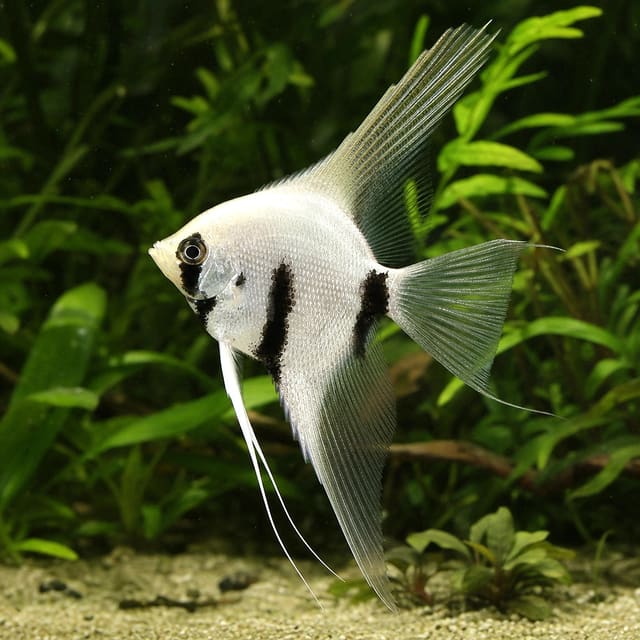
The Angelfish Society describes Zebra fish as commonly expressing three to five vertical body stripes in addition to the eye stripe. The reference photo displays several bold bars across a silver-gold body and patterned fins. Individual count and continuity can differ, so the reference is a guide rather than a template.
Writing "zebra" after the species name in supplier data identifies a domestic form; it does not create a formally described subspecies called Pterophyllum scalare zebra. The customer title therefore keeps Zebra as the common trade name and puts the valid species separately in brackets.
The species has South American origins, but that does not prove this batch came from a particular river, breeder or country. Wild-caught and captive-bred status are also unstated. Those limits are carried into the structured facts rather than filled with assumptions.
The reference photo has a pale silver-gold body with green-gold areas through the fins. Domestic colour can look warmer or cooler under different lamps and backgrounds. No exact metallic shade is promised.
Vertical markings are influenced by inheritance, age and the fish's immediate state. Stress, social display and background can make contrast change. A recently transported juvenile may not look identical to a settled reference image even when it is the intended form.
The reference photo and representative images show dark patterning through the dorsal, anal and tail fins. Fine detail varies between individuals. Patterned fins still need the same protection from rough ornaments and nipping tank mates as any long-finned angelfish.
The body is flattened from side to side and deep from top to bottom. Long dorsal and anal fins exaggerate that height, while pelvic filaments trail below. This shape explains why a tank can hold enough litres yet remain unsuitable if it is too shallow.
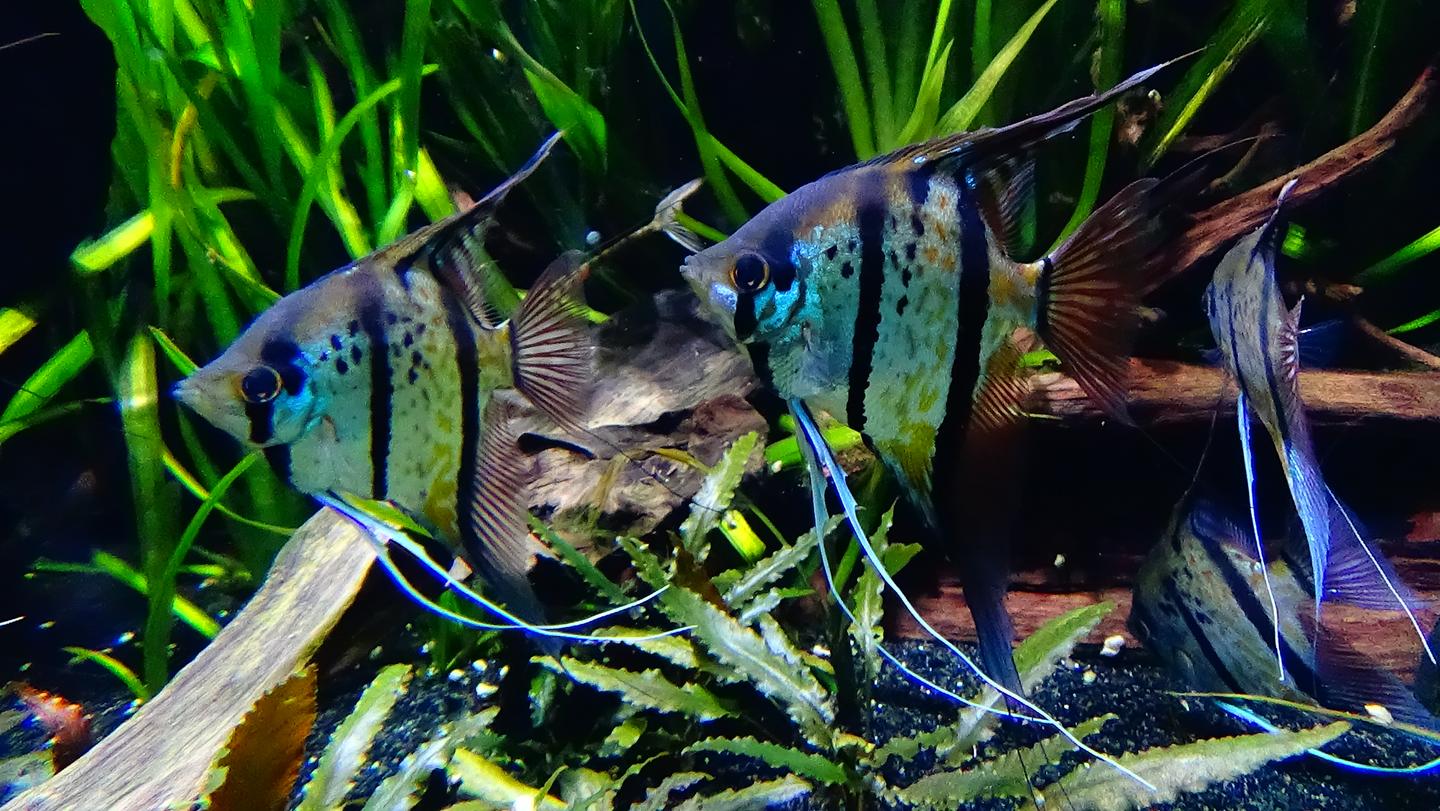
Four images are representative scenes based on the product reference, and the reference photo remains in the gallery. They communicate form and markings but are not exact dispatch portraits. The image showing two fish is a social illustration, not evidence that two or a pair are included.
FishBase gives 10.5 cm as the maximum published total length for Pterophyllum scalare. That is a horizontal measurement. It should not be expanded into an unsupported 15 cm body-length claim or used alone to decide whether the aquarium is tall enough.
A practical adult plan should reserve roughly 20-25 cm of overall vertical envelope for body and extended fins. This is conservative retail husbandry guidance, not a published maximum measurement. A tank around 50 cm tall leaves more useful clearance after substrate and surface space are deducted.
A 1 cm or 2 cm fish may look suitable for a small tank on arrival, but it is growing towards the same adult form. The permanent aquarium should be planned and available before growth creates crowding. Purchase size does not reduce adult territorial behaviour.
Livestock grades may use a practical visual measure rather than one scientific protocol. Use them to match food size and immediate companions, not to estimate a birthday or promise a future growth rate.
| Stage selected | Immediate requirement | Long-term reality |
|---|---|---|
| About 1 cm | Fine food, protected intake, nursery-style observation | Still needs the adult aquarium later |
| About 1.5-3.5 cm | Size-matched companions and fair feeding | Hierarchy develops as the group grows |
| About 4-5.5 cm | Established tall aquarium and calm community | Pairing and territoriality may emerge |
| About 5.5-7 cm | Adult footprint and height already in place | Large size does not establish sex |
| Over about 7.5 cm | Immediate full-size territory planning | No guaranteed maturity or pair status |
This species usually eats prepared foods and adapts to stable aquariums, but its deep body, long fins, social hierarchy and breeding territory add genuine management. Moderate reflects the need to test water and observe individual behaviour rather than labelling every community cichlid easy.
Ammonia and nitrite must test at 0 mg/l before the fish arrives. An aquarium is not ready merely because it looks clear or has run for a certain number of days. The intended adult livestock load must be within the filter's real biological capacity.
Check upright posture, steady breathing, complete fins, appetite and access to open water. One fish hiding continuously or missing meals can indicate hierarchy pressure even when the dominant fish rarely makes contact.
Several juveniles can become an established pair plus excluded companions. A mature spare aquarium, suitable divider or responsible rehoming route prevents a behavioural change from becoming an emergency. No stocking chart can remove that possibility.
About 180 litres, at least 100 cm in length and around 50 cm in height is a practical baseline for one established adult in a compatible community. FishBase directly lists 100 cm minimum aquarium length; the volume and height are conservative display recommendations.
A known compatible pair can use a similarly sized or larger aquarium, but spawning defence changes how much territory is available to other fish. The word pair describes a relationship demonstrated by behaviour, not simply any two fish ordered together.
For a group, use roughly 250 litres or more, about 120 cm of length and 50-60 cm height. Add space for other middle-water fish, bulky wood or overlapping cichlid territories. More litres cannot compensate for a short, obstructed footprint.
Tall plants and upright wood can interrupt a direct view across the entire tank. Keep enough open routes that a subordinate can leave without entering another dead end. Structure should create choices rather than cages.
A juvenile community can look understocked while carrying a heavy future load. Calculate using adult size, waste production and territory. Bottom fish still affect filtration even when they do not compete for the same swimming level.
| Keeping plan | Practical starting dimensions | Behavioural safeguard |
|---|---|---|
| One established adult | About 180 L, 100 cm long, 50 cm tall | Suitable adult companions and clear turning room |
| Compatible established pair | About 180 L or more | Manage defended spawning territory |
| Five to six | About 250 L+, 120 cm long, 50-60 cm tall | Several feeding sites and a separation route |
| Community with other cichlids | Larger than the group baseline | Map adult territories before purchase |
| Temporary grow-out | Mature, stable and size appropriate | Move before vertical or social crowding develops |
Vallisneria, tall stems and broad-leaved plants can provide visual cover around the upper and middle levels. Species choice depends on the available light and water. Leave open gaps so the fish can glide between planted zones without folding its fins.
Vertical roots and branches create natural-looking divisions and make the bars stand out, but every piece must be stable and smooth. Avoid narrow forks that an adult might enter during a chase and fail to reverse through.
Reserve a clear route through the central or front middle water. Dense planting against every pane can leave plenty of vegetation but little usable volume. Trim before leaves force the dorsal and anal fins against hardscape.
A subdued background often makes the barred pattern easier to inspect. This is a viewing choice, not a method of manufacturing stripes. Do not use harsh light or reflective surroundings solely to intensify colour.
Use a secure lid with sensible service gaps and an air space above the water. Check that equipment openings cannot trap a small juvenile. The cover also reduces escape risk during disturbance.
The broader FishBase range extends to 30°C. A 24-28°C working band gives practical overlap with many suitable companions and leaves more oxygen margin than permanently using the warmest edge. Keep the selected point steady.
FishBase records pH 6.0-8.0. The narrower practical band avoids selling every extreme as equally desirable. Understand the source water and buffering instead of repeatedly dosing products to chase a decimal.
Use FishBase's documented 5-13 dH rather than the inherited 1-20 dGH supplier band. A result within range still needs stability, and movement between very different waters should be handled gradually during acclimation.
Any measurable ammonia or nitrite means the system is not maintaining safe biological processing. Pause new additions, perform an appropriate partial change and investigate filtration, food, dead material or recent media disruption.
Keep nitrate low and predictable through realistic stocking, measured food and regular maintenance. Compare aquarium and prepared tap-water values. A clear pane is not evidence of low dissolved waste.
Dissolved oxygen falls as temperature rises. Maintain surface movement, keep intakes clear and ensure overnight plant respiration does not leave the tank short of oxygen. Group-wide rapid breathing is a reason to test immediately.
| Test | Working result | Response priority |
|---|---|---|
| Temperature | 24-28°C | Correct faults gradually and check oxygen |
| pH | 6.0-7.5 | Understand buffering before adjustment |
| General hardness | 5-13 dGH | Avoid sudden mineral change |
| Ammonia | 0 mg/l | Act on any detection |
| Nitrite | 0 mg/l | Act on any detection |
| Nitrate | Low and stable | Review stocking, food and water changes |
Enter your tested values in the water matcher for a quick comparison. A chemistry match does not override aquarium height, adult size or behaviour.
Clean mechanical waste without sterilising all biological media at once. Replace components according to condition rather than discarding every mature surface on a calendar day. The filter must cope with the intended adult community.
A spray bar or broad return can move oxygenated water without creating a narrow jet. Provide calm edges but avoid stagnant pockets behind dense wood. The fish should be able to hold position without continuous effort.
The approximately 1 cm option can approach gaps that are irrelevant to an adult. Use an appropriate pre-filter and inspect heater guards, overflow teeth and cable openings. Keep any sponge clean enough to preserve circulation.
Match replacement temperature and chemistry, and use test results to set the schedule. A sudden very large environmental change can affect both physiology and social stability. Consistent partial work is easier to evaluate.
Long-finned fish may not retrieve food that falls into narrow root gaps. Siphon accessible debris and inspect low-flow pockets. Good maintenance prevents a rich feeding plan from becoming a water-quality problem.
Published research shows clear social hierarchy in juvenile Pterophyllum scalare. Rank can influence aggression, activity and feeding. A visually calm group still deserves checks that every member eats and uses open water.
FishBase recommends a group of five or more, but five fish in an undersized tank is not responsible group care. The aquarium must supply enough length, height, sight breaks and feeding positions for the chosen number.
Watch for one fish remaining behind equipment, holding dark bars constantly, folding fins, losing body condition or rushing for food only after others leave. Change layout or feeding access promptly and separate if the pattern continues.
As fish mature, two may form a pair and claim a leaf, wood face or filter surface. The remaining group can lose a large part of the aquarium. Remove pressure before repeated chasing damages fins.
Trade form does not determine one fixed personality. Health, maturity, prior social experience and territory all matter. Zebra bars do not make the fish more or less aggressive by themselves.
Select warm-water fish that are not persistent fin nippers and are too large to be swallowed by an adult angelfish. A small fish that coexists with a juvenile may become prey as mouth size increases.
Calm medium tetras, deeper-bodied rasboras and selected peaceful rainbowfish can work when their group and swimming-space requirements are met. Avoid filling all open middle water with very fast feeders.
Suitable Cory-type catfish or a carefully chosen bristlenose can use another level, but they still contribute waste and require their own food. Check the warm end of their preferred range and ensure sinking meals are not monopolised.
Tiger barbs and other repeated fin-biters can damage dorsal, anal and pelvic fins. A larger shoal may change behaviour but does not guarantee safety. Long fins should not be used to test whether a particular group will nip.
Minute fish, fry and shrimplets can fit into an adult mouth. Adult shrimp may sometimes remain in dense cover, but a shrimp-breeding display or fry-rearing aquarium is not a dependable match.
| Community choice | Potential fit | Question to answer |
|---|---|---|
| Calm medium tetras | Often suitable | Are adults too large to swallow and kept in a proper group? |
| Deeper-bodied rasboras | Often suitable | Do water and swimming-space needs overlap? |
| Cory-type catfish | Suitable with planning | Can every bottom fish feed at the selected temperature? |
| Other angelfish | Use caution | Is there room and a separation plan for hierarchy or pairing? |
| Fin nippers | Avoid | Long-fin injury is foreseeable |
| Tiny fish, fry or shrimplets | Prey risk | Can an adult fit them into its mouth? |
A quality angelfish or cichlid flake, soft granule or appropriately sized pellet should provide the nutritional base. Choose particles the fish can swallow cleanly. A food is not useful because it floats in the tank; each fish must actually ingest it.
Frozen or live brine shrimp, daphnia, mysis, bloodworm and mosquito larvae can add texture and feeding interest where appropriate. Variety is an addition to complete nutrition, not a reason to feed excessive rich food.
The smallest options benefit from fine complete food offered in several modest portions. Higher frequency increases waste risk, so observation, filtration and removal of leftovers become especially important.
Spread food so a dominant fish cannot block every bite. Watch body condition over days, not only the first rush. A subordinate may need a sheltered feeding point or temporary separation.
Good nutrition supports condition and normal pigment expression, but no supplement can manufacture a certified Zebra genotype or exact set of bars. Treat dramatic colour-food promises cautiously.
| Life stage | Useful approach | Main risk |
|---|---|---|
| Approximately 1 cm | Fine complete food and tiny suitable live/frozen variety in frequent small portions | Starvation beside larger fish or polluted grow-out water |
| Small juvenile | Small flakes/granules plus measured variety | Dominant siblings taking every meal |
| Medium juvenile | Complete staple at several positions | Overfeeding while encouraging growth |
| Larger fish/adult | Appropriate cichlid staple with varied frozen/live foods | Rich single-food diet and excess waste |
Very small does not mean suitable for a new uncycled nano aquarium. The receiving setup needs established biological filtration, steady heat and easy observation. A simple layout can help monitoring while still providing visual shelter.
Do not place the smallest fish with adults or any resident capable of swallowing it. Large feeding differences also matter when no predation occurs. Size-matched grow-out companions make food access easier to verify.
Cover intakes, overflow openings and heater-guard spaces before delivery. Recheck after cleaning because equipment can shift. A mesh or sponge must not become so clogged that oxygenated flow falls.
Powder disappearing into the water column is not proof of feeding. Watch the juvenile take and swallow appropriately sized particles. Remove deposits that collect on the floor or sponge.
Where the community is already medium-sized and active, choose a larger available fish after checking compatibility. That reduces some immediate juvenile risks without removing adult cichlid needs.
A newly arrived fish may darken, pale or hold bars differently while adapting. Judge recovery through breathing, balance, fin carriage and eventual appetite rather than expecting display colour inside the shipping bag.
Look for smooth upright swimming and fins held open without new tears. Damage can point to rough decor or social pressure. Repairing the cause is as important as supporting healing water conditions.
Check temperature, surface movement, ammonia and nitrite if several fish breathe quickly or remain high in the water. Do not dismiss a system-wide change as shyness. Prompt testing provides more useful information than guessing.
A fish can rush towards food yet swallow very little. Check that the belly does not become persistently hollow and that faeces, posture and activity remain normal. Continued appetite loss deserves qualified aquatic-veterinary guidance.
Good husbandry cannot promise disease-free life, and a product page cannot diagnose illness. Check compatibility of any treatment with every aquarium resident and seek specialist advice rather than dosing repeatedly without a diagnosis.
| What you see | Possible context | First check |
|---|---|---|
| Bars become darker | Normal display, background response or stress | Breathing, feeding and social environment |
| Fins clamp or tear | Water problem, nipping, chasing or decor | Tests, companions and swimming routes |
| One fish hides and thins | Hierarchy pressure or missed food | Feeding access and separation need |
| Several fish gasp | Low oxygen, heat, ammonia or nitrite | Immediate water and circulation tests |
| New fish refuses one meal | Settling can suppress appetite | Posture and trend, without heavy feeding |
Confirm temperature, pH, hardness, ammonia and nitrite before ordering. Check that the selected size cannot enter a filter opening or a tank mate's mouth. Preparation cannot be postponed until the courier arrives.
Inspect the sealed package promptly and follow the current guarantee instructions if anything is wrong. Keep the bag and packaging until any required evidence is complete. Opening or discarding items too early can remove useful information.
Float the sealed bag only for the appropriate period. Avoid strong light and excessive delay. Once the bag opens, gas exchange can alter shipping-water chemistry, so an extremely long acclimation is not automatically kinder.
Choose a controlled method based on measured differences and the current delivery guidance. Keep shipping water out of the display unless instructed otherwise. A smooth transfer matters more than performing a ritual for a fixed number of minutes.
Lower the lights and prevent established fish from immediately surrounding a small newcomer. Provide cover with an exit. Observe aggression and breathing before leaving the aquarium unattended.
When posture and respiration settle, try a small size-appropriate meal. Remove leftovers and do not use a large feeding response as the only health test. The acclimation timer can help organise steps while observation remains in control.
Juveniles do not provide a dependable external sex cue, and adult features overlap. Breeding tubes during active spawning can improve assessment, but no fish in this listing is sold with sex confirmation.
Two randomly chosen fish may fight or simply coexist without pairing. Keepers who raise a juvenile group to allow choice need enough space for the full group and a route for fish excluded after pairing.
Angelfish commonly clean a broad leaf or other firm, often vertical surface before spawning. Both parents can participate in care and defence. Providing a leaf does not guarantee reproduction.
A pair may drive every other fish away from the selected site. The defended area can be large relative to an ordinary home aquarium. Move pressured fish before repeated chases cause injury.
Without certified parent genotypes, the stripe patterns of future offspring cannot be predicted from the trade name alone. This product does not guarantee fertility, pair bond, eggs, hatch rate or any particular phenotype in young.
The Zebra Smoke Angelfish combines striped and smoky pattern language. The fish offered here is the standard Zebra trade form shown by its own reference photo. They should not be treated as the same form merely because both names include Zebra.
The Blue Diamond Angelfish emphasises a blue-silver trade appearance. It can still show bars, but the product identity and reference gallery are distinct. Compare current size and stock rather than assuming two names describe the same line.
The Koi Angelfish is selected for warm patchwork colour. Its adult height, social hierarchy and water needs remain those of domestic Pterophyllum scalare.
The Platinum White Angelfish offers a much paler display choice. Colour does not make one form a nano fish or remove the need for a mature tall aquarium.
Use the Angelfish shop or Angel Fish category to compare all current forms. Those pages serve broad shopping queries; this product is intentionally specific to Zebra.
The product contains nine grades and each can have a different price or stock state. Confirm the selected option immediately before checkout because availability can change between visits.
Weather, courier and livestock-welfare conditions can influence dispatch timing. Read the latest delivery information and arrange for someone to receive and acclimate the fish without delay.
Eligible UK livestock orders receive Live Arrival Guarantee cover when the current terms, timing and evidence requirements are followed. Review the process before the parcel arrives rather than after discarding packaging.
Eligible first-time customers can use WELCOME10 for 10% off under the current terms. Enter the code at checkout and let the live basket confirm whether it applies. A discount never changes suitability or animal-care obligations.
Before ordering, confirm adult dimensions, established filtration, tested water, protected intakes, appropriate food, compatible adult tank mates and a separation option. The smallest grade needs the grow-out safeguards as well.
This fish suits a mature tall freshwater display where the keeper wants a bold striped centrepiece, can observe social rank and has calm size-appropriate companions. It is especially effective among vertical plants and roots with an open middle-water route.
Do not choose it for a shallow nano aquarium, uncycled setup, fin-nipping community, tiny-fish display, shrimp nursery or tank with no answer to cichlid territoriality. A low purchase price or small dispatch grade does not make those situations acceptable.
Each selected quantity supplies one live, unsexed Zebra Angelfish in the approximate size chosen from the option selector.
No. One unit is one fish. The two-fish gallery image is illustrative and does not promise a pair or two supplied fish.
No. It is a domestic striped form of Pterophyllum scalare, not a formal species or subspecies called Pterophyllum scalare zebra.
No exact count is guaranteed. Specialist phenotype references describe multiple body stripes plus the eye stripe, while inheritance, age and condition can alter expression.
No. The supplier provides the trade form and reference appearance but no genotype or pedigree certificate, so the listing does not promise `Z/+` or `Z/Z`.
FishBase records 10.5 cm maximum published total length. For the deep body and fins, reserve roughly 20-25 cm overall vertical envelope as conservative planning guidance.
Plan around 180 litres, 100 cm length and 50 cm height for one established adult or compatible pair, and about 250 litres or more with 120 cm length for five to six.
FishBase recommends five or more, particularly relevant to juveniles. An established adult or compatible pair can be managed separately, but unfamiliar fish need space and a hierarchy plan.
Yes, when companions are calm, warm-water compatible, not fin nippers and not small enough to be swallowed. Pairing can still create defended territory.
Complete safety cannot be promised. Small shrimp and shrimplets can be eaten, making this a poor choice for a breeding shrimp display.
Use a practical 24-28°C, pH 6.0-7.5 and 5-13 dGH with ammonia and nitrite at 0 mg/l. Avoid abrupt change.
Feed a complete angelfish or cichlid staple with restrained frozen or live variety, adjusting particle size and frequency for the selected juvenile grade.
It needs a mature nursery-style setup, protected filtration, fine food, several small meals and companions unable to swallow or outcompete it.
No. Stock is unsexed and routine external features do not support a reliable juvenile sex promise.
No. Four are representative scenes based on the product reference, and one is the original reference photo. Natural individual variation is expected.
Choose the size in the selector and check the basket state. Care and comparison information remains visible even when that grade cannot currently be ordered.
WELCOME10 provides eligible first-time customers 10% off under the current terms. The checkout confirms eligibility.
FishBase supplies the published length, water, group and aquarium-length evidence. Behavioural and reproductive studies support the hierarchy, feeding-rank, territory and parental-care discussion. Tropical Fish Co's volume and height figures are labelled as conservative planning judgements where research does not prescribe a retail tank volume.
The Angelfish Society phenotype library helps explain the established Zebra appearance and gene terminology. It is not used as a genetic certificate for this supplier batch. The reference photo remains the strongest evidence for the fish actually represented by this product.
Read the Angelfish care guide for broader setup support, then use this page for the Zebra appearance, selected sizes and live product status.
The supplied trade name and reference image do not confirm an exact stripe count, genotype, pedigree, breeder, collection locality, captive or wild origin, sex, compatible pair, exact individual measurement or future breeding outcome. Those details are left open instead of being guessed.
No reviews for this item yet. Bought one? Honest reviews only, good or bad.
What customers say about ordering from us
I have a small group of long finned mountain minnows. So was delighted to be able to order ten of this variety to increase the genetics in my tank . The ones I recieved are healthy but it’s to early to give a verdict on wether they are of a long finned type since they are small currently.
Gordon Walker · 23 Sept 2026
100% success travel and "installation". Pleased with quality of purchase. The Siamese fighter a bit "shy" so have not yet seen him at his best yet but looking good. Happy customer. GG
George E Garratt · 21 Sept 2026
Reviews of our shop, collected by Judge.me, an independent third-party review collector. Newest first.