Easy
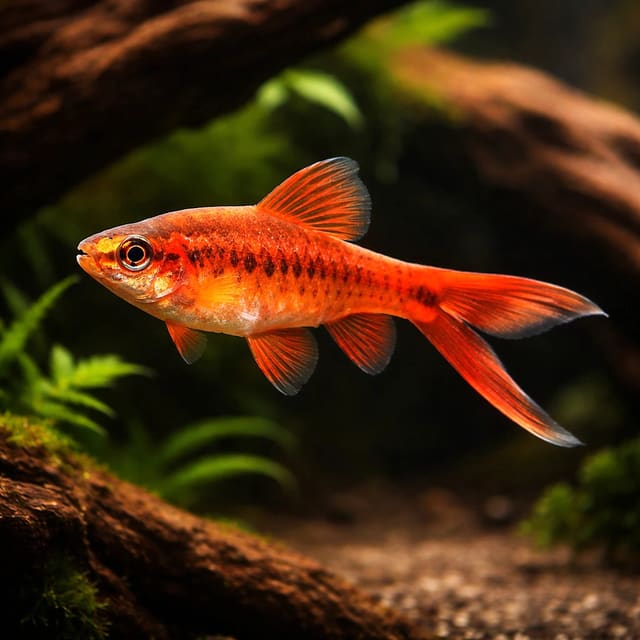
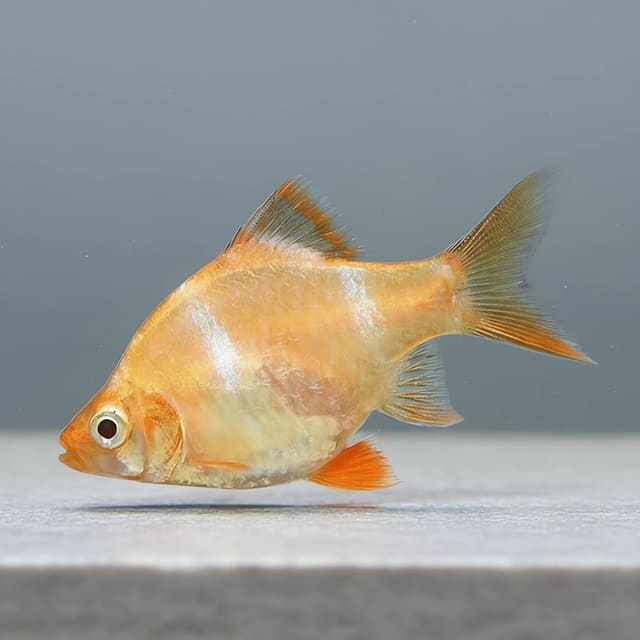
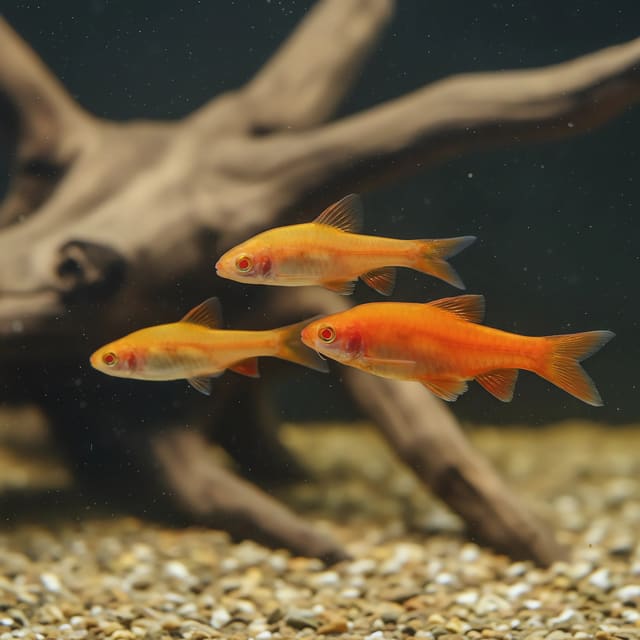
Albino Cherry Barb (Rohanella titteya)
20–27°C · pH 6–8 · 54L
£2.99

The Checkered Barb (Oliotius oligolepis) is a peaceful schooling cyprinid from Sumatra, Indonesia, that reaches 5 cm. It suits well-researched community aquariums; keep 6–10 at 18–25°C, pH 5.5–7.5 and 2–12 dGH in at least 75 × 30 × 30 cm. Sold individually in sizes from 2 cm to 3.5–4 cm.
Adult size is the maximum length this species reaches at full maturity (scientific sources). The livestock you receive will be younger and smaller — pick a size above for the actual shipping size. Product-photo provenance and any image-specific limitations are stated on the listing.
Oliotius oligolepis
Shoaling fish: kept in a group they feel safer, stay calmer and show their best colour.
Minimum of 2 per order.
The Checkered Barb (Oliotius oligolepis) is a peaceful schooling cyprinid from Sumatra, Indonesia, that reaches 5 cm. It suits well-researched community aquariums; keep 6–10 at 18–25°C, pH 5.5–7.5 and 2–12 dGH in at least 75 × 30 × 30 cm. Sold individually in sizes from 2 cm to 3.5–4 cm.
Adult size is the maximum length this species reaches at full maturity (scientific sources). The livestock you receive will be younger and smaller — pick a size above for the actual shipping size. Product-photo provenance and any image-specific limitations are stated on the listing.
Maintain these water conditions for optimal health and vibrant colors
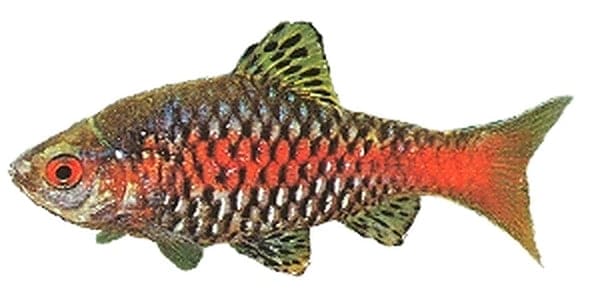
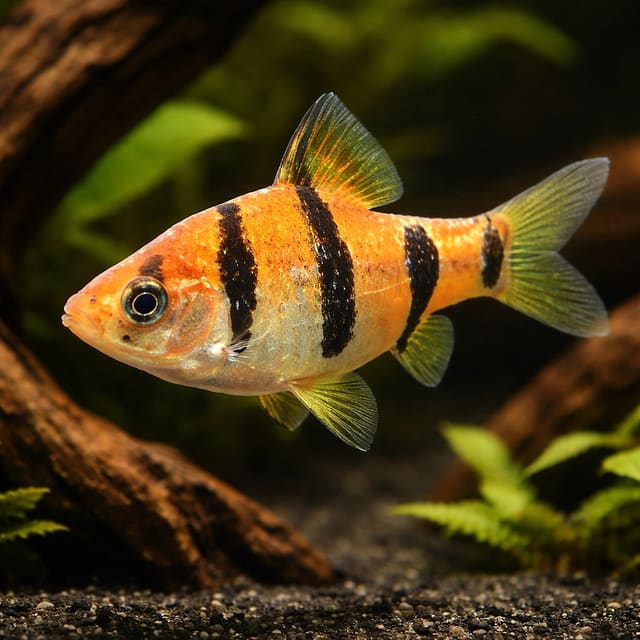
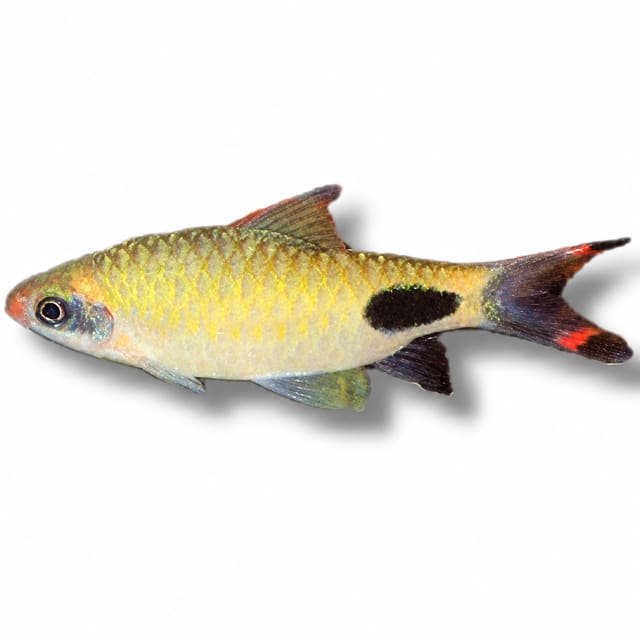
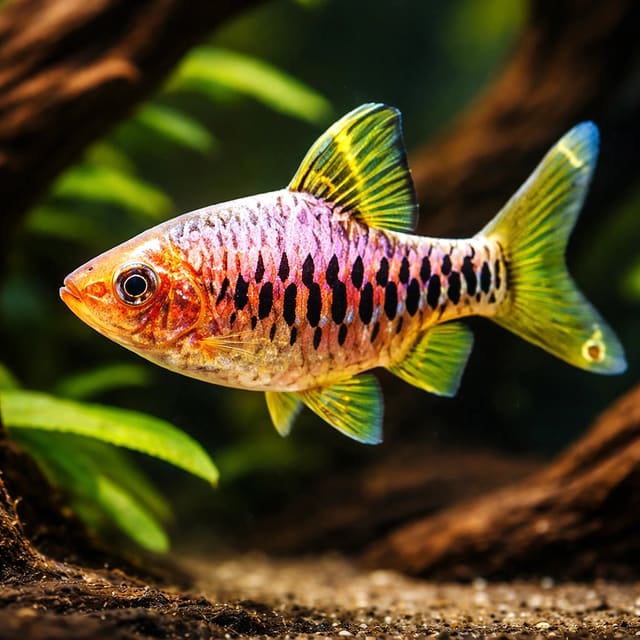
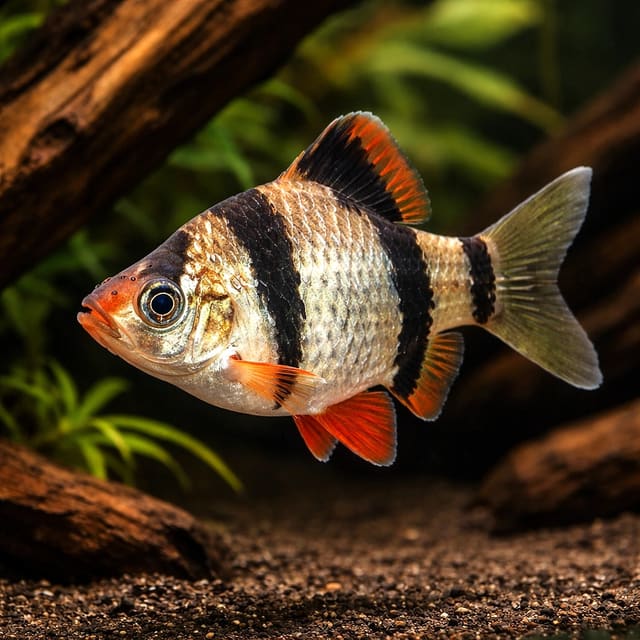
The Checkered Barb (Oliotius oligolepis) is a small freshwater cyprinid from Sumatra, Indonesia. Black crescent-shaped markings on its scales create the checkerboard pattern behind its common name. Older aquarium labels may use Puntius oligolepis or Capoeta oligolepis, while Checker Barb, Checkerboard Barb and Island Barb are established trade names for the same fish.
FishBase records a maximum length of 5 cm total length. Treat that figure as the decisive size when planning the aquarium, even when the selected fish is much smaller at dispatch. A full school needs more room than one 5 cm fish, so group size and swimming footprint matter alongside body length.
| Suits | Not suited to |
|---|---|
| A complete school of 6–10 fish | Solitary keeping |
| An aquarium of at least 75 × 30 × 30 cm | A smaller or tall, narrow aquarium |
| A peaceful community with overlapping water needs | Tank mates with incompatible long-term water needs |
| Water maintained at 18–25°C, pH 5.5–7.5 and 2–12 dGH | A setup maintained outside these ranges |
The Seriously Fish species profile describes it as generally very peaceful and recommends keeping at least 6–10 together. That combination suits a well-researched community aquarium where every fish shares compatible water requirements and has space for its complete social group.
This is an active schooling choice rather than a fish for keeping alone as a single decorative specimen. It works best for a keeper prepared to establish a mature biological filter, test the water every week, feed small measured portions and watch how the whole school uses the aquarium.
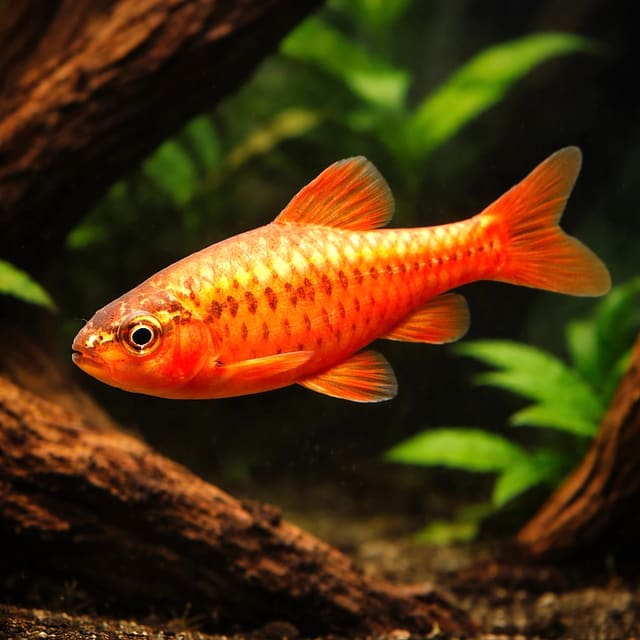
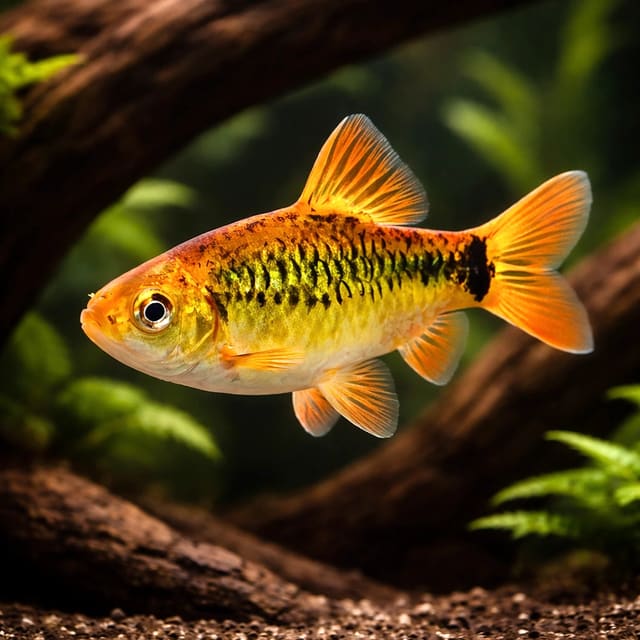
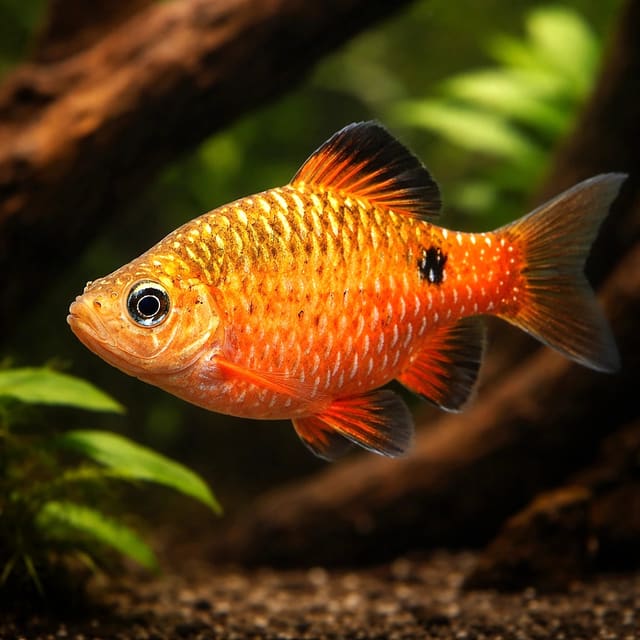
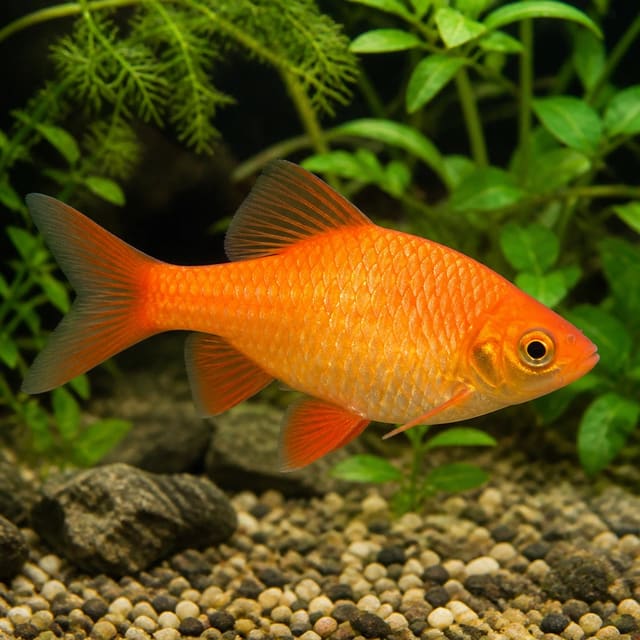
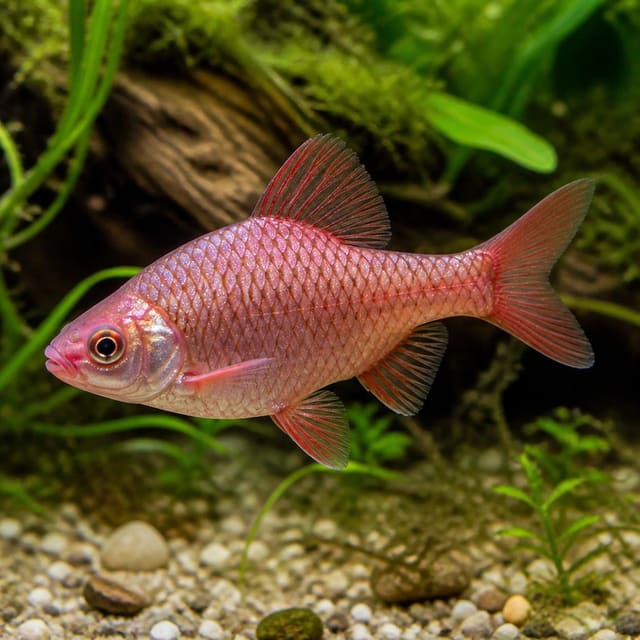
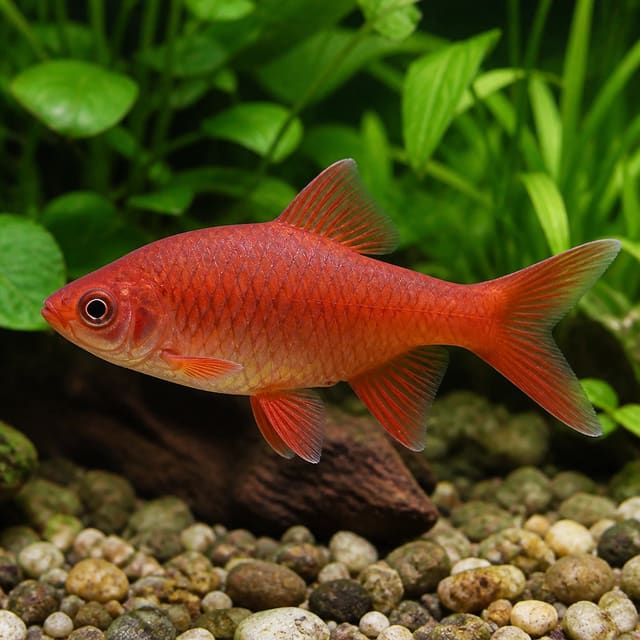
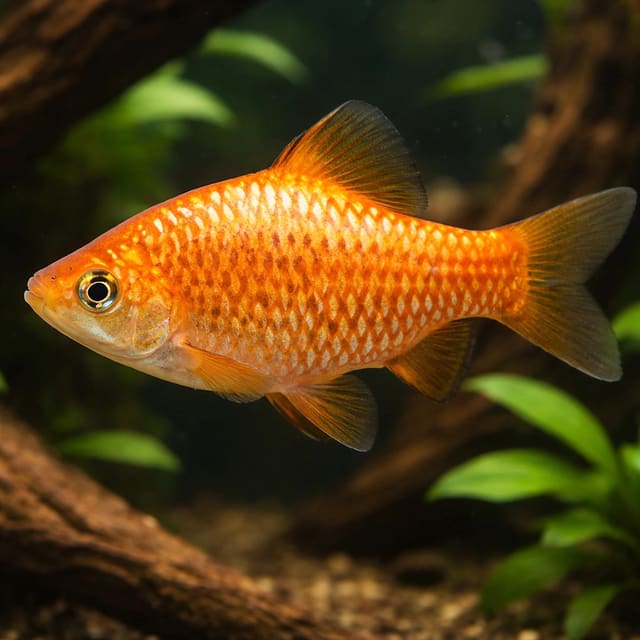
You can compare this fish with others in our barbs collection. Some gallery images are representative, based on reference photographs of this species, and none shows the exact animal supplied, so colours can look slightly different from the live animal.
One purchase quantity supplies one animal of the selected option. Use the live size selector to choose 2 cm, 2.5–3 cm or 3.5–4 cm. Check the selector for the live choices and price rather than relying on a size mentioned elsewhere on the page.
The size you select is the size supplied, not the adult size. All three sizes are the same species and require planning for a fish that can reach up to 5 cm total length. A smaller supplied size does not reduce the eventual school, footprint, filtration or water-quality requirements.
For example, selecting six fish means planning for six adults of up to 5 cm each, not six fish that remain at the chosen supplied size. If an established aquarium already contains another school or a bottom-dwelling group, assess their adult sizes and space requirements before adding the Checkered Barbs. The 68-litre baseline is not permission to ignore the needs of existing animals.
Sex is guaranteed only when the selected option explicitly states male or female. This Checkered Barb listing has no sex-guaranteed option.
Adult males are described as smaller, slimmer and more colourful than adult females, but appearance does not change the offer terms. Plan the school without assuming a particular sex ratio and judge each fish as an individual after it has matured.
Before placing an order, prepare the aquarium for the whole selected quantity and review our current delivery and Live Arrival Guarantee policy. Check the aquarium dimensions, measured water values and established population first; the delivery date is not the right time to discover that the planned school exceeds the remaining space.
Use an aquarium measuring at least 75 × 30 × 30 cm, equivalent to about 68 litres, for a Checkered Barb school. The 75 cm length and 30 cm front-to-back width provide the footprint behind that volume, so do not replace the stated dimensions with a tall, narrow aquarium that happens to hold a similar number of litres.
A school of 6–10 must share this footprint while feeding, displaying and moving between cover and open water. More space becomes necessary when other fish are present because their adult groups need room as well. Calculate the final population rather than treating 68 litres as a fixed allowance for any combination of community fish.
A simple worked example helps prevent accidental crowding. Six Checkered Barbs alone meet the lower end of their school recommendation. Adding another schooling species means accommodating two complete social groups, not using the same swimming area twice. Choose a larger aquarium when the second group would compress movement or place too many fish around the same feeding zone.
Prepare and biologically mature the aquarium before the fish arrives. Our first tropical aquarium guide explains the setup sequence. A newly filled tank is not equivalent to a mature filtered aquarium because the biological filter needs an established bacterial population to process fish waste.
Do not use the fish’s small adult size as a reason to keep it in a bowl, unfiltered container or solitary display. The aquarium must satisfy its schooling behaviour, footprint and water-quality needs together. That joined-up plan is more useful than choosing the smallest container into which one fish could physically fit.
Build the layout around a clear swimming area and sheltered edges. The exact decorative style is flexible, but floating or overhanging vegetation and driftwood roots or branches are useful forms of cover. Arrange them without blocking the main length of the aquarium.
| Area | Purpose |
|---|---|
| Open central lane | Allows the school to move and feed together |
| Planted sides or rear | Creates shelter without closing the footprint |
| Floating or overhanging cover | Provides shelter higher in the aquarium |
| Roots or branches | Adds structure and broken sight lines |
Aquarium gravel or sand can be used as the substrate. Live plants provide cover, while suitable artificial plants and ornaments can serve the same shelter function when live planting is not part of the setup. Check that every ornament is intended for aquarium use and position it so the school still has an uninterrupted route through the tank.
Watch how the group uses the finished layout. Confident fish should be able to move into open water and return to cover without one individual controlling the only sheltered place. If several fish remain crowded behind one object, spread cover across more than one area rather than adding a single dense barrier.
Keep feeding access in mind while placing tall plants and wood. Food should reach more than one point so a quick individual cannot intercept every piece. Leave enough access for a siphon around the substrate because solid waste must be removed during routine partial water changes.
A well-decorated aquarium may help the fish show its colour, but decoration cannot compensate for inadequate dimensions or an immature filter. Secure the practical foundation first: the required footprint, the complete school, stable water conditions and biological filtration. Add plants and wood to improve cover and structure after those essentials fit comfortably.
Maintain Checkered Barbs at 18–25°C, pH 5.5–7.5 and 2–12 dGH. These are aquarium husbandry ranges for this animal rather than a single ideal point. Stability inside the range matters: do not chase a particular number with abrupt chemical changes when the aquarium is already stable and suitable.
Measure the source water and the aquarium instead of judging water by appearance. Our water chemistry guide explains what the principal readings mean, and the water matcher lets you compare measured values with the stated range.
| Reading | Action point |
|---|---|
| Temperature | Keep within 18–25°C |
| pH | Keep within 5.5–7.5 |
| General hardness | Keep within 2–12 dGH |
| Ammonia | Maintain at zero mg/l |
| Nitrite | Maintain at zero mg/l |
| Nitrate | Keep no more than 20 mg/l above the normal tap-water level |
OATA’s group-level barb guidance sets the ammonia, nitrite and nitrate limits in the table. Those waste readings answer a different question from pH and hardness: a tank can sit within the desired pH range and still be unsafe because ammonia or nitrite has accumulated.
Test at least weekly and record the results so gradual movement is visible. An unexplained change is a reason to inspect feeding, stocking, decomposing material, filter flow and maintenance practice. Test immediately if fish breathe differently, lose interest in food, hide more than usual or swim abnormally.
Match companions to the same long-term range. A fish that merely tolerates 18–25°C briefly is not automatically a suitable resident. Use the normal maintained temperature, pH and hardness for every species when screening a proposed community.
Use a well-established biological filter and keep it running continuously. RSPCA aquarium welfare guidance explains that fish release toxic ammonia, which filter bacteria convert first to toxic nitrite and then to the safer nitrate. A filter therefore needs both adequate flow and a living bacterial population.
For an aquarium of about 68 litres, the species profile uses a turnover of four to five times the aquarium volume per hour. That calculation gives roughly 270–340 litres per hour: 68 × 4 is 272, while 68 × 5 is 340. Treat the manufacturer’s rating as a selection guide and confirm that actual flow remains present after media and pipework are installed.
Do not replace all biological media during routine cleaning. Chlorine or chloramine can damage the bacteria, while aggressive cleaning can sharply reduce the population needed to process waste. Preserve established media and restore unobstructed flow without trying to make every component look unused.
Increase livestock numbers slowly. Adding a full new population creates more waste and increases feeding, so the bacterial population must adjust. Test after an addition instead of assuming that previous results will remain unchanged.
If ammonia or nitrite rises above zero, stop treating the calendar as proof that the system is stable. Test again, inspect the filter and review recent stocking and feeding. Water clarity alone is not a measure of biological safety; clear water can still contain dissolved ammonia or nitrite.
Feed a good-quality flake or small granule as the regular dried food. Checkered Barbs are omnivorous: in nature they probably feed mainly on aquatic invertebrates, with smaller amounts of plant material and organic detritus. In an aquarium, small live or frozen foods such as Daphnia, Artemia and chironomid larvae can add variety alongside the dried staple.
Offer only what the school can finish within a few minutes, once a day. This schedule makes the portion measurable and reduces the chance of uneaten food breaking down into waste. A food’s quality does not make an oversized serving safe.
Use live or frozen food as part of a varied routine, not as permission to double the total portion. Bloodworm, Daphnia and Artemia are examples of suitable small foods; rotate them with good dried food rather than relying on only one item indefinitely.
Observe access as carefully as appetite. If one fish remains away from every feeding point, spread the same measured amount more widely and check whether chasing or the layout is preventing it from feeding. Do not respond by pouring in excess food, because uneaten material increases the load on the filter.
A sudden reduction in feeding interest is a health or water-quality warning, not simply a reason to try richer food. Test ammonia and nitrite, review temperature and observe breathing and swimming before changing the diet. This separates an access problem, an unsuitable particle size and a broader husbandry problem.
Complete the aquarium checks before adding the fish. Confirm that the filter is established, ammonia and nitrite are both zero mg/l, temperature is 18–25°C, pH is 5.5–7.5 and general hardness is 2–12 dGH. Check the intended quantity against the aquarium’s dimensions and existing population one final time.
| Checkpoint | What to do |
|---|---|
| Before introduction | Test water and confirm the complete 6–10 fish plan |
| First feeding | Offer a small portion and check that food reaches the group |
| Every day | Compare swimming, breathing, colour and hiding with the previous day |
| After stocking | Retest ammonia and nitrite rather than waiting for the normal weekly test |
| End of week | Complete the regular test and maintenance review |
Introduce livestock gradually when building a community because each increase in fish numbers and feeding increases the demand on filter bacteria. Where the Checkered Barbs are the intended school, do not deliberately keep one fish alone for a prolonged period as a substitute for planning the social group.
Expect individuals to differ slightly in appearance and behaviour, but look for the school to settle into normal movement and feeding. Temporary shelter use immediately after a change is less informative than a continuing pattern in which a fish cannot leave cover, reach food or move without being chased.
Test first when something changes. Hanging at the surface, sitting on the bottom, erratic swimming, unusually rapid or slow gill movement, marked colour change, loss of appetite or increased hiding can accompany a water-quality or health problem. A prompt reading for ammonia, nitrite and temperature gives you concrete information before other action.
Keep the first week calm and consistent. Avoid adding another group immediately, altering the layout repeatedly or changing several water variables at once. Stable conditions make it easier to judge whether the school is feeding, swimming and using cover normally.
Use the first month to establish a reliable baseline for this particular group. Note where the fish rest, how quickly they approach food, how the school spreads through the aquarium and how each individual looks when conditions are stable. Later changes are easier to recognise when you know the normal pattern.
| If you see | Do this |
|---|---|
| Surface hanging or unusual breathing | Test ammonia, nitrite and temperature immediately |
| Erratic swimming or prolonged bottom sitting | Check water readings, filter flow and recent changes |
| Darker or paler colour than normal | Compare behaviour, feeding and water quality |
| White spots, fluffy growths, damaged fins or lost scales | Test the water and seek fish-health guidance |
| Reduced appetite | Check food access, portion size and water readings |
| One fish repeatedly excluded | Review school size, cover, feeding access and tank mates |
Do not diagnose a disease from one sign alone. Similar behavioural changes can follow ammonia, nitrite, temperature, feeding or social problems. Record the reading, the observed sign and any recent addition or maintenance change; that information makes the next decision more precise.
Inspect the whole group during the once-daily feeding. This creates a consistent observation point without adding extra food. Clear eyes, intact scales and fins, normal swimming and an appropriate feeding response are useful comparisons from day to day.
Continue changing 25% of the water at least once each week and testing at least weekly after the first month. A stable run of readings is a reason to preserve effective husbandry, not to stop measuring. Stock growth, increasing food intake and trapped debris can alter the waste load over time.
If abnormal signs continue after water checks and immediate husbandry issues have been addressed, contact us for fish-health guidance. Share the aquarium volume, temperature, pH, ammonia, nitrite and nitrate readings, school size, tank mates and observed change rather than treating a photograph alone as a diagnosis.
Keep 6–10 Checkered Barbs together. This is a schooling species, and maintaining the recommended number makes the fish less skittish and creates a more natural group display. Adult males may also develop better colour in the presence of rivals within the school.
Do not plan around one or two fish simply because they fit the remaining physical space. Barbs kept singly or in too small a group will often become stressed, while larger groups can help distribute social attention. The solution must still fit the aquarium: increasing the school without enough footprint or filtration trades one welfare problem for another.
Plan without assuming a guaranteed mix of males and females. Adult males are generally smaller, slimmer and more colourful, but the selected option does not promise sex. A social plan that depends on receiving an exact sex ratio is therefore the wrong foundation for this offer.
Watch distribution within the group rather than looking only for obvious injury. A fish that never reaches food, remains isolated behind cover or is repeatedly displaced may need an adjustment to feeding access, shelter, group planning or the wider community. Make one purposeful change at a time so you can judge its effect.
More fish is not automatically better once the recommendation and aquarium capacity are considered. Ten Checkered Barbs may make a more substantial display than six, but the upper number still has to coexist with every other adult fish in the aquarium. Use the lower number only when it forms a complete school and the upper number only when water quality and swimming space remain suitable.
Checkered Barbs are generally peaceful and can usually be mixed with other peaceful species. That description is a starting point, not a complete stocking decision. Screen every proposed companion for long-term water overlap, adult size, social group, swimming space, feeding access and observed behaviour.
Use extra caution with slow-swimming, timid or long-finned companions because some barb species may nip fins. Checker Barbs are described in UK guidance as among the smaller barbs that can generally mix with peaceful species, so assess the actual school rather than automatically applying the behaviour of a different barb species.
Avoid any proposed combination that places one fish outside its long-term water range. Also avoid continuing a pairing when persistent fin-nipping or chasing stops another fish from feeding or resting normally. Separate the compatibility decision from the idea that all animals labelled “community fish” suit one another.
When considering an established aquarium, write down its dimensions, maintained temperature, pH and hardness, current adult population and group sizes. Add the proposed Checkered Barb school on paper first. This makes hidden conflicts visible, such as two schools competing for the same limited footprint or a companion requiring a temperature beyond 25°C.
Compatibility remains conditional because aquarium dimensions, group sizes and individual behaviour differ. Peaceful species with overlapping water requirements are the appropriate candidates, but continue observing after introduction and revise the plan if normal feeding, schooling or resting is disrupted.
It is a freshwater cyprinid from Sumatra, Indonesia, scientifically named Oliotius oligolepis. FishBase records a maximum of 5 cm total length, and the black crescent-shaped marks on its scales create the checkerboard pattern.
One purchase quantity supplies one animal of the selected option. Keep a school of 6–10, so select the required quantity while checking that the aquarium can support the full adult group.
The size choices are 2 cm, 2.5–3 cm and 3.5–4 cm. These are supplied sizes rather than final lengths; plan every choice for an adult-size reference of up to 5 cm total length.
Use an aquarium measuring at least 75 × 30 × 30 cm, about 68 litres, with a mature biological filter. Leave open swimming room and provide cover with plants, overhanging vegetation, roots or branches.
Keep it in a school of 6–10 rather than alone. The recommended group makes the fish less skittish and supports a more natural display, provided the aquarium has enough footprint and filtration for everyone.
Keep it at 18–25°C, pH 5.5–7.5 and 2–12 dGH. Maintain ammonia and nitrite at zero mg/l, and keep nitrate no more than 20 mg/l above the normal tap-water level.
Feed good-quality flake or small granules, with small live or frozen foods such as Daphnia, Artemia or bloodworm for variety. Offer only what the school finishes within a few minutes, once a day.
Before introduction, confirm a mature filter, zero mg/l ammonia and nitrite, and water within 18–25°C, pH 5.5–7.5 and 2–12 dGH. Increase livestock gradually and retest the water after the population rises.
Choose peaceful species whose long-term water requirements overlap and whose adult groups fit the aquarium. Use caution with slow, timid or long-finned fish, and avoid continuing any pairing where persistent chasing or fin-nipping prevents normal feeding or resting.
No reviews for this item yet. Bought one? Honest reviews only, good or bad.
What customers say about ordering from us
I have a small group of long finned mountain minnows. So was delighted to be able to order ten of this variety to increase the genetics in my tank . The ones I recieved are healthy but it’s to early to give a verdict on wether they are of a long finned type since they are small currently.
Gordon Walker · 23 Sept 2026
100% success travel and "installation". Pleased with quality of purchase. The Siamese fighter a bit "shy" so have not yet seen him at his best yet but looking good. Happy customer. GG
George E Garratt · 21 Sept 2026
Reviews of our shop, collected by Judge.me, an independent third-party review collector. Newest first.